I struggle with our 2024 single variety Dabinett. There, I’ve said it. There should be a certain ruggedness to bittersweet cider – or what is the point of tannin and how it expresses in the first place? – but our Dabinett goes, to my palate, beyond the acceptable boundaries of coarseness. When I drink it, and for the most part I leave it alone, it feels astringent to me; almost chalky, the insistence of its texture riding roughshod over the fruit. I remember an excellent maker once writing ‘a challenging drink’ about a cider we were judging together, and that is how I feel about this one.
It is all the more frustrating because I know all too well how good Dabinett can be. In fact I’ll go further; I know, specifically, how good Dabinett from the orchard we picked it in can be, because it has been responsible for some of the best ciders I have ever tasted. I could, with justification, say that 2024 was a wet, miserable, low-sugars year, and so astringency, particularly in dry cider, is to be expected. Except that I have tried 2024 Dabinett from the same orchard, fermented in much the same way we did ours, from another maker, and thought how much better theirs was.
Which is the other point: I don’t like the way my Dabinett makes me think about myself, and I don’t like what those thoughts reveal about me. It slips its fingers beneath the lid of my Pandora’s box of personal shortcomings. Here, it says, is impatience, frustration. Here is impostor syndrome riding sidecar to a problematic streak of competitiveness. Here is willingness to give up, to moan. Here is technical incapability. Here is fear of not being good enough. Here is everything that is rough and spiky, everything I would rather hide, and struggle to.
My co-makers, I should say, don’t share my misgivings. Indeed, they would tell you that I am too critical of our ciders more broadly. And I should admit that, over the year it has been in bottle, our Dabinett has improved. It is not as astringent as it once was, and the slight reduction raised by its long, truculent fermentation has all but dissipated. Besides, I have tasted enough Dabinett over the last decade that I should know better than to judge it in its infancy. It needs time for tannins to soften and fruit to bloom. I would love it to be perfect today, but that’s not how bittersweet fruit always works. It is on a journey, and it will be better tomorrow.
***
An inherent part of much of the human condition, I think, is a reluctance to wait. We want things now – and we don’t want to see gradual improvement, we want them to arrive as a fully-formed version of themselves. And this is the nub of the insidious promise of artificial intelligence.
What the billionaires who own the various AI systems now in commonplace usage are fundamentally selling is convenience and immediacy. The guarantee is not necessarily a ‘better’ product, per se – though they certainly play on the lure of ‘you, too, could be an artist’, ‘you, too, could be a writer’. Predominantly what they are selling is the thing, whatever it is – the coursework, the data analysis, the short story – being done. To a broadly-speaking ‘good enough’ level.
It’s such a seductive promise, isn’t it? How much time of our life do we spend doing things we wish were just over and done with? Speaking personally, I’d say at least a decent chunk of every working day. I’d look, too, at the glacial crawl at which Caroline, Justin and I are getting through the various pieces of seemingly eldritch admin that pave the road to being a functioning cider business, and my God, I’d wish them finished. Business plan, taxes, invoices, web building. Figuring out the size of hose fitting we need for this tank and that pump, whether the threading needs to be male or female. The hygiene stuff, the sanitisation stuff, the registration stuff – oh dear Lord let it all be done and out of my head.
And that’s just the admin, never mind the tasks that require special skills; the label design, social media, marketing, copy. The list of jobs involved in the creation of a small business is seemingly endless – not to mention the cost if you get a professional to do them for you – on top of which we’re taking them on after a week of regular work, a commute and trying to keep the house clean, the cat entertained and some sputtering ember of social life more or less aglow.
‘Honestly,’ you would be forgiven for thinking, ‘everyone else is using it anyway. What difference is a couple of small tasks assigned to a robot really going to make? Maybe it’s not perfect – but I’m busy, I’m tired and it’s good enough.’
***
The more I have thought about AI, the more I have come to see parallels with big – macro – cider.
Like AI, macro cider’s foundational premise is convenience and immediacy. How can we make cider quicker, more efficiently, at lower cost? It is a conscious rebellion against the tyranny of the seasons and their variability; against the nature of cider as a product that can only be made once a year, and which has inconsistency baked in by the inherent fickleness of any given vintage’s conditions.
Macro cider promises that wherever you are in the world, whenever you choose to drink it, it will be available and it will taste the same. The concentrate, the chaptalisation, the dilution, the focus on monocrops of particular varieties chosen first and foremost for consistency and yield, are in service of those essential tenets. The lagerification; the move away from historic bittersweet apples to lighter, less-flavourful varieties, the dilution to a strength well below that which apples naturally ferment to – all is in the name of creating a broader common denominator; a single, more universally ‘acceptable’ product.
Innovation, when it comes, does not arrive as new single varieties or experiments with different styles that would necessarily alter the composition of the base product. Rather it is the addition of an artificial flavouring to that base. A ‘people like our standard cider and people like blackcurrants, blood oranges, strawberries. People will therefore like a combination of the two.’ The most formulaic, predictable, risk-averse route to portfolio expansion.
And of course, the more efficient cider is to make, the more you can produce; the more you can produce the greater your market dominance; the greater your market dominance the easier it is to set the narrative of what cider is and how the government should legislate for it. With the result that the UK is at once by far and away the largest producer and consumer of cider in the world, and perhaps the market in which competition from smaller producers is hardest. A country in which cider has ubiquitous visibility and yet in which full-juice cider continues to struggle for a platform from which to explain what it is, highlight its differences and qualities and be accepted by a broad audience. A country in which cider’s path of least resistance – its ‘good enough’ option – is almost too easy not to take.
How many people can learn about varieties, styles, regions, producers, when the ciders that are inevitably put before them have an active interest in painting over all of this, and establishing cider as essentially monolithic? Who would ever want to buy my troublesome Dabinett, to age it long enough that it blossoms into a fruit-filled, better version of itself, when it tastes so utterly different to the cider you might find on draught at any pub, and when that cider will always be available, and will always taste as you expect?
***
I don’t know about you but I find writing so fucking hard. Blank documents leer at me like cliff-faces; threads of words and thoughts that felt so clear, so intricately knitted together when they lived solely in my head, seem to drift apart and clang about the moment they appear as text. I can’t think of a single thing I have ever written that I have read back entirely without a wince.
Books and articles by other writers seem to flow with an ease and cleanliness that I can’t begin to comprehend; sentences, sentiments, paragraphs, imagery that seems conjured so effortlessly and with such lightness of touch, whilst I stomp my heavy-footed way through a murky lexical bog.
It’s stifling, nerve-wracking, paralysing, effortful and it takes absolutely ages. And that’s just the writing I do in my spare time for love. No wonder so much professional content – more repetitive, formulaic and requiring of consistency – is now outsourced to artificial intelligence, which never gets writer’s block, fusses over sentence composition or loses the thread of its argument partway through. I do interviews with a lot of winemakers at work these days, and it bewilders my colleagues that I still transcribe old-school, by hand and ear. Sometimes I question it myself, however clear the reasons seem to be in my head.
This is the sixth piece I’ve written for Cider Review in the last eighteen months, and it’s taken the best part of 2026 to make myself sit down and wrench the words out. Whatever it was that rattled articles out of my brain so relentlessly a few years ago now seems to have disappeared completely. I’d say that sometimes I feel like giving up – but honestly it gets harder and harder to drown out the little inner voice that suggests I’ve virtually given up already.
And when AI can churn out pieces a thousand times faster than I could even at my peak, when it is becoming ever harder to discern the human-made from the robot slop, and when so many people seem unbothered either way or have accepted the seemingly-inevitable with a weary shrug of resignation, how on earth do we keep going? What hope can there be? What’s the point?
Everyone will have their own answer to this question, and I’m not in a position to judge any of them, but this, I think, is mine: I am not much of a maker of things. I don’t play music, I can’t do carpentry or meaningful DIY. I’m a functional cook, but nothing you’d write home about, I’m not a potter, nor a gardener, nor a singer and my Art teacher made it very clear that I should drop the subject as quickly as possible. But I have spent the better part of 36 years now making a written voice. It isn’t finished and never will be. It chops and changes, is rough round the edges and it’s stretched like worn elastic where I’ve often pushed it too hard, but it is the best I can do, is like no one else’s and is mine. It is born from books and articles and emails and from repetitive workplace copy. I have fed it with everything I have written and read and heard and known, laced it with all my habits and feelings and grudges and peccadillos. It has been flavoured by the people I have loved, admired, been jealous of; is seasoned with griefs and longings and joys and failures. It is most of what I carry with me; what I still have when I stand washed up on the beach; the closest I have to a sense of self. Start asking robots to write for me for the sake of an hour or two, and what do I still have left?
The world’s first recognised alphabet was created in secret by enslaved people in the turquoise mines of the Sinai peninsula. Not having pictorial hieroglyphs, they used the first sounds of clearly understood symbols to piece together a way of communicating, that could not be controlled or prevented; that was theirs. A voice that could carry further than the people stood next to them. Our language, our words, our individual voices, however they are spoken or written or expressed, are our ultimate proofs of humanity. They are something AI cannot create, only steal from and repurpose with algorithms and formulae. They can’t be bought by tech billionaires, ring-fenced or constrained by anyone but ourselves.
AI exists to remove creativity and originality; to set in stone a burgled pool of art and writing which its owners can claim as theirs and invite you to use their services to draw from. It is an inverted Eden that says ‘only from this tree may ye eat’. Our voices, our own written words, however slow and difficult and tiring and hard-dredged, are what separate us from it. They are the clearest expression of who we are, the people we choose to connect with and the ways we attempt to stitch those connections together.
***
Craft, aspirational, full-juice cider – whatever your adjective, to me it stands in incompatible opposition to everything AI is and is built on. Slow, inefficient, shaped by nature, unpredictable. Most of all, for all that its flavours are driven by varieties and orchards and terroir, it carries the signature of the people who made it; their experience, their intentions, their choices. At the Yew Tree Cider Trials a couple of weeks ago, over 40 makers of different sizes brought 108 ciders and perries to taste and judge together. All agreed that cider and perry was made from apples and pears, and all used 100% juice, and there the similarities ended, and we were so profoundly the richer for it.
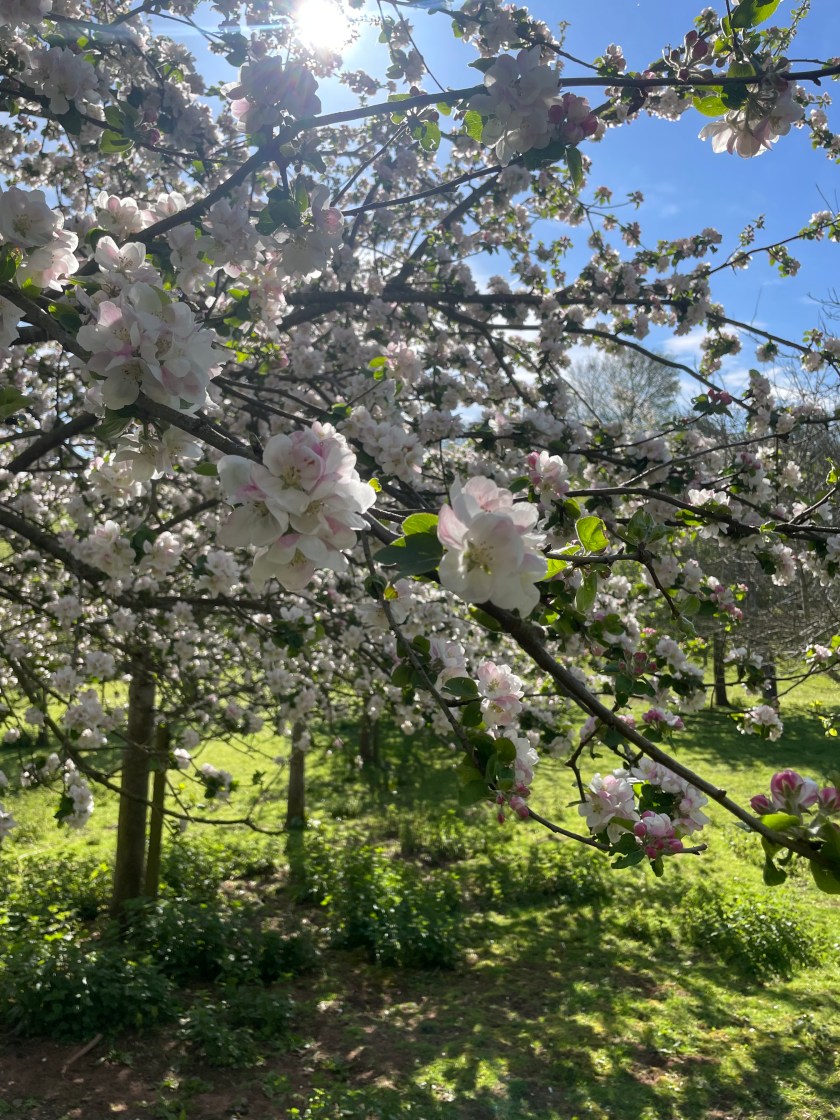
Full-juice cider is a rejection of all that is uniform and incurious. To make it is to embrace the vicissitudes of weather and climate and vintage; to ride, perhaps, the currents of spontaneous fermentation. To have in your head a rough sketch of varietal flavour profiles and accept each year that they will shift and smudge and sometimes surprise you completely. It is to crawl through mud and rain and biting cold in search of a single damn apple un-pecked by birds. To grind your teeth against the third fuse of the day blown by your mill, or to test the gravity of your cider in June and find that there are still months of fermentation left to go. It is to hear someone tell you that your dry cider is ‘too dry’, or to watch something you loved receive no votes from your peers. And it is to stand in an orchard under a shaft of slanting sunlight and a hallelujah of pink-white blossom, with a glass in your hand of something no one else would have thought to make, which exists because of your choices and is beautiful.
I have never been a patient person, and as a result – and as I expected before I began – there are huge parts of making craft cider which I have found and continue to find incredibly difficult. The sentiment that ‘life is not about the triumph, but the struggle’ is one which I at once whole-heartedly endorse and fail entirely to personally live by. I have always, in my heart of hearts – in writing and cidermaking as in life – focussed more on the destination than the journey. I am very much the person AI exists to subsume.
But in the end the journey is all we have, and the destination is any point at which we stop, look back and see how far we have come; wonder at the tangled paths that brought us here, then heft our packs on our shoulders, turn and continue again along the road. We meet our struggles, we conjure our words, we embrace the truculence of last year’s Dabinett and we ponder how we might make it better next vintage. And thus we think, and thus we breathe, and thus, still, we live.
Discover more from Cider Review
Subscribe to get the latest posts sent to your email.


That’s a wonderful piece, Adam, superb. Might be the most interesting article I’ve read on Cider Review!
And I’m sure that your dabinett is excellent.
LikeLike
Thank you so much for reading it and taking the time to comment – I’m so glad it struck a chord.
And thank you – Dabinett’s getting there gradually!
LikeLike
Thank you so much for reading – I’m so glad it struck a chord. And thank you re the Dabinett – it’ll get there!
Adam
LikeLike
I always love your writing Adam. We make cider but have given up, for now, the idea of trying to make it a business. It is hard as you say and we are also trying to water a new orchard through this heat, develop a new smallholding more generally, learn about livestock and breeding, government grants, hedge laying, tractors and their implements, and all the TB testing, insurance, bureaucracy and tedious bits and pieces that go with our new life. It is a struggle and at times it is easy to wonder why we have chosen this when we could have a nice little house with a small garden somewhere and our life would be so much easier. This article talks to a lot of the reasons why we have chosen it. More generally taking the easier, more efficient option can often lead to worse outcomes. Mass market cider is the case in point, convenience food, politics, academic hiring could all be examples. Struggle on. The world is better for your efforts.
LikeLike
Thank you John. There’s so much to contend with, isn’t there – and we’re not even managing an orchard on top of it. I think it is all part and parcel of something we’ve chosen to do. As Gabe Cook once said, cidermaking is mostly moving stuff and cleaning stuff, never mind the admin and – for you – the orchard maintenance. But it’s all in service of an amazing cause, and if we’re not investing ourselves in every part of it, I’m not sure what the point of doing any of it is in the first place. (Certainly not money or necessity!)
Thanks so much for reading and taking the time to post such a heartfelt commet.
Adam
LikeLike
A great piece, with a wide range of threads. The section on self-criticism and competitiveness really rings a bell (my cider at the Yew Tree trials was called Impostor Syndrome).
As for AI, I feel like it’s just another truncheon for capitalism to beat us all with. Consistency, efficiency and cost-cutting vs tradition, creativity and heart. I consciously avoid ‘brands’, however big, that use AI, but sadly it seems to be creeping into craft cider too.
LikeLike
Thanks so much Mitch – and I think so many people who enter the YTT would empathise – we certainly would. But what an amazing competition, and brilliant thing to be a part of.
It’s definitely more and more visible in craft cider. I can completely understand – there are so many unfamiliar and time-consuming skills involved in creating a small business, often with nowhere near enough money to bring in professional assistance. (I’m ok at the copy and we’re alright on design – but the admin side and all the HMRC/registration stuff is totally alien to us). And most people are doing it on top of a regular job.
But we’re learning a huge amount by doing it that we wouldn’t if we used AI, and I think there’s a value to skill development – and engaging mentally with complex things – that has a huge personal benefit. I’m exhausted after doing almost anything cider-related, but I know that I’ve developed in a number of ways as a result, and that wouldn’t have been the case if we outsourced to AI.
Thanks so much for reading and taking the time to comment. See you at the next Yew Tree Trials if not before!
Adam
LikeLike
Your piece on AI hit the spot for me, being a retired journalist and now cidermaker…. “From the Press to the ciderpress”
And yes, good writing is flipping hard. Great writing might appear to the reader to have appeared on the page effortlessly flowing out of the end of a pen or from a keyboard but it’s hard work.
LikeLike
Thanks so much for reading and taking the time to reply! (I love ‘from the press to the cider press’!
Adam
LikeLike
Hi Adam – This piece struck so many chords with me, I found myself nodding along from the start and didn’t stop until the end. I’m not a cider maker – there’s no way I can afford to start a new hobby that I know would quickly grow into an obsession – but I am a cider drinker. And I would far prefer to discover something interesting, uniquely flavourful and yes, even challenging, in my cider glass, than put up with the boring, safe, saccharine sameness of the macro-brands. More power to your apple press!
And as a long-term blogger myself, I completely sympathise with the trials and tribulations of putting one word in front of the other for hours on end. Sometimes the sentences flow like a clear mountain stream, and then sometimes the muse is silent for a month or more and nothing useful comes to mind. But like you, I abhor the idea of reaching for a quick AI fix, just to keep the clicks coming. I’d rather have nothing to say for weeks at a time than risk the enshittification (to use Cory Doctorow’s latest meme) of my wordage. I have never, and will never use AI to generate written content for my site, or to ‘polish’ anything I’ve written, and I’m always glad to hear there are still fellow old-schoolers out there who feel the same. So, yes, more power to your written word as well! Keep on plugging away, keep on honing that voice.
LikeLiked by 1 person
Pingback: A Cidermaker’s Tale | Cider Review