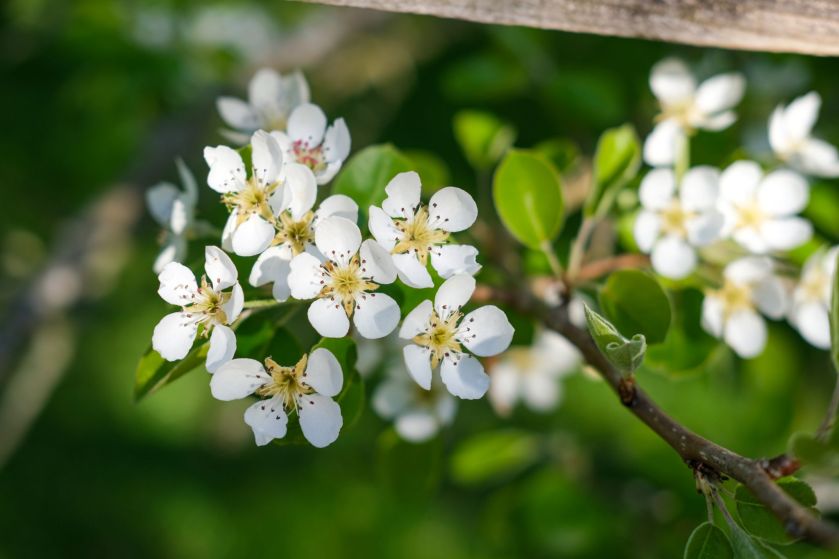
One of the earliest known varieties of English perry pear, the Barland’s historically attested productivity and popularity begs one simple question. Whatever happened to Barland perry? It’s likely the most famous variety of perry pear that you might have never heard of.
On the 27th March 1798, a Herefordshire property auction was advertised in the local paper. It included several lots of arable land, notably one acre of a field known as Walsow, or Warsaw, in Bosbury, just north of Ledbury. That parcel is singled out for specific attention as it had several Barland pear trees growing upon it. Most of the eight lots promoted alongside this listing also contained orchards or fruit trees, but Barland is the only variety that the advertiser chose to name specifically.
The emphasis on variety gives us a clue to the fame of this hard perry pear. It is possible that this reference may be significant also for its proximity to the supposed location of the original Barland tree, in a field called Barlands, nearby. Dating back to at least the 1600s, this venerable OG tree is said to have been finally blown down in a gale in the early years of the 1800s, when it was likely approaching 250 years of age.
One of the earliest prolific cider writers, John Beale, extolled the virtues of the Barland, or Bareland, as one of the best pears for perry in 1657.[1] The variety is mentioned in John Evelyn’s Pomona of 1670, which also bore heavy influence from Beale.[2] In fact, such was Beale’s dedication to the subject that it is recorded he paid for 20,000 cider apple and perry pear grafts of Herefordshire varieties – including the Barland – to be distributed in Somerset, Devon and Dorset.[3]
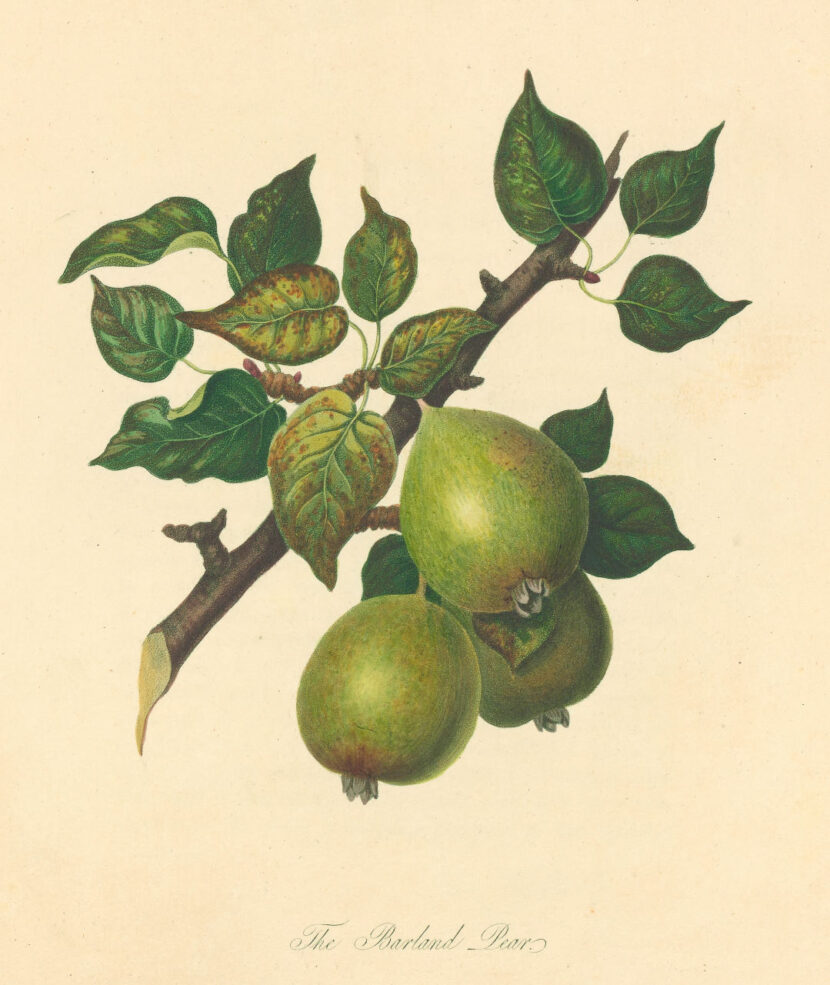
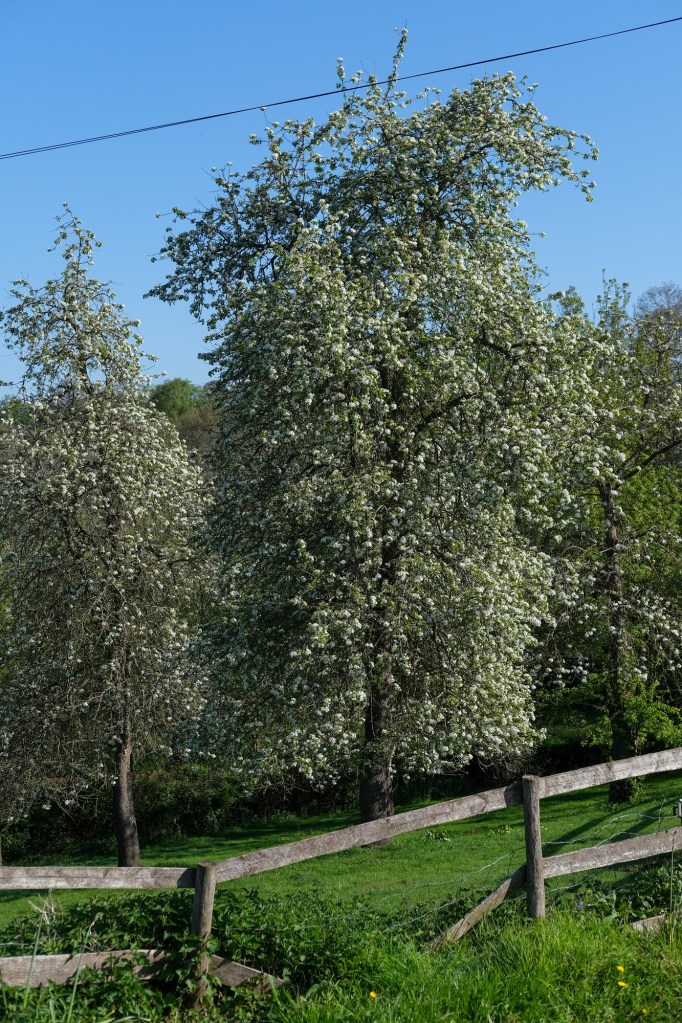
From what we can assume, therefore, to be a relatively robust population of trees, the highlighting of Barland orchards and perry in advertisements continues unabated throughout the nineteenth century. These sources tell us that the pears were desirable not just for the quality of perry they produced, but also the quantity that could be gathered from trees that had the potential to grow to an intimidating size. One four acre stretch for sale at Merryman’s Hill near Worcester in 1833 boasted a solid planting of Barland that was likely to produce 50 hogsheads of “rich Perry” that year. That’s nearly 10,000 litres of the stuff.
The Hereford Times, in 1855, found the tenacity of one tree in Ross to be particularly newsworthy:
“It is a large tree, the trunk of which is hollow, and sufficiently capacious to contain two men. It has a spacious door-way, and also a considerable aperture on the opposite side, and yet this apparently frail foundation supports a most luxuriant [emphasis the writer’s own] pyramidal head of foliage, loaded too with its far-famed produce. The situation being high, the tree may have been struck with lightning many years ago, and being thus injured have become hollow.”
The quality of Barland perry was never in doubt. The compilers of the Penny Cyclopaedia of the Society for the Diffusion of Useful Knowledge Vol IX in 1833 listed it amongst the finest varieties of perry pear, alongside Teinton Squash, Oldfield and Longland. The Barland was also often noted for its medicinal properties, in particular believed to be singularly efficacious against complaints of the kidneys.
“Really good perry is little inferior in flavour or quality to Champagne” wrote one commentator in 1817. The promotion of perry as a homegrown alternative to the best sparkling wines of France took a deep hold in 19th century Britain. One Liverpudlian provision merchants, John Evans and Co, boasted about their access to “genuine Barland perry”, which was “Champagne in its influence, and of a complexion quite recherché.”
Over in Gloucestershire, in 1837, large quantities of Barland perry from “one of the first-rate Makers in Herefordshire” was sold under the heading of “Sparkling Champagne Perry”. A generation later, in 1867, a Mr Jones of Bell Orchards in Ledbury offered 300 cases of “Jone’s celebrated Barland Champagne PERRY” for sale.
So, why did England’s answer to Champagne disappear? Well, it’s hard to say. At the time, other much-loved varieties were becoming scarce because their core plantings had reached the end of their lives. Teinton Squash trees, for example, were described as being in decline in the 1800s, ravaged by old age. However, the productivity of the ancient Barland trees was still much lauded. Thomas Andrew Knight, the president of the London Horticultural Society for 27 years in the early 1800s, observed the Barland to be an exceptionally durable form of pear tree.
“The identical trees which supplied the inhabitants of Herefordshire in the seventeenth century with liquor,” he wrote, “are likely to do the same good office to those of the nineteenth.”
There are clues, however, which may give an indication as to why the Barland all but disappeared from our glasses. In 1901, the Hereford Times noted that producers were struggling with the perry’s tendency to become cloudy.[4] It was clear that this was an issue of appearance, rather than quality, but it is not inconceivable that some makers may have been inclined to abandon those pears in favour of something more compliant.
The same article also lets us know that there had been concerns about the variety winking out of existence “for want of propagation.” Beale’s merry distribution of Barland grafts, some two centuries earlier, were likely winding up their natural lives, if indeed they had made it that far at all. Though there was hope that the Barland would be continued, particularly in its native Herefordshire, we see it gradually dropping out of the literature in the decades that followed.
There’s no clear reason for such a popular variety going into decline, except for gesticulating vaguely to the box labelled “market forces.” Across all of Europe, perry was in decline by the middle of the twentieth century and we are lucky that the variety survived at all, where others did not.
Nowadays, you can nearly count on one hand the modern producers who have made use of this distinguished pear. They include blends and a mistelle from Wilding, Gould Cider & Perries blend with Taynton, Bushel & Peck’s The Avenue and the much-missed Bartestree Cider released one some five years ago. Ross Cider put out Barland as part of a blend in 2018, and a single variety from the 2022 harvest. My list begins to run out of steam there, although there surely must have been others.
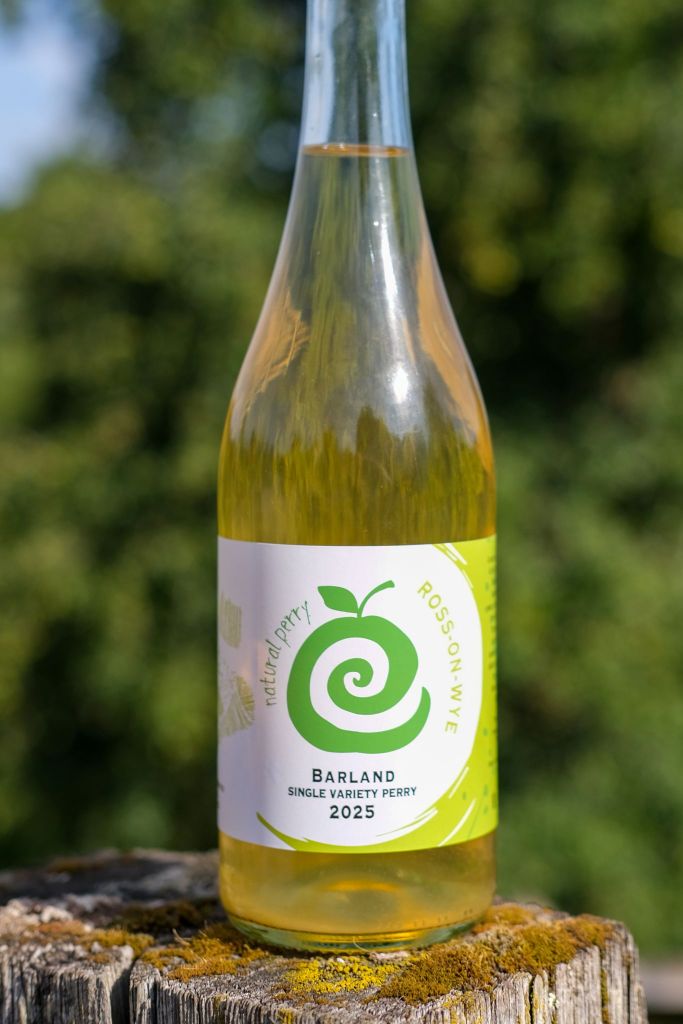
But, as luck would have it, when I contacted Albert Johnson to talk about Barlands, he told me that there is a new one in the pipeline that may be ready for release at this year’s Ross Cider Festival. What luck!
“The perry is very fun and the trees healthy and vigorous,” Albert says. “Which may be the issue for Barland – they are very upright trees that want to grow tall. It isn’t what machine-managed orchards want.”
Another clue, perhaps, to why the Barland fell so hard out of fashion. While one release from a single producer certainly does not spell a comeback for this old variety, it is heartening to note that there are a good number of trees being preserved. An old avenue of Barland trees at the National Trust’s Westbury Court was reinvigorated with new plantings in 1986 and would appear to remain a stronghold. The tree also sits within the collection of the national Perry Pear Centre in Gloucestershire from whom scions can be obtained, depending on the quality and scale of the previous year’s growth. And there are plenty of nurseries offering the Barland for commercial sale in various parts of the country.
A slow return seems fitting for these massive, ancient trees. Perhaps in a generation or two our descendants will be sipping on a glass of England’s answer to Champagne and wondering how we ever managed without it.
[1] Herefordshire orchards, a pattern for all England written in an epistolary address to Samuel Hartlib, Esq., J Beale (1657) Full text available at https://quod.lib.umich.edu/e/eebo/A27154.0001.001?view=toc accessed 10/08/26
[2] Pomona, or, An appendix concerning fruit-trees in relation to cider the making and several ways of ordering it. J. Evelyn (1670) Full text available at https://quod.lib.umich.edu/e/eebo/A38807.0001.001?view=toc accessed 10/08/26
[3] Oxford Dictionary of National Biography available at https://www.oxforddnb.com/display/10.1093/ref:odnb/9780198614128.001.0001/odnb-9780198614128-e-1802 [paywall]
[4] Hereford Times, 12th October 1901
Title image: Barland blossom. Photo: Ross Cider.
Discover more from Cider Review
Subscribe to get the latest posts sent to your email.
 Cider Review