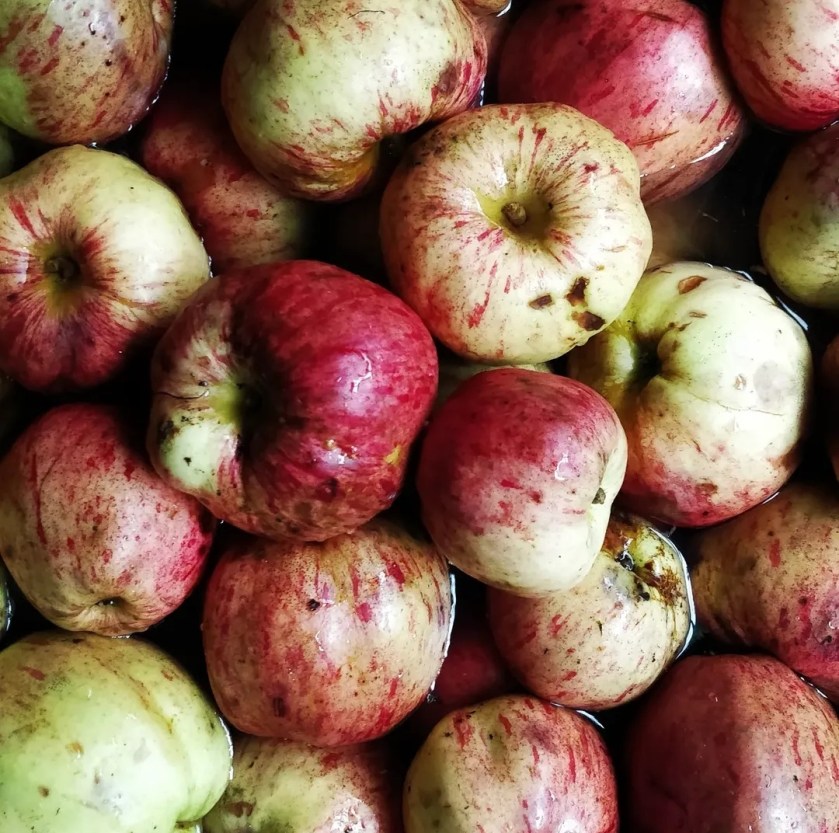
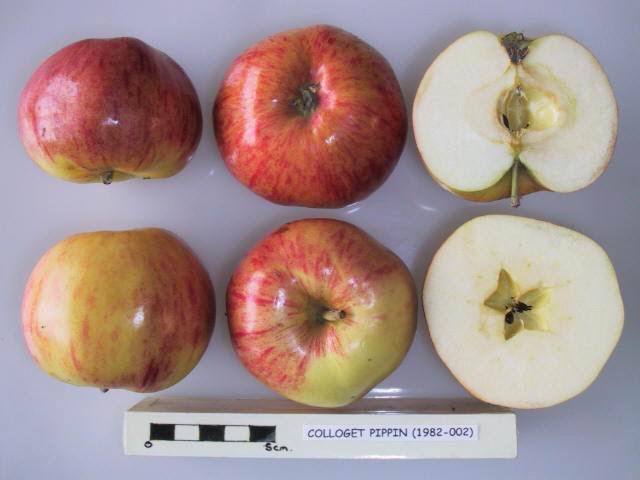
“COLLOGET PIPPIN. (Lawry’s Cornish Giant.) Culinary, October to November, very large, 3 1/2 by 3 (often much larger), flat, conical, very irregular. Colour, yellowish-green with red flush, and bold broken stripes. Flesh, yellow, firm, acid, flavourless. Eye, a little open in a rather deep and much ribbed basin. Stem, short in a rather wide cavity. Growth, extra vigorous, prolific. Leaf, undulating, flat, down hanging. Origin, an old Cornish variety named after the place of its origin. Of no particular merit.”
— Edward Bunyan, A Handbook of Hardy Fruits More Commonly Grown in Great Britain (1920)
A year or two ago, when I was living in west Cornwall, I was chatting to James Fergusson of Vagrant Cider about the Cornish heritage variety named Colloggett Pippin. James described it as “one of the most useful Cornish heritage varieties in [his] opinion”. This piqued my interest, especially as it certainly didn’t match the first-ever description of the variety, which I looked up later (and have quoted above). I decided it was time for me to try and learn more about this Cornish Giant, as the variety is also known.
There aren’t a huge amount of sources on Colloggett Pippin: it’s in Pomiferous and James Evans and Mary Martin’s seminal Cornish Pomona (2014), and it gets mentioned in the occasional article extolling Cornwall’s apples and their funny names (cf Cornish Gilliflower, Pig’s Snout, Bottlestopper, Limberlimb).[1] From the Pomona, I learned that it’s a “very large cider apple, bred by Jack Creber and first described in 1920, which may also be cooked, vigorous but needs a strong rootstock as it can be susceptible to canker.”[2]
From his experience, James told me, “it’s very well behaved in the orchard, [with] moderate vigour, mid season blossom, mid season fruit and reliably heavy cropping most years.” Speaking of heavy cropping: the variety is also called (Lawry’s) Cornish Giant, after Mr James Walter Lawry, the Tamar Valley market gardener who, in the middle of the 19th century, was famous for introducing early Cornish strawberries and narcissi to the London market.[3] Market gardening took over from mining as eastern Cornwall key industry in the Victorian period and remained so until the advent of more industrial farming in the mid-20th century.
Like so many Cornish apples, the Colloggett is dual-purpose, lending itself to both cooking and cider. The Pomona states that “in a good year the apples can be both sweet and bitter as well as acid.” James confirmed both the variability and potential: “If the weather is poor, the tannin content is relatively low, but acidity is high and vice versa. It’s so variable from one year to the next, depending on weather, the only real consistency I can fathom is that it always clarifies beautifully. The juice is beautiful, very low in pectin.” Cameron Beach of Ripe Cider near Liskeard, whom I also interviewed about his use of this apple, highlighted its usefulness as an acidic component in blending: “it is great as an early-ish bittersharp to start off a nice safe wild fermentation, as it has nice low pH levels.”
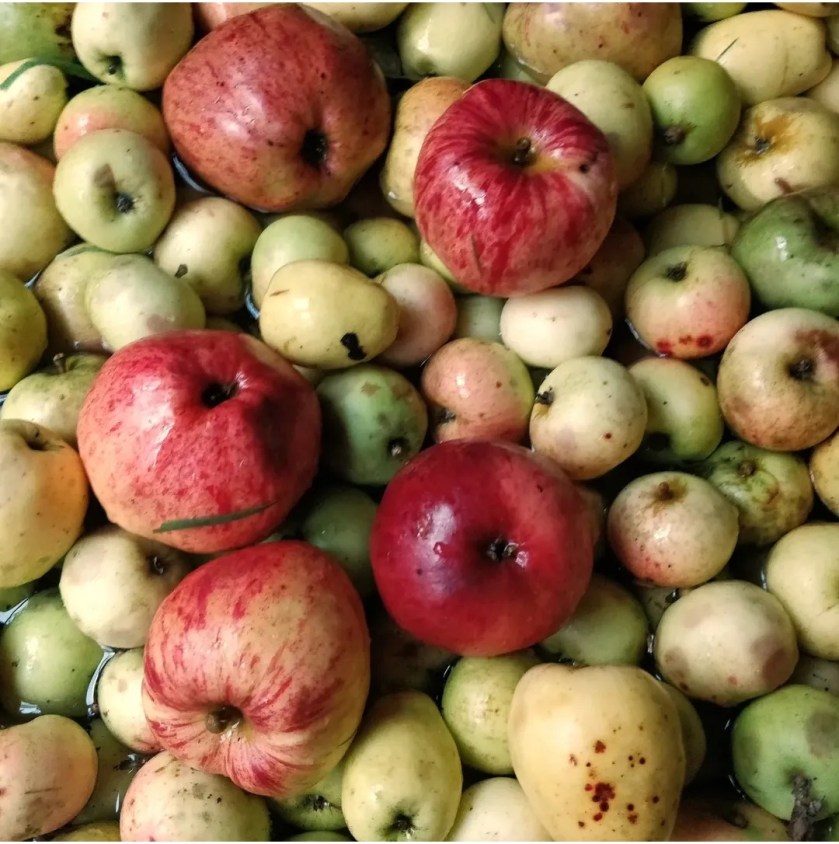
Imagine a red-washed, red-striped apple that is, above all, huge (Cornish Giant, after all). James has previously described Colloggetts as “the size of melons” in wet years”, which he told me was “appealing when gathering is a hand exercise.” Cameron concurs: “First of all it is massive, so has great pick value when gathering by hand. It doesn’t take long to fill a sack, which is such a bonus. It is also very juicy so you get good yields.” “Its main advantage seems to be its ease of collecting, being such a large apple,” quipped my final interviewee, Jeremy Harris of Cwm Maddoc Cider and Perry in the Welsh Marches. However, size isn’t everything: James mentioned that “the Speidel scratter struggles because they are so huge.” Another characteristic is the ripe apple’s waxy exterior; Pomiferous describes it as “very greasy when ripe.”
You’d think Colloggett Pippin would be more widely popular, given its size and the pressing and blending characteristics highlighted by James and Cameron. It’s possible climate has played a role in the limited variety’s limited reach: Fleming’s Cider in Fife are the only cider maker outside Cornwall I know to have access locally to Colloggett—unfortunately, I haven’t had a chance to try their cider using it—and Fife and Cornwall share a high-humidity maritime climate with mild winters (unlike the traditional apple-growing regions of the UK).
Indeed, Jeremy said that when he first got access to Colloggett in a 1960s orchard behind the Jacobean manor house of Treowen in Monmouthshire (“a good mix of fruit including eating and perry pears, plums, apples and a medlar”), “the planting plan had been lost but [the owner told us that] the varieties had been chosen by someone who ‘knew what they were doing’.” No one could identify the apple; Jeremy had to send it for DNA testing to get a clear identification. “We have since found it in Cornwall near the river Tamar and suspect it hasn’t gained popularity outside its home county.”
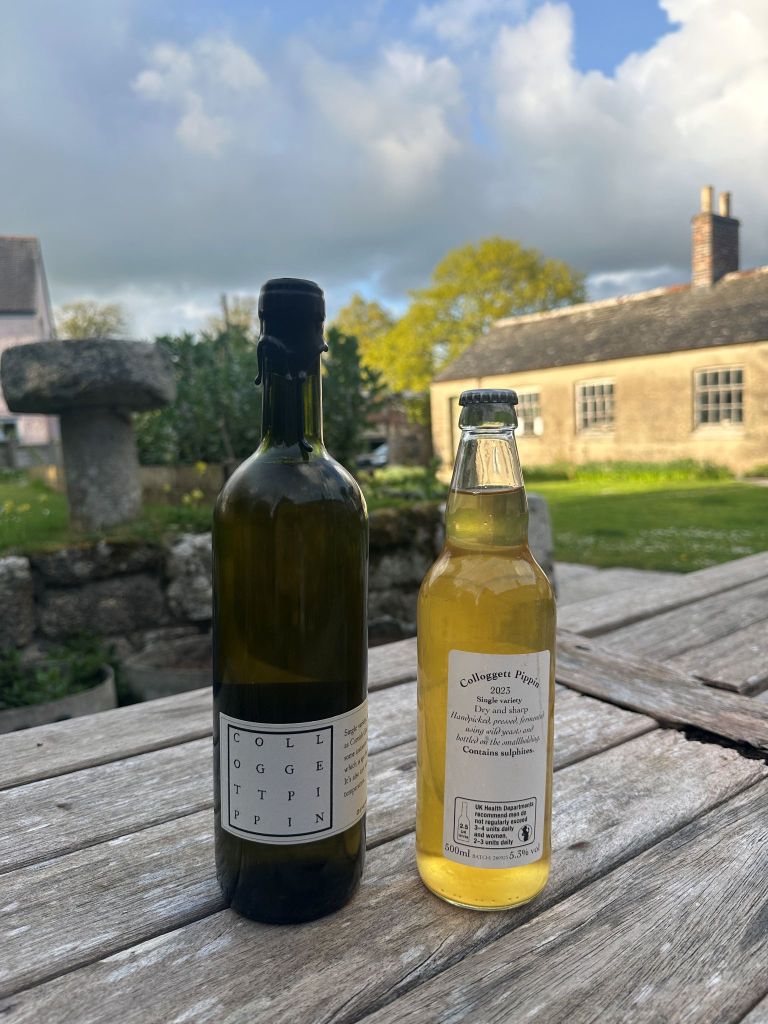
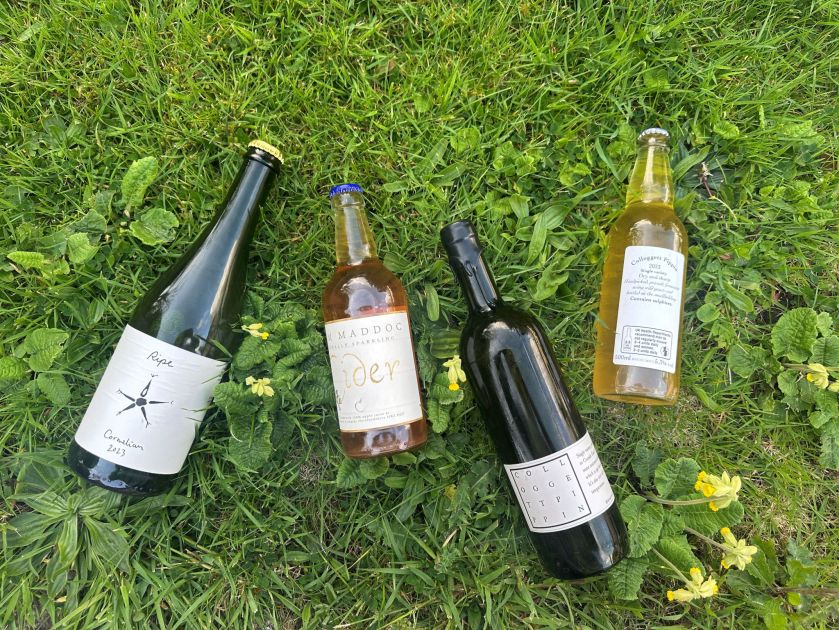
The obvious next step in my exploration was to get my hands on all the Colloggett Pippin ciders I could find. Unsurprisingly, I could only think of a handful of makers using the apple. Before, during and after tasting, I researched the variety, trying to find out more about its history, and quizzed the makers featured here for their takes.
In case you fancy coming on the journey too: the Cwm Maddoc ciders included in my tasting below are still available from (at least) Cat in the Glass; the others are sold out, but other Collogett Pippin-containing ciders from Vagrant and Ripe are available (see here and here, for example).
Single-variety ciders
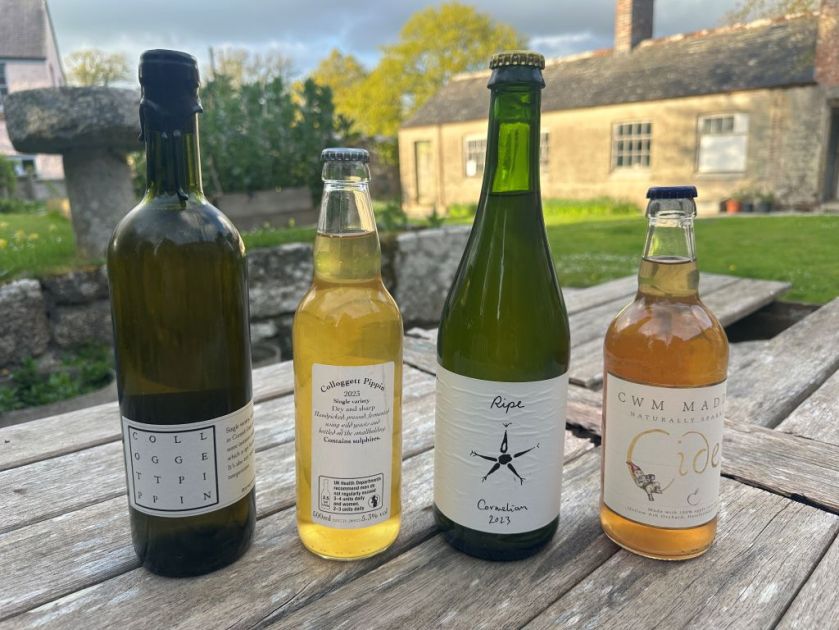
Vagrant Cider, Colloggett Pippin 2023 (SV) – review
How I served: Left to warm up a bit out of the fridge.
Appearance: Clear gold.
On the nose: This is a delicate one. Honey, stone fruit, hay. Something a little like quince. Wet rocks.
In the mouth: With a surprisingly tannic, silky weight but quite restrained aromas, this instantly has that “vinous” feel. I’m getting the same notes as on the nose, plus a bit of herbal bitterness and melon. Still, the acid is pretty high. There’s a slightly yeasty saline finish. Quite “perry-esque”, in a way.
In a nutshell: All wispy melon and honey in its aromatics but surprisingly punchy with the acid and tannin, this is a deceptively shy and elegant “giant”.
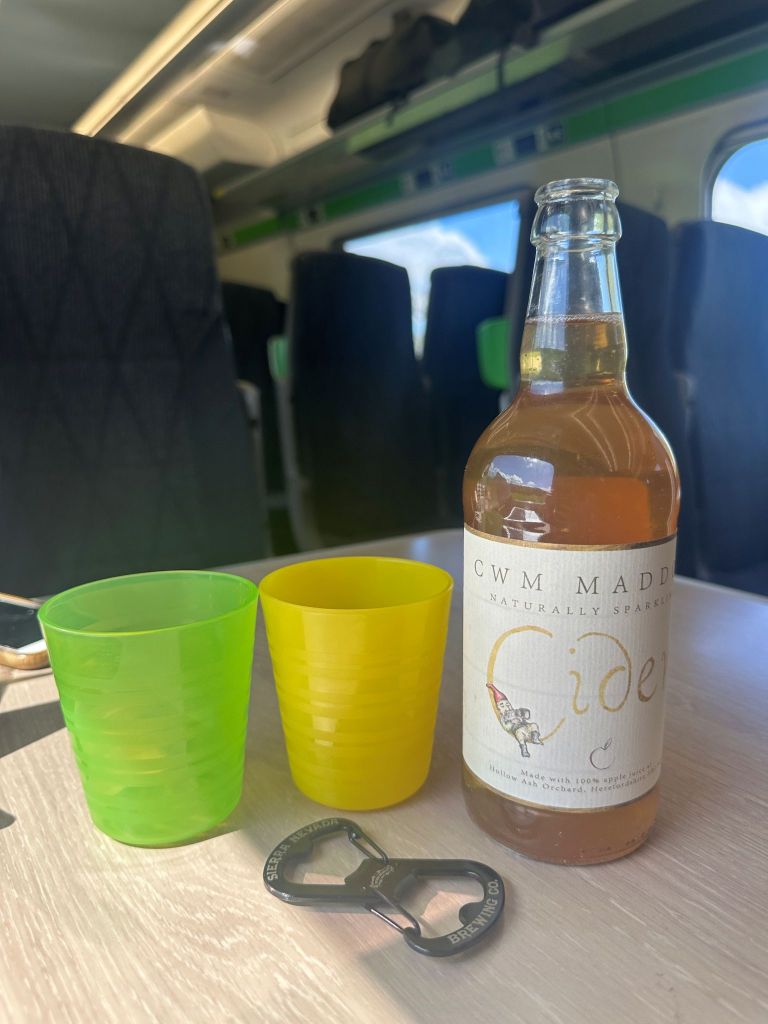
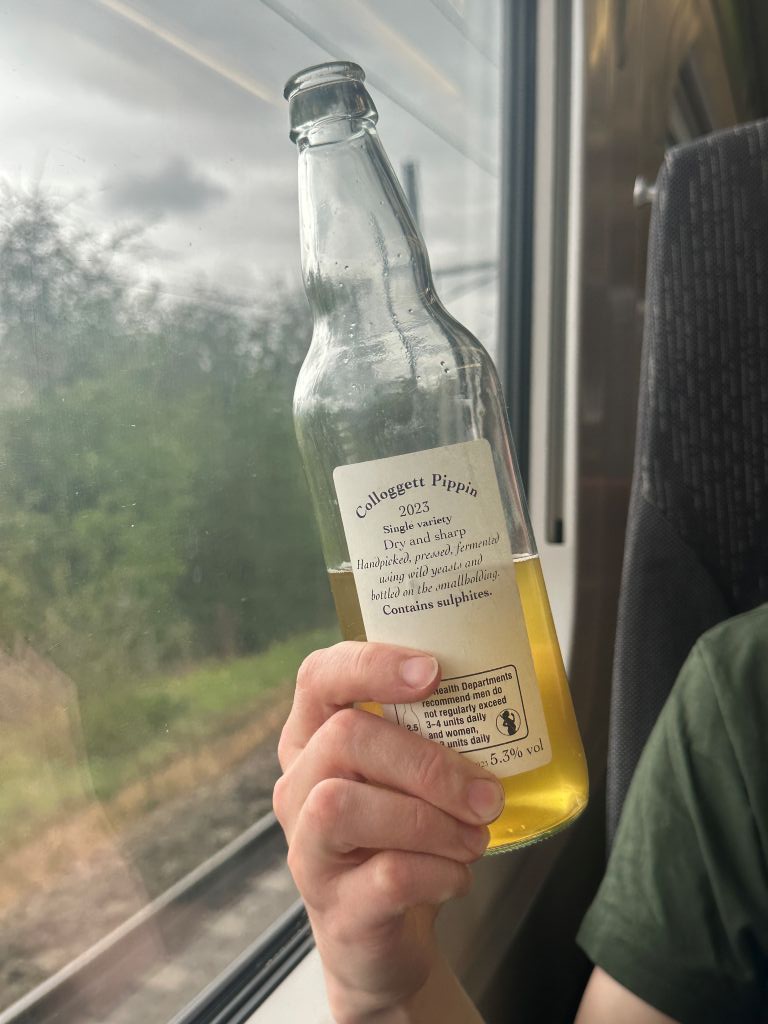
Cwm Maddoc, Collogett Pippin 2023 – review
Appearance: Watery yellow.
How I served: Taken out of the fridge in the morning; tasted on the train around noon.
On the nose: Reticent but fresh apple; a bit of sulphur that isn’t offensive and blows off quickly.
In the mouth: A line of piercing lemon acidity that lingers in the mouth, softened by a bit of gentle stone fruit and some nuttiness. Very refreshing indeed, but with an austere depth. Very dry, as well as drying.
In a nutshell: Dry, astringent, and most lemony, this reminds me of nothing so much as an (uncharacteristically bubbly) Apfelwein.
Cameron and James both highlighted Colloggett Pippin’s complex profile to me. James said that “it generally makes a very good single variety, if a little on the tart, mineral side, but I think that style embodies Cornish cider,” and Cameron added that, as with other Cornish bittersharps like Dufflin and Captain Broad, “the tropical and sherbet notes continue as do the slate tannins…it can create nice mineral wine like notes when aged as well.” So far, that all checks out. Now, just for fun, let’s see how it behaves in a blend!
Blends
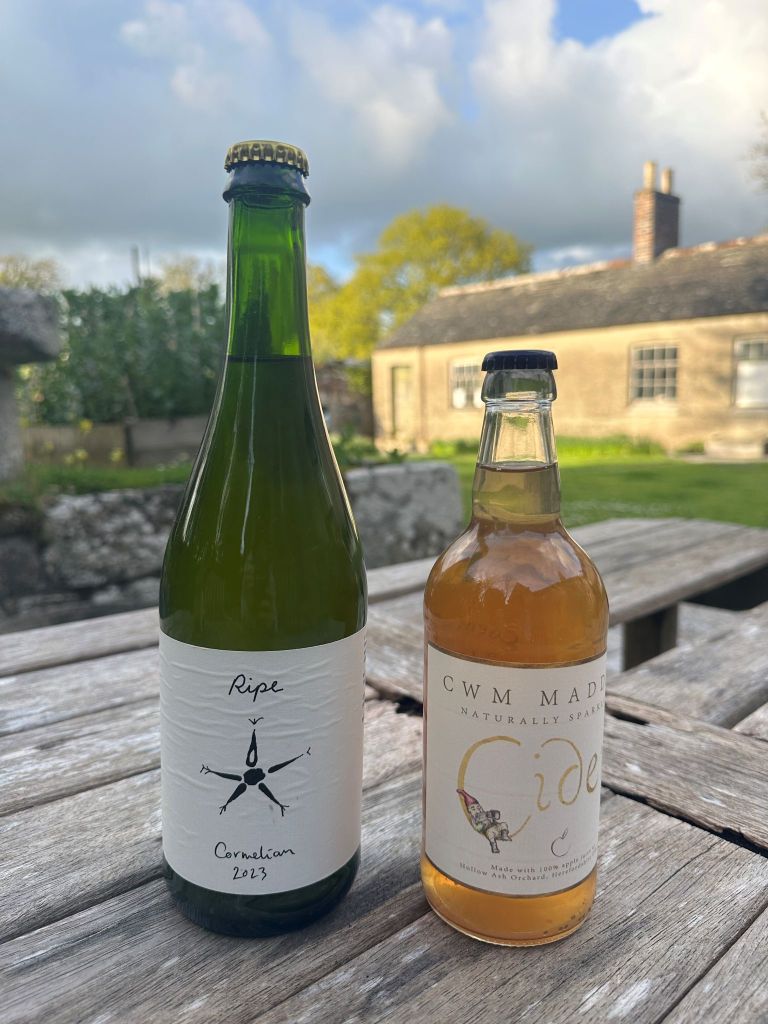
Ripe Cider, Cormelian 2023 – review
70% Sweet Alford & 30% Collogett Pippin.
How I served: Fridge-cold.
Appearance: Cloudy amber.
On the nose: Interestingly, my first thought is of Discovery: this smells of juicy, candied strawberry. There are hints at a cornucopia of other fruits, from peach and nectarine to melon and passion fruit. Or maybe it just smells like a ripe, juicy, honeyed pear?
In the mouth: There’s none of the sweetness you expect from the nose, although fruity aromas linger. A slight funkiness and a creamy breadiness from the near-year of lees aging add savory complexity. A good amount of carbonation keeps things light and moreish, although I would have enjoyed a touch more acidity for balance. Over time in the glass, something very intriguing happens where the fruit aromas turn into something quite herbaceous, even cannabinoid, almost like it’s a hopped cider.
In a nutshell: With low tannin and acidity but lots fresh, fruit, and herbaceous aromatics, this summery cider feels Sweet Alford-led.
Cwm Maddoc, Cornish Giant & Foxwhelp 2021 – review
Appearance: Clear gold.
How I served: Taken out of the fridge in the morning; tasted on the train around noon.
On the nose: Apple juice, fresh pear, caramel.
In the mouth: Mouthwatering, lemon juice-like acidity (although not as much as you’d get with a pure Foxwhelp, I think). Big berry notes, especially strawberry; gentle tannin; more of that caramel apple concentration, but without hardly any sweetness at all. The carbonation keeps things crisp and breezy.
In a nutshell: Relatively rich for something with such light and summery notes, allowing the Foxwhelp’s fruity side to shine—the perfect travelling cider.
It’s perhaps unsurprising that James and Cameron were more enthusiastic about Colloggett Pippin than a maker from Herefordshire, where there is such a plethora of excellent cider fruit available. Jeremy gave me his take on the above ciders of his: “For two or three years, despite my reservations, we used the fruit in combination with Foxwhelp or as a single variety. The result was predictably sharp, but it mellowed with age and displayed some interesting and pleasant flavours. […] The single variety is great paired with fish and chips.” His TLDR on the variety: “I haven’t been persuaded to include Colloggett Pippin in my own orchard as l have plenty of other early sharp fruit like Tom Putt or indeed Foxwhelp.” Nonetheless, he admits that his Colloggett Pippin ciders have “gained a small but vocal following of devotees” (Adam and myself among them).
I know trying to draw out the characteristics of one apple by drinking both single-variety ciders and blends may not lend itself to an, er, apples-to-apples comparison, but I think we can see a few running themes, including the presence of high acidity; fruity, lemony, and herbaceous notes; and a wisp of tannin. Indeed, as James told me, Colloggett Pippin is “one of few widely grown apples in Cornwall with any tannin at all.” I can only concur with Cameron, who sums up its flavour as: “super fresh and tropical with a really prominent sherbet acidity. There is a really nice level of bitterness in the background and the tannins are drying, slatey and clean.”
In terms of drawing out the differences in how each maker treated the apple, I’m slightly grasping at straws. I know all these bottles are minimum-to-no-sulphite; with more vintages of the single-variety ciders from Vagrant and Cwm Maddoc to hand, it would be fascinating to do a slightly more systematic comparison of the terroir influence of the differing climates of the Marches (drier, more inland, with colder winters and warmer summers) and Cornwall (wetter, milder and more maritime) on this cider apple. It does seem like the flavors may have been punchier in Cwm Maddoc’s Marches version, but I feel the sample size here is far too small to say much more. Or you could go more granular: James told me he’s now collecting the variety from five different orchards, including having “just taken on a new orchard which has [Colloggets] growing over a rare patch of schist based rock on the opposite side of the valley from the trees growing over granite, so [he’s] looking forward to potential differences in the terroir affecting the outcomes in the cider.” Horizontal SV CP tasting soon, please!
One thing on my mind during my tasting was an oft-quoted remark, also referenced by the makers I interviewed at various points: the idea that Colloggett Pippin makes a “ladies’ cider”. The commonly accepted origin of this idea is the Cornish Pomona (2014), which states that “the apples […] are reputed to have made exceptional ‘ladies’ cider’ as a single variety.” Neither a cursory Google nor James from Vagrant, who’d also wondered, and eventually asked Pomona authors Mary and James about it, could tell me what this “reputation” implied or where it had come from. Sure, all the Colloggett Pippin ciders I’d tasted had been bright, crisp, low-tannin, acid-led—one could imagine someone back in the day conceiving of this as a more feminine counterpart to a tannic, still, wintery cider profile—but I had to know more.
In my journey down the ensuing rabbit hole, I learned that anyone who has written anything online about Colloggett Pippin since the publication of the Pomona in 2014 (admittedly, masses of people), has referenced the “ladies’ cider” idea—clearly quoting Mary and James, and usually with a sort of virtual shrug. Pre-Pomona, meanwhile, I found scattered references to the concept in delightfully retro corners of the internet, which didn’t yield a coherent narrative about what a ladies’ cider might be. Still, there are fun examples:
- From a 2013 post in a smallholder forum: “Do you mix water with the scratted apples and stand them over night before putting them through the press and mixing the appl juice with the water befoe fermenting. My mate in Hereford told me something about this for making ‘ladies’ cider. Tht is cider of 6% or less apparently.” [sic]
- From a “What is a cider apple?” segment in a 2013 Orchard Link newsletter: “Most varieties of cider apple have to be blended to get the right proportion of sugar, acid and tannin for a palatable cider. There is of course scope for personal tastes and descriptions such as “mans’”, “boys’”, and “ladies’” cider, are sometimes used.”
Meanwhile, the first reference to “ladies’ cider” I could find online was in the 1909-10 issue of the Journal of the Bath and West and Southern Counties Society. Ridler & Son, a Herefordshire cider maker later bought out by Bulmer’s,[4] won a reserve, or 4th-place prize, in the ‘Cider in Cask made in 1908’ category at the 1909 Bath & West Show for a “choice ‘ladies’’ cider”. All the ciders entered into the competition were quite sweet by modern standards, which I’m guessing was achieved through frequent racking (as described in a discussion of “early made cider” in a previous issue of the Journal in 1902—“sweet cider, after all, if we may believe the evidence of the trade, is what the majority of cider drinkers want”). So, it wasn’t a particular sweetness that marked out Ridler’s cider as one for ladies. It also wasn’t particularly low in alcohol or, as far as I could tell from the analytical data provided, particularly high in acid (no details on tannin were given). In any case, I had no evidence that this use of the term “ladies’ cider” was in any way related to the Colloggett Pippin issue; it had been an interesting detour nonetheless.
No dice at the Bath & West. I was relatively confident by this point that “ladies’ cider” was not an established category, and that I was unlikely to find the answer to my question in straying far from its source. So I leafed (virtually, at least) through the books in the Pomona’s bibliography, to no avail, until I dug up an Orchard Link newsletter from 2001 that profiled Colloggett Pippin in its “Pomme Parade” section. That profile, an expanded version of the one given in the Pomona, predated that work but mentioned the “ladies’ cider” idea. Therefore, it had clearly got both the apple profile and the phrase from elsewhere. It gave as its source a book that was also in the Pomona’s references: Virginia Spiers’ 1996 Burcombes, Queenies, and Colloggetts (BQC).[5]
Naturally, I needed to track it down. However, even The Cornish Pomona, an invaluable reference for anyone interested in Cornish fruit and historic English varieties more generally, hadn’t been easy to get hold of, despite my living in Cornwall (I finally managed to order one from an online farmer’s market in Plymouth). BQC, which turned out to be by Mary Martin’s sister, was even trickier. I felt sure I needed to consult it, but the occasional copies per sale were expensive, and as a one-off print run in the 90s, the book had not been digitised. Finally, I found a west Cornwall bookseller offering an affordably priced copy, and I pounced.
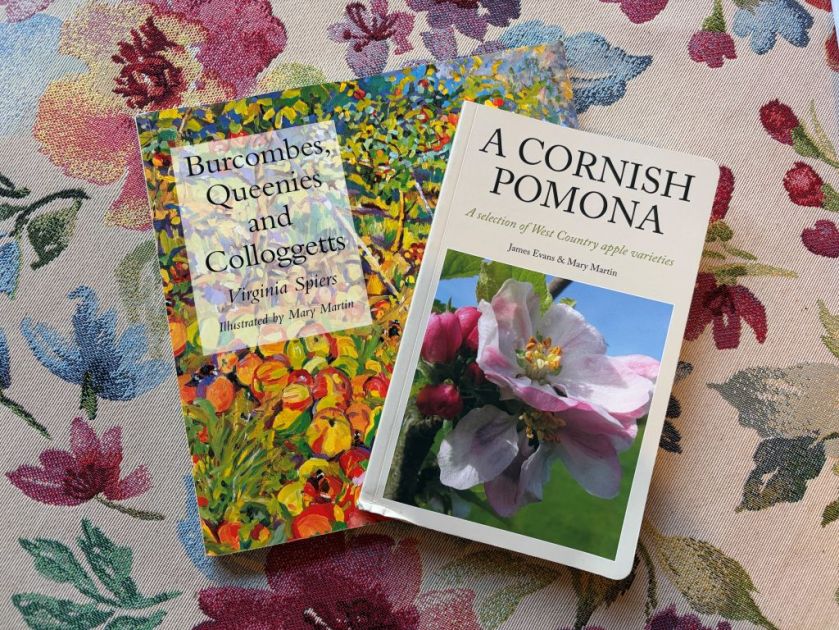
The book is a treasure-trove. Illustrated to the brim with Mary Martin’s joyous paintings of her beloved Tamar Valley orchards, it tells the story of Mary and James tirelessly searching out and recording hundreds of historic Cornish apple and cherry varieties over decades, as well as grafting them into their orchard at St Dominic and sending key varieties to the National Fruit Collection. (Of course, that gift to the region is still giving; in 2007, nearby National Trust property Cothele established a Mother Orchard of 125 rare and heritage varieties collected by James and Mary to further secure them against extinction.)
Incorporating James and Mary’s notes for a book they once planned on a similar subject, BQC furnished lots of detail for my Colloggett Pippin story, including enchanting bits of social history. I learned that in the 1950s, when the sisters were growing up in the Tamar Valley near the watermills their grandfather had worked, “sour sweet and dry cider apples, including handsome striped Colloggetts, were left in heaps under trees in the small upper orchard by the reservoir…Later they were gathered into sacks and taken by horse and cart to the dark cider-house at Glamorgan Mill”. Later, when James and Mary had started on their joint mission in the 1980s and first discovered the variety in an overgrown orchard (not on but near Colloggett Farm in Landulph), “they literally fell over enormous stripey Colloggetts lying in the grass”.
These big apples clearly valued locally: BQC recounts how James and Mary restored an old cider house near Calllington around 1980 and gathered around them an enthusiastic group of local helpers keen to see the return of “‘real’ cider”. As James wrote for Cornwall and Southwest Fruit Focus in 2008, “When we made cider all the old chaps came in and gave us advice. They told us we were using the wrong apples. We should be looking for Colloggett Pippin, Pig’s Snout and other wonderful named apples.”
Given that all that real cider and its wonderfully named varieties are not nearly as common these days, BQC also recounts heartbreaking parts of the Cornish fruit story, echoing what happened elsewhere during the 20th century[6]: “During and between the two world wars, new apple and cherry planting declined considerably. Growers were exhorted to plant more essential crops to help counteract food shortages and there were harsh financial penalties with fines of £200 for failure to replace so-called non-essential crops such as apples and daffodils with cereals which were often unsuitable for the area.” A characteristic orchard visit is described thus: “In common with other orchards in the area most trees were old or dying but they did at least exist unlike many which had been grubbed out, particularly since the 1960s.”
And then, dear reader, I found something. I was on a plane recently, reading the chapter titled Collecting Apples (which chronicles James and Mary’s early collecting and orcharding years), when I came across the following anecdote: “Mr Hambly senior also spoke enthusiastically of the Collogett which, in one notable year, when all other apples failed, made cider which ‘tasted like champagne—a lady’s cider!’”
Given that the Pomona’s profile on Colloggett likely grew out of the same notes as BQC and that everyone quotes the Pomona re: “ladies cider”, Mr Hambly’s remark seems to me the most likely origin of Colloggett Pippin’s modern association with “ladies”. Or rather, “lady’s”—as in, a lord and a lady, not ladies and gents.
It’s fascinating that the natural morphing of “a lady’s cider” into “ladies’ cider” obscures the aspect of class—rather than gender—that the speaker was probably emphasising. He presumably meant that the cider was of Champagne quality, the sort of thing a real lady would drink (the average 1980s woman’s drink was not Champagne). Moreover, it sounds like Mr Hambly was talking about a particular year, saying that the Colloggetts did particularly well one vintage, cropping when others trees didn’t, not that Colloggett cider is inherently a certain way. All this made more sense to me than Colloggett Pippin always making a cider particularly suitable for women.
I’ll admit, I went on this search for the sake of it. I love Colloggett Pippin, and researching it has given me great satisfaction; I hope I’ve whet the appetite of those who weren’t familiar with the variety before. I don’t have proof that my theory of the provenance oft-quoted “ladies’ cider” phrase is correct, but I am neither surprised nor disappointed that the whole thing was likely based on a one-off remark, and that finding it hasn’t yielded much insight into what I already knew, which is that this variety makes great cider. Cameron went so far as to call it “maybe Cornwall’s answer to Foxwhelp, but better obviously”, and I can see where he’s coming from.[7] My next job is to seek out Crackington Cider Co’s 2025 Colloggett Pippin Méthode Traditionelle in honor of Mr Hambly senior’s enthusiasm for “Champagne”.
And who was Mr Hambly senior? I’m pretty sure that he was the farmer with the old cider house that James and Mary restored in 1980 for their first foray into cider—“the making”, as they called it. He’s here in the blog post I cited earlier, next to the cider mill in a photo with James, Mary, and Mike Hambly, presumably his son. It’s the one captioned “30 years on James and Mary reminiscing with farmers Peter and Mike Hambly in winter 2010.” I’m still not sure whether Colloggett Pippin is a ladies’ cider or not; but it’s certainly real cider.
Thank you also to James Fergusson (Vagrant Cider), Cameron Beach (Ripe Cider), and Jeremy Harris (Cwm Maddoc Cider & Perry) for their generosity with their time and insights. Photos are by the author unless otherwise stated.
[1] To sound Cornish, pronounce it “Clog-et”. The spelling also varies widely, I just like using all the consonants.
[2] I couldn’t find out anything else about Mr Creber and whether the variety was in fact a chance seedling, as the “pippin” in the name might imply.
[3] Nerds like me will enjoy the contemporaneous write-up of a talk Lawry gave at Helston guildhall in 1892, further west in Cornwall (and my old stomping ground), on “fruit-growing in the Helston district”. He was spearheading an experimental initiative aiming to demonstrate the merits and feasibility of table fruit growing in western Cornwall, “the County-council feeling that Cornish farmers are rather backward, in some respects, in farming experiments.” Half-acre model fruit farms were to be laid out “under the supervision of Mr W. J. Lawrey, of St Dominick, Callington—a practical and very successful grower ; and no doubt the experiment will be watched with interest by the agricultural community.”
Lawry, it seems, was particularly keen to get apples going in the Helston area, his part of Cornwall being more suited to strawberries, gooseberries, etc (perhaps he didn’t want the competition!). A fervent advocate for the now-obscure Lord Grosvenor cooking apple (now also known as Lawry’s No 1), he recommended “hardy apples like Lord Grosvenor for granite soil”, and advocated for inter-planting with soft fruit like raspberries over grazing.
One of the talk’s attendants, a certain Mr Davey, was envious of the fruit-picking labour available in Lawry’s part of the Duchy: “Our women [and children] would rather work a sewing machine, and they would not like to soil their stockings. (Laughter.)” Other parts of this time capsule are more charming, as when the farmers discuss how seaweed is “a grand manure for an orchard” or how apples should be “sent to market “packed in barrels rightly like potatoes, without paper wrappings”.
Source: The Cornishman (October 6, 1892), p. 6. Accessible via various newspaper archives; local libraries tend to provide log-ins.
[4] Fun fact: Ridler & Son also sent cases of cider to the White House in the 1930s, as discovered by Natalia, aka the Cider Explorer, during her visit to the Cider Museum a few years ago. It seems that Eleanor Roosevelt, very much a (First) lady, was a fan.
[5] Queenie is a Devon dessert apple which Spiers says was very popular around St Dominic, just on the Cornish side of the river Tamar, and Burcombe is a black cherry said to have been raised at Burcombe Farm in that area.
[6] See previous writing on Cider Review such as Barry’s investigation of the Swiss Tree Murder (parts 1 and 2) and Adam’s on UK politics and orchards.
[7] I do think Foxwhelp has the edge, if we’re picking favourites.
Discover more from Cider Review
Subscribe to get the latest posts sent to your email.


Just hearing the name makes my mouth start watering since I had the Cwm Maddoc SV a little while ago. It also ironically started off a little journey into Eastern style bottles.
Genuinely exceptional cider.
LikeLike