What do I remember?
I remember sitting, grey-faced, on a zoom call as a brilliant friend and wonderful cidermaker explained hose threadings to us, and why the equipment we had bought probably wasn’t going to work, a week before we had to use it. I remember feeling stupid and naïve as my fellow neophytes made whatever notes they could, and I just sat there afraid of admitting that I couldn’t follow any of it.
I remember the 2am finish on our first day of making, because we didn’t have a spare day for it to run into. I remember pushing tanks about, trying to look busy, failing to be useful, arguing over sterilisation protocols and fretting that every decision we made might hole our cider below the water before we began.
I remember the day the mill broke just half a tank into pressing. I remember the shamefaced feelings of incompetence as we had to admit it to our friends. The certainty that we were out of our depth, were a farce, shouldn’t really be doing this. I remember discovering that we couldn’t, as we had hoped and believed, mature our cider at a friend’s facility, but would have to build a shed a quarter the size of our garden at last minute instead.
What else? I remember the embarrassment of how little it turned out the three of us had picked in a day of trying. I remember the endless ‘help, how do we do this?’ messages sent to extraordinarily patient friends. I remember the hand I opened and the fingernail I lost trying to take our press apart so it would fit down the side-alley. I remember realising we were trying to fill keykegs through the wrong part of a coupler. I remember discovering that an apple we’d built our plans around wouldn’t be available. I remember all the hours we spent trying to make sure that a day of pressing wouldn’t completely destroy our garden, and the days we spent putting everything back together when we realised that it still had. I remember the fear and stress and uncertainty of not knowing how much liquid needed to be in the pump hose before we turned it on, and gnashing our teeth and starting again, trying to turn back the tide like Canute, every time the smallest air bubble appeared. I remember the slow, painful understanding that no amount of lending hands at harvest, no level of theoretical study, quite adds up to having to take these actions and decisions for myself.
I remember how I felt when I tasted our single variety Dabinett; the gnash and astringency and truculence of its tannin; the realisation that it would still be years before it was worth drinking. I remember my friend’s partner asking if it would be ok to pour the rest of her glass down the sink the first time I shared my ciders with anyone else. I remember looking at the scoresheets of the first, peer-judged competition we ever took part in, and seeing that only one of our ciders had been given a single vote. I remember the knowing ‘really?’ looks, the ‘are you sure about that’ tones of voice from almost everyone we have told we would only be making dry, still ciders bottled in 750ml under cork. I remember the endless admin; trying to co-ordinate between the three of us, amidst jobs and hobbies and the warp and weft of normal life. The late starts, the missed deadlines, the chaotic record keeping. The discovery, when we thought we were finally there, that the government now legally required a detailed business plan. I remember the slumps, the frustration, the imposter syndrome, the despair.
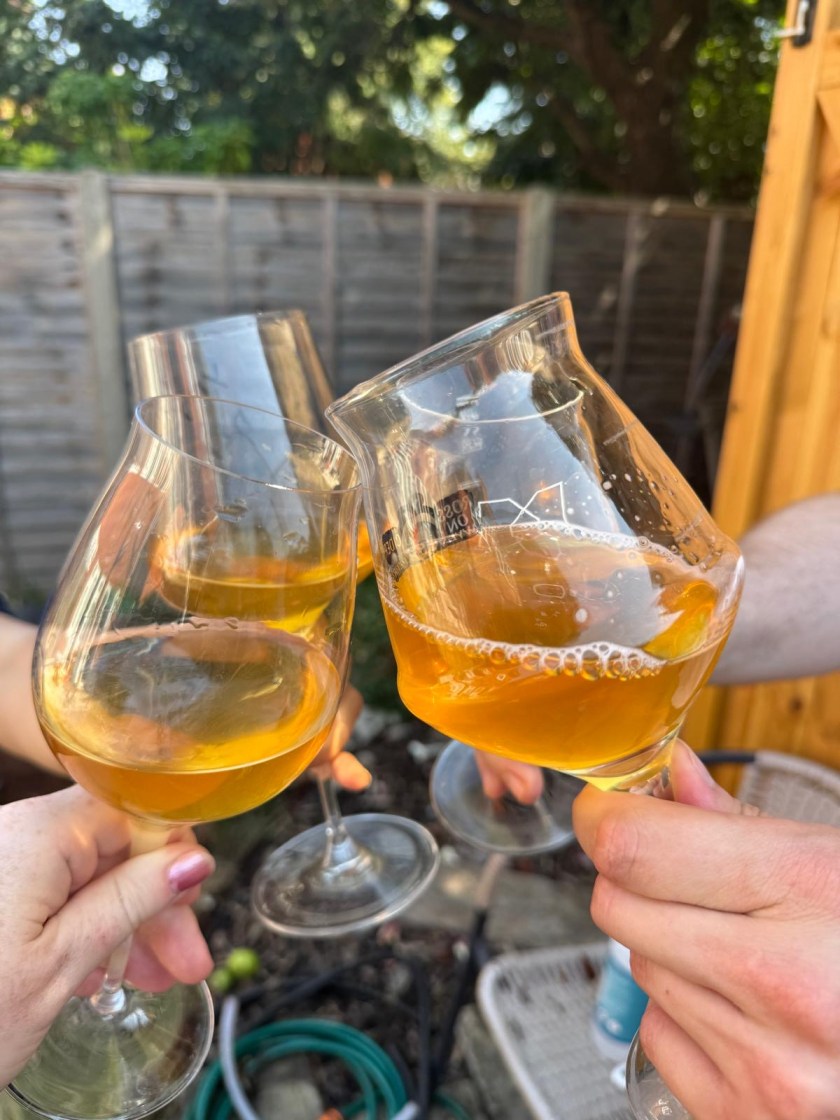
And I remember the first time Caroline and I tried Triptych from tank as the sunlight angled through the Magnolia leaves. The clarity of feeling that here was one of life’s folds; a before and after moment; a sustaining click of the camera shutter to grasp at in those inevitable moments yet to come when we might wonder again why we did this.
***
An interesting quirk of the cider writing community – something that exists to the same other degree in no other congregation of drinks writers – is the percentage of us who have also embarked, at one scale or another, on making our own.
Indeed for a long time I was almost distinguished amongst the founders, editors and contributors to Cider Review by not having done so. I am not, as I have recently pointed out, one of life’s natural makers of things. I can barely make the bed. The more I have learned about the production of drinks in the fifteen or so years that I have been meaningfully interested in it, the more certain I have been that I lack the requisite skills and attributes that drinks production involves. I am not a patient or practical person. My ability to focus on something in which I am not interested is nil. I find admin, and particularly the language in which admin is invariably couched, overwhelming. I’m not good with my hands and am nervous around most tools and equipment, never having really been taught to use them and mistrusting of my capacity to figure it out. I’ve a tendency to catastrophise and I’m too quick to despair when things go wrong. Besides which, anything with even the vaguest whiff of science about it goes in one ear and out the other. I’ve been podcasting with Albert Johnson for three years now, friends with him more than twice as long, and I still couldn’t really begin to tell you anything meaningful about the varying growth habits of trees without a good long look at what few notes I’ve actually made, which really tells you everything.
And on top of all that, the three key ingredients in cider production – and probably most things production – are storage space, finance and a vehicle you can fit an awful lot into, none of which I had in any great supply.
All in all, it seemed for the best that I just take the minutes for aspirational cider, and for several years that was what I did, to the tune of some three-hundred articles, the founding of this website with James and a book about perry. (Which, incidentally, is still available and being discounted at a slightly embarrassing rate, should you like a copy or want to get ahead on your Christmas presents please and thank you.)
But the daydream common to all drinks writers is unshiftable. The ‘what would mine be like?’ The ‘here’s how I’d do it, given the chance’. Notes doodled in pads; the sparkles of ideas flashing through on the tasting of another drink. A sticky little ‘if only’, impervious to removal by anything so prosaic as common sense. And so when my cousin expressed a vague wish to make something together, and my wife expressed a very specific ‘not without me you don’t’, and when I concluded that I didn’t have a year to waste learning how to ferment things in a tiny way in demijohns, Three Wells Cider emerged from its 15-year gestation in the primordial brain soup.
***
However much you might feel you know theoretically about a drink; perhaps even lending a hand with a few weeks of harvest, or a bit of time spent pitching in on production, making it yourself is a humbling rebirth.
I came to cider having written about it exhaustively for the five years preceding, having done in-depth interviews with probably around a hundred makers and having tasted some several thousand of their creations, so it was somewhat galling to discover that my useful knowledge as regards actually making it could fit on a bottle cap. Caroline read Andrew Lea’s indispensable Craft Cider Making, spent a couple of evenings down the Cider Workshop rabbit hole and emerged as manifestly the person best suited to be in charge of production, if she hadn’t been already. To be honest, anyone who could use an Alan key without dropping it would have been a step up from me.
Drinks writing, for very understandable reasons, really only tends to skim the surface of what is actually involved in the making of drinks. We are, on the whole, writing for drinkers more than we are for makers, flattering ourselves ‘journalistic’; very few of us in the grand scheme of things get into the really technical stuff. Sure, we’ll discuss things like varieties and delve into pitched yeasts versus ambient fermentation. We’ll do our best to elucidate the differences between styles and what goes into distinguishing each one. But our view is taken largely from the far side of the finished bottle. And describing the colours that refract from the prism is not the same as understanding the light that hits it. I could extol the virtues of sanitisation as long as I wanted, but ask me to decide on a sanitisation protocol for my own production and I didn’t know where to begin. I was paralysed by ignorance, by choice and by the fear of what would happen if I got it wrong. And you could rinse and repeat that for virtually every step we’ve taken as a company for the last two and a half years.
And so began that humbling rebirth, and with it a shift in my dynamic with both makers and other writers. Up until 2024, I had found myself almost pooterishly assured in my interactions around the cider community. I am not an expert, and have never considered or described myself as one, but I had developed a confidence in my opinions and experience, where I felt it sat on a sure foundation. I felt I knew what I was on about and where I stood with my knowledge. There can also be – and I notice this more now, having stepped, as it were, through the looking glass – a tendency among many makers to excessively humour the takes of drinks communicators, and set great store by them. Probably, quite naturally, because there is always the chance that a drinks communicator might say something critical or inconvenient, however accurate or otherwise, in a public place. This, in turn, can have the somewhat dangerous affect of adding lustre to the communicator’s regard for their own opinions. And certainly in bigger industries such as wine or whisky, where interested drinkers might have a thousand in-depth conversations without any one of them involving someone actually in production, the trend towards ‘I would simply’-style certainty can border on alarming. I have become acutely aware of industry colleagues who have never meaningfully troubled a vine explaining, sometimes even to winemakers, how they would do something or other differently, or what they feel that the given winemaker should have done.
In aspirational cider, where the access to makers is easier and the community smaller, this phenomenon doesn’t exist in quite the same way. But finding myself suddenly the most neophyte and ignorant in any given conversation again, experiencing other drinkers telling me what they thought of my handiwork and how they felt I could adjust it, questioning to myself my direction and approaches – and all the while still clinging on for dear life and hoping Caroline and Justin understood it all better than I did, was a chastening lesson in humility. Listening to Albert talk shop with Artistraw’s Tom and Lydia the other day, following barely half of it, feeling dew-eyed and wet-eared, I realised that I’m still very much flying by the seat of my pants as a cidermaker, and likely will be for many years to come. I’m only just about to start my third go at it, after all. And we haven’t even sold a bottle yet. I’m still the baby.
So what have I learned? Or, perhaps, what am I in the process of learning? I’m a little more confident in using our kit than I was, though at some point I’ll have to remove the stabilisers and trust myself to run the press and the bottler. I’m more assured in some of our setups and routines; a bit better equipped to cope when something breaks. (Apologies, incidentally, to those of our friends who have suffered several hundred ‘help me’ texts in the last two years). I no longer fear the pump. I’ve learned – at times, to our cost – that no two cidermakers have identical approaches, and that if we find one that works for us and that we are comfortable with, we should stick to our guns, even if it differs from the ways more talented and respected cidermakers operate.
I’ve learned that, for all that it is right, proper and important for writers to romanticise cider and cidermaking in many ways, and that it is precisely that romanticisation that has the power to compel new drinkers into our world, the written romance masks a universe of lived reality. Cidermaking is, for the most part, at turns exhausting, nerve-wracking, lonely, stressful, boring, painful, pitiless, draining, tedious and difficult in not only a million ways, but in a million which you would never have expected or imagined. And all of that is before you have to confront a largely-apathetic public and persuade them to part with £10, £12, £15 a bottle for a drink that sits outwith their field of organoleptic experience, but on which they have opinions and condescensions deeply-imbedded by cultural consensus and bias that may not always be fair or true. And yes, I’m aware that in choosing to focus on still, dry cider we have made that aspect even harder for ourselves.
I have also learned that there is nothing whatsoever that I have experienced in the world of drinks – not jobs, not awards, not the podcast, this website or the book – that brings the same joy as sitting with friends, sharing a bottle of our cider or perry, seeing them enjoy it, and being happy with it myself. I have learned the wonder of reflecting that no one else would have produced this drink in the same way – nor even thought to. I have learned, really for the first time, the satisfaction of having made something good that is tangible; that can be held. I have learned that the results outweigh the cost. I have learned that, whilst it may not get easy, it gets easier. I have learned that, if something breaks, it’s usually just the fuse.
We are, as all three of us would admit, an unconventional trio of co-workers, each with our own foibles and neuroses. A friend once commented that it was funny to think of us making cider together, and although it slightly stung at the time, they were right, and it is. But I have also learned that, for all that, without any one of the three of us we couldn’t possibly have arrived at what we have. And therein, I think, lies the most important lesson that cidermaking has taught me.
Though the strength of Cider Review is its collective, writing is an inherently lonely occupation. I had never, for a long time, done anything truly collaborative, and although I was delighted and proud to be welcomed by the cider community, I always felt that, by the nature of my contribution, I stood slightly alone within it. Making cider with Caroline and Justin, learning from the people who have explained equipment and technique to us, who have introduced us to orchards, made recommendations, advised on process or just offered a digital arm has underscored to me that people are not just a part of cider, they are the fundamental essence of it; what upholds and sustains it and the reason that aspirational cider, despite everything, still has a chance.
In my years of writing I have talked so often about ‘the soul of cider’. I have looked for it in orchards and apples and the cycle of seasons that nourishes them. I have looked for it in region and culture and tradition and method. I have looked for it in toil and effort and ache. But these things, wonderful and captivating as they might be, are what cider is made of. What makes cider, gives it life and meaning and identity, are the people who haul it painstakingly and against all odds into being. Varieties, terroirs, methods and styles – all these things give lustre and flavour and joy. But it is the maker, however nervous, daunted or new, who grants to cider its soul.
As for us and Three Wells, we’ll keep muddling through, trying to find our heading. As you read this we’re into harvest number three and in the middle of figuring out how to use the press again. We even have our APPA now, at last, so it’s only labels standing between us and having to actually sell something. The worrying thing is the number of people who tell us that now comes the hard part. But on we stumble, and if we’ve picked too slowly and the mill’s broken and we’re finishing in darkness and being told our dry cider’s too dry, isn’t that always the way?
Discover more from Cider Review
Subscribe to get the latest posts sent to your email.

