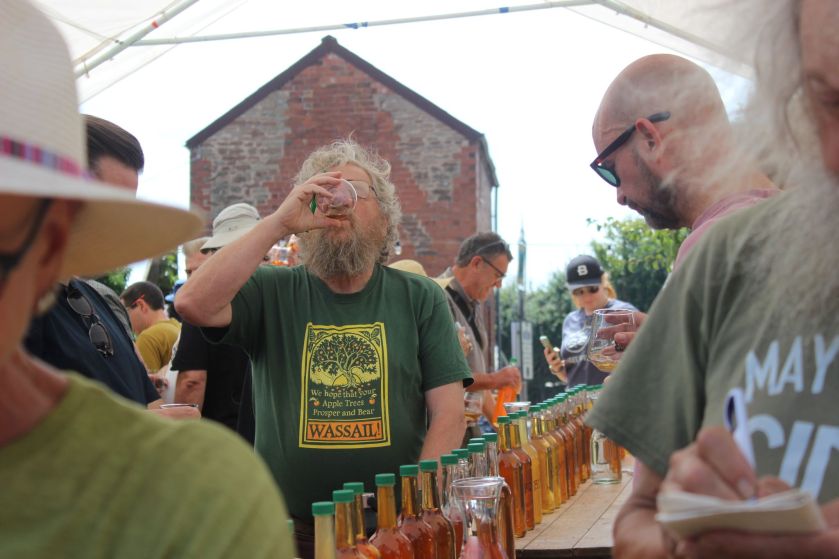
One of the joys of attending the Yew Tree Cider Trials in Peterstow is the distinct chance of stumbling across your new favourite cider- or perry-maker under a marquee that feels half ‘best corner of the county fair’, half day drinking for nerds at your local pub. It isn’t drinking, at least to begin with, but without a spittoon (and with a record 108 different drinks in the running this year) you need your wits entirely about you to avoid overpouring.
The pub garden grass gets well watered with cast-off fermented juice as the two and a half hour judging afternoon whiles itself on. A proper libation to the orchard deities. Thank god it’s a pub lawn not a pub carpet, or it’d surely win the category for stickiest floor I’ve ever set foot on.
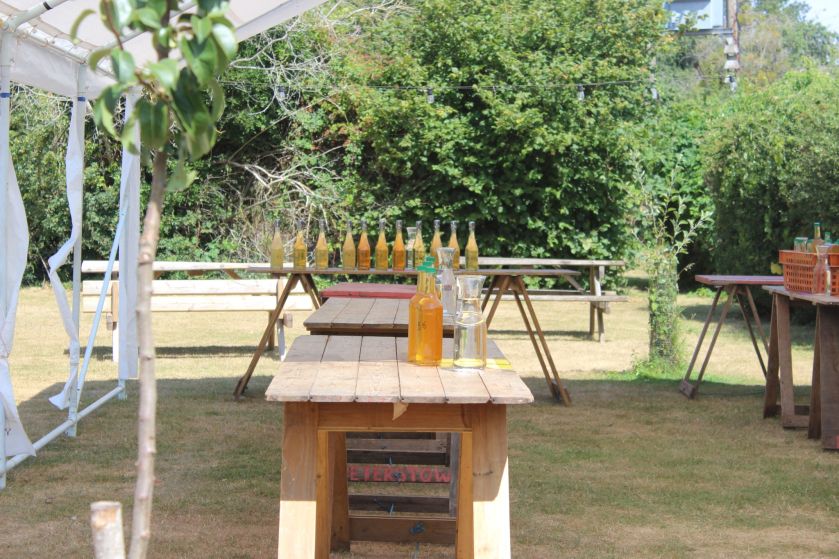
Sample bottles are drawn off from bag-in-boxes (bibs) for the peer-judging panels to sniff, swallow, and score. All that remains is donated straight behind the bar for a clean £2 a half, £4 a pint, with all proceeds going to charity. This year’s competition has raised more than £1,525 for local Ross-on-Wye early years charity WyePlay.
It is a neat system, but harbours hidden dangers for the easily smitten. Some of the bibs contain one-of-one competition blends, put together exclusively for the competition, and even for the drinks that prove less popular with the judges, there is always the risk of an enthusiastic patron buying the entire batch if and when it drops commercially. A local cidermaker, here with his perry-making spouse, tells me he’s done just that before, scooping up an underappreciated rare-variety Ross drop.
Judging is a pointless affair. Instead of grading each entry, guest judges like me simply pick a top three, while peer judges each choose their top four. The extra selection acts as a safety buffer; if a maker loves the taste of their juice too much, it can be cleanly taken off the final results.
On my way over from cat-sitting duties in Cardiff, I spot green buses in Hereford with apple and perry pear names ‘Handsome Norman’ and ‘Green Horse’ right on the front like a mascot. Half of me hopes all the locals know these names like old drinking friends, but the other longs to believe some passengers spend their journey assuming Handsome Norman and Green Horse refer to a legendarily good-looking (and humble) driver and his magic pet.
The whole situation of the Yew Tree pub, where you can almost be lulled into orchards unawares, puts me most in mind of an inn I chose to visit earlier this summer because it was the only pub in the world inside a stone circle. I, greedy for prehistory, assume this means the rocks will be right slap bang in front of my pint. In reality, the whole village is contained within the stones, which I decide is in some way more beautiful.
There at Avebury the stones, and here in Herefordshire the trees, wrap themselves around you without announcing themselves the way you expect. Not in your face, present in the air about you. I can’t believe some people have this pub as their local but there we go, it isn’t for us to be jealous is it. Some people throw their winning lottery ticket in the bin, get it back out of the entire lorry full of waste and take their cash to the bank. Some people get to go to the Yew Tree Inn for a pizza and a pint on a random Thursday. Some people are simply blessed.
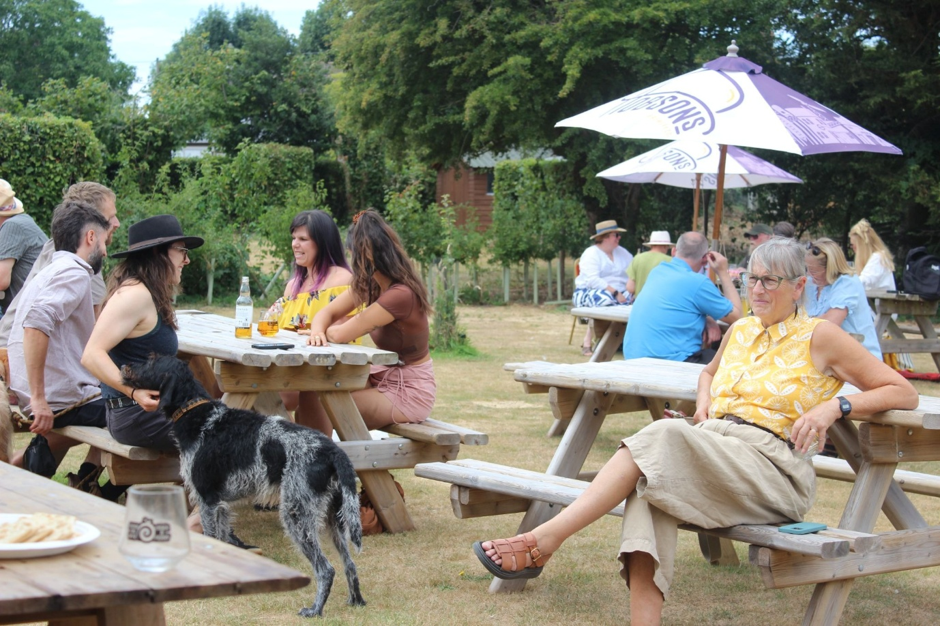
If perry gets to be its own drink, then how should its perryness express itself when it competes? The 2025 Malvern Autumn Show gave us the world’s first perry-only competition (coming back this year, entries are open till 18th September), whereas the Yew Tree trials equally divided their prizes into three each for sweet-medium-dry cider and perry, and an overall champion maker for each. As you’d expect, given the known tricksiness and comparative rarity of perry, the cider categories received almost double the number of entries (71 ciders to 37 perries). The fact that I was drafted last-minute-ish to join the perry judges testifies to this, too. One day I’d love to go to a competition with a broader range of perry categories (like single-variety sound so fun) but this is an event doing what it should as it is.
Of course, the big draw of this set-up, along with the setting, is the peer judging. You can’t fully split one from the other, though. A big reason all these makers of all different scales (ok, not the really big ones, but that’s no bad thing) tell me they are willing to turn up here, donate their stuff, take the time, is because it’s Ross. Free from precise technical breakdowns and the limits (and benefits, of course) of a standard tasting lexicon, it’s all about what makers think about drinks, however they want to think about them.
And Ross is somewhere they want to be, coming from down the road in rural Herefordshire, slightly further-off counties like Cheshire, Leicestershire, and Nottinghamshire. One pair of attendees (sadly, not entrants. Maybe next year?) I meet ferment their cider in the Dordogne in south-west France. They’re now also making wine, you know, as a side thing.
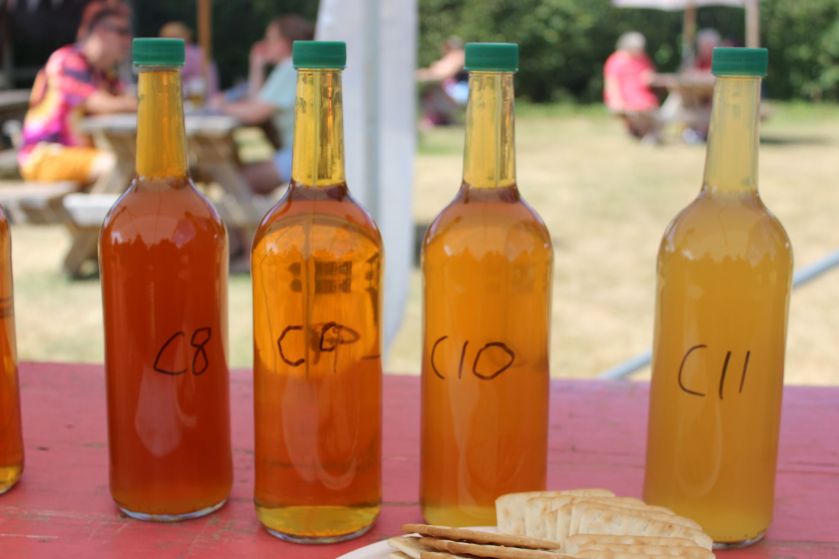
The bottles on the judging tables stripped of labels for the blind tasting remove the at-a-glance gap between bottles that may look pretty well like this anyway, all wholesome and unadorned, and the beautifully labelled bottles we’ve come to anticipate and coo over from some makers. The study in fine differences in colour the glass bottles stood together makes you wonder why stained-glass artists bother with the whole mad, gaudy rainbow of colour. Why not just stick to ruddy browns, rich yolky yellows, and haunted-looking lime cordial greens? It is quite a spectrum enough to satisfy the eye.
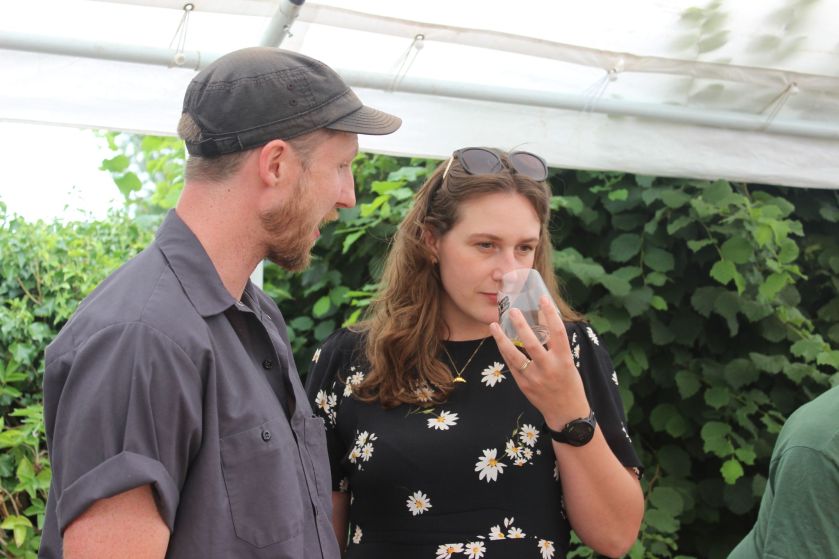
When I fetch my three crayon-coloured voting slips for dry, medium, and sweet perry from the cider bar, I feel like a primary school kid with slightly scary homework and three golden tickets jammed in my hands all at once. For me, as a token non-maker and non-expert, the joy is as much getting to eavesdrop on the peer judges as it is tasting the fruits of their labours.
I listen out for dark mutterings like ‘that’s got a tail, that one’ and later commiserate with an amateur maker who had never contended with mouse until… just now. Some judges tackling many more categories than I am take tips from those who have gone before on what they really ought to try (and, let’s be real, avoid). I understand this as a tactic for drinking carefully and getting your slips back to the cider bar in time. But I do worry a little that it could deprive some initially overlooked entries from placing. I start off trying to take notes on everything I taste but as the time melts away I dismiss drinks more quickly, focusing on getting to everything. I can see how pre-filtering it a bit could focus the palate a little.
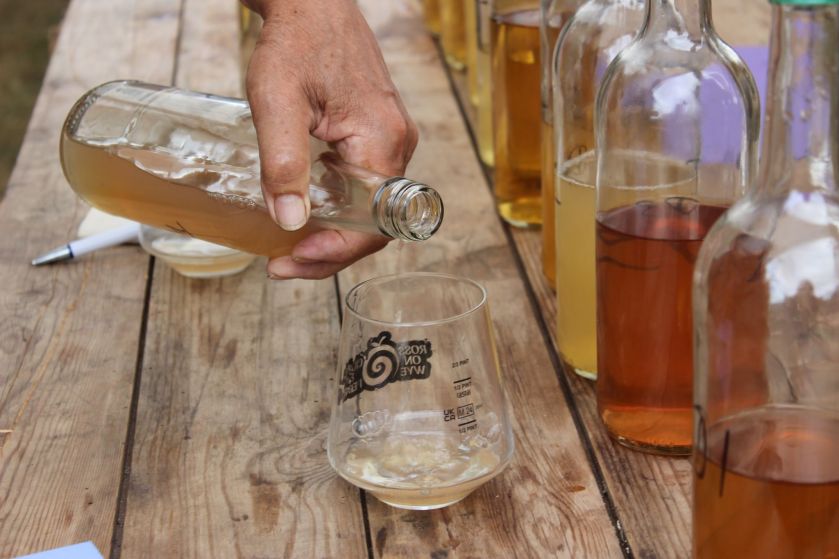
I am reassured that my tasting notes and takes are not dangerously contagious when I declare one perry smells like smoked cucumber and get quizzical looks rather than the cries of recognition I anticipated in response (do try cooked cucumber and get back to me when you’ve added it to your mental aroma bank and still disagree with me that any drink smells like that, however).
When we gather back round to hear the results a little later in the afternoon, Robin Bornoff emerges as champion cidermaker, defending the title he won last year. A win in medium cider, close second in sweet and a third in dry rounds off a consistently placing set with three Redbreast blends. Ross-on-Wye are once again champion perrymakers, coming a close second in sweet perry with their single-variety Flakey Bark, another second in dry perry with a blend of Yellow Huffcap and Thorn, and third in medium with a lovely pithy still lemonade medley of Winnal’s Longdon, Yellow Huffcap, Worcester Black, Red Pear, and Flakey Bark. More on the winning perries in each category in my reviews below. Palmer’s Upland picks up sweet cider, and dry cider, probably the most coveted category in play today, is swept off by our hosts Ross on Wye with their Headland blend.
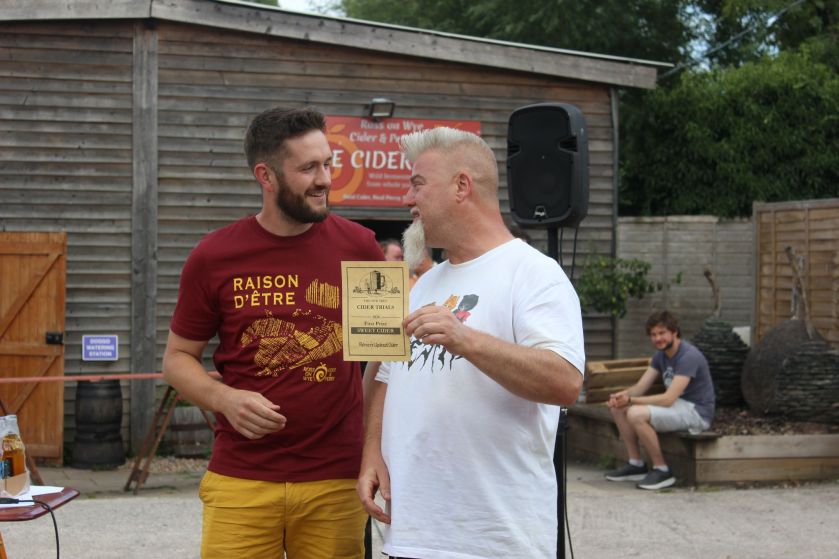
My personal pick of the champion perrymaker’s perries is undoubtedly the sweet Flakey Bark. Almost ice ciderish in its plush, high-up nuttiness, it smells to me like banana sour cream pie, if such a dessert exists, and has a way greener banana peel texture in the mouth. Can baby food purees have this much tannin and taste this delicious? Some of my ones that got away include a dry number by Tom Wallis of Press Stone that somehow smells like your favourite dressing and a Charnwood sweet that feels like a mouthful of peach skin before the juice dribbles down your neck.
As much as everyone loves Ross on Wye as one of the perennial ones to beat (or as it often turns out, not), it’s great to see that two of the perry category winners are fairly new experimenters with the drink. Luke Bettison, winner of sweet perry and maker of a remarkably sweet/savoury medium perry (dill crisp aroma and soft grapefruit peel tannins, anyone?) made with some unknown varieties, tells me he’s been entering the Yew Tree Cider Trials since 2019, but only started making perry and bringing it to competitions a couple of years ago.
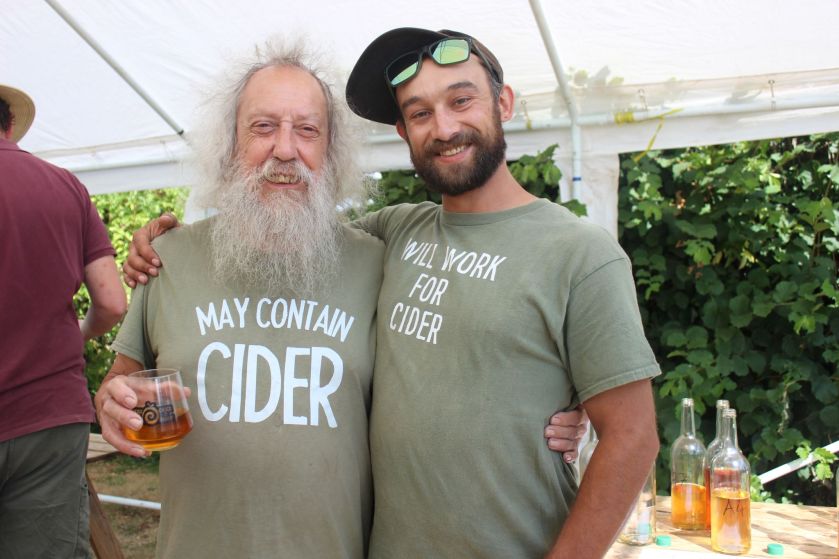
“I decided to have a go at making perry, only a very small amount to see how it went. 45 litres in fact.
“After some positive feedback and a few awards at a few competitions, I decided to upscale on volume for 2025. Still very small amounts compared to other makers out there.
“Last year at the yew tree cider trials, I got second for my sweet perry, so I was pretty chuffed to go one better this year.”
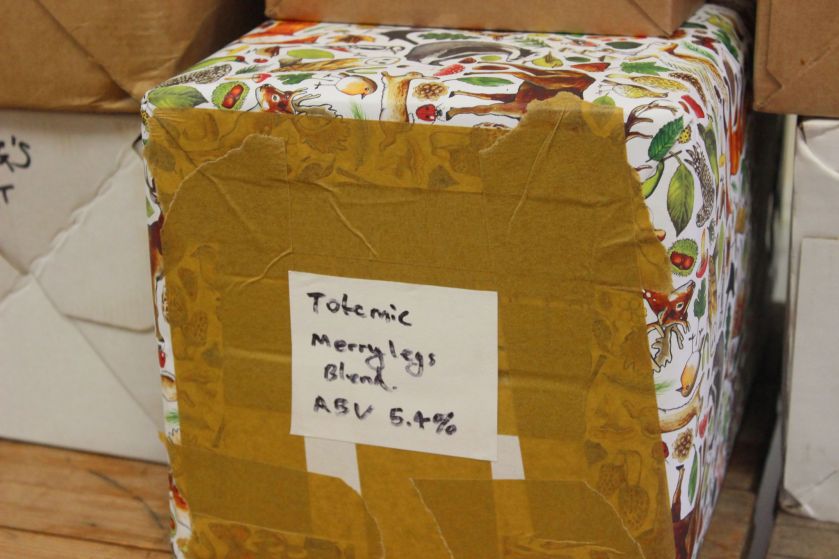
Matt Smith’s win in medium perry has come at a great time in his new-ish perrymaking project. “I went in both feet first with perry, knowing little a year and a half ago.” A win at Putley last year was a welcome boost. Look out for the Totemic 2026 releases. One cider and five perries!!
Surviving being hit in the face by perry pears on multiple occasions and having too much Moorcroft explode needlessly on the floor, Matt has built his perrymaking profile on DNA samples, repeat picking in old and new orchards (allowed for by his gardening job) that reminds me of Find & Foster’s patient testing. Matt’s willingness to take educated guesses and take a punt on varieties with a murkier, more confusing history than some, like Merrylegs and New Meadow, seems to be paying off.
A challenge of perry (when it comes to judging, not making, for once) is that it doesn’t fit as cleanly into sweetness categories as cider: rather than a straightforward progression from dry to medium to sweet, most perry pears contain high levels of sorbitol, a sweet-tasting sugar alcohol that doesn’t ferment out. Hence even ‘bone dry’ perry can taste relatively sweet, much more fruit and flesh than bone. This created a few problems for me while writing tasting notes: a lapse in concentration during pouring and palate fatigue after sampling 30+ perries, meant I lost track of which was which out of the three sweet, medium, and dry winners in front of me. Perry ‘bastard’ pears are easy to hype and easy to blame, too (often, when talking about how damned difficult they are to work with, this comes as one and the same thing). It’s on me and my stage of palate development, too.
Many thanks to Root + Graft of Cirencester for helping me out and ordering the same flight from the bar for us to dissect a little together.
I’ll let our host Albert Johnson’s summary of this event’s appeal round us out so I don’t end on dwelling on my own Ls: “Virtually everyone who entered in 2025 (and previous years) participates year on year if they can make it, and virtually all of the new entrants were non-commercial producers. I think it shows that interest in cider and perrymaking is still growing. More and more folks are looking at the forgotten trees in the landscape and thinking ‘someone should stop that fruit going to waste’ and discovering the world.”
“It’s also an endorsement of the day; winning is good, but participation in a peer judged event like ours, or the Big Apple Cider Trials at Putley, also affirms one’s place in the cidermaking community. Cidermaking itself can be quite a lonely task. There might be help picking and pressing the fruit, but who do you turn to over the long winter months and early spring as you agonise over how best to take your cider forward? Placing yourself in the community by participating in events like this helps you learn and develop as a cidermaker, confirm the ideas and techniques you’re already using or consider new ones to experiment with.”
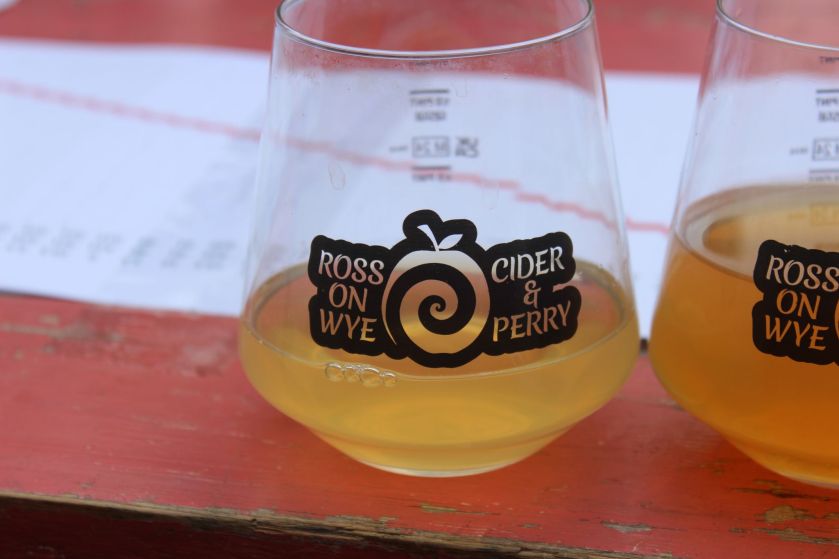
Dry perry winner: Seb’s Cider, single variety Butt – review
How I served: Straight from the bib, baby!
Appearance: Soft, almost pastel-yellow with a cool, creamy undertone.
On the nose: Delicate melon upfront, subtle floral notes and a sudden, unexpected peppery, fruity kick. Underneath it all, there’s a fascinating hint of olive oil and crushed yellow petals.
In the mouth: Oh, it’s pineapple! Didn’t get that on the nose at all. Lime squeezing over it all. It doesn’t exactly taste like tajin on honeydew but it’s having a similar juicy-spicy effect on my tongue.The finish is remarkably pleasant and gentle given the opening and the sometimes austere reputation of a single-variety Butt.
In a nutshell: This is one I’d serve people who want to think about varieties and what perry can be beyond your initial expectations. That makes it sound like it doesn’t taste good, but it’s a sipper, too! Just a thoughtful back and forth one.
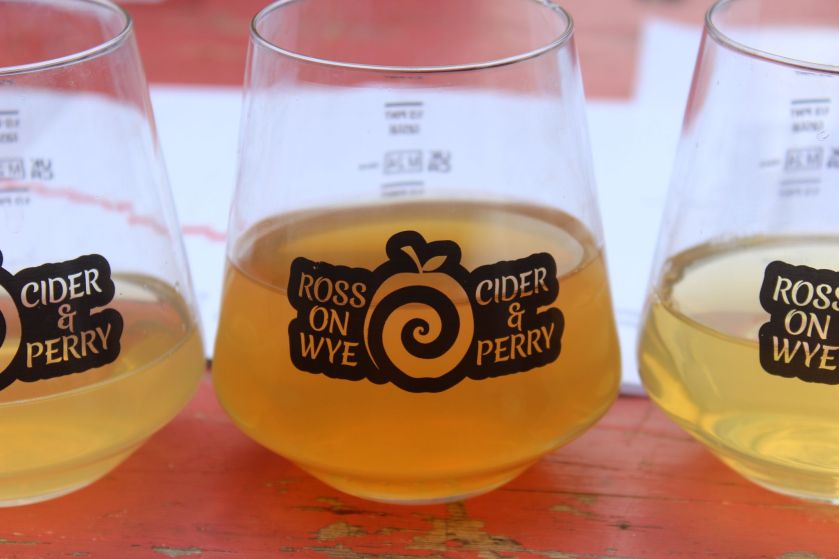
Medium perry winner: Matt Smith, a blend of Merrylegs, New Meadow, Hendre Huffcap, and Winnals Longdon – review
How I served: With a side of mounting panic as I note these are not nearly as easy to tell apart as I had hoped.
Appearance: Darker, deeper orange gold with some haze. Much richer colour than the other perry winners.
On the nose: Dried orange peel and mandarin jelly, backed by a slight hint of the lees. There’s a faint, almost stressed sulphurous edge on the very back that mellows into a rich muskiness on second sniff.
In the mouth: An orange crème caramel richness fills the palate, lifted by a touch of acidity on your cheeks. There isn’t much lingering astringency here—just a hint of structural richness rather than a heavy tannin grip. The nose was intriguing, but this tastes better than the aroma led me to expect.
In a nutshell: A rich blend where old and new orchards can sing together.
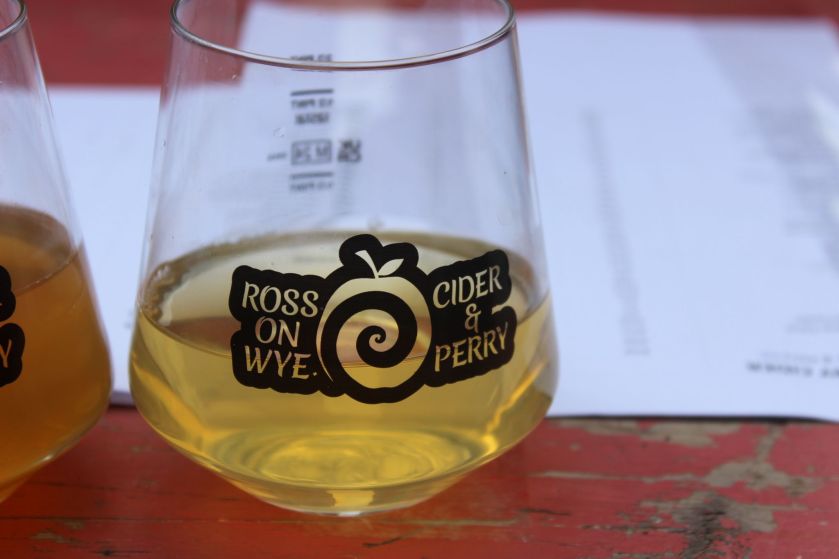
Sweet perry winner: Luke Bettison, Newbridge,Butt and Hendre Huffcap blend – review
How I served: Mellowed out and halfway back to baseline after a little help from absolutely everyone I could grab and beg to help me.
Appearance: Clear, pale yolk, greenish around the edges. Scant few bubblets round the rim.
On the nose: Cooked apple and earthy… mushroom (?!) notes sweetened by a distinct thread of wild honey and fresh wood on top.
In the mouth: Brings considerably more tannin than I remembered from the judging table. It hits with a tangy passion fruit acidity that keeps the sweetness from feeling cloying, holding up for a brightly juicy finish.
In a nutshell: A remarkably well-executed sweet perry that stays vibrant from start to finish.
Discover more from Cider Review
Subscribe to get the latest posts sent to your email.
 Cider Review
This was a great read and an excellent summary of the day! I’m off to bask in my new-found fame…
LikeLiked by 1 person
thanks Mitch, kind of you to say. Lovely to meet you and Caysie. Intrigued by your planned (?) Pitmaston Pineapple SV too. One of my dream competition categories that wouldn’t work is one for loved varieties found at apple days.
It’s time to ditch the Imposter Syndrome bib and come back next year with Megolomania, Prima Donna or Ego Ego Ego blend (egremont russet?)
LikeLike
Pingback: On cider and voice and struggle and AI | Cider Review