
At some point last year I promised that I’d make my way out of Somerset for a piece. Well, mission accomplished. But seeing as the subject of this article is pretty much the same as my last, I fear I might not be moving the needle that far, such is life. Let’s just call this a sequel of sorts then.
When I spoke to Jaye & Grant Hutchison of æble last year, they unveiled tentative plans to hold a Scottish cider tasting, similar in vein to the Bristol and London cider salons, intent on highlighting the growing number of Scottish producers, eventually solidifying into what has become Ubhal. Such are my skills as a writer & interviewer (and the fault of some badly recorded audio on my part) that particular details didn’t make it into the final interview. Luckily here at CR we don’t rely on tantalising scoops, or at least I hope we don’t.
Over the years Jaye & Grant have regularly included at least one Scottish producer in their subscription box, and both Bristol & London salons have on occasion played host to the likes of Naughton, Seidear & Diggers. So I’d like to think I’ve tried a reasonable cross section of what Scotland has to offer. But to have so many in one room, plus a few favourite English producers, was an opportunity to get out of Somerset for the weekend that I wasn’t going to pass up. Especially as things like this are one of the rare times the work/life balance thing actually seems to, well, balance. My wife Karina is along for the getaway as well, I’d say in tow, but she’s been to Edinburgh before and I haven’t, so I’m the one in tow.

And so, to Ubhal, both figuratively and literally. Scottish Gaelic for apple, the rather apt name for this social gathering. Custom Lane, the art and design hub set against the cobble stones and sea air of Leith’s docklands, plays host for the day. And if the London salon’s home at the Tate has taught me anything, it’s that a mix of cider & art make a pretty good getaway for the weekend. Both two hour tasting sessions sold out a month in advance, a positive sign for a first time event.
As we arrive to queue, the last of the first sessions attendees are making their way out, there’s definitely a good vibe in the air. Getting inside, the first thing I notice is that after the past couple of years of going to various salons and tastings, you inevitably run into a lot of the same people over and over which, don’t get me wrong, is always a joy to see familiar faces, but can feel rather like you’re in a little cider bubble at times. Ubhal, however, with the exception of a few of the producers is entirely new faces to me. Again a positive sign that cider is reaching new crowds. I manage to catch up with Grant, albeit briefly, early into the second session as he tends the ex situ æble shop table. He mentions that they’d invited along a lot of hospitality folks and they’ve all seemingly opted for attending this later session and is now hoping it’s not too crowded around the tasting tables. I assure him it’s not, whilst musing on how great it is there’s such a strong hospitality turn out. It’s a Saturday night after all so I’m sure some are coming along to blow off some steam and just try some cider, but others will hopefully be on a mission to discover something new for their respective drinks lists. A walk round the city pre tasting and then again on the Sunday confirms how seriously restaurants, bottle shops and delis in Edinburgh are taking their cider offerings, so once again the crowd feels justified.
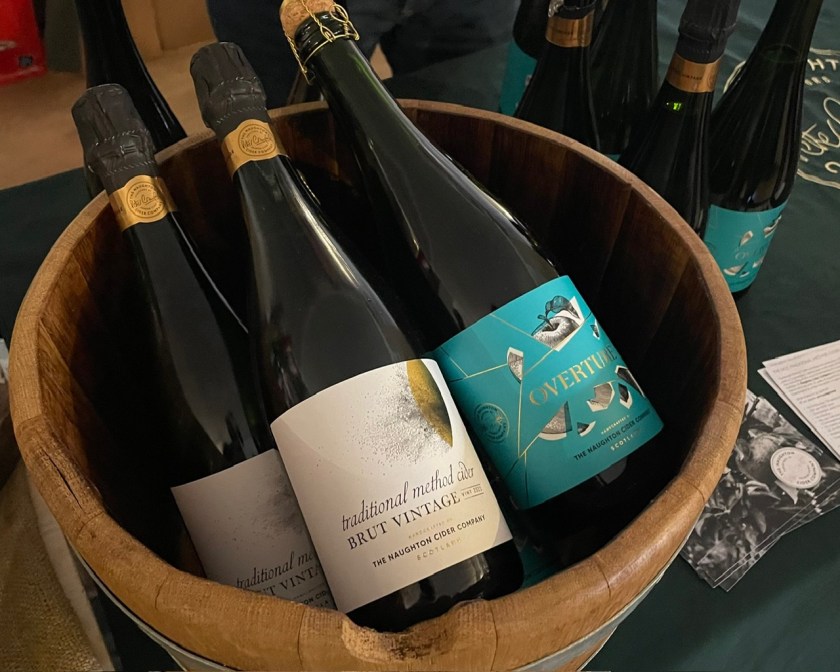
Anyway, musings over. Heading first to Fife’s own Naughton Cider and a quick chat with Peter Crawford. His Traditional method and Overture are well established at this point, but I always enjoy tasting through them regardless. The unsurprising standout however is his Grand Cuvée a blend of ’19, ’20 & ’21 vintages, scheduled for release in September. I first tasted this last year along with Beatrix at the 2025 London Salon, where Peter held a short tasting session. It was a standout then, but the extra 8 months have only added to it. I know it’s inevitably reductive to compare it directly to Champagne, so I try and skirt that as best as possible, but if you were to do a side by side comparison with a few different Champagne cuvées, I wouldn’t be surprised if this came out on top. In all honesty it’s one of the best examples of a traditional method cider I’ve had. Elegant, crisp, balanced and with a little brioche on the nose, and a little salinity in the mouth. A very strong start to the evening.
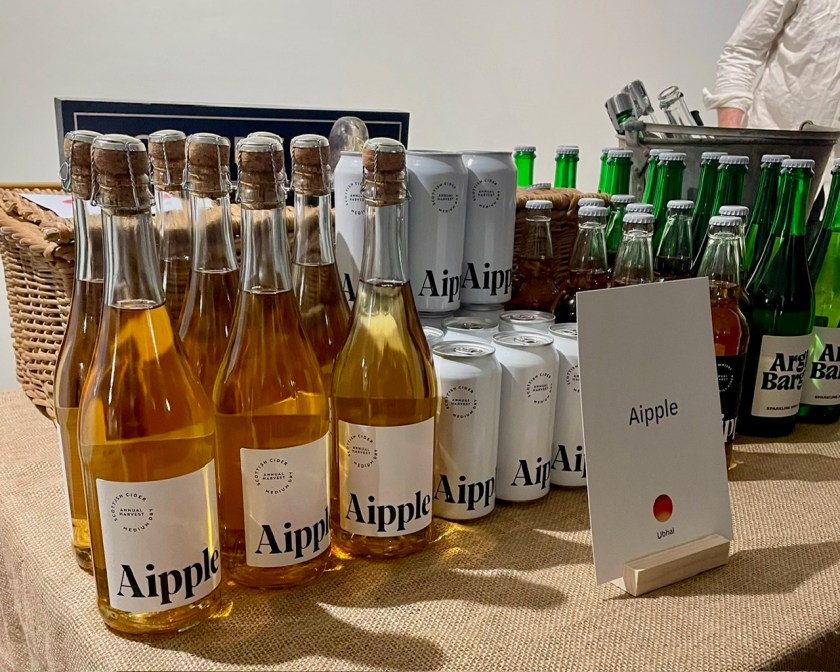
A selection from Aipple. Photo by Brett St Clair.
Next up is Aipple by Hyrneside Farm, their annual harvest blend kicks things off. Super approachable, dangerously drinkable, and pleasingly on the drier side of medium dry. A delicate sparkle in the glass and some crisp redcurrant like acidity. If you’re looking for an in road to Scottish cider this may very well be the perfect gateway cider to try. In fact, it might make a perfect gateway cider full stop. Their whisky cask aged cider is an altogether different beast. And I know aging in Scottish whisky barrels isn’t as du jour as it once was, but there’s an argument to be made here for immediately revisiting the technique. Yes, you get a few of the usual tasting notes, yes there’s a smokiness, yes there’s a hint of vanilla. But what you also get in droves is big vegetal notes, Middle Eastern spices, pomegranate molasses-like tannins and an almost creamy feta salinity.
Diggers from Perth start with their Aster perry, a juicy, chewy, pack of gummies Perry that appeals to your kid-in-a-sweetshop side, as well as your adult making smart choices side. Carbo pear, a carbonically macerated perry, could literally be the photo negative of the Aster. Dry, sharp acids and almost savoury undertones with not a trace of tannin. It’s a beautiful contrast to the Aster before it, and one that’ll appeal to your adult making smart choices side as well as the adult who likes explaining what carbonic maceration is to your friends side. The real highlight though is Ludo, a take on a royal cider, made from their 2020 harvest, fermented in stainless steel before being transferred to Amontillado sherry cask to mature, fortified and then reserved apple juice from 2020 added back in before another three and a half years in barrel. In all honesty they had me at Sherry cask, and while I don’t relish evoking the word Christmas so early in the year it’s very much a reason to punt that bottle of Sherry or Port you’ve had open since lockdown to the cooking alcohol shelf and square yourself away in a corner with a glass of this and a big wedge of blue cheese.
Seidear of Aberdeen will be familiar to anyone who’s attended the Bristol salon over the years, but it’s been a little while since I’ve last tried any of Christian’s wares, so a quick stop off at his table is needed. Stairs is a keeved traditional method that’s as solid a keeved cider as I remember it being, and another contender for gateway Scottish cider. The draw here though is Sea, a cider that as far as I’m aware is completely unique, in being matured and bottled with seaweed harvested locally. It’s an ocean breeze in a glass, the seaweed bringing umami and savouriness without salinity, there’s really nothing else like it. It might be a marmite proposition to some, but if you think you can get away with drinking a 750ml on a beach somewhere without breaking any local laws with a large box of fish & chips, you’re in for an experience. Later on, whilst we make our way around, I find out from a couple of gentlemen we get chatting to that Christian also has a flask of mulled cider under his table for those in the know and daring enough to ask. It’s what’s best described as not taps-aff weather outside, so the secret inclusion seems strategic. But I’ve long since warmed up after an earlier very breezy walk around the docks, so I don’t go back and ask for any.
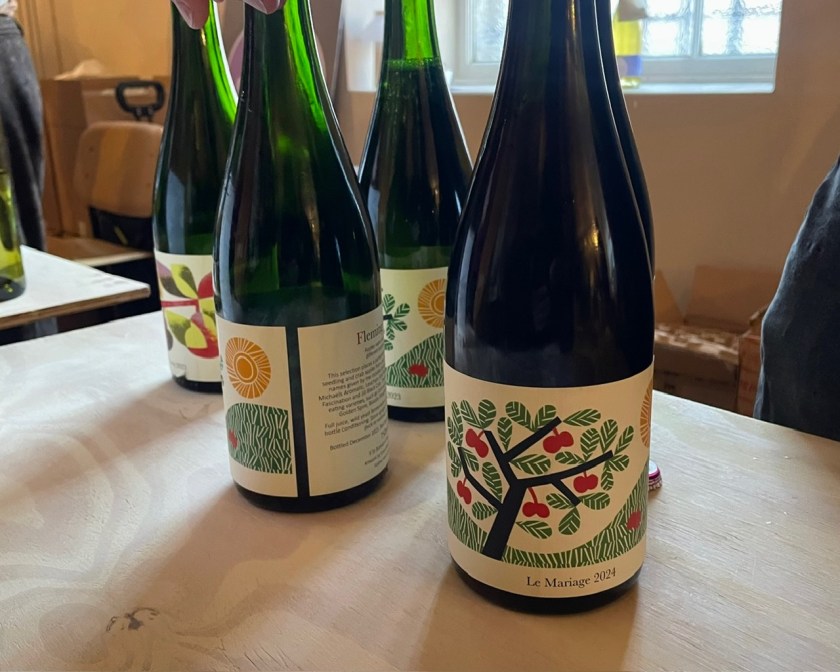
A selection from Fleming’s Fife Cider. Photo by Brett St Clair.
Fleming’s Fife cider showcase le Mariage from ’23 & ’24 respectively. I have to be honest, I think I butted in halfway through on this one, so I’m not sure which vintage I got, but logic would dictate it’s probably the ’24. It’s baked apples, heavy sweet spice, biscuity richness, Proustian visions of childhood apple crumble, that sort of thing. Their perry simply titled Perry (Patrick Bateman voice) is a bottle that makes me wish we hadn’t travelled via easy jet, otherwise I’d be taking a case back to Somerset with me. As viscous as a dessert wine, rich and resplendent with the taste of blackcurrant, it’s a juicy fruit bomb. Should you be one to partake, then ridiculously good perry Mondays absolutely require this.
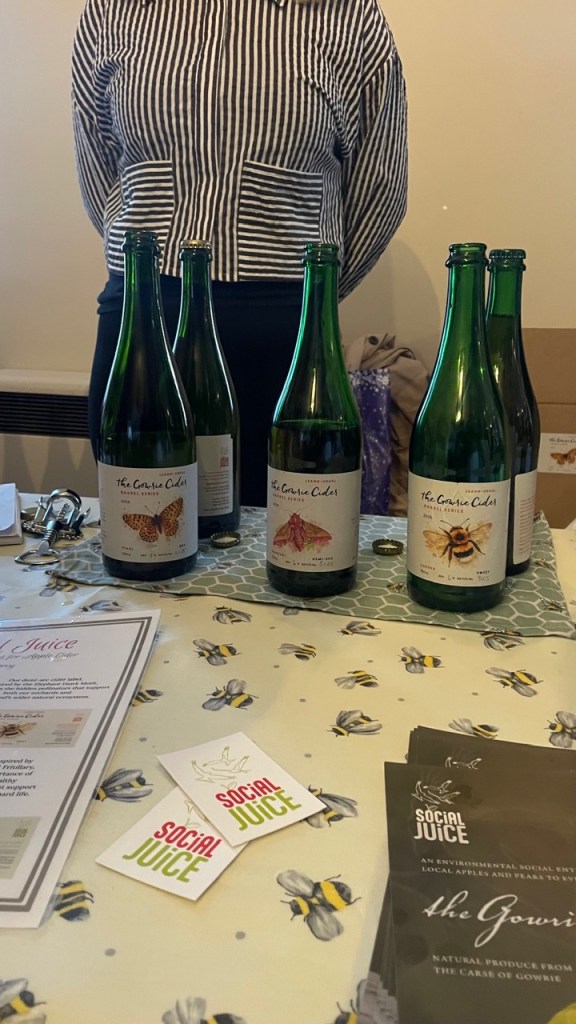
A selection from Social Juice. Photo by Brett St Clair.
Social Juice is a completely new producer to me but, as I discover, doing amazing things. A social enterprise taking surplus fruit, making cider, then using the profits to fund community orchard projects, along with creating many different education & employment opportunities. This evening they’re pouring the ciders, Pearl, Elephant & Carder. Dry, medium sweet & sweet respectively. All three very deserving of attention, though Elephant is the highlight for me. Notes of orange blossom honey, thick and viscous in the glass, almost belying its medium sweet label. But with a reserved, balanced sweetness that never threatens to become anywhere near cloying. Even more surprising is that the Carder pulls off the same trick, sumptuous without ever bordering on saccharine. At the moment, it’s not widely available, and with Grant selling bottles on the other side of the room I’m once again lamenting my choice of Easy Jet.
And look, I know this is a Scottish event highlighting Scottish producers, but as I said earlier there’s a selection of English producers as well, and it would probably be remiss of me not to talk about a few highlights from them as well. If only in the interest of balance and fairness. Eskimo Eyes from Tom Oliver, a still dry perry matured in a heady mix of ex French wine & American rum casks is described by the man himself as maybe the best still perry he’s ever made. I’m not sure if I necessarily agree on that one, but it definitely comes close if only because it’s unlike anything he’s made before. Tropical, zingy, peachy lusciousness and, maybe to the alarm of some, a hint of acetic acid taking it into almost natty wine territory that might have me lining up jabs about Hackney & Dalston wine bars, Carhartt gilets and four anchovies on a plate for how much?? if I wasn’t so disciplined. Jokes aside though and regardless of your feelings when I say natty wine, this is a bottle that could dissuade you of any negative bias to a little oxidisation in your cider and perry (and wine!). It’s a bottle that I want for as soon as it’s hot enough to cook in the garden and let that acidity cut through the heat like a razor.
The ’24 vintage of November from Wilding is a very welcome return after the ’23 was probably one of my most consumed bottles of perry last year. Shorn of the spicy stem ginger notes that characterised the last vintage for me, it’s nevertheless so distinctively a Wilding perry, the terroir on full display, the rural method accentuating all the sweetness and nuance of the fruit into something that lingers long in the glass.
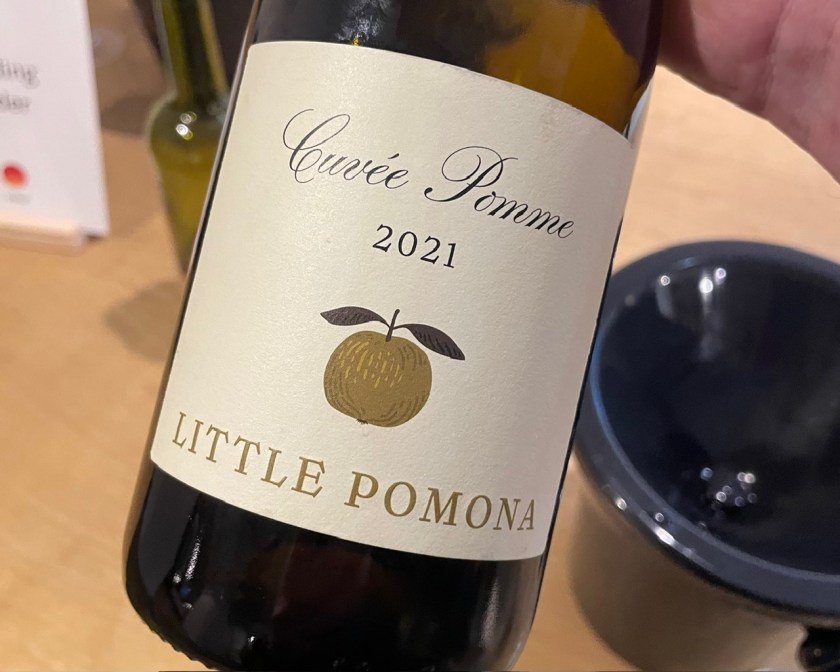
Finally to Little Pomona, at this point I’d expect nothing less than a new expression of Egremont Russet making an appearance, but nothing could quite prepare me for Cuvée Pomme. Traditional method Egremont Russet fermented in steel and oak before two years aging on lees, disgorgement and a small dosage, then cellaring for 18 months. It is simply put the purest expression of Egremont you might ever taste; it’s the three Michelin stars of Egremont. Sophisticated, refined, anything extraneous expertly trimmed away. Can I get away with saying one the best traditional methods I’ve ever had twice in one piece? Just as I’m recovering though, James brings out the second iteration of FOMO, the LP take on a pommeau. I ask if this one features any greengage like the first, knowing full well the answer, given the uniqueness of the first iterations inception. “No, of course not” James clarifies as if it was in doubt, “this is 100% Kingston Black”. At this point I could probably slide a blank cheque over to James and be done with it. It would be churlish of me to say that I miss the subtle marzipan tones that the greengages brought to the original (I kind of do), at the same time the new FOMO is every bit its predecessor and more. It feels like the Top Gun: Maverick of drinks, every part of it specifically engineered, every last detail refined to hit the right notes and have you clapping your hands and punching the air by the end it. I only hope there’s a few more bottles available this time round.
Sadly, as happens with these things, we ran out of time to make it round to Cairn O’Mohr, although luckily there’s a bottle of theirs on my shelf from a previous æble box as consolation, and also only made it to Artistraw in time to sample the last dregs from the new vintage of Bisquet, not enough to do a fair review, but I’ll recommend it on the basis of the label once again being a riff on Prince’s 1999, anyone who’s down with the purple one gets free pass from me.
Post tasting we decamp to a pub just down the road with many of the producers and have an unofficial debrief of CraftCon, featuring an impromptu round table of Lydia & Tom of Artistraw, Sam & Sam of Nightgale & Wilding respectively, James of Little Pomona, Christian of Seidear, Peter of Naughton with many others coming and going. The main topic of conversation turning to possible changes in legislation and what that could all mean for the future and what effects that could have on macro producers in the UK. Each person giving their perspective, but overwhelmingly all speaking optimistically. It’s hard not to think given a day like this that the future is looking very bright. And given the response, I hope Jaye & Grant are at least considering an Ubhal II.
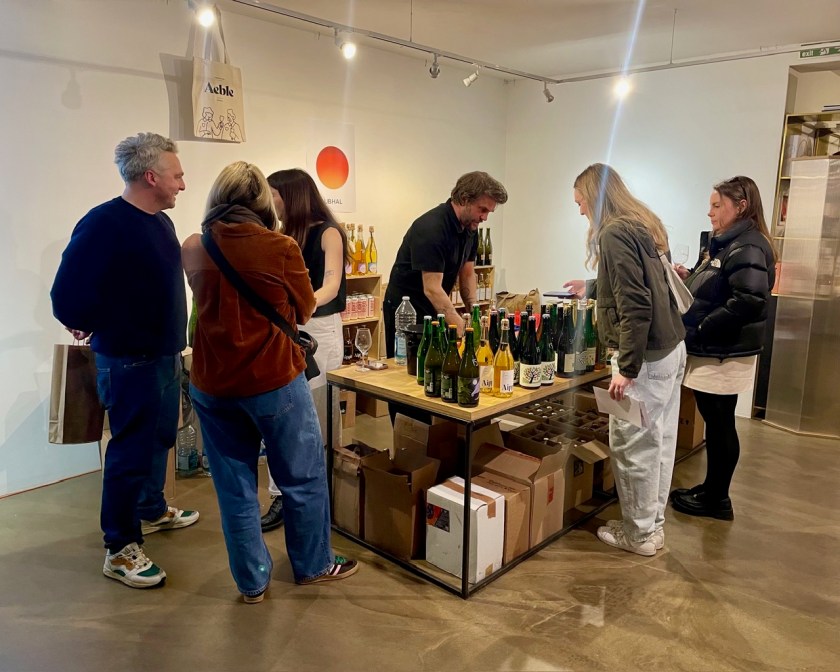
Cover photo by Sam Nightingale.
Discover more from Cider Review
Subscribe to get the latest posts sent to your email.

