The Mostviertel. The name alone gives me pangs of envy. Imagine living in a part of the world where perry pear trees and perry is such an integral part of the cultural identity that the whole region is named after them? Just over three years ago, Adam reported in detail on the history and culture of the Mostviertel, which is well worth a read for context. Or of course his book, Perry: A Drinkers’ Guide, which features a whole section dedicated to this important perry region.
Soon after Adam’s article was published, and on his recommendation, I ordered a case of perries from the Haselberger family. They were all pristine, presented very much in the style that has developed there since the founding of the Mostbarone group in the 1990s, aligned very much in the style of Austrian wine.
This initiative was initiated partially in response to the negative image that Most had in the region at the time, often seen as something old-fashioned and rough. Indeed, it’s something I have experience of myself, as in southern Germany it’s quite similar, with the word Most often triggering strong reactions from drinkers as they associate it with something granddad made in the cellar, often bearing a close resemblance to vinegar, scratchy on the throat. An unjust reaction, I also have to say, having tried many Mosts made by older neighbours that are genuinely enjoyable, honest representations of the land.
But back to the Haselbergers. Over the past couple of years, I had noted some change in their online presence, with the addition of an Instagram account called Almost Pearfect, and a different kind of style and marketing. Curiosity piqued, I reached out to Peter to ask for a chat and find out what this is all about.
Just to note that during the interview you’ll see the German word Most used somewhat interchangeably with cider or perry, as generally, to me they are all part of the same family. But if I leave the word Most in, it means we are referring to the style that is traditional to the Mostviertel, after all, the region was named after it. This would mean a still perry, or if specified, a blend of apple and perry pear.
Sitting comfortably? Let’s go!
Cider Review: Peter, thanks for taking the time to let me quiz you on what you and your family is doing. Let’s get straight into it: how long has your family been making cider and perry?
Peter Haselberger: My grandfather has been producing Most since he moved into our house in 1951. However, it was mainly for personal consumption and for a few customers.
CR: I assume he was producing Birnenmost/perry then, or was he also using apples? And I assume in the traditional way, not as technical as the Mostbarone (cider or rather perry barons) later became? How would you have characterised what he was making?
PH: He always produced apple-pear Most[Ed: very traditional to combine these fruits in a Most]. He never really tried single variety Most. But at the end of the 1990s, he started working with cultivated yeasts and then also did fining, and over time he became more and more involved in technical production because he wanted to have a ‘better cider’ himself. He produced a very good apple-pear Most with which we were always among the better producers in local competitions. Of course, we had quality fluctuations between the different batches, but my grandfather was known for making very good cider.
CR: For some reasons, I had always assumed Haselberger was one of the Mostbarone, but that’s obviously not the case. However, your family did end up making cider in the same style as that represented by the cider barons. Which came first? And out of curiosity, why did you never join this group?
PH: In 2014, I took over cider production from my grandfather (he was 84 years old at the time and felt it was too strenuous for him). After I wasn’t entirely satisfied with the results, I decided to train as a cider sommelier in 2015. It was a very interesting course, which was important in order to significantly improve quality. As a result, we then took a very traditional approach, which is prevalent in our region.
This also gave us a lot of contact with other producers, such as the Mostbaronen. This group has achieved a great deal for the region and has also made a big difference in terms of quality. After celebrating great success at the Falstaff Cider Trophy in 2018 with three wins and one second place, we were convinced that we could use this for marketing purposes. However, as we were still struggling to establish a decent distribution network for our products, we began to revamp our entire marketing strategy in order to start the future with a more professional image.
In the course of this change, we also looked into international ciders and perries and came into contact with the natural wine scene. As we liked the new natural style, we decided to develop more in this direction (of course, there were some key moments that drove us forward). During this time, the Mostbarone asked us if we wanted to join their group (you can only join if they want to accept you), but as we were already repositioning ourselves at the time, this was no longer a viable option for us.
CR: The Mostbarone have quite a big presence, at least it seems so, marketing-wise. Why do you think it wasn’t a good fit for your vision and production?
PH: The Mostbarone produce all their Most [Ed: usually this means perry in this context] in a very classic and technical way [Ed: read this as being more wine-oriented in process and style]. However, we were strongly drawn to a more natural style with spontaneous fermentation. In 2020, we conducted our first trials without degumming [Ed: using pectinase or other techniques to clear the juice before fermenting] and with spontaneous fermentation. As this worked well, we completely converted our production the following year because we simply wanted to align ourselves with international standards using this process (we incorporated a lot from nationally renowned wineries into our production).
CR: That’s quite a brave move, considering the work the Mostbaronen did to kind of “clean up” the perception of local Birnenmost (perry), which seemed to have developed a bad reputation before then, pretty much like all of southern Germany too, I have to say. So they leaned heavily into making their products more wine-like, and highly polished.
PH: For us, this was an enormous development process that required a lot of courage and also a little bit of madness. We lost a large part of our customers, but noticed that this method was much better received in upscale restaurants, which continues to spur us on to this day. The philosophy of allowing all the tannins from the pears to remain in the drink was another development process that no one else in our region was doing. However, we see this step as an important factor in establishing perry as an international beverage.
In 2021, we made our first attempts to bottle some products unfiltered, which resulted in our ciders appearing much smoother and rounder. As we also really liked this change, we converted our entire production again in 2022. We believe that this gives the cider or perry in the bottle enormous potential for development and that, with subsequent storage in the bottle, it will improve over the years (depending on the variety), as is the case with many red wines.
However, this only works if the natural ingredients are left completely in the drink. With Dorschbirne, for example, storage is very important because it has a very distinctive taste. We tasted the 2024 vintage and found it to be slightly astringent at first due to its high acidity and tannin content, and it is only now slowly becoming palatable after storage. In my opinion, however, it will only reach perfect maturity in 2-3 years.
CR: Very nice. I totally agree that heavy-duty perry left with its original tannin content has massive potential for ageing. I notice a trend in some parts of southern Germany, with a growing tendency to over-process the juice, reducing tannins in the perry pears, tweaking acidity and filtering everything to within an inch of its life. I wonder if these makers will also see a return to lower intervention processes.
So, on an aside, I see you are calling your new products Pear Cider. Why not Perry or Natural Pear Wine or something like that? For many, Pear Cider is a term used by some industrial producers, such as Kopparberg in Sweden, for a pear-flavoured ‘cider”.
PH: We chose the term Pear Cider so that we comply with the legal standards here in Austria. With the Obstweingesetz (Fruit Wine Act) if we put Cider on the label, it must have a CO² pressure of 3 bar and must not exceed 5% alcohol by volume, whereas a Most must have more than 5% alcohol by volume.
CR: 3 bar? So any of your drinks with the word cider in the name must have quite high pressure. In Germany and other countries that would take you into Schaumwein (sparklng wine) tax territory. But does this law also mean you have to dilute what you call cider – including “pear cider” – to bring them below 5%, or are you stopping the fermentation to stay below this level? [Note: later, when I looked up the Fruit Wine Law of Austria, it states the pressure must not be over 2.5 bar, but yeah, Austrian law ridiculously states that to call something cider, alcohol level must be below 5%, which just panders to industrial production – see my earlier article on the dangers of bad definitions where I also commented on this.]
PH: We currently have three products with higher pressure in our range: an Apple Frizzante, which is only for regional sale and with added carbon dioxide, a sparkling pear wine that is Traditional Method, so produced like sparkling wine with bottle fermentation, and the Pear Pet-Nat, where the CO² comes from the first fermentation.
We simply want to try out what goes down well on the international market. It is important to us that everything is as natural as possible, so we do not dilute anything or stop the fermentation process. Our Pear Cider is an experiment where we simply wanted to try bottling pear juice very cold and selling it that way. We learned from another producer that this works. Unfortunately, it didn’t work for us, and it started to ferment. The conclusion was that it was actually a failed attempt, but it still tasted very good. That’s why we classified it as cider, so that we are legally compliant.
CR: I’ve not heard of that technique before, unless they meant frequent cold racking to reduce the yeast and nutrient load, till it stabilises. I’d imagine otherwise once it warms it will just start again and could be quite gushy!
You’ve mentioned a few times now the desire to push your creations internationally, and that your new direction is more in line with what you feel people want internationally. Looking at Austria, and particularly the Mostviertel from outside, it’s one of the few regions of the world (I’ll include west England and parts of Wales along with northwest France in that list) where perry is still a living culture. It as all but lost in southern Germany and Switzerland. So, how does the Austrian market look to you for perry, and why do you think you might do better internationally. And then, where internationally?
PH: Our drive to expand internationally stems largely from our own enthusiasm for the drink. We want this diversity and the drink itself to become known beyond the Mostviertel region. We don’t set ourselves any geographical limits. There is also plenty of potential within our own country, which we are now actively pursuing. It’s about finding people who share the same values, philosophies and appreciation for the treasure we have. and these people exist all over the world.
As we are now certainly seen by some in the region as being a bit old-fashioned, we need to get even further out of the Mostviertel. We bottle unfiltered, and a ‘cloudy’ cider is a no-go in the region. So for the region we have 1-litre bottles that are classically filtered. In the Mostviertel the approach to cider is simply technically driven, in our view, and to capture the full flavour, it simply takes time to allow the product to reach its drinking potential. We also notice that the current zeitgeist is very much in favour of natural production, and that making products without extensive technical intervention appeals to people. And so we are consciously taking a step back to our roots.
And to be honest, it’s a wonderful feeling when, for example, we’re at an event in Asia and show people pictures of the Mostviertel and tell stories about our work and our landscape.
CR: Can you explain your Almost Pearfect branding. Is this a separate company or just a different branding to your classic Haselberger products? The use of “almost” suggests it’s not quite perfect, but I guess that’s what you want with a fully natural approach?
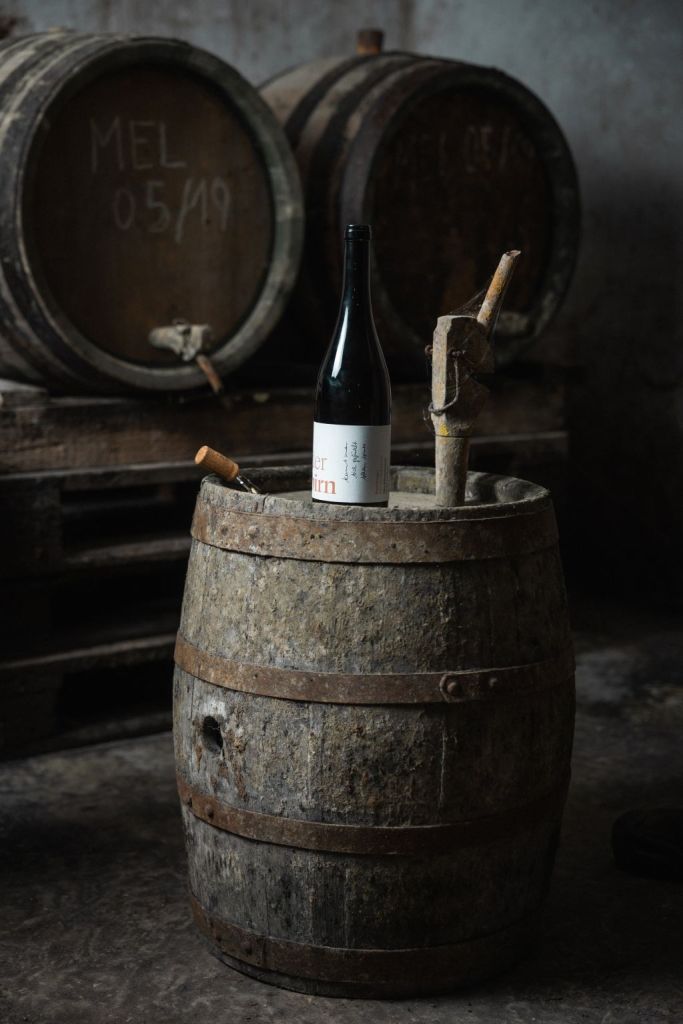
PH: It’s a way to reach a different target audience, and it also allows us to tap into the international market through the English language. The approach via the pun – ‘almost pearfect’ – is brilliant. It brings a smile to people’s faces and piques their curiosity. We developed the branding in collaboration with a fantastic agency from Linz (zunder.studio), and they managed to secure the services of a renowned photographer, Kurt Bauer. It was simply a pearfect match! The small photos on the bottles (there are 11 different designs) depict almost perfect scenes: for example, a photo of red lips with lipstick on the teeth, a sculpture with a broken nose, an ice cream cone with the ice cream running down the hand… so everything is a bit of a laugh
This campaign opens the door to new customers; it particularly appeals to young people, and the product, the PetNat, for example, is a pearfect fit.
CR: You mentioned earlier that you trained as a Mostsommelier back in 2015. Can you tell us more about that course, who it was run by and the context?
PH: The Mostsommelier course was organized by the Rural Training Institute and aims to make Most production more popular again and also to improve quality. During the course, we learned how to use technical methods to improve quality, but also a lot about marketing and sales. However, an essential part of the course was training our own sensory perception. The training was so important to me because it allowed me to acquire a lot of knowledge that was very helpful when switching to more natural methods.
CR: And now a random question that I like put to all makers of perry, what are your favourite pear varieties and why?
PH: My favourite varieties are the Grüne Pichlbirne and the Landlbirne. Due to their high acid and tannin content, these two varieties are particularly suitable for longer storage and are really great accompaniments to food after a few years.
CR: I think that’s a nice way to end our interview, with people wondering where they can try Grüne Pichlbirne and Landlbirne perries! Peter, thank you so much for your time!
I find it interesting that makers in regions where a particular style has developed in modern times are now starting to break away from the perceived restrictions such styles suggest. Makers like Domfront’s Jérôme Forget breaking out of the AOP there, for example. And while the Mostvierteler Birnenmost PGI isn’t as limiting in terms of what varieites must be used (any of 59 local varieties may be used, but I have not seen what that list is), the influence of the Mostborone on the methods, and their definition of quality enshrined in that PGI, has meant that even in a blind tasting of perry, one can usually tell which ones come from that region. That the Haselbergers want to do something outside that is both a risk and an opportunity, perhaps.
Although I still had (indeed have) a couple of Haselberger bottles from the last time I ordered, I wanted to try the newer vintages that were wild-fermented and unfiltered, so Peter and I did a small cider and perry exchange. Sadly, he didn’t send the Almost Pearfect Pet Nat, due to fears of breakage (I’m interpreting that as highly carbonated, perhaps), but I was happy to see that a few of the still perries marked as “unfiltered” were their newer wild ferments. So look forward to some tasting notes coming up in the near future!
Discover more from Cider Review
Subscribe to get the latest posts sent to your email.


Pingback: Four Perries & Two Ciders from Haselberger | Cider Review