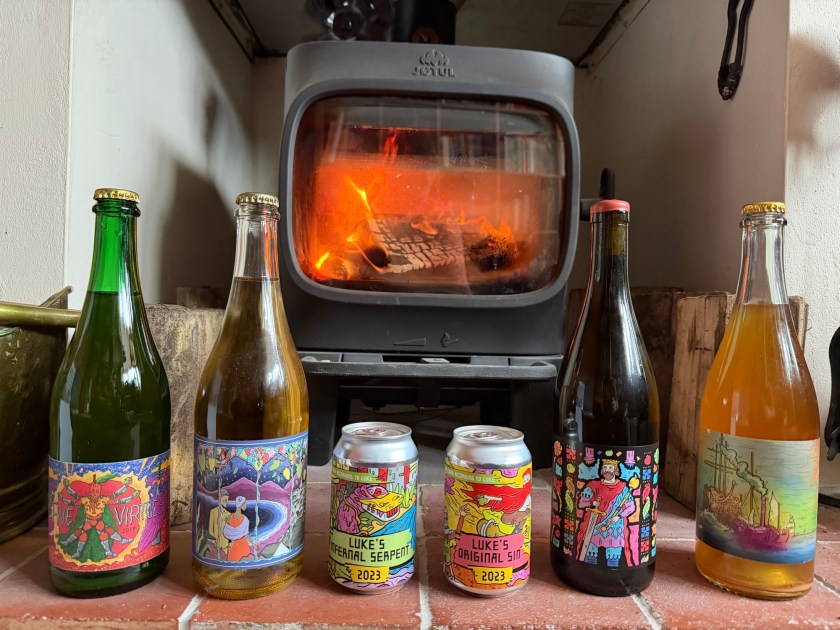
I had always thought of Luke’s Cider as a London-based cidery. Cider and perry, a predominantly rurally-produced drink, does indeed have a few producers across the UK that are urban in their location. In London there’s Duckchicken, and there was Hawkes pre-Brewdog M&A; Three Wells Cider from our very own Adam over in Reading; Brollins Cider from our very own Ed in Birmingham. I thought, Luke’s Cider in London, for quite a while too, but, I was wrong for quite a while, and I’ll freely admit that. It started, I think, back in April 2024 when my good friend Alison Taffs took me for a wander around Walthamstow before I presented my wares at the London Cider Club gang that evening. In a lovely local deli were some cans of Luke’s Cider, which Alison heartily recommended I try. They were brightly illustrated in a manner reminiscent of Japanese manga comics and a few of the craft beer brewers at the time. I just assumed Luke was a cider maker from around that area. Then in the Tate Modern, at the London Cider Salon the following year, I met Luke pouring his tasty beverages to everyone overlooking the Southbank, with the Globe Theatre just down below us. Again, I just presumed that hey….it’s Luke in London, his home turf as it were. Wrong! When it came to Part 3 of the Harvest Reports from last year, I even covered Luke as being Walthamstow, London based. Well, as we will discover throughout the progression of this week’s article, I’m not 100% wrong, but definitely not 100% right in my assumptions. The moral of the story may be to never assume too much about a cidermaker before committing to a long-form article and review of their recent releases on Cider Review!
One of the reasons I really like Luke’s Cider is the affinity I have for a cidermaker who has chosen their name (be it forename or surname) and included it in their cidery name. I followed this path with my own cidery after deliberating for a few months on being location-based (already taken in my case, and I’m guessing there must be a “London Cider” brand name out there already in Luke’s case?), or using some kind of metaphorical/allegorical/symbolic name instead. It does of course throw up mild challenges when you have cider in your cidery name, and then put out a number of perries, but such are the niche issues facing producers who choose to bestow upon us this lovely pear-based drink from time to time. Phil at 99 Pines has none of these problems if he were to choose to pivot from 100% perry-making to a bit of cider as well, but where the fun in that be when you’re the resident perry-maker at the National Perry Pear Collection in Hartpury and Malvern (ed. I think he does now make a little cider)? All this is to say, a part of me identifies with Luke and his decision to name his cidery after himself.
The other month, whilst doom scrolling on Instagram through constant adverts for nutritional chews for my dogs, solar panels and battery systems, and plants for the garden (you can never have enough), something organically posted popped up that I actually connected with and responded to. Luke’s Cider had a 20% sale on over that weekend. Finally the algorithm was sending me something I can connect with on an intellectual, monetary, and spiritual level! It’s funny the psychology of online purchases – the act of going to a new online shop and committing to that first purchase can sometimes be the hardest step to overcome, even if you’re a seasoned cider and perry purchaser. This tasty little discount was enough for me to step over the precipice of digital indecision and get my act together. I’m glad I did. Everything arrived on my doorstep within two days, safely packaged, and ready to be reviewed. Before that, and with a chance to clear up my assumptions about the locations of Luke’s Cider, I had a little chat with the main man himself: Luke McCoy!
Cider Review: How long have you been working in the cider industry? I see in your bio that you’ve worked for other producers. Can you tell us a bit about your journey to setting up Luke’s Cider?
Luke McCoy: My origin story as it were, I’ve been in the industry around 15 years now. I started after leaving university, studying English & Film, nothing remotely cider-related. I knew it was something I wanted to do though. At that time it was around the boom of the craft beer movement. I wondered why it wasn’t happening in the cider industry as I’ve got lots of connections to the West Country, spending a lot of time at the Bath & West Show in the Cider Tent. That was formative for me in my appreciation of British cider. It’s a national drink as isn’t quite recognised in the way it should be. It was a self-enforced work experience for me as there wasn’t a great deal around then to jump straight in with one of the big producers. I had a family connection with Alan Hogan, of Hogan’s Cider, so I spent 3 years on and off working with him on all sides of the business as his company went through a big period of growth. I also spent some time out in Normandy with Adam and Anne Bland, who make Templar’s Cider. Again a wonderful experience, seeing a different scale and approach to cidermaking, alongside an introduction to Calvados. I made it down to New Zealand as well to see how a few producers out there approach cidermaking and their harvest. After that I got back and got a job with Sheppy’s as their Assistant Cidermaker, a formative insight into cidermaking on quite a different scale as well. Then I made the decision to start out on my own. I moved to London, my first year there and attempt at cidermaking resulted in around 1000 litres produced. I released a can called First Batch from that. In the beginning it was somewhat of a hobby alongside other things, but I scaled up a bit over the first 3-5 years, but still kept it as part time. In the last 5 years however I’ve packed in the daytime and am committed to it full time and seeing how I will get on. I can now say I’m a fulltime cidermaker!
CR: What are some memorable vintages for you? Have there been particular years that have stood out in your production?
LMcC: Memorable vintages – one that stands out was the first time I ever made a perry, 2017. At the time I was getting all my juice from David Weaver in Castlemorton, near Malvern, in the middle of the Three Counties. I was getting my cider juice from him, and he said you have to take some perry juice from me from this year as it won’t be this good again for a while. I didn’t have a clue, I wasn’t well-versed at that time in anything to do with perry. I took 1000 litres from him and it was magnificent. I treated it the same as I do with my cider, minimal intervention, spontaneous fermentation, and it tasted out of this world from the get-go. I could tell it was something very special and it continued to be special in tank so I bottled it, my first 750ml bottling, Luke’s Vintage Perry. I have not reached those heights since. I’m waiting on that quality of juice to come around again. We’re approaching 10 years on since that harvest, so hopefully I see a good vintage like that again soon. I have one bottle of it left.
I’m quite excited about the Kingston Black that I’ve got this year, it’s tasting really good already even though it’s early stages in its journey. It’s the Kingston Black I’ve been sourcing from the same orchards for the last 3 or 4 years now, so it’s interesting to watch the changes with each season. It’s a watch this space cider for sure.
The bottles we’ve got from the Barrel Project, the 2022 vintage, were quite interesting and a fun foray into barrel-ageing juice as well. I’d say those are the ones that stand out for me right now.
CR: I’ve always thought of you as a London-based cidery (incorrectly). Do you make cider for an urban market, or are you at heart more of a West Country cidermaker?
LMcC: I’ve always considered myself a West Country cidermaker, I’ve always used West Country fruit in my cider. That’s very much a tenant of my process. The London element came out of circumstance in that I moved to the city for my wife. I’m not sure I would have ended up there without her. It coincided a bit with what I had in mind for Luke’s Cider, I was trying to approach that craft market, an urban angle, although I’m reluctant to pigeonhole it too much in that way. Having lived there, I was mostly selling it there, even though I was making it on my uncle’s farm just outside Bath. I was then bringing cider in to London, which was manageable on a smallscale then, but as I’ve grown it’s become increasingly unsustainable, which is why we’ve now recently moved over to Bath and I now live roughly 10 minutes away from the farm. It’s a much better situation. Having spent 10 years in London, I’ve built lots of connections there which are super valuable. London’s a funny one, in many ways there is a lot of great stuff happening there, but cider is still on the whole a little misunderstood. It has positives and negatives in that there aren’t a whole lot of preconceptions with a lot of folk living in London towards cider. We’re very keen to maintain our presence there, we had a little taproom which was just up the road from where I used to live, it was brilliant and a great way of connecting with the local community. Very sad we had to close that but it would have been very difficult to run if I wasn’t present in the area. My friend and business partner is still London-based, so he keeps an eye on our London relationships. For me personally, I’ve always considered myself a West Country cidermaker, so to now be here is great and I can get stuck into this side of the business practically. It’s positive step for me and the business for here on in!
CR: What are the orchards like that you work with? Is it a family farm that you’re dealing with?
LMcC: As I mentioned above, when I first started, my fruit came exclusively from David Weaver near Malven. He does contract pressing, working with a lot of farmers around that area, a lot of whom will have previously had commercial contracts with Bulmers back in the day. He also presses for locals who bring in trailers of fruit, a bit of a mix. The quality of the fruit was always great. I still get a bit of stuff from David. I also started sourcing a lot of my fruit from Ross Mangles, who is nearer my farm, he’s also great and has a brilliant selection of fruit that he grows. I can pick and choose the varieties of fruit I get from him, allowing me to build on the blends and single varieties I produce. From the get-go it’s been buying in pressed juice and bringing it back to the farm as I haven’t had the kit to press myself, or the time to go back at harvest to do that when I was based in London. Now I’m on or nearby the farm we’re planning to plant up a bit of space around the farm, around 8 acres which my uncle and cousin have allocated, which we are going to plant up next winter, really exciting. These will be traditional orchards, slower growing, but a holistic part of the business where we can get people out to visit on orchard days and wassails and the like, all the brilliant things which come with having an orchard of your own. We’re choosing three little separate spots on the farm, one of which is the old location that an orchard once stood on the farm in years gone by so it’s a really cool thing to bring that back and reinstate.
CR: Are there varieties of cider apples and perry pears that you haven’t worked with, but would love to? And what have been your favourites to work with so far?
LMcC: What I’d like to work with more, starting with the perry, as I am limited in my selection process as it’s what David has for me at the time, which is often not much as that’s the nature of perry pears, I’m at the mercy of that. I’d love the opportunity to have a bit more specificity when it comes to the perry pears. I’m hoping now that I’m based down here near Bath I’ll be able to find some old trees that are still around and see what we can do with them, on a small scale, for personal satisfaction. Cider-wise, I actually really love Discovery, I’ve got a soft spot for it as my Mum had a Discovery tree in the garden when I was growing up. They’ve always been my favourite apple, but they always went soft very quickly. Some of the Discovery single varieties that folk are making these days are awesome: Little Pomona’s Disco Nouveau is awesome, it’s totally different from what I normally make. The other one, more what I’m normally working with, the traditional West Country tannic, bigger bolder stuff, I like Tremletts Bitter, Yarlington Mill, Chisel Jersey, some real umpfh! I’ve got hold of Yarlington Mill for a few years now and it’s never quite done what I wanted it to, so I’m still on the hunt for the perfect Yarlington Mill.
CR: Your barrel-aged offerings, both cider and perry, are brilliant. Tell us a bit about your barrel selection process at Luke’s Cider?
LMcC: Barrels are definitely my passion project and I’ve been very happy with the releases that have come out so far. I’m always a little reluctant to get too much whisky involved in the cider. Personally I’m not a massive fan of peated whisky-aged ciders as I think it overtakes any of the cider character. I’m a little reticent for that reason about using old whisky barrels, although I have got some old Irish whiskey barrels, not quite as confrontational as peated Scotch I hope. It’s also dictated by just what I can get my hand on. I’m building up my barrel store. I started out with two wonderful rum casks from a distillery down near Exeter called Two Drifters Rum. They weren’t cheap, barrel costs you obviously have a real spectrum, but they were fresh casks and that’s what you taste in the rum cask bottling you’re trying, the liquid was only 6 months in the cask. The rum compliments it quite well. I’m collecting more barrels, got a couple of Brandy casks from Burnt Faith in Walthamstow. I’ve put out the first bag-in-box cider, a single variety Browns, that used those casks. It’s not just the 750mls I use them for, it’s using them for what I think will work more widely. I don’t necessarily set out with too much of an end goal, it’s anticipating what might work well and seeing how it goes. I’ve just got six more rum barrels, so I’m up to about ten barrels now in the cidery. The cider and perry from them should be really interesting. I’m trying to drip-feed it into the bag in box format, blending a bit of the barrel-aged juice in with the neutral containers. Lots of fun things coming out from the barrels, and it keeps me interested!
CR: In terms of presentation formats, what can customers expect to purchase your drinks in?
LMcC: I’ve got a bit of everything. Draught-wise it’s keg and bag-in-box. I have more core range. The Gospel on draught is designed to be super accessible whilst adhering to my principles in cider-making. It’s of a single vintage year, with seasonal variation. It’s designed to be a regular placement on a bar and demonstrate that there can be more to cider than Thatchers on that bar. My Vintage draught is a classic, unfiltered draught cider. At the moment I’m doing two canned formats, a medium and a dry, and there will also be some lovely seasonal variation with these as they’re of the year they were produced. I am rotating limited bag-in-box which are single varieties, things that stand out, I’m getting good ideas now of what can be released now from the 2025 season (later in the year or early next year), 2024 is just now starting to make its way out to market. On the 750mls, I try to keep a vintage perry out every year. I’ve got enough to do it this year as well. And alongside this it’s the barrel projects too which come out in 750ml. I’d like to try keeved and traditional method as well, that’s on the cards for the future. Ostensibly what I’m trying to do is have commercial ciders, which can get out into the market nice and widely, and alongside that have the more specialised stuff. That’s the rough plan!
Thank you to Luke for the chat, now let’s try some of his range of ciders and perries!
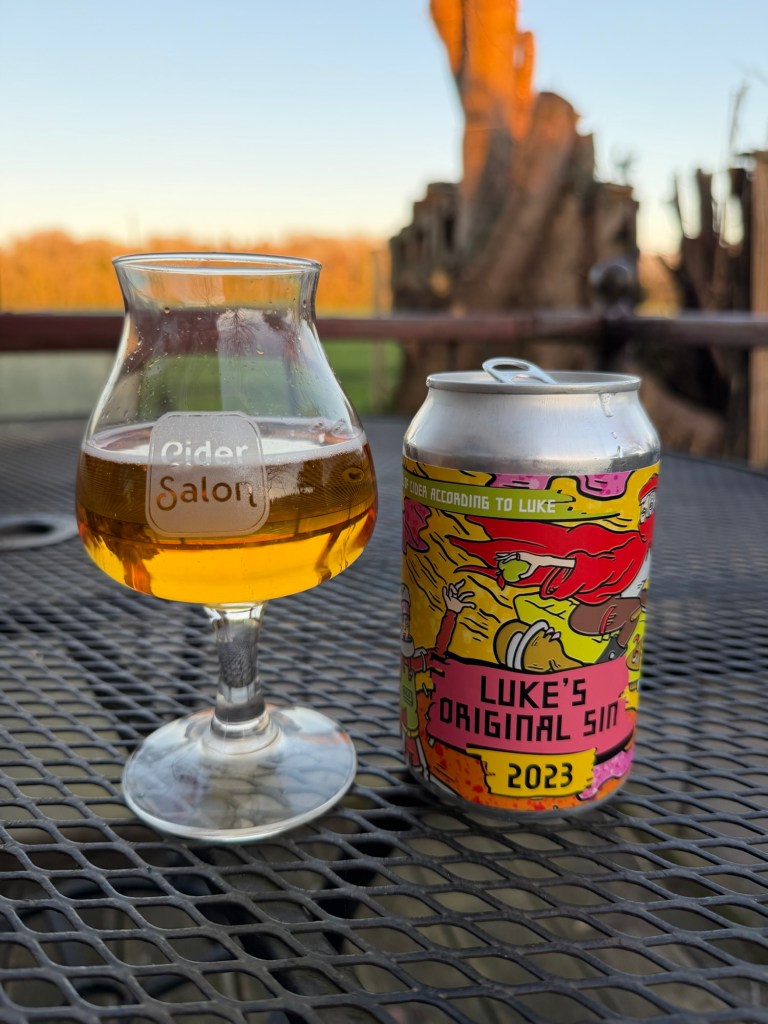
Luke’s Original Sin 2023 – review
How I served: A gloriously warm spring day outside meant refrigeration for most of the day, then out on my odd little bit of decking for 10 mins this evening to acclimatise.
Appearance: The golden orange of clementine flesh, a really rich, vivid glow. Tungsten streetlamp glow from the 1990s. The kind of colour that folk say: “Oh that looks like cider!” (Cider can be many colours of course). Moderate effervescence and a mousse which last a minute or so in the glass.
On the nose: Damp, Autumnal orchard floor, stewed apples, star anise and cloves, incredibly fragrant and suggesting to me a bittersweet cider delivery.
On the palate: Medium delivery in terms of sweetness levels, soft tannins, the delicate carbonation levels working well here with the bittersweet delivery. Might let this warm up a tad further to see how it develops as may have been a little too chilled upon first sippage. [time passes]. The tannins come more to the fore as this becomes less chilled. 5.5% abv is enough to carry all those lovely, interesting flavours we get from a cider or perry with decent tannin present. This is full juice, wild ferment as well, ticking a lot of boxes.
In a nutshell: A delicious, sessionable, full juice and wild ferment orchard blend. If this is your introduction to Luke’s Cider, you’re off on the right path.
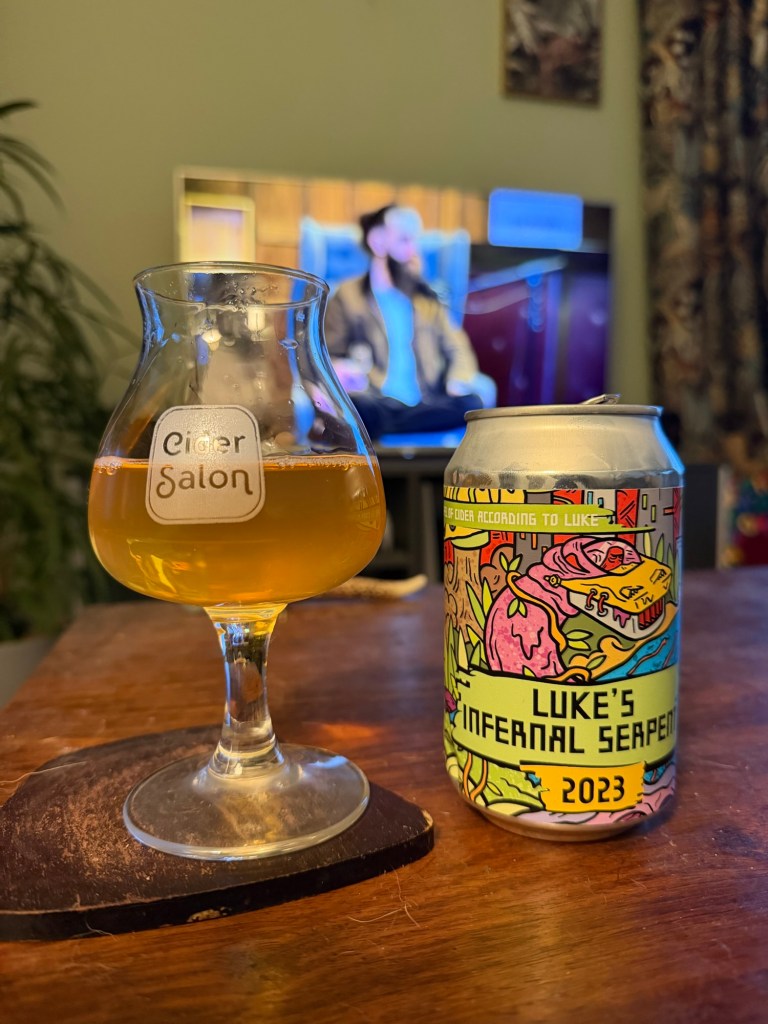
Luke’s Infernal Serpent 2023 – review
How I served: Day in the fridge, 10 minutes out to warm up a little.
Appearance: The slightest of hazes upon pouring, minimal effervescence, and no real mousse to speak of. Lucozade orange glow to the liquid.
On the nose: Freshly pressed apple and orange juice (in neighbouring glasses). Clove, black peppercorn, the merest whiff of VA, but in super low doses that it sits nicely with the rest of the liquid.
In the mouth: Tannin and acidity dialled up compared to the previous Original Sin can. There’s also pleasing astringency with this cider, it’s got a lot more going on, mouthfeel is more complex, bone-dry presentation, abv higher at 6.2%. I’m going to say this is bittersharp-led in its composition of cider apples. Sherbet, lemon citrus, green apple, borage. Fascinating to drink these two side by side as Infernal Serpent is noticeably more complex and perhaps for a slightly more seasoned cider-drinker, someone more acquainted with tannin. One to check-in to the Tannin Inn on the winter solstice.
In a nutshell: The bittersharp canned companion to bittersweet Original Sin, a full-juice cider for those with more adventurous palates that repays the trust given in it.
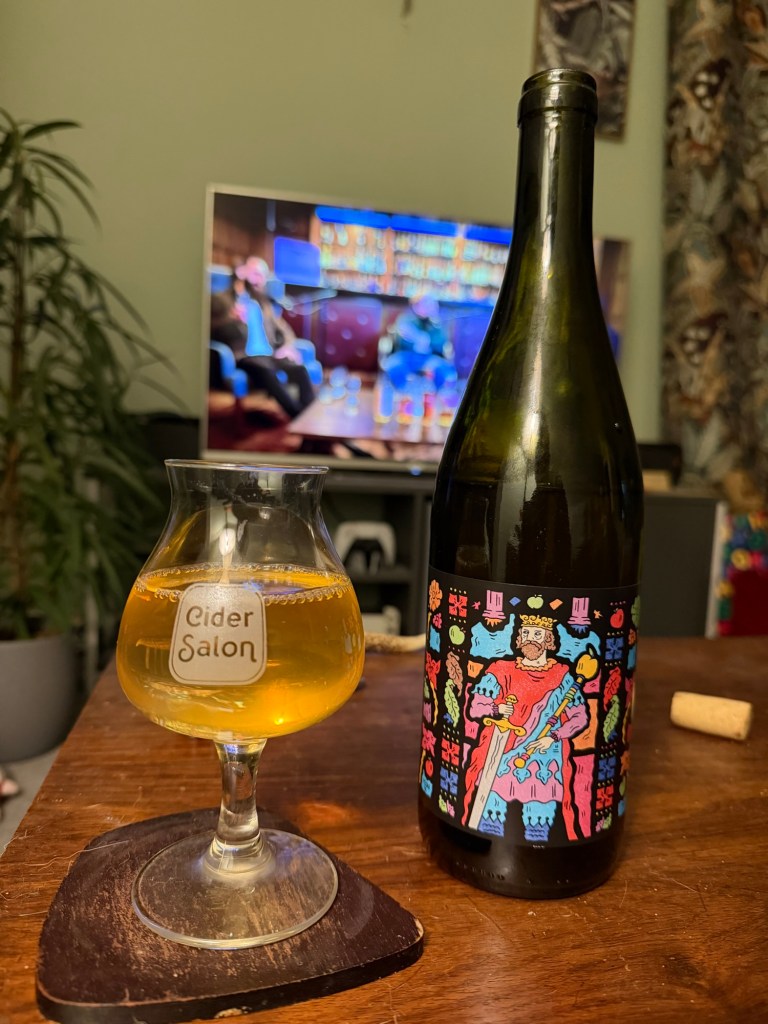
Luke’s Cider Barrel Project No 2: The King – review
How I served: 1 hour in the fridge to chill down as the garage had surprisingly warmed up a good deal today in mid-March.
Appearance: Lemon gold, still presentation (cork in bottle, wax on top), no mousse, good clarity.
On the nose: Bang the drum for rum, here we come! I LOVE a rum cask finish on a cider (and possibly even a perry). The cask influence is coming through in spades here. Herbaceous, nettle leaf aroma too which is a curious direction, perhaps Kingston Black does this from time to time, it’s the 2022 season, which was the last big hot one previous to the 2025 season. As it warms, there’s a pleasant Spanish Sidra note to the aroma.
In the mouth: The Kingston Black is soft and lemony, the rum cask is doing 55% of the flavour profile delivery here. Spanish Sidra note softly continues, the mildest of VA that adds interest to the mouthfeel, whilst not overpowering it. I agree with the tasting notes that this has a wine-like texture, it’s reminding me most of a Little Pomona barrel-aged release specifically from a textural standpoint. 7.4% abv surely adding to that mouthfeel. I’d love to have tried this with a rice and fish dish, feel it would have worked really well with it.
In a nutshell: An oily, textural Kingston Black that benefits greatly from the 6 months the liquid has spent in a delicious rum barrel. Seek it out.
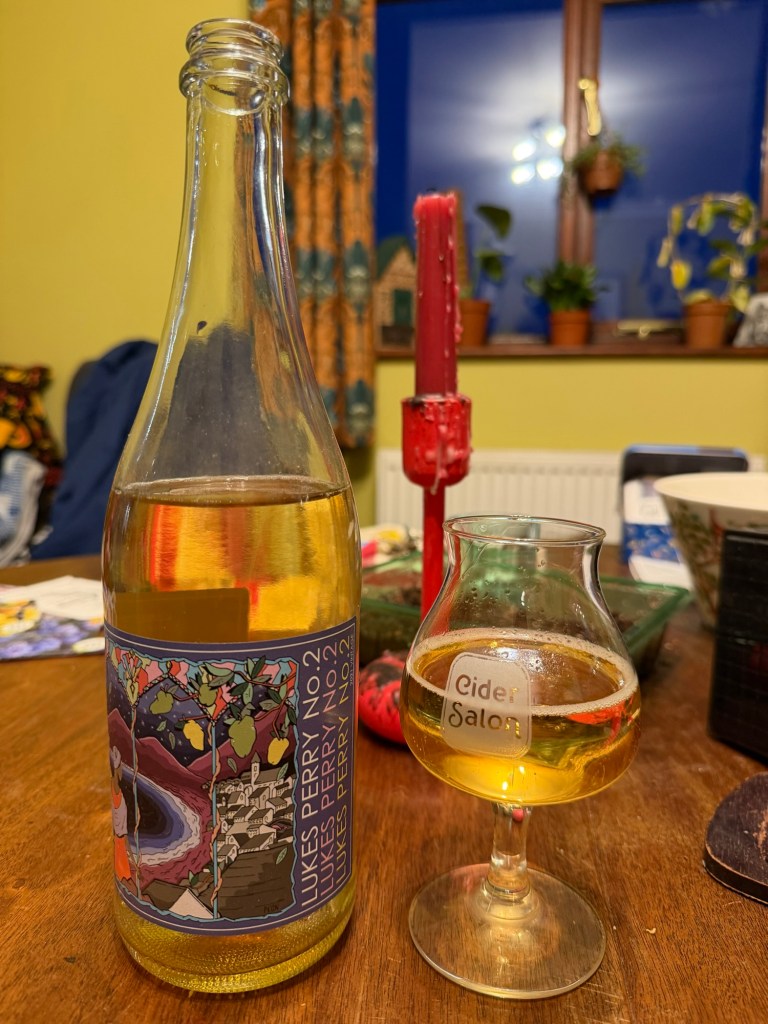
Luke’s Perry No. 2 – review
How I served: Half an hour in the fridge to chill then served.
Appearance: Lemon gold, very faint fizz, no real mousse, great clarity.
On the nose: Honeydew melon, tropical notes, haribo gold bears (the candy jelly aroma from the pack), little bit of vellichor underneath this tropicality.
In the mouth: This is gorgeous. The kind of accessible, palate-pleasing delivery that just the right blend of perry can entrance new drinkers and bring them back time and time again. It’s the juicy, jammy notes that you find with young Moorcroft, Blakeney Red, and Red Pear (I don’t know if these varieties are in this blend). Slight acidity top-note for balance. 5.5% abv, so dangerously quaffable alongside that little bit of residual sweetness- to share with friends or enjoy on a Spring evening in the garden?
In a nutshell: A perry to please every palate! Share this with folk who have never tried perry before and you’ll have converts for life.
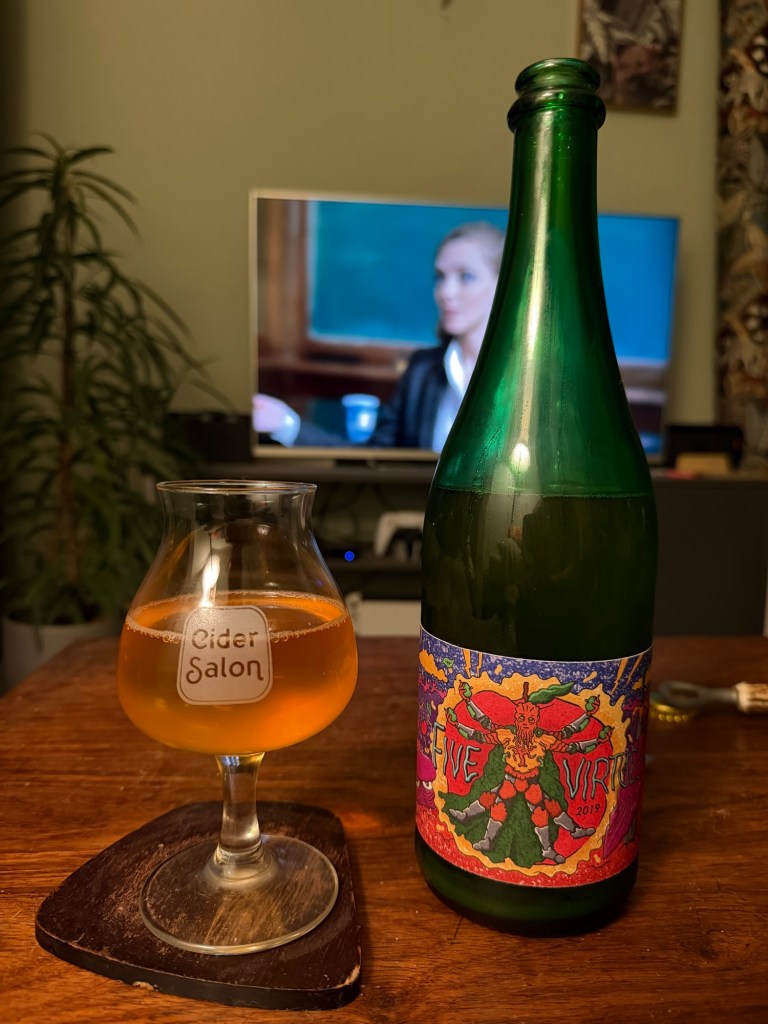
Luke’s Cider Five Virtues 2019 – review
How I served: An hour or two in the fridge then 30 mins out to settle at room temperature.
Appearance: Noticeable hiss when the cap is popped, but upon pouring in the glass, there’s hardly any effervescent or mousse whatsoever. The colour is a wild, vivid, Irn Bru hue, very inviting.
On the nose: Spanish Sidra meets West Country cider, a pleasant level of VA, apple frangipane, pureed apple. I don’t think this needed to be chilled in the slightest, should have just tried it Springtime garage temperature.
In the mouth: Bittersweet apples galore, medium to medium sweet delivery, reminding me of one or two of the Wyldlands ciders I tried last year. It’s more apple strudel on the palate than I was expecting, hints of brown sugar, cloves, and nutmeg. I really like that interplay of mild VA aroma and bittersweet, natural sugar delivery on the palate – the two compliment each other very well. It’s comes in at 7.5% abv, punch, robust, tantalisingly tasty,
In a nutshell: Luke has chosen well with these 5 apple varieties in his orchard. The definition of a brilliant orchard blend.
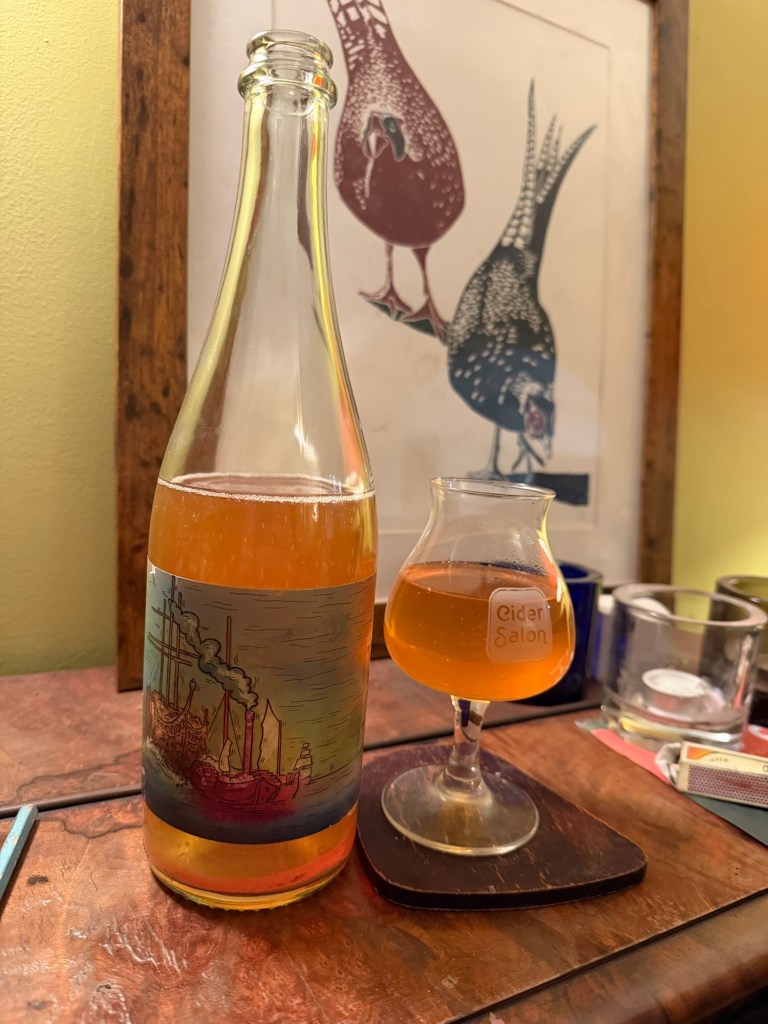
Luke’s Cider Barrel Project No 1: Rum Cask 2022 – review
A blend of Dabinett, Chisel Jersey and Tremletts Bitter
How I served: A cooler day in the garage, served at cellar temperature straight up.
Appearance: Hazy brassy gold, interestingly a constant flow of bubbles in the bottle, but when poured in the glass, near still and no mousse.
On the nose: A hefty, active rum cask nose which I find really appealing. Orchard floor in Autumn, damp, dewy apples and leaves, some more rum!
In the mouth: Loads of textural goings on here, there’s some pretty hefty tannins from the three bittersweet varieties used, but something about the rum cask influence is lifting the delivery in the same way acidity would to tannin, but it’s not necessarily an acid top note I’m getting from the rum cask, something green and refreshing if I were to give it a colour. Little bit of a menthol note at play, dry presentation, long finish after each sip. This is an 8% abv cider finished for 6 months in one of my favourite cask types, with a great blend of bittersweet apples utilised. Would go well with Korean Pork Belly bites, or some kind of stir fry involving sprouting broccoli, there’s a note here that I think would work great with either.
In a nutshell: A stellar example of finishing a blend of cider in a rum barrel. Everything is elevated, my synapses are now firing!
Conclusions
It’s a great feeling to work your way through the output of a producer you’re only partially familiar with. All of a sudden, their drinks, their ethos and their way of sharing their products with us consumers draws into focus. The producer satellite being drawn into the gravitational pull of Cider Review. I like that there’s a story here encompassing the pull of the countryside, ruralisation being the antonym word to the more commonly used urbanisation in our lexicon. That cider and perrymaking can be a draw back to the villages and hamlets to set down roots and expand your business seems poetic and somehow right. One foot in the city and one foot in the country seems a very sensible approach to building that base around North London and beyond.
His canned drinks come in at between £3-£4 a pop, which seems like a fair price to appeal to a wide audience. The 750ml bottles ranged from £9.60 for the Vintage Perry up to £22 for the Five Virtues bottling that encompassed apples from his own family orchard. I’m personally very happy spending around the £10 – £15 mark for a 750ml with a good story and great liquid inside, anything higher enlists a more considered, cautious, conservative approach to my spending habits. I’ll go there, but it has to have a really good USP. I also found it very engaging to hear the excitement in Luke’s voice when he describes his barrel projects – those oak casks elicit a spark of creativity and passion which is evident in the quality of releases thus far – here’s to many more.
All being well, I look forward to bumping into Luke in the Tate Modern again for London Cider Salon on Sunday 24th May. If you’re in the UK, remember to get your tickets early as this event just gets bigger and better every year!
Discover more from Cider Review
Subscribe to get the latest posts sent to your email.

