My biggest take-home from writing Perry: A Drinker’s Guide was that it is apparently literally impossible for me to pose for a photograph in which I’m looking at a perry pear without coming across as utterly bewildered. (Sorry Helen – I’ll be better next time!) But my second biggest was that the world of perry is deeper, richer, wider-spread and more surprising than any of us know.
I’ve been all around the UK for the last five or six months giving talks on perry, and in pretty much every one of them I’ve been at pains to emphasise its rarity. There are, at present, only three places on earth that could really classify themselves as ‘perry regions’ – the Three Counties and Monmouthshire in the UK, Normandy (especially the Domfrontais) in France and the Mostviertel in Austria. In only one of those regions (the Mostviertel) is perry, rather than cider, the dominant concern. And even there, most people in the local town of Amstetten are drinking something else.
In all of those regions perry pear trees are down by terrifying numbers; from over a million in the Mostviertel in the 1930s to c.200,000-300,000 today. One and a half million in the collective orchard of the Domfrontais in 1960 to 100,000 by 1999. And no count kept in the UK, since Thatcher defunded the only people who did – the Long Ashton Research Station – but numbers were dropping rapidly by the 1950s, and since Showerings uprooted most of their orchards in the 1980s, we can imagine it was a similar story. (Incidentally, a blackly-funny aside that I was told by Charles Martell a couple of weeks ago is that Showerings planted vast acres of Hendre Huffcap in the 1960s to supply Babycham, but pruned them the wrong way and effectively wiped them out).

Then there’s Germany and Switzerland, both of which had substantial perry cultures until very recently but, as Barry has diligently researched and reported in many a Cider Review article, lost them almost entirely after the mid-20th century. Luxembourg has many ancient trees (and a few eponymous varieties) that testify to a historic culture now upheld only by Ramborn. And it was even a rural staple in North Eastern America for a couple of centuries until a combination of fireblight, lager and, ultimately, prohibition knocked it on the head.
All of which sounds terribly depressing – and indeed I worry that many of my talks take too negative a tone (‘nice perry we’re sampling here; shame if it was all wiped out in a decade…’) But as Albert wrote in his beautiful foreword, ‘there is space to hope’. Because not only is perry picking up in each of its three key regions – and positively glowing in the USA when you look at the number of world-class makers turning their hands to it – writing the book revealed to me just how many makers and countries are now producing perry.
Granted, in many of these instances it’s just one or two brave fermenters, who having noticed a few trees full of oddly-shaped, belligerent fruits have decided to whack them into a spare tank. But more often than not it is the result of peering across at the growing perry renaissance elsewhere and being inspired to give it a go. What’s more, in most of the countries trying their hand at perry for the first time (or the first time in generations) one maker is leading to another until there is a veritable clutch of pear-scented yeast-botherers bottling it up.
So there’s perry made Normandy-style in the Nagano prefecture of Japan. There’s champagne method perry from New Zealand. There are Moorcroft, Yellow Huffcap, Gin and Green Horse trees in Australia. Latvia boasts wonderful perrymakers, as does Belgium and Poland and Ireland and Estonia. Ukraine had at least one sensational perrymaker, and I hope soon will again. Canada makes ice perries and mistelles. Italy has over a dozen perrymakers now – including on the volcanic slopes of Mount Etna in Sicily, which I am absolutely desperate to go and visit. There are perries in places like Chile, Mexico and South Africa that I didn’t even find out about in time for the book (reprint when?).
And the most exciting thing of all is that each of these countries, for the most part, is bringing its own varieties and flavours to the international perry party. Sure, many of them are grafting English, French and Central European pears and discovering how their climates and terroirs inflect the flavours of those varieties differently – but just as many, if not more, are sending their own indigenous pears to the press. Whether they’re bright, fresh, culinary varieties or – perhaps even more exciting – pears from random wilding trees that offer a character hitherto undiscovered and that (cross everything) have a chance of natural resistance to fireblight.

The international perry scene is not only inspiring – it is probably essential to perry’s long-term health and survival. And it is by far at its most effective when it’s joined up. The more we know about the pears, perries and producers in other countries around the world, the greater the hivemind of experience and understanding we can build, and the better chance this great perry revival has of continuing.
Unfortunately, in the UK at least, opportunities to taste perry from the otherwheres of the world are vanishingly few and far between. Fine retailers like The Cat in the Glass and The Cider Vault have excellent examples from France and Germany, and I believe there are still a few bottles of Eve’s from the Finger Lakes tucked on certain bottle shop shelves. But largely our imports remain modest – not helped, still, by the B-word.
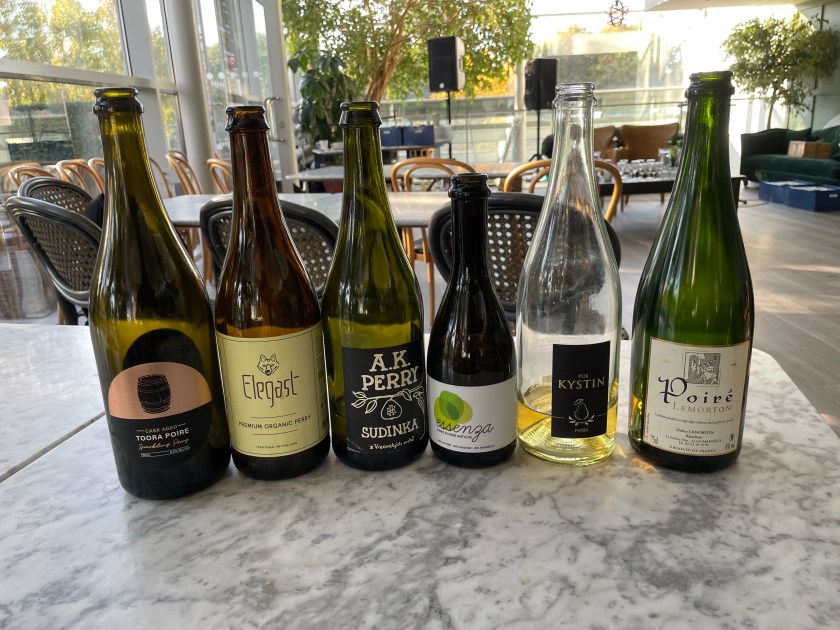
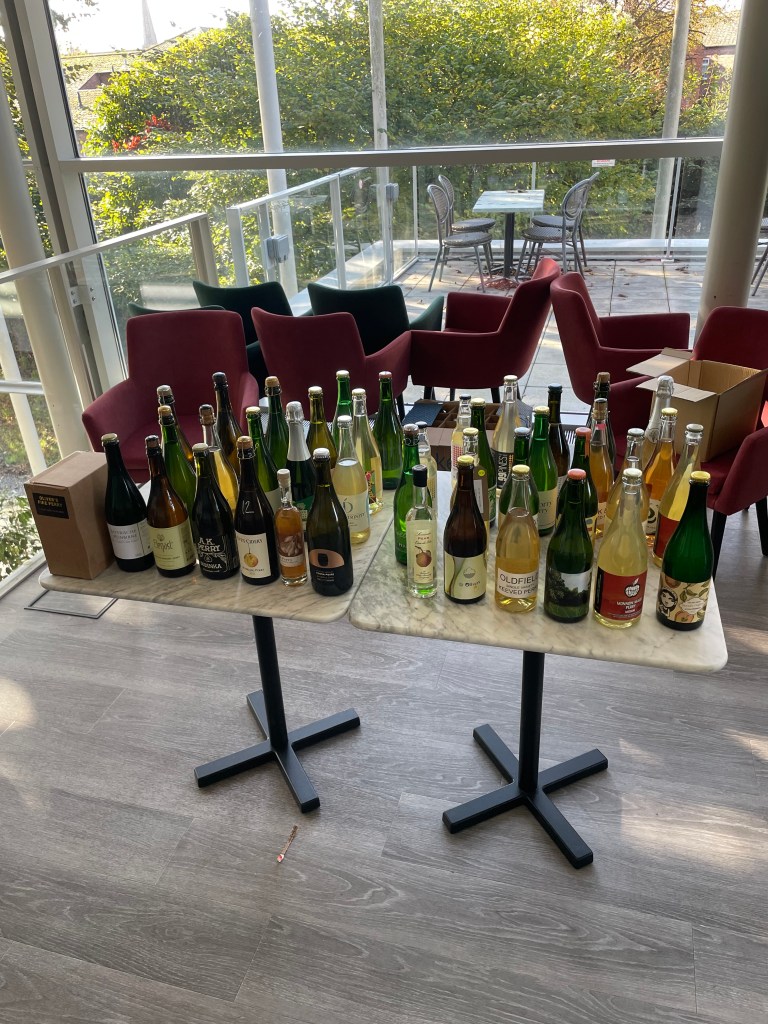
So it was fantastic a couple of weeks ago, on the now-annual Perry Day organised by the Three Counties Cider & Perry Association, to be able to put together a table full not only of the best examples of perries from around the UK but, thanks to people like Tom Oliver, Nicky Kong and Natalia Wszelaki, a selection of fascinating bottles from around the world.
Having made the genius tactical decision to ‘staff’ the samples table, I was able to scribble my way through a bunch of the ones we’ve not previously written up here. I didn’t quite make my way through all of them, but five countries and two continents was a good smattering. It’s possible that none, I’m afraid, are currently available for sale in the UK – a disclaimer which, I know, understandably annoys some of our UK readers. But CR is now lucky to be very much an international website, and indeed this is our internationally-focussed month. So I hope that in this instance I can make recommendations for our friends overseas – and perhaps put a few travel destinations on the mental maps of those in the UK, like me, who aren’t able to taste these perries regularly.
Our voyage by pear takes us first to The Netherlands, where we meet Elegast – a maker who kindly spoke to us for perry month a couple of years back, after hosting the opening of RossFest 2022. They’re very much at the forefront of the Dutch cider movement, and I was intrigued (in a good way) by what I tasted at their presentation. So I bought a couple of bottles and held onto them for a suitable moment. Which turned out to be perry day. Premium Organic 2020 is a traditional method perry made from cooking and eating varieties, organically farmed. In fact readers in the UK may possibly be able to pick up a bottle of this one, as I believe there are still a couple on sale at the Yew Tree shop in Peterstow.
Elegast Premium Organic Perry 2020 – review
How I served: Room temperature, as we didn’t have a fridge for perry day. For what it’s worth I’d chill this and then leave it half an hour out of the fridge before serving if I was having it at home
Appearance: Pale lemon green. Persistent mousse.
On the nose: Walking through a pick’n’mix store holding a bouquet of fresh flowers and a pack of digestive biscuits. Lovely, rounded, plump fruit and florals dusted with candy and icing sugar, a splurge of fresh, green leaf and a brush of savoury lees character. A very alluring traditional method perry nose.
In the mouth: Delivers as expected; fruit still fresh and bright and rounded and juicy despite four years of age, bouncing up and down delightedly on a trampoline of bubbles. Less of the candied nature here – it’s melons and tangerines and fresh pears. Just off-dry, and very delicious.
In a nutshell: An absolute crowd-pleaser; an epic aperitif perry. Yet more proof that great perry can be made from any sorts of pears, in the hands of the right maker.
Shuffling further south and into Italy we encounter the only mildly terrifyingly-named Apple Blood in Trentino. They’ve been making cider from a range of varieties – well-known modern ones, and others that stretch back into Italy’s past. But we don’t care about apples for today, and Marco Manfrini, Italian cidermaker, advocate extraordinaire, parrot-owner, ACA-Certified Pommelier and all-round very very excellent chap kindly brought their perry to the display, rating it as the best in Italy. (Without Marco and his Italian cider partner-in-crime Andrea I wouldn’t have even known that Italy made perry, so a big extra two cheers from me.)
Essenza is a cuvée of three distinct pear varieties, separately fermented. Klotzen, Spadone and an unidentified pear from a centuries-old tree. All-new pears as far as this parochial palate is concerned, so let’s dig in.
Apple Blood Essenza NV – review
How I served: As above. Again, would chill – and in this instance likely drink straight from the fridge.
Appearance: Similar to the Elegast, but lighter fizz and a little clearer
On the nose: ‘Essence’ is right – this is pure pear; fresh, juiced and tinned. And, indeed, very lightly spiced. Also a lot of blossomy florals, a touch of rich tea biscuit and a little white grape. They’re ever-so-slightly simple aromatics, but they’re very pure and clear and lovely.
In the mouth: Super juicy and rounded, but balanced by just a nibble of lemon and lime and green apple that cuts through the ripe, soft, juicy canteloupe, grape, pear and gentle apricot. A dabble of light fruit sweetness, as those flavours would suggest. Good Lord, my glass is empty already – where did that go?
In a nutshell: This may not be the most complex perry, but it’s unbelievably moreish.
How about a Czech perry? Rude not to, I’d say. Certainly the first Czech drink of any sort that I’ve written up here – can’t remember whether one of my learned colleagues has beaten me to it. Anyway, this was a very kind gift brought across by the mighty Natalia of Cider Explorer when she paid a visit during the summer. Another instance of a bottle that waited for an auspicious opening date and found it in one of the year’s biggest celebrations of perry.
What I know about Czech cider and perry you could, until very recently, have written on anything big enough to contain the sentence ‘some cider and perry is made in Czechia’. Happily at this year’s iteration of Rossfest I was lucky enough to have a few chats with Anastasiia, who had come to volunteer at the festival and for a bit of harvest, and who has made her own cider in Czechia for the last few years. (Indeed she has just launched her commercial instagram account which you can and should follow here). In the face of the country’s almighty beer culture, cider is very much a minority concern, but as in so many places, small numbers of artisanal makers are now determinedly beating against the grainy current, and we’re very much here to see it.
One such maker is A.K. Cider, who per this Cider Explorer piece have been making fruit wines of one sort or another since 1928 and specialising in cider since 2013 – but of course it’s a perry of theirs I have in front of me. Sudinka is named from the Wallachian variety from which it is made. Apparently dry, natural, unfiltered and unsulphited – let’s give it a whirl.
A.K. Cider Sudinka Perry – review
How I served: As above. Would only chill this one lightly given a choice, I think
Appearance: Bright, clear mid-gold, light mousse
On the nose: Slightly faint aromatics initially, before some green fruit, green leaf and mineral tones come through. Pear drop. Green apple. A light touch of caramel. There’s a tiny volatile smidge of acetone, though it’s just about on the nit-picky trace level.
In the mouth: Dry, fresh, full-bodied and white-winey delivery that really closely follows the nose in terms of both character and level of intensity. Delicate flavours of green fruits, hedgerow, pear drop and green pear (skin and all). Unfortunately the acetone has grown a bit too much for me personally, which is a real shame as there are lots of positive elements here.
In a nutshell: A few rough edges to an otherwise very white wine-coded perry. Much to continue exploring in both A.K’s range and Czech cider more broadly.
France is a country whose ciders and perries I have gushed over semi-regularly, though not nearly as regularly as I think I would like. Would I love to see a larger number of single varieties and drier styles alongside their excellent off-dry to sweet blends? Yes, of course I would. But I still think that, pound for pound, it has the highest concentration of exceptional cider and perrymakers anywhere in the world, combined with a collective orchard of cider and perry fruit really rivalled only by the UK and which I would like to get to know much better than I already do.
So I’m tres tres delighted to have a couple more French perries to taste today. Indeed it’s a bit of a battle of the regions – a faceoff between Brittany and Normandy.
Kystin, in the Brittany corner, is a cidery I rate highly, but have somehow managed not to feature on Cider Review except in a note of general admiration following my visit to CidrExpo in 2020 and in this review of their apple and toasted buckwheat co-ferment later that year, which I found slightly heavy on the toasted buckwheat for my taste. My esteemed CR co-founder, James, also covered their Opalyne cider here, calling it ‘a fantastic and well-balanced expression of the fruit.’ Anyway, Phil, who can be found under @cidercask waving a proud flag for cider on X, passed a bottle of their Poiré on to me almost two years back now, so it’s about time it was given a hearing.
Representing Normandy is the curious case of a perry from the Domfrontais (I think?) that doesn’t bear AOP Domfront on its label. Didier Lemorton is certainly a Domfrontais producer, being responsible for some of the best Calvados Domfrontais of all. Indeed so focussed are they on Calvados that the fact of their making a perry had completely passed me by until I chanced on a bottle of it in a Parisian wine shop. (The shop assistant checked three times to make sure that I knew it was made from pears, not grapes, and that I was ok with that).
A few reasons it might not have the AOP – perhaps it’s made from pears grown outside the Domfrontais, or perhaps it has less than the stipulated 40% Plant de Blanc in its cuvée. Perhaps it hasn’t quite followed the appellation strictures in some other respect of harvesting or making. Or perhaps they just didn’t fancy putting AOP Domfront on the label. Who knows? (Them, probably).
Anyway – both perries seem to have been made the same way; cold-racked and bottled pét nat, with the ultimate aim being a naturally sparkling perry with residual sugar. (This was something of a worry when I was opening all the bottles at room temperature – I kept warning people that any given bottle might go off like a bomb, and almost disappointingly none of them did. I dare say it was that I was being so concerned about it – if I’d forgotten to say anything about one of the bottles maybe it would have redecorated the ceiling).
I’ll shut up, shall I, and we can find out what they taste like.
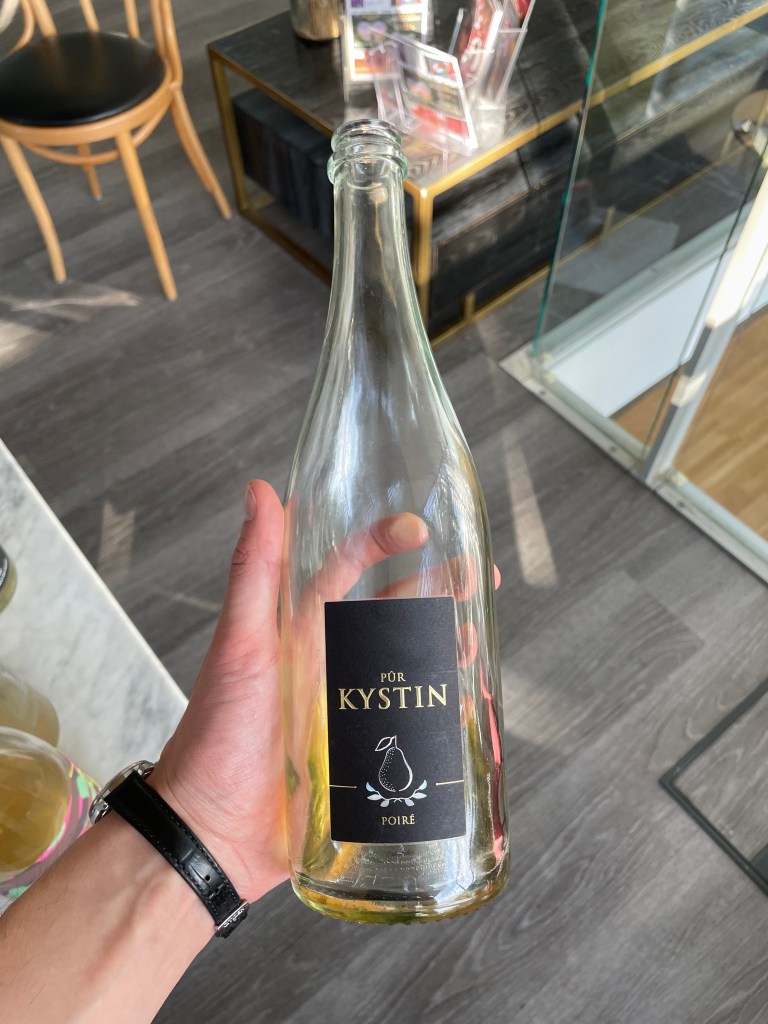
Kystin Pûr Poiré – review
How I served: Gingerly, with hot little hand clamped around that champagne-style cork. But I needn’t have worried.
Appearance: Pale, super-bright gold, lively mousse.
On the nose: Pûr is another good name. Just the purest, freshest, cleanest, ripest, juiciest of pear juice. Floral honeys, lemon marmalade. Compôte. This is just the most heavenly, dangerous, summery, sinful pear juice nose ever. Take me directly to a sunlit garden. No, an orchard.
In the mouth: Again, just like encountering the best pear juice there ever was. So clean, so bright, so fresh and flavourful. At 2% ABV I could just drink this forever. Light marmalades and honeys and lilies all orbitting the freshest, juiciest poached pear. This is like a great Loire dessert wine – Coteaux du Layon, perhaps, but in pyrric form.
In a nutshell: Super-sweet, but beautifully balanced. Love this. A pudding perry of dreams.
Didier Lemorton Poiré – review
How I served: As above
Appearance: Hazy pearlescent pear juice. Steady mousse.
On the nose: Fascinating, if this is indeed Domfrontais. There’s some of the Plant de Blanc tangerine-pear-melon axis, but it’s augmented by a rather attractive dusky savouriness. Bananas. Indeed foam bananas. Pear skins. Slatey minerality. It’s not as fuulsome and voluptuous as the Domfronts I know and love, but it’s complex and interesting within its comparative reserve.
In the mouth: There is sweetness, but it’s so well-balanced by savoury pear skin and wet slate. Red apples, more of that tropical banana and rounded apricot. Again, it’s complex. It’s not a Domfront fruit-bomb. I wonder if this is outside regulations? A little low on Plant de Blanc? It’s good, anyway.
In a nutshell: A very interesting example of south-Normandy perry. Not a typical Domfront, from my (albeit comparatively limited) experience. But a tasty one.
And now for something completely different, as perry Godfather Tom Oliver came to Perry Day bearing no less than an Australian traditional method perry from English perry pear varieties (mostly Gin, I gather) aged in a brandy barrel.The producer responsible for bringing this excellent constellation of words into confluence is Gurney’s, founded in Victoria by the Gurnett family in 2001, and who apparently boast orchards of cider apple (and pearry pear) varieties as well as the world’s largest underground cider cellar.
It has long been a source of niggling irritation that not one single Australian cider or perry has featured on Cider Review – despite a fascinating conversation with Camilla Humphries on the burgeoning Australian cider scene. So after a mere four years and 10 months, I’m delighted to finally have one in the glass.

Gurney’s Cask Aged Toora Poire – review
How I served: I’ll give you one guess.
Appearance: Lightly hazy lemon-green, persistent mousse.
On the nose: Has a very particular form of gunflint reduction initially, which puts me in mind of some New Zealand (and Australian – why did my brain go to NZ first?) Chardonnay. It’s actually a characteristic which (whisper it) I quite like. Anyway, alongside all that this perry is giving me bug Green Horse vibes, if I didn’t know it was mainly Gin – hedgerow, green leaf, lime skin, lemon juice and wet stone. Extra virgin olive oil, and a touch of elderflower. Complex, fresh and aromatic. Not sure I’d have guessed at the brandy barrel element.
In the mouth: Great acidity. Very woodland walk – leaves and mossy pools, given pith and poise and vibrancy with a brush of lemon and lime peel and electric green pear skin. A bite into a fresh, crunchy green pear. A flutter of vanilla and oak spice. A whisper of tannin. Lots going on, and I’m into all of it.
In a nutshell: Super racy, vibrant, elegant traditional perry. I like this a lot. An Australian CR debut well worth the wait.
Conclusions
What an incredibly cool selection. The wonderful thing about perry is that none of us really knows all that much about it in the grand scheme of things. (Though you can learn a bit more by buying this right here, cough, cough, shameless cough christmasiscomingup cough). Even when I explore perries from a British producer – often even when they feature varieties I consider myself familiar with, I encounter new flavours and surprises.
But this lineup was a real palate-stretcher. At least three of them were made of perries completely off my radar, and the ones whose pears I might have had a clue on nonetheless took me down fresh avenues of smell and taste.
I reckon if I have to pick just one of the bunch it’d be that Kystin, which is truly exceptional – one of my perries of the year. But I’d take another bottle of most of them again in a heartbeat, and all of them have spurred me to dive deeper into their respective country’s output as soon as I get the chance.
Perry is certainly rare, precious and indeed endangered. But lineups like these are a tonic. A reminder of how many people there are out there all around the world who care deeply about this very special drink. A space, as Albert so wisely has it, to hope.
Discover more from Cider Review
Subscribe to get the latest posts sent to your email.
 Cider Review
Hi Adam, would love you to visit South Africa one day and come taste my artisan perry I make in still , pet Nat and barrel aged. Regards , William Everson
LikeLike
Hi William. Thanks so much for getting in touch – and your perries sound absolutely incredible. I’d love to visit and taste them, but in the meantime I’d love to hear more about them! Any chance you could drop me a line at ad_wells@live.co.uk with some more details? Cheers, and thanks so much for reaching out. Adam
LikeLike
A great day; thanks to all the speakers and organisers.
Thanks for all the different perries we tried too…the one from Normandy was my favourite.
LikeLike