The faraway ferry cuts through the looking-glass fjord with the silence of a picture. The surface is bedecked with ribbons of mist that hang like the opening lines of a saga and gossamer-wrap the sheer, dark mountains erupting from the mirror. If there is any lapping of water, not five yards from my feet, I don’t notice. If there are seabirds calling, I don’t hear them. Nobody moves or speaks or seems to exist; the morning feels like an intake of breath. For just a few moments I am transfused into the stillness of this timeless tableau; the hardnesses of its textures, the bite of its sunrise cold and the murmuration of its weathered, fishscale, northern greys that wrap themselves around me, earth and sea and sky, then are suddenly punctured by the unexpected brightness of crimson apple skins.
There are orchard landscapes, and then there is the shore of Utne, the crossroads of Hardangerfjord, where the water spears southward as the Sørfjorden into the belly of western Norway. To reach it, you fly to Bergen (or ‘Bergen?’ as the enormous sign outside the airport enigmatically has it), take the two-hour fast boat to Rosendal that people use like a bus, then drive through a mountain tunnel beneath a glacier.
It’s a landscape to bring you out in kennings; a ridged and ruffled whale-road coastline, all crags and crannies and the suddenness of corners turned into something freshly spectacular. Inlets roughly shaped by the battering of millennia, mountains brooding with low, wrathful cloud; solid, sheer cliffs and swooping hills shaggy with the bent, bowed branches of ancient, wind-wracked trees. At the entrance to the Hardangerfjord its high banks pinch inwards; looming and chiselled. This is a world blasted into shape by relentless natural force; a wild place of gnarled and battered beauty, the archetype of the mythic North.
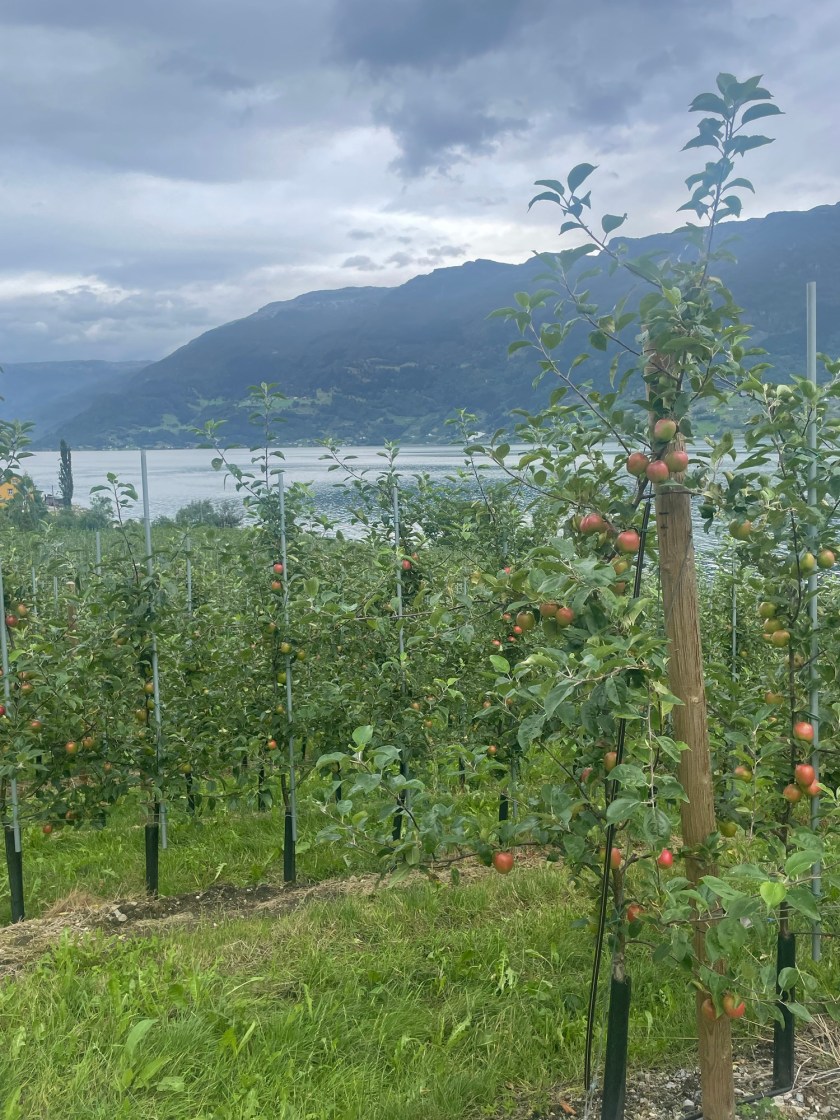
And then, amidst all that savage glory, spilling down slopes that seem, as you climb them, impossibly steep: fruit trees. A ribbon of them, tracing the feet of the stark mountains like the bottom of a picture frame; electric, red-speckled green piercing the darkness. The landscape seems otherwise identical to all you’ve driven through; the trees appear like a conjuring trick. Suddenly you’re amongst them, and then they continue, more or less, all the way down the Sørfjorden to the town of Odda. There are cherries here, and a few pears where it’s just about warm enough, but first and foremost this 24-mile spear is Norway’s apple orchard.

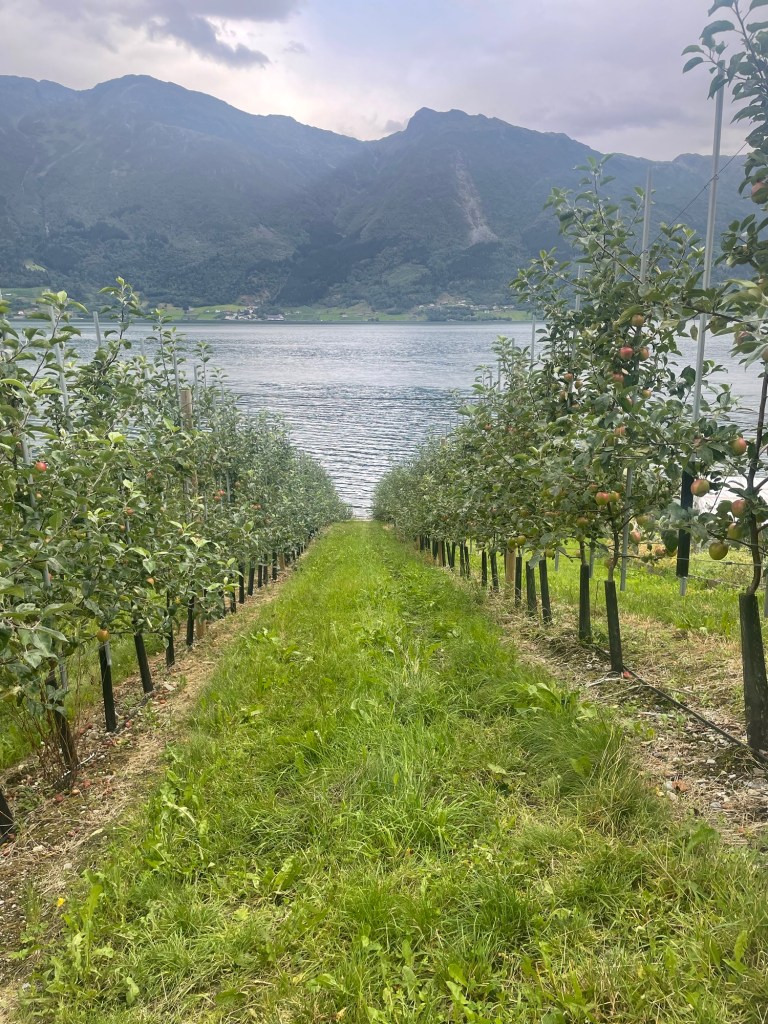
There have always been apple trees here. A few of the old guard; tall, gnarly-trunked traditional old giants still dotted about, tucked away in gardens or squirrelled behind hotels. But for the most part every one of the thousands of trees that line the Sørfjorden is young, dwarving or semi-dwarving and trellised like a vine, tripping down to the fjord that glimmers back towards them. The dizzying aspect, and the diamond-bright glitter of the water at their feet, has me in mind of some of the steeply sweeping vineyards that bank the Mosel in Germany and, as I learn, the resemblance isn’t solely visual.
Loaded onto boats the fruit could quickly reach Bergen and beyond when Sørfjorden and the broader Hardangerfjord first began its apple trade. But the opportunities for transport are more effect than cause; the reason the trees grew and grow so successfully here is a physical, geographical one, the impact of the fjords themselves.
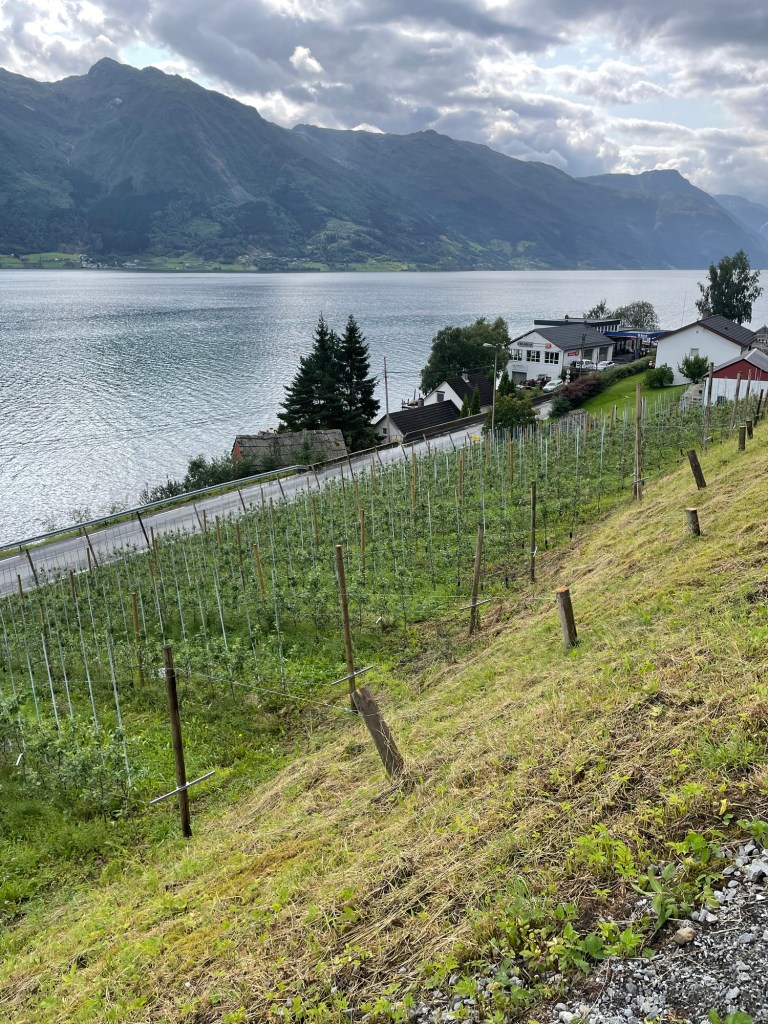
Just as in wine regions that would otherwise be too cold to fully ripen grapes, the presence of these huge bodies of water lends the Hardangerfjord orchards an advantage when it comes to eaking every possible scrap of warmth and light available from the cold north. Reflection is one advantage; an increase in the sunlight afforded to the apples. And the depth of the fjords means they lock in heat as well. It’s most visually demonstrated in the winter, when the mountains the orchards rise towards are covered in snow, whilst at their base it rapidly melts – but the effect is felt by the plants throughout the year. There’s a rise in temperature that simply wouldn’t be as significant without the presence of the fjord, and a point of the slope where that advantage is suddenly cut off, and the orchards stop. The steepness of the slopes is also critical. Not only to make the most of the fjord’s reflection, but to allow maximum drainage of the enormous levels of rainfall. ‘We’d plant apple trees wherever there was flat land,’ a maker says on one of my visits. ‘But flat land here means 30 degrees.’
Where there are apples there is almost inevitably cider, and it has certainly been made here throughout history, with records as far back as the twelfth century. For almost the whole of that time, though, it has been almost exclusively consumed locally; barely written about, barely thought of, barely even known outside the tiny villages and hamlets that made it. And yet today, Norwegian cider seems radiant. Though still tiny in quantity by comparison with the likes of France, Spain and the UK, quality is such that the overall champion of the International Cider Challenge was Norwegian for three years in a row – each time for an entry in a different category. Producers have multiplied, have grown exponentially in size, and more than once in these pages I’ve described Norway as having arguably the most exciting modern scene outside of the traditional cidermaking countries.
There were two key points that changed the face and fortunes of Hardangerfjord cider. Until 2003, for the most part, it was still barely drunk outside the tightest radius of its production. Even locally, it wasn’t considered with undue excitement or reverence. A cidermaker tells me that the usual method was to add enough sugar to the juice to get it to ferment to around 15%. ‘People would be competitive about who made the strongest!’
In 2003 there was an awakening. Increasingly keen to find a new market for their cider, producers invited politicians, journalists, restaurateurs and drinks experts to Hardangerfjord, both to increase awareness of Hardanger Cider and to canvass opinion on how quality could be improved. The first consensus was that the level of chaptalisation needed to be brought way down, but various improvements in cidery hygiene and best practice were also instilled.
The second shot in the arm for Hardanger cider came in 2016. Like its next-door neighbour, Sweden, Norway’s alcohol sales are controlled by a national monopoly, the Vinmonopolet. Anything stronger than 4.7% ABV could only be sold at the monopoly’s outlets. Since a single nationwide retailer requires, apart from any other considerations, a certain scale, and since cider of course ferments naturally to significantly higher than 4.7%, incremental growth for small producers unable to meet the monopoly’s volume demands was virtually impossible.
In 2016 a national law changed to allow producers to sell from their own farms. Suddenly producers could sell full-juice cider in smaller amounts, directly to customers. Growth could be steadier, and start from a lower base; startup capital to grow and invest became achievable. What one producer describes as ‘the commercial boom’ had begun, and the scene was set for the modern Norwegian cider landscape.
Today there are around twenty producers large enough to sell to the monopoly down the Sørfjorden spear, and perhaps forty to fifty around Hardangerfjord in total. But the undisputed capital of Norwegian cider is the tiny stretch of land encompassing Aga Sideri and the tiny village of Nå on the western bank of the Sørfjorden. Five cideries, which between them account for around fifty per cent of the cider sold in the monopoly.
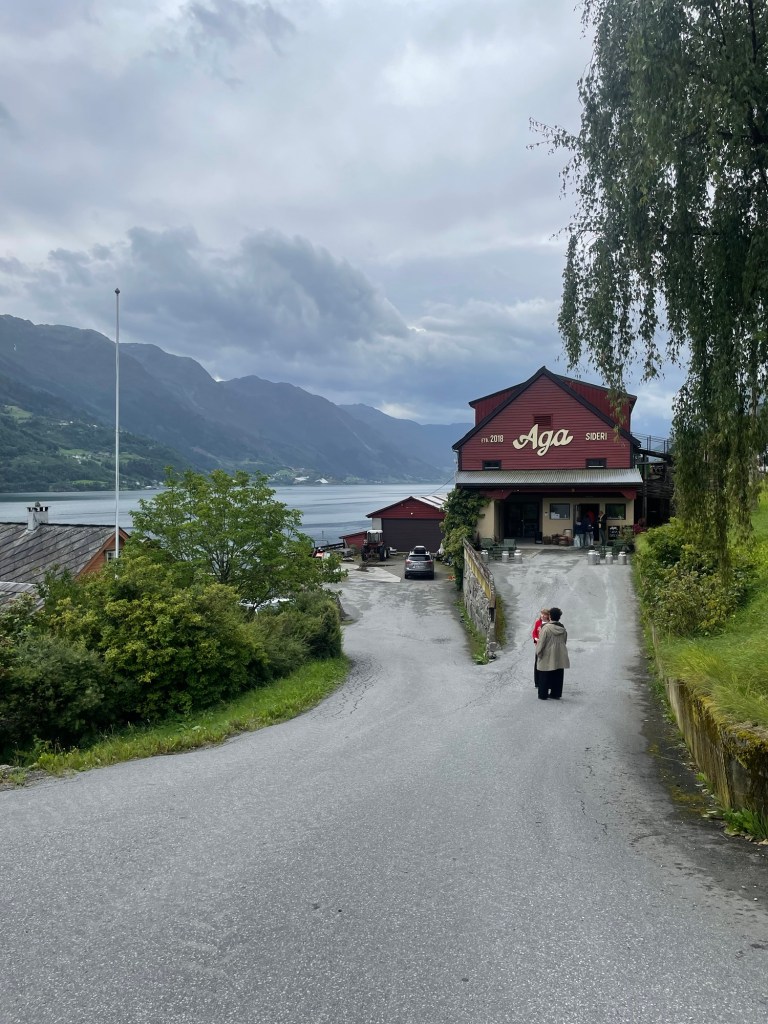
Aga is the biggest of all, though you wouldn’t necessarily guess so, tucked away as it is on the shores of the fjord, silence hissing sibiliant as anywhere else along this wild stretch. Everything feels old and untroubled. Two hundred metres down the road, perhaps less, is the historic village of Agatunet, the largest listed hamlet in Norway, with buildings dating back to the courtroom, first raised in 1220. It was the project of knight and lawmaker Sigurd Brynjulvson, who met his end when he was found floating headless in the fjord. Aga commemorate him with their ‘Laggman’ (lawman) cider today.
Yet amidst the seeming sleepiness, the hushed orchards and the dotted houses roofed with every texture of slate, from intricate dragon-scale patterns to half-tonne slabs, are touches of the vibrancy, the modernity, the forward-thinking that has galvanised Norway’s cider movement. A bright billboard here, an electric car there. Apple trees on trellises and ferries that run like clockwork.
Aga itself reflects that paradox of the new infiltrating, but not intruding on, what has come before. Its showroom is a building that migrated from Agatunet before the Norwegian government fixed the remaining buildings where they were. But the cidery is as slick and sleek and shimmering with stainless steel as any you’d find in the UK – and far more so than most. The impression, instantly, is ‘modern winery’, and indeed this seems to be the template which Norwegian cider has set itself.
Whilst I’d be hesitant to suggest ‘homogeneity,’ and each of the cideries we visit certainly reflects its own particular character in bottle, there is unquestionably a shared DNA; a clear regional style to the producers we visit. Only natural, perhaps; the usual thing of neighbours peering over fences at what the folk next door are doing, taking bottles round to each others’ houses, sharing opinions and ideas. There’s an apparent youthfulness to many of the producers we meet; a distinct generation doing their own thing. Indeed the collegiate nature is underscored by a map in the back of Aga’s tasting book, marking out all the commercial cideries not only in the immediate vicinity, but around the whole of Hardangerfjord.
That DNA begins with the apples. With very few exceptions the ciders we taste revolve around the same quartet: Discovery, Gravenstein, Summerred and Aroma. All are culinary apples; no tannins in this neck of the woods, these orchards were planted originally for the eating market. They are early-ripening – harvest needs to come in before the weather gets too aggressive – all with comparatively low alcohol and higher acid. A handful of single varieties are available, but blends are more common, with at least one maker citing high acid as the reason not to bottle their favourite variety, Summerred, as a solo act.
Following harvest, virtually everything is fermented in stainless steel with selected wine yeasts. I don’t encounter any wild fermentation at the trio of producers I visit, though a small amount is present in tiny commercial batches elsewhere in Hardangerfjord and Norway. A small degree of chaptalisation is virtually ubiquitous; not the enormous levels of yesteryear, but enough to bring the ciders up to a relatively uniform 7-or-so per cent abv. Almost everything is bottled with a small degree of residual sugar and the majority of what we taste is lightly carbonated, with the occasional appearance of pet nats, charmat methods and traditional method bottlings. Other than the ice ciders, nothing that I taste in Norway – from anywhere – is still.

If that all sounds a little safe and controlled stylistically, I’ll swiftly add that everything I taste uniformly ranges from good to very good, that there are frequent flashes of excellence and that across the entirety of my tasting in Hardangerfjord I don’t taste a single cider displaying a fault.
Youth, vibrancy, aromatics and primary fruit are the dominant characteristics in the majority of bottlings. Discovery, which many of our English readers will know, presents all its strawberry and pink-flecked citrus, Gravenstein thrills and trills with yellow and green fruit, whilst Summerred blushes with stone-fruited tones, skewered again with that mouthwatering seam of bright acid.
Initially I think that the ciders stand entirely apart from the energy of the brooding, chiselled solidity of the place they’re made – terroir, of course, not being the same as pathetic fallacy – and then I think of the glitter off the fjord, the sudden patch of colour on the mountains when a sunshaft breaks the skirling clouds, the unexpected electricity of green pasture bursting from dark pine forest, and the flavours suddenly fit perfectly.
Though the fruits are different, and though the output here is uniformly sparkling, the cultures they parallel in my mind most compellingly are the cider and perry regions of Austria; Mostviertel and Steiermark. The focus on eradicating faults, the emphasis on bright, fresh, primary fruit, the unmissable and indeed deliberate links in presentation and, to some degree, flavour, to wine.
And, like wine, and like those Austrian regions, the makers of Hardanger have committed to upholding standards and establishing a baseline for quality through the formation of a Protected Geographic Identity (PGI): Sider frå Hardanger. To achieve the designation, along with various other stipulations, ciders must be made entirely from Hardanger apples (and no other fruits). At present it is the only such PGI for cider in Norway.

Whilst there is always a suggestion that PGIs can stifle innovation, it is clear that Hardangerfjord’s makers have not allowed themselves to fall into that trap. Indeed Aga’s bestselling cider – the best selling in all of Norway – is Humlepung, a cider that falls outside of the PGI through its addition of hops. Fragrant, thrilling and devastatingly bright, it’s one of the most convincing hopped ciders this writer has yet to taste.
Perhaps more exciting though – at least to your apple-pilled correspondent – are those ciders that push at the edges of what makers can do only with their primary fruit. As you’d expect in this part of the world, ice ciders are commonplace. But something I also find myself encountering from virtually every producer are ciders made from the second collection of juice melted from the ice. Not the initial, syrupy-sweet run, but the juice that follows it; still sweeter by far than conventionally-pressed apple juice. Fermented to around 8%, it retains a semi-sweet level of sugar, but nowhere near the levels of an ice cider. The flavours, meanwhile, hold much of that signature concentration, richness and depth. Bottled sparkling, it sits in a category entirely of its own – completely distinct to semi-sweet styles like keeves and ancestral methods, a riot of deep, pure apple juice; some of the most complex flavours I’ve encountered in an eating-apple ciders and a style, for now, distinctively Norway’s. I am instantly taken.
As I’ve written in virtually every regional spotlight penned for Cider Review, cider in Norway lags some way behind beer and imported wine in the national consciousness. But the signs that it is growing – that the makers of Sørfjorden and Hardangerfjord more broadly represent not only a collection of individuals, but the beginnings of a coherent region – are increasingly difficult to miss.
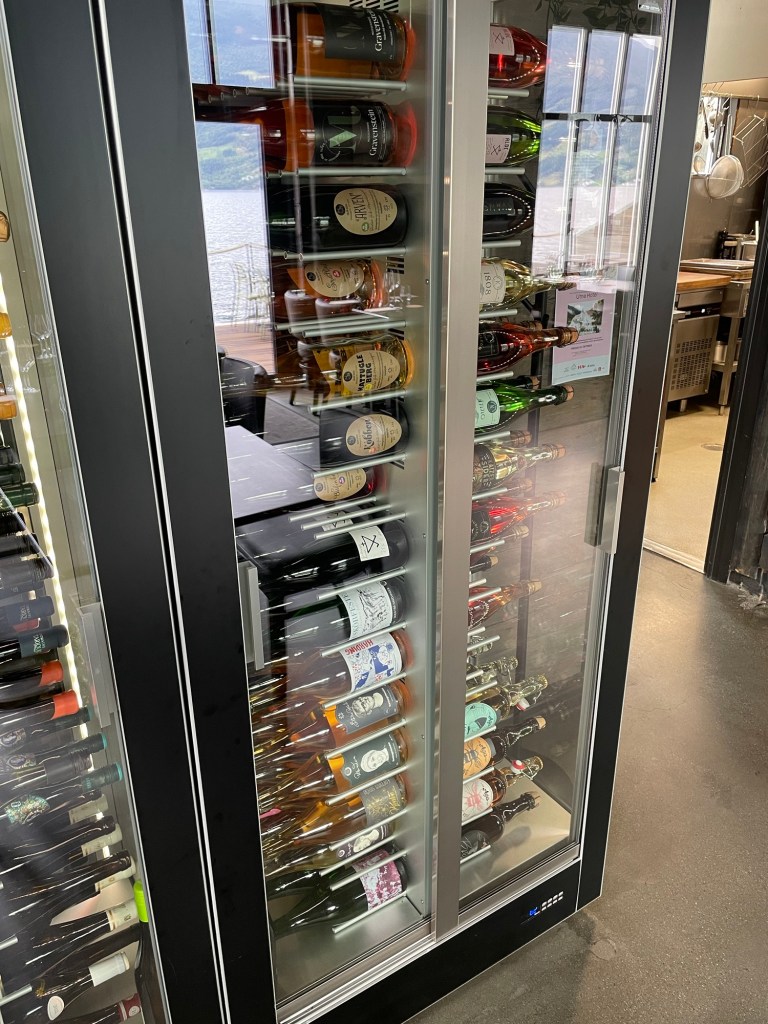
They are there in the establishment of a PGI to which all the makers I visit, or encounter at a festival in Bergen, subscribe. When I have dinner in the Utne Hotel, one of the oldest and most traditional hotels in the country, they are there in the presence of a cider list, and dedicated cider pairings, alongside the usual flights of wine. They are certainly there in Siderhuset Ola K, a dedicated cider restaurant on the Sørfjorden shore, in Nå, where the cider list stretches across a bewildering array of Norwegian bottles, from the immediate vicinity and further beyond, all presented like wine alongside some of the best seafood I’m ever likely to eat. And they are certainly there in the inaugural Bergen Bobler, a festival of cider (with a small nod to other sparkling drinks) held in the heart of Bergen with ciders from right across the country and beyond; an opportunity to taste Norwegian cider joined up to a degree never previously achieved, dreamed up and brought to life by the unofficial brand ambassador of Norwegian cider, Thomas Digervold.
It is at this festival, and whilst talking to makers at associated events before and after, pouring out glasses with slices of pizza, chatting in quiet corners of bars or over coffees in the morning, that the true breadth and potential of Norwegian cider is revealed. Wild-fermented ciders, single varieties, traditional methods from close to Oslo and pet nats from bewilderingly far north, up in Sunnmøre and beyond; ciders made in more northerly latitudes than southern Greenland. There are varieties beyond ‘the big four’, ice ciders, co-fermentations. Even, praise be, Norwegian perry.

Norway’s cider scene is not yet fully-formed. How could it be? We don’t have a fully formed cider scene in the UK, and we make more than anywhere in the world. Arguably nowhere does. But Norway’s is certainly in a more fledgling place than the likes of France, Spain, Germany and the USA, and in some respects it shows. I’d love, for instance, for that albeit small degree of chaptalisation to be more broadly reconsidered, especially where the cider is being presented as a premium offering in a 750ml bottle. I’d love – and yes, there is a degree of personal taste here – a little less ubiquity to the residual sweetness.
But how many cider cultures have gone from virtually nothing on a commercial level to something approaching national – certainly regional – cohesion and establishment in the space of less than a decade? I would venture to suggest that, in this respect, Norway stands almost alone; certainly in the scale of its sophistication and development. There have been individuals, or small groups, of cideries that have sprung up and offered the same, or greater, quality in that time. Italy, and the Baltic countries, perhaps, have something approaching an established broader culture. But nowhere else has quite found its voice in the way Norway and particularly Hardangerfjord have managed, in an astonishingly short space of time. A year ago, dedicated Norwegian cider festivals hadn’t happened. Siderhuset Ola K has existed, in its current form, only as long as this website. The list of commercial-scale producers in Norway, before the law change in 2016 was virtually nil, now you can buy 750ml bottles of full-juice cider at Bergen airport. Astonishing, in a place that so many people not inducted into this cider world of ours might imagine to be beyond the limits of where apples can even ripen.
Development will no doubt continue. At the Bergen Bobler I spoke to Hardangerfjord producers who are beginning to eschew chaptalisation. To take risks with yeasts. To push at the boundaries of styles and approaches. But, as I said of the perrymakers of Mostviertel, I think their decision to first set a minimum baseline of quality; to cement an image of cider in their consumers’ heads as a drink without faults, approachable by anyone, but offering the reassurance of a familiar 750ml package, is wise and brave. You establish a piste before you start venturing off it, and by that measure Norwegian cider is in a very good place indeed.
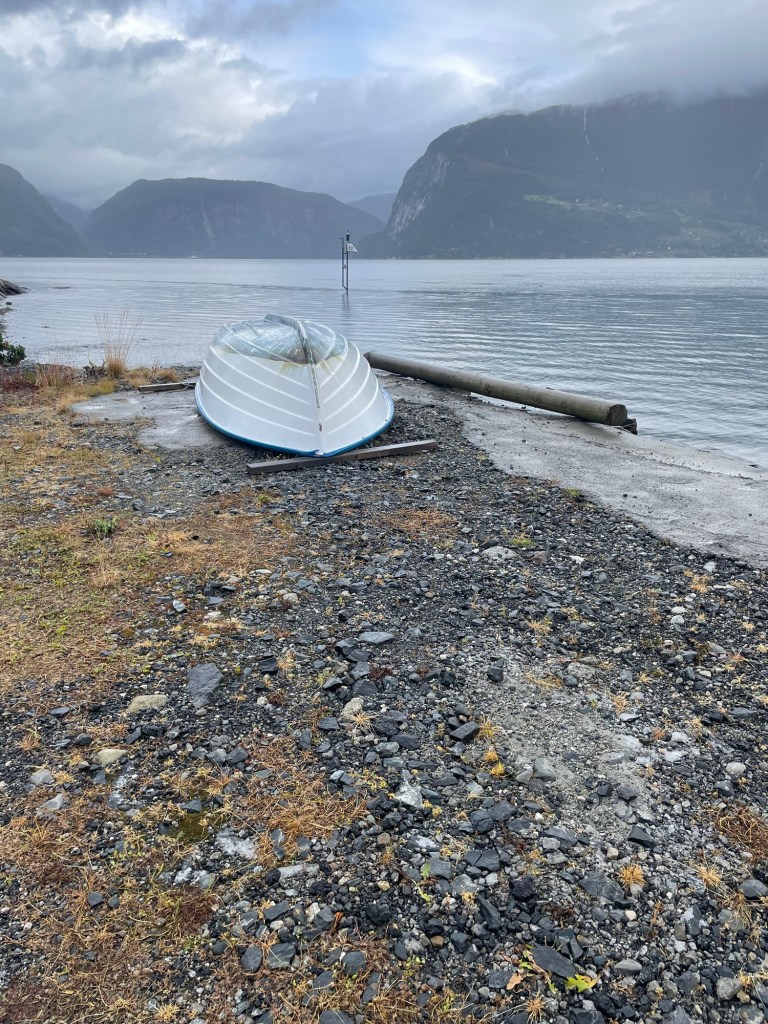
And so back, then, to the shores of Utne. To the rocks and the stillness, the hanging fronds of mist and the iron-cold, iron-grey water. Still the picture seems barely to move; the apples behind me, speckled with raindrops like jewels, hang lonely and expectant in the cold northern air, like an orchard at the end of the world. No one else is out; not the slightest sign or sound of life. Even the ferry seems to be frozen. But there, heartbeats later, the disturbance of ripples behind it; fissures through the water’s surface. Still far-off yet. It won’t arrive for a while, but that doesn’t matter. This place, and its cider, has waited long enough. It moves. It breathes. It is on its way.
This article was made possible by a free press visit to Hardangerfjord covered by Fjord Norge and Visit Hardangerfjord and facilitated by Thomas Digervold, who also provided me with a speaker’s guest pass to Bergen Bobler. That said, we have retained all editorial control over the content and any opinions expressed here. Many thanks to my guides, Kristoffer and Hege, and particularly to Thomas for organising this opportunity.
Discover more from Cider Review
Subscribe to get the latest posts sent to your email.
 Cider Review
Beautiful writing Adam. I still maintain that you are the best writer in the Cidersphere and tis article proves it!
LikeLike