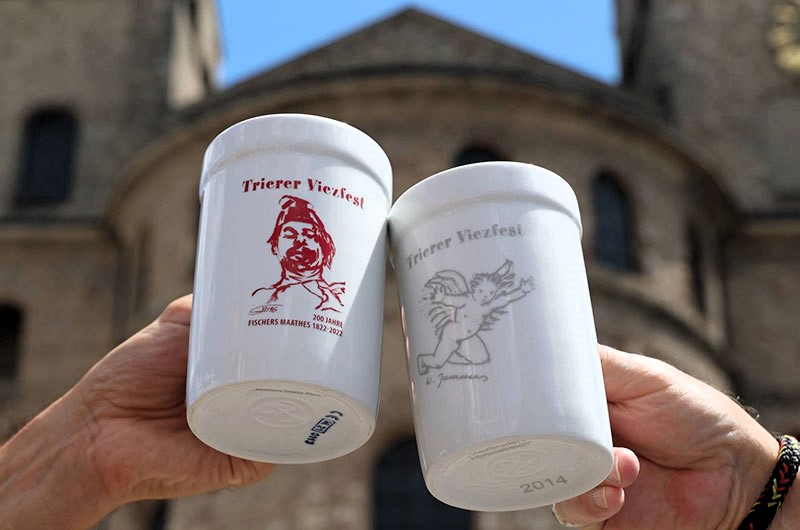
Viez.
With the German v being pronounced like an f, and z making a ts sound, “feets” would be a good phonetic approximation for English speakers. It’s the local name for cider in the far mid-west of Germany, a region where the Mosel-Franconian dialect is spoken. An area ranging northwards from the tiny state of Saarland, along the border with France and Luxemburg, to the Mosel region around the city of Trier at the northwest corner of Rhineland-Palatinate. A definite incursion into wine country up around there, but Apfelwein has long been associated with that region, too. While the Beerewei(n) perry tradition of the region may have vanished in the nearby western Palatinate, the traditional ciders of this region seem to be enjoying a revival in recent years.
I first tasted Viez at Frankfurt’s CiderWorld in 2023, an example from the Saarland as I recall. If I’m to be brutally honest, it was like battery acid, and that’s saying something for a country where acid is the very mark of a quality cider apple! And that was basically what I thought of as Viez and I left it at that. Until I was researching that article about the lost perry culture of the western Palatinate. There was so much crossover with Apfelwein from that region, particularly combined with mentions of the city of Trier in historic documents, I had to stop myself falling down another rabbit hole. And then a chap called Ernst commented on the article, making me aware of the Viez Brotherhood, a citizen-led group dedicated to preserving the Viez traditions of the region. Indeed, one of their achievements was successfully applying for Viez to be added to Germany’s list of intangible cultural heritage by UNESCO in early 2024 (where it joins Hessian Apfelwein, and sits alongside Berlin’s Techno culture), so I think it’s about time to drop into that rabbit hole and take a closer look at Viez and the culture surrounding it.

What does Viez mean?
Most global cider fans will think of Apfelwein as the generic name under which German cider is sold. But there are other local names, such as ‘Most’ in the region I live in, or Ebbelwoi colloquially around Frankfurt. In past centuries Cider and Cyder was briefly used interchangeably with Apfelwein in German literature. But Viez, now there’s a rather different name for this apple-based drink, where did that come from?
There seems to be a lot of mythology about the word Viez. The city of Trier has a page on its website giving one theory.
“When the Romans moved north, they had to forego much of what they loved at home in the warm Mediterranean region ‒ wine for example. And so they discovered another inebriating potion, the apple wine or cider. It became a substitute wine while the newly planted grapevines grew. As a representative of the wine obtained from grapes, the Roman cider was called ‘Vice Vinum’… so it is told. Whether this story is true cannot be clarified anymore. But the name has remained: Viez! This is what cider has been called since time immemorial in the region between the Moselle and Saar”.
The statement that this local cider has been called Viez since time immemorial is a tough one, as is the tale of where the name came from, as we’ll see later. The earliest written record found so far of the word Viez in reference to the local cider only goes back to 1834, when a poem attributed to Philipp Laven, a poet who wrote in the local dialect of Trier, was published in the second edition of Treviris, the “Trier Archive for Patriotic Studies”. I have done my best to translate it below, however I am sure there are some mistranslations as neither I nor my neighbours speak the Mosel-Franconian dialect, but I think you will get the drift.
A Song of Viez
The Viez is a favourite drink,
We like it better than wine;
If you always drink it, you won’t get sick,
You will always be cheerful.
The Viez, I’ll say it again,
It’s better than the wine;
No one will count the number of barrels,
That are now already drunken.
The wine is so bad it’s in your head,
You’re just drunk on it,
You give out money at a gallop,
The devil could have enough of it.
The schnapps can be taken from me
It burns away your heart,
No glass of beer comes into our hands:
You get too stupid, like a sheep.
It’s not like that with Viez.
We drink a whole bucket,
You talk and smoke your pipe,
You still get home all right.
For 18 pennies you can buy
A measure of the very best Viez,
You sip in so sweetly,
Anyone who doesn’t know that is a fool.
How good it tastes with bacon,
with meat, cabbage and fish!
You can’t get away from the spot,
We love Viez on the table.
My wife likes the drink herself,
She goes quite often with her husband,
She drinks from the Porz with me on the bench,
On me the little eyes.
And we go home in the evening,
So she grabs me by the neck
And inclined to laugh and be so happy,
And I, I am also so.
Whoever has something against the Viez, come,
I’ll beat him crippled and lame,
Follow me and knock the vineyards down,
And we’ll plant lots of apple trees!
It’s a fun song, and I can’t help but be enthused by the idea of planting more apple trees in the vineyards (another topic we may return to later). But it does seem strange that this is the first recorded use of the word Viez, like it sprung out of nowhere while hinting at a familiar usage. So far there has been no other documentary evidence found of the use of the word Viez for cider before this 1834 publication. Perhaps it was simply used colloquially for some time before being written down, though I find that strange given how much was written on the topic of Apfelwein in the region well before then, but then it was typically called Apfelwein or Apfeltranck (literally apple drink) in the 17th Century. Apparently, it wasn’t till 1890 that the word Viez even appeared in a newspaper advert.
Oddly, by 1843 the song was included in a book of German folk songs (Firmenich-Richartz, 1843), making me wonder how, if it had been first published only 9 years previously, would it be considered a folk song. So maybe Laven didn’t write it, and it was passed down orally to him? But that’s just me spit balling.
But on the origin of the word Viez, Leven had added a footnote, saying it came from the Latin Vice Vinum, meaning a substitute, or second-class wine. The city of Trier postulated above that this was because the Romans had to drink it instead of grape wine, while some other sources say that Vice Vinum was actually a piquette, a wine made from a second pressing of grape pomace mixed with water, to English-speakers, a ciderkin in the case of apples. But it seems that Leven’s footnote is where that particular origin story was born, repeated until it became the accepted truth, even to today.
There were other theories, that it came from vitis, the latin for the vine itself, but linguist Johannes Kramer did some intensive studies on the etymology of Viez in several papers. In one, he closes the door on the idea of it coming from the Latin Vice Vinum.
“The pretty and repeatedly distributed explanation that there is Latin vice vini, because Viez instead of wine was drunk, unfortunately cannot withstand the Romanistic scribbler: vice with its short ẽ in free syllable could never lead to i with hereditable development, and if we had to do it with a “learned word”, for example from the environment of the monasteries – then there would have to be evidence in Latin or German documents, and that is not the case” (Kramer, 1998).
In the paper I quote from, Kramer explores a lot about the etymology of cider and perry from Latin and Greek, well beyond the scope of this article, but for the Viez he ends on one plausible explanation.
“The latin faex [dregs] … could be used for all forms of Nachwein [a German term for a wine similar to piquette, but seemingly also including wine lees residuals, perhaps ‘yeast press wine’] … The Nachwein was a despised drink for the slaves and the servants [here he references Cato], and because of its low alcohol content it was administered to the elderly and the sick. So we are dealing with low-quality wine. It would now be quite conceivable that in the Latin colloquial language of the Moselle region, faex not only referred to the Nachwein obtained from grape yeast but, without regard to the method of production, to any inferior wine – yeast wine, pomace wine, fruit wine. This by no means particularly daring assumption would offer the semantic prerequisite for faex to be used as an etymon for Viez.
If we weigh the two etymologies proposed here for Viez, … with faex the initial form and phonetic development are of the most desirable clarity, and the assumed semantic development of ‘wine yeast’ > ‘low-quality wine produced from wine yeast’ > ‘low-quality wine’ > ‘fruit wine’, is by no means far-fetched or even risky.”
I’m no linguist, but even I can follow this reasoning, and it maintains an important cultural link to the history of the Mosel-Franconian dialect. But I’m quite sure the vice vinum story will persist, as “substitute wine” sounds considerably more appealing than “the dregs”!

Viez in History
While the name Viez might not have been written down till the first half of the 19th Century, the region definitely has a long history of Apfelwein making and drinking. In the Viez Brotherhood application to UNESCO, the author explains that like any other product and social practice, Viez in the region was historically subject to a social tension characterised on the one hand by the consumers’ desire for a drink that meets their needs, and on the other by the interests of those in political power who determine the social framework. Some things have not changed. Formerly considered a “poor man’s drink”, Apfelwein in the region became a political issue in the 17th century when farmers began to plant more and more apple trees in vineyards owned by monasteries. Before they had Leven’s song! Unlike wine, the apples and the drink produced from them were not subject to tithes, which enabled the farmers to earn a better income but reduced the income of the monasteries, leading to a case before the imperial court. I’ve mentioned before that researching historical cider and perry culture is made more difficult by this very fact, as taxation means records are kept, as with beer and wine, but cider, that was for the peasants.
However, there were also tensions in the other direction. Apparently during periods of French occupation in the region, while some of the monasteries fought for the removal of apple trees the French prefects were encouraging the expansion of fruit growing and the making of fruit wine – Apfelwein being one such fruit wine. But they encountered resistance from large sections of the farming community who were unwilling to accept the prescribed varieties and production specifications. I wonder if they had, would Germany also have developed a tannic apple culture of its own, but that’s me becoming fanciful.
Nevertheless, in 1787, such was the consumption of Apfelwein in Trier that, in order to protect the wine trade, the city authorities imposed limits on how much citizens could bring into the city for their own use. 160 litres were allowed for each person, and anything above that would be taxed. But so beloved was the Apfelwein that the citizens were not too pleased about this, and two years later the limit was doubled.
Fruit wine production in the region took an interesting socio-political turn in the 19th century when health policy discourse considered cider as a suitable means of combating alcoholism. The relatively low-alcohol cider was considered an effective alternative for the rural population, in the hopes of curbing widespread drinking of spirits that had steadily gained traction. This seems in stark contrast to the Swiss situation which considered the mass destruction of fruit trees to be the best solution, not that they held out for much longer in the Palatinate.
Nevertheless, as I have probably repeated ad nauseum in other articles about Central European cider and perry culture, changes in agricultural practices and indeed lifestyle from the middle of the last Century meant that cidermaking and drinking lost a central role in rural life. With a huge loss of fruit trees due to rationalisation of the farming landscape, and easier access to alternative drinks, Viez was relegated to being something for old people, a relic of another time. But that is changing.

The Viez Brotherhood
Founded in 2010, the Trierer Viezbruderschaft is a group focussed on the preservation of local history and culture surrounding Viez, as well as the preservation of typical regional orchards that are so tightly bound to the culture of the drink.
In their own words, “The primary aim of the association is to preserve and develop the traditional status of Viez, its production processes, the customs surrounding Viez and the associated Viezporz for the general public.”
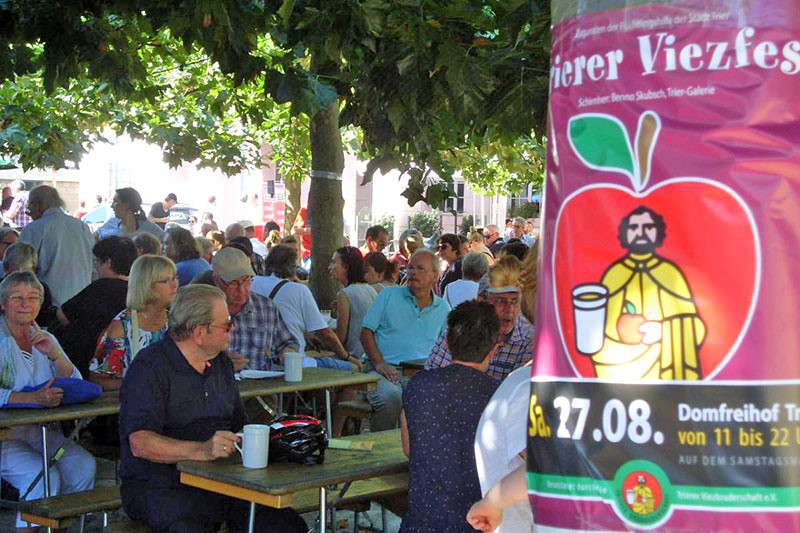
While it started with a group of nine Viez enthusiasts based around Trier, their goals were quite impressive. Since 2012, they have organised a biannual Viez festival, the Viezfest, in Trier which sees 2,000-3,000 visitors to the weekend event. They published a book on Viez in 2020, successfully added Trier to the formal Viezstraße (Route du Cidre), and as already mentioned, successfully lobbied to have Viez recognised by UNESCO as part of the intangible cultural heritage of Germany.
I think those achievements alone indicate that there has been quite some turnaround in the fortunes of Viez compared to cider traditions in some other parts of Germany, but it’s certainly not time to become complacent, and I doubt this small group will sit back too soon.
With a current membership of 29, two of which are makers, the Viezbruderschaft can be seen as a small, citizen-led marketing organisation, having partnerships with many Viez producers, the Viezstraße association, tourist offices and everyday people who care about Viez. With the growing popularity of Viez, they recognise the potential for an umbrella organisation that would give the Viez as a product the attention and promotion it needs, but I imagine that would require a different structure than the current organisation.
What differentiates Viez from Apfelwein?
I generally consider cider, apfelwein, cidre, sidra, most, ebbelwoi or whatever you want to call it, all part of a big cider spectrum, but there are usually regional differences, often based on the fruit or methods used, that can help define how one of these regional iterations manifest. In the case of Viez, I had just assumed it’s what they call Most or Apfelwein over there, but my own views have been refining, tweaking out general differences and broad brushstrokes that can define a region’s approach.
I had asked Ernst Mettlach, a member of the Viez Brotherhood, what he saw as the main differences between Viez and Apfelwein, considering how close the two regions are. “What differentiates viez from Hessian cider is that we lack large, commercial producers. The tradition of making viez was a domestic, familial one and that is a strength and a weakness. With the death of part-time farming and the industrialisation of agriculture, this tradition is also declining. Hence the club. We would like to preserve and strengthen this tradition and see ourselves as a lobby organization, but not for profit.”
To my mind, this keeps it close in concept to the Most of Baden-Württemberg which very much stayed an agricultural product, while by 1903 Frankfurt was described by the US Department of Agriculture as having “Apfelwein factories”, at the time the largest and most advanced cider-producing facilities in the world. But it also confirmed my feeling that the biggest differences are cultural rather than something in the product itself. But I felt it best to ask some makers in the region on their thoughts.
When I chatted with Dirk Kirsten of Lampadener Viezjungen, a small cidery producing both traditional and more modern interpretations of Viez, about his perceived differences between Viez, Apfelwein and Most, he gave me some fascinating background.

“Personally, I don’t think there’s much difference between Viez and Ebbelwoi or Äppler from Hesse. I have tasted a lot of Hessian cider in the past. People always say that Viez is particularly sour and tastes different to Ebbelwoi, but that’s not really the case. A properly matured Viez is absolutely comparable to the Äppler from Hesse. It is said that Viez used to have a certain sharp acidity, and perhaps some producers still attach importance to this today, because for some seasoned Viez drinkers this acidity is certainly a must. However, the majority of Viez available on the market today tends to be produced in such a way that it also tastes good to the masses. Without being a mass product, that should not be misunderstood.
I can certainly achieve a dominant acidity in Viez by using apple varieties such as the White or Red Trier Wine Apple, or the Erbachhofer. We tried this out a few years ago and, lo and behold, some of our customers were delighted, but the majority did not like this acidic cider. However, many of these varieties have disappeared more and more in recent years, or I should say are no longer so common, as the trees are no longer cared for and are falling into disrepair, unless they have been deliberately replanted.
As a result, growers are increasingly resorting to other varieties which are less acidic. A few months ago, a pomologist from Trier told me that the Rheinischer Winterrambur is the most common apple in the Moselle-Franconian region. It is not a pure cider apple, but rather a dessert apple which, when used predominantly in Viez, results in a rather mild flavour. And so the ‘modern Viez’ is increasingly losing its original reputation as a sour cider.”
The sour character mentioned by Dirk, and often mentioned with a grimace when people from outside the region have tried Viez, is something that’s hard to get around, so it’s interesting that this might be changing. Writing about Viez in 1993, Walter Ludwig stated that the “Viezologen”, the old gents who specialised in drinking Viez in local bars “swore that the Viez was right when it was sour.” But I was never sure if they meant sour in the sense of lots of fruit acid or if it becomes acetic.
“Well, if you talk to the older men in the village”, Dirk told me, “This is what they always tell you. In days gone by, Viez was a staple of every farmhouse, the fruit from their own orchards was pressed and fermented into Viez. This was then stored until the following autumn in old wooden barrels, usually somewhere in the barn or cellar, and drunk until the barrel was empty or the contents were no longer drinkable. Of course, you can imagine what cider must taste like if it is drunk from a half-full wooden barrel, exposed to oxygen, over a long period of time. A lack of cellar hygiene when processing the fruit naturally favoured this transformation. So it is easy to explain how this definition could have come about, that Viez always tastes particularly sour and not particularly good either.”
I can sympathise. Viez is not the only traditionally made form of cider in Germany, indeed in the world, that suffers from this preconception. The traditional Most of the region I am in is also usually given the side eye, as many only know it from the permanently tapped barrel in their grandfather’s cellar slowly transforming into vinegar. But a new wave of small cider makers across Germany is changing that perception.
The apple varieties
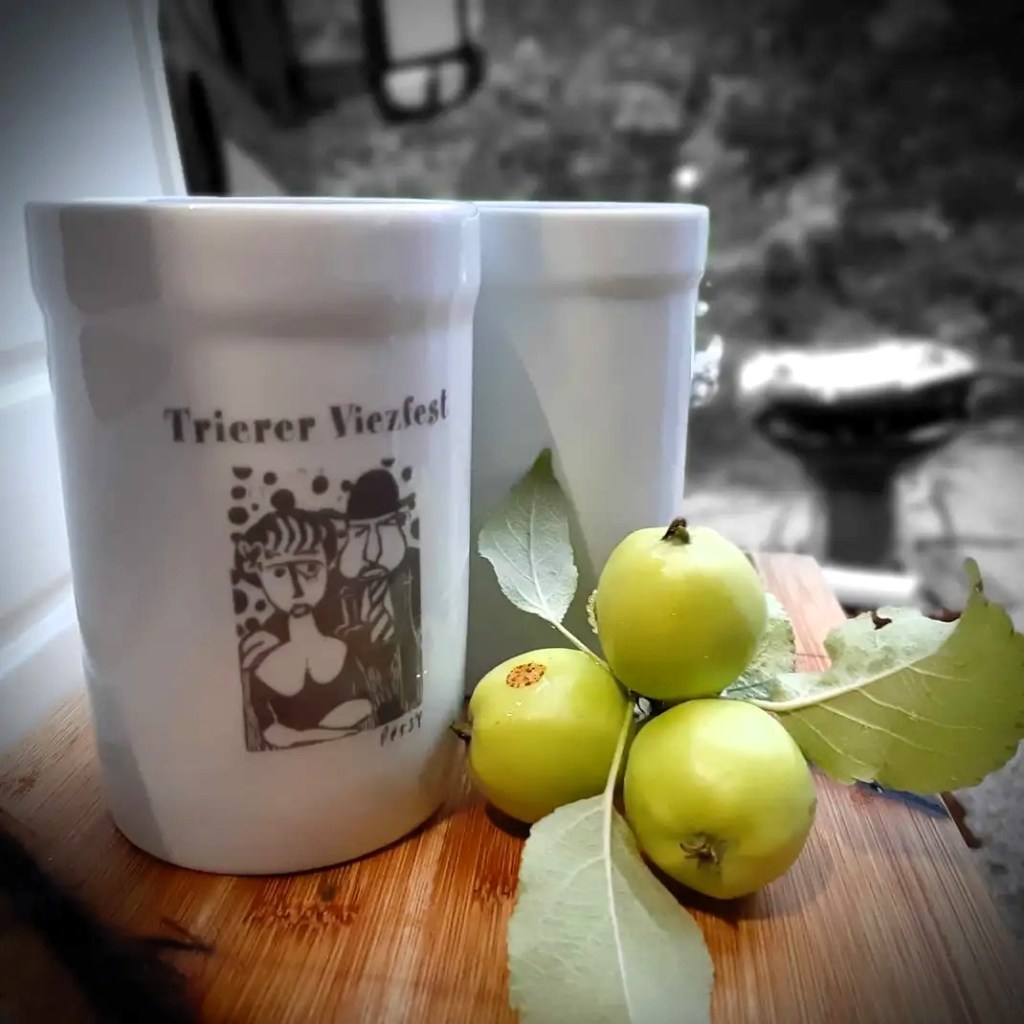
Axel Christmann, current chair of the Trier Viez Brotherhood, told me that the terroir and varieties used to make Viez are two of the things that characterise it. Helpfully, the Viez book published by the Brotherhood has a list of varieties they consider suitable for making Viez. There they list Biesterfelder, Rheinischer Bohnapfel, Erbachhofer Mostapfel, Roter Trierer Weinapfel, Hauxapfel, Geheimrat von Oldenburg, Jakob Lebel, Rheinischer Winterrambour, Jakob Fischer, Brettacher, Ontario, Baumanns Renette, Glockenapfel, Winterzitronenapfel, Schöner von Boskoop, Kardinal Bea, Roter und Gelber Bellefleur, Schöner aus Nordhausen, Wiltshire, Porzenapfel (Trierer Viezbruderschaft 2020).
Many of these I would say can be found across southern Germany, and certainly many are popular across northern Baden-Württemberg, so not specific to Viez culture. But there are some that are quite special to that region. Dirk mentioned the Red Trier Wine Apple (Roter Trierer Weinapfel), one of the most famous varieties of apple from that region, and as the name suggests considered a very good apple for making an Apfelwein. This has also spread out so even we have a tree in our old orchard. Porzenapfel I had never heard of, but it originated around Trier in the 1920s, and the name links it to the Viezporz drinking vessels, another good sign. In general, as per German tradition, mostly quite acid-led varieties.
I wondered if the timing of pressing was a factor. An experienced pomologist from the Frankfurt region, Werner Nußbaum, recently told me that he had to carry out his mapping activities for local municipalities around Frankfurt before mid-September, as after that all the fruit had been harvested for Apfelwein. In German fruit circles there is a differentiation made between baumreif, or “tree ripe”, and genussreif, or “ready to be eaten ripe, as some varieties require some storage time to fully develop their flavours. The logical suggestion Werner was making was that they were pressing unripe fruit which would naturally deliver a higher acid profile.
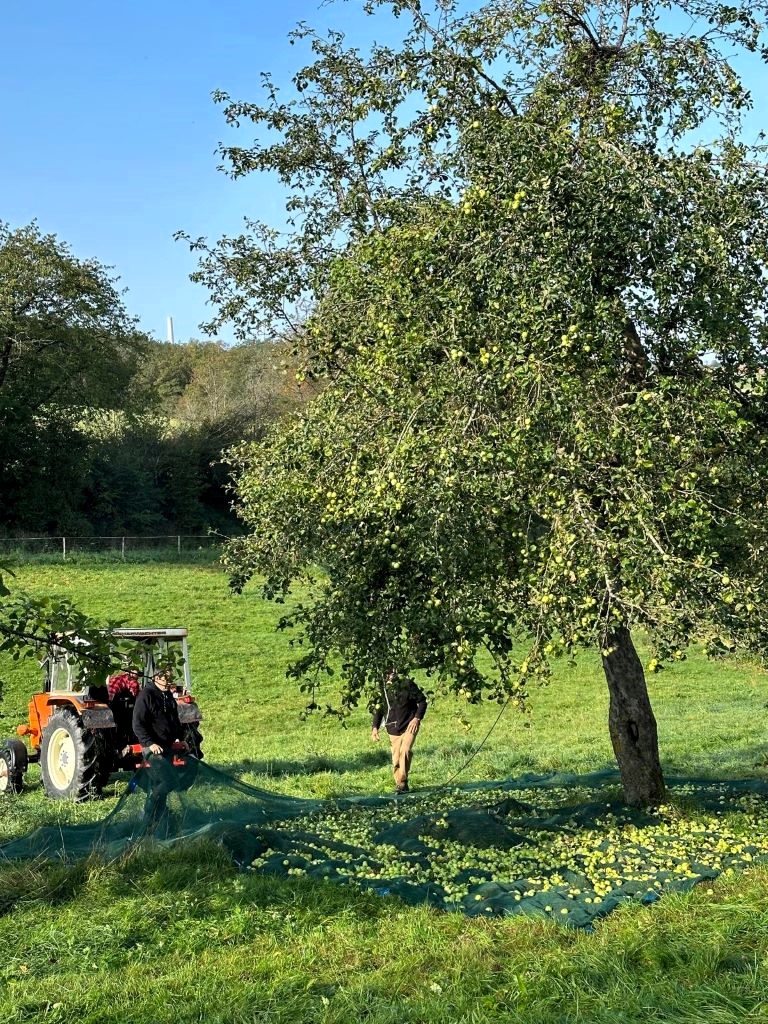
I recently mentioned this to a small maker from the Frankfurt the region and he took exception, but another person from the region, with whom I recently shared a long car journey, confirmed it. Kevin, who is involved in a project to map meadow orchards with an eye to see how they are faring in climate change, told me that the large Apfelwein manufacturers have their delivery dates for growers often in September, but the better ones stagger their dates. So not saying they all do it!
But could high fruit acid Viez come from a similar practice? Certainly, in my own region, many people harvest their apples in one go, shaking everything down and pressing them the next day, which will give the Most a bigger fruit acid hit. I asked Dirk if this is also the practice around Trier. “Yes, that is the case. The trees are generally shaken at the same time and the apples are then pressed. Everyone does it that way. Nobody really differentiates between varieties and ripeness. Some producers may harvest a little later than others. That’s the only thing.”
As to why? Tradition probably, for practical reasons not wanting to extend harvesting or pressing period over months, getting it over in one go. One might conclude that this practice could be to the detriment of aroma and flavour, but it is part of the culture that lends traditional Viez its particular character.
What makes Viez culture different?
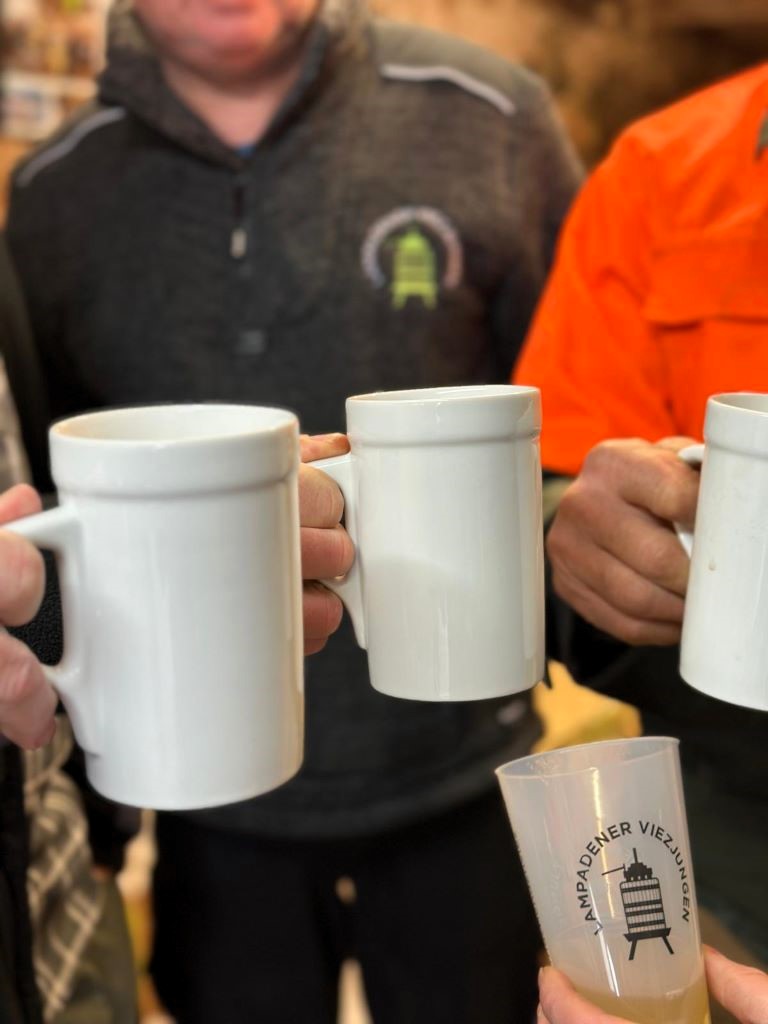
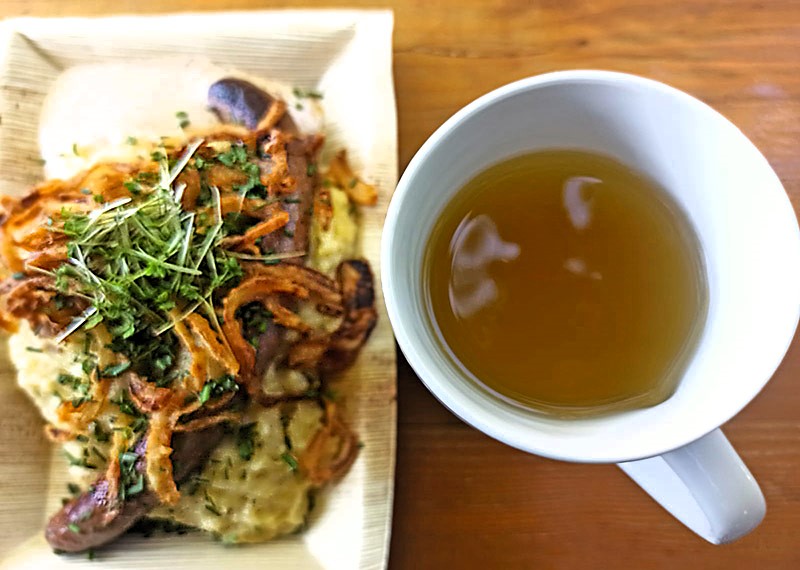
One of the physical ways that Viez culture differentiates itself from the neighbouring Hessen Apfelwein culture is the vessels from which it is traditionally consumed. While Frankfurt has its Geripptes, the diamond-patterned glass, and the stoneware beakers that match the round-bellied Bembel jugs, Trier uses a white, handled mug called a Porz. Typically in a 400ml size, the Viezporz has a simple, straight shape, made of white ceramic with a wide drinking rim.
The oldest recorded Viezporz was made between 1876 and 1893 by Villeroy and Boch, a ceramic company that is still very well regarded today (we have wedding gift to prove it), and headquartered in the Saarland, very much in Viez territory even then. Listed in the catalogues simply as a straight-side beaker, it was produced by V&B probably up to the 1930s, and then other companies started producing to more or less the same design. Some of these older designs can be seen on Museum pages of the Viezporz website.
Some literature attempts to link the name to the Romans and Latin, with one theory suggesting it comes from Portio, a measure of drink. But it seems far more likely that Porz simply comes from a diminution of the material it is made of, porcelain, as the form of the beaker only dates back 150 years.
I asked Axel of the Trier Viez Brotherhood about the emotional ties people might have to Viez, as well as the terroir.
“Viez is deeply rooted in the people who live here; they feel it is a unique part of their homeland. What is interesting here is the parallel with our home dialect, Mosel-Franconian. The Saargau, where the Saarland’s Viez is produced, ends between Merzig and Saarlouis. On the one hand, this invisible border is the dialect boundary between Mosel-Franconian and Saar-Palatinate, and this is where Viez production ends or begins. I don’t know exactly why this is the case, but it shows that there are strong cultural and local connections here.
This is also confirmed by the fact that in the Sauer region, the natural German-Luxembourg border, the orchards of the German and Luxembourg Moselle vineyards lie opposite each other, separated by just 30 metres of water. There in Luxembourg, there is also ‘Viz’, even if that is also the name for sweet, still-fermenting Viez.”
This again suggests a mostly cultural definition, strongly tied to the Mosel-Franconian identity and dialect rather than a strict terroir or apple variety definition. And that is more than enough to make it culturally significant. But in what ways does that culture manifest differently when compared to neighbouring regions?
Dirk expanded. “In the countryside, Viez was one of the staple foods. Beer was rare and hardly available, and Moselle wine was simply unaffordable for the poorer classes. Viez was the only alcoholic drink that the population could fall back on, simple and affordable. This is how the typical Viez culture of our region developed: in the villages, people drank Viez in the fields and meadows, and in the evening with their neighbours in front of the barn or in the parlour. And in the city, people met in the typical Viez pubs, which were once so numerous and so well-known on every street corner in the city of Trier.”
Again, strong parallels here with the Most tradition which remained an agricultural pursuit in the villages of Baden-Württemberg, also suffering a strong decline in the past half century. But Viez pubs on every street corner? Now there’s a strong culture! Only the Sachsenhausen quarter of Frankfurt am Main can still claim such a vibrant, cider culture in Germany today.
Modern Viez
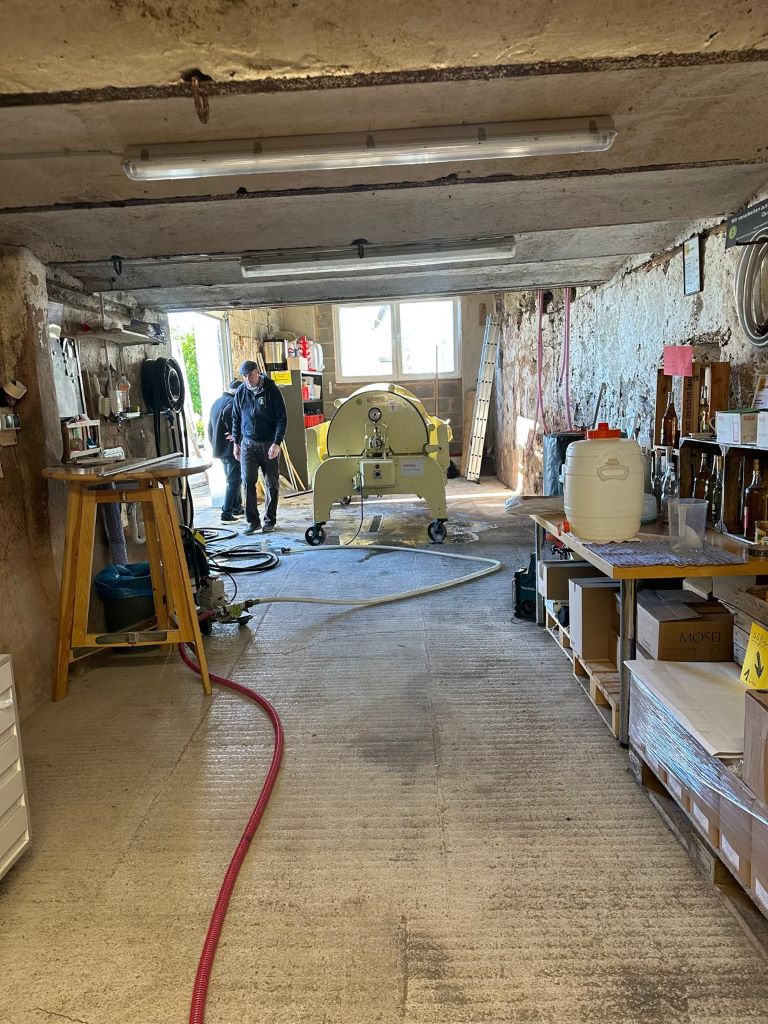
As In most other cider regions of Europe, it seems that in the 1960s, fruit growing experienced a major crisis and Viez was threatened with extinction. The partly obsolete full standard trees fell victim to the land consolidation and road construction that pushed across Germany from the 1950s. A wave of new prosperity greatly reduced the consumption of Viez in the Trier region as young people switched to other drinks. However, it would appear that Viez has been experiencing somewhat of a renaissance in recent years. I asked Brother Axel about the slow rise in interest, and what that could be attributed to.
“Interest is always generated through public relations work. That was also one of the reasons our founders had in mind when they formed the Brotherhood 12 years ago. And you can see it best in the fact that our efforts, first with the Viezfest in Trier, and most recently with the UNESCO application and success, have significantly increased interest in Viez and brought Viez from our Moselle-Franconian corner of Germany to the attention of a wider public. The former ‘poor people’s drink’ is now culture! Viez didn’t really have a lobby, but that has now changed for the better!”
And what about the style of the drink itself? Axel again: “Viez has become somewhat milder, without losing character, and thus appeals to more connoisseurs. Let’s put it this way, Viez has become a little more sociable.”
And what do the makers say? Dirk on the modern Viez scene: “In recent years, Viez has experienced a real renaissance. A well-known brand that sells cider in a can has certainly contributed to this. However, the contents of these cans are not Viez, and artisanal Viez is certainly not comparable with such a mass-produced product. But it has brought cider a little closer to young people in particular, which I don’t think is a bad thing. Because today, Viez is more popular than ever.”
I won’t make you read between the lines, he is most certainly referring to ‘Bembel With Care’, originally a contract brand cider started by a man who was forced to exit in 2020 after posting a picture of himself in a Nazi uniform to Instagram on Victory in Europe Day (referred to as Liberation Day here in Germany), but now continued by the then contracted maker, Kelterei Krämer. It is everywhere, even in our village supermarket, and comes in 500ml cans premixed with sparkling water, cola, or cherry, and a “pure” version at 6% ABV.
“When I was young”, Dirk continued, “I used to visit a typical Viez pub in the Trier region with a few friends from time to time. Here, the Viez was still brought out of the cellar in a stone jug and served in the Porz. Back then, you could only really enjoy this drink if it was mixed with cola or lemonade. A lot has changed since then. Nowadays, artisanal Viez is easy to drink, and the modern scene has developed to the extent that Viez has been accepted as a regional drink by young and old alike and is once again accepted as the drink of our region.”
Perhaps Bembel With Care had a kind of German Magners effect, raising the awareness of local cider cultures. But it is surely double-edged as it is very cheap, about €1,25 for a half litre can, perhaps reinforcing expectations on price that are unsustainable for small, artisanal makers. Recently I noticed some wine makers in the region selling Viez, perhaps jumping on the bandwagon as cider becomes a small trend, but selling it at a far lower price point than their wines, perhaps underscoring that it is perceived as an inferior product.
“Traditionally, Viez was a drink for people who couldn’t afford wine, hence the theory that the name Viez comes from ‘Vize-Wein’, or substitute wine”, says Axel, referencing the myth. “In fact, Viez is still sold much cheaper today than wine or even beer. If a 0.4 litre Porz of Viez costs €3.00 here, it is perceived as expensive. For comparison: the industrially produced regional beer from the Eifel is sold here in the trade at €5.00 for a 0.4L glass! A price increase, which would be justified by the title of intangible cultural heritage, would trigger a great deal of protest from some locals. But it will be unavoidable, because after several poor harvests, the base costs have increased, wages have risen, etc. etc.
This is a complex issue where different views arise. The fact is, and we are currently working on this, that something must happen because the idea that ‘what is cheap cannot be good’ does not fit in with the value of a cultural heritage. Depending on the producer and their commitment, Viez can achieve a quality comparable to that of grape wine.”
Indeed. In wine-producing countries like Germany – and Trier is very much in the heart of the Mosel wine region – there are varying price points to cover all means, it’s not all posh and la-di-da. I’ve always believed that cider is and should be no different.
Viez as Intangible Cultural Heritage
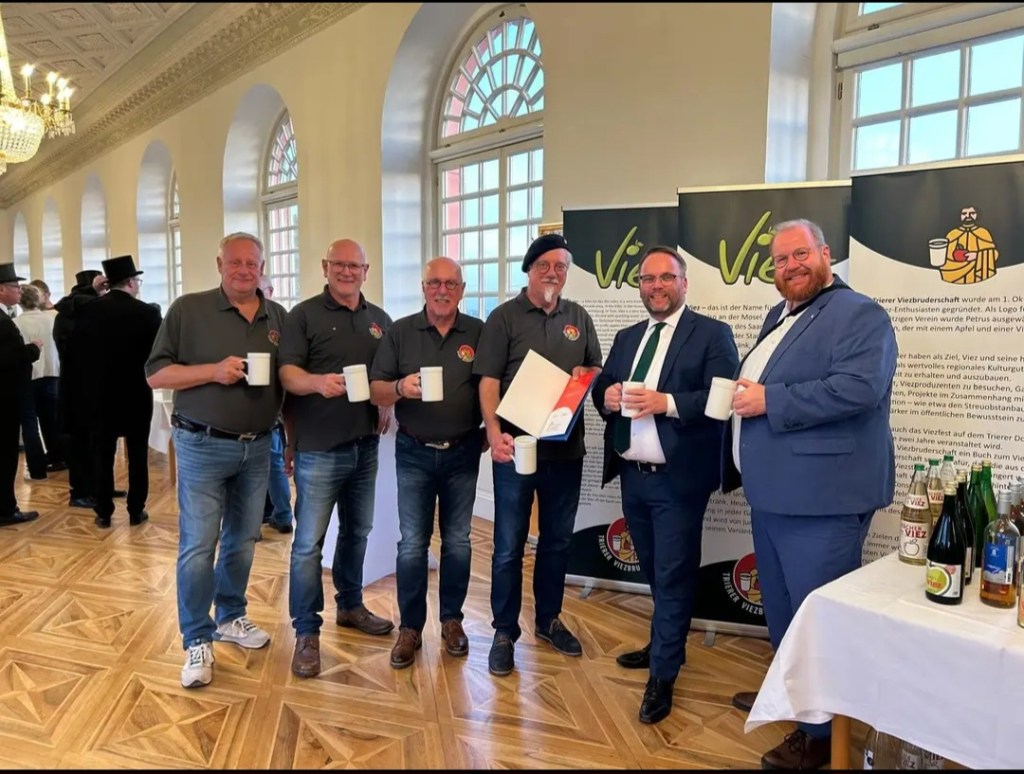
One of the real wins for Viez culture in the region this year was the aforementioned recognition of the tradition as an Intangible Cultural Heritage by UNESCO, based on the application by the Viez Brotherhood and hot on the heels of Hessian Apfelwein being awarded the same recognition in 2022. The German UNESCO Commission described the award:
“Viez is pressed from old apple, pear and quince varieties cultivated in the traditional meadow orchards. The cultivation strengthens biodiversity and characterises the image of the cultural landscape in the Mosel-Franconian language region. The production of these typical regional fruit wines involves, among other things, specific knowledge of nature and craftsmanship. Through the production of Viez in predominantly small, artisanal farms, knowledge about the handling, care and preservation of fruit trees is passed on. The expert committee recognises the fact that the cultural heritage community is also involved in public outreach activities, such as specific hiking trails and courses. It also emphasises the social and community-building aspect, for example through membership of associations or festive events.”
Obviously the Viez Brotherhood thought this important enough to do in the first place, but I asked Axel how important this recognition was for the preservation or further development of Viez in the region. “UNESCO recognition is immensely important and can and should become a driving force to take everything further. This year alone, we have been in the press twice, on television several times in Rhineland-Palatinate, and producers and restaurateurs are reporting growing demand. In an interview, I said: ‘Viez is on everyone’s lips’, in the truest sense of the word.”
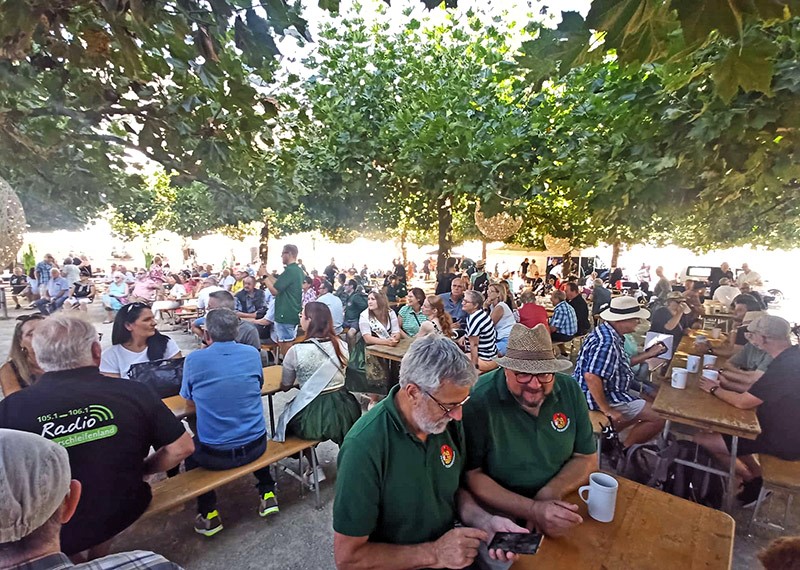
Viez in the broader landscape
While I have mostly focussed on the Viez tradition centred around Trier, it must be noted that this is just a small part of it. The Viez region stretches some distance, covering the Saargau region (the upland area between the Mosel and Saar rivers), the German-Luxembourg border area, and part of Rhineland-Palatinate up to Trier.
Indeed, there is a Viezstraße, a tourist route focussed on the Apfelwein, mirroring the famous Weinstraße. The 175 kilometre long looping Viez route leads from Merzig on the Saar via the Saarlouis Gau and the Saarburg region, darting a little towards the Luxemurg border, then up to the Moselle city of Trier. Along it there are listed 45 cideries, farm shops and other chances to buy Viez, not to mention a plethora of recommended restaurants, tree nurseries and general sightseeing opportunities. At the time of writing, the English version of the site does not work, but you can download a very good PDF in German that lists everything you need for a road trip.
Certainly, I will need to start looking at Viez from the southern parts of its territory but be aware that most Viez makers are very small and the vast majority of products can only be purchased locally, which also adds to the charm and mystique.
Personal conclusions
While I privately started out wondering what the point of a UNESCO recognition is for something that I didn’t see as all that different from other German cider cultures, I have been converted. It’s actually amazing to have any cider culture recognised and enshrined in such an award, and as each region can have its own special takes, even if “just” culturally, this is something that should be cherished and celebrated. The Viez Brotherhood, the makers, and all that contribute to this culture, should be rightly proud.
All these things are part of what we often describe as a global tapestry of cider. None of it exists in isolation, and none should revel in regional or national chauvinism, but it is exactly the small differences that make the world of cider so compelling. There are surprises waiting for you in that tiny corner of western Germany.
References
Firmenich-Richartz, Johannes Matthias. (1843). Germaniens völkerstimmen: sammlung der deutschen mundarten in dichtungen, sagen, mährchen, volksliedern, u. s. w, Volume 1. Berlin: Schlesinger. pp. 556.
Kramer, Johannes. (1998). ‘Cidre, Äpfeltrank und Viez‘ in Hummel, M. and Ossenkop, C. (ed.) Lusitanica et Romanica. Hamburg: Helmut Buske. pp. 85.
Leven, Philipp. (1834). Et Lied vom Viez in Treveris Nr. 2, 5. Juli 1834. Schönberger. pp. 4.
Trierer Viezbruderschaft e.V. (Editor).(2020). Viez. Trier: Michael Weyand.
Cover image courtesy of the Trierer Viezbruderschaft.
Discover more from Cider Review
Subscribe to get the latest posts sent to your email.
 Cider Review
Thanks Barry for a very informative and detailed article on Viez. I visited Zur Alten Saar near Merzig about 20 years ago and the landlord explained it then as being the vice or second to beer over a few pints of his excellent product. But he may have meant wine. I did have quite a few pints😊
LikeLiked by 1 person
Glad you enjoyed the article! 🙂
Yeah, likely second to wine, as the common myth goes. Beer probably comes third 😁
LikeLike
Thank you for a magnificent article. I got here while drinking some weißer Glühwein in a 2,0 cl glass that reads “Westricher Viez”. I got the glass (probably 🍺😵?) at the small Weinachtsmarkt in Trier over 30 years ago. Wondering what was up with Viez these days, I was led here by Mr. G**gle. Your enthusiasm is impressive: the internet for good and not evil. Now I look forward to trying your perry.
LikeLiked by 1 person
Thank you! So glad you enjoyed the read. 🙂
LikeLike
just back from Trier.
love the place and the Viez. Delighted to find great article. Thanks Barry.
Conor
LikeLike
Thanks Conor! Glad you enjoyed the article and the Viez. I’m working on a big Viez tasting. 🙂
LikeLike
Cool.
keep me posted.
what time of year is that roughly.
LikeLike
Pingback: Pyrus Invictus – Barry’s CraftCon 2025 Keynote | Cider Review
Pingback: A Viez MEGATASTING | Cider Review