
It’s six o’clock on Tuesday morning when the alarm squawks at me with the fervour of a klaxon on a submarine whose safety hatch has breached. I execute a poorly-co-ordinated, sleep-addled roll-and-swipe at the horrible thing and discover that my legs are communicating on a level of insistency not experienced since the day after I ran the Paris marathon eight years ago. My person has been intruded upon by an uninvited arachnid, it’s a four minute walk to the nearest toilet, the alarm’s still yodelling and I’m only one day in. The shower, thank Christ, is hot.
It is early October in Herefordshire. The apple and pear trees have begun to dump their fruits, the orchards clank and rumble with tractors and harvesters, the wasps are having a last hurrah and I’ve come to the Ross-on-Wye Cider & Perry Company to help with a week of harvest.
I am here for one reason and one reason only. Not because after years of writing about cider and perry I feel moved to understand it at a deeper level by immersing myself in its creation. Nor because the notion of honest labour in sweet, clean air sounds some ancient, luddite bugle in my soul. No. I am here because last year my cousin, Justin, now co-presenter on Cider Voice, spent a couple of weeks on the farm, and neither he nor Ross-on-Wye’s Albert Johnson has shut up about how I haven’t since. Where the spirit of altruism and the romance of harvest failed, whatsapp messages accusing me of shirking toil have succeeded with interest.
Arriving on the Sunday, intending to catch the last of the now annual ‘Rosstoberfest’ held at The Yew Tree, the pub run by Albert’s brother Martin, I am informed that toil, in fact, is to begin straight away in the form of a Frederick tree that needs picking. I am not what you might describe as ‘dressed for it’. Leather of jacket and black of jeans, an uncharitable but not inaccurate subsequent whatsapp group message reads ‘looks like a member of the Arctic Monkeys was let loose in an orchard.’ Nonetheless, keen to show willing and impress on my first day, I take a bucket and fall to it. It is then, when a couple of buckets are full and the ground below the tree is offering slimmer pickings, that I am introduced to the ladder.
Ross-on-Wye are, by common consent, one of the great aspirational cidermakers of the UK and, indeed, the world. Their handiwork has been praised by every contributor to these pages and just about everyone on cider social media. So you might expect that the purpose of the ladder is to elevate me into the Frederick tree’s leafy branches, where I might discerningly pluck the ripest examples of its bounty. But there you would be wrong. The purpose of the ladder, as Albert vigorously demonstrates, is to rattle the tree like Basil Fawlty thrashing his broken down car, bringing remnant fruits down with startling efficiency.
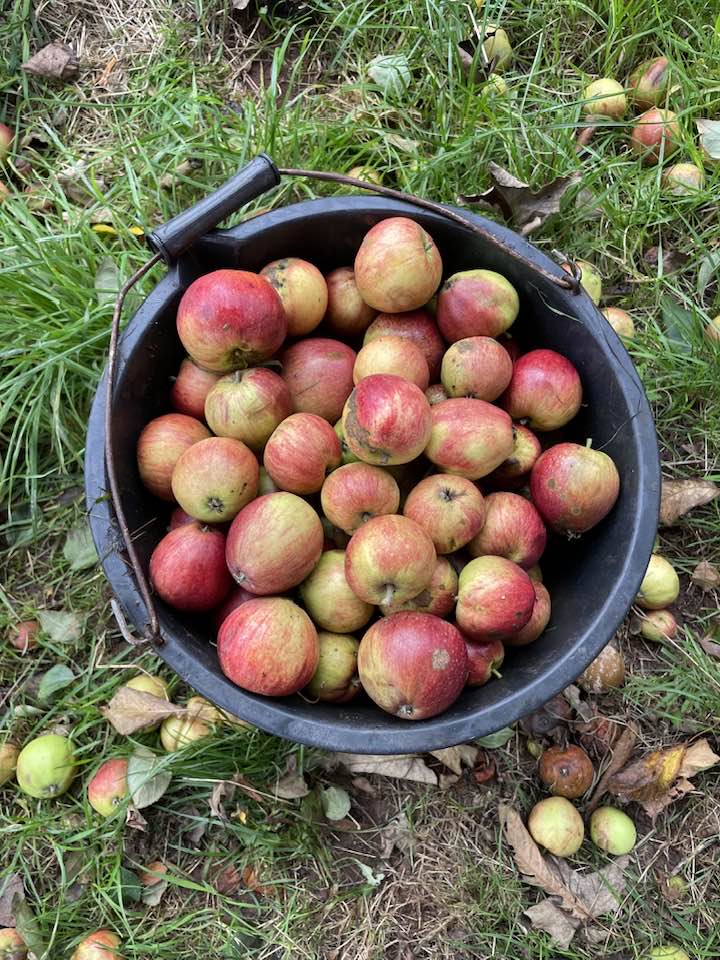
I do not recall the chapter on ladder battering in Gabe Cook’s ‘Ciderology’. I wonder aloud whether this is some manner of prank played on all new harvest hands at Ross. Apparently not. The traditional panking pole – the usual tool for loosening stubborn apples – is presumably elsewhere, and the ladder will do. Divesting myself of lingering uncertainties, I set myself to the task. And I will say this: the ladder method is nothing if not effective. Our buckets and sacks swiftly filled with Fredericks, Albert calls a halt and we make our way to the pub, me still wondering whether I’ve just been some Herefordshire cider version of punked. Certainly that’s the last I see of the ladder method for the week.
Determined to capitalise on this positive start, and having been given to understand that work began on the dot of 8am, I report to the barn at 7:40 where the day begins promptly at 8:37 or thereabouts after breakfast and coffee and a bit of a natter. Not having a pair of my own, I’m directed towards the library of wellies that fringe two sides of the barn. ‘Make sure you check them for mice,’ advises John, the head cidermaker. The pair I pick are happily rodent-free but robustly lined with cobweb. By the end of the week I have concluded that they are also occupied by invisible creatures hiding in the toes whose sole purpose is to steal my socks.
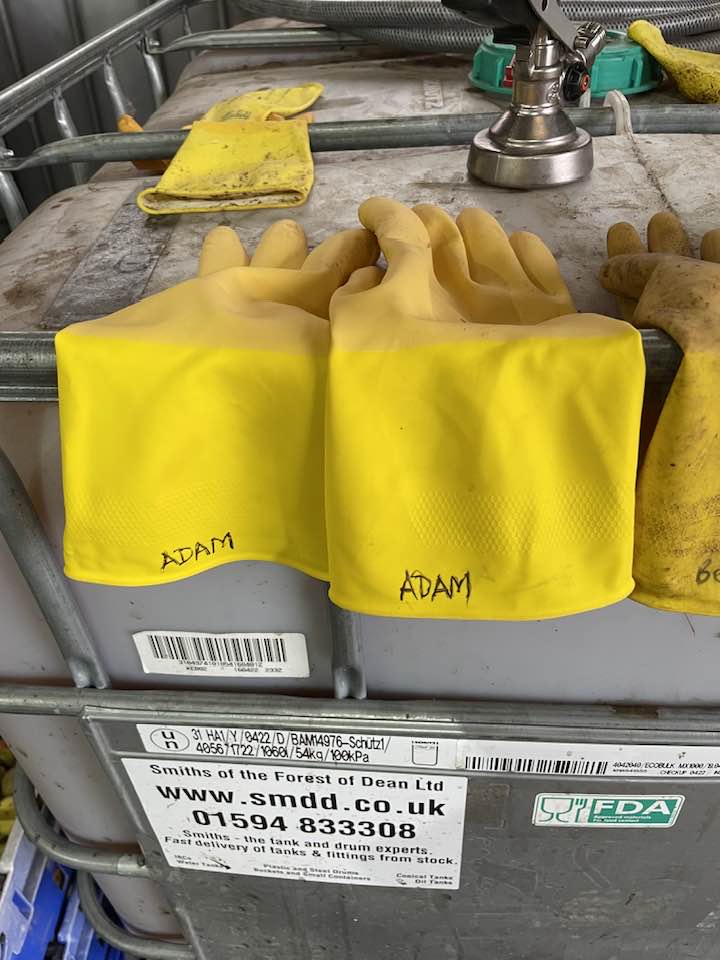
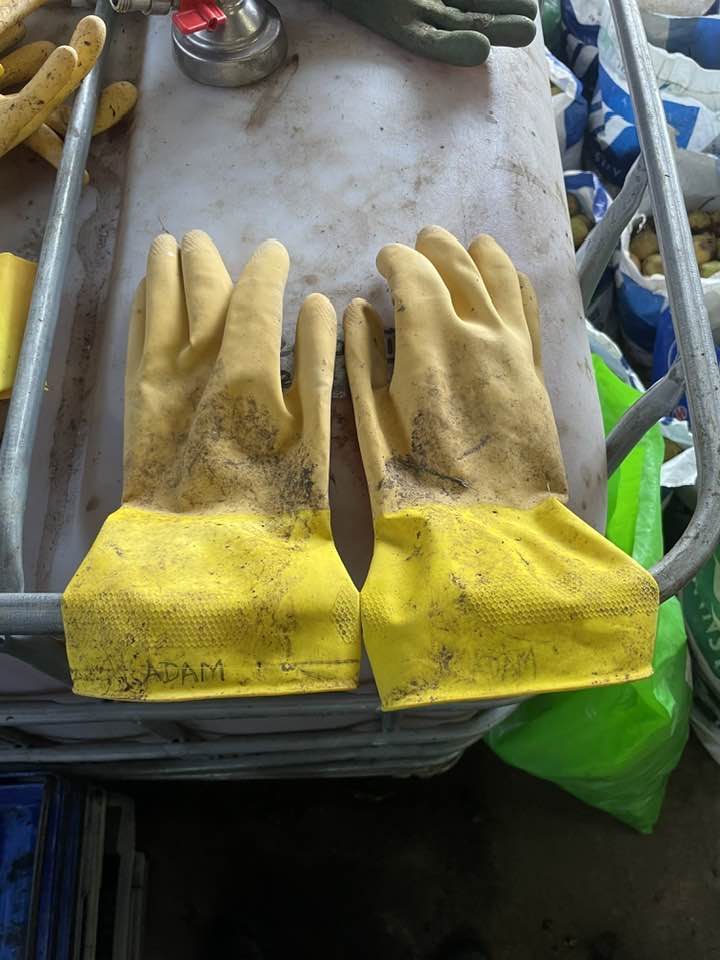
I am also given a pair of marigolds. These are important. They are new marigolds, fresh from the pack. These are my marigolds, I am informed. There are many like them, but these ones are mine. Without my marigolds I am nothing. Without me my marigolds would be given to someone else. I will be using my marigolds for everything, I am told. Picking, sorting, pressing, the works. I dutifully write my name on them and post a picture on twitter, where some wit tells me they are too clean and that I need to work harder. I offer myself the consolation that by the end of this week I shall have pressed more cider than they will all season.
The elder statesmen of the farm head out on various pieces of juddering machinery whilst I am pointed towards a Tremlett’s Bitter tree. This time the ground is thick with fruit and there is no ladder in sight.
Harvesting apples and pears, particularly from traditional high stem trees, is not, it need be said, like harvesting grapes. A standard grapevine carries a couple of bunches. It will look more or less identical to the next vine down and when the grapes ripen you go along and, by hand or machine, remove more or less all of them more or less straight away. There’ll be a few exceptions; some less-even ripeners; and it isn’t quick or easy work by any means, but a traditional apple or pear tree it is not.
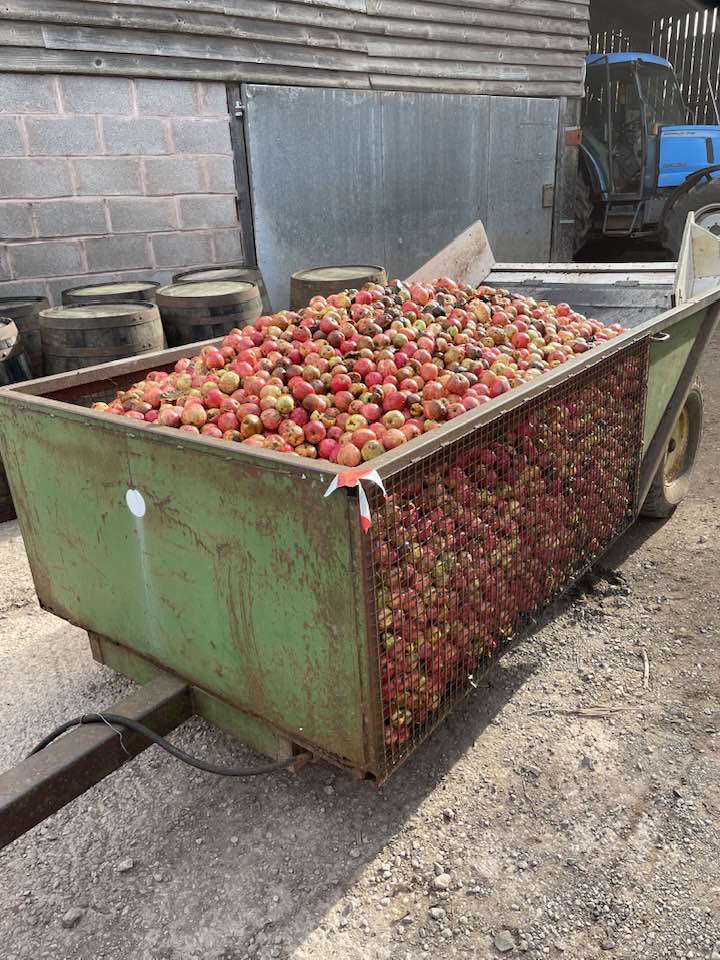
Apple trees, and particularly perry pear trees, count their fruit by the hundreds of kilograms. Each apple grows and ripens individually, receiving markedly different quantities of sunlight, shadow and rainfall depending on their position on the tree and some varieties – Harry Masters’ Jersey in particular – have ripening ranges of months. What’s more, unlike grapes, when they are ripe they fall, and must be picked up from the ground, where if the tree is on a slope, or in long grass, the fruits will do their best to run and hide. You can persuade the apples to come down with machines or panking poles (or, occasionally, a ladder) but many varieties, notably the more tannic bittersweets, will be thoroughly underripe if coaxed down early, and will let you know about it through extreme astringency in the cider, which is why French cider appellations insist by law on floor-harvesting only. You do not, in short, harvest apples and pears in trousers of which you are especially fond.
We scrabble about on hands and knees, grabbing, checking, bucketing; grabbing, checking, bucketing. Some of the apples are still too green, others have already been claimed by wasps or birds or one of the farm’s dogs. You’d be amazed how many apples fit into a relatively small square footage. Every so often, as we work our way around the tree – my companions methodically, me in a random zigzag according to which patches look good – we are taunted by the rustle-thump of another fruit detaching itself from above and adding to our to-pick list. ’This is the third time I’ve picked this tree,’ Becky remarks, as we pour our bucketfuls into sacks. Judging by what’s still clinging to the branches there’ll be at least another three visits to go.

Most varieties, especially the aforementioned bittersweets, can and should continue to ripen once off the tree. So once the Tremletts are bagged, we store them outside the barn and I report for what will prove to be my primary job of the week: sorting.
The oft-repeated truism in wine is that the best is made on the sorting table. This is the point at which any less desirable bits of fruit, stalks, leaves and debris (misc) is removed, ensuring that only good fruit goes to the press.
Sorting is arguably even more critical for cider, where much fruit is harvested from the ground, and particularly for fruits that have been harvested by machine. Mechanical floor harvesters are far more efficient than hand picking, but inevitably, as well as damaging some of the fruit, they pick up all of the apples that have rotted on the orchard floor along with a reasonable chunk of grassy sward, none of which you want to send to the press.
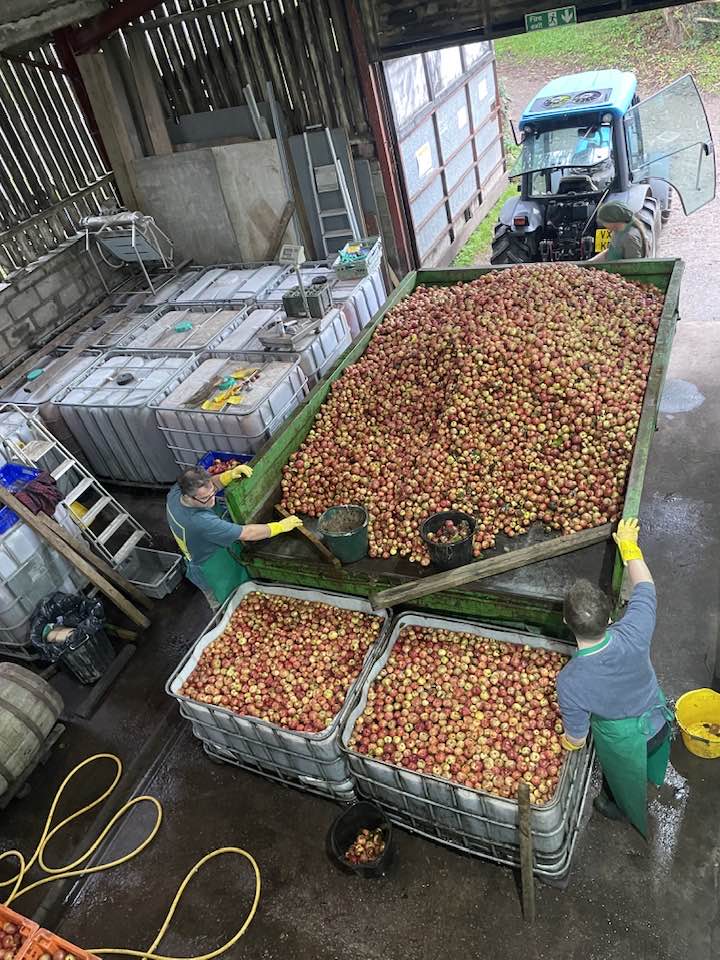
Our team is assembled thus: a trailer full of apples (three quarters of a tonne if you’re lucky, two tonnes for the real slog) is positioned at the door to the barn, the end of the trailer just over the edge of two large, plastic, open-topped IBCs full of water. A sorter takes up position on either side of the trailer’s end. It is their job to ensure that only the good fruit makes it into the water. Everything else we discard in buckets.
Next in the production line are the washers. Armed with large, perforated baskets, they collect and wash sorted fruit, removing anything that’s slipped erroneously past the sorters’ net. (Not that anything did on my watch, of course…) The washers are in charge of passing the baskets up to the person managing the press. It’s also their job to remove the discard buckets once filled. These go into the digging bucket of a JCB and are ultimately taken with spent pomace to be used as natural fertiliser. The press loader is the captain of the ship; elevated on their small gantry, a helmsperson at their wheel. They empty baskets of apples or pears, one at a time, into the press’s gaping maw. There, the last of any bits of leaves and grass fall through narrow slats, the operator scans for any final rogue pieces of sub-par fruit, and the apples bob through a small basin from which they are carried to the scratter where they are minced into pressable pulp and thence to the press itself.
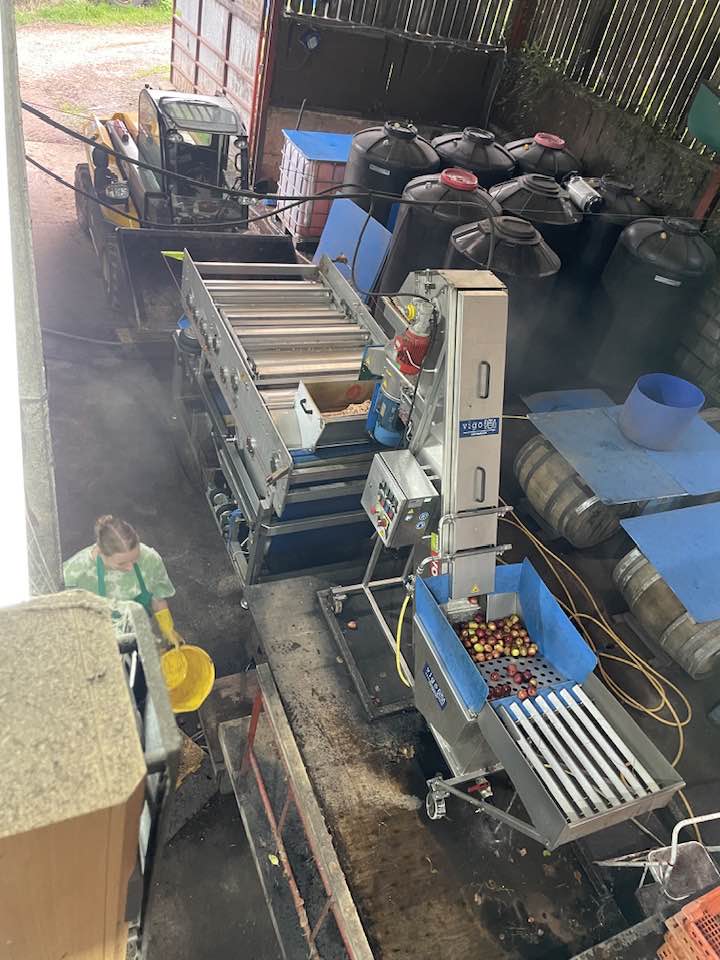
There are various different sorts of presses in cider and perry, from the traditional rack and cloth to the most modern (and expensive) pneumatic numbers, such as you might see at a winery. Ross-on-Wye, for the last couple of vintages, have used a belt press. The scratted pulp spreads itself across a fabric belt, where it is pulled into a system of rollers, pressing the juice out of it. The juice passes through a revolving coarse filter to remove any lingering debris, and is pumped into tanks. As the fabric runs through the rollers, its alignment minutely shifts, and every so often the operator needs to pull a lever to readjust it. I forget to do this once and am confused when everything stops.
The spent pomace continues to the end of the belt, where it is the job of the washers to nip round every few minutes and pull the pillowy buildup of pomace into the JCB bucket with the discarded apples. It looks like enormous pieces of branflake, or some kind of vegan jerky. Hauling it out of the end of the press and crumbling it in your hands is surprisingly satisfying, though much of it goes down my marigolds when I haul too enthusiastically.

Also intensely satisfying, as I finally admit to a fellow sorter, Thomas, on day three, is removing rotten fruit during sorting. Reader, if you saw what we took out, you would understand the importance of sorting in a trice. Those machines pick up everything from the floor; apples butchered into tiny oxidised pieces, jet-black rotten fruit that pulps in your marigolded grasp like a burst water balloon. Buildups of leaf and grass and apple that sink through the good fruit forming buildups of unholy squolch – no other word will suffice – that we splat into the discard bucket by the fistful. Every five minutes or so – depending on the condition of the trailer – the bucket is filled and replaced.
Sorting is by far the most intensive process on the line. Every apple of a two tonne trailer requires inspection and consideration, even if only over a matter of milliseconds. It takes a couple of hours, depending on the sorters, for the trailer to be emptied, and every second of that requires fast hands and concentration. I ask what the metric is for ‘keep’ apples and am told if you wouldn’t eat it, don’t let it through. As the apples drop into the IBCs they splash increasingly dirty water back up at the sorters. Maintaining a layer of bobbing apples minimises splash, but the washers usually empty the IBCs faster than we can fill them, especially if the trailer’s apples are on the later end of their ripening spectrum.

A two ton trailer is too broad for the armspans of a pair of sorters to meet in the middle. As we gradually make our way through the load, every so often someone goes to the tractor and tilts the trailer, letting the apples run down. They are surprisingly reticent to – largely thanks to buildups of squolch. We create crude channels from planks to divert the apples, preventing rotters from whizzing though the middle into the IBCs. But the further through we get, the steeper the trailer tilts, the more care we need to take with our channels and the slower and more deliberate we become in our sorting. Albert shows me a selection of techniques he has honed to coax apples down, attesting to his conviction in what he calls the ‘sweep method’. It involves swishing a stick at the stuck fruits like a windscreen wiper. I make noises that I hope sound impressed, and then prove to be utterly terrible at it.
The apples keep coming, the squolch bucket fills again and again, the IBC water splishes and splashes and like scaling the false peaks of a wretched hill, I look up in misplaced hope every 20 minutes or so to discover that we’ve barely made a dent. Leaning round the trailer for hours on end, I can feel muscles down the other side of my back rediscover themselves with no small indignation. Occasionally, when I don’t think Albert is looking, I allow myself the luxury of a small stretch, like the cowardly keyboard-wrangler I am. Slowly, slowly, grab, sweep, push, splat, grab, sweep, push, splat, the two tonnes whittle down as behind me the press rattles and rumbles and Albert and John direct the juice into barrels and IBCs. When we’ve finished up, we sweep the trailer, pump the last of the juice from the press tank and bring in the next load. By this point the water in the washing IBCs is the colour of dubious coffee.
Speaking of which, at about 11 there’s coffee in the barn. Lunch is at 1, or whenever we’ve finished a trailer load. On the first day Albert asks what I’d like. I ask what he’s having. ‘Crumble’. ‘Just crumble?’ ‘Well I’m having it with cream’. On the second day, he makes us a dish of steak and eggs that is the harvest lunch of Olympians.
When I’m not sorting, washing or pressing, Albert sends me out to hand-pick with Chris, a friend of Albert’s dad Mike’s, who has been coming to help out for decades. Chris, it transpires, is the hand-picking GOAT. Out on his hands and knees all day every day for the week I’m there; apples, pears, any variety, any orchard. More machine than man. He fills his buckets half as fast again as I do. For a while I flatter myself that I’m simply a more discerning picker. It turns out I’m just fussy and slow. We pick Styre Wilding, a new variety to the farm that loves nothing better than nestling beneath long clumps of grass, crimson Dymock Reds with pinkish flesh and White Jersey from the tree I got engaged under. It’s a good job I have an emotional connection to the latter, since its fruits are vicious little ping-pong-ball-sized anaemic spheres of malice and misery of which you require approximately seven trillion to fill a bucket. My good will towards the tree survives just about intact, but it’s a close run thing.
The White Jerseys, though, aren’t as devilish as the Hendre Huffcaps. I dare say I should count my blessings that I’m only sent to pick one variety of perry pear during my stay, and for all I know Hendre Huffcap may be the most forgiving of pears to harvest. It doesn’t feel that way on the first afternoon as, in perennial squat position, I bobble around the base of the wretched tree, picking the tiny, squishy pears, checking each one for all-too-frequent blemishes, muttering darkly about their seemingly hydra-like ability to multiply threefold with every one I harvest and rapidly reconsidering my hitherto rose-tinted view of perry pear trees as Chris blithely fills sack after sack after sack. Four hours later, or thereabouts, we’ve filled a few dozen. When I walk past the trees again in a couple of days the ground will once again be carpeted. Pears, as Barry Masterson memorably had it, are arseholes.
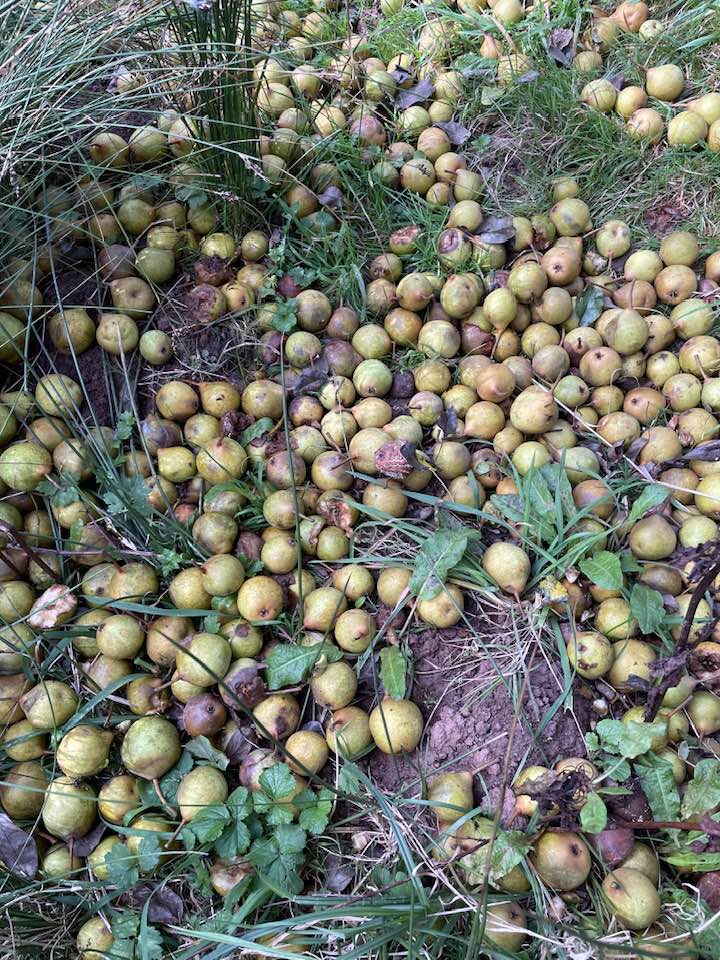
Nor are they much fun at pressing. Unlike the apples, we can’t simply let them bob about in the IBCs. Pears are too dense; they’d sink. We empty the sacks into small baskets, then lower each basket by hand into the water, washing and sorting as we go before the press is fed. The handpicked Hendres aren’t too bad. The Thorn I helped with on a brief visit a couple of weeks earlier seemed to my unpracticed hand and eye to be about 30 per cent mulch.
The week of my harvest falls in the early-mid season. Too late for Foxwhelp, but a while away from the late-harvest likes of Dabinett. We press trailers full of Major – towards the end of their ripening window and more painstaking to sort; some early Harry Masters’ Jersey – firmer and easier; Somerset Redstreak soft enough to stick a thumb into with a little effort. There’s the Fredrick, the Tremlett’s, the Dymock Red and White Jersey, sacks of Hendre Huffcap and baskets of Blakeney Red. Something a little sharp that I’ve forgotten but might have been Browns, mixed apples brought by Helen and James from Wildnerness Brewing for a future collab. The pressings keep coming, the varieties start bleeding into one another and as the days go by I feel a little less achey – but a little more tired – with every six o’clock alarm call.
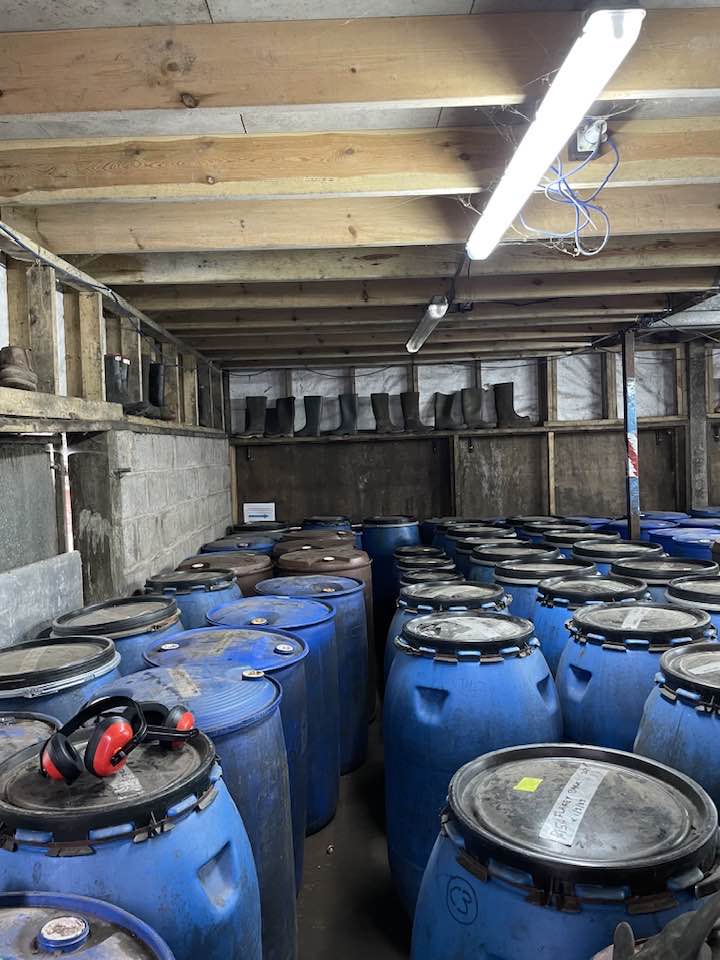
The day ends at around half five, or whenever the load we’re currently on is fully pressed. At which point we do the cleandown, which takes just under an hour. Every part of the press is scrupulously washed with a high pressure hose, the last JCB load of pomace and rotten fruit driven to the heap. The IBCs are drained, then cleaned themselves and finally the floor is swept and washed. Attention to cleanliness is paramount. At last, all cleaned down, we lock up and make for dinner, bottles and bed. Mine is in the cider shack in the old orchard, and as I walk back from Albert’s house each night the Milky Way burns above me. I’m asleep in seconds without fail.

Four days later, suddenly and almost unexpectedly, I’m done. Friday is Perry Day, part of the Hereford Apple Fest celebrations, so I’m in town rather than pressing. (Albert accuses me, correctly, of shirking). Saturday is a rest day and on Sunday, a few generous bottles heavier, I make my way home where I have been thinking about the week ever since.
It is easy, appropriate and probably necessary to romanticise much of cider and perry. These drinks come in for so much condescension and disparagement that emphasising that which is special and aspirational is critical to their elevation in the mind of the average consumer. Espousing concepts such as terroir and minimal intervention has the power to capture imagination and increase ‘high value perception’. Talking about and showing bucolic, fecund orchards, trees full of fruit or blossom, slumbering barrels full of new season juice – all of these add to cider’s romance and allure. We should talk about varieties and styles and faults and process. We should share pictures of beautiful bottles and praise eye-catching packaging. We should celebrate innovative methods and exciting new makers. I sometimes talk about the ‘soul’ of cider, and when I do I am generally talking about the apples, the trees, the land and the cultures that build around them.
But though cidermaking – aspirational, full-juice, harvest-based cidermaking – is ‘simple’, in being simply the fermentation of apple juice with yeasts, it is hard. It is logistically hard – managing the varying ripening windows of perhaps over a hundred different varieties of apples and pears, balancing storage space and available containers against the quantity of fruit being brought in. And it is physically hard; a series of laborious, heavy and repetitive processes.
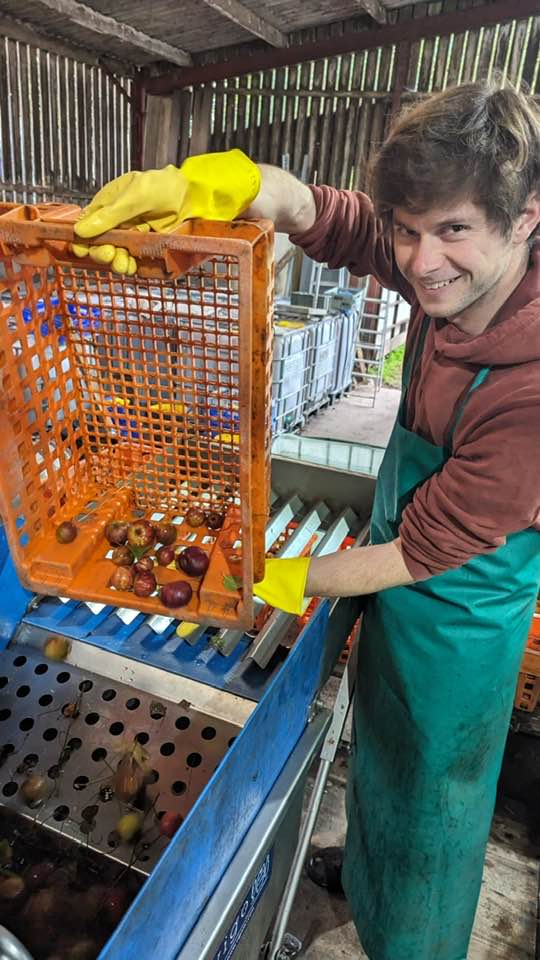
I worked four days of harvest at Ross-on-Wye this year, and I felt every hour of them. I felt them in my knees as I crawled around the base of trees, the wet cold grass, squashed fruit and soil seeping into my trousers. I felt them in my thighs when I stood up after hours of crouching and picking and bagging. I felt them down my sides, in the moments of stretching amid another two-ton sort, swapping round with the other sorter every hour or so to balance ourselves out. I felt them in my arms as I swung washed baskets up to the press, or tipped them in from my gantry vantage point. I felt them in my dulled brain and wearied trudge back to the cider shack each night and in the aches and stiffness running through me when I woke. I felt them all, and I worked for only four days. A full harvest, give or take, is four months. That there are people who, year on year, work every day of those months, through the sweat and ache and planning and repetition – to sort and press a hundred tonnes of apples in a season and touch every one of those apples as they go, to make the best version possible of a drink widely held in so much scorn, is not just inspiring; it is a little miracle.
Romantic though it may be, I do believe that cider has a soul. I do believe that soul is locked in the apples, the trees, the land and the cycle of vintage that binds them. But it lives, too, in every knee to the wet ground, in every perfect apple picked and every bad apple removed before the press. It is in the will that wakes up after two months of heavy harvest and goes again for another two. The soul of cider is in the bend, the ache, the haul, the push and the hour long clean-down at the end. It is in the people who with force of arm and force of mind give a third of their year to wring cider out of fruit.
It is in toil.
Discover more from Cider Review
Subscribe to get the latest posts sent to your email.
 Cider Review
Adam
<
div>Love this article. Just a reminder of all the hard work and graft th
LikeLike
Thanks so much Peter. So pleased you enjoyed it!
Adam W.
LikeLike
That sounded like a lot of fun!
LikeLike
Cheers Andrew. It really was! Hard work but I loved it. I’ll be back.
Adam W.
LikeLike
I really enjoyed reading this, informative and fun. Now I know why Ross Cider & Perry tastes so good!
LikeLike
Thanks so much Marcus – glad you enjoyed the read!
Ross 2923 vintage to be extra good after my input I’d wager…
All the best
Adam
LikeLike
Wonderful article, I do this on a very small scale in my garage and it is a time when get a bit of peace from the pressures of the world.
One word that describes this process best is love. I love what I do and Ross Cider love what they do and it shows in the process and end product.
LikeLike
Super article Adam. I agree: cider making is truly a romantic endeavour, but it’s a bittersweet, Hardy-esque kind of romance (so all the more real and worthwhile). I’m glad that you enjoyed the experience and came out of it rather better than the unfortunate cider maker in Thomas Hardy’s novel ‘The Woodlanders’, where cider, its culture and connection to the land is portrayed beautifully.
LikeLike
Thanks so much Paul! I think there are so many places to draw meaning from cider and I’m very glad to have seen a little of the importance of this side.
Embarrassingly, as a former English student, I haven’t read The Woodlanders. Extra embarrassing as a fan of both Hardy and Cider. Added to the list!
Best wishes
Adam W.
LikeLike
Nice to see the labor aspect conveyed so viscerally. It rarely shows up in all the happy insta posts of smiling people joyfully picking fruit on a sunny day. Cider is an agricultural product; and like all agricultural products involves a lot of manual labor, exposed to the vagaries of the seasons. It’s a shame that this is rarely properly priced into the product and (mostly) just taken for granted by consumers.
On the flip side, it also really speaks to the passion of cider makers, that embrace the toil each season in the hopes of crafting something exceptional.
LikeLike
Cheers TV. Absolutely, that was what I wanted to really focus on – some of the reality behind the insta posts. I’m glad that came across. (Though I got away with the weather a bit – it broke the week after I left).
Thanks as always for reading and taking the time to comment.
Adam
LikeLike
Adam, I always love your writing, and have been reading since you and James first started this review. But this, in my opinion, is the most insightful article you have ever written about cider–it is all in your penultimate sentence. It is about the people. I can only repeat my comment on your October 12 2022 post: “I’m drawn to cider most of all for its simplicity, the effort and care cider makers put into their products, and the accessibility of cider making as a craft.” Well done on this article (and on mucking in).
LikeLike
Thanks so much for those kind words Wayne and I’m so glad this piece struck a chord. It was one of my favourites to write.
All the best
Adam W.
LikeLike
Pingback: My essential case of perry and cider 2023 | Cider Review