I’ve mentioned the region of Swabia a few times in previous articles on German cider. It’s an area that takes in the districts of Stuttgart, parts of Tübingen and Bavarian Swabia, though most people would just roughly say the southern part of the former state of Württemberg (Baden and Württemberg being combined into one state in 1952). It’s a region with its own dialect and famously thrifty culture that the denizens are quite proud of. We’re talking the land of Spätzle, Maultaschen and good stuff like that, if you want to put it in a culinary context.
Swabia also happens to be one of the old heartlands of German cider. Going back 120 years or so, Swabia was the second largest producer of cider in Germany, just behind Frankfurt and the Hessen region, which at the time was industrial in scale. Like other cider-making regions across southern Germany, Swabia (and indeed the then neighbouring Baden) remained more agricultural-based, which ultimately led to its general decline as farming cultures modernised and Most, the local name for cider, became less important.
While commercial cidermaking seemed to have all but vanished in that intervening period, Most was still being made by farmers, but eventually came to be seen as something old-fashioned, and generally looked down upon quality-wise. Cue wrinkled noses when Most is mentioned, and people expecting something rough and acetic.
However, in more recent years there has been an upturn in the number of producers in the Swabian region. We’ve met Jörg Geiger on these pages before, and he’s been at it a while to be fair, though now turning more towards no- and low-alcohol alternatives. But there is a plethora of Mostereien, basically juice makers, that have added cider to their portfolios in the past decade. They market it as cider, which in turn makes me expect something off-dry – as this is the false perception of what cider is around these parts – but it’s encouraging to see some of that culture return, and get organised.
Why organised? Well, some makers of that region have banded together to found an association to market Swabian Cider as a brand and to further their common interests. Starting in 2018 with a feasibility study on “Most-Gastro-Marketing” in the Stuttgart region to essentially improve the image of Most/cider and to try and increase potential sales. By September 2019 they had formally founded an association with 20 producers and representatives from the city of Stuttgart and surrounding districts as an advisory board. So they were also doing this at a political level. In March 2020 they sucessfuly applied for funding from the Marketing Society of Baden-Württemberg to create a quality label and Swabian Cider brand, and a year later had awarded several ciders the first certification of the Swabian Cider marque. So all relatively recently!
Their website includes a manifesto of sorts, outlining the goals and some of the criteria for achieving this certification – though they also have laboratory and sensoric criteria which are not published – which I will translate and include at the bottom of this article for anyone interested in the hardcore details, but the high level blurb states:
“Swabian cider is produced by fermenting freshly pressed juice from aromatic old apple and pear varieties. It contains alcohol and carbon dioxide. Swabian cider builds on the centuries-old tradition of cider making in Baden-Württemberg and Swabia. Since the 18th century, the people of ‘im Ländle’ [the cutsie marketing term for Baden-Württemberg] have known how to create true taste experiences from the typical fruits of the orchards.”
And also from the website:
“Certified Swabian cider stands for proven quality and origin and is produced by regional artisans. Swabian cider is guaranteed to contain at least 75 per cent pome fruit (apple and pear) and 100 per cent direct juice.
At least 90 per cent of our apples and pears come from local orchards, certified meadow fruit or comparable extensive contract farming and originate exclusively from Baden-Württemberg or the neighbouring Bavarian district of Swabia. In accordance with our high standards, no artificial additives are permitted. All products undergo analytical and sensory testing before being awarded the label.”
I know one maker who didn’t receive the certification as their cider didn’t meet the sensoric criteria. They recently told me that the panel was led by a distillary consultant with some restaurateurs and members of the group, and believed they may not have understood the complexities of low intervention, artisanally produced cider. But as I’ve mentioned before on these pages, the German concept of what cider is has largely been influenced by large, industrial brands, so people expect it to be sweet and fizzy, perhaps not recognising that the Apfelwein, Viez and indeed our local Most culture are all part of the broader cider family. However, I was told that at least a few years ago, they had made a conscious decision to focus on “very accessible” drinks, though the maker who told me this expressed concern that there seemed to be a lack of understanding of the broader range of styles found in the world of international cider. But I digress!
Nevertheless, it’s absolutely praiseworthy that this group got organised to be able to receive political support and marketing funding, all for the promotion of local cider. I hope to see this develop as newer makers gain more experience and trust that young people are not just into sweet drinks. I know I may have inculcated my close circle of friends to dry cider and perry, but most of the younger people I know in our village do prefer dryer cider. But then Most was also part of the culture here, cities are probably different. Am I digressing again? Sorry.
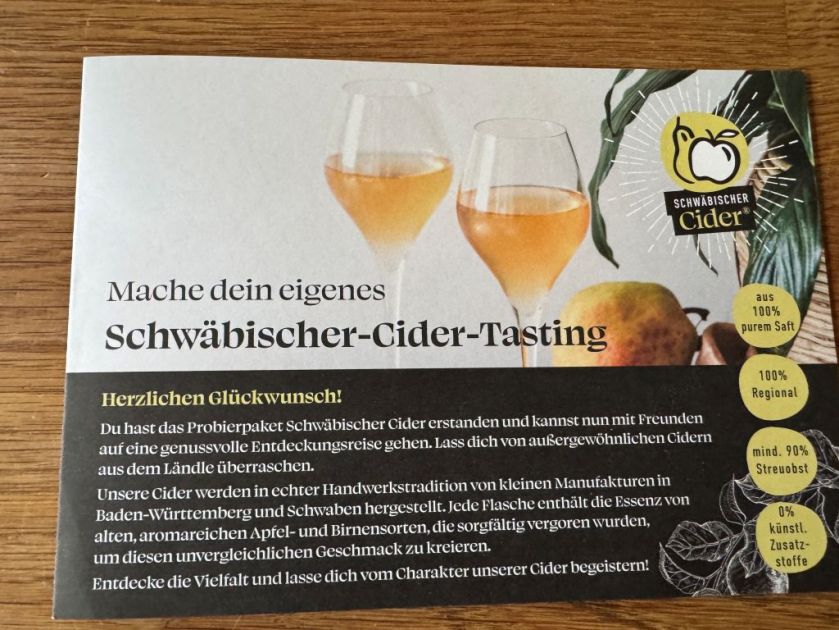
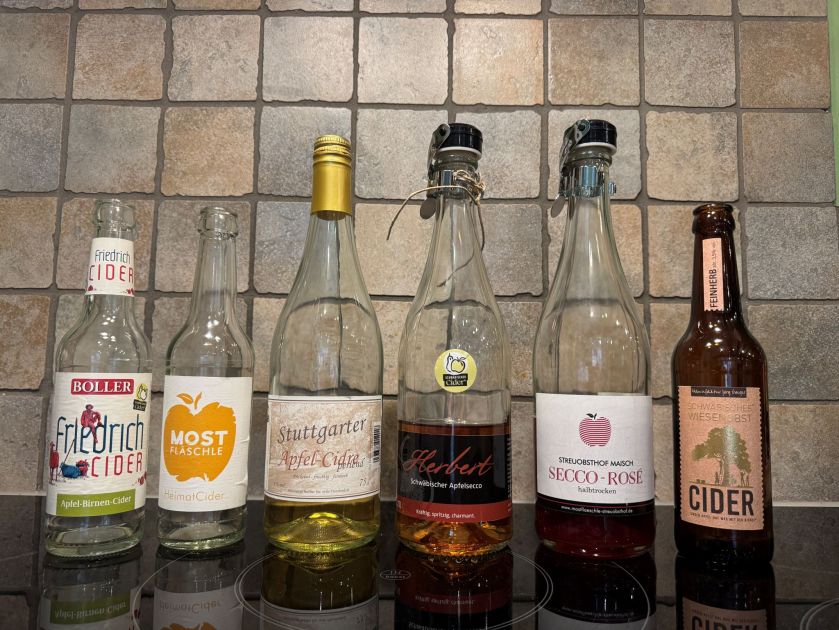
As part of that marketing drive, last year they released a tasting box with six bottles from five makers. Sold as a Cider Tasting box, it included nicely printed tasting sheets that explained how to run a tasting, with descriptions of the ciders and space to write in your own notes.
I’ve been sitting on this case of cider for a few months now, so thought it was high time I got a couple of friends over and make them work. On a rather spontaneous evening last week, three of us sat down and went through the bottles. While Andrea and Uljana claimed they would not be able to write detailed tasting notes (I didn’t believe them, I’ve put them through enough tastings by now to know to expect some remarkable tasting notes), I just asked them for key words, an overall impression after each round, and to say if they would buy a bottle for themselves. I’ve appended some of their comments (translated of course) after my main tasting notes.
Let’s get to it!
* * *
Mayer Fruchtsaftkelterei, Stuttgarter Apfel-Cider – review
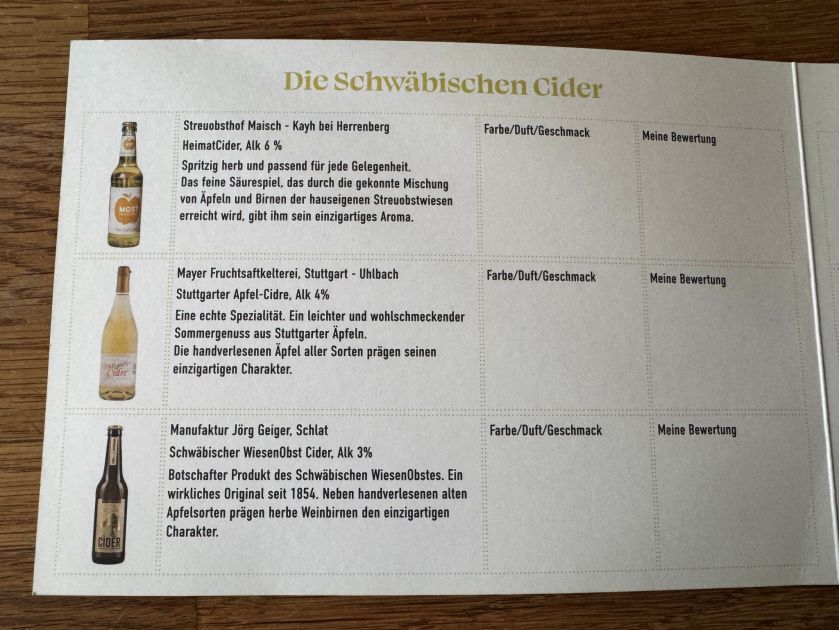
Made by Mayer Fruchtsaftkelterei, primarily a juice maker, with some fermented products in 1L and 750ml bottles, based in Uhlbach near Stuttgart. The blurb on the tasting sheet said the following:
“A real speciality. A light and tasty summer treat made from Stuttgart apples. The hand-picked apples of all varieties shape its unique character.”
Coming in at 4% ABV we’re expecting some residual sugar.
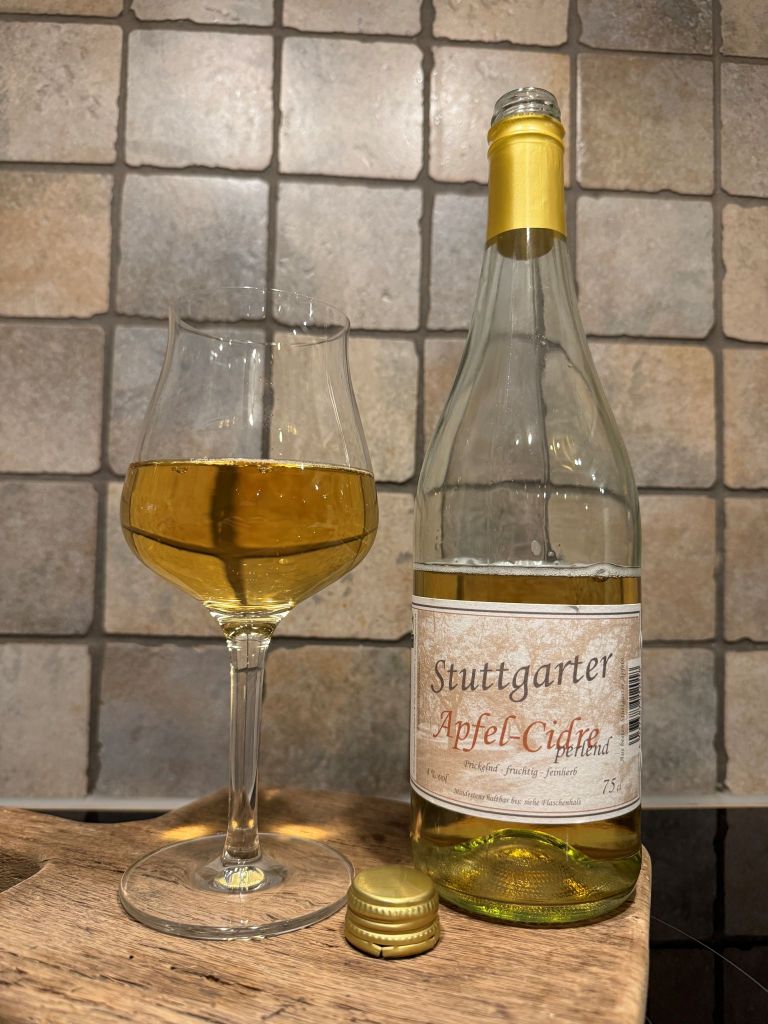
How I served: Cellar temp, currently 12.5°C.
Appearance: A pale gold with just a light fizz on pouring, crystal clear.
On the nose: A big fruit-forward nose, full of ripe pear flesh, red apple and slight floral highlights, like white lilies and lemon zest. Underneath all that, something approaching strawberry yogurt… no, more like those strawberry and cream candies.
In the mouth: Lands with a surprising splash of acidity on the tongue. Well, it shouldn’t be surprising I guess, given where we are and the apple varieties usually used, but it was belied by the aroma that came over much softer. It’s all green, crunchy apple, followed swiftly by a butter and sugar sweetness, like licking the beaters from a mixer after mixing a cake dough. The strawberry and cream motif repeats on the tongue. The acidity continues to take the lead as you sip so at least it doesn’t become cloying, finishing with a bitter red apple peel and lemon zest.
In a nutshell: Quite decent, if a little sweet for my personal tastes. The battle between sweetness and acidity makes it sometimes hard to know in what direction it’s going, but overall a comfy cider with no real wow moments.
And how did my companions summarise it? “Tasty, but too sweet for my taste, could use a splash of mineral water” and “tasty, but reminds me of apple juice, sweet, fruity, ordinary”. I have to add here that adding a splash of sparkling water even to still, dry Most from the cellar is standard practice in farming families here, so no shame there. But the best note on the aroma that made me laugh was “like using citric acid to clean stainless steel”. She was right too! I promised not to say who though.
Mosterei Seiz, Herbert – review
This time a Mosterei, so a business that presses fruit for other people who want to make their own juice, but also making their own juice to be sold in bottles or bag-in-box, and as of writing, quite a few types of Most and co-ferment in Bag-in-box and 750ml bottles. Based in Straßdorf, Schwäbisch Gmünd.
“The best sparkling composition from meadow apples, ripe pears and fragrant currants. From old and regional orchards of the Swabian Alps.”
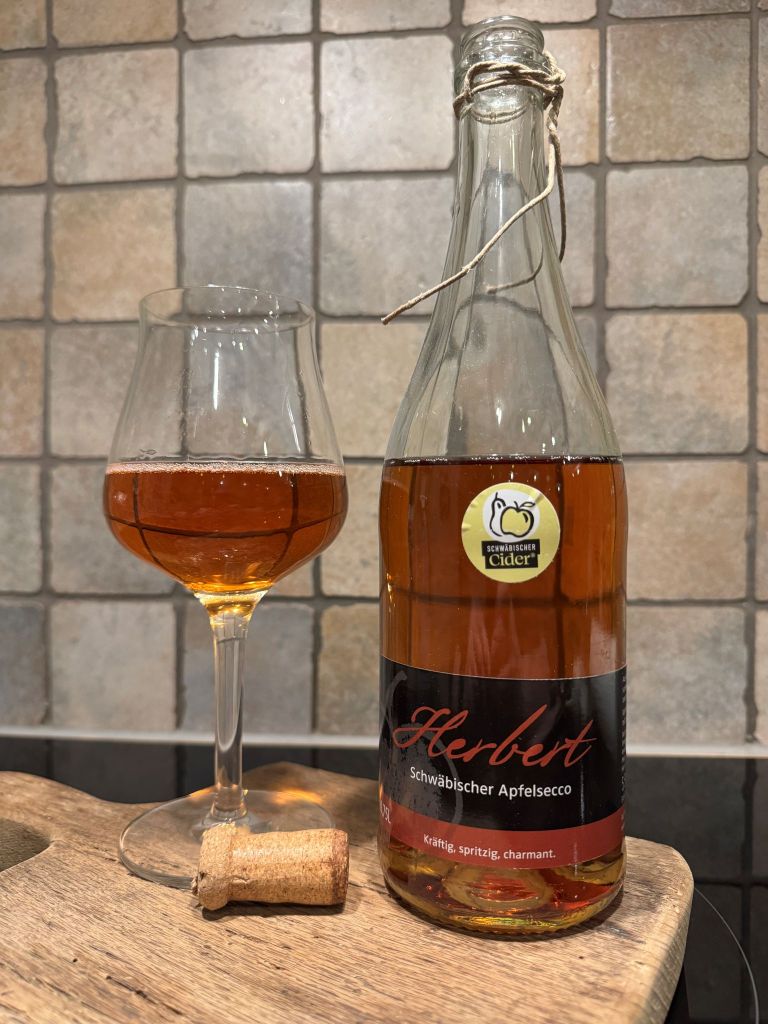
How I served: As above, 12.5°C
Appearance: Deep rose gold, slightly petillant, crystal clear.
On the nose: More delicate than expected, but warming dried berries, strawberry jam and slightly boozy.
In the mouth: The jamminess is to the fore here, but on the tongue it’s more raspberry than the strawberry nose suggested. Cherry, with a lick of marzipan on the swallow, lending a fizzy jelly of apple and blackcurrent on the finish. It’s sweet, but not overly so as the acidity steers it, taking off the sweet edge without dominating. Berry tea (sorry, infusion), and just a bit of a drying tannin-like effect closing off the proceedings, presumably a helping hand from the perry pears.
In a nutshell: Pleasantly comforting and different enough to make it very interesting, certainly worth trying if you prefer a sweeter cider with a bit of depth and finesse.
Let’s see what Andi and Ulli write on their tasting sheets. Ulli said “a little less residual sugar would be nice, if not perfect”, which is high praise, and Andi said it was very tasty and she would buy it again. Both are lovers of dry cider and dry Sekt, by the way. The way nature intended!
Streuobsthof Maisch, Secco-Rosé – review
A farm-based company that also presses for others (it’s great these exist as a way for people to process their own fruit without having to invest in equipment), and since 2016 making their own Most/cider. Based in Kayh bei Herrenberg, a village close to Tübingen.
From the tasting sheet: “The distinctive taste of black currants, harmoniously combined with fresh apple and pear aromas, dry.”
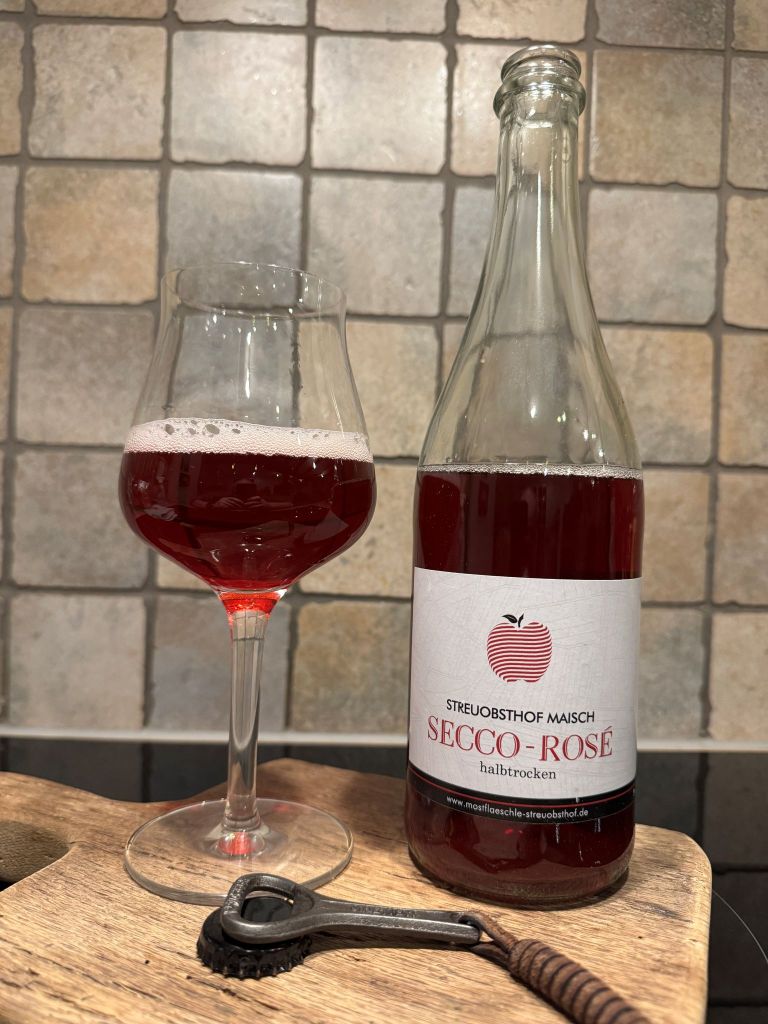
How I served: As above, 12.5°C
Appearance: A striking ruby red, petillant, clear.
On the nose: Ribena. In your face Ribena. For those who are not familiar, a blackcurrant concentrate/cordial that I for one grew up with. It’s slap in the face blackcurrants and frankly, hard to pick out much else. It wears its heart on its sleeve and smels delicious.
In the mouth: As above with an added touch of bitter almond. A faint base of residual sugar, but thankfully not dominating or it would be just like Ribena. It finishes with a pleasing cranberry-like dryness that keeps one sipping along, and I found myself knocking it back rather fast.
In a nutshell: Very nice and intense flavour, but very one dimensional and little different to having a blackcurrant spritzer, though with the benefit of a warming alcohol element.
The two ladies more or less agreed with me. Andi said it “tasted very good, but I couldn’t drink it all evening, just not my style”, while Ulli reckoned it was “refreshing, tasty, but a bit ordinary, like Bionade, but with alcohol”.
Streuobsthof Maisch, Heimat-Cider – review
Staying with Maisch family, the name „Heimat“ suggests a local cider for local people. Here’s what they have to say about this 330ml longneck Mostfläschle (translated, little bottles of Most):
“Sparkling tart and suitable for every occasion. The fine acid play, which is achieved by the skilful mixture of apples and pears of the in-house orchards, gives it its unique aroma.”
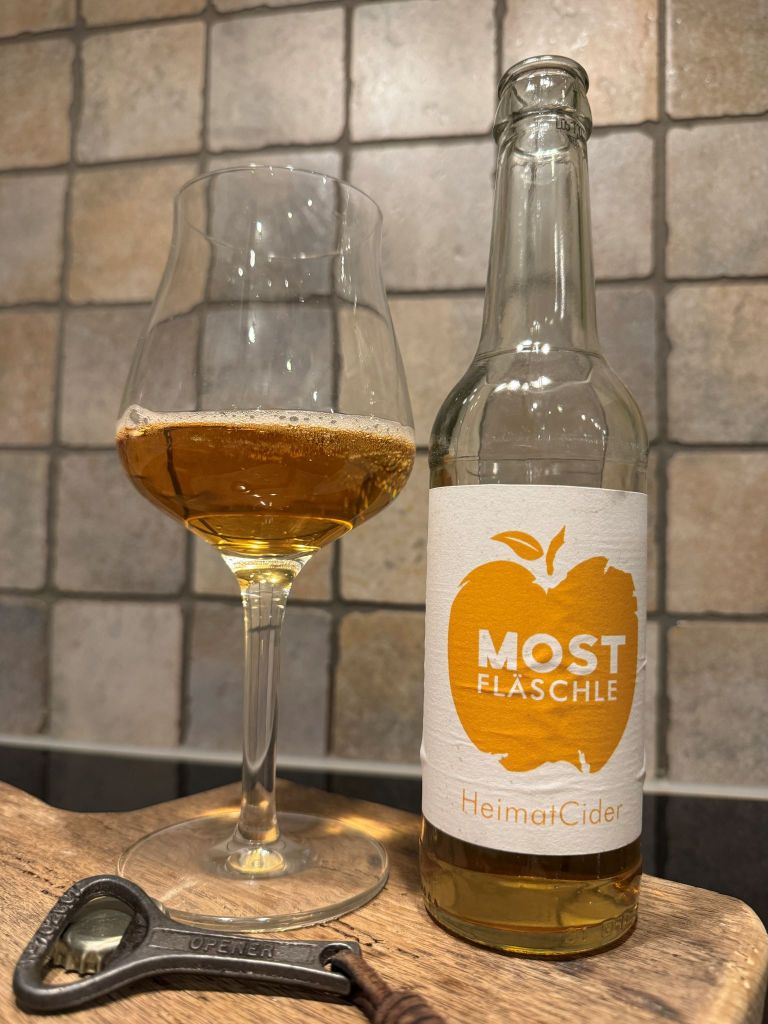
How I served: As above, 12.5°C
Appearance: Burnished gold, petillant, clear.
On the nose: Unfinished cider and schnapps distillery. If you know the odd aroma in a distillery when schnapps is being made, that kind of aroma. I’m not sure if it’s entirely pleasant, but it is intriguing. A bit of cooked vegetables to it.
In the mouth: Almost as above. Stewed apple sauce, touches of cinnamon, red apple peel bringing just a hint of bitterness and finishing with a lingering jam effect. But little structure and not entirely enjoyable to my taste.
In a nutshell: The unusual aroma is a little off-putting, but one can drink into it. The finish is a saving grace, but certainly one for lovers of sweet cider.
Ulli summed it up as “Yeah, you can, but you don’t have to (that German phrase, kann man, muss man aber nicht)” and “Interesting, but not exactly perfect”. Andi, who quite liked the aroma, said “the expectations from the aroma were not met on the flavour, but personally, too sweet”.
Boller Fruchtsäfte Stolz, Friedrich Cider Apfel-Birne – review
Boller is a large company with an extensive range of juices, ciders and even whisky! Here we have one of their small bottle presentations, coming in at 3% ABV. They say:
“Friedrich-Cider has the fruity, slightly tart taste of the apple, the sweetness of the pear and the gentle tingling of a sparkling wine.”
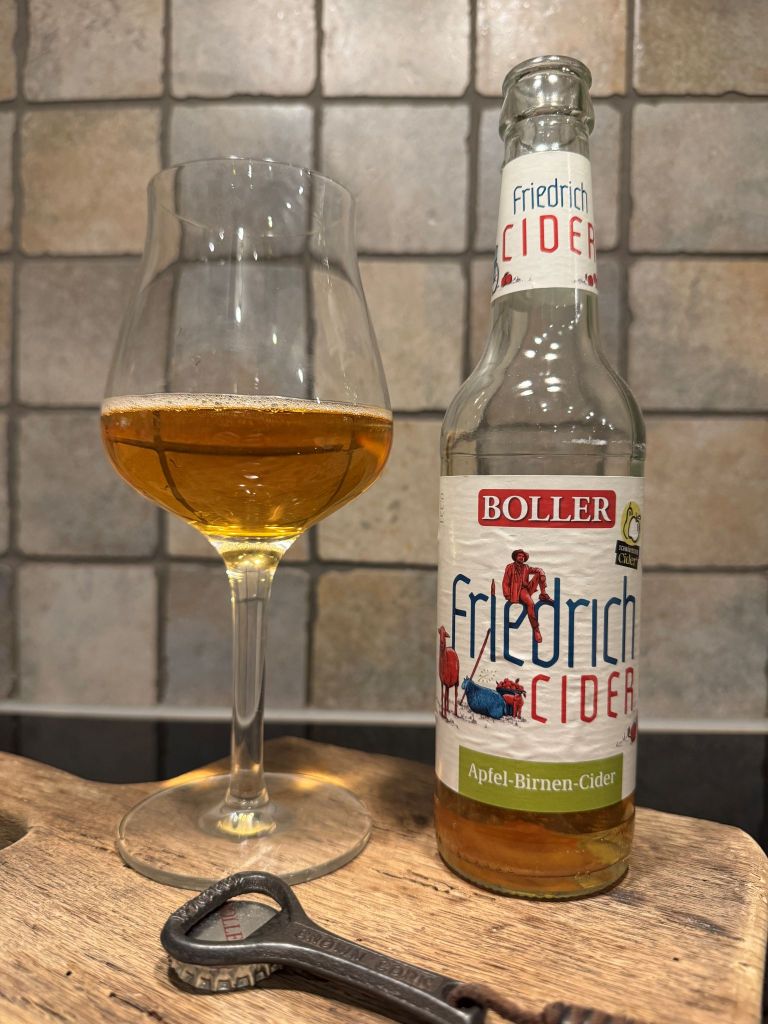
How I served: As above, 12.5°C
Appearance: Deep gold, petillant, clear.
On the nose: Sweet, floral aromas, reminiscent of hyacinths and lilies. Dried apricots, more jam, bitter almond.
In the mouth: Sweet, almost sugary. Very apple juice-forward, just about balanced by a refreshing acidity, like biting into a crunchy green apple. Big lime juice and melon jelly beans. The pears make themselves known for sure, both on the flavour and a touch of tannin that just about dries the finish. But the overall impression is of a sweet apple sorbet.
In a nutshell: Sweet, but rescued by a solid acidity. A decent low-alcohol refresher, I bet it would be a smash served ice cold on a hot summer’s day.
I’m afraid also too much residual sugar for Andi and Ulli. Ulli said “way too sweet, feels like I’ll get heartburn from it, otherwise the flavour is good, but just like juice”. Ehh, I think I won’t transcribe what Andi wrote about what effects she would expect from drinking a full bottle. But she did appreciate it more when it was mixed with sparkling water.
Manufaktur Jörg Geiger, Schwäbische Wiesenobst Cider – review
And finally, a long neck bottle from Manufaktur Jörg Geiger, in Schlat, east of Stuttgart, who we have spoken with before. The tasting sheet describes it as “an ambassador product of Swabian meadow fruit. A real original since 1854. In addition to hand-picked old apple varieties, tart wine pears characterise the unique character.”
I don’t think they were making it in this sweeter 3.5% style around Swabia in 1854 (old reports describe something else delicious), but let’s see how we fare.
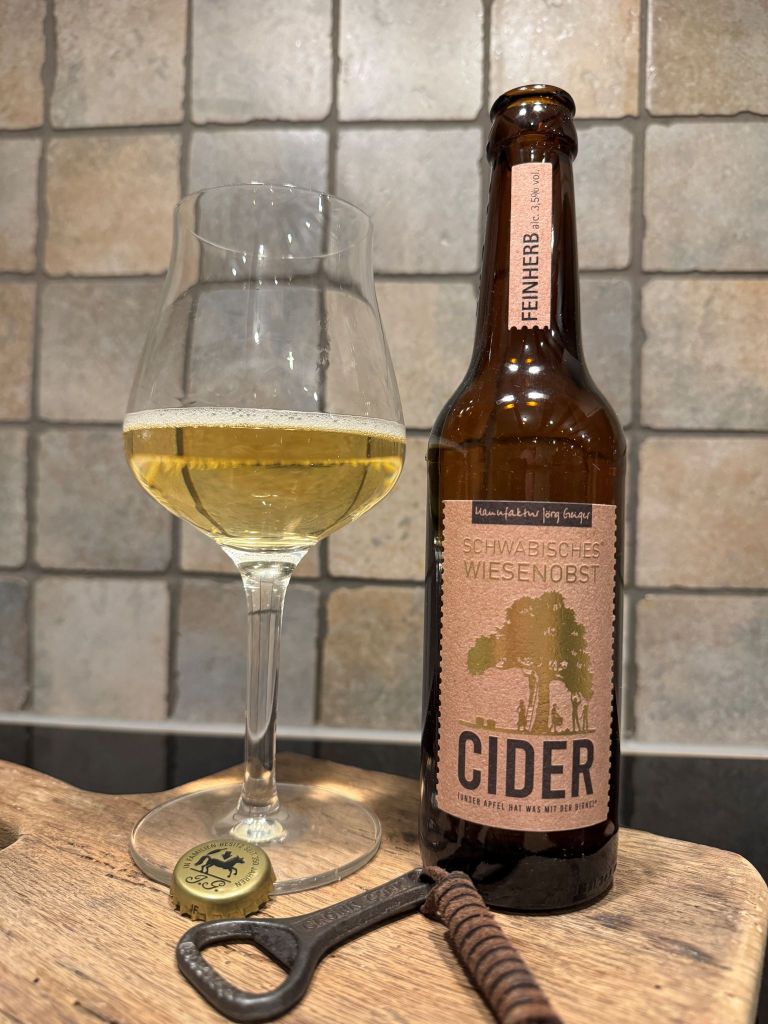
How I served: As above, 12.5°C
Appearance: Very pale gold, clear, petillant.
On the nose: Fresh pear flesh in spades! Candied orange peel and mandarin juice. Very clean and refreshing on the nose.
In the mouth: A spiced, ginger and cardamom character, it made me wonder if spices were added as Geiger does to many of their low and no-alcohol products. Smooth as butter, with a creamy mouthfeel. Red apple flesh, peel, tinned pears. As one drinks, the pears seem to take the lead, all lychee, honey melon and mandarin peel. A long, spiced finish makes it a very fun drink.
In a nutshell: Even at 3.5%, this cider can offer a lot to lovers of dry cider like me. Juicy, spritzy, and just enough tannins to bind it all together.
We ended on a high note here. Ulli said it was “very tasty, a little less sweetness would be nice, but it’s light, refreshing, and would be great on a summer’s day”, while Andi said it was “sweet but delicious, and would buy it (if certain other local cider was not available)”.
I think Geiger’s 20 plus years of experience shows through here, as it’s certainly a very refined product that I would also be happy to drink again.
* * *
So there you go, a small sample of what is coming out of Swabia at the moment. Looking at the websites of just these makers, there’s a lot more to explore, and of course many more makers in this group. Though the sheet included in the box said they are all small makers, I question that, as Geiger is a pretty big maker, and the volume of some of those juice makers must be quite large too, though their cider output is clearly small in relation to the industrial producers. In any case, most are family run and as it is all full juice, with no concentrate and no additions, that is fantastic to see.
Highlights for me were of course the Geiger cider, and I really enjoyed the Seiz offering, as it offered a bit more complexity than some of the others. But generally, production quality is good, with no faults, and the sweetness levels are of course a matter of personal taste. The oddness of the Maisch Heimat-Cider was not so much a fault as perhaps processing-related, and I think this would be a very good medium cider if they managed to remove that cooked aroma.
I’ll be making a return to Swabia, I think! Sure it’s just around the corner.
* * *
For those curious, here’s a translation of the manifesto published on the Swabian Cider website.
With the Quality Charter for Swabian Cider, producers and their partners in the catering and retail sectors are committed to our binding quality promise.
1. Fruit varieties for Swabian cider
Swabian cider is characterised by fruit varieties that are typical of the region and shape the landscape, having adapted over centuries to the interplay of climate, soil and careful cultivation.
2. Flavour profiles of Swabian cider
The flavour of Swabian cider is defined as tangy and fresh. Swabian cider is to be established as the carbonated drink of choice for young connoisseurs.
3. Exclusive growing region of Swabian cider
The fruit varieties that characterise the landscape originate from the picturesque landscapes of Baden-Württemberg and/or Swabia. They are refined by hand in Swabian factories.
4. Growing qualities of Swabian cider
In addition to the authentic fruit varieties, location-specific care characterises the quality of the fruit and the refined products obtained from it. The produce comes mainly from classic orchards, may be of special meadow fruit quality or may come from comparable extensive contract farming. Swabian cider is always a quality product from different forms of cultivation in Baden-Württemberg and/or Swabia.
5. Drinking and glass culture for Swabian cider
Swabian cider is already clearly distinguished as a quality product. However, its distinctive aroma and charisma are brought out in a very special way by a drinking culture tailored to cider. This can be in the modern, sparkling form of the 0.33 litre longneck bottle or in the enjoyable, classic form of the 0.75 litre sparkling wine or semi-sparkling wine bottle.
6. Swabian cider as part of pub culture
Swabian cider confidently stands out in its own section of the drinks menu. Depending on the target group and type of pub, Swabian cider is either presented only in bottles or with its own distinctive glass style.
7. Product presentation for Swabian cider
Swabian cider also presents itself confidently and independently in shops. It is neither part of the wine nor beer shelf, and certainly not the juice shelf, but is visibly presented as an alcoholic product of Swabian fruit-growing culture.
8. Specialities define Swabian cider
Swabian cider impresses with its typical characteristics as a high-quality luxury food developed from its origin, variety, terroir and artisanal cellar craftsmanship. But Swabian cider also strengthens its profile with its own specialities. And with around 1,000 fruit varieties still available, a wide range of single-variety cider specialities are available for the market.
9. Product awards for Swabian cider
A wide range of platforms for product awards are already available to ‘Swabian Cider’. With the ‘Baden-Württemberg Quality Mark’ (QZBW) or comparable certified systems for quality and origin, Swabian Cider is consistently seizing the opportunity to permanently establish itself as a high-quality product typical of the region.
10. Swabian Cider brand
Swabian Cider is registered as a collective mark with the EU by Wiesenobst e.V. and appears on the market with a supplementary figurative mark from IG Schwäbischer Cider.
11. Quality criteria for Swabian cider
Swabian cider has the following specific quality criteria:
- Minimum alcohol content of 2%
- Carbon dioxide pressure of at least 1 bar
- Swabian cider must contain at least 75% pome fruit
- Swabian cider contains no artificial additives or flavourings
- Swabian cider is produced only from direct juice
- The (main) raw materials come from Baden-Württemberg and/or Swabia
In addition, at least 90% of the raw materials come from orchards with trees on vigorous rootstocks, as evidenced by corresponding producer declarations, or from proven extensive contract cultivation (e.g. Swabian meadow fruit).
Discover more from Cider Review
Subscribe to get the latest posts sent to your email.
 Cider Review