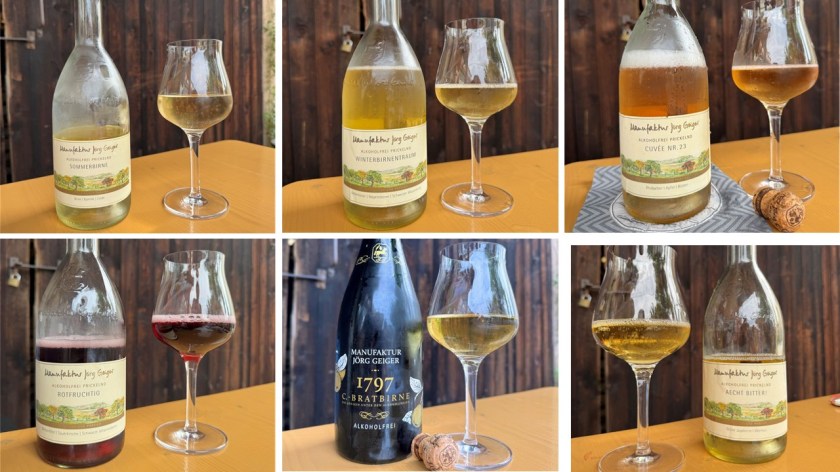
Last month, I published an interview with Jörg Geiger, one of Germany’s most well-known cider and perry producers. As mentioned there, over the past 20 years he has steadily shifted his production towards non-alcoholic beverages, such that low- and no-alcohol drinks now make up the majority of his portfolio.
Admittedly, it’s not a category that I’m particularly interested in, but it’s one that has certainly gained traction in recent years. Alcohol-free beer has been a fairly significant part of the German beer market for some time. A few years ago, alcohol-free wheat beer (alcoholfreies weizen or weißbier, depending on where you are in Germany) was being marketed on TV as an isotonic sports drink. According to WDR, alcohol-free beer, including beers with up to 0.5% alcohol, accounted for around 10% of the total beer market in Germany last year. Add to that the so-called Biermischgetränke – pre-mixed, beer-based drinks such as Radler (beer and lemonade), Cola-Bier (yes, that’s beer with cola), and other variants like grapefruit Radler – and low-to-no alcohol drinks account for a significant proportion of the German beer market.
But what about low-to-no alcohol cider or apfelwein? That’s a much smaller segment. I can only think of a few German producers that specialise in such drinks, which are usually made with sparkling juices and flavoured with herbs, flowers or fruit.
Geiger produces this type of drink, too, but as we discussed in our interview, he also makes non-alcoholic cider and perry using vacuum distillation methods. This includes an alcohol-free version of their flagship perry, made from the Champagner Bratbirne.
Given that low-to-no alcohol drinks are such an important part of their portfolio – and the array of products on their German website is bewildering – I thought it was time I sampled a range of them. Armed with a credit card and some tips from Leonie Haselmaier, Head of Marketing at Manufaktur Jörg Geiger, I duly placed an order.
Rather than drinking six large bottles of non-alcoholic ciders and perries by myself, I thought it would be fun to get some friends together, one of whom is pregnant, giving her the chance to take part in a tasting while remaining abstinent. It was also a great chance to get some short reviews from a group of people who were my early sensory panel and influenced the naming of my own cidery!
Let’s dive straight in.
* * *
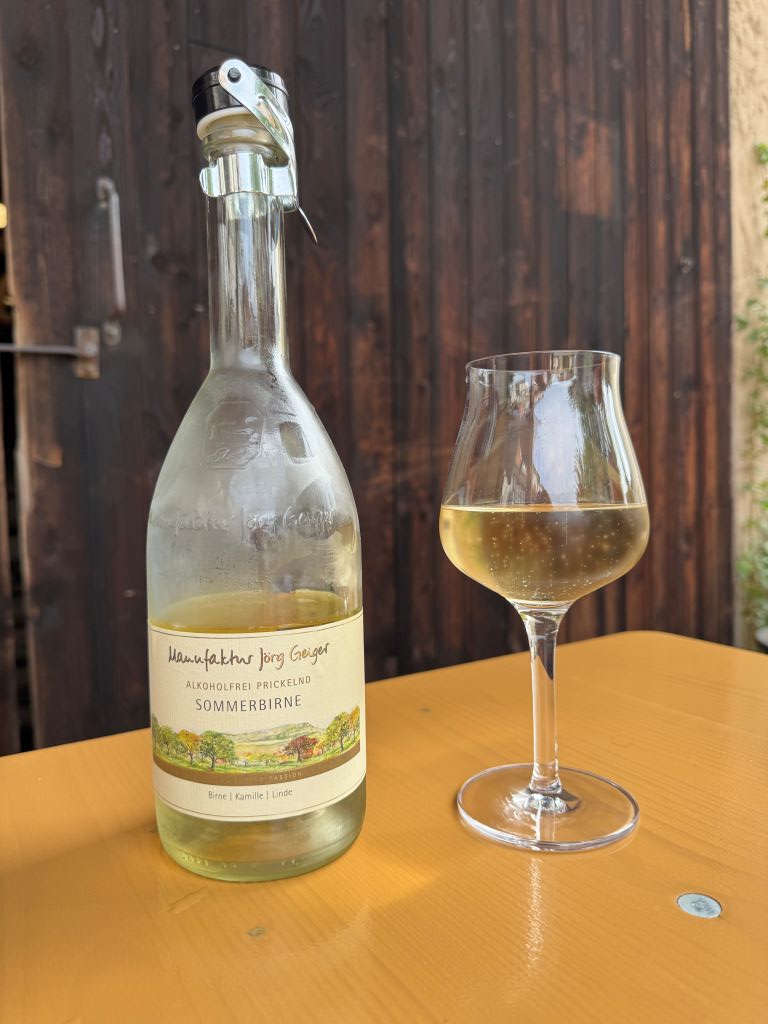
Manufaktur Jörg Geiger, Sommerbirne Alkoholfrei – review
Based on pear juice (varieties not stated), infused with chamomile and lime blossom water, green oats for body (explaining why gluten is listed as a possible allergen), spices (ginger and anis) and added carbon dioxide. This is a 0% alcohol drink.
How I served: Straight from the fridge.
Appearance: White gold, clear, sparkling.
On the nose: Juicy, ripe pear, tinned pear syrup, definitely getting the chamomile, like a fresh-brewed chamomile blossom infusion. Apparently there are lime tree blossoms in this too, but as I know what they smell like, I am glad they have not manifested in the same way here.
In the mouth: Does what it says on the nose, plus thick honey melon, lychee syrup, more ripe pears. The chamomile isn’t as forward as on the nose, but provides a softening effect. I am assuming the summer pears are dessert pears and not perry pears, as there is no real discernible tannin structure. The finish is sweet, a touch too sweet for my tastes, but with a slight ginger heat spicing it up. Adding a splash of mineral water to make a light, summery Schorle (spritz) really opened the flavours, as they were no longer overpowered by the sweetness.
Notes from the group: Most of the group said very- to too-sweet, but noted the fruity, spicy flavours. Notes of white flowers, ice tea, cinnamon and cloves, on a base of pear compote.
In a nutshell: With a major caveat that this is too sweet for my tastes, Sommerbirne Alcoholfrei is quite a pleasant, refined drink with gentle spicy and floral undertones. But I preferred drinking it as a spritz, as it really opened up.

Manufaktur Jörg Geiger, “Cuvée Nr.23” alkoholfrei – review
A switch up on ingredients here, as technically this has more rhubarb juice in it than apple. Rhubarb juice (54%), apple juice (46%), rose and apple blossoms, ginger and added carbon dioxide. The description also mentions oxalis, though that is not listed on the ingredients.
How I served: From the fridge.
Appearance: Over-carbonated, I got sprayed upon opening. Burnished rose gold, sparking!
On the nose: Iced tea, peach iced tea to be specific. Turkish delight, rhubarb tart.
In the mouth: Th first taste brought back childhood memories of rhubarb and custard candy chews, tastes exactly like them! It’s sweet, like its sister, but the tartness of the rhubarb slices right through that, waking it with a wonderful tingly zing that makes it very appealing indeed. Rhubarb, raspberry, maybe a slight touch of vegetal redcurrant pips. With a dash of mineral water the more subtle elements get dialled up, but the star of the show is rhubarb, and certainly the sourbelly hit of oxalis stems. The added spices seemed pushed to the background but make a brief showing on the finish.
Notes from the group: Generally very positive. Notes included gooseberry, vanilla pudding (I never mentioned my custard note), light grain flavours, cinnamon, red berries. More than one person noted it as being refreshing and very well balanced.
In a nutshell: A hit with the team, Cuvée 23 is a wonderful combo of rhubarb and apple, hitting a perfect balance between sweet juices, refreshing acidity, and compelling flavours.
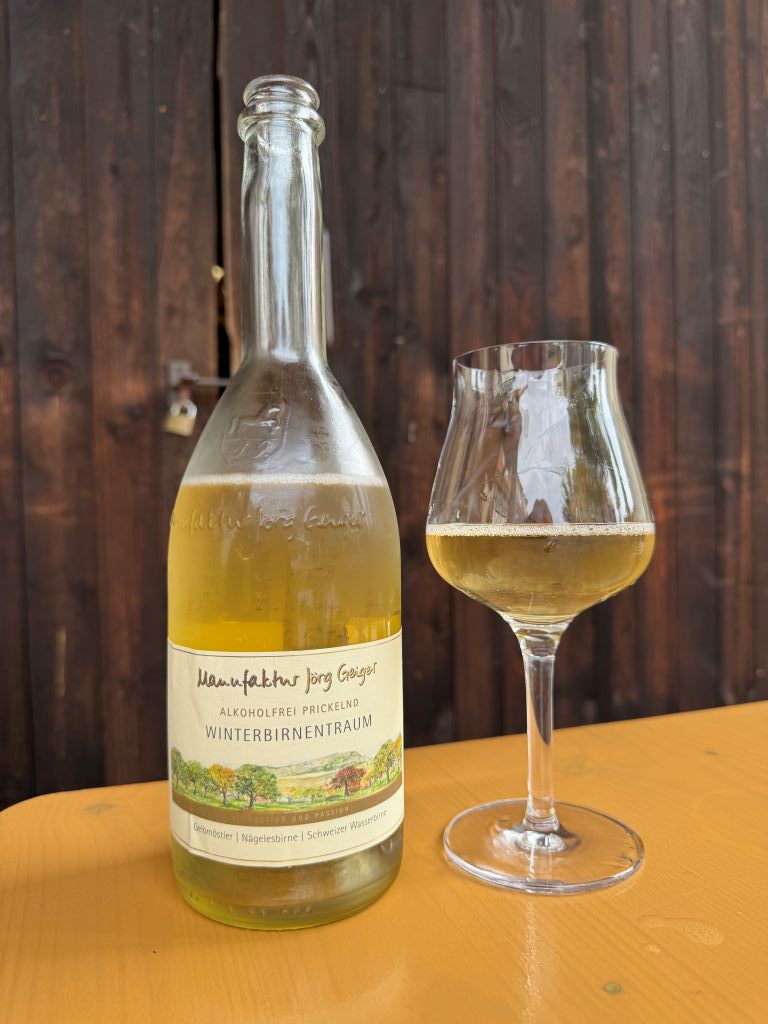
Manufaktur Jörg Geiger, “Winterbirnentraum” alkoholfrei – review
A pear juice drink (Gelbmöstler, Nägelesbirne and Schweizer Wasserbirne), infused with ginger, anis, and cinnamon listed as an allergen, with added carbon dioxide. Another juice-based 0% alcohol drink.
How I served: From the fridge.
Appearance: Pale straw, clear, sparkling.
On the nose: Fresh cut, slightly unrip perry pear, tinned lychee, blueberry yogurt and something I couldn’t put my nose on… a deep memory of summer flowerbeds. Poached pear, perhaps slightly overcooked.
In the mouth: All of the above. Luscious, big jellied fruits, lychee, blueberry, suggestions of strawberry. As with the others it is sweet, of course, but a much better structural fit t my tastes than its summer pear sister, the Sommerbirne. Puff pastry and stewed apple with a dusting of cinnamon lingers long on the finish.
Notes from the group: Candies apple, clear pear flavours, aromas od walking past pear trees in the autumn, ripe fruit on the ground reaching your nose before you see them (thanks to my wife for that, it’s a lived experience), Bratapfel mentioned twice, Christmas in the summer time and a camp fire.
In a nutshell: My pick of the lot so far, displaying the types of flavours I enjoy in a perry, helped along by a very good structure lent by the perry pears.

Manufaktur Jörg Geiger, “Rotfruchtig” alkoholfrei – review
I believe Geiger’s first alcohol-free drink, Rotfruchtig is a cornucopia of fruit juices! The website lists apple juice (50%), pear juice, sour cherry juice (8%), blackcurrant juice (8%), elderberry juice, quince juice, lime juice concentrate, spices (anis, ginger and cinnamon listed elsewhere) and added carbon dioxide. 0% alcohol.
How I served: From the fridge.
Appearance: Deep ruby red.
On the nose: Hibiscus tea, sour cherry, strong black tea, suggesting tannic notes. Ribena (that blackcurrant concentrate I grew up with).
In the mouth: The dominant cherry and blackcurrant flavours come through strongly. It’s less sweet than earlier samples due to sour cherry acidity, but the taste is somewhat one-dimensional, with blackcurrant being most prominent.
Notes from the group: Super-sweet, cherry, blackcurrant, nice acidity, light spices, Glühwein.
In a nutshell: I think the least favourite for the group so far, Rotfruchtig feels very basic, such that Ribena with sparking water would probably taste similar enough.

Manufaktur Jörg Geiger, “Aecht Bitter!” alkoholfrei – review
This is one I had a sample of at Cider World 2025. Based on one of my arch enemies (of, one of my favourite pears), Grüne Jagdbirne (more correctly called Metzer Bratbirne), an already tannin-heavy pear, then infused with wormwood. The website lists the ingredients as pear juice (60%, presumably Grüne Jagdbirne), gooseberry juice, quince juice, wormwood (0.002%), herbs, flowers and spices, with added carbon dioxide.
This is one that Andi was not allowed to sample, as wormwood is not something pregnant women should be drinking.
How I served: Fridge.
Appearance: Pale gold, clear, sparkling.
On the nose: Elderflower, quite gin-like, evoking a mix of botanicals, with sweet elements of wormwood and woodruff syrup to the fore.
In the mouth: Bright acidity reminiscent of lime zest and mandarin pith leads into a sweet, full body with ripe pear notes. Herbal flavours dominate the palate, accompanied by some bitterness but little astringency. The finish is long, featuring a pleasant herbal sweetness similar to woodruff jelly.
Notes from the group: Dried bay leaves, bitte, gin, tannins, cough syrup, “too many aromas!” (can there be such a thing?), fennel, anise, a good balance between sweetness and bitterness, but the herbal aromas disturbed the balance a little.
In a nutshell: Despite the sweetness, this combination of fruit and herb, bringing acids and gin-like notes, delivered a harmonious taste explosion that I really enjoyed.
One of my favourite mixed drinks, since Elizabeth Pimblett once posted a photo of a 1950s beer mat on Twitter (long before I abandoned that platform) with a recipe on it, is gin and perry. I don’ t like tonic water, so found a very tannic perry makes a great substitute, and I bet Aecht Bitter would also mix fabulously with gin! And as it happens, Geiger’s website recommends using this drink as a mixer with either gin or vermouth, both of which they also produce.

Manufaktur Jörg Geiger, Birnenschaumwein Alkoholfrei – review
A de-alcoholised single variety perry made from the local Champagner Bratbirne variety, it is listed as having less than 0.5% alcohol. The perry is fermented as normal, then bottle condiitoned a la Traditional Method, after which it is uncorked and put through a vacuum distillation process to remove the alcohol. Following that process, it is bottled again with a dosage of pear juice to round it off. The website lists the ingredients as 65% de-alcoholised pear wine, pear juice, herbs and spices (but doesn’t say which), and force carbonated. Can we pick out the herbs and spices? Let’s see.
How I served: From the fridge.
Appearance: Pale gold, clear, sparkling.
On the nose: Delicate. Evokes spices, juice ripe pear, kumquat, cinnamon roll, poached pears in syrup.
In the mouth: Sweet, yet with a drying, slightly astringent finish, which I like in my perries. Peach yogurt, spiced poached pears, lemon juice, mandarin zest. The overall impression remains sweet, though, and sadly the added juice dominates, so it’s hard to tell what the underlying original perry might have been like. There are some undefined, cooked vegetable flavours, that distract, and the whole ting feels flabby, and unstructured.
Notes from the group: Dried pears, very sweet, no bitterness, conserved pears with spices, an unpleasant aftertaste, cinnamon, cork.
In a nutshell: Expectations had been set very high, so maybe it was hard not to be disappointed by this offering. The sweetness and cooked veg notes were too much for me, and given the price, the other options in the selection offer better value. Stick with the normal Champagner Bratbirne perry to experience what this variety truly has to offer.
I need to add here that on tasting, I thought this was a single variety, pure Champagner Bratbirne just dealcoholized and back-sweetened. But as Jörg explained in our interview, what comes out of a vacuum distillation process is something very different, so they need to add things to get some flavour profile back. One on our tasting panel suggested that having gone to the trouble of bottle conditioning, then removing the alcohol and apparently enough flavour to require putting juice, spices and herb back in, then he’d rather just have the original, as he’d be very disappointed if he had paid close to €29 for a bottle of this. Luckily for him I paid for it, but I would agree. Your mileage may vary.
* * *
Conclusions
While I ordered these thinking of them as non-alcohol alternatives to cider or perry, they are not really that. The first five being juice-based, flavoured with herbs and spices, they are something else entirely. The C-Bratbirne dealcoholized perry was the only one that might be comparable to an actual perry, as it was at least fermented.
There’s no doubt, these are all interesting and well-made drinks with good flavours, but as with everything, it’s a matter of personal taste. For the majority of the 5 other participants in our little tasting panel, most of the drinks were leaning into too sweet, and this is where the Cuvee 32 stood out, as the acids from the rhubarb and oxalis definitely helped balance out the sweetness, and the ‘Aecht Bitter!’ as it had oodles of structure brought in by the herbs. My personal favourite was towards the Wintebirnentraum, just because it had more perry-like flavours, and a bit more structure from tannins to support the sweetness, but Cuvée 32 was a very close second, if not a draw for me.
Judging by Instagram, Geiger has been popping up more up on the radar with UK and other European wine people, with a recent event including journalists at their Manufaktur, so don’t be surprised if you see more of their products in the UK in particular, probably in restaurant settings. Definitely worth trying if you are looking for non-alcohol alternatives to cider or perry, as there is a hell of a lot to explore!
Many thanks to the original Kertelreiter, Ines, Andi, Ulli, Christian and Basti for playing along on a hot Sunday afternoon.
Next week, Jack will be looking at a maker in the UK that has turned towards no-alcohol ciders.
Discover more from Cider Review
Subscribe to get the latest posts sent to your email.
 Cider Review
Pingback: By Chance Or Design: Preserving Historic Varieties of Perry Pears | Cider Review
Pingback: Craft Cider vs. Craft Beer: Where Are the Trends? | Cider Review
Pingback: A Schwäbischer Cider Tasting Box | Cider Review