As someone hailing from the west of England, I now expect that, when visiting artisanal cider makers outside the UK and France (and perhaps outside the proud German or Spanish cider regions as well), they will at some point turn to me and wistfully say, “But of course, we don’t have the kind of apples that you have.”
Doubtless, tannins are excellent, and they lend balance, complexity, and structure to some of the best ciders out there. That said, when confronted with these automatic nods to the polyphenolic riches of my adopted home, I often gesture handwringingly around myself and go, “But look what you do have!”
This impulse was particularly strong recently when visiting Federico Pedrolli, cider maker at Apple Blood. The cidery sits on the Piana Rotaliana in northern Italy’s Trentino-Alte Adige region, a flat plain nestled between the Adige river and the surrounding mountains. Based on the table apple farm that Federico’s family has been running since 1970, it’s near the mouth of the stunning Val di Non, a broad valley blanketed, vineyard-like, in grids of commercial orchards. Planted with 70% Golden Delicious, it’s the birthplace of 20% of Italy’s plentiful yearly apple harvest (and a must-visit for apple fans).
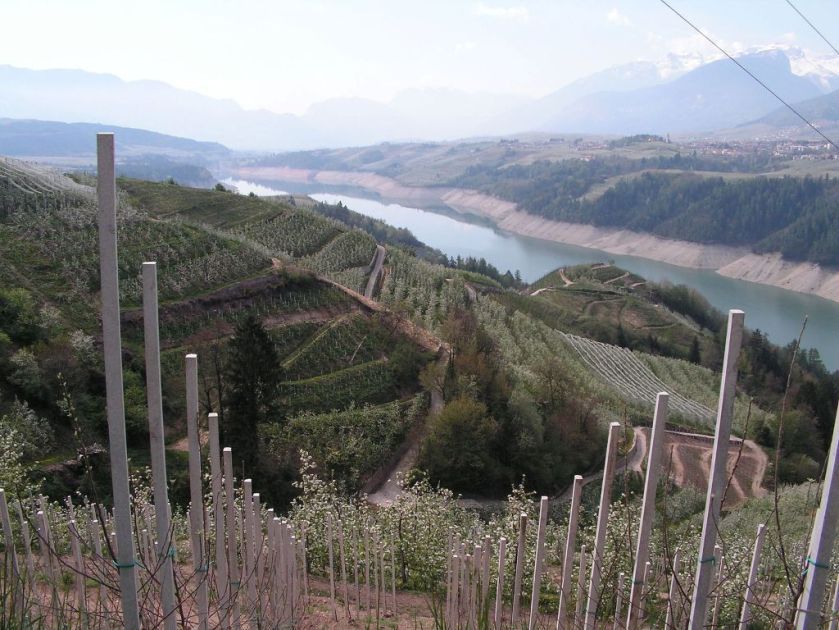
If it’s not clear already: my jaw was on the floor. With rows and rows of gracefully trellised apple trees racing off headily in all directions towards the Southern Limestone Alps, which tower over you with their craggy, tree-studded certainty, Apple Blood is one of the most picturesque cideries I’ve visited. I can’t wait to return to the area for spring blossom sometime.
Equally picture-perfect is Federico’s grandparents’ house, a classic Trentino farmstead or maso fringed with orange-baubled apricot trees. Only the large Italian flag hanging from one of the flowerbox-studded balconies indicates which Alpine country we’re in.
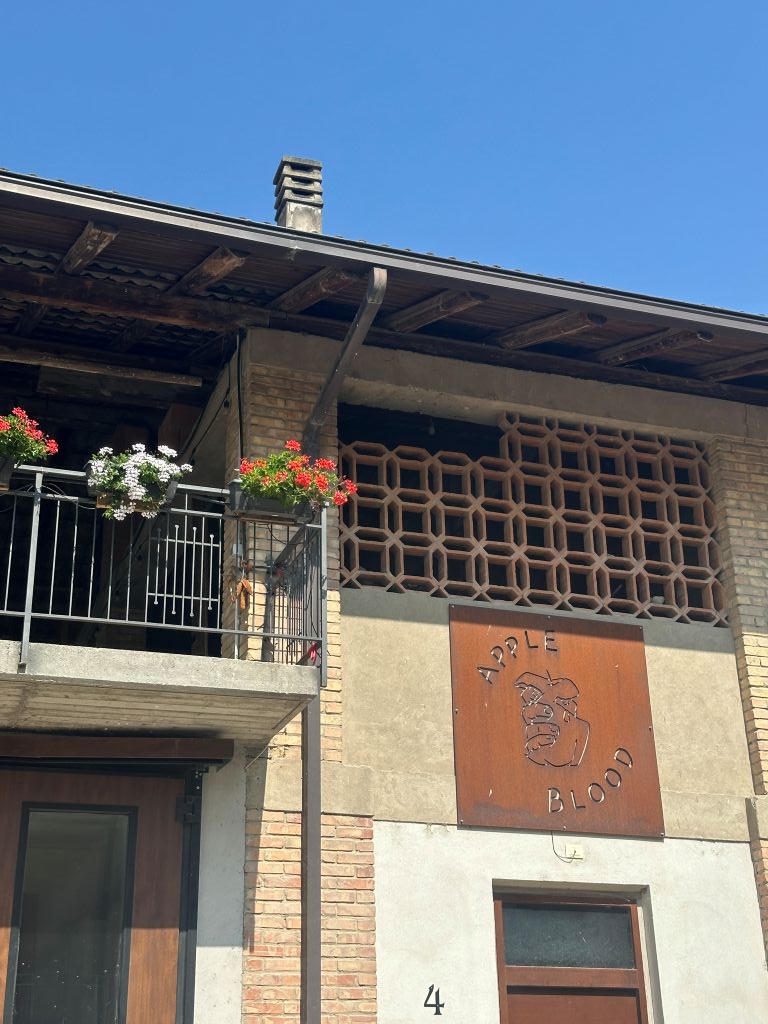
We meet Federico in front of the renovated barn that houses the cidery and begin an unrelentingly sunny walk around the five hectares of orchards. This apple farm, like almost all in the area, is part of the farming cooperative supplying the Melinda Consortium. This behemoth stores hundreds of thousands of tons of Val di Non DOP apples in Bond lair-like caves cut deep into the Dolomites and manages their distribution within Italy and abroad.
Excitingly, we learn that Federico is supplementing the Fuji, Gala, and other usual suspects here with his own grafting project. He says there are only a few table apples he likes to use for cider—among them Granny Smith and Golden Delicious—so around a thousand self-grafted trees are now planted in treasure-trove stretches of empty row between the tall spindles. They are on MM111, MM106, and (for the pears) pyrus pyraster rootstocks, and they will be transplanted to new sites soon.
The varieties Federico has selected run the whole gamut of cider and perry: for instance, there are varieties coveted for German Apfelwein, such as Bohnapfel and Goldparmäne; northern European multi-purpose heirlooms such as Gravenstein and Champagner Renette; and traditional central European distilling or perry pears such as Schweizer Wasserbirne. Among these, I am introduced to a new favourite apple name, Morgenduft (“morning’s fragrance”): it’s a traditional Tyrolean “winter apple,” a cooker that stores well.

Not all the varieties are named: there’s a super-tannic unknown apple found in Liguria; there are some simply numbered Kazakhstani trees from a breeder who uses these ancestral wildings to infuse more resistant genetics into modern varieties. Most fascinating to me are the varietà antiche: traditional Italian varieties, usually multi-purpose, that cider makers like Federico are increasingly researching, bringing back, and celebrating. Some of their names hint at colours, shapes and tastes, such as Fiamma (“flame”), Musetto (“little snout”) and Limoncino, while others are deliciously evocative—take Spadone del Curate (“the curate’s greatsword”).
Not everyone understands the project and its goal of bigger, more diverse trees. While Federico collaborates in the cider business with two orcharding specialists (his uncle Francesco and his cousin Davide), some of the old boys who work the commercial orchards can’t understand why, when the family has been farming table apples this way for generations, you would want to do anything else. Somewhat surprisingly to an outsider, it’s these densely planted rows that they see as “traditional”. Federico’s desire to broaden what Trentino apples can be is part of what motivates him to bring visitors into his world: “Here, I’m the mad guy,” he says. “But in the cider world, people get me.”

Although he’s now firmly part of the cider world, Federico has been able to draw on several other worlds too: a craft brewer by trade, he learned about fruit-based fermentation from a winemaking friend who teaches at the local agricultural school. From there, he says, making the leap to cider was all about lots of experimentation and sharing with friends; Apple Blood opened in 2020.
Back in the little tasting room adjacent to the main fermentation space, we have the chance to try several ciders in the Apple Blood range (currently only available in Italy, but hopefully soon further afield). The diversity is astonishing: Federico experiments with every part of the process, selecting different yeast strains suitable for the long, cool fermentations he favors and using all kinds of vessels, from stainless-steel tanks of various sizes to the several as-yet unfilled old wine barrels currently slumbering in a strikingly cool cellar.
Most Apple Blood cider (by volume) is charmat-method, dry-ish, and flavoured with fruit additions as co-fermentations. This “Evergreen” range, which comes in 330ml brown beer bottles, cans, and kegs, contains one of the most mouthwatering raspberry ciders I’ve tasted, Lady Rosé. Other, more limited-edition ranges consist of 500ml ancestral-method bottles of single-variety varietà antiche and 750ml traditional-method dessert apple blends.

We start with an Evergreen, Orange County. This “cider with American hops and grapefruit” (added as juice and peel during fermentation) is clearly brewing-inspired. In fact, it’s practically an IPA, with a big tropical fruit nose and quite a bit of grapefruit’s zest on the palate. It’s refreshing, summery, and perfect for the sweltering temperatures outside.
We then try an ice cider which was aged in the tiny amphora peeking out coquettishly from behind one of the variable-capacity tanks. Made from almost 100% Granny Smith, it’s a delight. The assertive tartness so characteristic of that apple is balanced by a big, warm, caramel nose, but what makes the cider particularly interesting is a sparkling mineral water-like prickle—an unusual texture I’ve also experienced in Apple Blood’s amphora-aged dry cider.

Even more unexpected is the chestnut honey mead that we get to try mid-fermentation. While Federico is keen to emphasize the seasonal nature of his cider, he admits getting the itch to start fermenting again mid-way through the cider-making cycle—making some mead in February it is! It’s incredibly, almost aggressively fruity on the nose, with a punchy Concorde grape note, but palate retains much of the sweet, nutty grittiness of creamed honey. This will be one to try when it’s done.
We don’t have time to taste the metodo classico ciders, but Federico kindly gifts us some (one of which I review below). Made of Canada Reinette and Granny Smith, it’s a homage to Val di Non as well as to cider making traditions from elsewhere, and indicative of the optimistic, infectious passion Federico has for his heritage—and for putting a new spin on it.
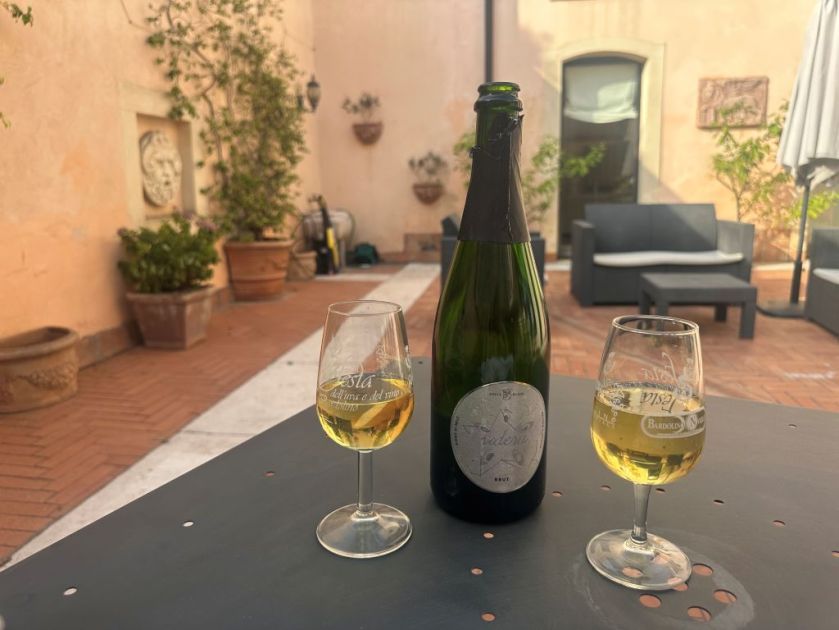
Apple Blood, Metodo Classico Brut 2020 – review
How I served: Rather too warm (the Airbnb’s fridge was broken) on a delightful Verona terrace.
Appearance: Sparkling and clear light gold.
On the nose: Fresh, clean apples with notes of yeasted, raisin-flecked baked goods.
In the mouth: Yum! In addition to the notes from the nose, there’s marzipan, but also actual almonds; it’s generally very nutty. There’s decent bubble retention as well as a medium weight in the mouth. It’s a dry cider without being austere or challenging, and there’s smidge of tannin. The tiny amount of sweetness is well judged; this is very moreish.
In a nutshell: As an apple-based Brut Champagne lookalike aged 40 months on the lees, this does an excellent job of what it’s setting out to do.

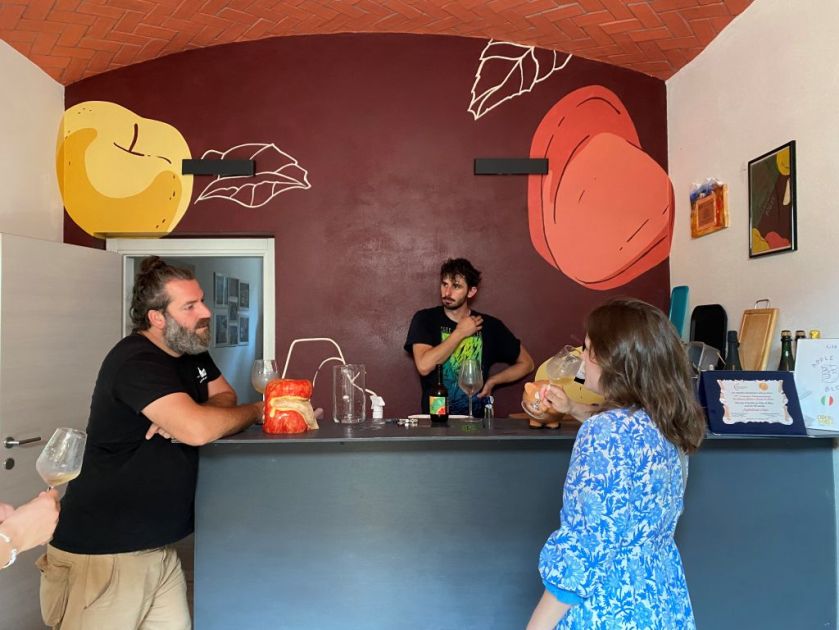
Cover image – Marco Manfrini, Federico Pedrolli, and the author at the bar in Apple Blood’s tasting room. Photo: Alfie Robinson.
Article updated 24.07.2025 for a minor corrrection as noted in the comments.
Discover more from Cider Review
Subscribe to get the latest posts sent to your email.
 Cider Review
A lovely article that really evokes the spirit of the cidery as I read it. I felt as though we were also ducking and diving through the ancient farmhouse, the narrow, near claustrophobia inducing orchard trellises(!), and the fantastic myriad of experimental ciders. Thank you for transporting my mind to Trentino! I wondered who the other man in the cover photo is? Perhaps Davide?
LikeLiked by 2 people
Thanks for the kind words, Thomas! The other guy in the picture is Marco Manfrini, mutual friend of Federico’s and mine and Italian Pommelier.
LikeLike
If his ciders are “flavoured with post-fermentation fruit additions”, how does he prevent fermentation from starting up again? Does he use sulfites?
The apple varietals sound intriguing.
LikeLike
I’ve just asked Federico about this, and turns out there was a misunderstanding—the fruit ciders are actually co-ferments, just very fruity ones. My mistake!
LikeLike
Great article Bea. I visited Frederico and Roberto at Appleblood with Marco last February and tasted their wonderful ciders. Trentino-Alto Adige has a lot of great apples and a growing artisanal cider scene. I’m so glad you are able to bring Appleblood to the attention of your readers. Did you get a chance to visit Floribunda as well?
LikeLike
Thank you Steve! The area is indeed exciting. We did visit Floribunda as well, and it was lovely, but it was a rather fleeting visit—will need to go back!
LikeLike
Pingback: Cider Review 2025: A Year in Reflection | Cider Review