Time is a funny thing, we can acclimatise quite quickly to new things or stay stubborn for an eternity, and both seem valid as options. I’ve been looking back recently and taking stock of my time drinking cider; proper, fine, aspirational, craft (Et al) and feeling that palpable excitement from the start mixed with the jaded feeling of being here a while. It personally feels like the ciders I love and those that make them have been running on the spot yet still making ground. Eight years ago, conversations with the likes of Tom Oliver in the Hereford Beer House and Gabe Cook in London were littered with hope about the next step of getting cider out there, with craft beer reaching its dizzying heights and wine firmly establishing its prefix of natural. It’s a decade later and it still feels like it’s getting close.
Cider has come on leaps and bounds since then, and ironically by reaching back to old practices in a lot of ways. Rural Method*, co-ferments, distillates and many other methods have had me lifting bottles to blue skies, whilst my stubbornness seems to have shifted, with Foxwhelp single varieties becoming something I’d buy quite quickly when they appear through the various online channels.
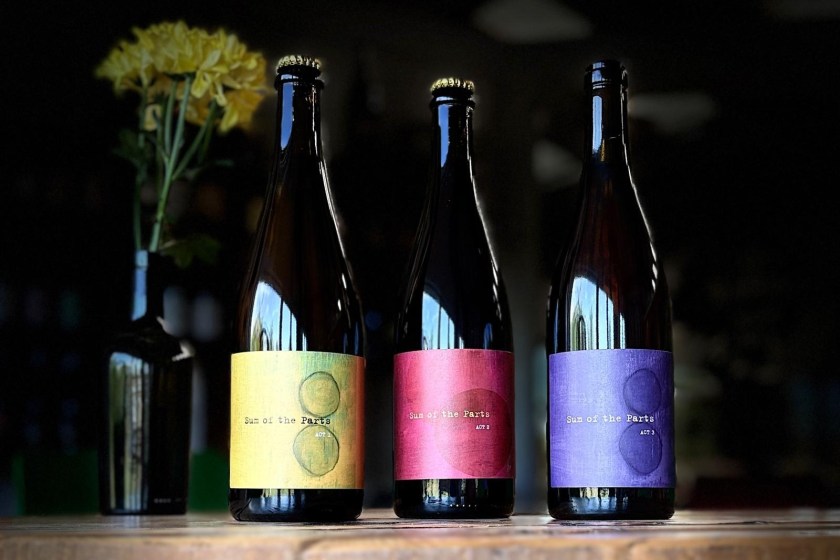
Enter Little Pomona’s Sum of the Parts, a series of bottles showcasing the combination of Foxwhelp, oak and time. I bought the first two bottles in the series back in October, with the third arriving in May from Cat in the Glass. I wanted to wait until an occasion popped up where opening all three would be justified, yet settled on three sequential weekdays, the kid put to bed and music on low for company.
I worked at Little Pomona through the 2021 harvest, and stayed on after for all the glorious grunt work a cidery could provide. Naturally cracking three bottles from an old employer and a good friend would stir up memories, and cider does what it does best, in providing a jump of for deep dive and a good old catch up.

* * *
Martyn Goodwin-Sharman: Can you briefly explain what a Solera is?
James Forbes: A Solera is a specific and deliberate collection of ciders from different vintages, destined for long aging. If you think of it as a kind of pyramid of, in our case, barrels, and on the bottom of this pyramid you have the oldest liquids, and at the very top you have the youngest. Every time we remove cider from the oldest part of the Solera, we then move the liquids down, and refill the top ones with new liquid. The longer the Solera continues to exist, the older the components will get on the bottom, and you will always have some component of the very oldest liquid that was in it.
Typically these things are done with fortified liquids to help keep them stable. Sherry’s fortified, spirits are obviously spirits, and vinegar is more stable because it’s already gone off. So to do it with cider is probably quite stupid and would be super risky with any other variety than Foxwhelp, and it’s because of the ultra-high acid and the tannin component that’s in that gives it some, but not total protection.
MGS: So with the oldest barrel in your pyramid, you’ve got the original cider still there, did that start in 2017?
JF: We established the Solera in 2018, but the liquid was cider that was harvested and pressed in 2017. So the oldest components now are seven/eight years old.
MGS: And how do you go about maintaining that, ensuring each barrel is full to the brim throughout the years.
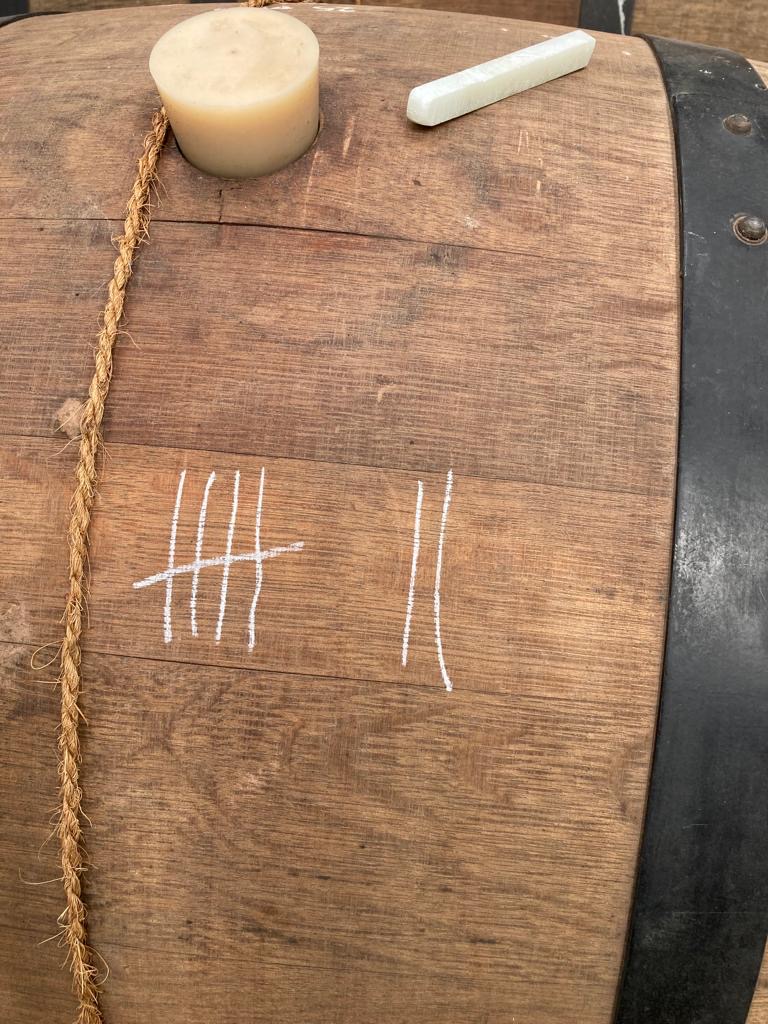
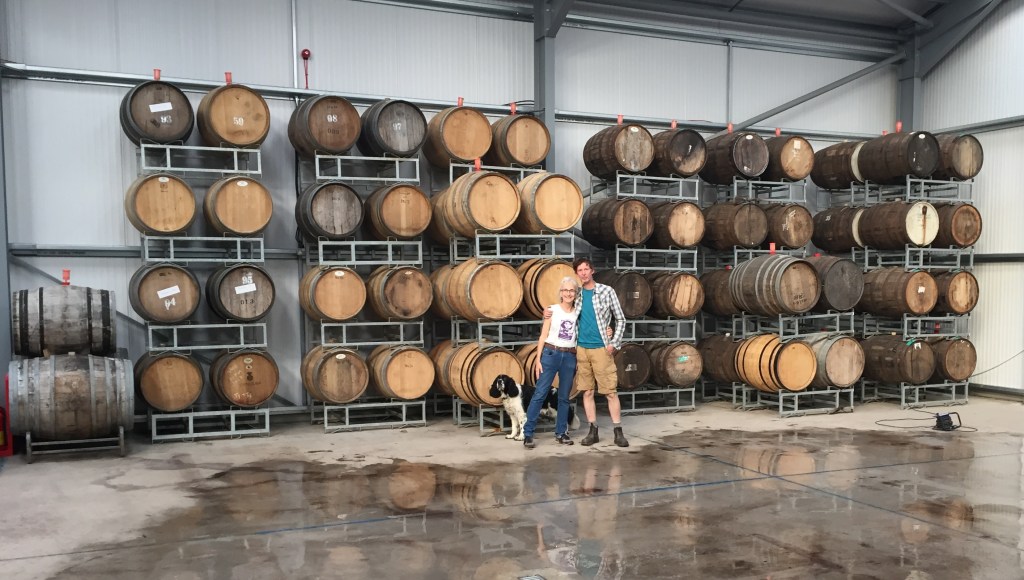
JF: I have to confess, we’re not as “on it” as we probably should be. I think at the very height of our barrel exploration we had 160 barrels, and that’s actually a lot to look after and as you say, you really do need to look after them, keeping them topped up, or you get too much oxygen and all the problems associated with that. We’ve lost a few barrels on the way because of our slight neglect. But yeah, but we do try and top them up when necessary. In the new regime however, we’re lessening the number of barrels, and we’re actually slowly moving towards much bigger barrels; partly because I want less barrel influence, and partly because a smaller number of bigger barrels is way easier to look after.
MGS: So Foxwhelp had the properties that you needed, did you have the project in mind and then needed to get the amount of Foxwhelp or did you have surplus juice and then put the project to it?
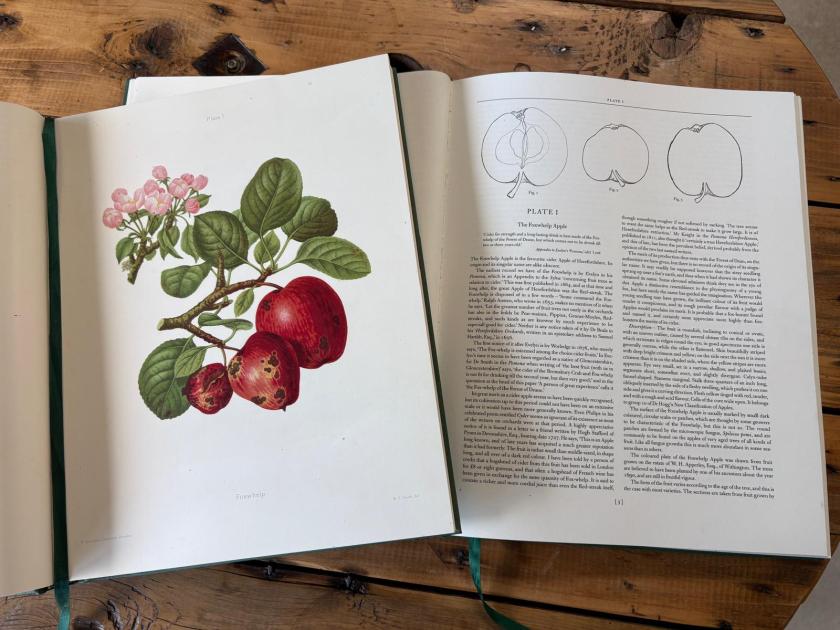
JF: I think the idea for the Solera project came from the Herefordshire Pomona. There’s a paragraph in which they talk about gentlemen keeping Foxwhelp cider that had been aged for a long time – three or four decades – for their friends.. That passage in the book made me think actually, maybe we could do it… and you know how I really like Sherry.

MGS: You’ve let on that you like it.
JF: So it was the idea to do something like Sherry with a similar level of complexity. And, when I read that passage, knowing that we grow more Foxwhelp than we actually need – it’s a blending component for us – it made sense. And I think it’s very challenging as a single variety, unless you’re retaining some sweetness, which we’ve never been able to do for whatever reason. We’ll keep trying though, because I know other people have achieved it.
MGS: Artistraw’s 2022 a personal favourite for me.
JF: I think if you’re going to do Foxwhelp as a single variety, you need to polish that acid so it’s not quite so aggressive and bring in a whole lot of other components to compete with it, and you can do that with aging for a long time in barrel or keeping some sweetness.
MGS: So there’s no scarcity with the Foxwhelp, meaning you don’t have to play logistically or compromise to create the blends in the cidery.
JF: Yes, exactly. The only problem is that the trees are quite biennial. So last year for example, it was a difficult time and we just didn’t pick it, so there’ll be a gap 2024. We won’t have any from that year, but I think that in 2025, we will. The truth of the matter is that the Solera releases are critically acclaimed but commercially they’re not the easiest thing to sell, so that gap won’t harm us.
MGS: How have the last four or five harvests been for the Foxwhelp?
JF: It’s quite a consistent variety in terms of its ripeness though, it doesn’t vary that much, the brix coming off the press are roughly the same each year. There’s not huge fluctuations like there are with our Egremont Russet, Dabinett or Kingston Black, they all have much more extremes I’ve noticed, but Foxwhelp seems to be in roughly that 7% potential alcohol bracket every time we press it.
MGS: My understanding would be that fluctuation would almost be bad for consistency, but if you’re showing off vintage it’s better to accentuate it. But with broad consistency, you’re showcasing the other variables, like the amount of time in wood and the maturation of tannins and acid.
JF: I think most of the effect of the Solera project is coming from its time in wood more so than from the combination of the vintages. It’s the barrel influence, the oxygen influence and the length of time that really gives it those characteristics. Yeah because it has such a strong personality to begin it never loses that, it’s always recognisably Foxwhelp.

MGS: How do you balance the finances of storing something that long in both wood and in bottle?
JF: There is no commercial gain for us. With the time, effort and the costs of making it don’t add up to a commercially successful product, but in spite of that, it’s quite fun to make.
MGS: How do you feel that the Solera project differs from the single barrel or blended barrel only ciders that you do?
JF: A lot of the barrel stuff that we’ve done has been experimental, a lot of those experiments have come to an end and so we don’t need to repeat them. In experimenting in small batches, I think you get a better sense of the whole. You know for long enough we didn’t, and still don’t actually, really know what we’re doing! But with that kind of trial and error approach you learn quick, like for example you find that a particular variety in barrel doesn’t really work, or it’s something that works great or that the barrel is just not necessary and we don’t do it again.
The Solera stuff is different from the rest of it because nowadays we’re putting stuff into barrel for specific reasons, learning the right course of action from the previous experiment. Whereas the Solera is like a separate thing that It has its own kind of reason for being and existing.
MGS: Would you ever start another Solera with a different variety, or is it just the extremes of Foxwhelp that work for you? You’ve leaned into Egremont Russet and oak quite heavily throughout the years.
JF: No, I think the Foxwhelp is nice, basically, even though the acid is high it’s still got other redeeming features. I think Egremont Russet would oxidise, which may be an interesting thing. Like in jura with Vin Jaune where they age the wine for a long time under flor, unfortified. There’s a slight similarity with Egremont Russet to these, and I was kind of quite keen to do that, but to match the alcohol levels of Vin Jaune are around 14.5%, 15% , so to emulate this with cider we’d have had to chaptalize a lot to get the alcohol up, so it’s just not worth it.
One thing it would do certainly is exaggerate the nuttiness of Egremont Russet, which people often perceive as some oxidation, whereas I think when it’s young, it’s not oxidation. It’s actually just the inherent nuttiness. You might get more and more of that, or you might get vinegar!
MGS: What if instead of chaptalising with sugar you brought up the alcohol with a distillate of a Egremont Russet?
JF: I think actually in terms of fortifying cider and then aging it in barrel, that’s something we’ll definitely try because I want to make vermouth and amaro, things which will do really well in barrel.
MGS: The ABCs with you is anything but cider, it seems.
JF: I don’t know. I mean, we’ll still make cider, but it’s like there’s a limit to how much relatively expensive cider you can sell. I think we’ve been slightly overproducing for a few years so a correction is needed. Like our pommeau, FOMO, people love it. So if we can make more of that, it’s just a whole different thing that we can sell. I can’t see a year in which sales and production are suddenly going to skyrocket, it’s just not going to happen. It’s going to be a gradual thing. And there’s more competition as well, like even five years ago there weren’t as many really nice producers as there are now.
MGS: I think Tom Oliver was speaking at Craft Con saying almost the opposite with competition in the market, in needing more makers making more, so that you can sell the concept of new age cider. We’re still on the first rung of the ladder of drinks, trying to get in.
JF: Exactly, Tom’s right. It’s up to us to continue to make the case for cider until people start to get it, but it’s a hard work.

MGS: But experiments like the Solera and the distillates are what push the conversation forward. How did you select the barrels that have gone into the Solera? Have you swapped any out, and are they the same throughout the pyramid?
JF: When the idea came together in my head we had some Foxwhelp in barrels, and they without design became the first steps in the Solera. We selected some barrels to be part of that and then each year we’ve just looked at the barrels that we have available and we’ve decided which ones to fill and put into it. If we’re, not happy with a barrel, we’ll either get rid of the liquid or move it into a barrel that we’re more happy with.
MGS: With the nature of the Solera, you’re almost holding on to the original harvest and prolonging it indefinitely. Is there anything particular-tasting that stands out from when you started on the project?
JF: It’s been interesting to see the evolution of things in the barrel, that kind of transformation of flavours and the perception of acid is really exciting. Because it’s Foxwhelp and it resists change quite strongly, its a slow transition, and you kind of see these gradual changes.
And then of course, when you empty some of the barrels and refill them there’s an immediate change in the composition of those barrels, you’re kind of resetting it from year to year in a way. The Sum of the Parts Act Three is really nice, and we created that from the older barrels, but by suddenly putting in a little fresh cider it was almost like obliterating that liquid, and you have to wait for that to come back. I honestly didn’t expect every barrel to be quite so different.
When it comes to blending time it is quite an exercise to look through all the possible components and put them together in the best way on that particular day. I thought it would be slightly more homogenised, but that’s not the case. They’re all different.
MGS: After trying all three acts they all coexist, but there’s a progression and divergence, like the same people in a band getting back in the studio again, but the Act Three is almost a completely different approach of flavour and aromas to the other two. Is that just down to what you did in blending or is that down to the contents of the barrel?
JF: Probably a bit of both. With the first releases we did Act One and Act Two, and that was just the to demonstrate the difference that time in the barrel made between them. Act One was blended from young parts of the Solera, Act Two was from the oldest parts. I but personally I think Act Two and Act Three are different, and that’s just that additional time having an effect on the flavour and aroma.
When we were blending we didn’t have a template that we were working to, it was a case of how best can we put them together and how much ultimately do we want to extract from the Solera in the individual bottling. The idea going forward would be just to do the older parts, and I suspect that’s how it will continue.
MGS: Between release of your archives in a boxset, the eventual release of FOMO and the nature of the Solera, do you find yourself looking back on your cider journey?
JF: I don’t think we ever look backwards. I think the Solera project was a kind of look back in time because the inspiration for it came from something that was written over 100 years ago, and it uses a variety that traces its lineage way back to the 17th century. In a sense we’re borrowing from things in the past, but we’re always looking forward.
People often ask me what my favourite Little Pomona cider is, and my answer is the next one we haven’t made. I want to keep moving forward, not dwelling too much on the successes or failures of the past. That’s kind of our nature, and it’s interesting to see how much better we could make ciders or other people can make ciders. I mean, how far have we got in that process, of bringing cider to that point where it’s really hard to get it to be any better? And what we can do to make it better? For instance, how could we improve on something like Once in a Lifetime Two?
MGS: Well, looking at the experiments over the years, including the Solera, you’ve got it to the point now where those ciders and experiments are complete. The next series of trials it could go forward or left and right comfortably, and that’s exciting in a different way.
JF: Yeah, that’s true. There’re many different pathways, and I think that’s part of the fascination. We can always do something different with the apple, moving forward.

* * *
Little Pomona, Sum of the Parts Act 1 – review
How I served: An afternoon in the fridge, 30 minutes out for a light chill.
Appearance: A crystal clear and light amber in the glass, absolutely golden and still.
On the Nose: Intense aromas of strawberry laces, lime, wine gums, leather, oak, and a trace of anise.
In the mouth: The acidity is first out of the gate, but time has been kind to it. That dried apricot and tart apple combo of 2017 – 2019 era Little Pomona immediately comes back to me, but unmistakable with its Foxwhelp charm. It finishes with a real, deep mouth coating tannin that feels like biting through kiwi skin, and a rounded bitterness to hold it in place.
In a nutshell: It’s all tenor and bass, extremes in harmony and one to sit with, like rewatching the classics and hearing Sergio Leone. They don’t make ‘em like they used to.
Little Pomona, Sum of the Parts Act 2 – review
How I served: An afternoon in the fridge, 30 minutes out for a light chill.
Appearance: Crystal clear and perfectly still once again, but strawberry red in the glass.
On the Nose: Fresh red berries, cherries, oak, Parma violets and creamy, with soft buttery notes.
In the mouth: That creamy note of the aroma hinted at the softness, and after Act 1 its definitely more integrated. It’s red apple skins, cranberry juice and black tea on the palate, with a real bite to those tannins, coating the mouth and lasting indefinitely.
In a nutshell: All the time and contact with wood on show here, with that trademark acidity brought into balance. However those fruits become hints, rather than unmistakable smacks. The colour suggests Foxwhelp, but the lasting impression is Ellis Bitter.
Little Pomona, Sum of the Parts Act 3 – review
How I served: An afternoon in the fridge, 30 minutes out for a light chill.
Appearance: Pours a brassy orange, and once again crystal clear in the glass.
On the Nose: Floral notes on the nose straight away with violets, backed by strawberry, rich oak, and oily citrus peel. There’s herbaceous and smokey notes that bring a subtle mezcal to the mix too.
In the mouth: Blackcurrants, red apples, bitter orange and charred oak, the tannins marrying with the hints of smoke for a gentle bitterness on the tip of the tongue.
In a nutshell: For me, Foxwhelp needs reining in to get the best of it. All the cymbals as hard as you can hit them, yet grounded in the mix with some residual sugar or in this case, a long slumber in wood. A drink that seems hard to understand and easy to drink in equal measure, and unapologetically cider through and through.
Conclusions
Foxwhelp is a funny thing, all bright light and white hot, but once subdued I can drink it in like sunset. Little Pomona have managed to show the effects wood and time can have on the juice in varying degrees, and as fun as this triptych is, it’s the promise of its continuation that’s the cause for excitement. The continuation of the project is evolving the cider’s history, always changing and staying the same. Rather than reproducing photographs, it’s a drawing of a drawing, and truly the sum of all the parts. After spending some time with these bottles, reaching out to James and diving back into the inner workings of Little Pomona, I feel a lot of promise for the project and its direction in the years to come, and my only thought it that other makers in different regions should try this trick. Wanting more makers to make more, and wishing no commercial gain and even less space on them seems a cruel wish from a drinker, but it’s the excitement and the possibilities that come from cracking a series of Solera ciders and truly dissecting them. It’s a decade on, and cider is headed in the right direction.
These ciders were purchased through Cat in the Glass, but are also available through Little Pomona’s website.
*In this case, Rural Method is a name used by some UK makers to mean a technique whereby multiple rackings are carried out to slow down fermentation and leave a naturally sweeter drink, not to be confused with Méthode Rurale/Rural Method that is a synonym for Ancestral Method/Pet-Nat.
All photos courtesy of Little Pomona.
Discover more from Cider Review
Subscribe to get the latest posts sent to your email.
 Cider Review
Fascinating and insightful – many thanks. I’ll need to open a bottle of Sum of the Parts later today. Not sure which one yet!
LikeLiked by 1 person
Thanks Paul, which one did you open in the end?
LikeLike
Pingback: Where You’ll Find Me Now | Cider Review