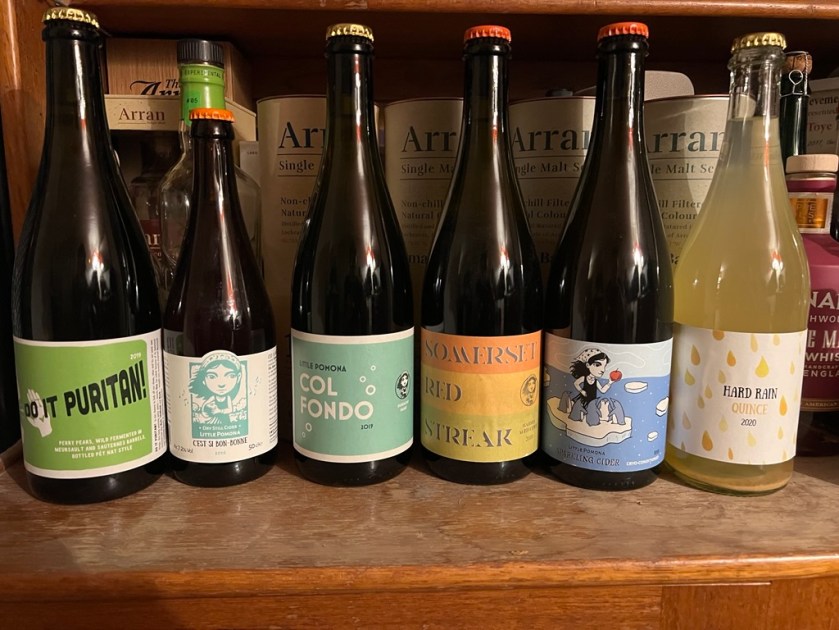
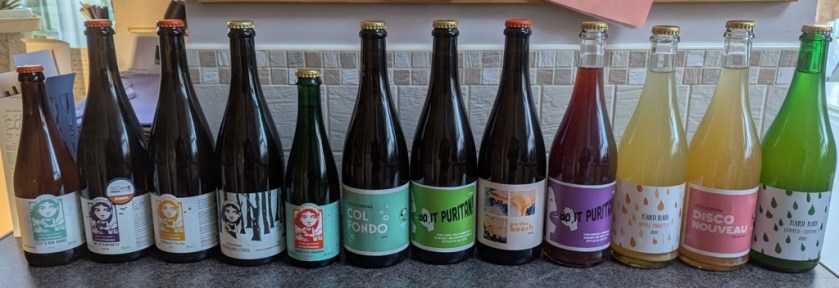
We’re usually gazing forward into the near future at upcoming releases/brand new drinks to the market here at Cider Review. Then once in a while, Surprise-Surprise (thank you Cilla Black) something brilliant and out of the blue comes along like Little Pomona’s Take A Dive Into The Archives box. The email appeared in my inbox on Friday 7th March and after a quick read of its contents, my hand was on autopilot and a box had been ordered for £60. I was not the only one, my friend and fellow CR contributor Andrew messaged me shortly afterwards, “Did you order one of the Little Pomona archive boxes?”. I’m sure a number of you ordered one too. Given the relatively short amount of time between ordering a box and reviewing the drinks (this must be a record for me, 2 and a bit weeks), I thought there would still be boxes for sale on Little Pomona’s website. This article was intended to shine a spotlight on a lovely offering that doesn’t come up very often – a chance to delve back into some yesteryear favourites, a little like my What’s That Bottle, Back There? mini-series (to be continued) in 2024 for Ross Cider and Pilton Cider. Boxes of 5-10 year old cider and perry wait for no person it would seem in 2025, and everything has sold out already.
Great news for James and Team Little Pomona, plus their legions of fans that managed to get some bottlings they never thought they’d be able to try again. Following on from Kevin Minchew’s The Last Hurrah 23 year old perry, released via Tom Oliver at the tail end of 2024, it seems aged ciders and perries really do have a dedicated and observant following. Who’d have thought it! By the time I’d bought the box I’d already committed to Barry that I’d write something around it, as it’s just such a fun release to delve into. So by writing these following words, I’m not intending to rub anything in anyone’s general direction, merely document a lovely release which has taken place in early 2025. From my conversation with James below, it also sounds like a larger range of old releases will be winging their way to the webshop and Little Pomona HQ in Bromyard in Magnum large format soon, so there’s still a chance to pick up some gems later in the year. One of the highlights of last year’s cider adventures, was sitting down with James Finch & Forbes at LPHQ, trying a sip from Lincolnshire James’ The Unicorn bottling. I’d never sampled it before, seen it mentioned a bit when I started getting into cider and perry in 2020, but there it was in the real world, sugar fermented away in-bottle, dry and sherried. To try it with the cidermaker and the eponymous Cider Critic was a special moment. I was looking for some of that magic with the box that I bought too.

Before we get going with the chat with James (Forbes), I should mention the premise of the box and my hopes for it before it arrived. Six bottles for £60, free P&P. A selection of bottles stretching back to Harvest 2015 from Little Pomona that have long since sold out and disappeared from bottle shop shelves. The one release that really caught my eye was On The Beech 2020. I’ve been after trying the still version of this cider ever since finishing my last bottle in November 2022 (thank you Untappd for reminding me). That bottling prompted me to buy a White Beech tree from Welsh Mountain Cider’s nursery a few years ago. I’ve looked out for single variety releases ever since from different producers, but so far it’s evaded me. There is a randomness to the bottle selection in each box, so no guarantee of any particular bottle. In my case, the parcel arrived in the post a few days after my order. I ripped off the top with excitement. Did I find that bottle of On The Beech in there?… No… Was the selection I had been sent still worth it? Absolutely, yes! If any of you did receive an On The Beech 2020 bottling and are looking for someone to enjoy it with you later on in the year… onto now the conversation with the lovely James Forbes at Little Pomona HQ!
Cider Review: Welcome to Cider Review again James! Why was 2025 the right time to (re)release these iconic Little Pomona bottles?
James Forbes: We started off very religiously always keeping a number of bottles back, of everything we released, in what we called ‘The Archive’. Kicking off with the first product we released back in 2017, we had no idea how long they would be drinkable for. It seemed like a good idea to look at their progress over time. When you release as many things as we do, that becomes quite a big task and you need quite a lot of space to tuck away 12 bottles of everything. By now in 2025 we must have released well over 100 bottlings – that’s a lot of bottles to store. Especially if you want to be able to access them at any given time. You could pile them up on a pallet, but then you could never get to them in practice. Over the last few years, based on our experience of what ages well, we’ve only been keeping things which we think have ageing potential. That’s our judgement. Some of the feedback I’ve seen from the cases we’ve sold shows me maybe some of my judgement was wrong. Some of the bottles I thought wouldn’t last as long, folk have said taste great, maybe even better than when we first released them. So, it’s not an exact science.
CR: In my mind, this archive of yours is guarded by Dobermans, turret-mounted lasers, and hidden behind a big metal vault door?
JF: Essentially yes, there’s electric fencing and guards with machine guns patrolling the vault! But in all seriousness, the reason we decided to sell off the bulk was just an idea, we didn’t know it was going to be possible, just an idea to test the market, my feeling about the ageing of cider hasn’t really changed. Things post-bottling, they need time in bottle before we’re happy to release them – that period is typically 9-12 months. Maybe longer in some cases. After that point, they can continue to improve, but they reach a plateau where they don’t improve that much, there’s a stasis for quite some time. I don’t know the exact science of maturation, but I was seeing quite a few posts on Instagram where folk were opening these bottles, and they were generally all very favourable. Some of these things we released four or five years ago, it’s amazing people are still interested in them. I don’t keep anything I buy for that long; they get consumed. A lot of these drinks would have been purchased around lockdown time, and then people went back to their normal lives, and I assumed they’d be forgotten about as releases. I basically thought I could do with some more space, and if people are enjoying them, I thought it was better if we release them all. We haven’t sold all the bottles, we do keep some back, as even at home, we were very rarely opening them, sometimes only for a really interested guest or two. It would have been a shame if we just kept them, and they went to waste.
CR: That’s incredibly generous of you I must say James! It follows the recent theme, if we can loosely trace the thread, in the world of cider and perry of Kevin Minchew’s The Last Hurrah 23yo perry, released at the end of 2024, of something you never thought you’d get to try again. I’ve seen quite a few people online saying words to the effect of “I never thought I’d get to try The Unicorn as I missed out on the early years of Little Pomona, and here it is in a box!” It’s brilliant you’re offering it.
JF: It’s been great, that’s been a really nice aspect of it. There are some people who have been fans for a long time and missed out on the odd thing. So, if they’ve been able to get a bottling of something they missed out on as a result of this, then that’s brilliant,
CR: The first few years of your production were from your home orchard am I right in saying?
JF: Yes 2015 and 2016 were only from our Home Orchard, and then in 2017 we made perry for the first time using fruit from a different orchard. In 2018 we branched out into using other fruits and we bought some fruit from another orchard and started to get bigger.
CR: Did you notice when you came back to these bottles, is there a difference in house style of the wild yeasts between the ciders you made at your first home site, compared to where Little Pomona HQ is now situated? I felt a few smelt completely different to the regular LP aroma.
JF: My feeling is we’ve got better at making cider over the years, so maybe there’s a change in quality in that sense. I think there’s a definite house hallmark to our bottlings, tending to be decent levels of acidity, even from the bittersweet varieties, and a lot of fruit-forward flavours. Drinks like The Unicorn, had some residual sweetness when they went into bottle, but over the years that fermentation has never quite stopped, until recently, and it has now become very dry when you open a bottle. The tannins are really present there as you’ve lost the balancing sugars. These were Pet Nat styles too, so the presence of the yeast in the liquid made a difference too.
CR: Alongside the Pet Nat bottlings, I had a few which were still in their presentation. Were you a bit more nervous about the effect of time on these bottlings?
JF: Not at all, I was very confident with the still products. They’re very stable products. They’re the ones that tend to have this stable evolution. The packs were nearly all two still, two sparkling, and a perry/co-ferment alongside a Hard Rain.
CR: In my box I had the Hard Rain Quince, and when I saw that 3.8% abv I was a bit worried. It absolutely is still holding itself together however! I wanted to ask about the bottles you used, as this time around I got a 500ml fluted bottle, similar to the 750ml we see used today. Why do we not see them anymore?
JF: They stopped making them, it was that simple and we couldn’t get a replacement. They may have started producing them again now, I haven’t checked. From our production and bottling point of view, smaller bottles are not very efficient, so I’m happier with the sharing bottle idea we’ve gone forward with. It forced us to lean into that size a lot more, which has been a good thing for us.
CR: In those earlier bottlings we see Dabinett, Harry Masters Jersey, Ellise Bitter and Foxwhelp. Are they the varieties you have growing in your Home Orchard?
JF: Yes exactly.
CR: Over ten years, have you noticed an evolution in the fruit from those trees as they’ve aged?
JF: I don’t think so. They’re much the same. It’s all about the season, that’s where you see the big changes. Some of the trees have tended to become more biennial as they become older – Harry Masters Jersey is one such beast.
CR: One of the things Kevin Minchew and Tom Oliver spoke of at the Last Hurrah cider club at Ross Cider was that over a spread of 20 or 30 they’d seen a completely different fruiting style and SG level from the fruit they used. Maybe that was because they were very old perry pear trees to start with. Your trees in your orchard are what kind of age?
JF: They were planted in 2001, so they’re really in their prime now.
CR: As you went back through these bottlings, has there been anything that stood out to you, where you look back with hindsight and think we were so lucky to get this varietal of fruit, or this type of barrel to mature in?
JF: I think so yes. The cider apple White Beech was definitely one of those. The Do It Puritan Perry in the Sauternes barrels also worked very well, it would be nice to try that one again. All of these things bring back memories. Feet Of Clay was our first ever release, and a few of those bottles went out, so that brought back lovely memories.
CR: Looking at the composition of that Do It Puritan Perry, I saw there was Gin, Butt, Oldfield, and then Rock. Do you use Rock every year in your perries?
JF: We haven’t had it for a while as we don’t pick down in that area anymore. It was a pure one off, and not that much Rock went into it. I remember it’s a very intense variety so it definitely adds something unique to the blend.
CR: At that time of us speaking, it now says Sold Out on the webshop for this box, is there a chance you’ll bring this box back on-sale again?
JF: It’ll be a few years before we do it again, once the archive builds up again. Some of these things are still in Magnums. I will look at putting these up on the website so if people are interested in trying them in larger format, I’ve got stock of things going back to 2018, maybe 2017 in some cases.
CR: Have you always bottled a few magnums of your releases too?
JF: Not everything, not really the still stuff. It’s always been predominantly the sparkling releases. Apart from Old Man And The Bee, Art Of Darkness, Dead Flowers, and the original Orange Cider from 2018 season, its’s always been sparkling. The magnum is the ideal format to age drinks in.
CR: Absolutely, I’m a stalwart Magnum purchased every time I pay you a visit in Bromyard!
JF: Yes and thank you for that. We’ve got a little more space in the cidery now which is nice. I was genuinely surprised by how many of these packs we sold. I wasn’t sure if people were going to be interested in them. There were a lot of people who made their first online order with us for these. That was fascinating that this box served as an entry point for people to buy from us. The power of age and history! Thanks to everyone who has purchased one, it’s been brilliant to see.
CR: Cheers James, thank you for taking the time to speak to us today.
Onto the reviews at hand!
—
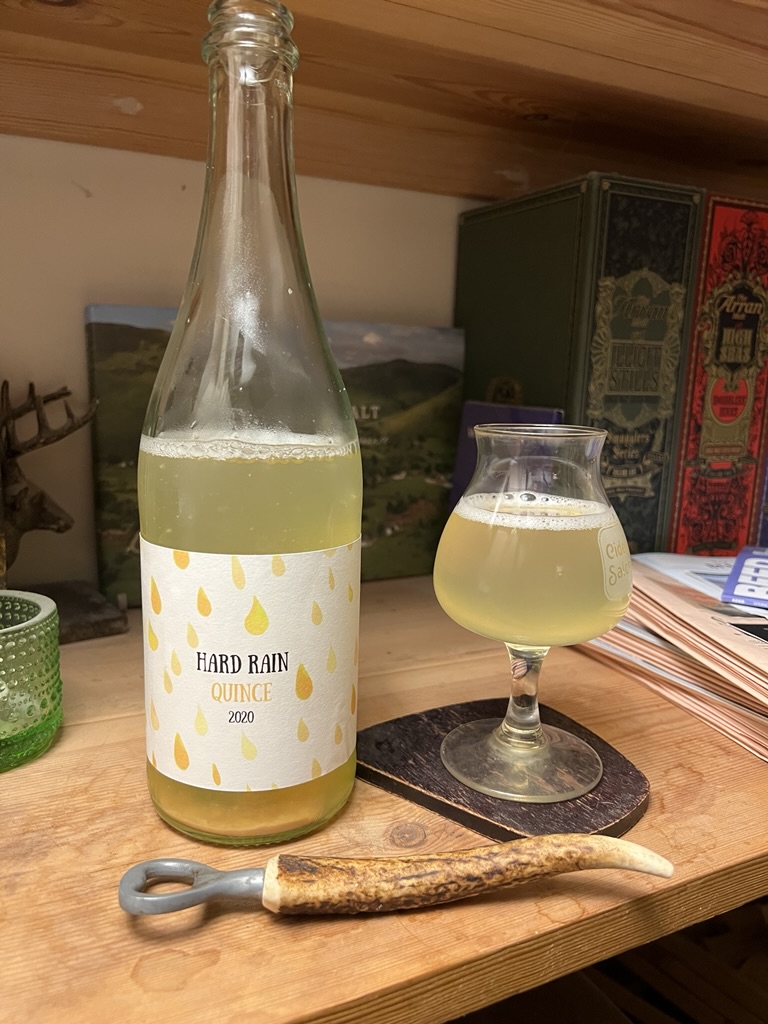
Little Pomona, Hard Rain Quince 2020 – review
A ciderkin composed of two varieties of Quince, some Ellis Bitter, fermented on the lees of Disco Nouveau.
How I served: A day in the fridge, 30mins to acclimatise in the sitting room.
Appearance: Hazy pastel lemon crush. A light fizz when the cap was popped (reassuring as this is low abv and from the 2020 season). A thin mousse sits around the rim of the glass, with super small, foamy bubbles.
On the nose: Presenting with a pronounced Spanish Sidra, volatile acidic note. As it’s majority quince I’m not totally sure how it ages in bottle, and at this relatively low abv of 3.8%. Part of the fun of doing these reviews! As the liquid warms up a bit more, this VA note seems to disappear – perhaps the contact with oxygen again after a good few years trapped the other side of the cap?
On the palate: An explosion of pineapple cube and dried mango. Absolutely delicious, tasting much fresher than it smelt originally. Strong kombucha vibes. Super juicy, reminding me how much I love these Hard Rain releases. Lemon meringue pie in liquid form. If there’s this much flavour in it at 3.8% abv, makes you wonder what it would be like at 8.4%!
In a nutshell: This ciderkin uses some of the finest quince juice to come out of lockdown, preserved in bottle for a low/no alcohol day.
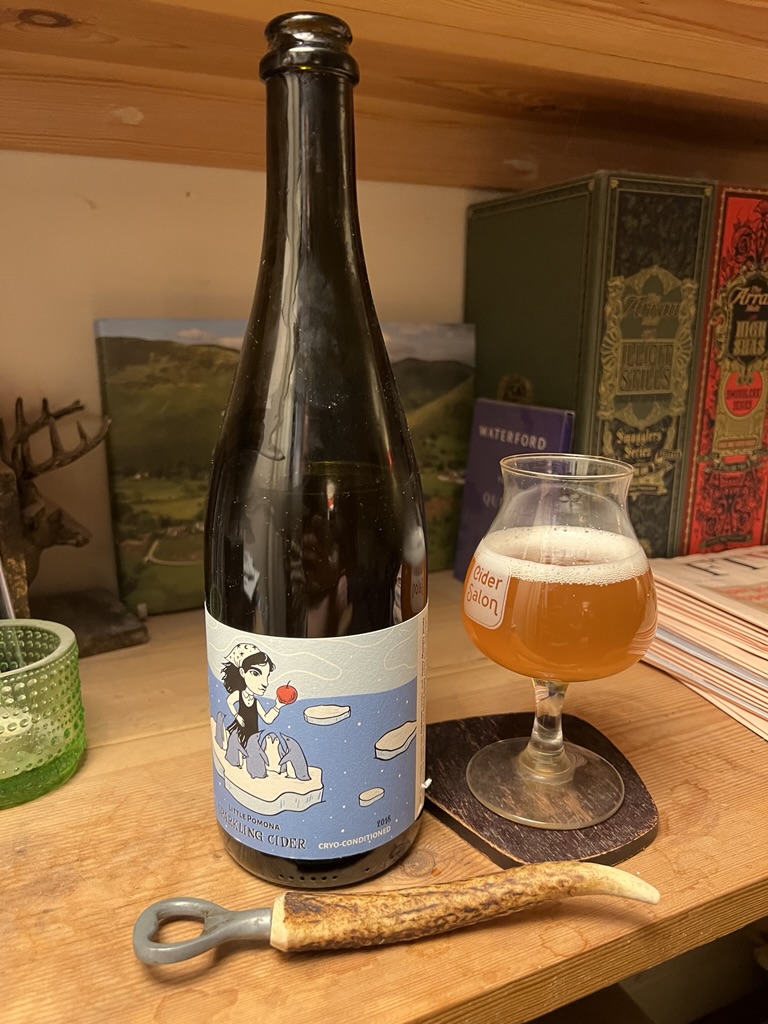
Little Pomona, Cryo-Conditioned Sparkling Cider 2018 – review
Barrel-aged Dabinett (70%), Harry Masters Jersey (20%) and Chisel Jersey (10%).
How I served: Half an hour in the fridge and then out. With a tannic base, I’m not expecting the need for much chilling prior to popping the cap. I’ve tried this once before in September 2020, can’t wait to see what another 4.5 years in bottle has done.
Appearance: Hazy tawny orange marmalade hue. Light effervescence and a 2mm mousse around the rim of the glass.
On the nose: That welcome, rich, stewed fruits, barrel-influenced Little Pomona wild ferment house style that you’ll come to recognise from regular releases like Old Man & The Bee, Art of Darkness, and more. It’s there as a bass note to the aroma. I’d say I’m getting more from the HMJ and Chisel Jersey than Dabinett here. It’s seven years after the fruit was harvested so all sorts can and will happen to the liquid.
On the palate: Dollops of Victoria Plum and its dehydrated stewed prune sibling, dry and astringent, absolutely bold and deep as the label states. Nutmeg butter, a creamy, spicy dual note sites to the front of the tongue, these are rich, Autumnal tannins on display here. What I imagine a Biffin used to taste like (cooking apple filled with butter and spices) if it was transposed to an 8.2% abv bottle conditioned cider 😉 .
In a nutshell: A tri-varietal, bittersweet, barrel-aged blended cider from 2018. Now if that doesn’t get your synapses and taste buds flowing…
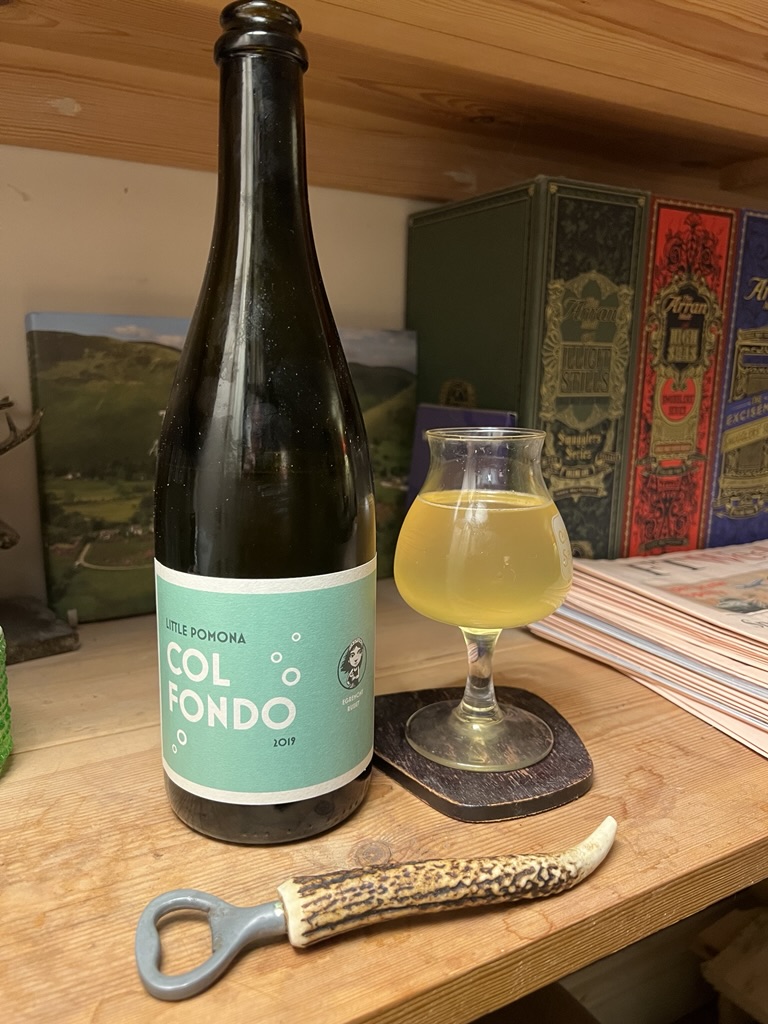
Little Pomona, Col Fondo 2019 – review
Egremont Russet aged in barrel and tank.
How I served: A couple of hours in the fridge, and then out to be served chilled (cold but not frozen, as the label instructs).
Appearance: Hazy lemon pastel hue. A foggy lemon teardrop(s) in a glass. Near still, and no real mousse to speak of.
On the nose: An exciting aroma – I know Little Pomona treat Egremont Russet extremely well, elevating it into the higher echelons of fine cider, and this has all those hallmarks. Crisp green apple, kiwi flesh, and lemongrass. It’s all there.
On the palate: I last tried this on 23rd December 2020 and looking through the other Untappd check-ins, 95% of them are blown away, and rightly so. This is structurally an amazing cider, one that has aged very well in bottle, that higher natural abv that comes with Egremont Russet is preserving it exceptionally. This bottle clocks in at 8.4% abv, and time has been very kind to it. There’s a real tropical vibe going on here with lychee, papya, pineapple, and lime notes dancing around on the palate. It’s the sugar and malic acid working wonders here. In a rare white wine analogy for me, this is reminding me of slightly crisper French Chenin Blanch. Makes me want to try lots of other russeted Apple single variety ciders – there must be a world of exciting flavours out there. Thank goodness for Little Pomona opening my mind to them.
In a nutshell: Masterful presentation of Egremont Russet. If you get it in your Mystery Box, ding ding ding, you’ve struck gold!
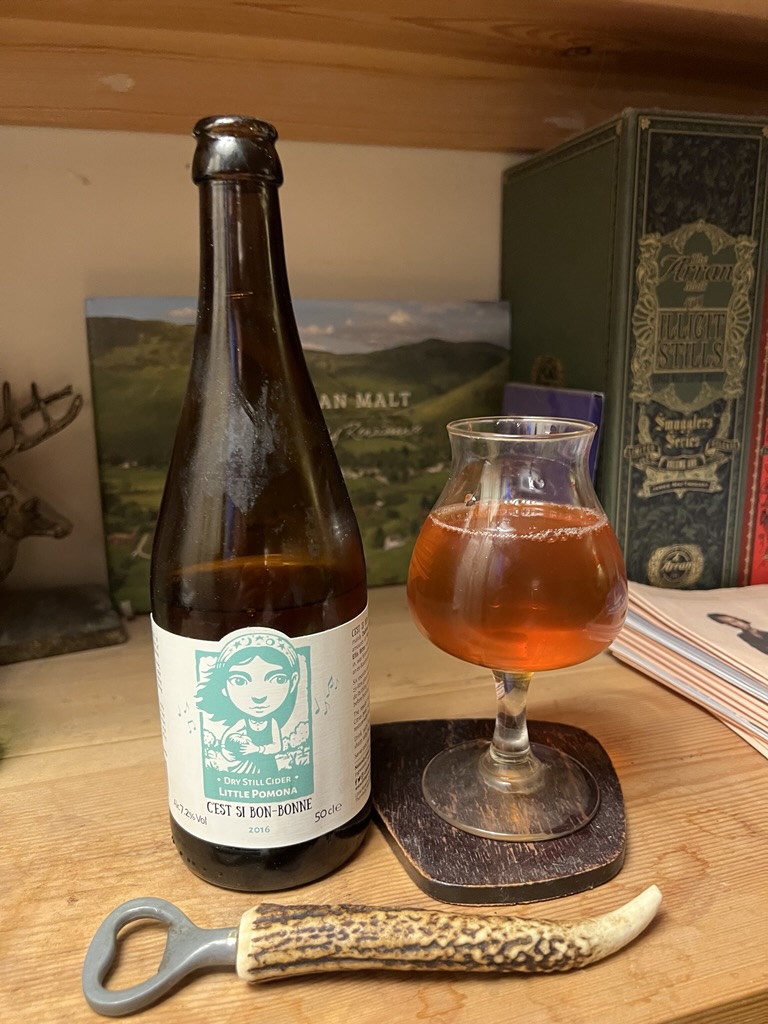
Little Pomona, C’est Si Bon-Bonne 2016 – review
A blend of Dabinett, Harry Masters Jersey, Ellis Bitter, and Foxwhelp, first fermented in an ex-bourbon barrel, and then racked into a 25 litre glass bonbonnes for further maturation.
How I served: A day in the fridge and then out for 20 mins fireside to acclimatise to sitting room temperature in Spring.
Appearance: Still cider by name, still cider (even after all these years) by nature. This looks like (an incredibly generous dram) sherried whisky in my glass, orange bordering on chestnut. Such a deep rich hue. I’m also going to sing the praises of these beautiful 500ml fluted bottles. We should see more of these from Cidermakers in 2025!
On the nose: Raisins, Tokaji wine, mulled spices, I’d say the HMJ and Ellis Bitter are pulling rank here after all these years. Crikey, 2016 seems an age away now! What a different world, and here it is, captured in aromatic form. Interestingly, it’s not the same Little Pomona aroma I’m used to. Perhaps indicative of their move to larger premises after this was produced?
On the palate: Rich, velvety, oily, tannic mouthfeel. Absolutely bone dry, sucks the moisture out of your cheeks in a gloriously astringent manner. Dehydrated apple. Like bobbing for apples in a sandbox. When you order a dry cider at the bar, a restaurant, or a cider festival, it’s this that you’re really after. Gorgeous.
In a nutshell: A cider from when David Cameron was still Prime Minster (how old does that now sound?!). It’s held itself together brilliantly.
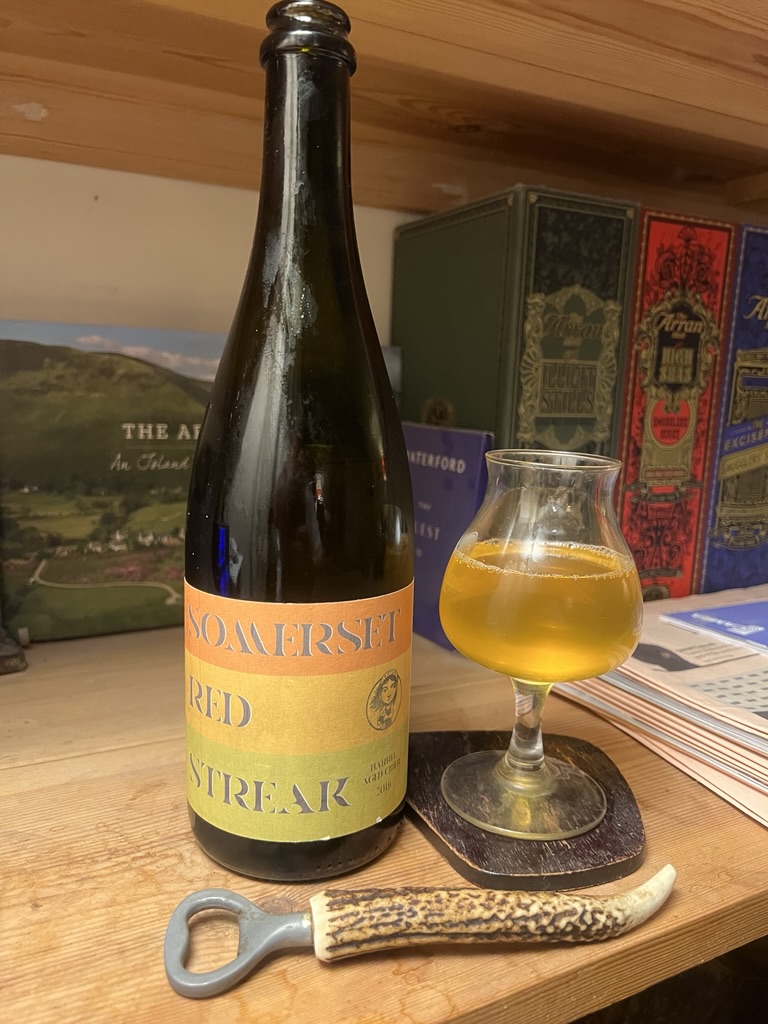
Little Pomona, Somerset Redstreak barrel-aged cider 2019 – review
Somerset Redstreak, aged in Chardonay barrels.
How I served: A day in the fridge, half an hour out.
Appearance: The colours of the liquid match the label perfectly: a combination of salmon pink, sandy yellow, and Spring green. Still presentation, slight haze, no mousse to speak of.
On the nose: Upon the first sniff, it’s got a pleasant and familiar farmyard funk, reminiscent of Ross Cider. Then upon reading the label further, I see the fruit was from Broome Farm itself! Sense of place coming through here. There’s a foam banana sweetie, estery note that appears after 5 mins.
On the palate: Got a bit of shoe-polish note going on. Giving it a good 30-40 mins more and it’s an acetone and acetic note I’m afraid. This one hasn’t held together so well, with this particular bottle, other bottles might be more intact.
In a nutshell: Not everything survives the ravages of time alas. This bottle succumbed.
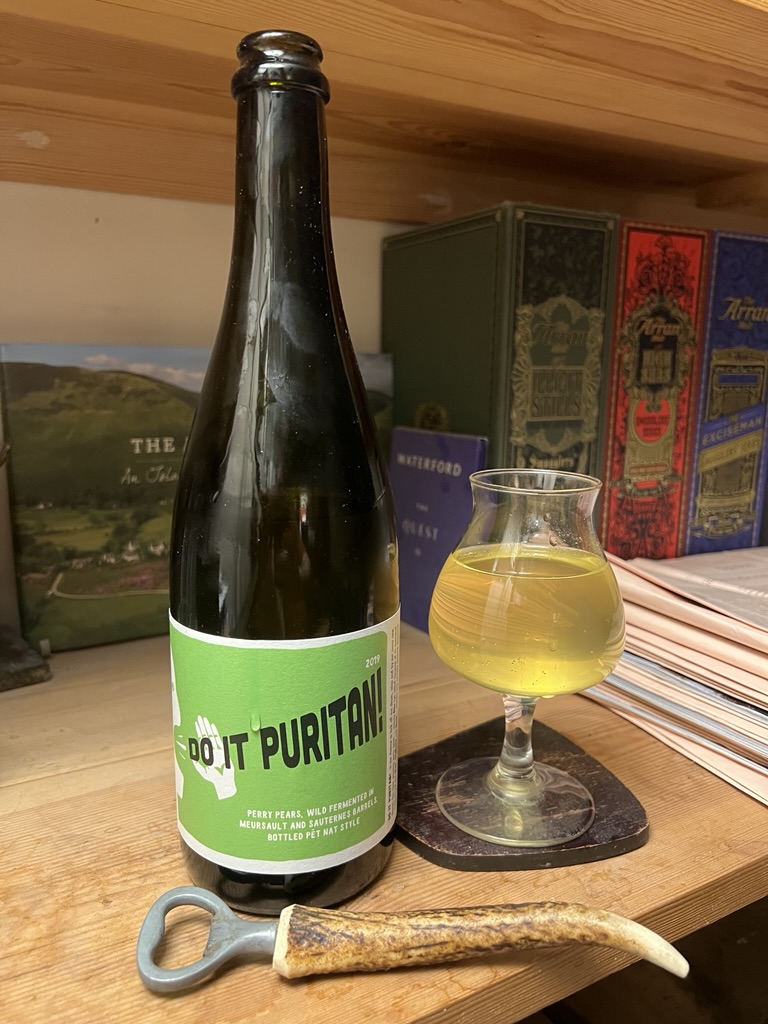
Little Pomona, Do It Puritan! 2019 – eview
A blend of Gin, Butt, Oldfield, and Rock, fermented in Meursault and Sauternes barrels.
How I served: Half an hour in the fridge and then out.
Appearance: Light effervescence in the centre of the glass cutting through light pastel daffodil yellow. Like the yolk of the first few eggs of the year when the chickens need a bit more sunlight in their daily activity. No mouse to speak of.
On the nose: Definite Sauternes aroma here, I recognise this second-hand in a drink as Arran do a core range Saunternes finish, and it has this similar apricot jam and honeysuckle note. The gin element of the perry is sat back a little whilst the barrels do the aromatic talking.
On the palate: There’s that 7.3% abv doing the heavy lifting on the mouthfeel, this is weighty, tropical and fruit-forward. Super estery lychee, yellow plum, cotton candy, and tinned, syrupy pear halves. The finish is poised and studied, lingering on the palate in way I’ve had from Yellow Huffcap before (but none of that in this blend). I last tried this in November 2020, loved it then, and am in love with it again now.
In a nutshell: All the syrupy goodness left in the bowl after a tinned fruit cocktail dessert. Anyone could fall in love with Perry after trying this.
Conclusions
Quite simply an epic selection. I’m so glad to have gotten to try these aged-beauties. Everyone’s box will have had a slightly different historic sparkle and pazazz to them. You quite often get this when touring a distillery – heading into a bonded warehouse or at a festival masterclass, trying something from many moons ago, but it’s not too often in the world of cider and perry that we get to do it. I feel very grateful to the help the cause of freeing up a bit of space at Little Pomona HQ for future endeavours by buying a box. That Do It Puritan sauternes cask perry was tasting top notch! I brought back an ex-Sauternes barrel from Arran a few years back, not to mature anything in, merely to stand ornamentally in my parents’ garden – they’re big hefty, beautiful things. If James can get a few more barrels down to Bromyard from some French wineries, I’m sure anything he puts in them will turn to liquid gold.
For those cideries that did bottle stock in the run-up to 2020 and its life-changing lockdowns, perhaps subsequently struggling to shift that stock, I’d take heart that stored correctly, these drinks will age and mature in ways not anticipated in the usual rhythm of sales. And if James’ recent experience at Little Pomona is anything to go by, there is an audience waiting to take another look at these bottlings, as long as the message gets out there to them. 1000s of litres stored in BIBs in warehouses, greenhouses, and polytunnels, well…that might not have the lasting power in quite the same way as had the liquid been racked off and bottled earlier. Any old way, it’s been another lovely cider experience to start 2025 off with. Who knows what the rest of the year will bring!
Discover more from Cider Review
Subscribe to get the latest posts sent to your email.
 Cider Review
Great write up Jack. I’m looking forward to working through my boxes!
LikeLiked by 1 person
Cheers Andrew, glad you enjoyed it. Have a brilliant time working your way through your amazing selection ☺️☺️☺️
LikeLike
Pingback: Magical Maze of Mysteries – Aging Cider | Cider Review
Pingback: Ubhal: a Scottish cider gathering | Cider Review