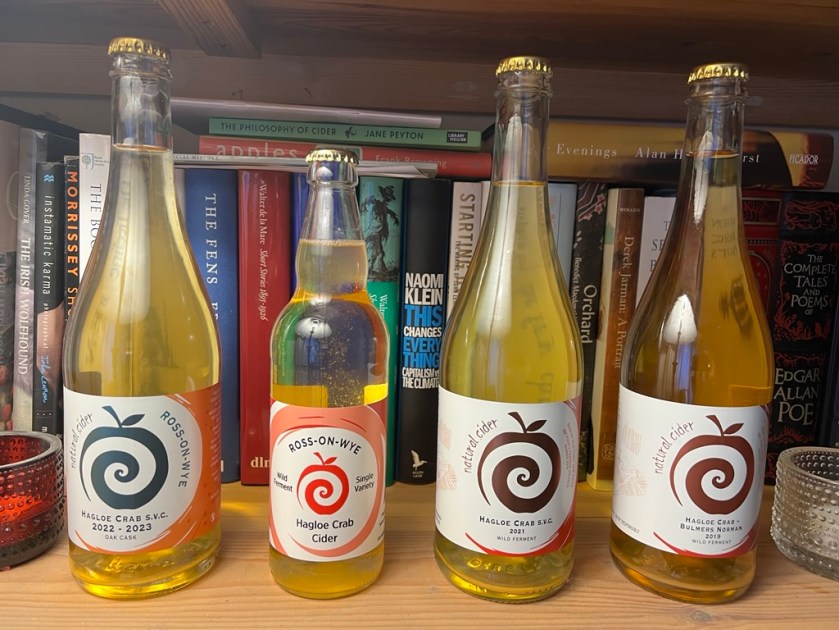
The start of 2025 feels like the perfect time to shine the spotlight on a cider apple variety not too often covered on the hallowed digital pages of Cider Review. There’s no particular bias behind its exclusion. Adam and Bea covered the RossFest24 release in their article last August, whilst Adam and James covered the RossFest21 release in their article three and a bit years ago. Other than that, the variety known as Hagloe Crab has been somewhat elusive here. Let’s change that for 2025 and beyond. I think part of its reticence to appear here is that (like many ciders and perries) there’s just not that much single variety Hagloe Crab being made right now. I can see Bushel + Peck mention Cambridge Quoining and Hagloe Crab, but whether that’s for a cider or just the trees they have in their orchard… From what I can see on google and untappd, the only producer out there in the entirety of the cider-making cosmos that is producing a drink featuring this variety is the wonderful Ross-on-Wye Cider & Perry Company. Before reaching out to Albert for some questions on this lesser seen cider apple, some historical context, and a divergence, or inflexion point, in the apple’s existence.
Mentioned by Robert Hogg and Dr Henry Graves Bull in The Apple & Pear as Vintage Fruits in 1886, Hogg & Bull state the variety “originated at Hagloe, in the parish of Awre, Gloucestershire […] it was raised from seed about the year 1720.” The fruit was described visually as “pale yellow, with an orange tint on the side next the sun, with distinct crimson spots irregularly placed, and with occasional cob-web streaks of russet.” Even back then though, its whereabouts were starting to become cloaked in a sense of mystery, as the variety “seems to have disappeared from Herefordshire, for it has never once been shown at any of the apple shows of the last five years. It is still to be found in the parishes of Minsterworth, Westbury-on-Severn, Longney and Elmore, in Gloucestershire.” After a good run of 160 years, with the Hereford Pomona 1870-1878 including it in a list of “the most valuable fruits of the last two centuries”, its time was nearly up it would seem. Well, not quite…

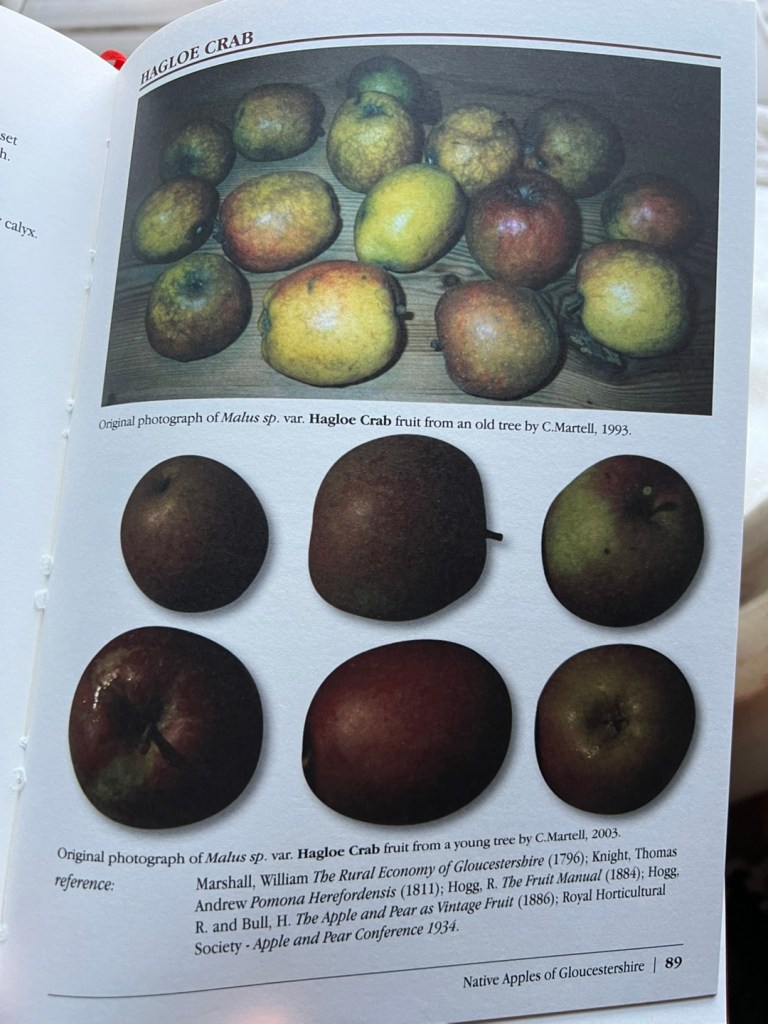
Fast forward another hundred years to the early 1990s and renowned apple and pear historian (as well as cracking cheesemaker) Charles Martell collects scionwood from an old orchard in Tibberton, Gloucestershire on the advice of the late Ray Williams. If you drive 10 minutes to the West from this orchard you arrive in May Hill; 10 minutes to the Northeast and you’re at the National Perry Pear Centre, 15 minutes to the North and you’re in Dymock. It’s slap bang in the centre of all sorts of historically important areas for cider and perry making and was used by the Long Ashton Research Station to source graftwood for their trials up to the 1950s. Charles’ scions are grafted onto M25 rootstock and planted in his Gloucestershire Apple Collection orchard in Dymock. Photos of both fruit from the tree in Tibberton and his grafted trees appear in his excellent book, Native Apples of Gloucestershire. The Tibberton fruit (the tree of which was sadly cut down in 1998), certainly looks for the most part pale yellow, with an orange tint, and cob-web streaks of russet. The fruit from his 10-year old trees in 1993, well it could be a tricky exposure on the photo, but they look distinctly redder, less yellow, less cob-web russeted. Could the material collected have been from a sporting branch of the Hagloe Crab? Or perhaps a different tree altogether? It’s time to talk to Albert about his Hagloe Crab trees, and where they diverge from Charles’ description of his trees.
Cider Review: When did you plant your Hagloe Crab trees and how many have you got in Broome Farm?
Albert Johnson: In total, we’ve got 10 or 11 decently-sized trees across two sites: 5 or 6 out on the front orchard, adjacent to the track that everybody who visits the farm goes past. With another 5 planted in the Old Orchard, but they haven’t done anywhere near as well as those trees out the front of the farm.
CR: How did you come about adding these trees to your farm?
AJ: The whole thing was organised by our friend John Teiser. He wanted to propagate the variety on from his collection. Where he got his wood from originally, I’m not sure. We had enough for our first single variety in 2019, they could have gone in around 15 years ago.
CR: How would you describe the cider from Hagloe Crab?
AJ: Despite the name, it’s not actually a crab apple. That’s probably where some of the confusion has arisen with two different versions of the tree. You might expect a crab apple to have intense tannins and bitterness, but in Hagloe Crab there isn’t. It’s a very juicy, very green citrus fruit, overripe lemon and lime character. In a very good year, you get something with more of a peachy and nectarine flavour profile. In a more austere year, the higher the acidity.
CR: Is your fruit that you grow exclusively yellow, with a cob-webbing of russet?
AJ: When a Hagloe Crab is really ripe, it turns yellow. It starts out green, with a red flush as it grows. The red flush disappears as it approaches ripeness.

CR: So there’s a chance that some of the fruit in Charles’ book might just be underripe as they’re quite red?
AJ: I don’t think so. The fruit is a different shape in Charles’ book. Our apples are reliably spherical, oblate if you will. The fruit in Charles’ book is much more elliptical, like the variety Cider Lady’s Finger, they’re long. They seem a completely different shape.
CR: The illustration in Knight’s Pomona shows a fairly rounded, yellow apple, with cob-web russet streaks and the odd red fleck. Are they reliable croppers for you?
AJ: Considering they’re still fairly small, young trees, they have become quite reliable yes. They were damaged a bit by Alpacas having a go at them. (Not something you’ll see in many Pomonas: Alpaca damage!). The fact we’ve had enough to do one barrel as a single variety every year since 2019 is remarkable. Even though the trees look a bit flimsy, they’re doing well for themselves.
CR: Are you putting Hagloe Crab into the Old Oak Meadow/HMJ orchard for your grafting project?
AJ: Yes, we have put a full row in, this should be their first year of fruiting this year. It will be one to keep an eye on with the blossom down that row. So, we should have an awful lot of Hagloe Crab in the years to come. It’s important to say for people that want to grow it, that the fruit ripens the earliest around October 6th, then it continues ripening up towards the middle of the month. The final ripening period, when it shines up and goes yellow, can really take as long as you want, giving you flexibility as a producer as to when you collect it. It’s a great apple really, very easy to blend with, lovely acidity, gentle and soft. We haven’t blended it as much as we’d like. In the future, these October sharp cider apples like Hagloe Crab, Browns, Reinnette d’Obry, if we have a huge surplus of bittersweet varieties, we can blend them in. I can see them adding to the blend of Birdbarker and Suzie’s Catch really well.
* * *
Our thanks to Albert for a bit more context as to the origins of his Hagloe Crab. If you visit the nursery site Bernwodefruittrees there’s even more context than I could find in any Pomona or Charles’ book. The variety may be even older than originally presumed, 1660s old, and from a neighbouring settlement to Hagloe, called Etloe, near the banks of the River Severn, (both of which are nearby to the village of Blakeney, namesake of a very famous perry pear). Bulmers were interested in the variety and planted it in their museum orchard in the 1930s, which is where John Teiser ended up securing his graftwood from, then passing some of the propagated trees on to Albert and Mike at Broome Farm. Ray Williams wasn’t totally sure which of the two varieties was the true Hagloe Crab at the time, hedging his bets and describing both in his records, the Bulmers version and the Martell version. Through the course of writing this article, I’ve corresponded with Charles, and he acknowledges the redder, Bittersweet variety growing in his orchard and featuring in his book is not in fact the true Hagloe Crab. With that said, it feels like time to try a selection of Hagloe Crab ciders, available from a range of bottle shops across the UK, I got mine from The Cat In The Glass with a recent order after Christmas.
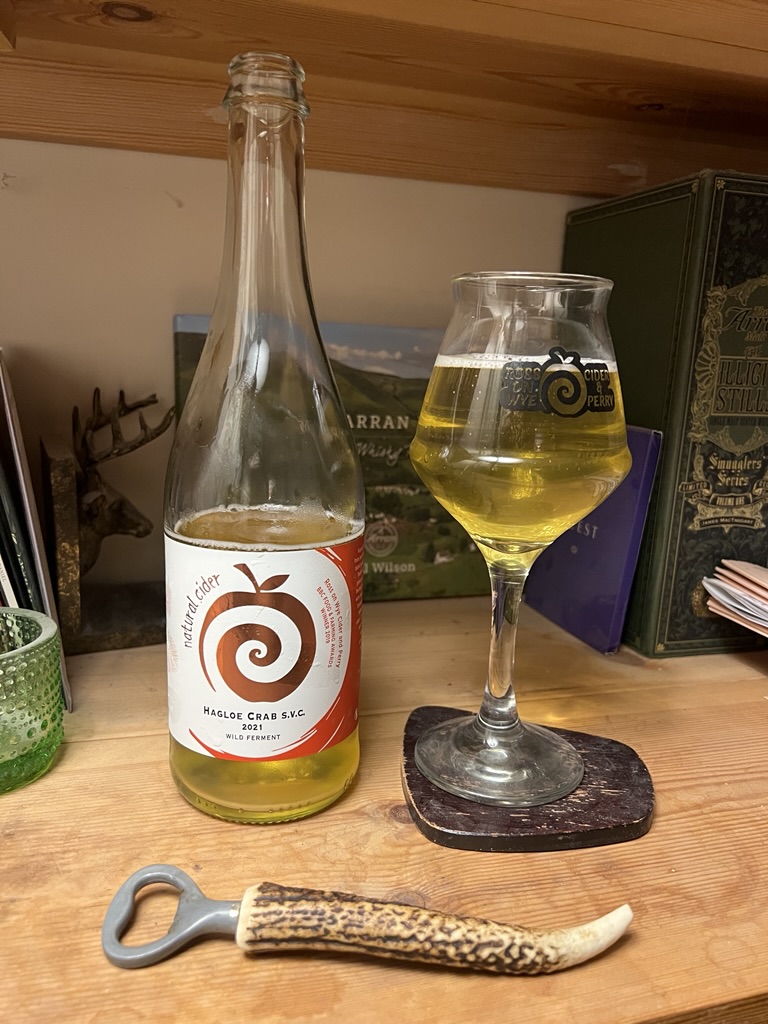
Ross Cider, Hagloe Crab S.V.C 2021 – review
How I served: An afternoon in the fridge and then 15 minutes to acclimatise to the toasty fireside sitting room temperature.
Appearance: Light golden hue, almost a clear pineapple juice, thin mantle/mousse which sits patiently across the roof of the liquid in the glass. Gentle effervescence as with most Ross releases.
On the nose: Stewed apple and grilled pineapple slices. I haven’t got that grilled pineapple note from that many ciders before, I wonder if it’s indicative of the variety. I think this one fermented in a neutral plastic container so it’s just the Hagloe Crab coming through here.
In the mouth: As a sharp variety, it’s delivering the crisp acidity I was expecting, but not in a full-fronted malic acid assault like Foxwhelp or Bramley, this is more nuanced and softened (over time perhaps, being from the 2021 vintage). There’s a melon note I experience with my single variety Golden Noble ciders, but it’s coupled with that tropical interplay of papaya and pineapple. A slight viscosity to the liquid, at 6% abv it’s sitting very nicely on the palate.
In a nutshell: A gentle cider, or rather perhaps, one displaying genteel qualities. You could share this one with friends and family and know no offence would be caused.
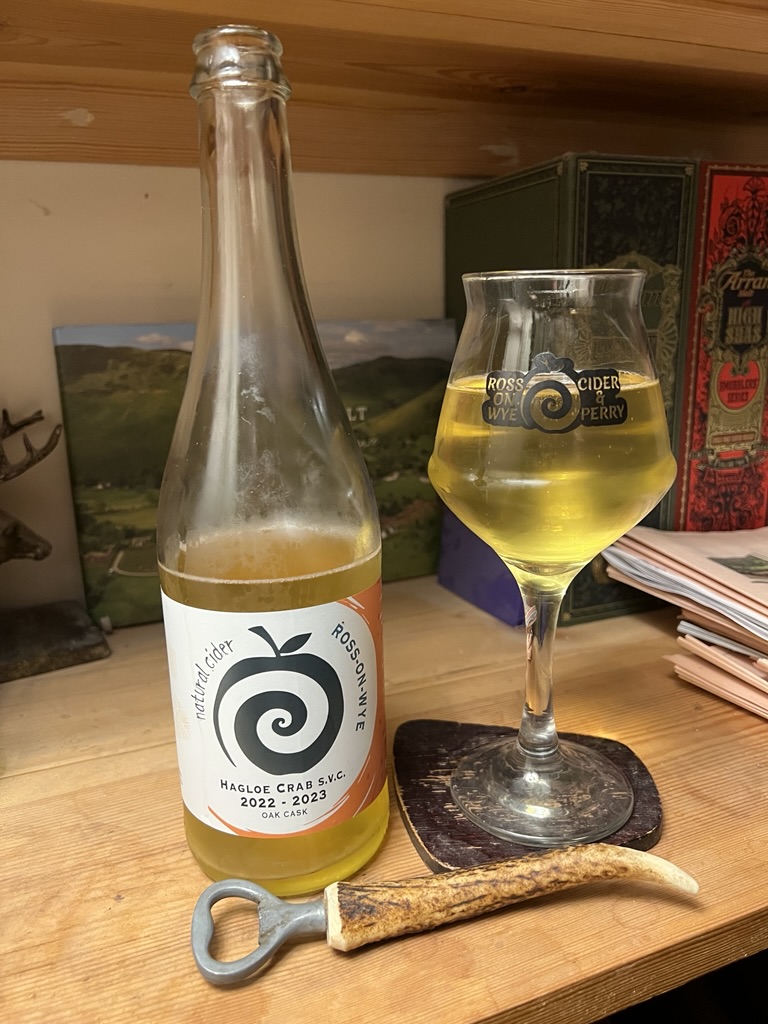
Ross Cider, Hagloe Crab S.V.C 2022-2023 Oak Cask – review
How I served: It’s had a similar treatment to the previous bottle, an afternoon in the fridge and then an acclimation to sitting room temperature.
Appearance: That same light golden hue, clear pineapple juice hue, maybe a slight amount more effervescence in the glass, and noticeably less mousse/mantel on this one.
On the nose: Stewed apple still, but alongside this time is the gorgeous aroma of peated oak cask. As it opens up, there’s an orange marmalade meets apricot jam note which is just divine. Full disclosure, I have inside knowledge here, having supplied the cask to Albert, it’s an ex-Lochranza distillery bourbon barrel, used for maturing their Machrie Moor Peated whisky (when they still made it). Perhaps seek out a bottle of Machrie Moore to try a Half n’ Half of the cider alongside the whisky? (Sam at Nightingale has the other cask of this pair FYI.)
In the mouth: The acidity of Hagloe Crab is elevated by the peat and tannins from the whisky barrel. Turning a Sharp variety into a Bittersharp presentation in liquid form. This is just so good, mouthfeel elevated to something befitting of Burns Night (which is when I’m reviewing this). Bit of astringency going on here compared to the 2021 vintage from plastic. A really long, mellow finish to the very sip. Not overpowering in any way. A full, and satisfying mouthfeel. As it warms up to room temperature, there’s that BBQ Pineapple ring note, which is simply gorgeous.
In a nutshell: Seek this out, right away. Released at RossFest2024 and one of the standout ciders of 2024.

Ross Cider, Hagloe Crab 2023 – review
How I served: 15 mins out of the fridge before serving.
Appearance: Light gold with the slightest hint of haze. No mousse, but there is a gentle effervescence and this time, the bubbles of CO2 seem to be clustering to the edge of the glass (wonder if that comes out properly in the photo).
On the nose: Only bottled two months previous to reviewing (Nov 2024), a slight yeasty aroma wafts up, following by a juicy apple flesh aroma.
In the mouth: At 5.2% abv this is the lightest alcohol by volume of any of the Hagloe Crabs, thinking back, 2023 like 2024 wasn’t that much of a knockout summer or autumn so perhaps lower SGs at play as a result. There’s that familiar lemon and lime citric acid note, accompanied immediately by a really juicy, fresh, crunchy apple impression. Apple sherbet, or a hard-boiled apple sweet with sherbet inside. Refreshes the palate on each sip.
In a nutshell: It’s a trip to the sweet shop for lemon drops and apple sherbet.

Ross Cider, Hagloe Crab – Bulmers Norman 2019 – review
How I served: A day in the fridge and then 15 minutes sitting room temperature acclimation.
Appearance: Full on golden this time, a fireside glow from the glass. A thin mousse which ends up sitting around the rim of the glass. Mellow effervescence with great clarity to the liquid.
On the nose: I’m going to say more Bulmers Norman on the aroma front, I’ve been really enjoying the special oak cask release in 500ml of this variety (with the B&W orchard photo label), and that clove, apple stew, slightly oaty aroma is present in this bottling too.
In the mouth: Mixing a Sharp variety with a Bittersweet to create that triangle of Sweetness, Acidity, and Bitterness that Gabe mentioned in his Pommelier course a few years ago. Even though this is 70% Hagloe Crab and 30% Bulmers Norman, coming in at 6% abv, it’s the addition of those tannins which is having a great effect, even six years after the harvest. There’s juicy apple flesh notes for sure, but I’d almost swear the slightest hint of a medicinal, TCP, Doctor’s leather briefcase note that you get in some Islay whiskies. It’s subtle, but there. Mild astringency on the sides of the mouth. Nice lingering finish.
In a nutshell: A mellower offering of Hagloe Crab, one that showcases its ability as a partner to another variety in the blend. For tannin followers (Andrew, I’m looking at you).
Conclusions
This is a story of a widely acclaimed variety of apple or pear from one century slipping into near obscurity the next, saved only by the interests of a select few passionate pomologists, cidermakers and curious historians. If it sounds a familiar narrative, it’s because this plotline could be applied to so many varieties that teeter on the edge of extinction. Be it the 1920s and 1930s with Herbert Edward Durham, the 1960s with Ray Williams, the 2000s with Charles Martell, it seems every few generations need a little literary nudge to remind them that varieties we took for granted won’t stay around forever without their advocates. For every Flakey Bark and Coppy perry pear, there’s a Late Treacle or Cheat Boy that by all accounts, should still be out there somewhere, but have slipped off the radar and right now, are termed as “Lost”. For these varieties to step back from the precipice and find an audience again requires a number of active players that have that tree’s back. In Hagloe Crab’s case, Herbert Durham’s scientific drive at Bulmers in the 1930s, to Charles Martell and John Teiser’s adventurous passion for rediscovery in the 1990s, to Mike and Albert Johnson’s kind-hearted, inquisitive nature to give Hagloe Crab a chance on their farm (alongside the Alpacas).
Be it Barry’s engrossing Quest for the Turgovian Pear, published here on Cider Review, or Adam’s excellent Perry: A Drinker’s Guide, published by CAMRA, I see awareness being raised across the board for rare apple and pear varieties in the 2020s. Long may it continue. I want to live in a world where more producers grow Hagloe Crab and we see the effect of regional variance, the terroir, on this variety. DNA testing of different varieties of apples and pears is helping speed up the ways in which we can track down other examples of near-lost/once-thought-lost varieties and get them propagated and cropping again on something resembling a scale of operations. Laura’s brilliant article on fingerprinting different varieties in Barney’s orchards at Sandford Orchards attests to that. For Hagloe Crab in 2025, after several seasons fruiting and being turned into cider at Broome Farm, this delicious sharp cider variety has found a route out to market once more, as a drink, and also as a variety for nurseries and orchard enthusiasts to plant more widely across the land. Nearly lost to the annuls of history once every century since its seedling origins near the banks of the River Severn, it now looks a bright future for Hagloe Crab. Back from the brink once again!
Discover more from Cider Review
Subscribe to get the latest posts sent to your email.
 Cider Review
A super article, Jack and a great piece of detective work – I really enjoyed it. It’s important to disseminate the knowledge about these obscure varieties, as well as grow the trees and maker cider out of them.
LikeLike
Awww glad you enjoyed it, my thoughts exactly, spread the info about these varieties a bit further and a bit wider and you never quite know who reads it and is affected by it. It helps of course, having some delicious drinks by Ross Cider to review as well 😉
LikeLike