And we’re back, kicking off 2025 after our January break. How have you been? Well, I hope, all things considered.
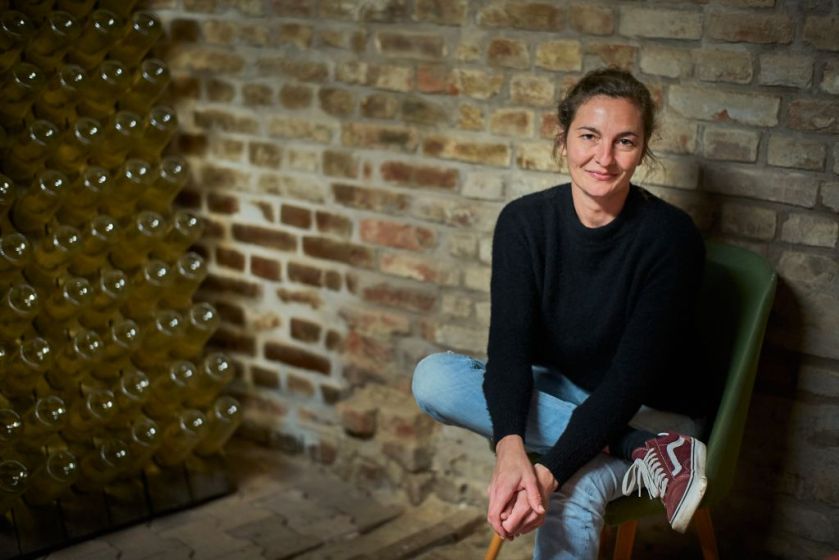
As we brush off the cobwebs here, I would like to introduce you to a German maker you may not have heard of, but you should have. A woman based in the former East Germany, in the northernmost wine region of the country, with a small farm, apple trees, and a wine consultancy business. Without further ado, let’s go chat with Franziska Zobel of Trinkender Zobel.
* * *
Cider Review: Let’s get right into it, Franziska! Please introduce yourself, where you are and what you do.
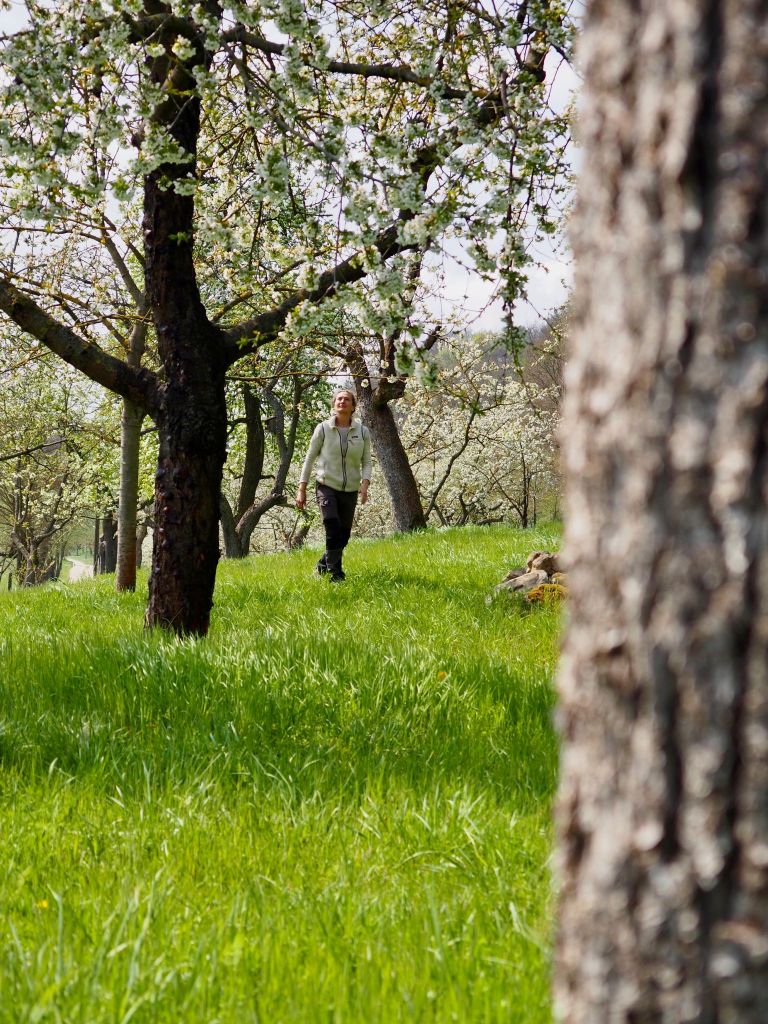
Franziska Zobel: I am a trained winemaker located in the wine-region of Saale-Unstrut, which is the most northern wine area of Germany around the cities of Naumburg and Freyburg in the former east of Germany. Besides winemaking, and especially working as a consultant for viticulture, I am deeply interested in orchards, gardening and nature conservation. I am a mother of three and a big animal-lover: I keep chickens, sheep and a dog on my little farm. Cider-making started with an orchard next to our house years ago. We needed an idea what to produce with all this fruit apart from juicing. That was the point when I started crafting cider.
CR: You founded your cidery, Trinkender Zobel, in 2021, though I read you’d started making cider in 2017. Your region isn’t one people would typically associate with cider making, but of late I’m always being pleasantly surprised by finding makers in “non-traditional” regions, or just having these preconceptions proved wrong. How did you fall into the cider trap?
FZ: You’re right, our region in the middle of Germany isn’t famous for ciders. This area, with a mostly plain landscape and fertile soils, has always been a granary in Germany. With the socialists in the 20th century, management units in agriculture even got bigger and important structures like hedges, trees or orchards vanished. Even earlier in time, orchards or high-stem fruit trees were planted along the streets like avenues, or on the riverbanks of Saale and Unstrut. You can also typically find fruit trees next to the suburban villages, but with more fruit for fresh consumption or for dessert than for making cider.
You may correct me, but cider making often developed in wine-regions or nearby and is part of a winemaking culture. Still, Saale-Unstrut is a wine-region, with steep hills and conditions that allow ripening of all different kinds of fruit and grapes. Having the knowledge about winemaking, it was a short path for me to arrive at cider making.
CR: I have to admit, I hadn’t realised you were a winemaker beforehand. We’ll come back to that. Trinkender Zobel is a bit of a play on words, or at least to this non-native speaker it seems to be. Can you explain the cute logo?
Franziska: When I founded my business and was in search for a name, I absolutely wanted to circumvent the classical naming for wineries or fruit farms. My surname is Zobel and it is as well a beautiful little animal, in English called a sable. So I had the idea of putting a little wine-glass into the hand of this animal, my aunt painted it and then we conceived to name the cider-manufacture “Trinkender Zobel”, which means the drinking sable.
CR: That’s lovely that your Aunt did the art! So what is the scale of your production?
FZ: My production is pretty small scale but growing. The last years I produced around 2.000 bottles a year. In 2024, we had a comprehensive spring frost disaster, which caused crazy reductions in yield. We couldn’t pick quinces or any stone fruit. As well, we harvested just a little amount of apples and moderate amount of pears. All in all, we will just produce 800 bottles this year.

CR: I feel your pain. We lost pretty much our entire apple crop last year, but I was able to get some interesting apples from a project just south of here, so we made some cider at least. On your website you describe that you restore and maintain old meadow orchards. Can you tell us about the types of orchards you find there and what they were used for historically?
FZ: Yeah and that’s where I am coming from. Firstly, I started with one orchard and dived into tree care, which really interested me. Extensive use orchards are such a strong habitat for so many insects, animals and plants, which should be highly protected. But the opposite is happening and orchards vanish due to age, economic reasons and the high water stress we experienced in the middle of Germany the last decade. So I took on three more orchards to restructure trees. These orchards were in a bad state, at least they had no more economical use. I left the habitat trees, which are important for insects and birds and completed the free spaces with new full standard trees of old varieties.
Orchards in this region are often sited at the riverbanks of Saale and Unstrut. Typically the trees were planted around 100 years ago and are now in decline. Mostly we find a wild mixture of apple, pear, plum and cherry trees. Very typical here is the high percentage of sweet cherries, which seem to cope better with the water-stress. Looking at the pomme, fruit was used for eating and storing to eat later, so we typically find Rheinischer Bohnapfel, Ontario, Jakob Lebel, Boskoop, Goldparmäne [King of the Pippins] and Kaiser Wilhelm.
CR: So what kind of varieties are you typically working with for your ciders? Do you have favourites, and if so, why?
FZ: Actually I work with most apple varieties I can harvest in my orchards, except summer apples and early autumn apples. I use the fruit I have and don’t believe in single variety cider. I especially like Goldparmäne, Zabergäu Renette and Gewürzluiken because of their aroma.
CR: All lovely apples that I am a fan of myself. If you were to plant a new orchard, what would you plant, and in what style of orchard?
FZ: I would plant high stem orchards, which could be used extensively and with my sheep. A mix of different trees like apple, pear, plum and nuts would be established. The last few years I kept an eye on susceptibility to diseases, water-stress reactions and of course aroma of different varieties. I started to plant typical cider varieties as well, but I just started here to make experiences. While I am very happy with Bohnapfel, Roter Trierer Weinapfel, Kantapfel and Kaiser Wilhelm, I do not seem to be lucky with pear-trees, maybe they need more water than is given in this region.

CR: Moving into the cidery, how would you describe your philosophy as a maker? What have been your influences? I mean, having trained as a winemaker, there is probably some influence there?
FZ: I am certainly influenced by winemaking! When I started making cider, I just wanted to vinify a low alcohol product with bubbles and good drinking pleasure. I also love drinks that get even better when storing, so I think that aging on the yeasts can be a gamechanger for giving a drink more complexity and tension. I really love dry wines, so I avoid sweet cider as well. Actually, I wasn’t orientating on other cidre or ciders, when crafting my own cider.
CR: So is it fair to say to you started off with a blank slate, with no cider culture to reference to, nor looking at what was happening in other regions either inside or outside Germany?
FZ: More or less, you can put it that way. Surely, I had a Cider on tap in some Pub, and I drank Cidre when visiting France, and I knew the products of one German producer. But I didn’t dive deep into the cider scene. I just vinified my cider the way I like it with the trial-and-error method. Of course, I am tasting and discussing products with colleagues and customers. So there is product development and changes in the range of my products sometimes.
CR: Are there particular methods that you stick to in terms of making, or things that you consider typical from your grape wine training that you apply to apple wines?
FZ: I use different methods of carbonating my products, mostly classical second fermentation as well as the methode rurale. I also try to conserve carbon dioxide. But mostly I work with bottle fermentation. Additionally, I am really fond of a long storage of cider on the yeasts to develop complex aroma and to achieve natural clarification. I do avoid putting external carbon dioxide in cider, because it concurs with my aim to produce as natural as possible. Therefore, I also don’t use filters, artificial yeasts, artificial aroma and many other measures that are allowed by law. It’s all about low impact when producing ciders.
CR: Is there anyone else in the region making similar products?
FZ: There are two to three more winemakers that also keep a cider in their product range, but it’s more a niche here.
CR: Patrick of 1785 Cider recently told me that he felt it was very hard for small, artisanal makers in Germany to get a proper foothold in the market. I’m certainly glad I don’t have to live off cider sales. Just thinking about the business side of cider, how do you find the market here, and who are your typical customers?
FZ: In fact there is no cider-culture in most German areas, surely it’s different around Frankfurt where ebbelwoi is popular. Hence, the product “cider” needs a lot of explanation, people simply just don’t know it. Big marketers have the possibilities to start campaigns, but the little artisanal producers need a lot of time to communicate their products. This is why I, from the start, put an emphasis on direct marketing. Still this needs manpower and results in selling of just little amounts at a time. My typical customers are young and middle-aged, often women, and enjoying sustainable consumption. At the moment cider production wouldn’t be enough to make a living.
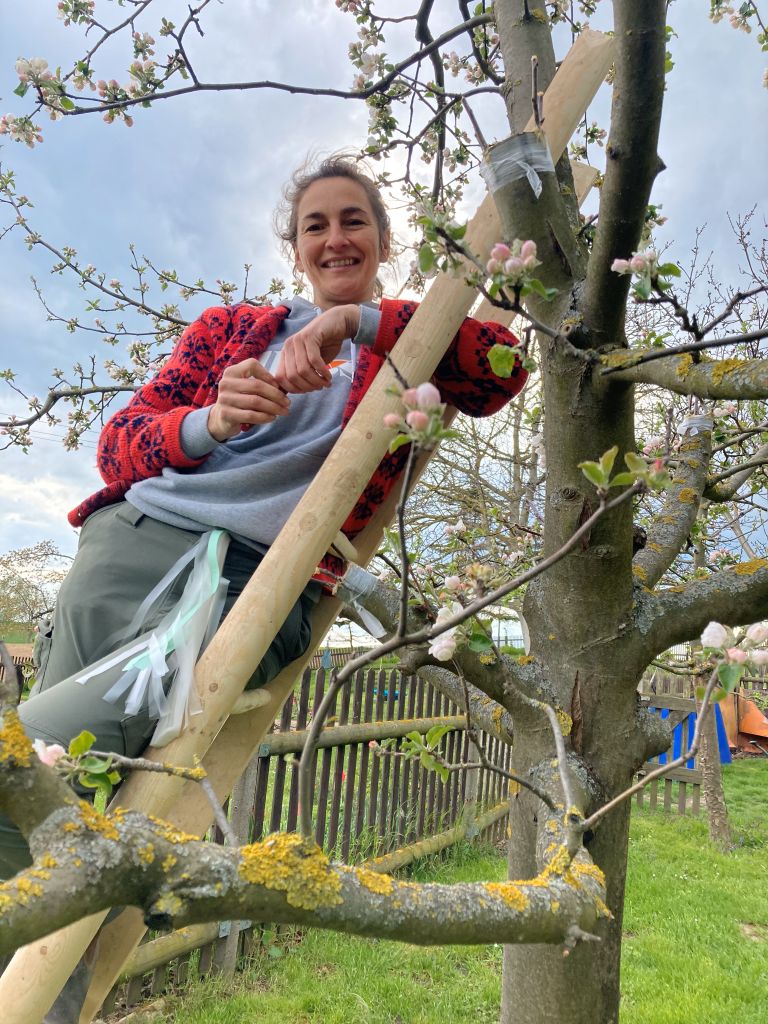
CR: I recently had a conversation with Kira Rehberger of Apfelgold cidery and mentioned that she was one of only two women that I know of running their own cidery, solo. You were that other woman. Well, she has since moved to open a cidery in Denmark, and Andrea Vögel stopped, so you might be the only one now. Well of course, there are a few women co-owners and makers in Germany who are prominent in the field, though Wendy of 1785 is the only other that really springs to mind!
I was wondering, given that your region might not be a typical cider region, if it makes a difference whether you are a man or a woman? Is it anyway just “weird” to have anyone making cider?
FZ: I am not so much about finding differences between men and women making wine or cider. Everyone, independent of their sex, who is passionate of the thing they’re doing, will be successful. Luckily, I see nowadays lots of young women choosing typical “male” professions, which I do support. Working in agriculture or production or gardening is a tough job and not always well paid. Speaking for my decision, it was an intrinsic motivation to produce cider independent of my gender.
CR: What would your advice be to prospective cider makers?
FZ: That’s a tough question. Probably to analyse the market well, before deciding in what kind of cellar technology to invest. Cider is still a niche product in Germany, but I see a trend for low alcohol, sustainable and regional products, which are all arguments for cider-production.
CR: And looking to the future, what does it hold for Franziska Zobel?
FZ: Hopefully good times! I am desperately hoping for the triggers of climate change to decline and the possibility to further produce in agriculture under normal conditions. Droughts, floods and temperature changes already show the enormous impact climate change has on agriculture, landscape, water levels and as well on us humans and our standard of living.
CR: Amen to that.
* * *
Franziska makes a range of ciders and co-ferments, some of which we will delve into shortly. I acquired these in a cider exchange some months ago, but as always, full inter-maker honesty is important. She also makes a perry, which I already featured last September in The Great Big German Perry Tasting, so you will find that there (it was one of the highlights in a very good array). But how are her ciders?
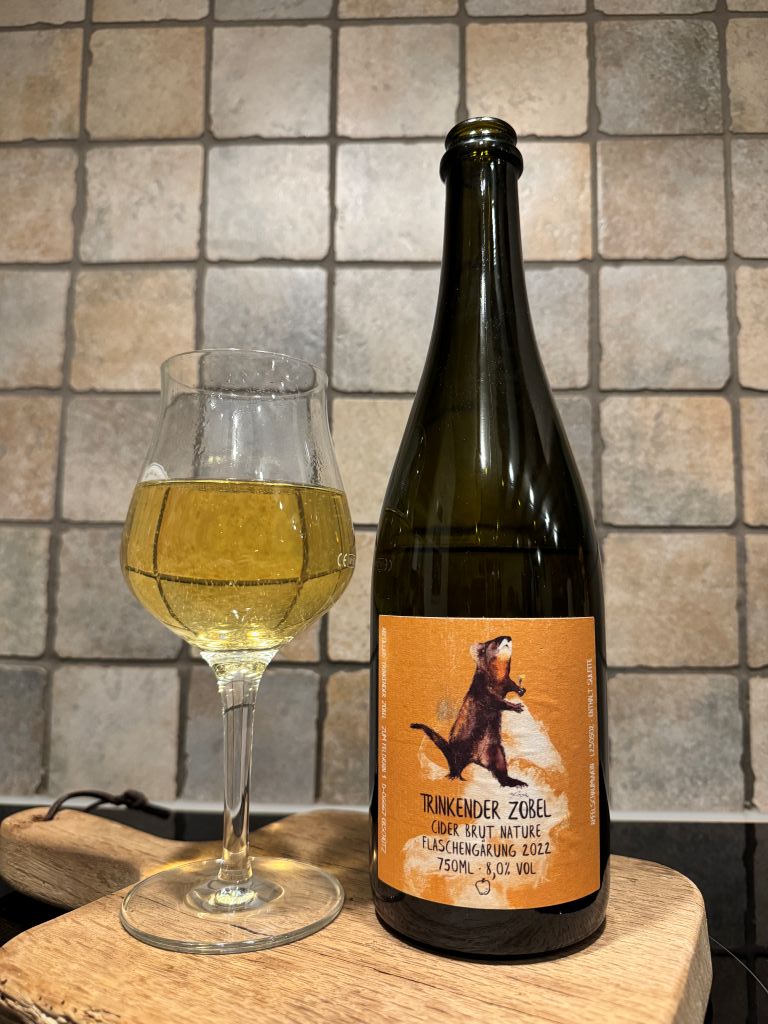
Trinkender Zobel, Cider Brut Nature 2022 – review
How I served: Cool, around 10-12°C
Appearance: Pale gold, clear, lots of bubbles.
On the nose: Biscuity, mandarin peel, marzipan, red apple flesh. Super clean.
In the mouth: Pearls on the tongue. Acid forward, lots of lemon juice with a twist of mandarin zest. A creamy mouthfeel, despite the zing, reminiscent of cream soda. Properly dry with a lovely fruity backbone – wild cherry, mandarin and perhaps a touch of pineapple. A reasonably long finish, with those mandarin and marzipan notes lingering.
In a nutshell: Super clean, elegant, with a pleasing array of flavours, a lovely sparkling cider with a soft acidity. Do not serve too cold and it will open up even more.

Trinkender Zobel, Cider Brut 2022 – review
How I served: As above.
Appearance: White gold, super effervescent, bright as a new penny.
On the nose: Fruit-forward with jelly bean notes. Soft and rounded tinned lychee, honey melon, pear flesh and a hint of alcohol warming up the edges.
In the mouth: As with the previous cider, more acid-led than the nose might suggest, this time great big juicy green apple and lime zest. Under that, soft lemon meringue (biscuity base included), while berry notes, suggesting blackberry jam, linger on the tongue. As per the nose, a gently warming sensation. Red apple skin rounds it off.
In a nutshell: Wonderful stuff. The feeling of slightly off-dry with super crisp delivery makes you want to come back for more. I certainly did!
Now we move on to a pair that have elements other than apple, the first bneing s cider infuised with elderflower, Holunderblüten in German.

Trinkender Zobel, Cider Brut mit Holunderbluten – review
How I served: Cellar temp, 13°C.
Appearance: Straw, bright and copious bubbles.
On the nose: Very elderflower, but on the spicy, green bell peper side, stems perhaps, backed with that unmistakable sweet perfume of elderflower and a touch of pear syrup.
In the mouth: As on the nose, elderflower well to the fore, the spicy, green bell pepper character, carrying through, enhancing the apparent acidity, so it zings lemon and lime juice with pear skins and a crisp green apple flesh background. It’s perfectly clean, faultless, but the elderflower is a tick too dominant for my taste.
In a nutshell: Very well made, and though I love elderflower in drinks, this was a tick too much for my tastes. Your mileage will vary of course.
The next is a co-ferment of quince (Quitten) and apple, and like the others, traditional method with bottle conditioning (Flaschengärung) and disgorgement.

Trinkender Zobel, Quitten-Apfel Cider Brut 2022 – review
How I served: Initially cellar temp, then out on the back step for 10 mins.
Appearance: Green-tinged straw, slight haze and as with the others, a consistent stream of bubbles.
On the nose: Big aroma with, and no surprises here, that unmistakable heady perfume of quince. Light bubblegum, carnations, it’s all delightfully soft and chewy. Yes, I realise I’m still talking about aroma here. Just a narrow like of lemon juice cutting through it all.
In the mouth: Sumptious. All of the above, brightened by lemon zest and juice, and a drying, lightly tannic spread across the tongue on the swallow. Quince flavour in spades, but not overwhelming as some can be, Oddly, elements of vanilla sauce, cantaloupe adding softness and fruit to the whole mix. A reasonably long finish whispers quince all the way.
In a nutshell: Such an aromatic cider and, as with its siblings, precise yet fun to drink. A fine example of an apple and quince co-ferment.
Conclusions
What can I say? The quality and precision of these ciders is simply fantastic, and none of them lack character. While my own personal tastes led me away from the elderflower version, I would happily reach for all three any time. If there was one that I had to choose (from this page, and not the perry I reviewed last year), I think the Cider Brut 2022 just takes it, with the Cider Brut Nature 2022 a close second. I’m looking forward to trying future vintages!
You can find Trinkender Zobel on Instagram.
Discover more from Cider Review
Subscribe to get the latest posts sent to your email.
 Cider Review
It’s always refreshing – even more so these days – to read about somebody following their passion and trying to make the world a better place, with economic success and growth an afterthought.
LikeLike