
Earlier this year, on my first-ever trip to Sweden to visit some relatives there, I discovered that I am related — and not terribly distantly — to one of Sweden’s most prominent temperance campaigners, Peter Wieselgren (1800–1877). A Lutheran priest and librarian, Wieselgren founded what was probably the country’s first temperance association while still a schoolboy in Småland in southern Sweden.
Peering into the windows of Wieselgren’s clapboard childhood home, I felt rather trepidatious. The government alcohol monopoly, the 9€ half pints out on the town, the entire nation’s making up for it by being addicted to filter coffee… It seems it’s all my inherited fault.

Sweden’s relationship with alcohol is storied, troubled, and fascinating. Once firmly in the Baltic ‘vodka belt’ of northern Europe — read, the countries where it’s cold a lot of the time and people traditionally drink a lot of spirits — it saw widespread excessive consumption of vodka-like drinks from the mid-18th century onwards. This was especially the case among hard labourers, who were (partly) paid in liquor.
In response, a fervent temperance movement arose in the mid-19th century. Partly driven by the Enlightenment’s enthusiasm for democratic self-improvement associations and fueled by preachers in the pulpit, the Swedish sobriety movement gradually united more and more of the country’s people against the public enemy of drunkenness. In this, it was just ahead of the curve of the many European and American temperance movements to come, of which prohibition in the US is the most famous result.

The Swedish government was soon on board the nykterhet (sobriety) train. The ‘Gothenburg System’, introduced in 1865, aimed to remove the incentive of profit from the alcohol industry. Then, under the ‘Bratt System’, named for the physician who proposed the legislation as an alternative to prohibition, the sale of alcohol was brought under a state monopoly. The accompanying motbok, a sort of alcohol ration book, was introduced in 1919.
Your motbok was stamped every time you bought alcohol, and you were only allotted a certain number of stamps per month — more if you were a man, more if you were of good social standing. As a fascinating 1928 article in TIME magazine attests: ‘Single, self-supporting women are sternly held down by Dr. Bratt to an average of a gallon a year. Bachelors must attain the age of 23 before becoming eligible for a passbook.’
In 1922, Swedes voted by a slim majority of just 51% against banning liquor entirely. So, the ration system continued until 1955, when high taxes replaced rationing as a means of control. A state monopoly on selling alcohol remained: Systembolaget.

To this day, the ‘system company’ (really) is an institution at the heart of Swedish life. With its gleaming stores, 20+ age restriction and moralising opening hours (stores close around 7 or 8 pm and are never open on Sundays), Systembolaget — ‘Systemet’/’Bolaget’ for short — is the only store that can sell alcohol over 3.5% ABV. It also has a web shop; while Systembolaget prides itself on the wide selection available there, home delivery has only been available since 2021, and it doesn’t come cheap or fast.
In case you were wondering: yes, the grocery stores are full of 3.4% beer. For what it’s worth, Sweden has some of the lowest alcohol consumption rates in Europe. On top of that, cider is the least-consumed alcoholic beverage category in Sweden. Just 4 of the 50 ciders in Systembolaget’s standard assortment can be classed as craft according to this definition created by the Svenska Ciderfrämjandet, an organisation dedicated to promoting Swedish real cider.
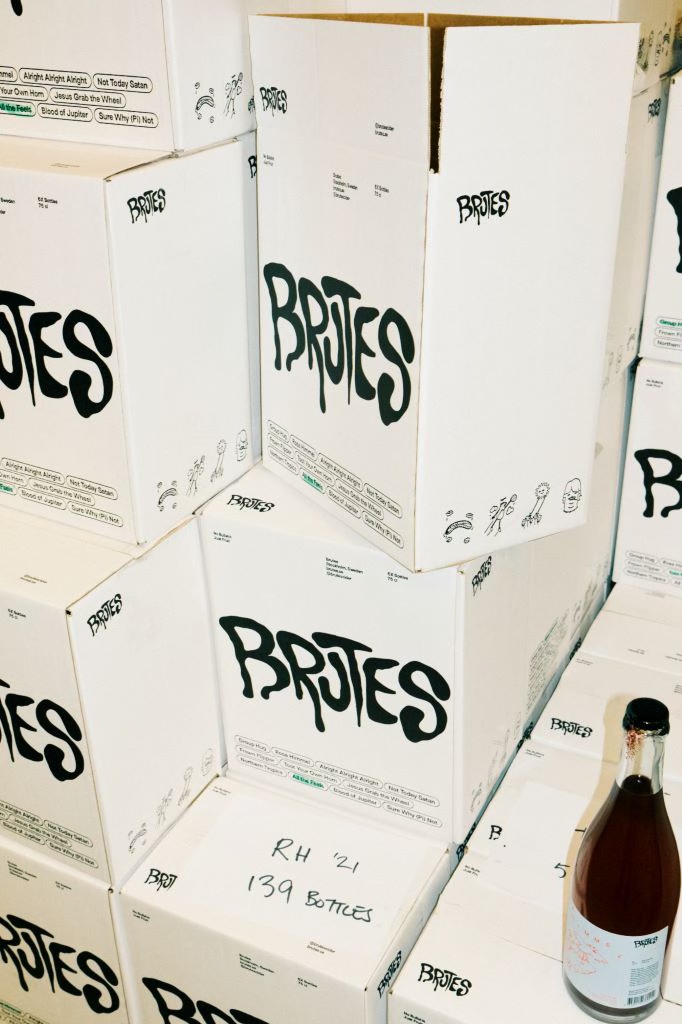
You may be wondering what all of this has to do with Brutes Cider. Firstly, as a fermented beverage enthusiast, I just find it fascinating: Sweden is a country that never instituted total prohibition and yet lives with a prohibition-esque system to this day. Also, we know that much of Sweden’s bounty of apples and other garden and wild fruits was historically made into must, which used to mean ‘cider’ rather than ‘juice’, as it does today (an interesting parallel with the ‘cider’/’hard cider’ situation in the US). In seeking out a Swedish craft cider maker like Brutes, I wanted to see speak to someone taking that tradition forward today.
If you didn’t know about the alcohol regulations, you might think Sweden would be a great place to make cider. For one, the place abounds in apple trees. During my September visit, Stockholm was laden with the produce of apples, pears, and crabs planted in gardens and as ornamentals in parks and housing developments. Harvest-time celebrations are a popular activity in Sweden; the musteri, or farm-based juice producer, is a common sight in rural areas and will take bookings to press your fruit for you long before harvest begins.
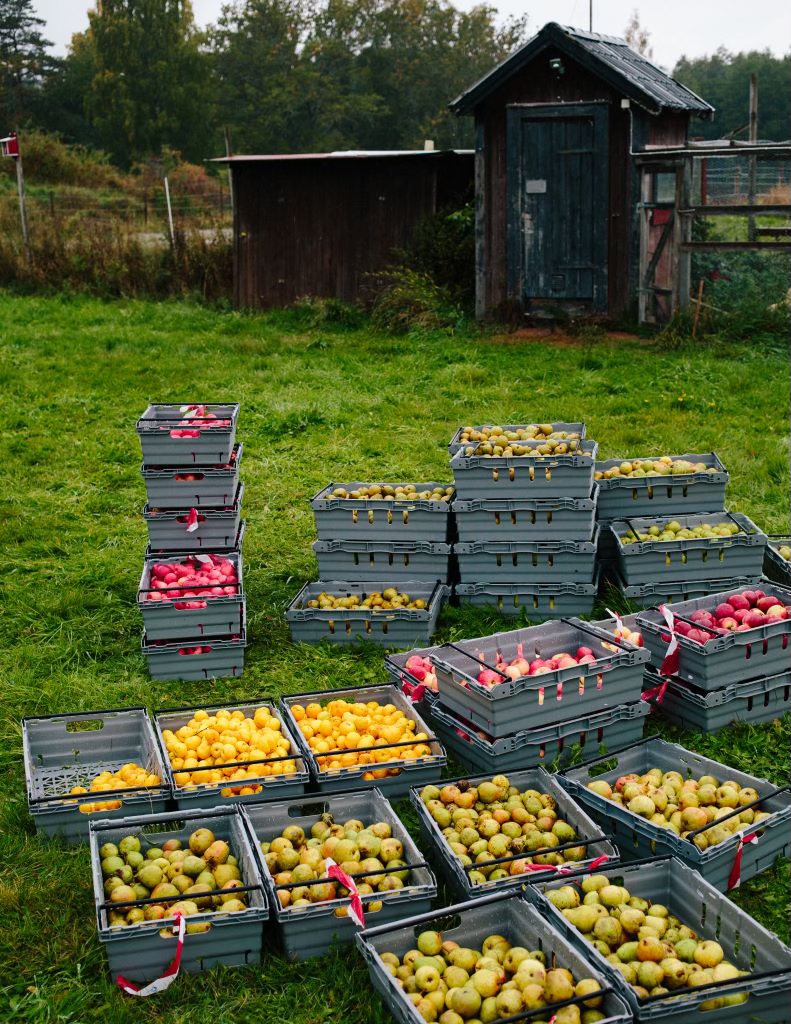
Moreover, the country has a strong tradition of fruit foraging. The historic Allemansrätten (‘every man’s right’), which was enshrined in the constitution in 1994, gives every citizen the legal right to roam and forage on all land (excluding private gardens and land under cultivation). With the Swedish countryside producing around 400,000 tonnes of wild berries every year, there was once a strong tradition of fruit wines made on the farm.
Sadly, it probably comes as no surprise that micro-provenance cloudberry wine is not particularly common in Sweden these days (although there are a few brands bravely reviving the berry wine tradition). The bulk of the country’s current fruited alcohol output needs no introduction, other than perhaps to say that the legal minimum for juice content in Swedish cider, the vast majority of which is in the style of Kopparberg and Rekorderlig, is just 15%. Somewhat unsurprisingly, Systembolaget groups ‘mixed drinks’ and cider into one eyewatering category.

Despite all this, Sweden is home to a nascent craft cider industry that features some very interesting players — Brutes, Frukstereo, and Pomologik, to name a few. Using both dessert and wildling apples, fermenting with wild yeasts, and experimenting with everything from berry co-ferments to birch leaves, they make up an exciting, if still small, scene.
Unfortunately, I have so far been unable to make it out of the city of Stockholm and into the countryside, where most of the cideries and musterier are located. However, I was able to meet up with Brad Sawicki from Brutes, who make ‘wild fermented Swedish dry cider’ in and around Stockholm, to chat about making cider in Sweden and taste some of their current line-up. Joining us was Brad’s friend Brent Miles-Wagner, another American cider-head expat.
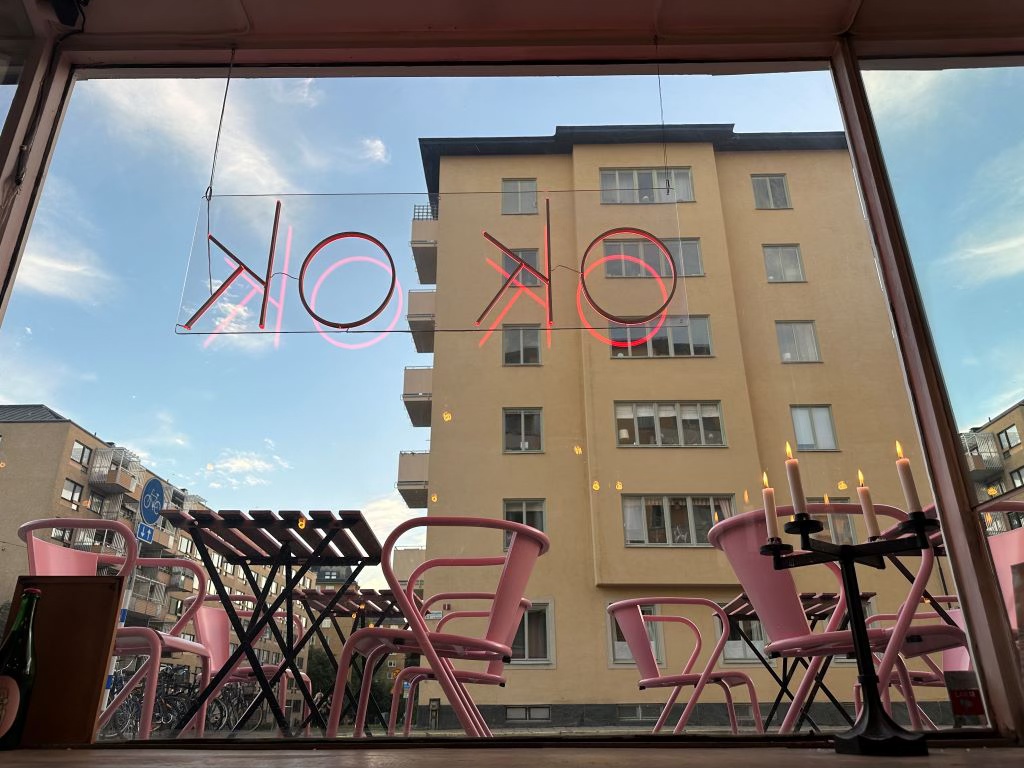
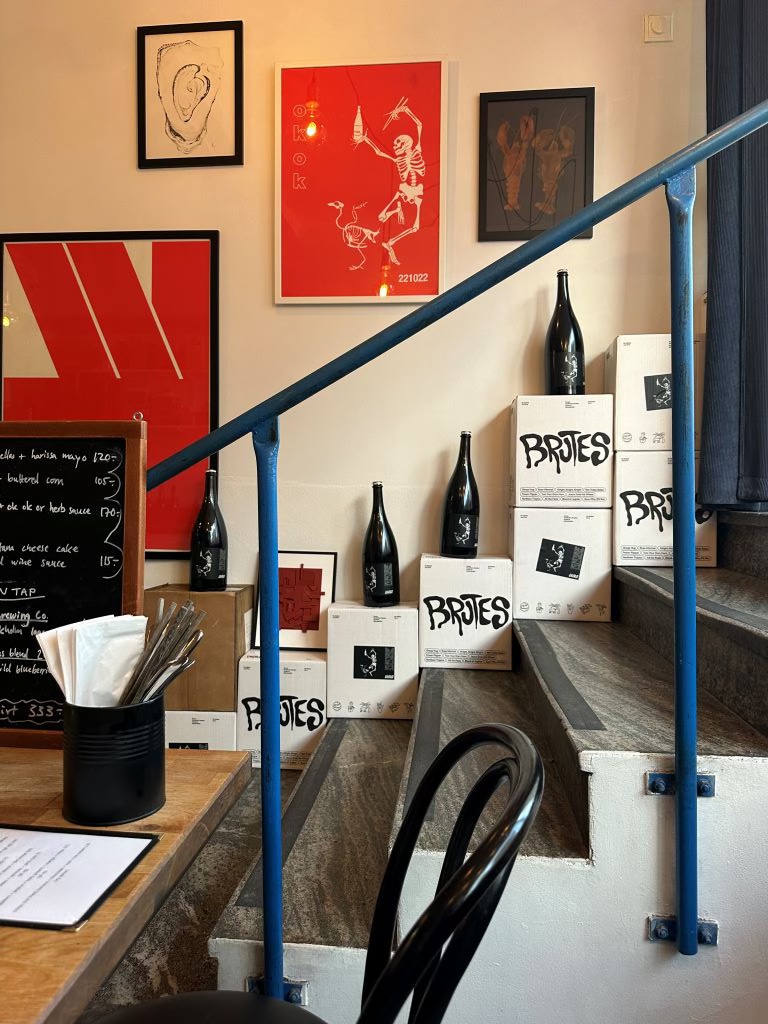
We met at Ok Ok, an Asian-inspired small plates restaurant in the bougie Östermalm area — according to Brad, Sweden’s only cider bar. With its pink neon sign, eclectic décor, menu of small plates (from deconstructed cornbread to incredibly unctuous, fish-sauced ‘thin thin beef’), and bottle list of fine ciders from all around the world, it immediately felt like the opposite of clinical, rational Systembolaget. Brutes’ fun(ky) co-ferments in hipster bottles with quirky cartoon labels were right at home.
Brent, Alfie, and I immediately got started on the Ok Ok x Brutes collab cider. I’m not sure how to sum up the fascinating, rambling, many-hour conversation which followed, so I’ll start with my impressions of the cider!
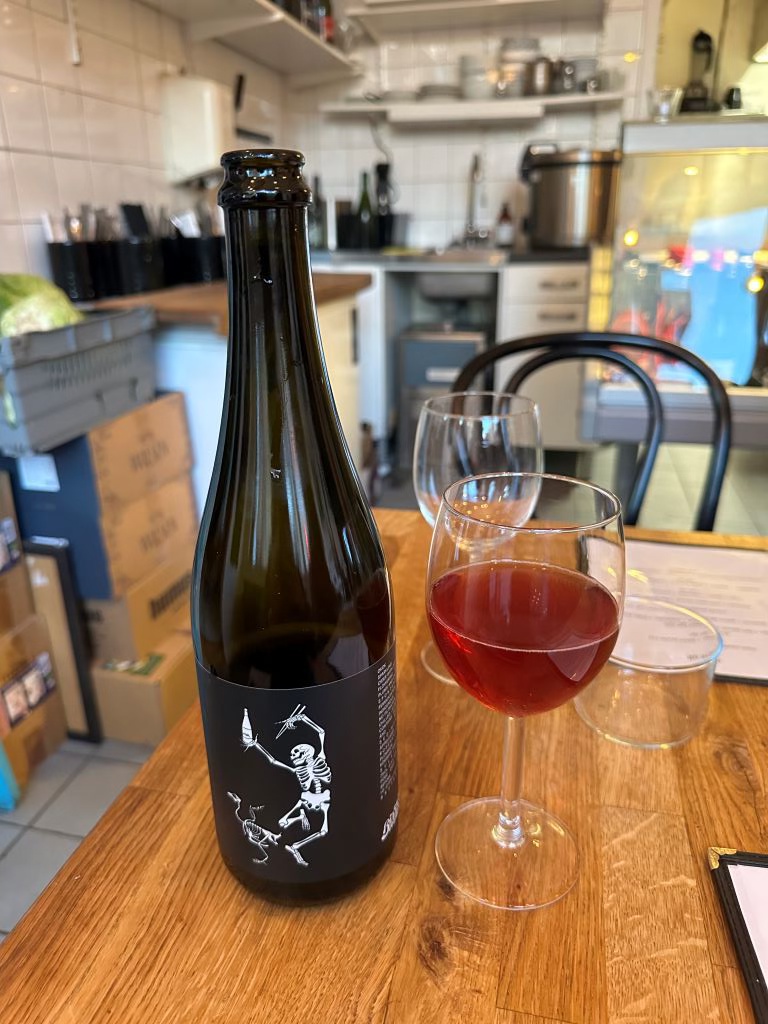
Ok Ok Cider – note
A co-ferment of apples with wild plums and Japanese flowering quince among other things, this is all big red fruits and plums. There’s a light bubble, intense sour cherry acid, and a floral rose-raspberry finish. Lambrusco vibes and colour! What a joy to experience such zero-zero co-ferment experimentation in the land of Kopparberg Strawberry-Lime.
Brad arrived halfway through the bottle. A graphic designer by trade, he hails from Chicago (‘The weather’s so friendly here in Sweden!’) and moved to Stockholm almost a decade ago with his Swedish wife. With his generous manner and big, mischievous grin, he’s easy to warm to, and he was very happy to talk candidly about what it’s like to make and sell cider in Sweden today.
But first, who are Brutes? A group of five friends, two Americans and three Swedes, they originally got connected through their significant others. The original idea was just to have a communal project, not specifically to make cider. However, as the five had bonded over a love of natural wine, they decided cider making was as close as they were going to get to becoming vignerons in Stockholm’s bracing Baltic climate.

They started with a little basket press and two garbage disposals mounted to a board as a scratter. They have now exported to 16 countries, although the UK is no longer one of these (thanks, Brexit) — any stock you can find here (such as at The Cat in the Glass) is residual. Their biggest market has historically been the US.
2019 was their first commercial vintage (of 10,000 L), which they produced in an old musteri in Sigtuna, 45 minutes’ drive outside of Stockholm. Having quickly moved to larger facility down the road and grown production to 40,000 L/year, Brutes are now looking for a smaller spot closer to the city. This will hopefully allow them to accommodate visitors coming via public transport — unsurprisingly, Sweden has a strict zero tolerance for driving under the influence.
Luckily, Brutes don’t seem to be slowed much by all these logistical niggles. A regular presence at wine fairs and always getting involved in collabs, they exude an infectious love of fun and experimentation. Thus, it was no surprise that the first thing Brad poured for us was a small, unmarked bottle of a ‘one-off experiment’.
Oak-aged dry ice cider (experimental) – note
This is a SV Ingrid Marie, a dessert apple that descends from Cox’s Orange Pippin and is very popular in northern Europe. On the nose: big coconut and hints of bourbon as well as lemon. The palate has more coconut and bourbon; a touch of varnish. Totally barrel-tastic.
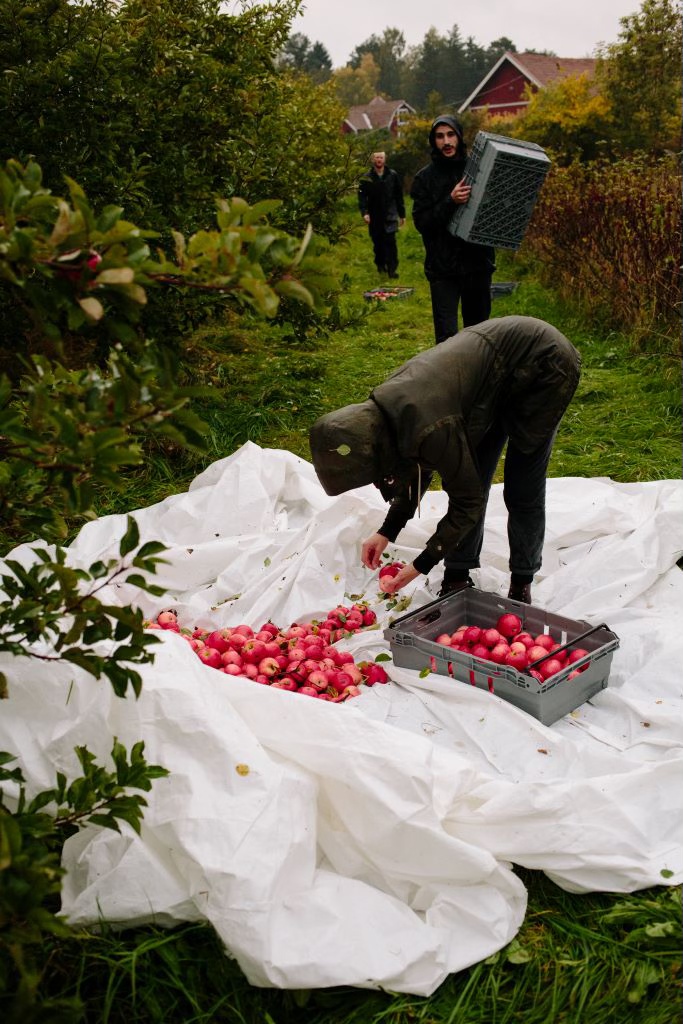
Most of Brutes’ fruit come from orchards around Stockholm, although they also source apples and pears from Skåne in the south of Sweden, where almost all Swedish apples are grown. However, around two years ago, they started ordering juice rather than apples. Brad told us that this not only saves the company money, but as the apples are shipped in their condensed form, the transport savings translate into fewer emissions, too.
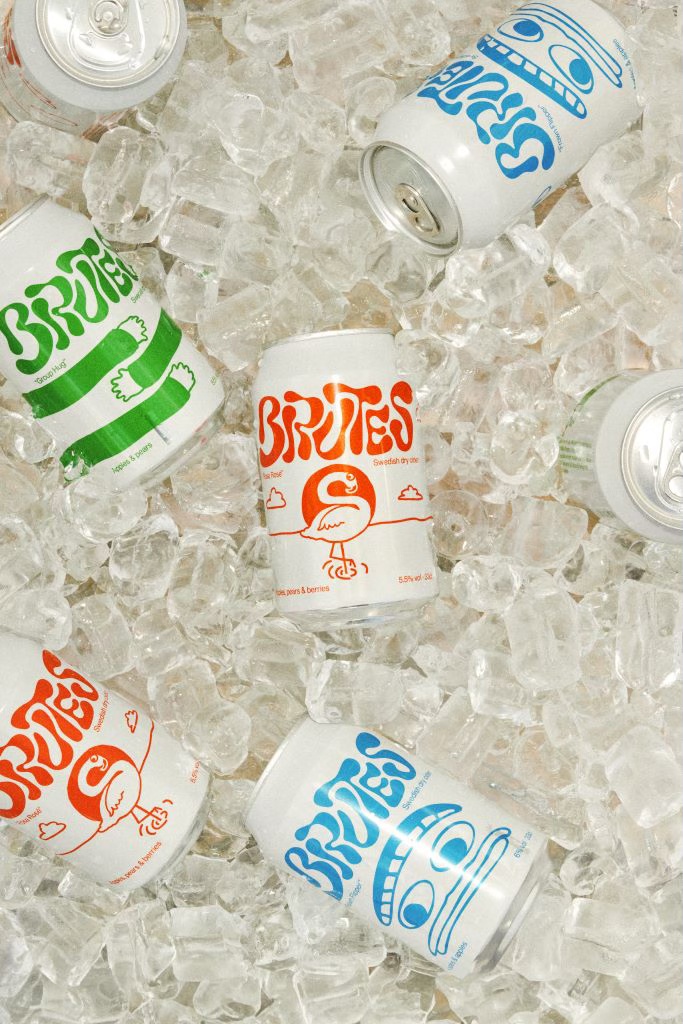
Sustainability of another kind is behind their plans to have their core-range cans made under contract in future. As they’ve now developed somewhat standardized recipes for their canned offerings, making them takes up more headspace than is desirable — they just need to figure out how to square this idea with their dedication to wild yeasts.
‘I want to go back to [cider making] being fun!’, Brad shrugged. He’s characteristically frown-flippant about his desire to have more time to come up with new ideas and focus on blending and cellar work. ‘Anyone can crush and press apples. That’s not where the magic happens!’ (I would counter that picking and pressing fruit at the right time is also integral to cider quality.)

Frown Flipper (can) – note
Smells like quince, but then intense, juicy red apple hits the palate, along with sour melon and nectarine. It’s light, bubbly, and has a hint of tannin. A characteristically Brutes-y fruit hug.
Group Hug (can) – note
Floral nose with big juiciness as well as cheesy notes; liquid Manchego and membrillo. The taste is semi-sweet, creamy, but otherwise quite similar to Frown Flipper — until you get to the bitter farmyard finish. The most complex can; my favourite.
Rosa Rosé (can) – note
Nose of aronia and rose. Creamy berry flavour. Not as juicy or citrussy as the others; the least more-ish in my opinion.

I was particularly keen to ask Brad and Brent what they think of Systembolaget. While a restrictive state-owned alcohol monopoly initially sounds bad for producers and consumers, I was wondering whether having access to just one legal retail outlet for alcohol, which is a non-profit to boot, might in fact make small producers’ lives simpler. I’d also heard that Systembolaget is legally required to make any product available to consumers if they pre-order it online. (I was quickly informed by people living in Sweden that, in fact, this is a highly expensive and lengthy process that is almost never worth navigating.)
My faint hopes were quickly dispelled. ‘It’s the worst thing about Sweden,’ Brad said firmly. ‘It can make or break, or make and break a company,’ he explained. Producers must conform to very specific product guidelines if they want to get onto Systembolaget shelves, requirements which are often inimical to the seasonally variable, harvest-driven work of a craft producer. Moreover, if you do scale up your business to meet the demands of a coveted Systembolaget contract but the retailer then decides to drop you a season or two later, you have nowhere else to shift the stock and can easily end up bankrupt.

In response a 2014 criticism by the EU of how difficult it was for small producers to access Systembolaget, the ‘small-scale alternative’ was introduced: small producers are now able to sell and deliver directly to one or a few local Systembolaget locations. As Brad pointed out, however, even this concession does little to help: to get access to the inner-city Systembolagets where products like their might sell well, a producer like Brutes must be making them nearby, rather than in rural locations where craft cider production is more logistically and financially feasible.
Brent explored these and other similar issues in the master’s dissertation which he completed at Uppsala University’s business school earlier this year. A seasoned cider maker who started off his career as founding Head Cidermaker at Seattle Cider Co, he now plans to operate his cider consultancy from Sweden, working with both Swedish and international clients. Indeed, he recently gave an EU-funded weeklong cider course to cider-curious Swedish juice producers.
When I asked him why he chose Sweden, Brent replied: ‘I decided to come do my master’s here in part because I knew there was a budding cider scene. I had met some Swedish cidermakers at CiderCon who told me that Sweden was 10 years behind the US in terms of its cider industry. Now I think there’s a lot of opportunity to help grow the industry, whether through education (like I did with the Svenska Must cider production course) or through consulting with Swedish cideries. Plus, my wife and I like Sweden, so if we can stay, that would be nice!’
One thing that likely gives people like Brent hope for the Swedish cider industry is government’s ‘farm sales’ bill, set to come into effect in 2025. Under the new legislation, which aims to boost rural tourism as much as anything, small-scale Swedish wineries, breweries, distilleries and cider makers will be able to sell directly to visitors (although amounts per customer will be strictly limited).

Currently, in another great irony of Swedish alcohol legislation, private individuals are in fact allowed to import alcohol for personal consumption via post or travel (although import taxes can be levied). This means a Swedish craft drinks product is more likely to make its way out of and back into the country via several levels of shipping and distribution rather than being bought directly by a Swedish consumer.
The difficulty of accessing Systembolaget under the current system drives producers like Brutes to focus on export and on-trade sales to restaurants and bars like the one we found ourselves in. The gastronomic slant of much Brutes cider, especially towards establishments in the Ok Ok vein, is evident from their focus on maceration, giving orange-wine like body to their ciders and ‘fruit pet-nats’. The last cider we tried fit this mould perfectly: a pet-nat of apples and pears, it was macerated with biodynamic Sangiovese and Merlot skins from The Winery Hotel in Solana, just north of Stockholm.
Blood of Jupiter – note
This smells very intensely of red grapes and raspberry coulis. There’s a bitter grape-skin taste — it’s very ‘natural wine’. Grassy olive oil, too!

So, how can I summarize the slice of Swedish cider life I experienced at Ok Ok? Certainly, Brutes make fruity ciders that are the opposite of those Sweden is known for — those you are most likely to find in Systembolaget. Dry, zingy, funky, and fresh, Brutes’ drinks assert their creativity in hip bars and restaurants, or even former churches in Bristol (I first tasted their wares at Cider Salon).
I’ve already had a quite a few craft ciders from Sweden in my short time in Ciderland. With people like Brad and Brent putting their faith in the country’s natural cider-making riches, more permissive legislation on the horizon, and a history of fruit fermentation that’s still mostly for the uncovering, I’m far from done exploring this must of the North.

Many thanks to Brad Sawicki for the samples and stories and to Brent Miles-Wagner for sharing his fascinating dissertation on the challenges faced by craft cider producers in Sweden. For more on the history of cider in Sweden, see this page by the Svenska Ciderfrämjandet.
Professional photos courtesy of Brutes, less professional photos courtesy of the author.

Discover more from Cider Review
Subscribe to get the latest posts sent to your email.
 Cider Review
Fascinating overview of the Swedish relationship and systems for alcohol. Brutes sound great: good luck to them. Thanks for this.
LikeLiked by 1 person
Hi Alison, thanks so much! I’m glad you enjoyed the article.
LikeLike