We’re at that point of the year, in the UK at least, when Autumn crisps and withers and hardens into the dark and heavy-brittle shell of winter’s coming. The leaves are on their last legs, faces are pinched and crinkled by the cold, fields have their harvest-bared, abandoned feel, and evening walks have begun to be punctured with the first flutterings of chimney-sighed smoke.
It’s a time of year I feel I ought to love, and indeed have told myself I do for a long time, spurred on by its briskness, by its paradoxical grey vitality, by the hurrah of red-gold leaves against the last of the clear, silvery-blue skies and, perhaps most of all, by the compelling cases made by persuasive people more intelligent than me, who offer their paeans to the cerebral joys of autumn-winter over the obvious pleasures of fecund and frivolous summer, and make me feel that agreement will burnish me with discernment and intelligence by association, like pretending to like Manzanilla more than I do Rioja.
But for all the undoubted charms and beauties of the season, love eludes me. I can respect it. I can admire it. But, in truth, it makes me tired and moody and introspective. My brain feels clogged and fuggy; coming up with anything interesting to say feels effortful. I’m not, apparently, evergreen; I shut down like an apple tree, waiting for the return of the sun to summon fresh green shoots of creativity, clutching whatever last scraps of summer I can to see me through long, dimming evenings.
Today’s memory of summer is a paradoxical one. A set of ciders released at what has become my annual sunlit zenith, the Ross-on-Wye Cider Festival, but which evoke and lift, perhaps more than any I’ll likely taste this year, the deep and darkening, brusque, bare-earthed firelit shades of late autumn.

There was a funny moment at this year’s Yew Tree Cider and Perry Trials when two old hands, both of whom have been drinking cider in general and Ross-on-Wye cider in particular, for far longer than I have, mentioned with a touch of regret that Albert – perhaps the most prominent advocate of bittersweet ciders I know – had pulled the general Ross profile in a slightly more acid course than that originally set by his father, Mike.
Naturally I enjoyed relaying this message to Albert, and thoroughly enjoyed his response that ‘I love bittersweet cider, but I also love selling cider’. But I’m not sure it quite passes the muster of more than brief scrutiny. First of all, since Ross-on-Wye predominantly release single variety ciders, avoiding acidity in their output is generally just a matter of not drinking the bottles that say, for instance, ‘Foxwhelp,’ ‘Browns’ or ‘Hagloe Crab.’ Secondly, in the likes of their flagship, Raison d’Être, the Aston Brown Jersey-Dabinett Blend from this year’s festival releases and this dual-vintage 2019-2020 Dabinett which, for the record, I happen to think is probably the best value-for-quality drink of any sort currently available in the UK, and certainly the most overlooked, they’re one of the very few aspirational makers in the country who put out meaningful-sized releases of nationally-available cider which don’t feature sharp apples whatsoever.
For all that the cult of Foxwhelp (in which, yes, I am happily complicit) and the broader influence of wine both in terms of making and appreciation has certainly sharpened the overall profile not merely of Ross-on-Wye, but of Three Counties and West Country aspirational cider in general over the last six years or so, it is bittersweet cider that remain this region’s and this maker’s beating heart. When I drink Ross-on-Wye at the cidery itself, it is bittersweet nine times out of ten, and oak cask bittersweet eight times out of those nine. When I drink at home, and have no prior plans of direction, it’s the bittersweets that my hand twitches towards more often than not. And at this biting, dark-windowed time of year, it’s the distant thunder and sonorous, booming fruit of full-bodied, bittersweet cider that I want more than anything.
Something I have learned about myself over years of writing tasting notes and recording my thoughts and feelings various ciders is that often the bottles whose flavours are the most immediately impactful, and which I might feel to be of exceptional quality, are not necessarily the ciders I most frequently want to sit with over an evening. This seems especially true when it comes to acidity and sweetness, two qualities which I’ve been no slouch in extolling over the years. Eden’s Queen Mab, for instance, has plenty of both, and I’ve described it as the best cider I’ve ever tasted on more than one occasion. I doubt I’d ever, ever turn down a glass, but even if I had a limitless supply, there’d only be so many nights when I thought ‘yes, bring the whole bottle on. I’m ready.’ Ditto almost all single variety Foxwhelp, however much I’ve banged the drum for it. Ditto the majority of ciders with more than the lightest touch of sweetness. Stick something like the vintage dry from Oliver’s on my hypothetical desert island though, or Old Man and the Bee, or Raison d’Être, and it’ll be months before I lob one of the empties into the sea with a message for help.
Bittersweet cider, and particularly oak cask bittersweet cider, is my comfort drink (insofar as that’s a term you should apply to anything with alcohol in it). I don’t subscribe to the notion that so-called ‘session drinks’ should inherently be bland or low in flavour or devoid of any complexities that might risk engaging your brain with what you’re pouring into your mouth. But the soft, rich sheer cosiness of bittersweet cider, whether oak-aged or not, where time has been allowed to shave down the firmer edges of tannin – the sort of cider that wraps itself around you, that calls for squashy armchairs and flickering hearths, that is the apple’s answer to a deep red wine perhaps, where I can think as much or as little as I want about the contents of my glass – that is my perfect happy medium.

Bittersweet cider is also the cider I personally find most evocative and compelling and pregnant with soul. At the most basic level, the idea of a whole, bewildering family of apples that have no other use but cider, that grow in serious quantity nowhere but the west of England, east of Wales and North-West of France, that cling on in the face of orchard decimation – no, not ‘decimation’, the word is too small, it’s so much worse than one in ten – and which contain such bewildering multitudes of flavour is enduringly extraordinary to me.
But most of all, it is what those flavours conjure in and of themselves. It’s not just the oranges, the tropical fruits, the citrus, the apple peel, all the petty descriptors I can wrangle into the tawdry order of a tasting note. Locked in the character of bittersweet ciders, and especially of dry bittersweet ciders aged in oak casks, are memories of places so pungent and precise and familiar that they conjure themselves instantly on my mind’s palate even where I can’t fully picture them in my mind’s eye. Memories of swept earth as you step unexpectedly from out of thick woodland into rolling, arable downs. Of lacing sea-foam that flecks the rain-dark slate of coastal cliffs. Of the last gold gasps of dying sunlight over worn and weary hills. Of the plume rising from a pub chimneystack at the end of a long day’s walk, still a way off in the distance yet, but steadily rising in welcome-home salute.
These flavours, these feelings, have nothing to do with terroir – the specific augmentation of flavour wrought by the growing conditions of a plant. Nor are they flavours that feature, or would possibly even be welcomed, in virtually any wine. But apples are not grapes, and cider is not wine. Its pleasures are brusquer, more chiselled, firmer-edged. It is a drink of harder, colder, earthier places. Places of fleeting sunlight, hulking clouds, buffeting winds and sheeting rain. Of moor and tor, of rough green pasture, of bare rock and low, grey hills. When I drink wine I find a dazzling nebula of astonishing, sensuous flavours that I admire and have come to love. But when I drink bittersweet cider I find myself taken to places that I know and understand and feel connected to. I enjoy wine and spirits and beers and teas and coffees and goodness knows what else besides. But bittersweet cider, like single malt whisky, is a drink I feel in my bones. That’s probably no use whatsoever to you, as a reader, but it’s the only way I know how to put it. What I can say, perhaps more objectively, is that there is no other drink in the world quite like it, in the grand scheme of things there’s barely any of it around, in a few short generations there might be none whatsoever, and the interested drinkers of the two countries that make it barely know it exists.
I’m getting melancholy again. Perhaps it’s just the weather. Let’s get on with some tasting.
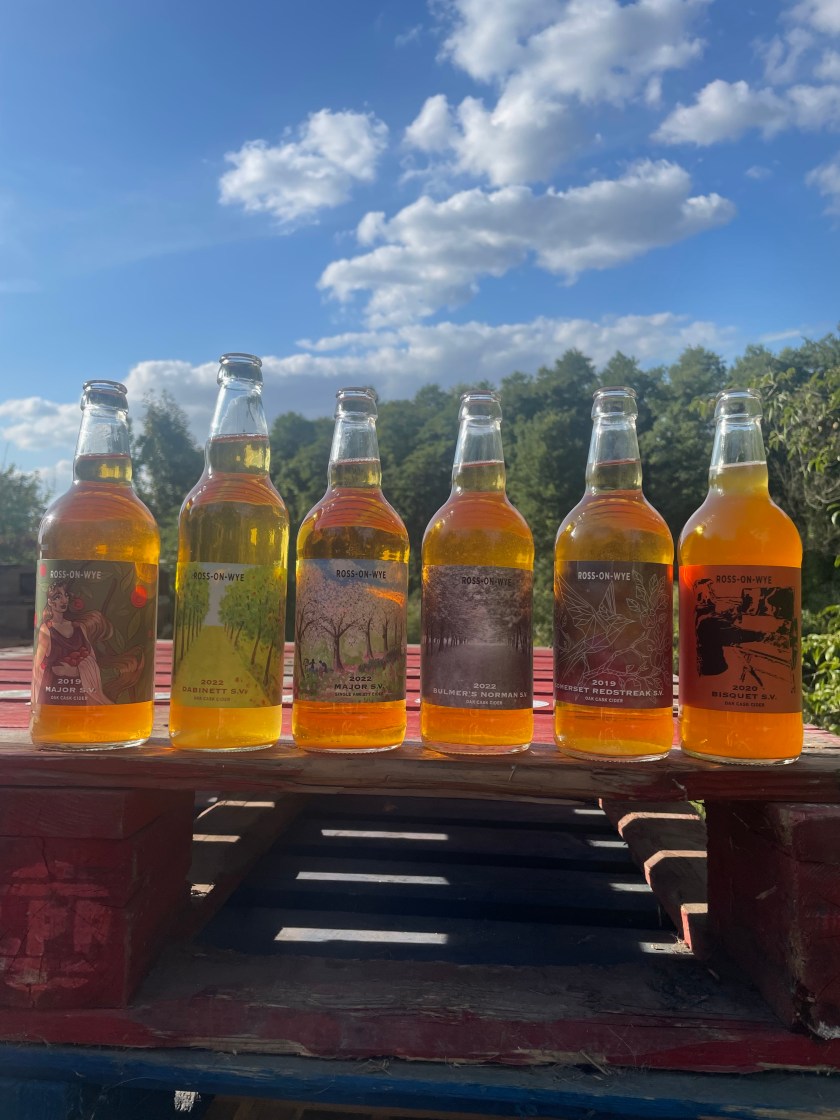
This sextet is – shockingly – all bittersweet cider, all single varieties and all but one aged in oak casks. It was released at the Ross-on-Wye Festival in addition to the eight 750ml special releases as a way of providing the same level of quality and rarity in a smaller format. All are dry, all are bottle conditioned, and each costs £7 a bottle, though you can buy them as a full set from Ross-on-Wye’s website for £37.80.
My notes are a little different to the Cider Review format norm, as they were written in the perry pear orchard at the festival itself and in relative haste, from a distinctly non-reviewing-ideal plastic cup. Funny story, actually – Nicky Kong of The Cat in the Glass had suggested we do a bit of a tasting of them there; it was only when we turned up that I discovered that this was going to be a tasting to a biggish group of people that I was expected to lead. Given I hadn’t actually tasted any of them up to that point I think I managed to fake my way through it reasonably. Anyway, Jack has kindly weighed in with his own notes, written under far more sensible reviewing conditions, so you should probably pay attention to his today, rather than mine.

Ross-on-Wye Bisquet 2020 Oak Cask Limited Edition – Adam’s note
Why didn’t this end up in Raison d’Être? Probably because it’s too good on its own. Beautiful, soft marriage of yellowy, waxy, bittersweet fruit and distinctly maritime, coastal peat. Yellow apples, apricot skins. A touch of campfire, almost barbecue. Beautifully-aged, soft tannins, but the fruit is still fresh. Smoke is very much to the fore, but that works for me. Nice woodiness to the tannins, but the fruit matches up to it all. Lanolin on the finish. Super delicious, beautifully coastal cider. One of my favourite Ross Bisquets ever. Maybe my favourite Bisquet full stop.
Jack’s review
How I served: A day in the bathroom with the window open (a new attempt at “barn temperature” in my flat.)
Appearance: A slight orange marmalade haze to the liquid. Very light effervescence and the thinnest rim of mousse around the rim of the glass.
On the nose: A mellow marmalade note rising up from the glass. I’m looking back in my olfactory senses to 2023’s Raison D’Etre release where Bisquet played the leading role in Irish Whiskey barrels. Faint whisp of peat and apricot skin.
In the mouth: Soft, juicy, apricot juice alongside a gorgeous pillowy tannic note that coats the palate. This is reminding me of the experience of sipping an Amarone wine, all that mellow, juicy tannic goodness, but at a substantially lower (than Amarone) 8.2% abv. Low in acid, high in juicy tannin bomb vibes. I’d never thought to position a Herefordshire cider alongside this kind of Italian red wine, but it’s there now!
In a nutshell: If Amarone turns raisins into gold, this cider turns Bisquet into gold.
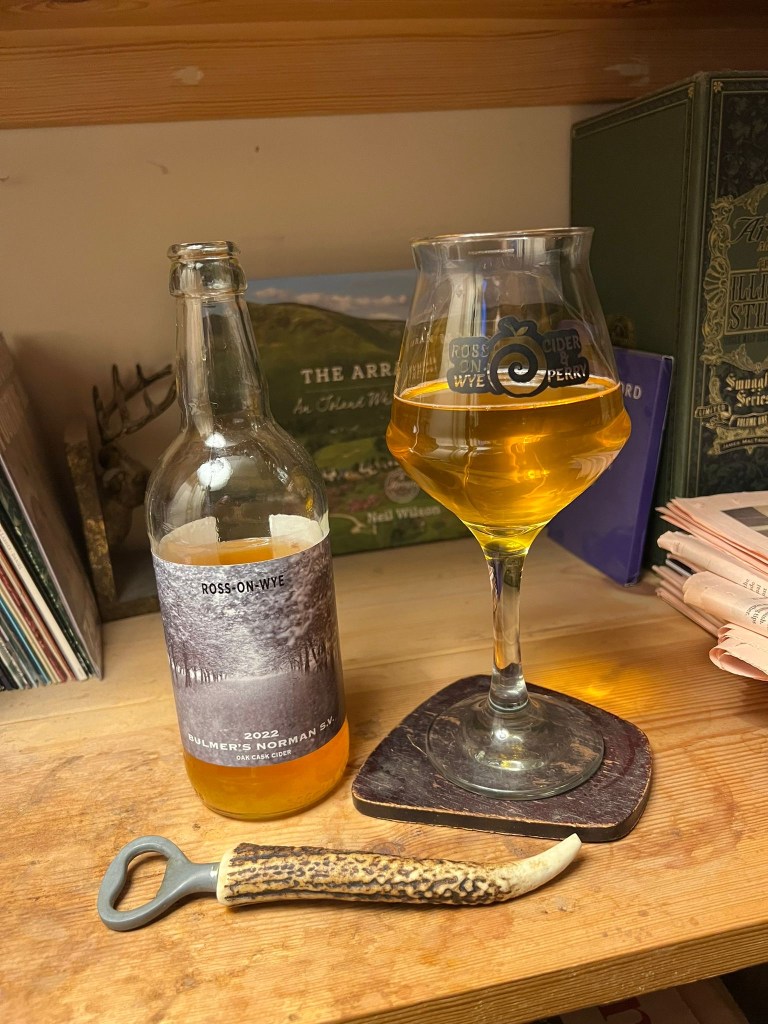
Ross-on-Wye Bulmer’s Norman 2022 Oak Cask Limited Edition – Adam’s note
Really juicy tropical fruit that presents at once as both fresh and dried, with some leafier, barkier, more savoury tones just circling around it. Orange and mango. Forest floor. Voluptuous delivery tempered by firm tannins that lead to a slightly (only very slightly) astringent finish. Great stuff already, but worth giving even more time to allow the delivery to soften and catch up with that already-stellar nose.
Jack’s review
How I served: Following the same bathroom experiment as the Bisquet. A day in the (emptied) bath with the window open to replicate the optimum barn temperature.
Appearance: Brilliant, bright, metallic orange. Merest hint of effervescence when the cap is popped. No mousse to speak of.
On the nose: Oh now there’s an aroma to get lost in for Autumn (thinking I might be described a number of these in that manner). Scots Pine bark, smouldering fireside embers, rolling tobacco, that big pile of leaves that kids and dogs love charging to in October. Incredibly inviting.
In the mouth: Soft tannins wash the inside of the mouth, apricot frangipane tart, apple strudel, a developing mulled note with a mild astringent finish. This is 7.1% abv and I can see this going down a treat with the lucky drinkers that get to try it this Autumn.
In a nutshell: Bittersweet cider for the clocks going back and the curtains being drawn.
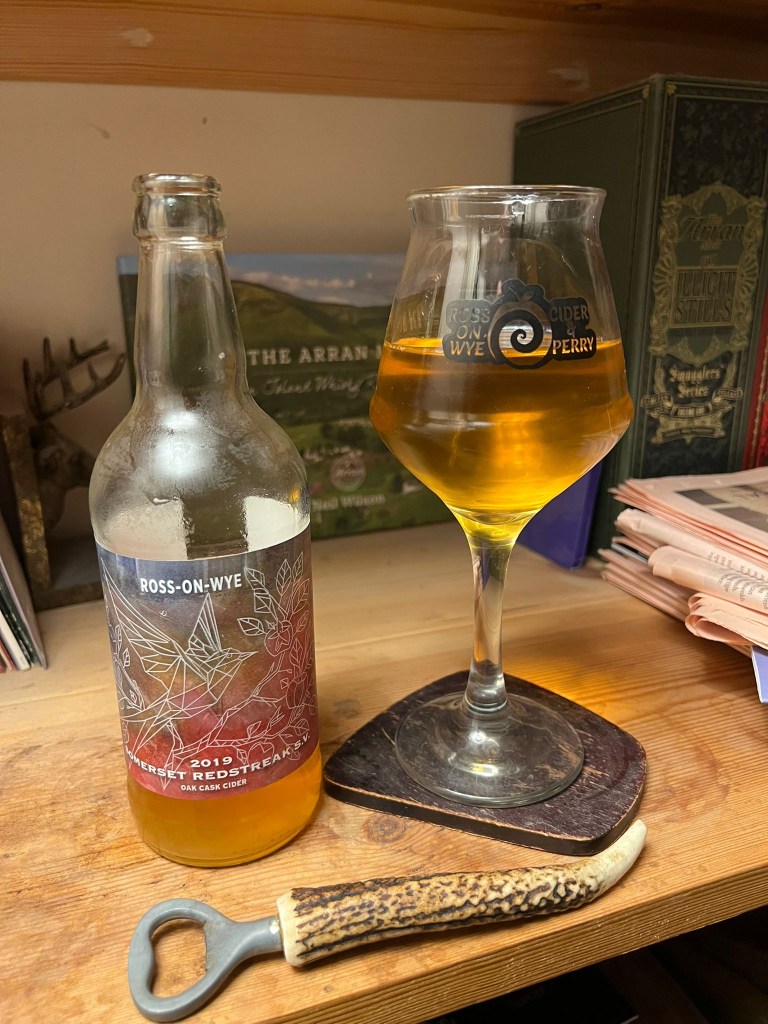
Ross-on-Wye Somerset Redstreak 2019 Oak Cask Limited Edition – Adam’s note
Classic tutti-fruitti Somerset Redstreak nose, the sheer fruitiness emphasised by the time it has had to ease into its fullest expression after five years. Tropical, peachy, childhood juice-carton tones have really been allowed to plush up and develop, and the oak presents as merely a luxurious vanillin gloss over the top of it. Really juicy delivery – oak and a touch of pith poke through on the finish but only after a whole punnet of medium-bodied, beautifully ripe and developed tropical fruits. A luxurious bittersweet cider of gloss and sheen.
Jack’s review
How I served: Bathroom barn style with the window open to the elements all day.
Appearance: Firelight glow, great clarity, little effervescence, mousse dissipates quickly after pouring.
On the nose: Raspberries, loganberries, biscuity crumble topping. More of a high note/treble note in the mix than mids or bass. Either the Somerset Redstreak are having more of an effect here or the barrels are near neutral in their aroma-giving qualities.
In the mouth: Raspberry jam on toast, with salted butter. There’s an integration here as the juice has evidently been left in the barrel ample time to make peace with its oaked environs. 8.4% abv, and carrying its flavours well alongside that preserving higher alcohol content. What starts as somewhat soft in delivery develops into a quite substantial tannic finish that lingers and lingers.
In a nutshell: A big, bolshy, juicy number that time can but try and tame. From Harvest 2019 with love.
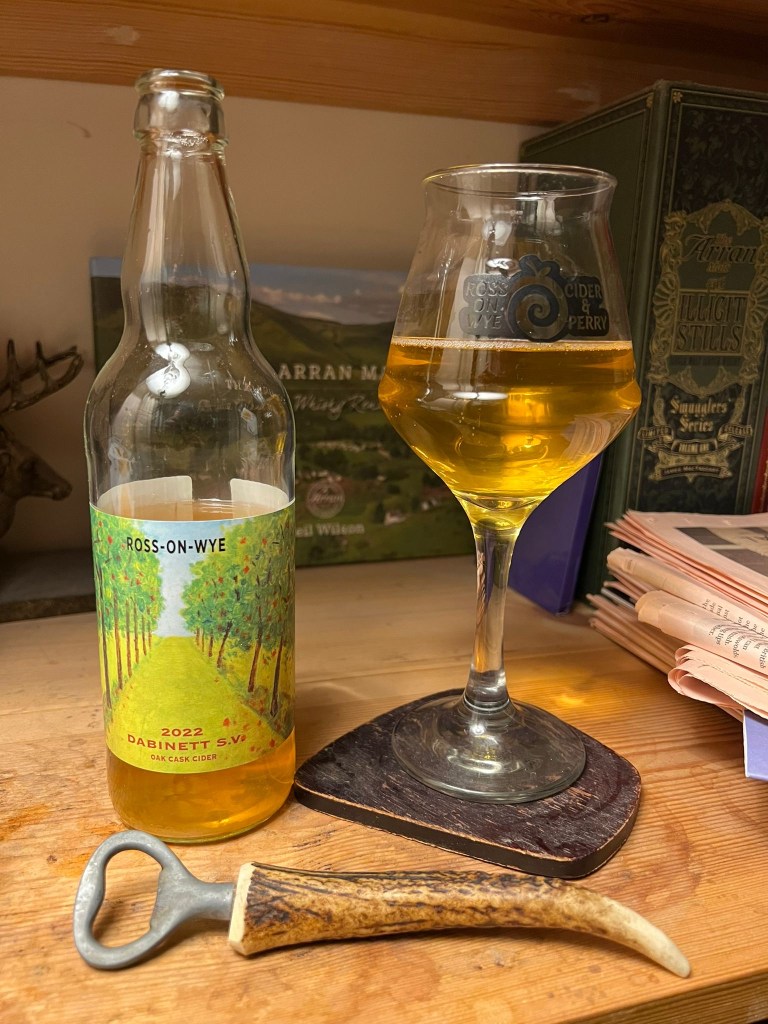
Ross-on-Wye Dabinett 2022 Oak Cask Limited Edition – Adam’s note
Very Dabinett, in a peachy, orangey sense. Lots of malolactic influence to this one, there’s a buttery, peach-yoghurty thing going on here alongside a flutter of earth and warm hay. Eneormous, ultra-orangey body, in a fesh, vibrant-orangey, rather than deep-marmalade-orangey way. Orangina, orange bitters. Then another pretty pithy finish. This is a bombastic oak cask Dabinett packed with fruit. Tannins might want a bit more time for some folk, but I’m a fan as is – especially if you put this with roast pork or a steak.
Jack’s review
How I served: Bathroom barn temperature. Think it got down to 4 degrees celsius this evening outside. Hopefully a bit warmer in the flat!
Appearance: Lemon gold sheen, crystal clear clarity, light effervescence rising through the glass (it’s the most active bubbles of all 6 of these ciders, but still not particularly pétillant).
On the nose: I could be completely wrong here but I’m getting a vanilla, creamy, bourbon barrel note on the nose at first. Then follows that familiar mellow orange marmalade note of the Dabinett. A very clean aroma.
In the mouth: Juicy and drying. Orange barley sugar sweets wrapped in leather. The bittersweet flavours just keeps rolling around the mouth, tumbling around for a good 20 seconds after each sip. The tannins coating my mouth must be carrying these flavours on them through the hefty 8.4% abv, accentuating their impact.
In a nutshell: A big, bolshy, barrel-aged cider that puts a smile on my face.
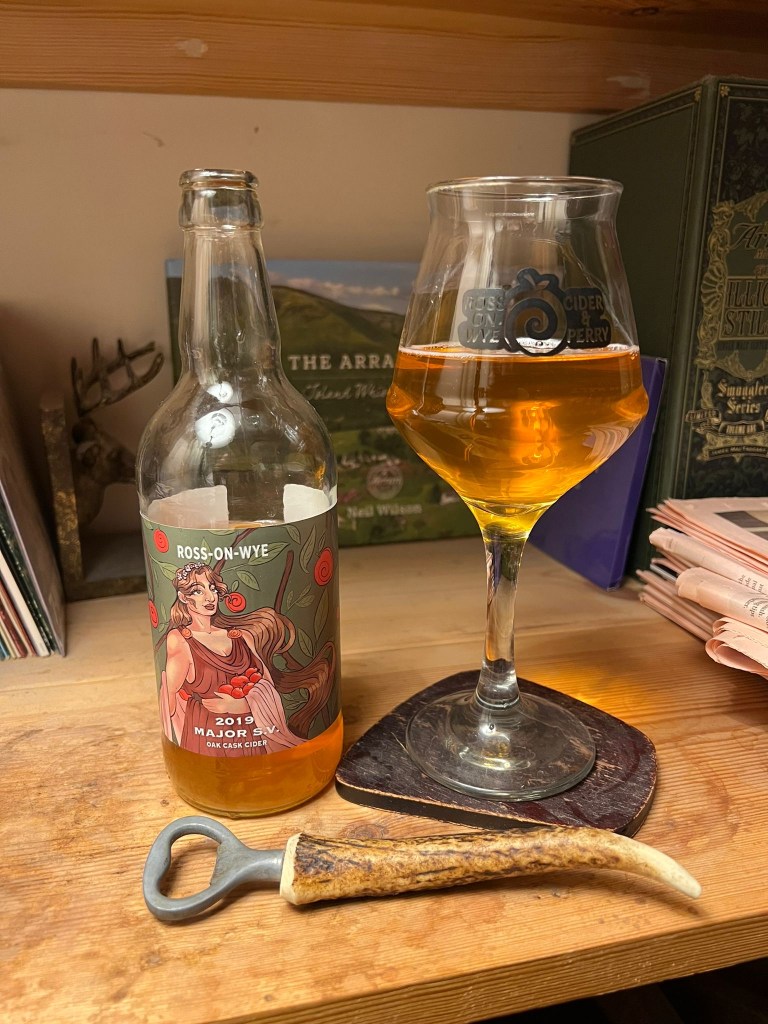
Ross-on-Wye Major 2019 Oak Cask Limited Edition – Adam’s note
(Small, random bugle toot for Adam’s 100th tasting note for a Ross-on-Wye cider or perry on these pages.)
The clearest evidence yet that Albert is deliberately trolling us by never releasing Major in a 750. This has a huge nose. Super rich, marmaladey orange and blood orange, with a classic touch of savoury Major woodland and a coil of old, ashy, woody smoke. Unbelievably soft, ripe, juicy delivery. Not sure this has completely conditioned – the expected spritz of fizz is minimal at most, and there’s the mildest dab of sweetness – but perhaps that’s just the heightened nature of orange and mango fruit, tropical squash. Then the coastal tones of hemp and charred driftwood float ever so lightly through, with the last traces of those huge Major phenols. This is a sensational cider, released at exactly the right time. Buy loads.
Jack’s review
How I served: A day in the bathroom by the open window.
Appearance: Ruby orange sheen, brilliant clarity. Prickle of effervescence forming a thin mouse around the rim of the glass.
On the nose: Stewed apple and rich plum tomato notes. Slightly herbaceous, leather furniture covering, dying fireside embers.
In the mouth: At first on the palate it’s a perception of sweetness I wasn’t expecting: a bit of rose fondant chocolate, which then gives way to this mellow, tannic mouthcoating tastiness. Super soft acidic undertones, but it’s really all about the bittersweet notes at play here, carried on the 8.4% abv. The finish is long, lingering, and lovely. If acidic notes play somewhat digitally in my mind, this is all about the analogue, vinyl and cassette, tannic rhythm of a cider.
In a nutshell: Coming to you from 5 whole seasons ago, time to give a warm welcome to Major!

Ross-on-Wye Major 2022 Limited Edition – Adam’s note
Fascinating next to its older, oak-aged counterpart. Lots of ripe, fresh, higher-toned citrusy, orange-flecked fruit, red apple skins, pith, dark chocolate and red wine-grape. Some earthy, phenolic tones too and savoury spice. There’s just a touch of sulphur, being picky – this needs the most time yet of the whole set I think. Gigantic orange calypso delivery that grows in savouriness and pith over time in the mouth and perhaps finishes with just a little too much of the latter for my preferred current drinking. Nonetheless a fantastically ripe Major with excellent bones that will reward patient ageing.
Jack’s review
How I served: Bathroom barn chic. It’s gotten pretty cold outside today so this has worked a treat and is much more revealing of flavour components that if it had been over-chilled in the fridge.
Appearance: Irn Bru Gold. Whilst not overly fizzy, this has the most noticeable effervescence of all the bottles so far, no visible mousse. Good clarity to it, shining bright from the glass.
On the nose: Noticeably different nose to its 3-years-senior 2019 bottling. Cassis, maybe a bit of blackcurrant leaf too. Tomato leaves in a greenhouses. Not sure where all this leafy insinuation is coming from, but I’m picking it up nonetheless. It’s smells juicy, let’s see if that continues through to the taste!
In the mouth: Definitely more of that cassis element. Blackcurrant jam. It’s fruity and yet completely dry from start to finish. Bit of astringency that comes at the end of each sip. It’s a curious sensation, at first there’s this jammy note on the palate, and then…a wave of soft tannin totally coats your mouth. That’s the bittersweet wave I suppose? Bit more underlying acidity to this 2022 season Major than the 2019, giving it more of a complete picture on the palate. Not sure I can pick out the exact barrel influence in this bottling, though it does sit again at 8.4% abv.
In a nutshell: One of the prettiest cider labels this year, leading to a blackcurrant jam adventure.
Adam’s conclusions
I can’t quite believe I’m saying this, but as a complete set I possibly prefer this flight to the 750ml Festival Releases which I genuinely thought had been the best RossFest outturn to date.
Others, I’m sure, will think that I’ve taken leave of my senses in this respect. Certainly these six arguably cleave pretty closely to one particular style of cider – a style that isn’t to everyone’s taste by any means. I was standing next to my current co-editor during the pear orchard tasting at the festival and got the impression that he was less enthusiastic than me (no one’s infallible). Maybe the more correct thing for me to say would be that if you combined the Bisquet, Somerset Redstreak, Bulmer’s Norman and Major 2019 from this set with the Raison d’Être, Flakey Bark, Foxwhelp and Hagloe Crab from the 750s you’d have my absolute RossFest dreamteam (and with an A-list sub’s bench).
But the evidence of my drinking since the festival definitely suggests that, whatever my feelings on paper, it’s to these six that my glass has most frequently turned in practice, and especially to the Bisquet 2020 and Major 2019 – two of my ciders of the year. For all that Ross-on-Wye produce a bewildering array of bottles, it is through ciders like these that I feel closest to the essence of Broome Farm. Soulful fusions of apple and tannin and oak and time. Ciders that transport me to places I love, whatever the time of year.
Jack’s conclusions
Yes, all of these amazing ciders could have been bottled in 750ml size. Indeed they could have been kegged, canned, BIB’d. But it’s been their fortune and fate to have been presented in 500ml bottles, with beautiful artwork adorning each release. With a lot of the conversation in the cider community about an increase in acidic-leaning palates of late, it’s lovely to taste your way through a selection that boldly sit at the tannic end of proceedings. Who’s to say in a few years, the next wave of drinkers that come onboard or rather, inside, the big, friendly, welcoming tent that is the cider community, won’t have discovered the joy that is tannins in drinks? Perhaps there’ll be a TikTok or *insert next big social media platform here* campaign that says drinking tannic cider is so much better than drinking watered-down, low acid, low tannin, high sugar cider (we can but dream)?
These ciders effortlessly suit the colder times of the year – there’s something inherently warming to me about the effect of oak cask influence on the palate when sipping these on a cold evening. Bonfire night accompaniments? Yes! Sunday Roast accompaniments when Beef, Venison, or Nut Roast is on the menu? Yes! Barrels fundamentally cost quite a bit more and have a rather shorter lifespan (if you want them fresh, and the influence from the oak to be felt in the drink) per litre than their plastic counterparts. Stainless Steel tanks may have more of an upfront cost, but their clean neutrality can keep on going year after year, whereas the lifespan of these barrels which have already held whisky, rum, wine and more is somewhat finite. I have no problem paying a little extra in the case of these releases, knowing the care that has gone into curating the drinks. If you’ve yet to try them, I urge you to seek these six bottlings out – they won’t disappoint.
Discover more from Cider Review
Subscribe to get the latest posts sent to your email.
 Cider Review
I’m still working my way through them again but they are a fun set so far.
Great write up as always!
LikeLiked by 1 person
Fabulous piece and great reviews gents!
I’m off to buy them all!
Thanks as ever
Gav
LikeLiked by 1 person
Beautifully written, thankyou. The Major 2019 is gorgeous, must try the others now.
LikeLike
Pingback: Winter is here. Ross Cider to the rescue! | Cider Review