
I think it was Summer 2021, and my wife had taken a message from some guy called Jakob living near Freiburg who wanted to come by to buy some cider and have a chat. It not that near, so I think he was passing by. And he did pop by, we had a nice chat, he bought a few bottles and I stored his mobile number under “Jakob Ciderguy”. I never got down to Freiburg, but three years later I was thinking the guy with the crutch at a booth in the corner of the expo space at CiderWorld looked very familiar. And that’s something considering my memory for faces and names is getting increasingly bad!
But Jakob Hörl it was, with a bunch of bottles before him, and our own Adam had recommended I try his perry. I think I hadn’t realised he had started selling cider, or I’d forgotten, but it was very nice to reconnect with this friendly chap, and indeed, the taster I had had been well recommended.
I promised I’d stay in touch, confirming the mobile number was indeed his, and thought maybe it would be nice to get Jakob to tell his story for our readers, as there aren’t that many truly small artisanal makers here in Germany. So I ordered a mixed box to have a proper tasting on my own, or with the neighbours if I was feeling generous, and set to quizzing Jakob about his cidermaking activities. So, let’s meet him!
* * *
Cider Review: Let’s get the formalities out of the way, Jakob, please introduce yourself to our readers.
Jakob Hörl: Hey, I am Jakob, a small producer of fine craft ciders, based near Freiburg, southwestern Germany. Recently, I moved to a village called Eichstetten, at the hills of an ancient Volcano in the Rhine valley, the so-called Kaiserstuhl, or “Emperor’s seat”.
I am a forest scientist by training and currently work at the University of Hohenheim, Germany’s leading agricultural university, at the agroforestry research coordination office. I’ve been a fermentation enthusiast for more than half of my life and deeply care about trees! I am happy to be interviewed!
CR: A question I like to ask all my interviewees, how did you fall into the cider trap? Was this something that you grew up with, as I guess Most is also a tradition on the western side of Baden-Württemberg?
JH: I never actually intended to become a cider maker, but over the course of the last 5 years, one step followed the other and eventually, I guess I became one.
I grew up with apple trees, actually not around Freiburg, but in Upper Bavaria (Rosenheim) at the fringe of the alps. This region is famous in Bavaria for traditionally growing fruit (apples, pears and plums) mainly in form of high-stem (standard) tree orchards, with cows grazing underneath. The traditional apple varieties serve multiple purposes, such as fresh eating, storage over winter, making juice, cakes and Kompott (apple sauce), or Schnaps. Most is known there, but not quite famous as Bavarian beer is quite good (if not the best) and quite affordable. In the past, the fruits have been used more for making schnapps.
Since a young age, I was also fascinated by fermentation and all things bubbling. So, I started brewing beer at the age of 14, based on a recipe I found in a Viking cooking book in Norway. I wasn’t really interested in drinking it, but just the process of making it. In school then, I had a farmer friend (Georg Loferer – today one of Germany’s youngest official pomologists) whose family runs an orchard farm since generations and who were making apple juice each season. Eventually I took some fresh juice and made Most out of it, probably at the age of 17. Through my skills in homebrewing, I managed to bottle ferment it and produce cider, resembling farmhouse style.
I came to Freiburg for studies and stayed there, starting a family. I participated in a professional fruit tree pruning formation and pruned fruit trees in the region for a couple of years, realizing the devastating state of a lot of older orchard trees.
This was when I started to think about the production system, the reasons for this decline and realizing that currently (if at all) apples are picked up and sold for making apple juice selling for 2-3 Euro per litre, which means getting less than 0,10 € per kilo of best apples. No wonder that this system does not work and trees are not taken care of.
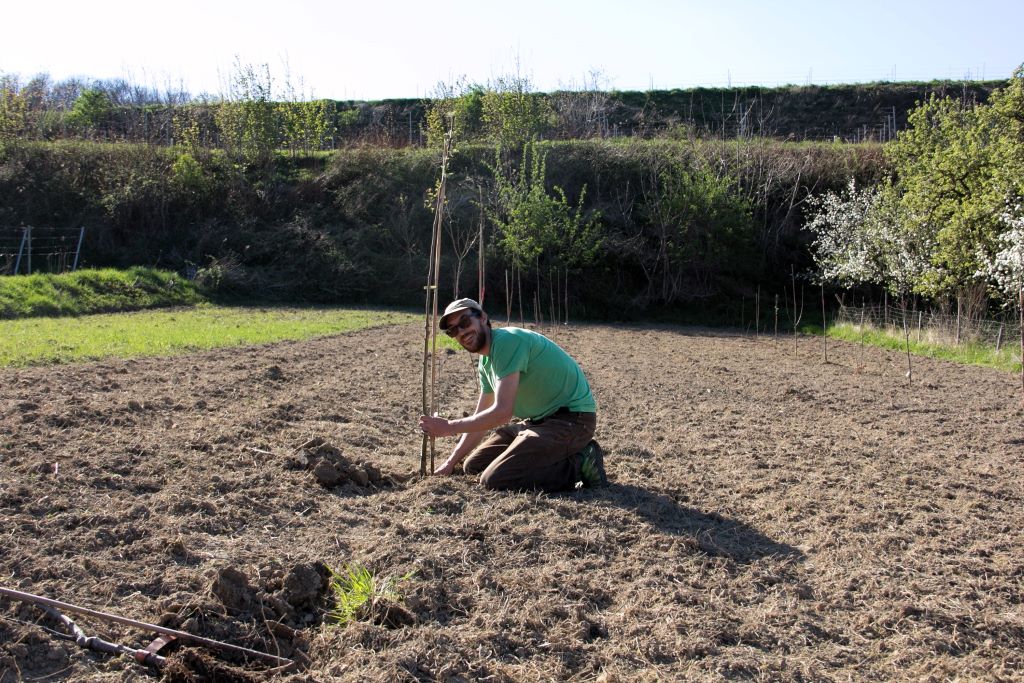
The goal of my project “FreuObst” was exploring ways to create the most valuable product out of (still) existing apple trees. As I am a researcher, it first had the character of a practical research project. On the way, I learned a lot and also influenced my way as a researcher.
CR: Well, growing up in Bavaria you of course know that perry is the true drink of the Bavarian peasantry! Tell us a little about the region you are now in and the cider tradition that surrounds you.
JH: In terms of topography, there is the Black Forest mountain range, stretching from the Swiss border in the very south-west of Germany over 100km north (till Karlsruhe / Pforzheim), bordering the Rhine river valley, which is the warmest and sunniest area in Germany. So, you have quite some climatic extremes within just 30 km distance – dry and hot in the Rhine valley and wet and cold in the Black Forest.
As mentioned, I recently moved outside of Freiburg near that ancient volcano, the Kaiserstuhl , with very fertile soils, but little rainfall. I harvest and supply my apples from both areas, the valley and the foothills of the Black Forest. The area around Freiburg is clearly wine country. Most was more a thing of farmers in the high Black Forest. Luckily, one still can find local Most on the menu of some traditional pubs in the Black Forest, which is completely different to what I do and call “Feine Zider”. It is rather a special thing to make cider in this grape growing area.
CR: Yeah, on your flyer and website you use the tagline “Feine Zider & Mehr”, so fine cider and more. But that spelling of Zider, where did that come from?
JH: Zider is actually the German word for cider. I didn’t know myself that this existed, before I started to do some historic research on the origins of the word cider. Today, in Germany, most people refer to the English word “cider” or “cidre” (French) when they talk about wine made from apples. I find this a strange thing, as the word “Zider” was already mentioned in the first German dictionary written by the famous Grimm brothers dating back to the 18th century. Today the term is still used in the alpine regions Austria and Bavaria, which I naturally feel connected to. By using the term on my labels, I hope to help spread the word!
CR: Hah! In all my reading of old German text I don’t recall having seen that at all, though I have seen it spelled “zider” in references to Devonshire. Every day is a school day! I did see a lot of Cyder with a Y in mid-18th Century German texts, but it seems that was a fad around then.
I guess it would be safe to say that Streuobstwiesen [meadow orchards for you non-German speakers] are still a thing in your region. I mean, your cidery name, Freuobst [essentially translating as “happy fruit”] is a play on Streuobst. How are they standing up to modern agriculture around you?
JH: Absolutely, in Baden-Württemberg, we are lucky to still see the highest population of traditional orchard meadows in the whole of Europe. Around Freiburg, along the foothills of the Black Forest, you can still find older trees being an integral part of the landscape. However, their decline is unfortunately quite rapid. Predictions based on regular state-wide monitoring (Landesweite Streuobsterhebung) show a loss of 1 million trees every 10 years. From today’s remaining 5.5 million trees, we will end up with less than 1 million in 40 years’ time. The reasons are manifold, but probably the most fundamental one is, that these trees do not make any (or little) money and require lots of manual work, so only few people care about them. I want to demonstrate the potential of utilizing their precious fruits and transforming them into a premium cider to spark the interest in working with the remaining trees again and at best, encourage people to plant young trees, which are urgently needed to form the future generation of old trees.
CR: That’s an absolutely shocking statistic, especially given that orchard meadows in our state supposedly have a protected status. Two of the main problems I see mentioned in the pomology circles here is that the generations that tended the meadow orchards are, well, kind of dying out, and few people are willing to take them over. The other is the big question on how they, the old varieties and rootstocks, are coping with a changing climate. Can you comment on those concerns with respect to where you are?
JH: Yes, climate change is the other dominating topic in pomology circles. I am a bit involved in this topic at my university (of Hohenheim), the thing is we know very little, yet would need answers very quickly. So far, there is no clear trend. Clear is that conditions will become more extreme and more fluctuating. There is an increased risk of late frost, due to earlier flowering, which can cause the loss of entire crops, as we have experienced the past years. Then, there is increased drought and heat stress in some areas, which leads to a general weaking of trees, which makes life easy for harmful pests and diseases. I guess growing fruit won’t become easier in future. But at the same time, there is increasing awareness about natural processes and adoption of forward-looking agricultural practices like regenerative agriculture, agroforestry and agroecology, which focus on strengthening natural processes and increasing resilience and will play a role in managing orchard meadows as well. I think we will see some change in the way we grow apples as well.
CR: Yeah, it’s quite a worrying time for those of us looking after old orchards or planting new ones. The rate and scale of change is so unknown, but we just have to do what we can, and hope for trends that will help us over time. Let’s step a bit back to basics. What kind of fruit are you using in your ciders and perries? Do you have favourite varieties to work with?
JH: Yes, absolutely. I really love Rheinischer Bohnapfel, it is vigorously growing, has abundant crop every other year and can serve for many purposes. Its slight tannins make it very interesting for cidermaking and, fortunately, it is a common variety in our region, perfectly reflecting the terroir. Other than that, I use common Mostapfel-Varieties like Goldparmäne, Brettacher, Boskoop, Gewürzluiken, Gravensteiner, Hauxapfel, but mostly in form of orchard blends. For pears I am still experimenting and managed to make a well-received single varietal perry from Schweizer Wasserbirne, a perry pear variety that is still quite common in our region.
CR: Is the fruit coming from your own orchards or are you buying in locally?
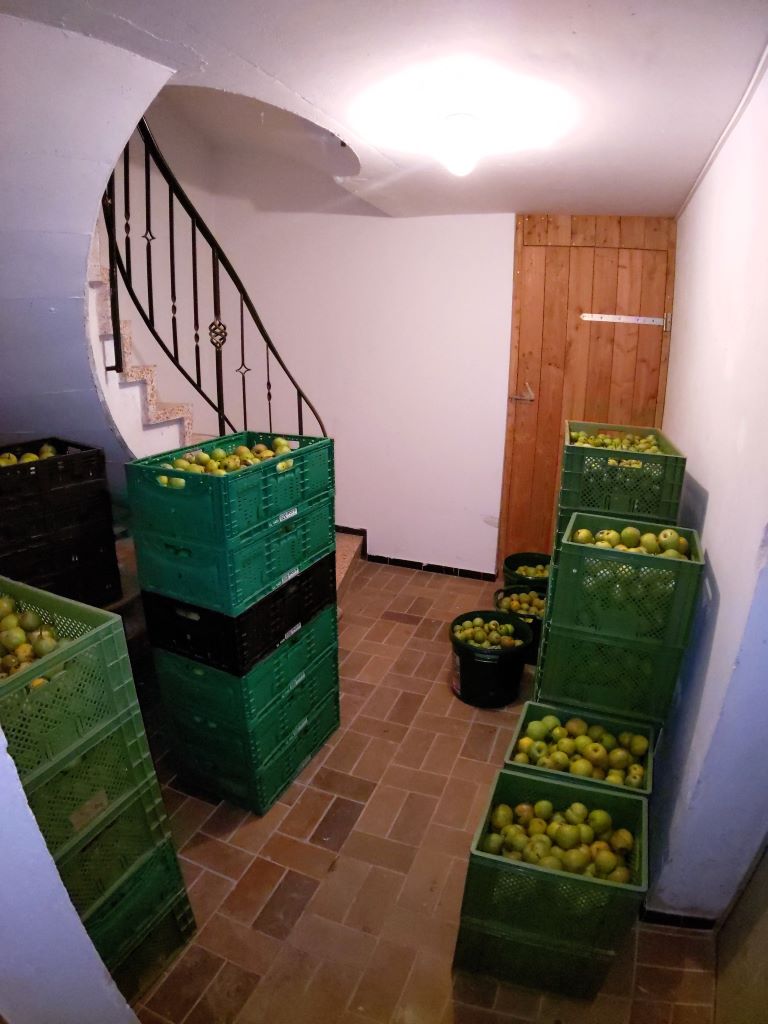
JH: I have different configurations to source my fruit. Mostly it is from my own orchards. But I do harvest at other places from single trees to whole orchards. Sometimes, I also buy from local farmers that still maintain their traditional orchards and I am happy to pay a good price to them, so they happily pick up the fruit and maintain their trees. Important to me is excellent quality and connection to the fruit. I want to know the trees and help them to survive and thrive.
CR: You mentioned planting some new orchards, tell us about this part of your project.
JH: Reading about traditional French and English cider apple varieties sparked the wish to try and use these for my own cider making. When I started looking for information on how they would do in our region and climate, I found basically no information and I had to realise that cider apple varieties are not offered in Germany fruit tree nurseries. That’s when I decided to graft my own trees of classic cider apple varieties such as Dabinet, Somerset Redstreak, Stoke Red, Michelin, Douce Moen and so, and started a little tree nursery. Once you realise how easy it is to grow your own planting material, the number of trees and varieties naturally increase. I still have a lot of nursery material left and did and do sell some of these.
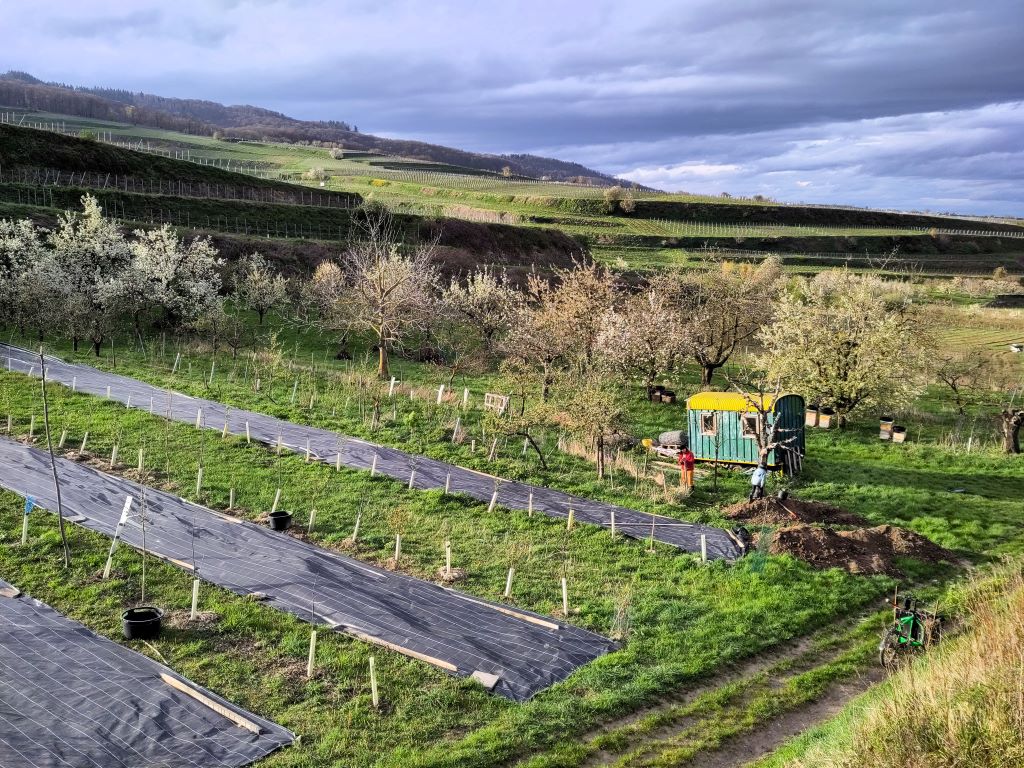
Two years ago, I planted a new plot, which I managed to rent for 20 years with about 20 different cider apple varieties, as a first trial site to observe how varieties and rootstock combinations perform. This plot has developed into a food forest as I interplanted with berries and vegetables in between the rows as long as the trees are still young. All is manged organically, and I work a lot with regenerative growing methods, utilizing plant extracts, compost tea and micro-organisms.
CR: I’m glad you embrace the local traditional varieties, but it is fun to add an influence from other traditions. And what kind of total annual volume and typical batch size are you making?
JH: I consider myself still being in the starting phase and allow the project to grow organically. The last years, I made batch sizes from 200-700l, with high diversity of styles and products. Our total production over the past 5 years has grown from500 to 2000L per year. Now I need to focus on marketing and getting the good stuff to people. In future, I probably will extent the volume probably a bit more and focus on specific styles that have their lovers.
CR: You’re south of Hessen – oh, that makes me think of a certain Slayer song – and that Apfelwein tradition, and I guess kind of on the edge of the Baden-Württemberg Most territory. Has either tradition influenced you, or has your way of making come from a different angle?
JH: These traditions haven’t really influenced me so far. I find my own style and learn and experiment a lot. I only really discovered good Apfelwein this year [2024] when I participated at Ciderworld and had the chance to taste some of the tasty traditional Apfelweine in Frankfurt. It is a perfect match with the local culture and tradition, but I will continue to find and manifest my own style.
CR: So, as we are on the making part, what is your general approach or philosophy of making? What guides your choices?
JH: Experimenting, observation, trial and error; continuous learning – screwing up, learning again, giving time to the product and process. My philosophy is to intervene the least possible and depending on the style, the least necessary in order to unveil the potential of the fruits. Throughout the many years of fermenting all things, I developed a certain intuition for the natural processes, but I do also read scientific literature about wine making and attended a cider making course in England. My product range is from fruity and clean (Apfel-Zider) to complex and earthy (Cidre Brut), to wild and pungent (Vulkan-Zider). While the first resembles more my interpretation of a classic English cider, fermented with cultured yeast, filtration and added CO2, the second is an attempt to reflect the French tradition, with a first spontaneous fermentation and second fermentation in the bottle with added Champagne-yeast and 9 months yeast-storage before being disgorged, where the third is a pet-nat style natural wine out of apples – nothing added, all natural.
CR: Has there been any other external influences on what you do or how you make, in terms of makers, or ciders that have inspired you, given that you went to England to do a course? It seems odd there are no courses in Germany at this stage.
JH: In 2014 I was in the US traveling the West-Coast. Eventually I spent a week in a small town Corvallis, which totally flashed me with the then still uprising craft beer scene. There were also a few still quite young cideries that inspired me (TwoTowns Ciderhouse) and Nectar Creek, which basically made a cider-style mead (low alcohol honey-wine, sparkling and real-fruit fruit flavoured), which inspired me and I dreamt of doing something similar one day. I read a few books from France and England as well as Canada, which confirmed that I was basically on the right track of my making. Attending the Cider and Perry Academy has also been a long dream of mine, which luckily became true in fall of 2017, when I attended a one-week cider making course with famous Peter Mitchell. I didn’t learn so many new things to be honest, as it was the basic-level course, but got exposed to the different approaches to cider making, when I visited also Tom Olivers with other participants. There I realized that there is no one style of cider making, but one has the chance to develop one’s own – and of course tasting and drinking quite a few nice Herefordshire ciders. For totally new beginners it would be great to have a cider making course or education in Germany, right now this is definitely missing.

CR: Making cider is not your main employment, I gather, so what made you decide to start selling?
JH: I want to share my passion about fruit trees and fermentation with people and I am fascinated by taste and flavour, predominantly in drinks. Having my own product, is the best way to communicate that love. In 2019 I decided it’s time to no longer hide in my basement, but to offer it to the people.
At the place we recently moved to, I am installing a real cider cellar. This will be quite a relief, as I was doing vagabond fermentation for a couple of years now, changing location basically every season and was producing at different places, such as an organic winery, an ancient wine cellar or just a farm barn, which was all exiting, but never optimal.
I am a forest scientist by training and today work in the field of agroforestry research, something that is well related to cider making, as meadow orchards are the most spread traditional agroforestry system in central Europe. In future I see potential for cider made out of newly planted and extensively managed fruit trees being an integral part of the landscape.
CR: A topic close to my heart! We, well modern farming, needs to rediscover the benefits of integrating trees back into the landscape for sure.
As Most is well known down in this half of the country, I suppose you weren’t starting from scratch when it came to marketing, but your products are different to what the farmers might have been drinking, even in recent years. How have your products been received locally?
JH: In the beginning, I was only marketing locally in the region, because it felt the most natural to me. Articles and interviews about FreuObst were well received in local newspapers. This created interest and people started to order and to buy my ciders. That’s when I started shipping Germany-wide as well. But I had to realise that people have different expectation when the buy cider – more of the pub-style, sweet and easy drinking stuff. I explicitly orient more towards the wine side and position my products rather on the drier side, with less or little residual sugar. Some people were disappointed in a polite way, others celebrated finally finding a non-sweet cider that goes well with food and nice meals.
CR: Yeah, big brand macro cider has a lot to answer for in terms of creating false preconceptions of what cider actually is. On the other hand, I often have people saying “oh, Most, my grandad used to make that, too sour and dry for me”, then being blown away by something that isn’t vinegar!
You seem to have a core range, the Apfel-Zider, Birnen-Zider, Vulkan-Zider and the Cidre-Brut. Three are harvest blends, it would seem, with the perry being a single variety Schweizer Wasserbirne. Do you try to keep the blends consistent every year in terms of the varieties used, or does it depend a lot on the harvest?
JH: The past years I experimented a lot and made also many smaller batches that I didn’t sell. Those you mentioned are basically the “product lines” or styles which have emerged from this. The next step is solidifying and repeating them. Of course, it depends a lot on the year, as we are still in a heavy biennialism with some trees that came with a frost in 2017 and again this year 2024. So some varieties only bear every second year, which I am not too sad about, as this brings variation and diversity in batches. 2020 was an excellent pear year for us, so we made quite some Schweizer Wasserbirne Birnen-Zider, 2022 my son was born in September, so no time for pear collection. I am very much looking forward to the 2024 pear harvest, which looks not bad.

CR: Who would your main target customers or outlets be?
JH: I think my Ziders are great for cider enthusiasts, but also newcomers to cider will find nice introductions to the exciting world of cider. I do both easy-drinking and fruity as well as complex and challenging. The main customers are people who like decent wine and are open for experiments, like natural wines, for example. Some really like to support me as a local and forward-looking producer.
I sell to a few well-sorted wine shops in the region and do direct selling (which I prefer), as well a bit of shipping. Selling to big distributors was never an option. The selling/marketing part is still the biggest construction site of the project, which I will need to dedicate more time and resources over the next years.
CR: Speaking with other smaller makers in Germany and elsewhere in Europe, it seems a real challenge to get into the market here, despite the impression that the idea or awareness of cider seems to be growing, but maybe only in our little bubble. What’s your take on the German cider scene and how it’s developing?
JH: I agree, I think the German cider scene is growing, as several smaller producers are popping up in recent years, though currently still small. Some maintain the traditions, while others try out new styles – I think all is good to save the old trees and plant new ones. I assume that the cider market will be growing the next years, which is a great chance for small producers to take people and show them what real, orchard based German cider is. But there is also another development of the beverage industry to make cider from juice concentrate or juice out of discarded apples from intensive apple plantations, which show a limited flavour profile and have a somewhat artificial and sweet taste. I guess these products have a market, which will also grow, but I personally do not like those. The alcohol-free drinks market will grow as well, which has also a place for apples.
CR: Actually, you won medals at Cider World 2024, did that help pick up awareness and trade?
JH: Yes, this was cool and a nice reward for all the effort of the past years, but also a validation that I am on the right track. It certainly helped to get visibility and attention and resulted in little increased sales. The next thing is a nice website and online outlet for people to easily order.
CR: wWhat does the future hold for Freuobst? What are your plans?
JH: I am looking forward to the upcoming harvest, as it will be the first time to ferment in the new cellar. I want to solidify my production and keep improving quality, while focus more on the marketing side, reaching out to gastronomy and restaurants more. Meanwhile my little trees are growing and have their first little crop this year. I am excited myself to see how it develops.
CR: I really look forward to seeing how your new orchards develop, as a counter to those declining tree numbers. But I’m also very much looking forward to seeing how your cider develops and how you will forge new fans in Baden-Württemberg and beyond. Thank you so much for your time!
* * *
It’s great to see another small, artisanal maker in Germany, producing something that you can trace right back to the trees and know exactly where it came from. In my next article we’ll taste through six of Jakob’s bottlings, going all the way back to 2020.
All photos by Jakob Hörl.
Discover more from Cider Review
Subscribe to get the latest posts sent to your email.
 Cider Review
Pingback: Five Ciders and a Perry from FreuObst | Cider Review
Pingback: Stashkiller – Random Bottles, no Occasions | Cider Review