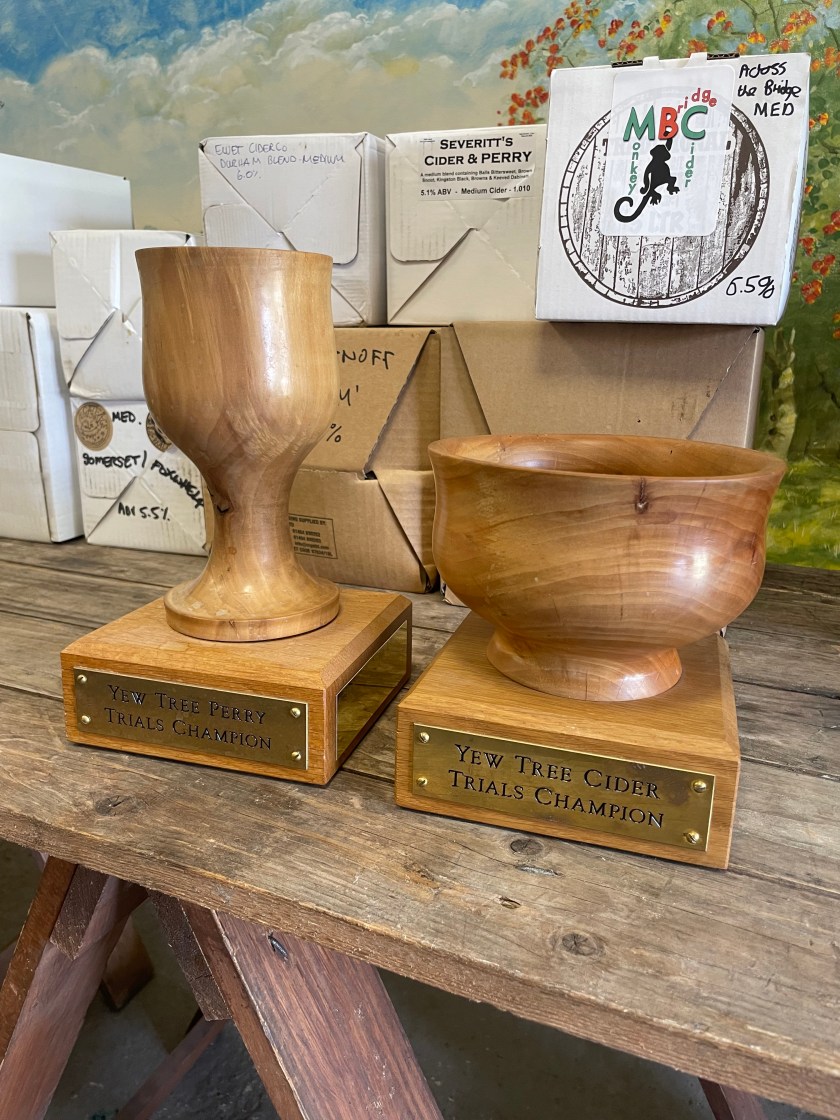
Artistraw submitted a sparkling bag-in-box.
There were a huge number of potential ‘ins’ to an article on this year’s Yew Tree Cider and Perry Trials, but somehow, thinking about it on the drive home the day afterwards, the sparkling bag-in-box was what best summed up the uniquely wonderful, chaotic, surprising and wholesome enchantment that comprises this annual competition.
Sparkling bag-in-boxes (bibs) do not of course exist, as it were, in nature. At least not intentionally. The bag in box is not designed for the pressure of carbonation of any form. They exist for the storage and dispense of still draught drinks, in this case cider. But Artistraw do not make still draught cider, and the Yew Tree Trials is a bib competition. The solution: decant a number of their bottled pét nats into bibs the day of the contest, knowing that they would be drained before pressure caused an explosion.
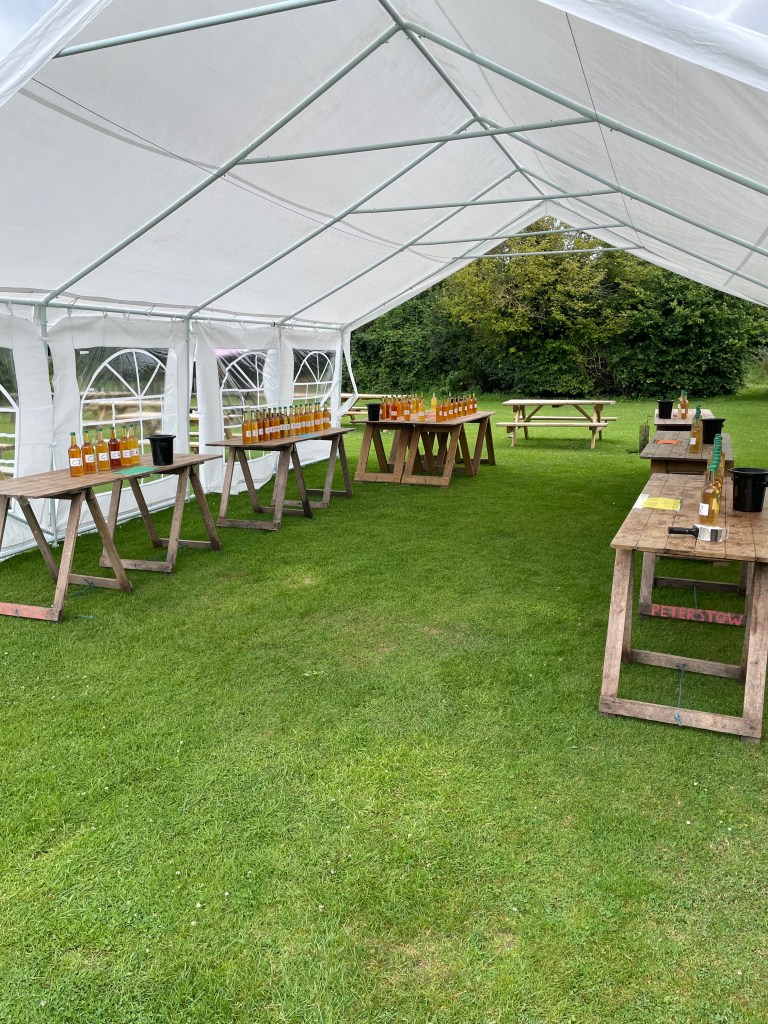
Let’s wind back a bit. Past the sparkling bib, past the record number of entries and the sunlit judging marquee bedecked with golden bottles. Past even the midnight tumblings over electric fences in futile search of Orion’s Belt and the bit where I woke up in a barn’s mezzanine (to be clear, I had gone to sleep there deliberately; there was a mattress and everything).
The Yew Tree Cider and Perry Trials is an annual competition held in the beer garden of the eponymous Yew Tree Inn. It is organised by Ross-on-Wye Cider and Perry along with, prior to this year, Bartestree Cider. Categories are dry, medium and sweet in both cider and perry, with dry cider invariably drawing the most entries. The competition is free to enter, is peer-judged (though a handful of guest judges feature each year) and every bib submitted is put on a bar in the event room to be sold to the public for £4 a pint or £2 a half, with all takings going to charity – this year UNICEF’s Children in Gaza Fund.
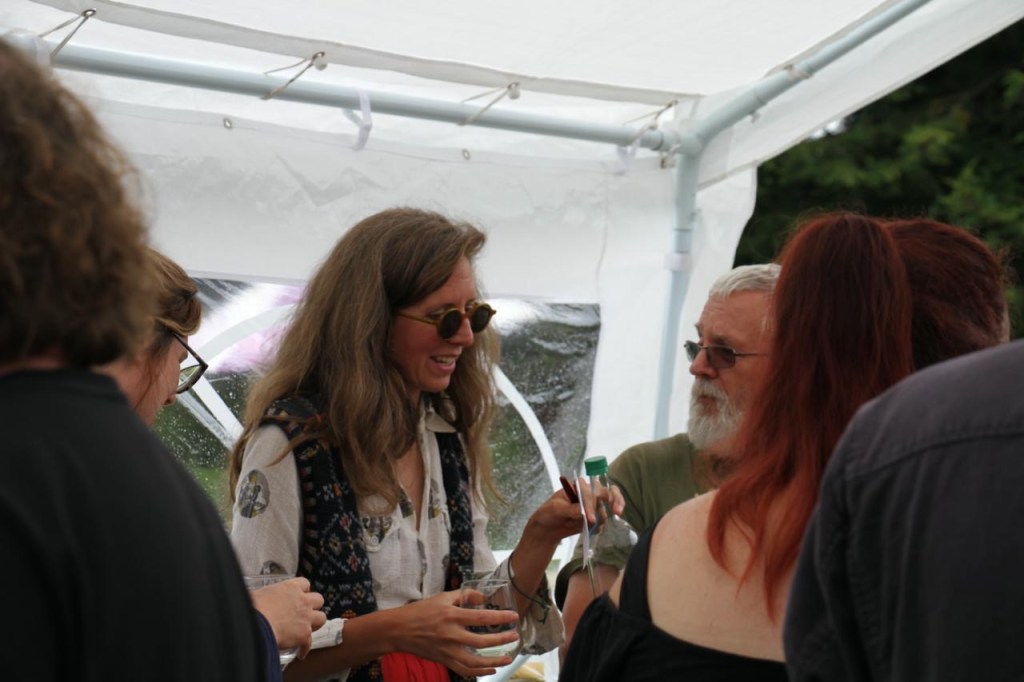
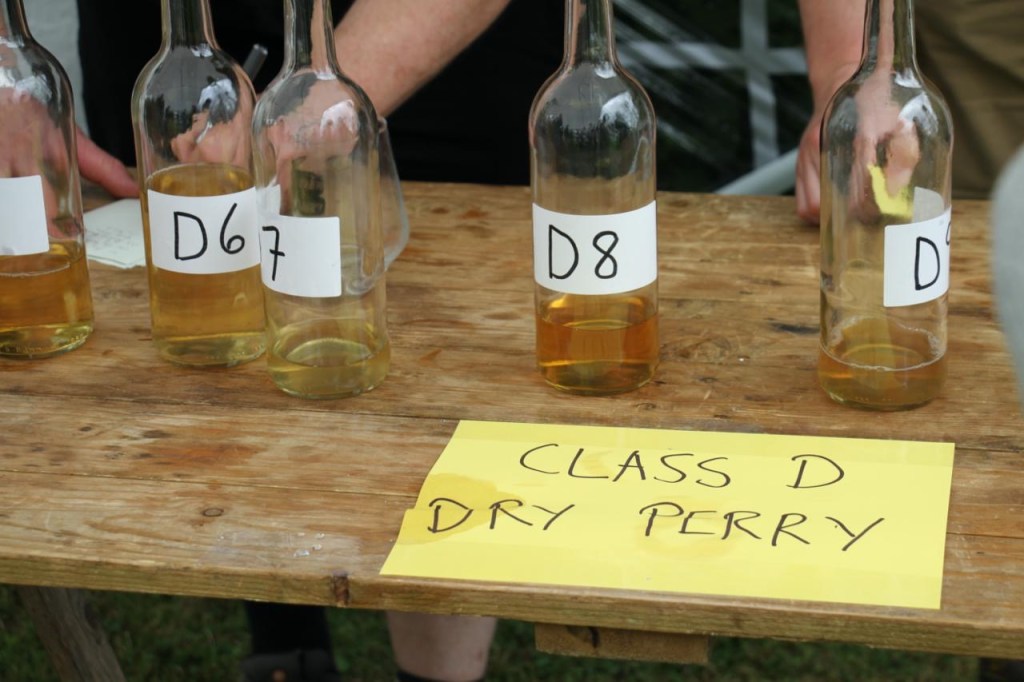
The format is similar to the Big Apple Cider and Perry Trials held around Easter at Putley, and utterly removed from virtually every other drinks competition I’m aware of for any category anywhere in the world. Anonymously-labelled bottles are filled from the donated bibs and set up on trestle tables under the cover of a marquee (it did rain this year, but only very briefly). Makers can judge any categories they’ve entered and, if there is time and inclination thereafter, any remaining categories they like. Guest judges can simply have at it.
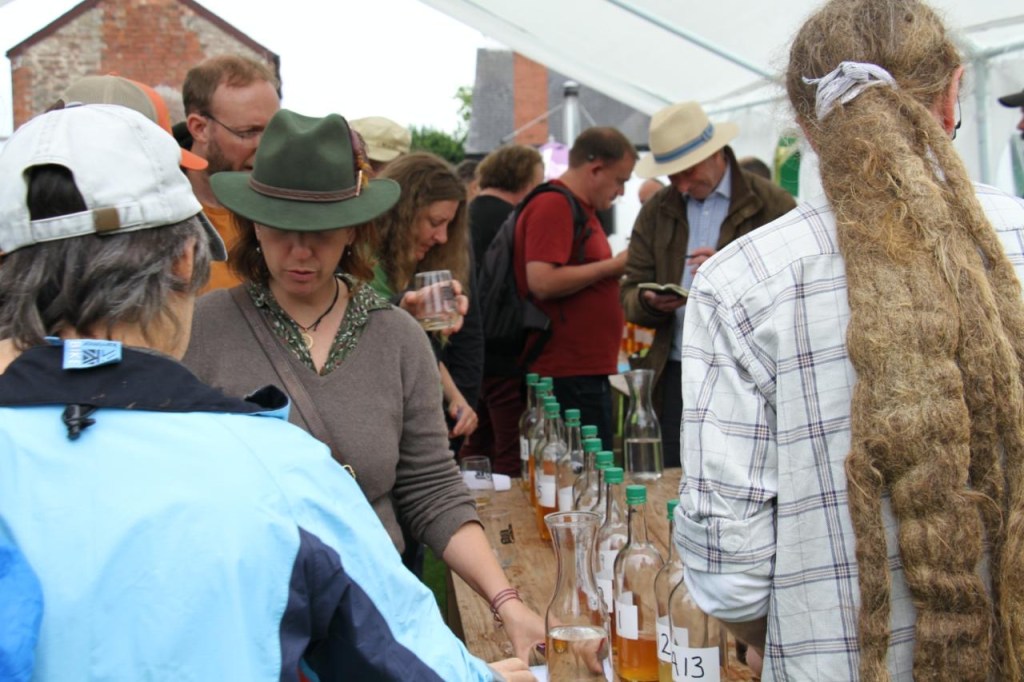
There are no points; each judge simply chooses a top four, if they are a maker, or a top three if they are a guest. (The additional choice from the makers is so that, should they pick their own cider or perry, accidentally or otherwise, it can be removed from their scores). Once the whistle goes, a scrum forms around the dry cider, a light smattering around each of the other tables, and two and a half hours of serious business commences.
This year, for the first time since I became involved, I wasn’t judging. When Dave and Fiona called time on their much-loved Bartestree Cider they also stepped back from the organisation and running of the Trials, and I offered to help take up some of the slack. This was, in part, to do one of my best friends a favour. It was also, I must admit, because I was sitting on a roasting-hot streak of having routinely picked a Ross-on-Wye in my top three across all categories over the last two years, and since everyone’s votes are published I’ve long been in almighty fear of the streak crashing to a public end and not being invited back. (As it happened Caroline carried the torch on my behalf this time – Ross was her favourite in four of the five categories she judged.)
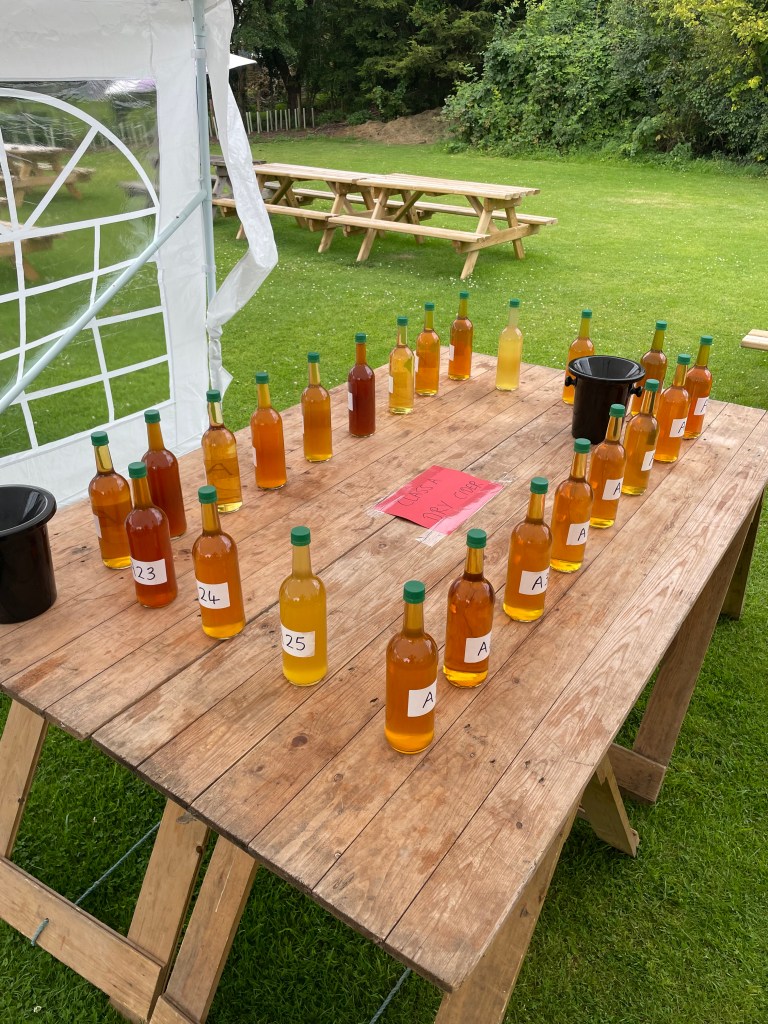
The judges take their voting slips and gradually through the warm blue afternoon mill their way around the emptying bottles, low contemplative murmurings harmonising with the buzz of wasp and bluebottle. Occasionally a colour will be remarked upon: ‘mm, quite dark, that’, ‘bit light for me that one.’ There’ll rarely be open praise for something really good – after all, it’s probably a rival’s – but every so often there’ll be a raising of eyebrows, a grimace, an ‘oh dear’ as something too far the naughty side of oxidised emerges, or a ‘watch out for bottle such-and-such’ when the spectre of mouse rears its head.
One of the many great things about the Trials is that it is open to all. Indeed everyone is actively encouraged to enter, and in fact there are people who I suspect make cider in no small part specifically to compete in the Yew Tree and the Big Apple. In the event room, where the bibs line two long tables that flank the space, the established names of cideries often lauded on this website – the Ross-on-Wyes, Little Pomonas, Olivers, Gregg’s Pits and Artistraws sit cheek by jowl with bibs simply labelled with the name of the person who made them. And indeed, the makers who don’t sell under a specific named brand are often numbered amongst those carrying off prizes at the end of the day. Alistair Smith, in particular, has seemingly annual form, especially in the perry category.

Nor are makers confined to the Three Counties. The aforementioned Alistair is an East Midlands maker, as is Luke from Monkey Bridge. There’s Blue Barrel over from Cambridgeshire and Phill Palmer over from Wales. Lincolnshire’s Chapel Sider and Leicestershire’s Charnwood aren’t here this year, but both have previous form. Elvet have come all the way down from Durham and valiantly entered cooker-eater ciders into what, it must be admitted, is a full-on tannin-fest. (They’re brilliant, incidentally, some of my picks of the competition, however the peers voted on the day.)
I am in shuttle mode. Within a few minutes the carafes of water are emptying and the spittoons are filling. Bottles quickly run down and need refilling, particularly on the dry cider table, but shortly thereafter on the medium cider and dry perry stands. (A good suggestion of who the frontrunners might be comes through the bottles that are finished first, whilst one or two others never find themselves more than about a quarter emptied.) As the afternoon progresses I am sent to hector judges for voting slips whilst Albert, confined to his laptop, is tallying the votes as fast as they come in.
All the while the beer garden is open and thronged with the Saturday crowd. Sun-seekers, cider-seekers, pizza’d to the nines by Yew Tree caterers Firebird, some heading to the bar but most calling in for draught competition entries as the charity till rattles along. Caught between marquee and event room, scrambling to figure out the card machine and grateful for the steady hands of more experienced volunteers I wonder if I’ve made the right choice abandoning my former judging post, and hope that my recommendations don’t turn out to be the bibs that come dead last…

At three o’clock I am instructed to call time and told to take a hard line against unreturned slips. Whilst votes are tallied and checked and certificates filled in with victorious calligraphy, the contestant judges find pews around the garden, seemingly far more relaxed than I would be in their shoes. Come to that, as the event room bib traffic increases exponentially with the competition’s conclusion, they’re far more relaxed than I am in my own shoes.
An hour or thereabouts later, the winners are announced. Ross-on-Wye themselves take champion perrymaker, with particularly approving glances cast towards their sweet Hellens Early (though my own preference is for their dry Gin blend, which I felt deserved more than the judges gave it). Dry cider is won by a record margin by Robin Bornoff, whilst Tom Oliver takes the medium perry. Phill Palmer of Palmer’s Upland Cyder takes overall Cider Champion for a barely-believable third year in a row, but this year shares the honour with Sam Everitt, with a first, second and third each respectively across sweet, medium and dry. The sparkling bib doesn’t take a certificate, but I have mentally bestowed upon it an honorary gong for chutzpah, and I hope it starts a trend for future years.
Announcement of the wins initiates a heavy run on the bibs, with everyone eager to taste the winners before they sell out. And the afternoon oozes slowly and sunnily into a low evening of cider, pizza, perry, more cider and a late mosey back to the barn where, a few more ciders later, I find myself once again in my mezzanine.
I’m not convinced that the Yew Tree Trials, or the similar Big Apple Trials, have any direct peer across the whole spectrum of drinks. Certainly they couldn’t exist in spirits – the idea of the world’s largest and most respected distilleries lining up against home-distilling amateurs in a free, peer-judged competition for charity would be risible even if amateur home-distillation was legal. Perhaps there exist small villages in France or Spain or Italy where small winemakers engage in some similar competition, but I doubt it resembles that which takes place every year in Peterstow. Certainly there is nothing in which the equivalents of Ross-on-Wye or Oliver’s or Little Pomona line up against and judge beside winemakers producing tiny amounts of their own expressions at home. Even homebrew competitions in beer aren’t quite the same; don’t have the same innocence and fundamentally essential camaraderie.
The interconnectedness – perhaps codependence – of aspirational cider and perrymakers is what separates them from makers of other larger, harder-edged, more cynical drinks. The understanding that whether they are making a hundred thousand litres sold on Cat in the Glass or by the Fine Cider Company, or whether it’s just a few bibs a year to keep an orchard relevant and enter into competition against a few mates, every producer at the Yew Tree Trials is a stick in the same fragile bundle.
Writing about cider and perry is an often lonely gig. I don’t even see fellow Cider Review contributors more than perhaps a few times a year. If we covered beer or spirits or wines, there would be organised tastings, London-centric events, launches, get-togethers. Occasionally, in stray, rogue moments of despondency and frustration, I peek across the parapet of social media at peers in other drinks and feel unworthy tweakings of envy. At the handful of cider events that dot the calendar I am aware of being one of the very few – sometimes only – people there who is not a maker. Even among the scribes of this website I am an odd duck; distinct as having never fermented an apple without supervision.
But what is remarkable – about cider in general, and the Yew Tree Trials in particular – is how little that matters. How normal it feels to be a lone writer among producers. How unaware of it I feel until I go home to start setting words to page. Because ours is not simply a world of PR events, press dinners, glitz and sheen. Increasingly it is showing that it can live and shine in such august environments, as Bea’s marvellous piece on the NorthWest Cider Awards proves. But at its heart aspirational cider is still a world of hand-scissored voting slips, of enthusiasts setting records in the dry cider category, of sticky labels on plastic bottles, of trestle table drinks with people you’ve never met whilst AGMs take place in on-the-grass circles beneath the hedge.
It is a world where amateur enthusiasts can chat to world-famous professionals and nervous bloggers and all may consider themselves equals. A world where we are all learning, trying things, exploring untrodden paths, making discoveries, getting things wrong, keeping something unlikely alive despite everything and coming together, whatever our role, to celebrate it all. A world where something can be at once both magic and life-changing and worthy of fine dining and aspirational prices, and drunk by crowds around picnic tables for £4 a pint to UNICEF. A world of peer-judged contests in sunlit pub gardens. Of bag-in-boxes that, against all logic, can sparkle.
Discover more from Cider Review
Subscribe to get the latest posts sent to your email.
 Cider Review
Always enjoy your articles, Adam, but really love this one.
LikeLike
Thanks so much Matt – so glad you liked it. Hope you can get over for the trials one year! Adam
LikeLike
Excellent article. It was a great day, and so friendly too.
LikeLike
Thanks Marcus. Looking forward to next year already. A.
LikeLike
Pingback: Ross-on-Wye Raison d’Être 2022 – on paradox and preference | Cider Review