Cast your mind back to March 2021, with the UK midway through the third lockdown of the pandemic and life best described as bleak. Among the gloom of furlough and social distancing, one of the few chinks of light is the growth of online tasting events, offering the chance to reconnect with the cider community and do what we do best- share great drinks in good company.
Little Pomona’s Zoom-based Some Like It Still event focussed on five new releases, all distinguished by their lack of carbonation. Hosted by James, Susanna and Blair, the event introduced the UK cider scene to Old Man & The Bee 2018, Netherwood Estate Reserve 2018, Solera Foxwhelp NV, Somerset Redstreak 2019 and the intriguingly named Orange Cider 2019.
Predictably, with the Forbes’ wine industry background central to their cider-making philosophy, the decision to name this release Orange Cider was a reference to skin-contact wines rather than anything to do with the colour, which to be fair, is a very much orange-adjacent hazy amber. James explains: “Some natural wines, usually orange wines get described by wine critics as tasting like cider, maybe that’s why I’ve long been a fan. We have plenty of ciders that are similar to orange wine and thus Orange Cider was born”.
Looking back at the post-event Instagram comments, the Solera Foxwhelp, another debutant cider that’s gone on to be an irregular highlight of the Litte Pomona release schedule, seemed to have edged it by a whisker for me, but after a night of tasting so many quality drinks it was tough to choose an outright favourite. However, the majority opinion seemed to be that Orange Cider was the winner on the night. In the words of Aeble’s Grant Hutchison – “I can’t see past the Orange. Just incredible”.
This first iteration began life as a blend of bittersweets Dabinett and Harry Masters Jersey with a tiny quantity of Gin pear, wild fermented in tank and transferred into a combination of Sauternes and Meursault barrels. Originally planned for use as Old Man and the Bee 2019, the tasting notes during its time in barrel suggested a cider with a character closer to that of orange wine and hey presto, Orange Cider moved from concept to reality. Described by Adam Wells in Cider Review as “An absolutely glorious fruit bomb” and making his shortlist for Little Pomona’s contribution to his 2021 Essential Case before narrowly losing out to their acclaimed On the Beech 2020, the future was beginning to look Orange.
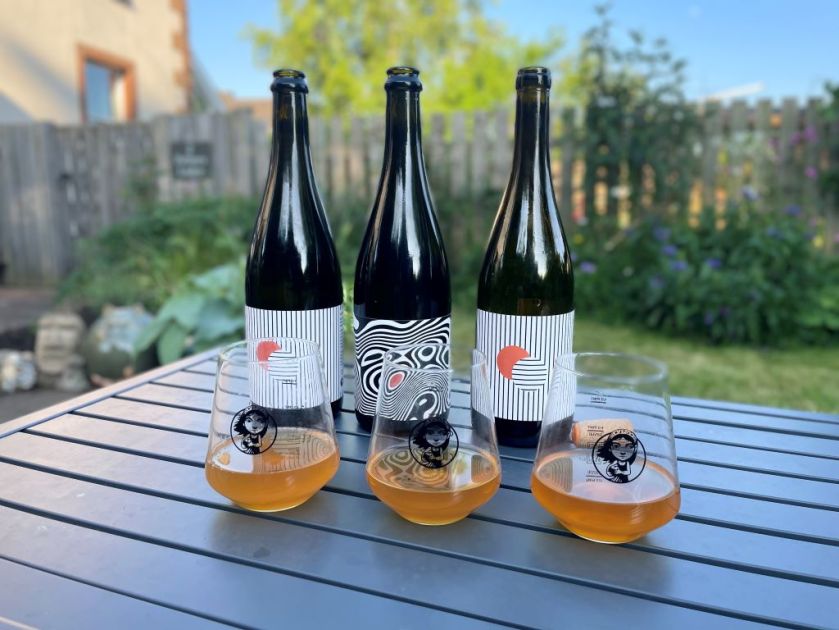
Fast forward to April 2022 and Orange Cider made a second appearance, this time leaving its neat pinstripe label behind to wear something I described at the time as a barcode on acid. Rather than replicating 2019’s approach, the follow up release was primarily Brown Snout, blended with Dabinett, wild fermented in tank, and aged in ex-brandy casks.

Remarkably, despite its differences in approach from the previous year, Orange Cider 2020 has far more in common than its predecessor than any drinker might expect. In James’ words “there’s an area of flavour, aroma, structure and mouthfeel where orange wine and still ciders made with bittersweet fruit meet and mingle” and this release was clearly evidence of that. Whether it’s down to its relative youth or the qualities of the fruit, the 2020 version brings more tropicality and juiciness, but the phenolic character, vinous mouthfeel and distinct flavour profile show a clear connection to Orange Cider 2019 and drew an equally enthusiastic reception from the cider community as well as lovers of natural wine.
After a two-year gap, during which time my Orange Cider stash came close to exhaustion, hints of a new release began to leak from Little Pomona HQ in March ’24 and the 2022 made a well-received debut at May’s London Cider Salon. Once again, a drink with its own unique journey from tree to bottle- this time 100% Bisquet sourced from Dragon Orchard, following the previous approach of wild fermentation in tank, but this time with a year in neutral oak prior to bottling.
Again, the same characteristics are there- if a thread runs through all these releases, it’s that combination of tropicality and ripe stone fruit against a smooth phenolic character. As in previous years, it’s a cider that rewards the leisurely drinker, increasing in complexity as it warms from fridge to room temperature and, as with so many bittersweet ciders, we kid ourselves if we think that anything other than room temperature shows them at their best.
As recent news stories have shown, the orchards supplying these precious bittersweet apples are under existential threat unless drinkers can be converted to the unique flavours they offer. These three releases from Little Pomona certainly aren’t the only ciders out there with a skin contact wine character but perhaps by marketing them in this way, they’ll pique the interest of natural wine drinkers and go some way to changing perceptions of cider. It won’t solve the problem on it’s own, but it can only be a step in the right direction.
The final word goes to Little Pomona’s James, who points out “What started as a semi-joke, has a very serious side and Orange Cider exists to make these points and show how delicious bittersweet apples can be”. Who can argue with that?

Orange Cider 2019 – 67% Dabinett, 31% Harry Masters Jersey, 2% Gin Pear
How I served: 30 mins out of fridge
Appearance: Still, hazy amber.
On the nose: Peach, nectarine, honeysuckle, vanilla. The barrel character’s there, but five years down the line, there’s still enough fruit to take the lead.
In the mouth: Fully dry with a gentle, slatey astringency. Orange pith, clove spice, peppery rocket and red apple skin.
In a nutshell: Despite its history as an Old Man and the Bee reject, this sits recognisably in Little Pomona long barrel maturation territory. Maybe OMATB’s shyer cousin, but still one with its own distinct identity. A great example of just how well cider can age. Pretty much unavailable in any bottle shop I’m aware of, but if you have any stashed away, you’re in for a treat.
Orange Cider 2020 – 90% Brown Snout, 10% Dabinett
How I served: 30 mins out of fridge
Appearance: Indistinguishable from 2019
On the nose: The most restrained nose of the three- orange, a trace of spirit and something floral- lavender maybe?
In the mouth: Forget the restraint, this is now a juice explosion! Chin dripping brandied peaches, mango and apricot. Juicy tropicality to the fore with 2019’s astringency traded for fruit.
In a nutshell: Choosing a favourite from these three isn’t easy but if I have to, this is it. The nose might offer a little less, but that super juicy stone fruit character is an absolute winner. An early three points in Albert at Ross’s campaign to take Brown Snout the top of the cider premiership next season. Whisper it, but there’s still a bit of this kicking around on the shelves if you know where to look.
Orange Cider 2022 – 100% Bisquet
How I served: 30 mins out of fridge
Appearance: A little brighter, a little less haze.
On the nose: Super aromatic- satsuma, nectarine, grape and yellow apple.
In the mouth: Unsurprisingly, the brightest and most youthful of the three. Ripe peach, melon and green apple- soft, young tannins and a trace of oak.
In a nutshell: Still early in its career, the nose sets expectations high, and it doesn’t disappoint on the palate. A cider that puts to lie any remaining argument that single varieties lack complexity. Tasting great right now, but the journey of Orange Cider 2019 and 2020 suggest it’s still to peak. One to enjoy now, but don’t forget to put some aside for years to come.
All photos by Ian Stott.
Discover more from Cider Review
Subscribe to get the latest posts sent to your email.
 Cider Review
Thanks very much for the article. A really interesting line up, which I’d love to try at some point. Great labels, too!
LikeLike
Thanks James- they’re as enjoyable as they are interesting! Hope you manage to track down a few bottles!
LikeLike
Pingback: Cool, cold & chilled. A temperate discussion | Cider Review