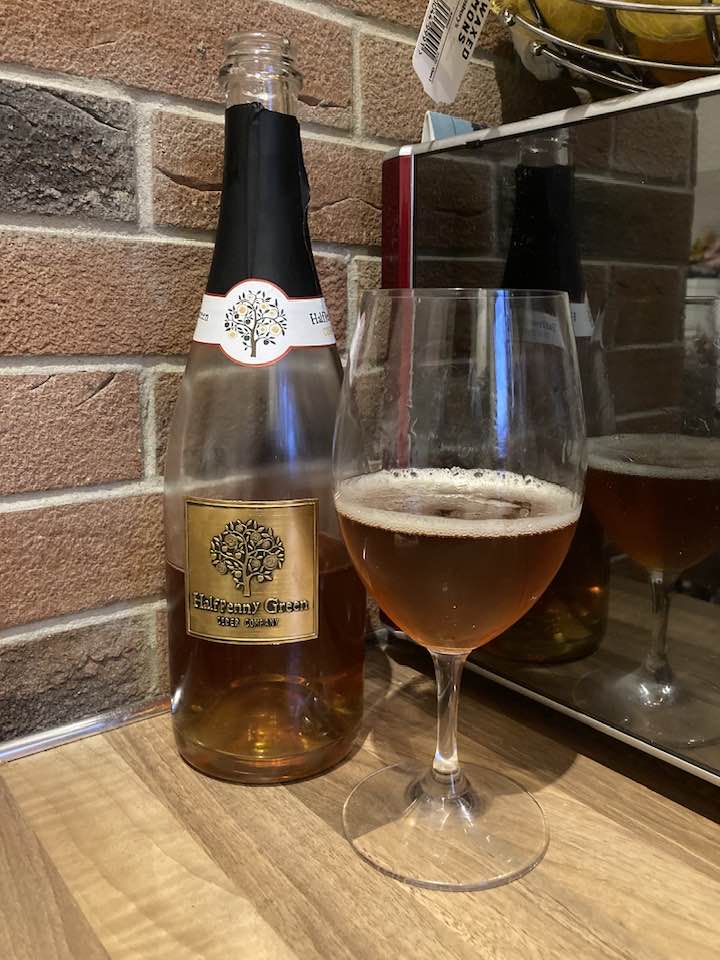
With Tony having passed, cider itself seems a little less fun. No, perhaps that’s not quite fair or right. It’s just that few makers have brought quite so much fun, so much originality, so much pure chutzpah to the making of cider as Tony Lovering did at Halfpenny Green.
One of my favourite stories, and one which perfectly encapsulates the unfathomable, marvellous curveball that was Tony’s approach was told to me by Albert Johnson. Tony had been telling him of a co-fermentation project he’d recently undertaken with damsons and apples. He had his damsons, a couple of tonnes of them, but he wasn’t interested in the stones. How to remove them?
‘Did you build a machine, Tony?’ Albert asked. Of course he did.
Of course Tony built a machine. A bespoke, home-made machine for removing the stones from damsons for a one-off co-fermentation project. It took him two weeks to build – knowing Tony it would have been made of something like duct tape, elastic bands and the repurposed guts of a tumble drier – and once he’d made it he had the stones out of those damsons inside an hour. I never found out whether he used the machine again, or what his co-fermentation tasted like, but I bet that he didn’t and I bet that it was delicious.
This sort of sheer why-not, can-do, sorry-you-did-what? joy suffuses Tony’s cidermaking legacy This is a man who built his own pressure tank so he could make charmat-method cider. Who built his own cross-flow filter system to clear up ciders without losing flavour and texture. Who made a mobile bar for dispensing keg-conditioned keeved cider. Who made keeved, pét nat ice cider, and when that wasn’t off the wall enough made dry, keeved ice cider traditional method. A man whose ciders could make you laugh – in exactly the right way – at the very idea of them.
I first properly met Tony a little over four years ago, when we found ourselves on the same ferry to Caen for CidrExpo 2020. I knew of him a little bit; I had tried one or two Halfpenny Greens by that stage, but I had written next to nothing on cider in those days, and besides a two-minute encounter at Ciderlands a few months previously he certainly didn’t know who I was, since nobody did. Nevertheless we spent almost all of the five hours-or-so channel crossing in conversation – more than enough time for me to understand just how original this maker’s mentality truly was.
An engineer by trade, Tony was always the ultimate rebuttal to the argument that the greatest ciders are made by minimal intervention; by ‘following the fruit’. In an interview we published a few years ago he explained his back-to-front approach; that he would consider what he wanted to make first, choosing apples accordingly, working with them as the ultimate aim demanded. What seemed to drive and fascinate him was the process; the hands-on-approach; the dreaming up of ideas and ways to execute them – considering not what he felt apples and ciders ‘should be’, but what they could be.
What’s more, in his hands, it worked. The awards roster speaks for itself. Reserve Champion British Cider at Bath and West. Champion Bottle Conditioned Cider at Putley. But Tony’s ciders weren’t simply made to tilt at trophies. They were, in the best possible sense of the term, crowdpleasers. Ciders with near-universal appeal. Tony had a rare care for his audience; as much as he was motivated by things he thought would be interesting to make, he always considered what people would like to drink. Not just died-in-the-wool cider nerds, but casual drinkers; anyone who might come upon his brand. Whilst his creations were almost invariably out-there in their conception, they were always infinitely accessible in their flavours; never niche, austere or challenging, and absolutely never faulty. It’s telling that of all the makers who showcase their wares at the Ross-on-Wye festival, he was the one that all of my friends, without exception, bought bottles from, and remembered when they returned to the festival the next year.
But they remembered him also for the way he engaged with them. Tony discussed his ciders with a rare enthusiasm and confidence, and his tone and content never changed, whoever he was speaking to, however far down the cider rabbit hole you were. He spoke to my friends in exactly the same way he spoke to me; explaining what he’d done and why, sharing his process, his excitement, his plans for future creations and adaptations. He was justly proud of his work and took every opportunity to showcase it. I remember him volunteering to do a shift on the bar at CidrExpo one afternoon. A few minutes later French cider lovers were being introduced to snuck-in Halfpenny Greens. I can’t remember a tasting we both attended when there wasn’t a box under the table or in the boot of his car; a pick-and-mix of the wild and wonderful, usually one-off bottlings the likes of which you would never taste from anyone else.
For all his individuality though, he had the humility to take inspiration wherever he saw it; to recognise what other makers and industries were doing well and adapt it into his own practice. Charmat ciders, inspired by prosecco’s popularity and accessibility. Cider Nouveau, with an eye on Beaujolais, bringing Little Pomona along with him. At CidrExpo his eye was as caught by Domfrontais perry as mine was; that season he set himself to make his own take on the style. Cider brandy before it took off among other small British makers. The first British fortified cider – as opposed to mistelle – I ever tried.
I never got to know him personally quite as well as I would have liked. That was my fault, not his; we didn’t meet quite often enough for the inherent awkwardnesses and anxieties I feel around all new people to fully fade away. Despite that, he would always seek me out, say hello, ask how I was and how the writing was going and share a selection of his new creations. And I hope he knew how highly I thought of him and what he made. Others will be able to write better, fuller tributes to who he was, but what I did know of him was his extraordinary bravery in the face of extreme adversity. To build his cidery back up in the wake of a devastating fire and make better ciders than ever before. To carry on making, creating, imagining, engaging with customers and cider lovers in the face of his battles with ill health. The outpouring of joy at the 2022 Ross-on-Wye festival when he had been cleared of his initial diagnosis was a testament to the esteem in which he was held by the whole cider community. I know that James and my other British peers on Cider Review felt just the same way.
I often place the ‘soul of cider’ in trees, in orchards, in apples and in the cycle of vintage that binds them. Tony and his work at Halfpenny Green, his cidermaking feats of pure imagination, stand as a reminder that these things, romantic and vital as they are, are ultimately hollow without the people who bring them to life; who infuse them with meaning and value and occasionally, if we are lucky, garland them with joy.
There is no one else I know of in the world of cider like Tony Lovering, nor any equivalent I can think of in any other branch of the drinks industry. Every maker is unique, but very few are absolute originals. Tony Lovering was one of them, and his legacy will be one of joy to all of us lucky enough to have known him.
Discover more from Cider Review
Subscribe to get the latest posts sent to your email.
 Cider Review
Very well said.
LikeLike
Cheers Wayne. He deserves much more.
LikeLike
Wonderful words to describe an irreplaceable human being
LikeLike
A legend. I’ll miss him whenever makers gather.
LikeLike