‘De gustibus non est disputandem’ – ‘in matters of taste there can be no dispute’ – is very much the sentence of someone who never encountered the internet.
I’ve been rattling thoughts and tasting notes around the digital hallways of online drinks discourse for knocking on nine years now, and let me tell you that across that time no end of people have popped up to disputandem my gustibus. Fewer, perhaps, in cider than there were in whisky, where the wrong opinion on this or that distillery is virtually public-hanging territory, but in its ornery way, individual taste is wielded every bit as belligerently amongst the apple-bothering set.
As an anxious man with a deep-seated fear of being wrong and a difficulty expressing myself quite as I want or intend to without the benefit of a private room and a keyboard with which to declutter my thoughts, I absolutely get it. Taste is personal. It is the proof we offer of choice and discernment and is integral to one’s identity, especially in a world like drinks, where it takes on an added layer of importance. Without so-called ‘good taste’, how can you make good drinks? Without ‘good taste’, how can you be a trusted and reliable source of information? And, of course, the longer one loiters around any given organoleptic field, the more rooted, immovable and sacrosanct one tends to hold one’s personal set of preferences. And the more concerning and potentially damaging any challenge to the perceived merit of those preferences becomes.
It’s worth noting that over the muddy field of preference is spread quite a broad marquee of consensus. Within the cider community, for instance, most people wouldn’t object to the contention that, say, Find & Foster or Little Pomona or Ross-on-Wye make some good stuff. We might enjoy different expressions from those makers more or less, but basically we think they’re pretty solid producers. Similarly, though certainly not ubiquitously, most people would agree when something is really, truly, undrinkably bad. Moreover, I’d hazard a guess that, were we to actually all sit down in person in a normal scenario with a few bottles, give or take a little strength of reaction, we’d be far closer than we might expect on the majority of what we’d taste.
But our differences are important, valid, and don’t necessarily follow an obvious pattern. Take me: my favourite two apples are on record as being Foxwhelp and Yarlington Mill, two varieties that occupy almost entirely different ends of the flavour spectrum, with perhaps the only commonality being that they are both big, statement-making flavours. The overwhelming majority of what I gravitate to for regular drinking is completely dry – but the cider I’ve publicly rated my all-time favourite is one of the sweetest I’ve ever tasted. I love many ciders and perries that revel solely in the flavours of the fruit from which they were pressed just as much as I love many ciders that have been aged in oak. Preferences are not narrow nor necessarily permanent, palates contain multitudes and people are not one-dimensional robots.
Whilst I’m here, it’s worth discussing the subjects of flaws or faults. On the one hand, you might tell me that these are relatively fixed; if something has mouse, for instance, it has mouse. But again, I think it is in fact a little less plain and simple than is sometimes made out. Mouse, for instance, is something that almost half of tasters don’t experience whatsoever – not from any lack of palate on their part, but merely from genetics. I’m one of the ones who does pick it up, and last year I tasted a perry which I couldn’t drink because of it. At the same time it was made by a producer whose palate is certainly better than mine, and the bottling in particular received rave reviews wherever I saw it. If you’re not impacted by mouse, it was plainly fantastic. If you are, it’s an unmitigatable fault.
Mouse, of course, is a genetic issue rather than a matter of taste, so here’s another consideration. Within the large group of people whose opinions on cider I absolutely value and trust, there are those to whom the merest hint of volatile acidity is an absolute straight red card, but whose tolerance for H2S is pretty generous. And of course there are those for whom the reverse is true. Brettanomyces is, to some tasters, an absolute no go, but I dare say I’ve had a few ciders – and certainly several wines and beers – that absolutely had more to say, and in (to my taste) a positive way because of it. And of course a binary approach to ‘faults’ suggests that all volatile ciders, or all ciders with H2S, or all ciders with brettanomyces taste of just one thing, which plainly is not the case unless they are heavily infected indeed. Sometimes I write notes here for such ciders and rarely is ‘volatile’ or ‘sulphur’ the start and end of their character. As Barry beautifully put it in his article on mercaptans, ‘the dose makes the poison,’ a metaphor I would extend by remarking that some peoples’ immunity is better than others. My own world of flavour and preference and faults and simply ‘I like how this thing tastes, however it’s been made, whatever from and whatever has happened’ is too vast and unfathomable for me to comprehend, never mind wondering why anyone else likes or dislikes the things they do. (With the caveat that volatile and sulphury ciders still generally aren’t for me!)
I’ve recently been thinking more specifically about the ways that drinkers occasionally have to wrangle some form of consensus from this self-evidently subjective matter. Judging season is rapidly upon us, with CiderWorld having come and gone and the ICC and the Yew Tree Trials already in my diary. At these events, none of which, incidentally, is run in exactly the same way, a panel of judges must reach some consensus on what they think is poor, what they think is good, what they think is better and what they think is best.
Naturally, whatever the system, there won’t be absolute consensus on any of these four categories, which is why an overall points system is used at the Yew Tree, and why table captains play a vital role in mediating discussion at the ICC and making sure decisions are reached in a reasoned and democratic way with which all judges are comfortable. As for the manner of tasting, it’s certainly not a long, stream-of-consicousness-style tasting note, such as I might pen for cider review. Rather it is a focussed, concentrated form, in which I simply decide whether and how much I like any given cider and why before discussing my results with other judges.
Then there are Systematic Approach to Tasting (SAT) exams, which I’ve previously written on here, and which I’ve unexpectedly re-encountered, since I took my Pommelier exam, previously an American qualification, now rolled out globally, last Saturday. These exams – and the American Cider Association Certified Pommelier programme is openly inspired by and extremely similar to the WSET’s SAT – are designed to purge you of preference in your writing of a tasting note. To judge a drink as objectively as is humanly possible: colour, depth and clarity of colour, intensity of aroma, a small handful of aroma characteristics, levels of body, sugar, acidity, tannin, flavour intensity. A handful of flavour notes, length of finish. Followed by a few notes on the quality of this drink based on the notes already made. Fundamentally, it is an attempt to get us all singing from a common hymnsheet. It’s not a system I’d use day to day for personal notes, nor a system entirely without flaw, but (in my opinion) it’s the best that currently exists for what it does.
In short, there are many ways we can taste, many directions that our tastes can take us in and many reasons, both personal and imposed, for all of the above. And that’s before we talk about the undue influence that can be exerted by someone loudly and confidently asserting that some drink or other definitely tastes like xyz or definitely has abc quality. A scenario I struggle with all the more because, as mentioned, it takes me time to compose and then order my thoughts on how anything tastes. Realising that the force and confidence with which someone imposes their notes upon you is no guarantee of the merits of those notes was a great relief – but not one that helps you in the moment.
One of the most difficult and persistent sources of disagreement in taste regarding cider and perry comes from the sweetness level of any given expression. I recently wrote (briefly) on styles of cider for Drinks Retailing, to which the response from one reader was that he didn’t care about any of that, he just wanted to know whether a cider was dry or not, and that he was fed up with ciders that said ‘dry’ on their labels not being ‘dry’ to his palate. It’s a complaint I’ve often heard before, and I agree that it can be irritating.
‘What is dry?’ is an oddly vexed question. Some people, very reasonably, would say ‘obviously it’s when all sugars have been fermented into alcohol.’ I suppose that’s more or less where I’d fall myself, but it’s far from a universal position. Indeed some cultures have a remarkably broad definition; in champagne a dosage of up to 12 grams per litre of sugar still counts as ‘brut’ – dry. In French, Norwegian and Quebecois cider the allowance is even more generous – up to 30 g/l in the case of Quebec, depending on whether the cider is sparkling or not. Plainly, these aren’t ciders that would pass muster for ‘dry’ on, say, Broome Farm.
An added difficulty is the weird phenomenon of the British palate, which tends to talk drier than it actually wants to drink. The problem is that ‘dry’ sounds somehow more grown up, more discerning, and so people ask for it. But in practice, given a selection of drinks without their labels, the majority will skew towards sweeter examples. The situation becomes more convoluted given the number of people who conflate dryness with tannin and astringency. I’ve often seen people reject definitively sweet ciders on the basis of being ‘too dry’ because of their level of bitterness. Returning to my article of the other week, clearly explaining on labels what to expect from a drink – in terms of tannin as well as sugar – is the key. After all, most people don’t even know what ‘tannin’ actually is.
Ultimately, I’m not sure there’s any way to perfectly navigate preference. And perhaps there shouldn’t be. People are muddled and complicated and don’t really fall into neat order; why should our tastes be any different? All that producers can do is be as clear as possible about what their cider or perry is; what its flavours and textures are, where they come from – why it tastes as it does. Disclosure and transparency on labels; as much detail as can be shared, as accurately as possible. And then if we still don’t like it, it’s very much our problem.
***
One producer whose transparency is increasingly unimpeachable is Herefordshire’s Artistraw. (How’s that for a tenuous segue?) They’ve long been a favourite here on Cider Review, with their range of natural, full-juice ciders playing around with various varieties, often little-seen Herefordshire apples.
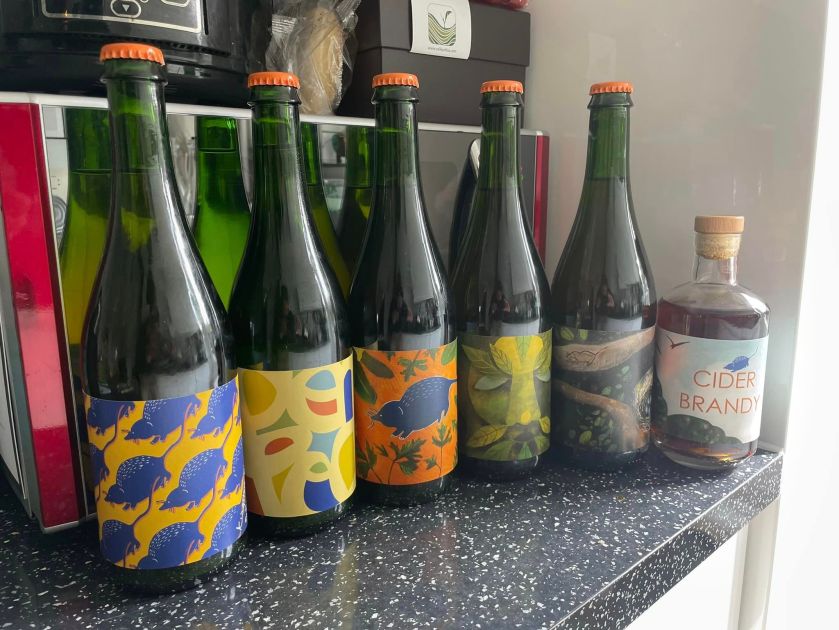
Whilst the labels have always been gorgeous, thanks to an in-house artist in the shape of Lydia (I still can’t believe she makes her own paints), there has been a clear evolution across the last few years; a sense, perhaps, of them finding a distinct identity. The labels of old, I remember, tended in a ‘colourful, and with shrews’ direction, but rodents aside there wasn’t perhaps a theme. These days their labels have become a key brand indicator; a visual asset that taps into their strong environmental convictions and work and the connection with nature and the seasons that they look to extol through their ciders and perries.
More pertinently, to this article, the amount the labels share about the cider or perry has increased severalfold. We see sweetness level down to the grams per litre, we see the names of varieties, even where a given variety only represents a small percentage of the blend. There are descriptions of the making, recommended food pairings, pointers as to the likely flavours. They’ve even started recommending serving temperatures on the label, as opposed to the slightly scary ‘warning, this must be chilled’ stickers that once adorned the bottle tops of expressions they felt might be a bit lively. (Though, full disclosure, Lydia admitted that she forgot to put serving temperature suggestions on the bottles besides the Kingston Black, below). And of course, led once again by their environmental conscientiousness, the carbon emissions involved in every bottle are fully disclosed too.
The importance of sharing this level of detail simply cannot be overstated. It’s easy to forget, in this bubble of ours, that most people aren’t familiar with the flavours and structures of full-juice cider – least of all full-juice bittersweet cider. Even within the bubble, there is so little (read: absolutely no) regulation of sweetness levels that words like ‘dry’ and ‘medium’ in and of themselves are rendered all but meaningless. The normalisation of detail sharing opens up our world of flavour; moves us forwards from the days of merely sweet-medium-dry, and generic terms like ‘west country style’ or ‘eastern counties style’, which homogenise our hundreds of apples and their thousands of flavour combinations into two hopelessly generic blobs.
If cider drinkers are to become auto-didactic – and the availability of information makes that so much easier than it was even six years ago – these are the sorts of labels and the levels of detail that must become commonplace. Labels that separate the likes of Artistraw from the likes of Inch’s, now a meaningless Heineken brand, that incongruously tattles its alleged local and environmental credentials, even as its owners ship in concentrate from everywhere in the world and then cut down 300-acre orchards citing a fall in demand for cider.
Anyway. Enough of Heineken and their skulduggery. Let’s drink some ciders (and a perry! and a cider brandy, Good Lord!) that give us hope for the world, for our drink and for the great fruits behind it.
Bottles are all available from Artistraw directly, as well as The Cat in the Glass (other than the brandy) and I dare say a couple of places besides. Full disclosure, mine were all samples sent to me by the cidery. It doesn’t affect my rating of them, but reviewers ought to be transparent too.
We’ll start with the perry, a blend of three marvellous varieties, Thorn, Blakeney Red and Winnal’s Longdon, aged for an impressive almost-four years and released in tribute to the perry pear trees absurdly felled by Herefordshire Council because they attracted wasps on a road called *checks notes* Pear Tree Close.

Artistraw Pears for your Heirs 2020 – review
How I served: Lightly chilled
Appearance: Delicately hazy sparkling lemon green
On the nose: Instantly a ‘walk in the countryside’ perry. Gunflint and hedgerow; limeskin and elderflower and white blossom. Varieties all very integrated – hard to see where one begins and the next ends. Thorn *maybe* has the aromatic lead, as I guess you’d expect, but it’s a very satisfying whole. And actually rather Ross-on-Wye-ish, somehow.
In the mouth: Also Ross-ish on delivery; that slatey, leafy, outdoorsy cut-grass tones, offset by white florals and energised with a squeeze of lime. The Blakeney Red has given it a nice middle too; some softness of body countering the Thorn’s edge. Beautifully balanced, more or less dry, harmonious, elegant.
In a nutshell: Possibly my favourite Artistraw perry to date. Treat as you would a lovely, mineral white wine. Grown-up stuff.
Onto the ciders now, beginning with the new vintage of what has become an Artistraw staple: their sweet Kingston Black. They’ve made a couple of vintages now, most recently prompting this interview of late 2022, and their case for Kingston making a compelling sweet cider – that acidity, that tropical fruit, the lovely vinous body – is a compelling one. Indeed they’ve been my primary source of reliable Kingston Black of any sweetness level for the last couple of years now, so much so that it’s becoming a bit of a signature dish. I’d love them to bottle one a bit drier too – but is that churlish when their sweet does so well?
Let’s see what I reckon of this 2022 vintage before we draw any conclusions.
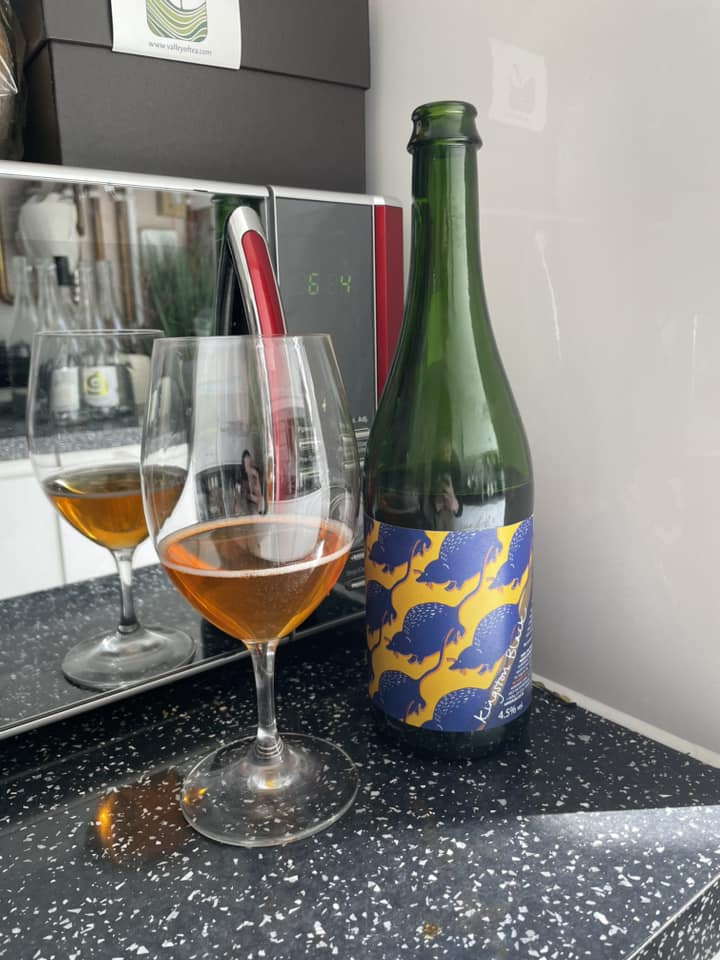
Artistraw Kingston Black 2022 – review
How I served: Chilled, per label’s recommendation
Appearance: Hazy copper. Says ‘still’ on the label, but definitely some fizz here
On the nose: This is the tricky thing about bottling natural cider sweet. A few tricksy yeasts have slipped the filter and some fermentation has continued. There’s a little sulphur on the nose here. Not much, but it’s definitely still resolving. I’d give your bottle a few months to sort itself out. That aside, some beautiful, ripe fruit going on here: classic KB tones of red apple, apricot, ginger and tropical fruits. It’s already cracking, barring the whiff of sulphur, and it’ll improve too.
In the mouth: Even better, if anything. The touch of sulphur isn’t presenting and it has that lovely in-mouth perfume of big apple, orange, apricot and more ginger and sweet spices. I don’t mind the fizz personally; it gives everything lift and energy, though the beautiful acid and integrated tannin don’t necessarily need it. Sweet, but a tad drier than expected.
In a nutshell: A full, vinous, textured Kingston Black that just needs a few months for its fermentation to fully resolve. Just isn’t still!
Since penning my notes I’ve discovered that the label wasn’t supposed to say ‘still’ and that it is, definitely, intended to be a pét nat. The note still stands though – give it a couple of months if you can.
Time for bittersweets? Time for bittersweets. We continue to bang the drum for these peerless, treasured, irreplaceable fruits, even as Heineken send in the fellers to hack them down by the hundreds of acres like the contemptible, soulless conglomerate they are.
Intriguingly, all the ciders in this lineup (including the KB) came from the same individual orchard: Jury, one of Artistraw’s favourites. So although they’re very different blends, perhaps we can spot a line of DNA threading through them. Or perhaps I can at least kid myself that I can, anyway.
First on the menu is Dandelion Shrews 2022. 2022, remember, was a mighty vintage. A scorcher, with sugars and tannins off the charts. So these full-juice, bittersweet-led ciders are still likely on the young side. Dandelion Shrews boasts a couple of my favourites; a blend of Brown Snout, Lambrook Pippin, Yarlington Mill, Tremlett’s Bitter and Ellis Bitter. One of the sweeter offerings in today’s selection at 32 g/l residual sugar, this one was bottled pét nat and says so on the label too!
Artistraw Dandelion Shrews 2022 – review
How I served: Room temperature.
Appearance: Rich fizzy bronze
On the nose: Oh here we go, this is your old-school Artistraw, Normandy-inspired, gluttonous, gastronomic, big ol’, sweet ol’ bittersweet blockbuster. Oranges pulped and stewed for marmalade, spiced toffee apple, barnyard and leather. Cloves. A big, brash, burly bittersweet nose that I’m personally very much here for.
In the mouth: Yes, we’re parler-ing Français here and no messing about. A rollicking, mouthfilling, greedy, irresistible rumble of deep, orangey fruit, sugar and tannin. Quite young tannin, being picky – rather a drying, slightly paracetamol finish (hey there Tremlett’s and Ellis!) But overall it’s a marvellous, structural, great fun mouthful of juicy, spicy bittersweet. Just wants a bit of time.
In a nutshell: A style many seem to be moving away from, but one I love when it’s executed as well as this. A little astringent just for now. Squirrel away for a year or so if you can, or have it with food.
Next up is a bottling named after the eponymous orchard. Jury’s a notch or two drier, down to just 14.5 g/l, but is another pét nat – this time of Medaille d’Or, Maréchal and Strawberry Norman, three apples with which I have only faint acquaintance. (There’s only one of me, for heaven’s sake).
Artistraw Jury 2022 – review
How I served: Room temperature
Appearance: A glowing, rich orange. Bright mousse
On the nose: A lustrous bittersweet aroma, that, beaming with red fruits – apple skins, dried cranberry, Sicilian blood orange (the bloodiest, I’m told) and a rich, woody, cinnamon-nutmeg double-twang. Polished leather and spiced apple juice. There’s a tiny touch of fermentation still on this one, too, so give it a few months if you can bear to.
In the mouth: It’s full, it’s rich, it’s loaded with orange and mango and red apple and… and… and… my strewth that’s a tannic finish. Some serious pith here: approach armed with cheddar or meat, and ideally not until the year ends with at least a 5. Awesome fruit, huge flavours, tonnes going on, years of life ahead of it, but this is *very* young. Food or time to unlock its potential.
In a nutshell: This is an epic cider, bursting with orchard or vintage, but in the very first flush of its infancy. The cider equivalent of drinking En Primeur Bordeaux at this stage.
Last of our bittersweet trio is Eadric Silvaticus, named for the folk hero who apparently pestered William the Conqueror slightly around the Herefordshire marches. This one is 8 g/l sugar, so more or less dry by all but the most stringent measures and blends three cracking (and slightly less tannic) apples in Bisquet, Yarlington and Foxwhelp. We’re also a year older here; a 2021 vintage, which was additionally much less hot than 2022. Let’s see the difference that makes.
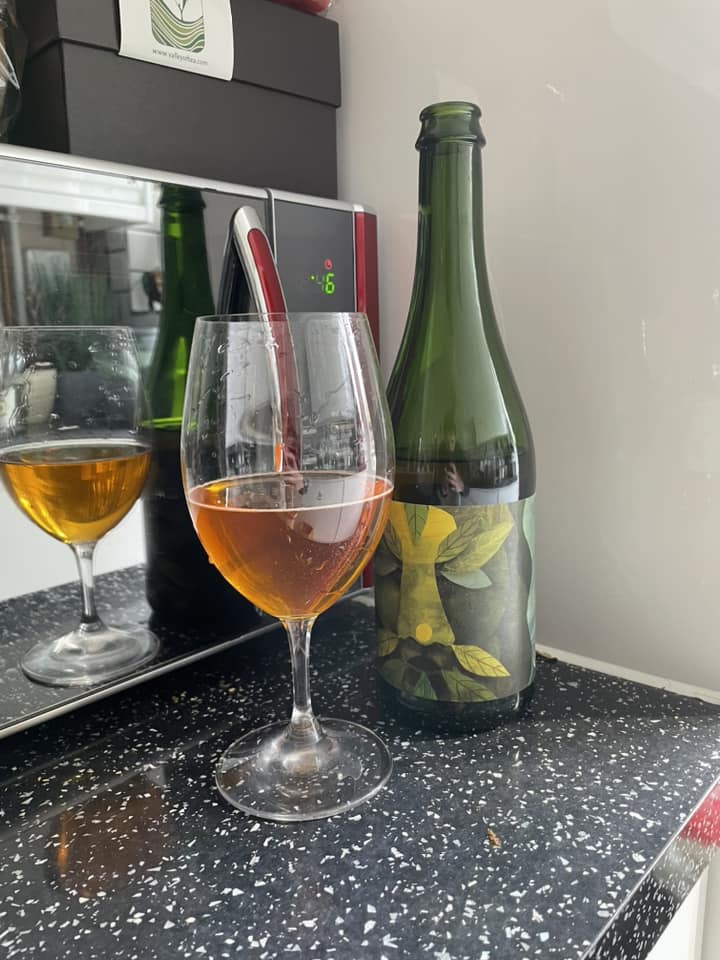
Artistraw Eadric Silvaticus 2021 – review
How I served: Room temperature
Appearance: Lord of the Rings letters. Bright mousse.
On the nose: Mellower, yellower aromatics; lemons, sun-warmed, pulp and skin. Warm hay, beeswax and some savoury spice. Despite just a year’s difference it’s noticeably more settled and savoury and fully-integrated than its predecessors. Complex and layered. Cracking stuff.
In the mouth: They’ve a very tannic palate at Artistraw. Firm, structured delivery, brightened up by Foxwhelp. Again the flavours are golds and yellows, rinds and waxes, spiced citrus, wet slate, hay. As it sits in the glass, those savoury tones crack open, revealing layers of tropical mango. Funnily enough, the trio of these apples has reminded me a little of aged Harry Masters’ Jersey. Very close to dry.
In a nutshell: This is a more cerebral, complex, savoury style of cider for unpicking slowly, with a meal. Super compelling. Again one that will age beautifully if you let it.
Finishing with a cider brandy? Well ok then. I really must dig into cider brandy properly one of these days, especially since half of Herefordshire seem to be at it currently. This one has been distilled for Artistraw and from their cider by Ludlow Distillery. Double distilled in copper pot stills (the only way worth distilling – I joke, I joke) and then aged in French oak for six months (so this is very young indeed). Bottled at the commonplace but somewhat disappointing (if I’m allowed to nitpick) strength of 40% – below the stage where the natural fatty oils that contribute texture and flavour remain unbroken. A shame for small-batch, carefully-made things like this. But that’s just my take, and perhaps a slightly biased one.
Bottles don’t seem to be available on Artistraw’s website, but I understand you can buy them directly from the cidery. Maybe pop them an email.

Artistraw Cider Brandy – review
How I served: Room temperature, warmed in my hands
Appearance: Mahogany
On the nose: The natural colour suggested it and the nose confirms it; there’s a lot of spicy oak here. Toast and clove and pepper and ground nutmeg from those French staves. Extraction has taken place, but not been tempered by evaporation or oxidation. Some nice spirit characteristics though – lovely, clear fresh and baked apple studded with sultana, mingling amidst all that spice. A big nose. Lots happening, in a youthful, shouty way.
In the mouth: Considering the strength that’s a surprisingly full, textural, oily, unctuous delivery. No spikiness at all, just the spices from the oak and a nice, clear, almost creamy apple and dried fruit character. There’s lots of loud flavours that I like a lot going on here, buoyed by a texture that feels less dilute than a lot of Calvados I try. They’ll knit into a slightly more harmonious whole given a longer spell in cask, but I actually like this a lot for what it is. Yes, it’s big oak – too much for some I dare say – but it’s pretty big spirit too. I like it.
In a (slightly larger than usual) nutshell: A very nice first apple brandy from Artistraw, albeit a somewhat oak-forward style of the sort seen at many a new craft whisky distillery these days. Would I also like to try a longer-aged, higher-strength version? Certainly. But personally there is room for both styles in my life, just as my whisky collection cheerfully includes both Bimber and long-aged, near-belligerently spirit-driven old stuff. Distillers, perhaps even more than cidermakers, often seem to me to be immovably wedded to a single style, to the point of attesting all others to be ‘wrong’. But there is room in my world for multitudes, and there is certainly room in my bottle cupboard for apple brandies like this.
Conclusions
What I love (well, one of the many things I love) about Artistraw’s outturns is how marvellously varied they are. Six utterly different bottlings here, all with their own flavours and textures, all absolutely firing with character.
Other than the perry, which is very much the shirt-tucked in, sensible bottling of the bunch, this is a no-holds-barred blockbuster outturn. No messing around here; a boisterous barrage of fruit and structure. I’m here for them all, I can recommend them all – but if I were you I wouldn’t drink them straight away, and if I did, I’d be drinking them alongside some gutsy, rich and hearty food. (Other than the KB, which is delicious on its own, but as mentioned could do with a few months for the last of its fermentation to dissipate).
These are very much the type of ciders that keep me at the keyboard. Ciders that should be aged. Ciders that should be drunk as part of a meal; as part of a whole gastronomic ecosystem. Ciders that speak unashamedly of their place and fruit. Ciders with stuffing and soul. Ciders with an endless, fascinating story to tell made by people who want that story to be wholly known.
Discover more from Cider Review
Subscribe to get the latest posts sent to your email.
 Cider Review
Thanks for this Adam, it’s an important topic and a very thought provoking read. I’d say one of my favourite articles you’ve written and that’s saying something given how many great ones they are.
I’ve often worried that what I’m smelling/tasting is ‘wrong’ as it doesn’t fully line up with published materials but it’s such a subjective topic and I’m becoming more comfortable with the difference as my cider (and perry) journey progresses.
I’ve only tried the Dandelion Shrews from the latest Artistraw outturn (I wasn’t aware Lydia made her own paints!) and it presented slightly different for me. It was more green citrus, soft leather and warm hay on the nose and honey, grapefruit, fig and lanolin in the mouth. Very much the same ballpark as your experience but slightly different and that’s part of the excitement. Also a great way to spark conversations, that would no doubt last long into an evening.
LikeLiked by 1 person