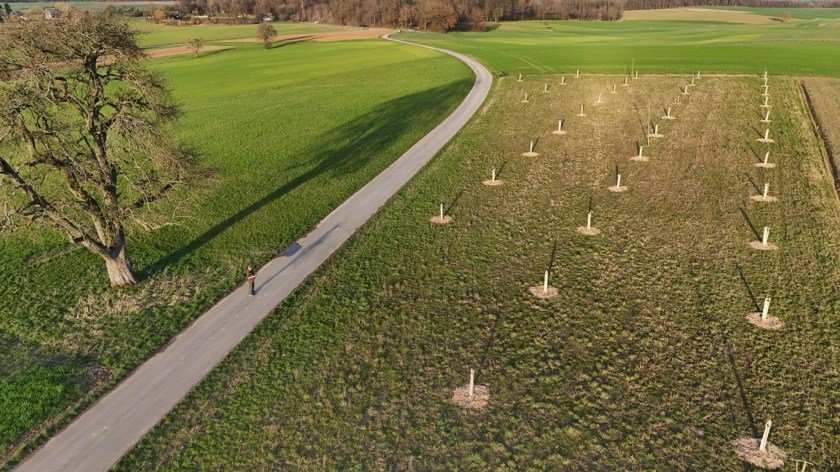
Please forgive me this self indulgence. I did something recently. Something that gives me quiet pride. But also a great sense of worry, wondering if I’ve done the right thing. You see, I planted an orchard. Not just any old kind of orchard of course. I wanted to create an old fashioned, traditional German meadow orchard. Oh, and dedicated to rare, endangered or culturally significant perry pear trees from across Europe.
What drives a person to do something like that?
For me, it began with Flakey Bark. A kind of poster child for rare pears, though believe it or not, there are rarer varieties than that one that was rediscovered by Charles Martell while driving a horse and cart through the Herefordshire countryside. Six known mature trees. Six. Though there are a couple of young trees at the National Perry Pear Centre at Hartpury, Gloucestershire. And now there are two more, planted in a field in Schefflenz, Germany. If it wasn’t for the Ross-on-Wye Cider and Perry Company, we’d likely never have heard of it. Begging the question, what drives a maker to seek out those trees and varieties on the edge of disappearance and make something sublime from their fruit?
We can add Tom Oliver to that list, with the single Coppy tree from which he made perry in the years it carried fruit. Tom reckons there are probably more out there, waiting to be identified, but again, the National Perry Pear Centre has a back-up Coppy, just in case, as does Tom himself, and I believe Butford Organics too. And so do I.
It was three years and four months ago that the idea started. On the advice of Ross-on-Wye’s Albert Johnson I’d contacted Jim Chapman at the NPPC to see if I could possibly get some Flakey Bark scions to graft. Just to spread the risk. A conversation that, incidentally, also began the Quest for the Turgovian Pear. But while we were at it, I added to the shopping list, specifically trying to get everything that Daniel Colwall mentioned as being the very best pears for making perry, in his supplement to John Evelyn’s Pomona back in 1664. I was looking for Red Squash, Harpary Green, Lullam Pear, Barland, White Horse, Red Horse. Some don’t exist anymore. Some have changed their name. It happens with a living language. But perry fans will recognise some of the old names. We did an exchange, and the varieties I was able to receive from Jim were all grafted almost exactly three years ago. They weren’t alone though. I sought out Swiss, German and Austrian varieties too. The French proved harder to source.

The following year it was more. This time I used Martell’s Pears of Gloucestershire and Perry Pears of the Three Counties as a shopping list, shortlisting the varieties defined as rare or critically endangered. It was a depressingly long list, though exciting.
The year after that it was Luckwill and Pollard’s Perry Pears book from 1963 that was my lodestone, leading me to varieties that were indicated as making very good or excellent perry. I mean, I also wanted to get something out of all this in the end! If I live long enough.
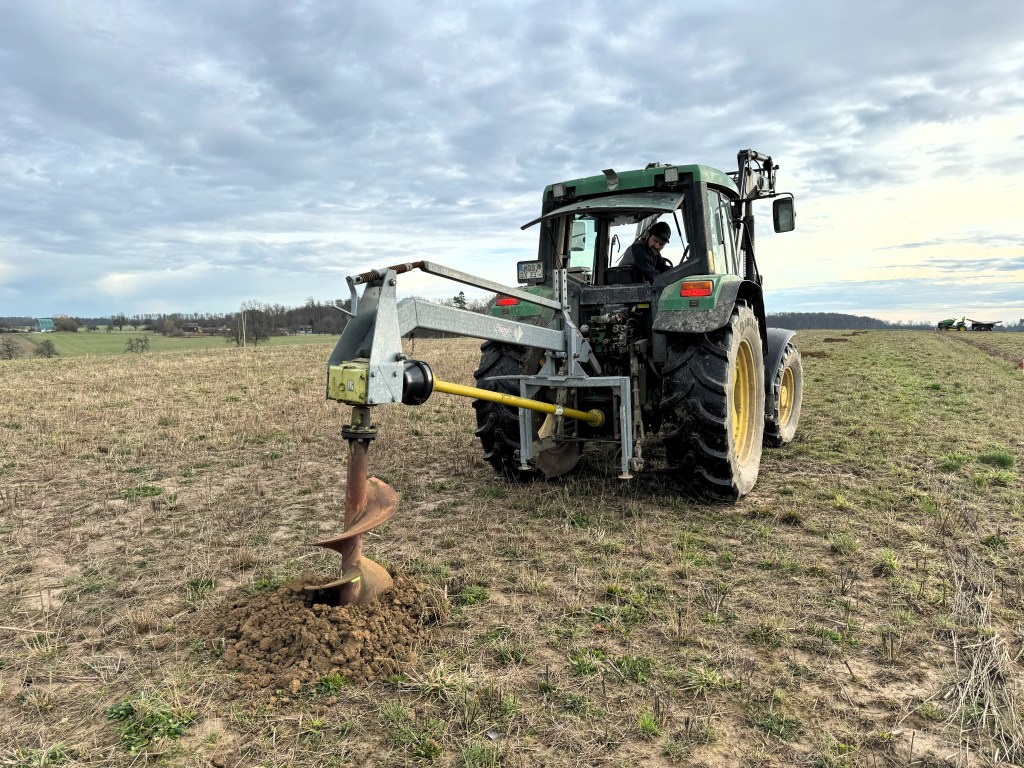
By that stage I’d grafted over 300 trees. This year I planted the first of the them in their final home, and now I’m worried about them.
So, again, what drives a person to do such a thing? Conservation of a disappearing heritage? Preservation of a valuable gene pool? Hoping for a rediscovery of a drink that hasn’t been tasted in a couple of centuries? A little touch of hubris? A bit of all of the above, if I’m honest. But as a perry drinker, like you, I wanted to be able to taste the drinks made by these pears. We all have stake in this game, somehow.
That first selection got planted two years after we sowed a certified flowering meadow mix on the field. A field we bought with the help of very generous sponsors. We could not have done it in the way we wanted without that help. The meadow is an important part of the overall concept. But it’s struggling. It was expensive, but the rains don’t come in summer anymore. Even I, only at this fruit thing for, well, coming on to 14 years since my interest was awoken, even I notice the change.

And that’s what worries me. With the changes in climate come more challenging extremes of weather, but also diseases. Either new ones or ones that were already there, but kept in check by generous weather patterns.
Are these old varieties capable of dealing with these changes? Is it all wishful thinking? Will it all be for nothing?
I’ve picked up Andy Brennan’s book again. Uncultivated. I’m on a long-haul flight as I write, and I’ve gone through another couple of chapters. Andy had big plans to become an apple farmer in New York State. As the second biggest apple growing state in the US, you’d think that would work, but the land he bought just wasn’t suitable for the modern way. The carefully selected varieties grafted on well-known cloned rootstocks were not growing well, quite the opposite. It was a big old wild apple tree that convinced him the path was to let natural selection do its thing. Uncultivating, the reversing of cultivating. Strewing spent pomace from pressing cider in forest clearings, the surviving saplings that grew from that wild nursery were planted instead of following the well-worn path. New varieties, tempered in nature’s forge. Just like many of our most famous old cider apple and perry pear varieties were found on the wayside. It’s not new. But we seem to have lost this approach as everything got standardised.
There are only a few people I know leaning in that direction, taking pips from varieties with qualities they want and taking a chance to see what comes out, but not at great scale. Every pip is a new variety waiting to be discovered. And disease tolerance is certainly a quality apple growers would like more of, as well as promises of organoleptic treats.
Others like Jan Bade, a pomologist in Germany, or orchardist and fruit explorer Eliza Greenman in the United States, are grafting onto wild rootstocks they find on the periphery. Another way to try to give old varieties a fighting chance in changing times. A sensible approach as we have developed an almost monoculture under the ground when it comes to rootstock choice.
With diseases like fire blight ravaging the pear trees of Ross-on-Wye’s old perry pear orchard, we should be concerned about the susceptibility of old varieties that developed in a time long before fire blight made its way from America to Britain, then on to mainland Europe just in the middle of the last century. A brutal bacterial infection that can wipe out entire orchards in a season.
Pear decline is another threat. Spread by the pear psyella and originating in Asia and Europe, it affects the flow of nutrients to the roots, often leading to the slow death of a tree. Drought conditions across Europe in recent years have made the decline more obvious, and is accelerating the demise of infected trees. I see big old Schweizer Wasserbirne trees near the village with autumnal foliage already in July, as the trees just cannot feed themselves enough to stay green in the harsh, dry summers.
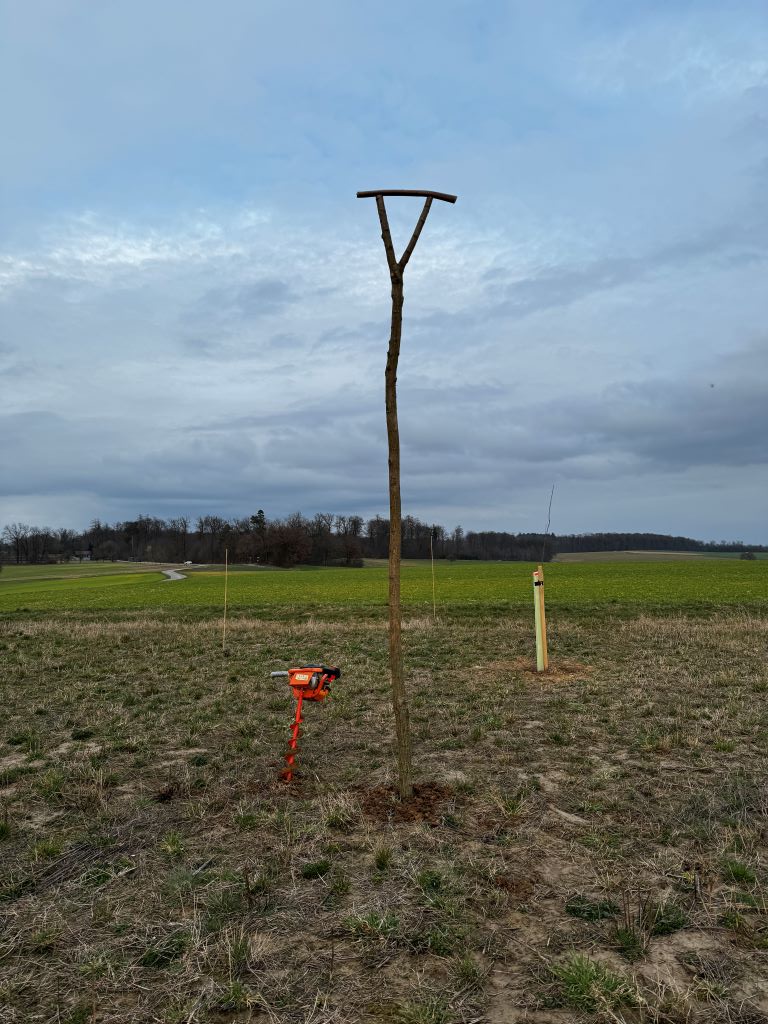
Will our new orchard survive? I have to believe it will.
There’s a reason old varieties are still with us today. Mostly it’s because we, the drinkers, have voted with our tastebuds over the centuries to elevate such named varieties, the majority of which in cider and perry were originally discovered as wild seedlings. They are worth preserving. But we shouldn’t forget the future and how climate will impact the choices of future cider and perry makers. We should have started years ago, but it’s never too late to try. It takes a long time though.
Will I keep grafting and trying to preserve old perry pear varieties? I will. But I am being more careful with rootstock selection. Spreading the risk. But I’ve decided I will also start keeping my eye out for seedling pear trees growing under the Methuselah trees, as the Germans call the ancient pear trees that still grace our landscape. Looking for survivors to see if we can usher in a new generation of perry pears suited to a changing planet.
For now though, I will try to stop worrying, and take quiet pride in a new sanctuary for rare pears. Till I start the next one…

Discover more from Cider Review
Subscribe to get the latest posts sent to your email.
 Cider Review
This is inspirational stuff; a wonderful read.
LikeLiked by 1 person
Thank you, I’m very glad you enjoyed it ☺️
LikeLike
Yes, we must not only be looking back but also forwards. In addition to new varieties, new rootstock or own-root trees, there is still much to be learned in terms of orchard management for resiliency. Enhancing soil vitality with mycorrhizae, bio-char, mulch, water retention features; modifying pruning practices e.g. for more shade; increasing diversity of plantings; just to name a few. I am hopeful that we can learn to work more in harmony with nature, as Martin Geng from Obstparadies likes to say.
LikeLiked by 1 person
Indeed! There’s so much we can try (or do, there is no try) to improve things. I should have mentioned Martin! Our visit there last January was just what I needed to think we’re on the right track, and an inspiration for our phase 2 planting 🙂 I have it on my to-do list to maybe interview him, though they don’t really make cider (just the one, I was told, and apparently that was a very happy accident 😄)
LikeLiked by 1 person
Pingback: Apples, Pears, & Pomonas: It’s time for Our Pomona | Cider Review
Barry, what a great job! I’ve been following your IG account for a long time and it’s great to see that you’re moving into the next chapter with perry pears. My colleagues and I are mapping old pear varieties in the White Carpathians in Slovakia, we found some old trees of German and Austrian perry pear varieties (150 years old Hirschbirne was a big surprise!!!) , so this connection is really interesting for further research. This year, we also planted an extensive orchard with some 30 local pear varieties. Of some, we found only the last standing old tree… Please, don’t underestimate the protection of trees against deer, in our case the only effective protection is a two-meter-high wire mesh… I look forward to other articles of your work 🙂
LikeLiked by 1 person
Thank you, I’m glad you enjoyed it. 🙂 Perry pears (and indeed making perry) have been obsessions for a few years now, and really took over from apples 😀 It’s such a long term thing, just the idea of planting this particular orchard began three years ago… But still over 300 babies to plant 😀
I’d love to learn more about your mapping project! As a former surveyor, mapping is in my blood, so I’ve been doing the same here around the village.
You can find some more articles from me here: https://cider-review.com/author/kertelreiter/ Maybe the ones about German and Swiss pears/perry history might be of interest for you 🙂
Yeah, I’ve had my fun experiences with deer at other places we’ve planted. Usually the issue is the bucks rubbing their antlers off the bark, or rather rubbing the bark off. They even broke ties and pushed protection tubes up, off the trees. But double-posting, with a band screwed to a thicker oak post will stop that happening. Or should! I might switch to mesh eventually.
LikeLike
If you are interested I have plenty of materials and also some very interesting pear varieties in our collection 🙂 for example 12 types of bloodpears, three of which are very large-fruited local varieties from Czechia an Slovakia, pear specially grown for bees due to its high sugar content of up to 24 °brix… and the list goes on.
LikeLiked by 1 person
I’m always interested in lists! 🙂 But also for a colleague here in Germany who collects redfleshed pear varieites.
You can get me directly via the contact form to exchange details 🙂
LikeLike
Pingback: Cider Review’s review of the year: 2024 | Cider Review
Pingback: In Praise of the Part-Time Cider Maker | Cider Review
Pingback: Cider Review 2025: A Year in Reflection | Cider Review
Pingback: Cider Drinkers are Conservationists. Aren’t They? | Cider Review