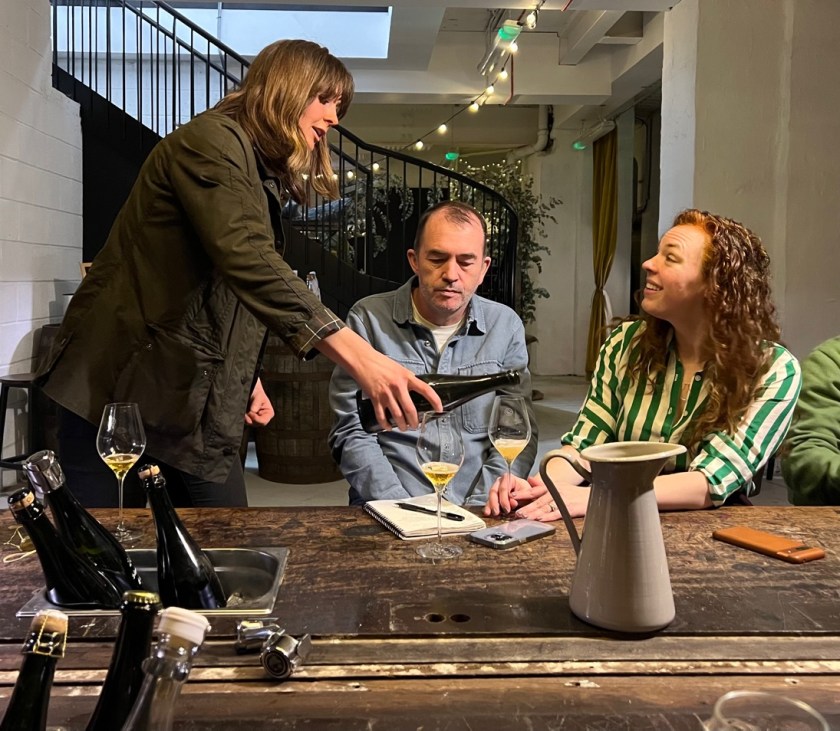
What’s the collective noun for a group of cider writers? A flash? A passion? A nursery? We certainly felt like a rare breed when attending a Traditional Method Cider Tasting event at the start of February, courtesy of an invite from Find & Foster’s Polly Hilton. When Adam and I have met up in-person over the last year or two, it’s been at venues like the Great British Beer Festival, Ross Fest, or Manchester Cider Club. Reconvening in the basement bar of Brityard HQ, a best of British produce shop located on Regent Street in London – a pulsing vein of 1800’s architectural facades, consumer culture, and tills ringing to the sounds of tourists parting with their pennies – there was a definite sense of “Toto, I’ve a feeling we’re not in Kansas anymore.” This was an event organised by Polly, bringing together bottles that showcased the Traditional Method style of cidermaking from Find & Foster, as well as Naughton Cider Company from Fife, Scotland, and Two Orchards from West Sussex. To recap yourselves on what Traditional Method as a style is, check out the Sparkling sub categories part of our Taxonomy of Cider page (think champagne method, but originating in the UK before France).
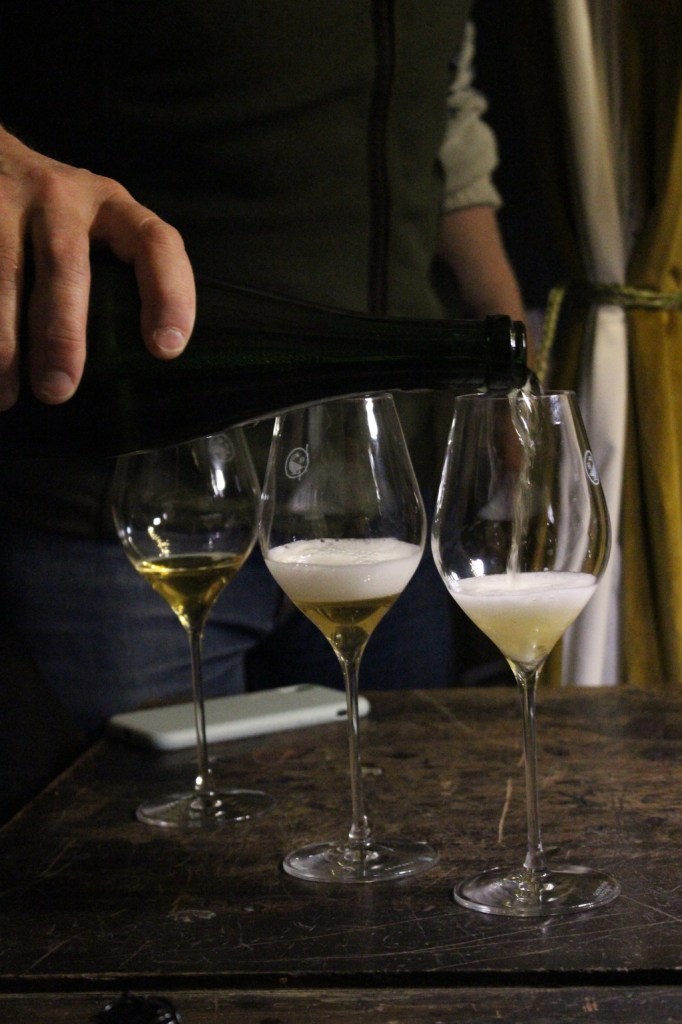
Looking around the room as we assembled at a charmingly re-appropriated high school science lab table-top, complete with obligatory teenage graffiti and holes where Bunsen burners once stood, Adam identified a number of very well-known wine writers. Quite by chance I got chatting to acclaimed drinks writer Jessica Mason, who then sat down with Adam and I for the tasting. In terms of writers with a laser-focus on all things of pomme-based origin, it was just Mr Wells and Mr Toye. Cross pollination in nature, as in drinks writing, is a wondrous thing however, and it was heartening to hear the inquisitive nature of many of the writers in the room, eager to find the similarities and differences between pressing the apple and pressing the grape. I did find the thought creeping into my head that is it wise to bring many Cider Review writers into one room at the same time? If the roof fell in, that would be a significant bump in the road for regular long-form articles on cider and perry in the UK. Here’s to sturdy foundations and roof joists!
First to lead us through a number of her bottles was Polly from Find & Foster. The event was pitched as a chance to look at some exciting previews of future releases, tasting the impact of prolonged maturation on the lees, dosage levels, varietal flavour profiles, and the impact of the fermentation vessel. This was on show in spades for Polly’s choices. One bottling – a particular blend of apples from a veteran orchard in the Exe Valley, harvested in 2015, blended together from three different tanks and then disgorged in 2017 – wafted aromas of the Hungarian dessert wine Tokaji, all noble rot and perceptions of sweetness, up from the glass. Alongside this, we sampled a 2018 cider, aged in a single oak cask from the Sharpham Estate on the River Dart (now Sharpham at Sandridge Barton). This little beauty was a blend of dessert, culinary and cider apples, and after 5 years conditioning away had sumptuous note of crème brûlée on the palate, followed by a distinct Palo Cortado sherry note to finish. It never ceases to amaze me the world of flavour profiles in cider!

Second up to lead the assembled group was Peter Crawford of Naughton Cider Company. I’d tried a few of Peter’s ciders before, all extremely well made, paying homage to this traditional method of drinks production. Even at the point I spoke to him for our Harvest 2023 summary, I had no idea just how integral a part of the UK Champagne scene he was. I spent quite a bit of the festive holidays watching his Champagne reviews on Instagram. This evidently plays out in Naughton’s cider output -we started with a 2020 vintage Cox & Bramley blend, left to mature in 2nd and 3rd fill wine barrels from France, and tasting all the better for it. There was a wisp of smoky spice on the nose, which progressed to some kind of spiced tangerine, Christingle service on the palate, underlaid by a very taught effervescence. A single variety Stoke Red from 2021 followed, matured in a reconditioned champagne barrique, with all the handpicked fruit coming from an orchard in Oxfordshire and then delivered to Peter in Fife. I’ve tried single variety Stoke Reds from Ross on Wye, Wilding, and Burrow Hill before – this was nothing like them. Firstly, a Sour Cherry/Greengage note greeted you on the aroma, followed by hedgerow fruit flavours and walnut tannin notes on the palate. A real curious discovery this one!

Third up was Ted Dwane and Fred Mcardle of Two Orchards – a producer I tried for the first time last year when a bottle of their Traditional Method 2020 came along in a Pommelier Club box (the subscription club from Fine Cider). I remember enjoying that bottle, and that it was definitely sparkling. Whether it was because they presented third to the group, and everyone had by now tried a little bit of cider and struck up conversations with their neighbours, there wasn’t any particular direction to the group at this point as to what we were trying. I gleaned some information from a sheet that was on the table. The 2020 Champagne Method Cuvee that we tried first from Two Orchards was a blend of Jonagold, Bramley, and Queen Cox. Both Adam I and picked up a note of volatility on the nose, which unfortunately masked the very pleasant frangipane note that came through on the palate. This drink, along with the 2022 Flor, and a 2022 Blend of Bramley & Jonagold, were all poured to our glasses near still in their presentation, which I’m sure wasn’t the intention of Ted and Fred at a Traditional Method Cider event. I don’t wish to appear too Eeyore or Oscar the Grouch on their ciders – I feel another time to try them fresh from the bottle would be fair, and full of a bit more fizz than was on show on this evening.

As we said our goodbyes at the end of the event, it was the versatility of cider as a drink that struck me. It really is like that friend of yours that you can bump into at the local market; a music festival; a formal black tie dinner; and then down the pub – lots of different changes of clothes, but comfortable, maybe in a chameleon-like manner, flitting between these different worlds. Some drinks get stuck in a rut, only adopted by a certain generation or at a specific social function (come on sherry, you can reinvent yourself!), but cider, at least here in the UK in 2024, manages to straddle all sorts of socio-economic and demographic daily occurrences. Is cider the David Bowie of the drinks world – constantly shapeshifting to stay relevant to subsequent generations? I don’t know if I can quite stretch that analogy to make it fit – but you get the idea.
I often find it’s the use of specific pitched yeasts, in this case yeasts used in wine production, that can attribute certain vino-esque flavour profiles to a cider. Even when the primary fermentation is wild ferment, there’s a familiar rigidity that appears when a champagne yeast is used with cider. I can see that is sought after from a producer like Peter at Naughton Cider Co, who is such a brilliant fan of all things champagne that it was bound to have influences on his work as a cidermaker. For Polly at Find & Foster, and Ted and Fred at Two Orchards, some of the joy I imagine is in the waxing and waning flavour profiles that can come with the changing of each vintage. Time on the lees and the effects of autolysis on cider I would need to consider more by attending further events like this. It’s really apple variety and fermentation vessel that I think excites me the most as a cider-consumer. To seek out varieties you’ve never experienced before, or ones you can return to over and over again with a love for the taste sensation they offer, is an exhilarating prospect. Whilst the effect of fermentation vessel on juice is like the binding choice to a book – will you go hardback and leathery, or plastic safety cover paperback (many other book covers are available I appreciate)? It’s all about the experience!
From rural locales to Regent Street, London. Then, once more to Bankside on the River Thames, as Felix Nash revealed the date for this year’s London Cider Salon at the Tate Modern will be May 11th this year – just in time for the reappearance of apple blossom throughout orchards in Europe!
*Thank You to Polly for the invite, and The Fine Cider Company for sharing some of their photos from the event.

Discover more from Cider Review
Subscribe to get the latest posts sent to your email.
 Cider Review
Thanks very much for this review–I’m always interested in traditional method ciders–but could I ask for a clarification? You have really piqued my curiosity about Sharpham at Sandridge Barton which I visited last year. Was the cider you tasted a Find and Foster cider that was made in one of their wine barrels, or is Polly also making the cider maker at Sandridge Barton? Since this tasting was pre-release without actual names attached to the bottles, I’m not sure what to look out for if I’d like to try these when they are available. Thanks in advance, Wayne
LikeLike
Hi Wayne, glad you enjoyed the article and thank you for your question ☺️ The cider was made by Polly from Find & Foster – she used a barrel from Sharpham, which had previously had wine in, and she then aged her cider in it. This one was labelled for us as Oak 2018, not sure if that’s the final name for release? If Polly’s reading this, hopefully she can elaborate a bit further ☺️ Cheers, Jack
LikeLike
Pingback: Surprise and Delight: The 2024 London Cider Salon | Cider Review