In the opening preface to Charles Martell’s Pears of Gloucestershire and Perry Pears of the Three Counties, a book I implore you to purchase if you are in any way perry pear-inclined, Charles states that his:
“priority was always to save the perry pear varieties. Further in-depth documentary research can always be conducted at a later date by those accustomed to this work. The pear varieties still surviving and those with the knowledge of them cannot wait”.
This book was initially published in 2013, with research first undertaken as far back as 1989 (there are a lot of fascinating perry pears documented within, so it naturally takes time to compile a substantial bank of knowledge like this). Since then, we’ve had Adam’s brilliant Perry A Drinkers Guide in 2024, giving an excellent overview of where the drinks category is globally in the mid-2020s. Preceding it, Luckwill & Pollard’s sought after 1960s book, Perry Pears (with research from Ray Williams and Gillian Faulkner), which so many of us go back to reference time and time again. I think I got my copy of Charles’ book as a birthday present from my parents in the covid-era, mandated-lockdown, sweltering summer of 2020. It’s been a brilliant read, helping to decode the expected characteristics of many a perry pear – perfect for someone who lives around 120 miles away from the Three Counties, and so, a trip to a particular orchard never really being just a spur of the moment occasion. I’ve come to see this book as something of a leather-bound, hardback treasure map of late, and this particular adventure all starts with a reply to an Instagram story on 8th May 2024…
I’ve a friend on Instagram called Will, he’s based in the US, we’ve never met in-person but share a similar level of passion for all things Malus and Pyrus. On this day in May 2024, Will’s Instagram story featured a question along the lines of: “does anyone know anything about the Cheat Boy variety of perry pear?” A little bit of searching on Google and Ecosia brought the initial tranche of SEO-delivered top results which I shared with Will, in no doubt he’d already seen this info doing much the same searching online from his side of the Atlantic. In truth though, no, I had not heard of Cheat Boy. As far as I knew then there are the Boy and slightly less fortunate protagonist, Dead Boy perry pears. The Boy element of these pears’ name appears to refer to the diminutive size of the fruit, its potential to be from a seedling, or the collecting of the fruit by gangs of young lads scrumping in the perry orchard. Certainly Boy Pear (which DNA testing reveals to be the same as Jessica Deathe’s Gwern Ddu perry pear at Three Saints in Monmouthshire) looks nothing like Dead Boy. The description I initially found of a Cheat Boy tree, a massive example, is certainly evocative, but many varieties on the right seedling rootstock will grow as large as described below:
“There are numerous kinds of perry pears, but certain sorts have a great reputation, such as Moorcroft, Barland, Malvern Hills, Longdon, Red Horse, Mother Huff Cap, and Chate Boy (cheat boy), a particularly astringent pear, these are small, and require quickly grinding when gathered. In the New Forest there is a perry pear similar to the Chate Boy, called Choke Dog, which in its natural state, is quite as rough on the palate as the former, but it differs in colour and is not the same sort. I had a splendid specimen of the Chate Boy pear-tree at an outlying set of buildings, said to be the father of all the trees of that kind in the neighbourhood, and it was a landmark for miles, as it stood on high ground. It was fitted with a ladder reaching to the middle of the tree, where seats were arranged on a platform for eight or nine people; but it was unfortunately blown down on the night of the great gale of October 14, 1877, when twelve other trees on the farm were likewise overthrown.”
– Grain and Chaff from an English Manor, Arthur Herbert Savory, 1920.
I’ve seen a number of really quite substantial, mature perry pear trees over the last few years, but I’m still not sure any were large enough to accommodate a platform holding up to 9 fully-grown adults! That must have been quite some storm, and upon researching further, it does appear that the British Isles was struck by one heck of a large storm across the 14th and 15th October 1877 – although well into Autumn, quite a few perry pear trees, as you’ll see today, still hold onto their leaves into October. The trees, then acting as a giant sail in the face of gale force winds, understandably… topple over. Whilst it’s very sad to hear of the loss of the particular tree, what does this historical account tell us? The tree in question was certainly mature around the late 1800s, so likely planted early 1800s or even well before in the 1700s. It was popular enough back then to be written about, deserving of recollection in a published account some 45+ years later by Mr Savory, so must have been a useful variety to have growing on his land and therefore (ideally) distributed a bit wider than just this one farm. This assumption is corroborated by this tree being described as the father of all the other versions of the tree in the neighbouring vicinity of the New Forest. So, at this stage we have a variety that is important enough to be named in the 1870s, has been grafted wider than its original location, and in 2026, is now a lost variety. Further investigation required!
Barry’s two-parter, the Quest for the Turgovian Pear Parts 1 and 2, definitely inspired me to believe in the possibility that a lost variety like Cheat Boy could be tracked down, or at least its last whereabouts could be traced. For this to work, I needed a bit more evidence than just “the variety existed at one point in time”. Ripening times and morphological features of the fruit, further locations of trees, demand for the variety from different perry-makers and orchardists would all be useful to reveal a bit more about the varietal character we were dealing with. Fortunately, with the great help of Will from the other side of the Atlantic, and the digitalisation of large swathes of documents over the past few years, there has proved to be, if not lots, then far more documentation than I could have hoped for to work with. John Wright’s The Fruit Grower’s Guide, published in London by Virtue and Co around 1891-1894, gives us a good description of the ripening time of the fruit:
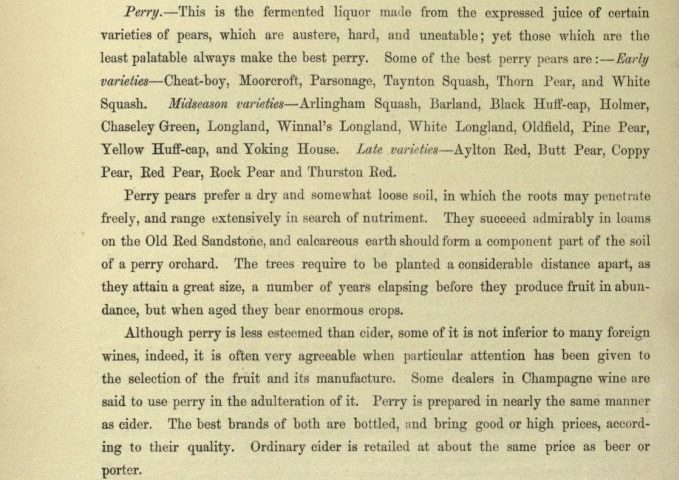
The early nature of the variety here suggests an August – early September ripening time, placing Cheat Boy into the category of what Jim Chapman describes on the National Perry Pear Centre website as a Harvest Pear. These pears, ripening early in the season, could produce a perry that was ready to drink within a month from picking due to the quick fermentation times brought on by the more clement weather conditions in August and September. They would then serve to quench the thirst of farm labourers for the remainder of harvest and into winter, whilst most other perries from that season were still slowly fermenting away for the following year. So, we have probable cause of Cheat Boys’ popularity being down to its early availability in the harvest coupled with a likely full-bodied mouthfeel from the astringency described by eating the fruit raw – this was no dessert pear. As industrialisation in the early part of the 1900s crept in, small, early ripening pears, that no doubt ripened quite quickly in the hotter temperatures of late summer, fell further and further out of fashion. For the perry pear enthusiasts out there in 2026, hand-picking fruit again, wild fermenting the juice and happily waiting to release the perry when it’s ready, varieties like this sound fascinating! They certainly were in demand around the town of Tenbury Wells in Worcestershire in the late 1800s, as an old pair of newspaper clippings shows (in a manner that Facebook Marketplace does for us now):

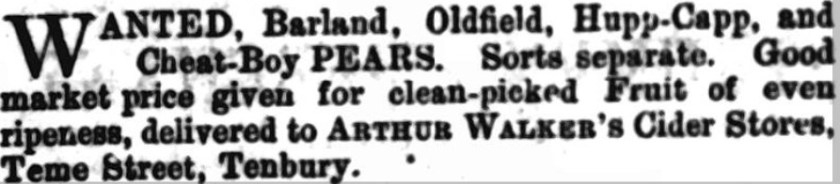
It would appear the Newman of Hays Farm, Tenbury Wells had Cheat Boy and Barland available (not necessarily the same ripening times as Barland these days is a late September/early October variety), and Arthur Walker’s Cider Stores, also of Tenbury Wells wanted them for his perry production or wholesaling of perry pears. Arthur Walker appears to have been a large landowner at the time of the late 1800s and early 1900s between the towns of Leominister and Tenbury Wells. Cheat Boy must have been a prevalent enough variety around that area for him to run newspaper advertisements to other local farmers imploring them to bring their Cheat Boy pears to him. Was there a rivalry between Hays Farm and Arthur Walker’s Cider Stores to procure the most amount of Cheat Boy perry pears early in the season? We may never know. But what this does show us is further evidence of local demand for the variety at this point in time. The advent of the First World War between 1914 and 1918, with the widespread loss of life of large swathes of agricultural workers, increased the pace of industrialisation and mechanisation in the countryside. Could it have been this sweet spot in history during the late Victorian/early Edwardian era in Britain that proved perfect conditions for Cheat Boy to flourish? Quenching the thirst of large numbers of parched agricultural workers throughout harvest, that in a few short decades would be drastically diminished in number, with the associated farming practices subsequently changing on the land they had previously tended to? Trees and orchards in general don’t just vanish overnight, it takes years of cultural and environmental change for their numbers to reduce, as we shall see.
In Volume 9 of the Journal of the Royal Horticultural Society, which lists the pears exhibited at the National Pear Congress of 1885 (oh to be a time traveller and pay a visit!), there amongst the list of named varieties, some lost, some still existing in 2026, is our Cheat Boy:
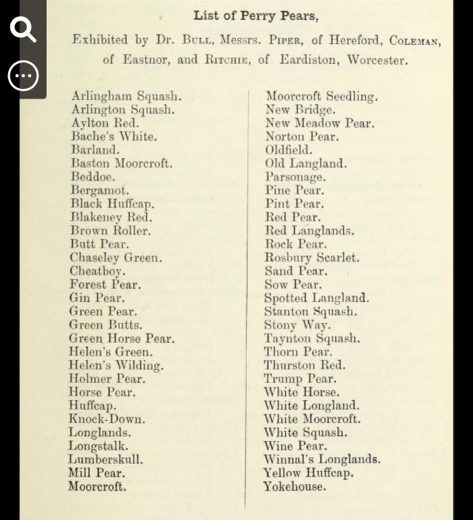
Dr Henry Bull here being the Bull of Hogg & Bull fame, alongside fellow exhibitors Mr Piper, Mr Coleman, and Mr Ritchie, have provided us with an insightful list of varieties that were utilised at the time of this fabulous Victorian Pear Congress. The numbers involved here bring to mind Jim Chapman’s award-winning display at the Malvern Autumn Show, which I was fortunate enough to finally visit last year. At a congress dedicated mostly to dessert and culinary fruit, showcasing the growing habits and survival abilities of hundreds of these varieties in different counties across the UK, you can’t help but wonder how a display of wonkish-looking, idiosyncratically named, often foul tasting perry pears, would have gone down with the upper echelons of the Victorian farming elite who were actively competing with each other to grow delicately flavoured, buttery-textured pears for the dining table. Perry pears were punk well before punk was even a thing!
A fruit catalogue from Fulham Grange Nurseries in Alphington, Australia in 1873 shows that Cheat Boy even made it down under! There it sits in this list alongside a good number of dessert and culinary fruit. Was it perhaps exported halfway across the globe at the time to see if perry pears could grow as well in Oz and the UK? Its ripening time here is listed now as late season, in Australian terms, which is their Autumn of March to May. It fascinating to see how a fruit variety can adapt to completely different geographic conditions and still make a go of it.
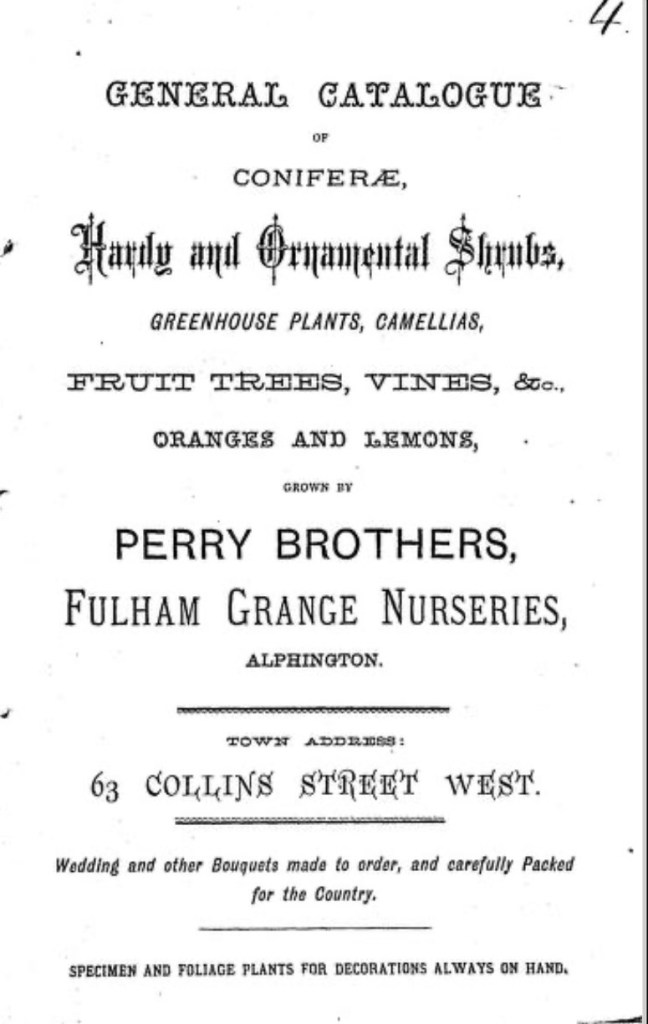
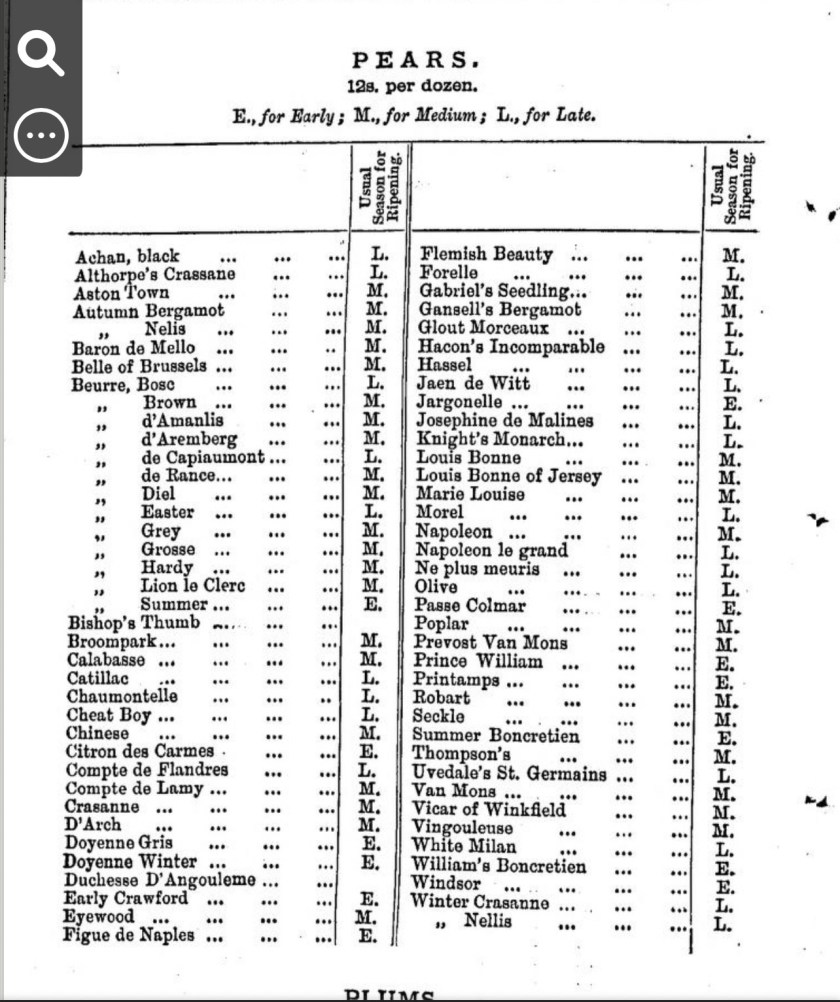
I did ask Gabe Cook in 2025, when he was on a trip to an Australian cidermaking conference, if any of the producers over there had heard of Cheat Boy, but alas the answer came back: no. In these two drastically different parts of the world, Cheat Boy’s time to shine appears to have been around 150 years ago!
For those that have been following Barry’s International Perry Pear Project over the past few years, you will know that he has been extensively grafting rare perry pear varieties on to rootstock around his home in Germany. It’s inspirational on many levels, building on the work of Charles Martell and Jim Chapman with their two National Perry Pear Centres here in the UK at Malvern and Hartpury. I was checking in on Barry’s Kertelreiter website last year, detailing his work on his project, when I stumbled upon an illustration that caught my eye. Drawn by Edith Bull, daughter of Dr Henry Bull, co-author of the The Herefordshire Pomona (1876-1885), it depicted a number of perry pears in great, colourful, beautiful detail. There was Blakeney Red, Thorn, Winnals Longdon, the elusive Huffcap perry pear Coppy, a few varieties also that I hadn’t heard of like Stoney-way and Yokehouse. And on the left-hand side of the illustration, with the level of exquisite detail you would expect to find in a modern-day Pomona, was Cheat Boy, flushed from the sun of a harvest many, many decades ago, the shape of its leaves and angle of its stalk clearly visible. This was surely a sign that Barry had chosen to select this particular image and upload it to his website that I had visited this day in the early days of my hunt for Cheat Boy!
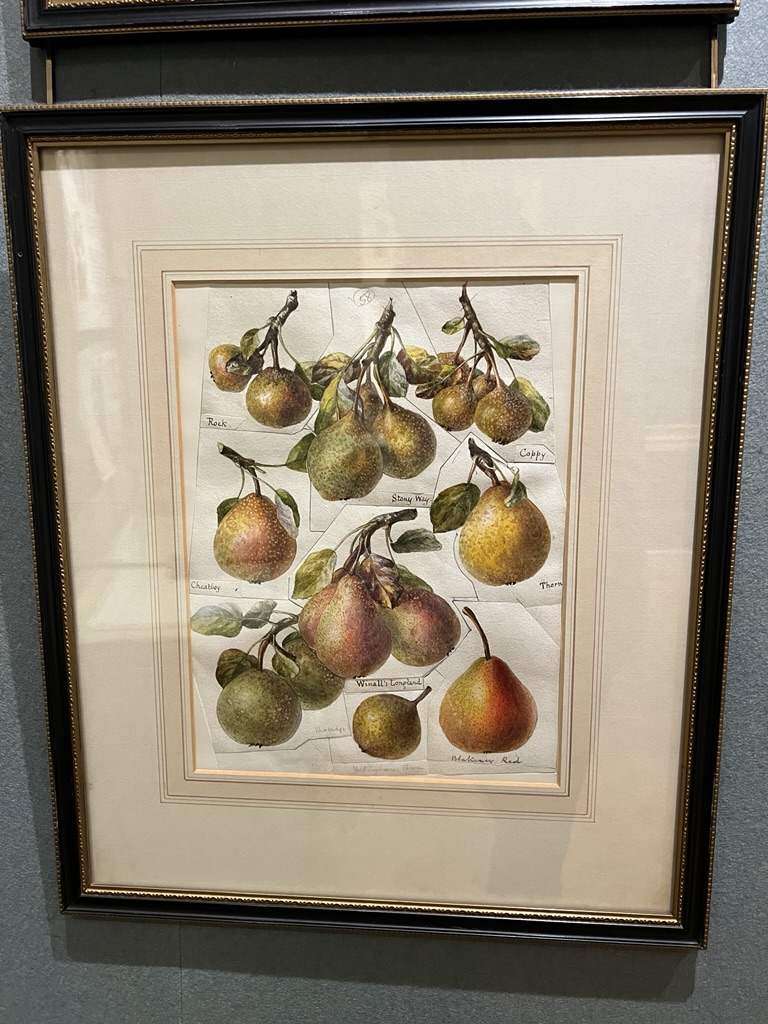
A visit to the Museum of Cider in Hereford during RossFest 2024 revealed the original drawing by Edith Bull, hung on the walls of a pomological collection exhibition, there is Cheat Boy, well, an illustrated version of Cheat Boy, quietly watching over the visitors to this brilliant museum. I’m very fond of the old adage that no-one is truly dead until the last person who remembers them has passed away. The timeless beauty of Edith Bull’s illustrations are something I’m very grateful for, for they are as close to the colour photographs of varieties in Luckwill & Pollard’s 1960s Perry Pears book as we can hope for with lost varieties like Cheat Boy. For those of you interested in the inception of the Herefordshire Pomona, I urge you to pick up a copy of Bill Laws’ recently published book on the story, it’s a fascinating read!
We can look to Hogg and Bull’s 1886 volume of The Apple and Pear as Vintage Fruits, published by the Woolhope Naturalists Field Club, for a more detailed description of what Edith Bull’s illustration of Cheat Boy is depicting, along with a very useful cross-section drawing of the fruit:
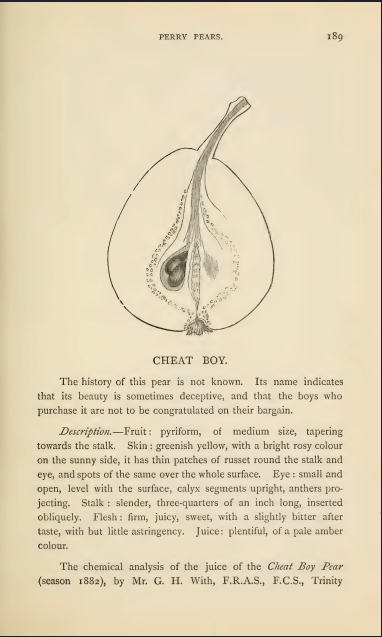
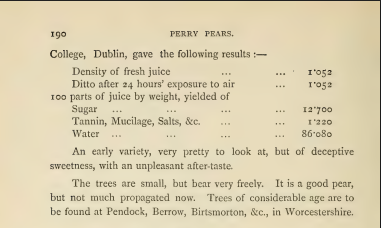
For the first time in the search, there is a reference to the SG (specific gravity) of the juice that comes from pressing Cheat Boy: 1.052, which if fermented to dry, would give a perry of a very hearty 6.8% abv! Interesting to note here that the Cheat Boy trees that Robert Hogg surveyed for this publication are noted as small in size, rather than the large mother tree that blew down in the gales of 1877, a decade earlier. Rootstock certainly has a lot to play here with the eventual size of tree, but it would seem that Hogg was likely surveying younger versions of Cheat Boy in the seasons of 1883/84/85 preceding the publication of The Apple and Pear as Vintage Fruits. Whilst intriguing to note the SG of a specific harvest, regular readers of Cider Review will know the drastic swings of SG that terroir, weather, and age of trees can give to the juice from its fruit.
The villages of Pendock, Berrow, and Birtsmorton, along with the whole county of Worcestershire, are listed as locations of the trees at this time. We know of at least one location in the county of Worcestershire: Tenbury Wells, mentioned in the newspaper clippings at the top of this article. Let’s add Leominister in too as Arthur Walker could no doubt have sourced pears from that town too. The pins are gradually being added to the Cheat Boy treasure map at this stage. Potential locations to scout out and investigate, with a fairly good visual ID of the fruit from Edith Bull’s illustration, and the cross section drawing above. Hopefully this map below helps show the locations for those not from the UK. Slice down the middle between Hereford and Worcester and you have Cheat Boy’s last known locations.
At this point I will refer again to Charles Martell’s Pears of Gloucestershire and Perry Pears of the Three Counties. I mentioned above that I was gifted it as a birthday present in the June of 2020, right in the middle of lockdowns and Covid-era isolation. At the front of the book was a little pamphlet that Charles had signed, inside it, various advertisements for his wonderful cheeses and spirits. On the very back page of the pamphlet, a selection of cross-section drawings of perry pears, all rare, but ones you can find in the library orchard in Hartpury. All bar one, right in the centre, there was Cheat Boy! Of all the pears to include from his book on the pamphlet, here was Cheat Boy, staring out at me from across centuries. I hadn’t noticed it before in 2020, only gradually delving further and further into the rabbit hole of perry pear varieties in the proceeding years.
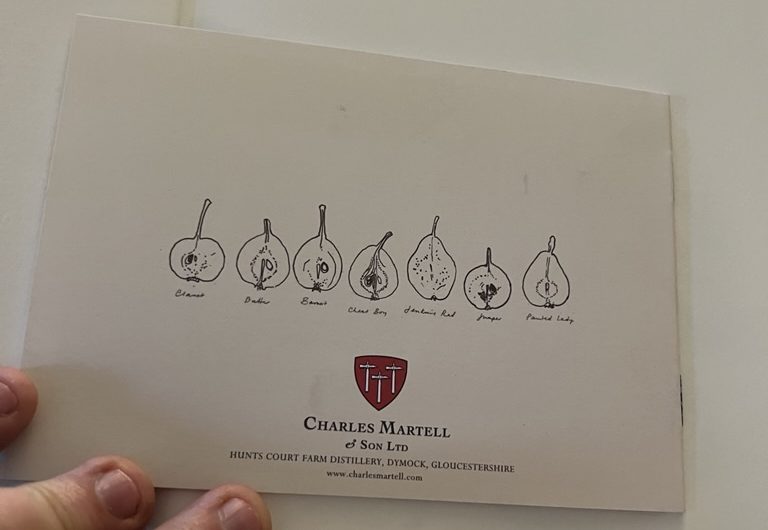
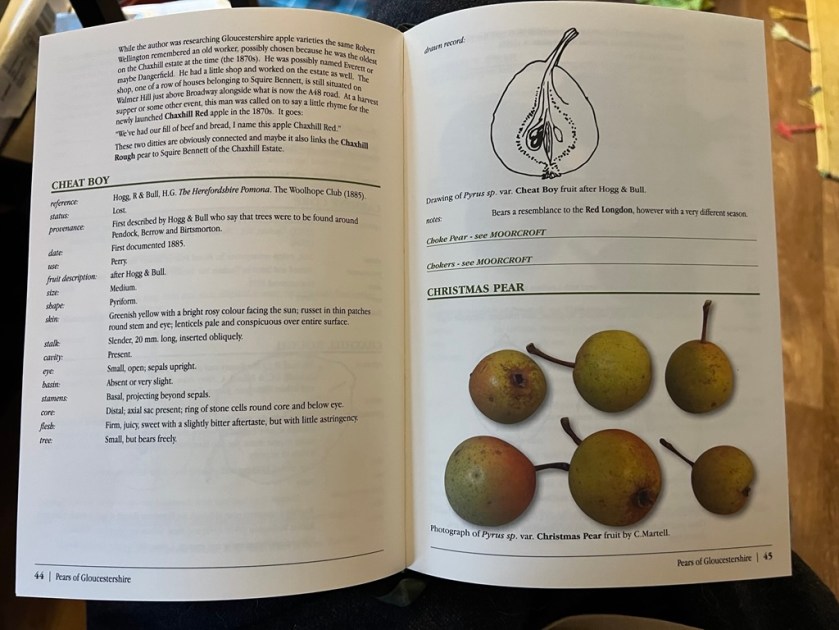
I’m not sure if this a case of subliminal messaging on the part of a presumed-lost perry pear, but I was getting the feeling this pear really, really wanted to be re-discovered. Or as is often the case when you get a new car and you suddenly see that make and model everywhere on the roads: I was seeing Cheat Boy everywhere I was looking for it! As our editor Barry noted, this is known as the Baader-Meinhof phenomenon, or the frequency illusion. Charles’ entry of the variety uses this cross-section drawing, along with a bit more information, laid out in the same careful and considered manner he treats the extant and rare varieties elsewhere in his book.
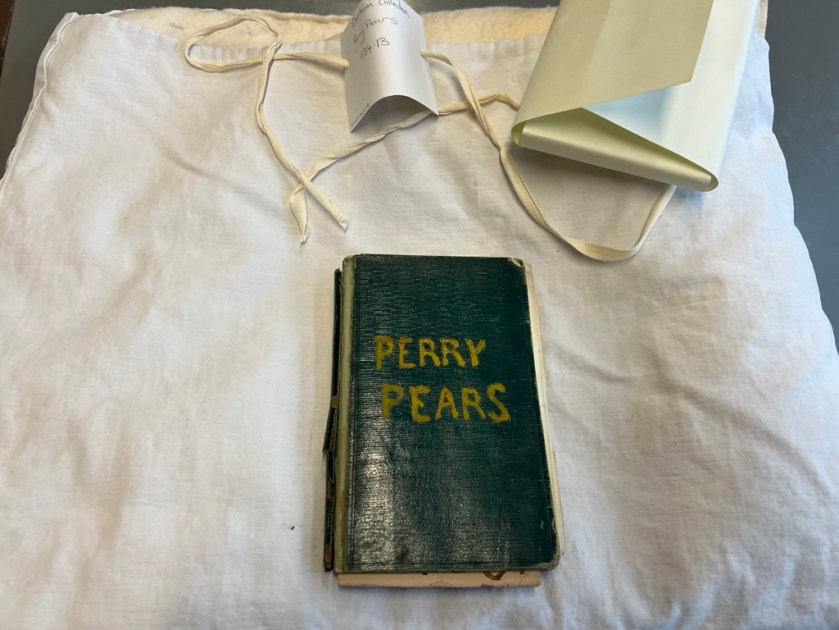
There was one more bit of textual detective work to do before literally going out in the field and looking for any remaining Cheat Boy trees. Linking back to the Museum of Cider site in Hereford, and in many ways to Hogg & Bull, Luckwill & Pollard, Ray Williams, Charles Martell & Jim Chapman, everyone mentioned so far: Herbert Edward Durham. From 1905 – 1935 he was, amongst other things, a Chemist and Scientific Advisor to Bulmers back in its independent days, also serving as President of the Woolhope Naturalists Club. The Museum of Cider being the site of the old Bulmers cider-making factory in Hereford, it’s very apt that this weaves itself so much around the building. Like Robert Hogg, Durham enjoyed going out into orchards, speaking to farmers and tracking down the many varieties of perry pears that still existed in the 1920s. After his death in 1945, his numerous research papers and archive were inevitably split up across different sites. The Woolhope Library, temporarily closed at the time of writing, holds some material. The Museum of Cider holds an astounding collection of Durham’s photograph albums of perry pear trees and their fruit. Whilst the Herefordshire Archive and Records Centre on the outskirts of Hereford, holds two incredibly important and breath-taking items originally belonging to Durham.
The first is the equivalent of a contacts book, akin to a handwritten telephone directory you may remember from your grandparents’ house. Written inside are not numbers, but an alphabetised directory of perry pears that Durham was able to find in the mid-1920s:
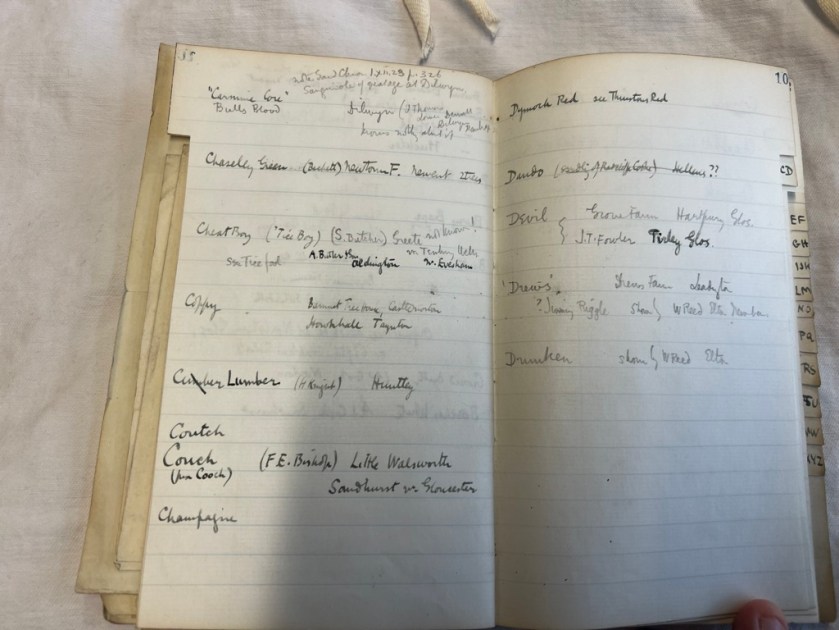
Under the letter C, we find Cheat Boy, and for the first time, it is presented with the synonyms Tice Boy and Tice Fool. The verb tice is an archaic word meaning to entice, tempt, or allure, or, if you will, to cheat someone (the Fool or the Boy in this case). It’s heartening to find reference to the variety as late as the 1920s, and one address which is legible states Tenbury Wells again. Signs are definitely pointing in that town’s direction as a location to scout out. Tice Boy is also mentioned by Durham in his 1924 article for the Journal of the RHS entitled, “The Beauty and Use of the Vintage Pear”.
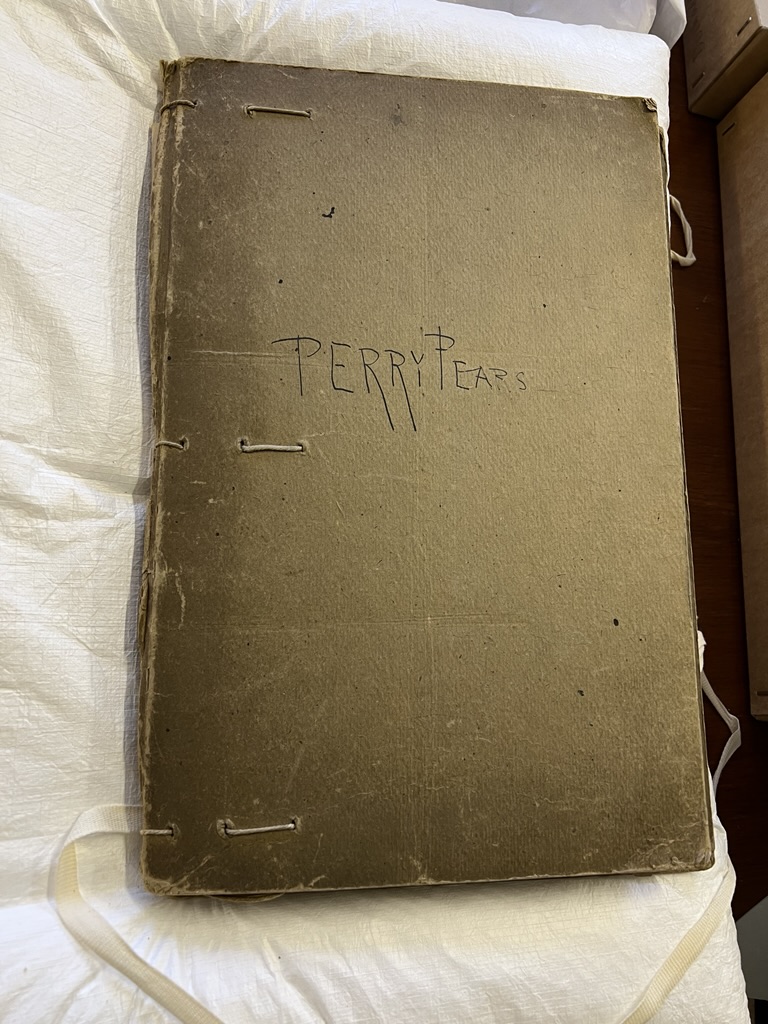
The second item in the collection of the Herefordshire Archive is a binder of Durham’s hand-drawn cross-sections and notes on a variety of perry pears. A similar binder to this exists in the collection at the Museum of Cider, focusing instead on cider apples. They are his unpublished 1920s Pomona’s if you will, and 40 years later were used as references for Ray Williams’ contributions to the Luckwill & Pollard Perry Pears book of the 1960s. This document serves as a snapshot of Cheat Boy as of 16th August 1924, almost 102 years ago!
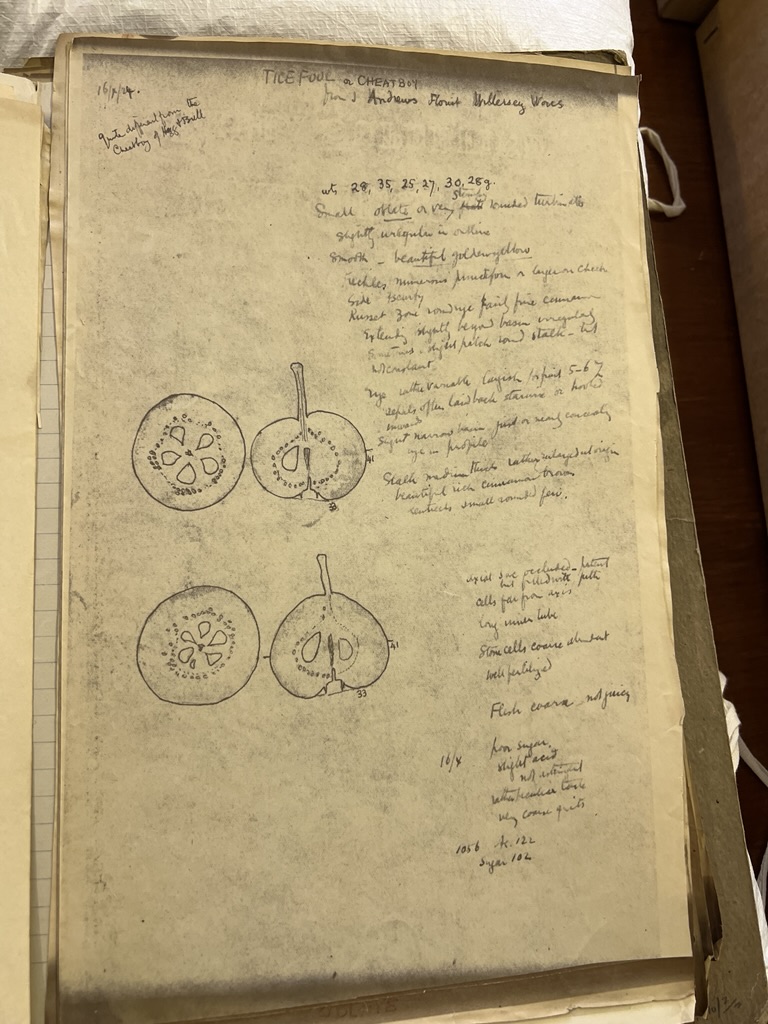
Interestingly, of the two examples of Cheat Boy that Durham draws, one has a passing oblate resemblance to a Squash form of a perry pear, the other a very dumpy, verging on obese, Huffcap pyriform shape. It looks like an overweight version of the fruit we see illustrated by Edith Bull. Durham mentions in the top corner of the page that the fruit he was presented with from J Andrews, Florist (?), illegible, Worcestershire, is quite different from the Cheat Boy of Hogg & Bull. Meteorological conditions may be at play here as August 1924 was widely regarded as a part of a terrible summer, one of the wettest and dullest on record. The red blush you would expect to see on the skin of Cheat Boy may not have developed due to a lack of sunlight, and the excessive rain in that month may have swollen fruit to noticeably different proportions that typically exhibited.
The SG of 1.056 matches closely the expected gravity of the juice that was recorded by Robert Hogg 40 years prior. I should also mention the at times atrocious calligraphic qualities of Durham’s handwriting – we’re approaching GP handwritten prescription note territory here. I’m sure there’s an AI handwriting tool that would do its best to decipher certain words with the power of a supercomputer bank of servers behind it, alas I have not found such a service myself yet. These little precious bits of paper, with handwritten pencil notes across them have against all odds, survived over the following 100 years. Think how many times a grandparent passes away and their diaries or photograph albums get chucked away in a house clearance or through lack of space in the next generation’s home. Thank goodness for the three archives that are storing these priceless artifacts from Durham’s working life out in the orchards of 1920s Britain.
With a whole host of historical references, potential locations, morphological features, and a good smattering of hope, excitement, adventurousness, I set off on the three and a half hour journey to the West Country from my home in Norfolk, confident I could find something, a shadow or a least a whisper of Cheat Boy’s continued existence in the 2020s. Find out what happened next in Part II of Missing Presumed Lost? The Cheat Boy Perry Pear. Coming soon to a Cider Review weekend slot near you!
Discover more from Cider Review
Subscribe to get the latest posts sent to your email.
 Cider Review
What a cliffhanger!
LikeLiked by 1 person
Lots of fun laying the groundwork for the fieldwork Mitch ☺️
LikeLiked by 1 person
What an incredible piece of detective work, Jack. You are a true Poirot! Looking forward to the big reveal!
LikeLiked by 2 people
Glad you enjoyed the read Paul ☺️ Lots of fun doing the research for it with lots of help from Will ☺️
LikeLike
My back door entry to Cider Review 😂Great work, Jack!
LikeLiked by 1 person
You’ve made it on the digital realm of CR 🎉 Thank you for all your help with the research material Will ☺️
LikeLike