
I decided to drive up to the Isle of Arran one more time in 2025. The 374 miles required to get to the ferry terminal in Ardrossan Harbour or Troon from my house may seem inconsequential to our US, Canadian, and Chinese readers. If word arrived on the orcharding street that a rare perry pear had been sighted 374 miles away, I’m sure you’d think nothing of it and hop in the car to go and investigate. In the UK, these distances instigate the obligatory “You’ll be careful on the roads, won’t you?” from loved ones. Particularly with winter setting in. Nonetheless, FOMO was setting in and it had only one cure. One final visit to my favourite island off the West Coast of Scotland. A 30 year old whisky had just launched at Lochranza Distillery – 30 years of time and learning and social groups and changing seasons, all captured in one bottle of liquid. The price tag was, as you would expect, a weighty, hefty number, but the completion of sale of my flat had finally come through, and after a lot of very sensible purchases (dishwasher, washing machine, new stove) it was time to spaff a little bit of it into the wind for joy and silliness.
Setting off late in the evening, I usually try to avoid whatever commuting traffic jams present themselves passing by Nottingham, Sheffield, and Leeds. The later you travel, the more you journey back in time to an era when there were less cars on the road. But it was dark. It was cold. And it was more or less thematically, if not astronomically, winter. After a few hours on the insatiably dull A1M, I arrived at my first pitstop – Scotch Corner. There was frost on the ground, I think it may have been snowing earlier in the day. At this point on the map, Scotland is still a way to go, but a lot closer than it is back at home in Norfolk. You hook a left, journeying North-West through the Lake District, on the A66, a big road, that rides atop hillsides, through valleys, and cuts through picturesque villages and towns like Barnard Castle (visit to the opticians anyone?). There are snow gates on this road, a harbinger of just how wild and elemental this corner of the UK can get. I had the heater on full blast in my van, on feet and windscreen mode, but resting my arm on the door to my right, I could feel the cold wanting to claw its way in through the glass and window seals.
Tiredness set in about 10 miles into this leg of the journey. Scotch Corner service station had been Arctic, the frigidity dulled my senses, and I forgot to buy a coffee for this next leg of the trip. Snow started to fall, at first muting the oncoming traffic headlights, then obscuring the road ahead, which in parts of dual carriageway, allows you to travel at 70mph. Not this evening. Traffic was down to a crawl. The snowfall thickened. “Siri, play Driving Home For Christmas”. Chris Rea’s dulcet tones weren’t enough. My eyes were straining to see the road markings ahead. I needed to pull off the A66 and find a small pub or hotel to check-in for the evening. I could always catch the ferry the next day, and drive in better conditions. I turned left down a sideroad, drystone walls each side of me now adorned with a hefty deposit of snow. A mile or two down this road, a pub appeared: whitewashed stone walls, small, latticed glass windows, a tall chimney stack ascending up into the falling snow, woodsmoke rising like a blanket of fog in the van’s full beam headlights. This would do.
The temperature on the van read 2 degrees Celsius, when I stepped outside the van and shifted over towards the pub, it could have been ten times colder with the wind and the snow landing on me. I looked up at the pub sign: The Tannin Inn. Was this a franchise? I had gone to one of these pubs last year with my friend Andrew, on the Winter Solstice. Somewhere down south between Norfolk and Kent. Hang on. It was December 21st again! The shortest day of the year. What are the chances! I stepped inside, paid for a room for the night and walked towards the bar for a nightcap. A big inglenook fireplace in the centre of the room contained a much-welcomed roaring fire. There were 10 wooden tables scattered around the room, all were empty bar one – the table next to the fireplace. At it sat a familiar figure, a bearded man in his early forties, book in hand, Tannins in Cidermaking – All You Want To Know. I walked over to the table, pulled out the chair and sat down.
“Andrew! What are you doing here?”
“Jack! Good to see you. I’m just driving back down from an academic conference in Glasgow and the snow got too much, so I’m stopping here for the night. What are you doing here?” replied Andrew.
“On my way up North, stopping for a similar reason!”
“You know what day it is?” exclaimed Andrew.
“It’s the flipping Winter Solstice again, let’s get a cider or two, for old times sake,” I said.
“For Auld Lang Syne indeed,” said Andrew.
The barman walked over, cider menu in hand, and within minutes we had ordered our first drink of the evening. Andrew orders the first drink.

Jack: I have heard good things about this cider from lots of people and I’d kind of avoided it for no real reason! It’s the Ross Cider multi-vintage Dabinett.
Andrew: This is probably one of the few ciders that I’ve had multiple times. I think I’ve certainly had it as part of Ross’s Cider Club boxes before. It is something that I would always go back to. It ticks a lot of boxes. Certainly, a lot of orange character came out, and then hints of peat smoke. It always reminds me of autumn walks in the early morning, out with the dog.
Jack: Yes, I got that autumn note. Dabinett cologne, it just really gets to the point of what that variety is all about. As you’ve had it a few times before, do you find it’s mellowed in the bottle? The tannins are really soft here for me.
Andrew: I think it has always been fairly soft. I don’t think it was on the harder tannic side a couple of years ago when I first tried it. I guess at that point it would have already been a couple of years old. I don’t know what it was like completely fresh. It’s still got that kind of rounded, slightly fuzzy tannin to it. Lingers quite a long time.
Jack: A good example of multi-vintage blending of a single variety.
Andrew: Absolutely. What made you avoid it up till now?
Jack: I love the rum cask Dabinett, which came out the same time. It’s so bombastically the other end of delivery and performance. It’s quite obviously: Rum & Dabinett. I always went for that one on an order. But on a showcase for what Dabinett can do, this cider we have here, it’s a lovely cider. A crowd pleaser for folk that might not have just tried a single variety of Dabinett before.
The fire crackled, the wind howled against the windows of the Tannin Inn. It was my chance to order up the next cider for the table.
Jack: See what you make of this one Andrew, from Ross Cider again, but a Bulmers Norman single variety this time.
Andrew: I think this one’s really interesting. For me, it goes all sorts of places on the palate. There’s that soft smoke, phenolic character to it, but the thing that jumps out that I’m always surprised by with this bottle is that it reminds me of croissants and apricot jam. A really weird French patisserie note to it that then becomes almost like leather and orange cake in the mouth.
Jack: I get the smokiness. I put down Lapsang Souchong tea and pipe tobacco. I think it was one of the most exciting 500ml bottles from last year. It’s this variety which we were always told it’s just an inter-stem for a tree, it’s violently tannic, and yet when you give it a bit of time in the bottle to condition, it’s beautiful. Do you think we could see a 750ml of Bulmers Norman at some point?
Andrew: A magnum! It’s normally only Ross Cider I see releasing it as a single variety, I’m sure it finds its way into some other blends from other producers.
Jack: It’s ironic, considering it’s so widely planted and so widely used, isn’t it? You don’t get that in the wine world where they use a grape loads in blends but never talk about it singularly.
An orange tabby cat makes itself known in the bar and saunters past our table towards the fireplace to site impossibly close to the glowing embers. It’s Andrew’s turn to order a cider.
Andrew: For me, I think this is probably one of my favourite drinks of the year. It’s Kertelreiter’s Double Oak 2020, and it’s really phenomenal. I have some really weird tasting notes on this one though. Certainly, on the nose, it had that kind of baked apple, soft kind of vanilla custard note, but then seemed to have gone into foam bananas and old wood. I think there’s real rich acidity that came with this kind of soft tannin. Tasting note-wise, there was kind of ash, tobacco, a touch of butter, and then gummy bears. I put down as a definite confectionery sort of element to it too. How about you?
Jack: I thought, because it said double oak on the label, it was going to be boldly tannic. The cask is definitely the key to this and it’s not a peated whisky cask. I’m thinking maybe it’s an ex-European wine cask or something like? I got loads from this: stewed plum, sauternes wine, hot honey, and then after a while with the cider in the glass, vanilla just right to the fore. Smooth classics at 8 on Classic FM! It’s not a harsh tannin whatsoever. I thought maybe Barry’s using the cask to make dessert fruit more interesting in this one and it’s worked perfectly. It’s a really nice cider, but it’s quite different to anything else on the list. I’ve tried most of his other bottles that were on Cat In The Glass and House of Trembling Madness, but I just hadn’t got round to this Double Oak for some reason, and it’s lovely.
Andrew: I have had more of his perry than his cider. This is something that I do need to remedy at some point in 2026.
We were by now, working our way solidly through the cider menu in the Tannin Inn on this cold, dark, wintery evening. What a lovely surprise to find an northern outpost of the pub chain up here in the Lake District! My time to order.
Jack: Back to a 500ml bottling for the halfway mark, what do you reckon to Charnwood’s Ellis Bitter single variety?
Andrew: Really easy-going. Perfect for a cold evening in front of a warm fire like this. It’s fundamentally quite a cosy drink. There’s a touch of green apple and damp earth on the nose, still relatively soft tannin, quite interesting acidity in it. Reminds me a lot of orange juice, which I think is always quite good in a cider.
Jack: I know that Ellis Bitter is quite a powerfully tannic variety. I was getting this odd salinity to it, reminding me of unpeated whiskies from coastal distilleries. I actually didn’t think it was as smooth as described on the label. I thought it had some real tannic grip to it. A nice offering there from Rob at Charnwood.
Time can move in funny speeds when conversation is flowing and tannic cider and perry is being consumed. The logs in the fireplace always seemed ablaze, never needing topping up by the barman (who was no doubt pleased to see some customers on what had proved to be a rather inhospitable evening in the Lake District).
Jack: Last year when we met on the Winter Solstice, we tried the 2019 Art Of Darkness from Little Pomona. Seems like a rarified privilege now, can’t be many of those bottles left. Now before us we have the 2021 vintage. James has moved on from a crown cap to cork and wax with the bottling. What did you think of this one?
Andrew: Always consistent, those Art Of Darkness bottles. I think you kind of know what you’re going to get. It’s that peachy plummy note, coupled with incense, that makes it always quite a Christmasy drink for me. Really juicy, soft, easy-going tannins, but still a whole load of barrel influence.
Jack: A lot of barrel influence! Mostly cognac, isn’t it? Interesting to follow an un-oaked Ellis Bitter from Charnwood, with this one. There’s a couple of years difference between the Charnwood and the Little Pomona, but they were both “off” years, weren’t they? The 2021 and the 2023 were wet, unremarkable years, whereas 2022 and now, 2025, have been the big sunny years.
Andrew: The cider and perry from this year is going to be interesting!
Jack: Yes, interesting for fruit up to October. All of the August, September, October fruit is looking like mega high SGs, and then the rain and wind comes and everyone’s saying the latter fruit got back to normal SG levels.
The barman came along and chucked a big, gnarled log onto the fire. Red and pink flames licked the bark and started to consume the wood. It chucked out a lot of heat into the room, and a wonderful aroma. I asked the barman “what kind of wood is that, it smells amazing?”
“Pear,” he replied. “We have a big old tree out the back of the inn and a huge limb snapped off last year in a storm. It’s provided loads of wood for us this year. Time for another drink?”
“A perry please, on that note,” I answered. “We’ll drink it to the health of the tree that remains.”
Jack: It’s Oliver’s Fine Perry: Prim and Proper. A single variety Gin perry. What did you think to Gin? Do you like it as a perry variety?
Andrew: I was quite surprised by this one. I think it wasn’t quite what I was expecting it to be, but very much enjoyed it. Really fruity character on the nose, probably more than I would have expected from Gin. I think there was an almost rose like note that I was getting that I think was slightly unexpected, I really enjoyed it. How about you?
Jack: I loved it, but my bottle was absolutely not still. When I pulled the cork out, there was fizzing in the bottle and then there was constant effervescence in the glass. It’s just as well the cork stayed in the bottle. It wasn’t champagne levels of fizz, more Ross Cider. I thought it was a really gentle perry that does have some tannin in it whilst being estery and fruity. A great introduction to what the different varieties of perries can showcase. It would go great with Mexican food!
Andrew: I can see that. Certainly, there’s lime leaf and pineapple elements that I had come across and I think that would go really well with Mexican. Quite soft tannins. I think the tannins were certainly presenting themselves in a slightly different way than you fairly see with ciders, but that’s part of the joy of perry! Let’s follow that one with the Cwm Maddock Gin Pear. For me, this is slightly more of what I would have expected from Gin. A touch of honey, alongside that kind of slightly herbaceous note. I thought it was a really well-structured drink. Probably slightly sweeter than I would normally drink.
Jack: Oh I enjoyed it too. We’re looking at the 2023 season again, so that kind of lower ABV presentation. Almost a Low/No rather than a regular perry. I thought it elegant and quaffable, with a vanilla and chocolate lime sweet note. Normally when I get a vegetal lime notes, I kind of think the fruit may have been under, but not in this case.
Andrew: Cwm Maddoc is a producer that I just haven’t had that much from, but it’s always been really good when I have tried them. I’m interested in trying to pick up a few more.
I looked up from our table and all of a sudden the room was darker, the fire dimming in the hearth. The wind whistled against the outside of the window frames.
Jack: Time for one more before I must get to bed, still a fair way to go to Scotland tomorrow for me.
Andrew: And Kent for me too. Let’s finish on something bold. Balance Brewing’s Yarlington Mill aged in a Bordeaux Barrel. This was a pretty interesting cider! There’s a lot of barrel influence, it was pretty barrel forward. Lots of really complex tannins, some kind of soft and fuzzy, some quite woolly. There’s certainly a lot of wood involved. I got a lot of red berries, dried fruit, and then kind of vanilla and tobacco. I think it was an interesting cider, not one that I’d had before. I don’t think I’ve ever had anything by Balance before. The one negative for me was the addition of a cork and a crown cap. It’s very curious that they’ve doubled up on it. I wonder if they’re not quite sure how effervescent it’s going to get with time?
Jack: Yarlington Mill is probably one of my favourite cider apple varieties. From what I know of Balance, they’re about a lot of the things which we love with cider. This shows me they have good access to fresh barrels. It reminded me a bit of an Oliver’s in the sense it had just the right level of volatile acidity, but it wasn’t going too far. And then a bit of a throwback to last year, the Coat Jersey from Temple Cider.
And with that, the fire died down, the cat went out mousing, the barman stacked all the chairs on the tables and Andrew and I went back to our rooms and slumber ensued as the snow continued to fall outside. Another Winter Solstice spent at the Tannin Inn. Here’s to tannic cider and perry, and the longer days ahead.
Cider and Perry Reviews

Ross Cider, Dabinett S.V.C 2019-2020 – review
Andrew’s review
How I served: Out of the fridge for an hour
Appearance: Burnished Gold
On the nose: Orange zest and a whiff of peat smoke. Autumn walks in the early morning.
In the mouth: Juicy acidity with plenty of fruit. Balanced by a touch of salinity and some lingering tannins on the finish. Oak and smoke.
In a nutshell: Old Fashioned.
Jack’s review
How I served: A blustery day (outside), all still and cool in the garage…I mean…from the Tannic Inn’s cellar!
Appearance: Brushed copper, light effervescence, good clarity, no mousse.
On the nose: Gorgeous aroma! It could be Dabinett cologne. Such an evocative smell of late season in the orchard, leaves and fallen apples underfoot, a sense of damp and cool pervading. All captured in this aroma. As it sits in the glass for a few more minutes, there’s notes of nutmeg and rolling tobacco that start to waft out of the glass.
In the mouth: Bone dry, super mellow, soft tannins here. How quickly do tannins’ potency decrease in the bottle over time? This has definitely settled down. A full-on flavoursome whisky marmalade experience at 7.0% abv. I can see why this bottling is beloved by quite a few cider friends. I’ve always skewed for the rum cask Dabinett bottling which was released at a similar time, but I’ll be heading for this bottle much more in 2026 (whilst it lasts).
In a nutshell: Dabinett loves an oak barrel, and time appears to love softening these tannins to a really mellow, tasty bottling.

Ross Cider, Bulmer’s Norman S.V 2022 – review
Andrew’s review
How I served: Out of the fridge for an hour
Appearance: Golden orange-yellow
On the nose: Inviting phenolics with soft smoke Apricot jam and croissants. Captivating.
In the mouth: Deep, rich tannins. Leather, orange cake, dried apple with some prominent smoke and woody tannins on the finish.
In a nutshell: Essence of autumn
Jack’s review
How I served: Pulled straight from the cellar (which happens to be the garage). A cool 11•c in there, maximum. Served straight away.
Appearance: Medium effervescence in the glass, those bubbles keep on rising in the glass for a good few minutes after pouring. No real mousse to speak of. Lemon gold hue, with good clarity all round.
On the nose: Apple crumble with a drizzle of Peated whisky over the top do good measure. Still got that lovely Scot’s Pine bark aroma from back when I reviewed with Adam in November 2024.
In the mouth: A really pronounced tobacco note, pipe tobacco I’d say in this instance. There are the tannins on my teeth after each sip, very similar to a slurp of Lapsang Souchong, but with a bit more apple at play. The flavour of each sip lingers and lasts a good 30 seconds to a minute. The fruity notes are playing second fiddle to the barrel with another year in the bottle. 7.1% abv, so practically a session cider in the Tannic Inn! Bulmers Norman gets a bad rep for its powerful tannins when young, but from a harvest 3 years ago, and having been in bottle 2 years now, it’s really settled down.
In a nutshell: This could easily have found itself in a 750ml bottle – a standout cider that showcases the best of Bulmers Norman and oak casks.

Kertelreiter, Double Oak 2020 – review
Andrew’s review
How I served: Out of the fridge for an hour
Appearance: Golden yellow
On the nose: Baked apple, soft vanilla, foam bananas and old wood.
In the mouth: Forward barrel influences and some rich acidity paired with some soft tannin. Ash, tobacco, a touch of butter and gummi bears (?)…
In a nutshell: I wish I had a lot more of this. One of my favourite drinks this year.
Jack’s review
How I served: Pulled straight from the wintry garage.
Appearance: Freshly polished brass. Very faint effervescence but a distinct mousse around the rim of the glass. Great clarity to the liquid.
On the nose: Wine cask, stewed plum meets Sauternes wine, something slightly mulled or hot honey about the proceedings. As this is an apple and pear co-ferment, I’m expecting a real mixture of different aroma compounds at play and it’s delivering. As it sits in the glass longer, I’m getting more vanilla notes so perhaps an ex-bourbon barrel instead?
In the mouth: Smooth and easy does it! We picked this bottling thinking the double oak element of first maturation in a cask, then secondary maturation alongside oak chips, would add a real tannic thwack. This is all creamy vanilla, a bit more acid at play under the barrel influence (dessert and culinary fruit?). 6.8% abv presentation, reminding me loads of a dessert wine meets cider. A very elegant co-ferment that uses the natural tannins from the oak casks to add body and mouthfeel to the liquid – a good lesson to learn from folk making cider and perry from dessert fruit in general.
In a nutshell: Call the time police, it’s 1984 and Sade is riding the charts with Smooth Operator! Expert use of an oak cask from Barry to elevate and tether a cider & perry co-ferment.
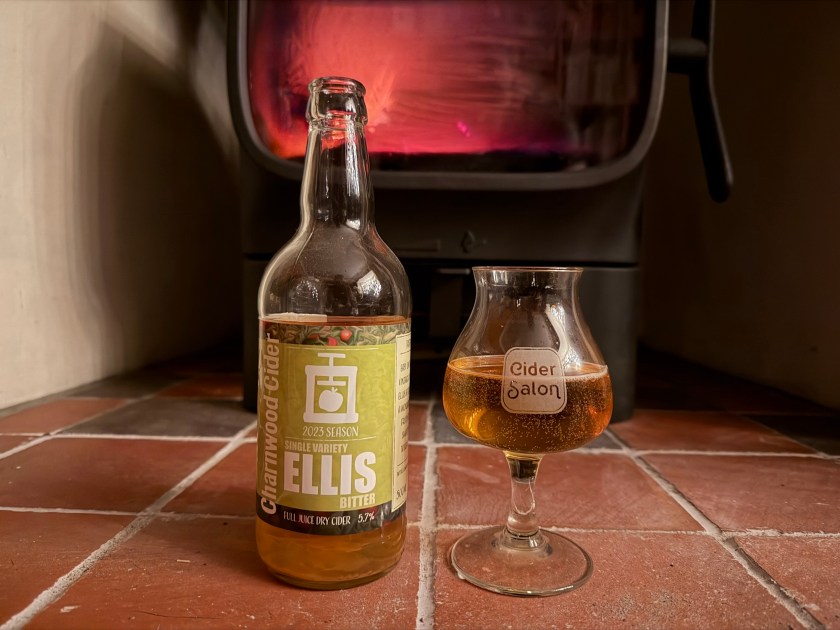
Charnwood Cider, Ellis Bitter 2023 Season – review
Andrew’s review
How I served: Out of the fridge for an hour
Appearance: Golden peach
On the nose: Green apple, aniseed and damp earth.
In the mouth: Soft tannin with some jangly acidity. Touch of sweetness. Orange juice.
In a nutshell: Perfect for a cold evening in front of a warm fire.
Jack’s review
How I served: An evening in the garage (an hour) and then poured.
Appearance: Near still, the merest hint of a hiss upon popping the cap. No mousse. Looking at a lemon gold, crystal clear cider in the glass.
On the nose: Homemade apple sauce with cinnamon sticks and a bit of ginger grated in for good measure. I’m getting Sunday Roast notes, a slight savoury aroma too.
In the mouth: There we go! Tannin is on the menu, thank you very much. Each sip starts juicy for a second and then it’s as if you’re also consuming a Nice tannic cup of Assam black tea. Bone dry. I’ve got that lovely medium-rough tannic texture on my tongue, teeth, and roof of my mouth. 5.7% abv and that is carrying a whole host of flavours. It’s neutral container fermented and matured, but it’s reminding me equally of certain whiskies like Oban, Old Pultney, and Bunnahabhain – namely an unpeated, leathery, saline note that can me very moreish when then mood hits you. I’m a bit of a whisky geek so these are my reference points, but the acid red wine drinkers amongst you can probably find a red wine that does similarly.
In a nutshell: The Tannin Force is strong in this one. A good cider to sip beside a bonfire in winter.

Little Pomona, Art Of Darkness 2021 – review
Andrew’s review
How I served: Out of the fridge for an hour
Appearance: Citrine
On the nose: Peach, plum and soft incense.
In the mouth: Stone fruit juice with soft fuzzy tannin all wrapped in and embrace from the barrel.
In a nutshell: Old faithful.
Jack’s review
How I served: An evening in the garage and then poured in the study (in a glass).
Appearance: Still presentation, cork & wax sealing the top of the bottle. No mousse, straw good with a luminous quality to the liquid.
On the nose: Dried apricot, Haribo Lemon & Ginger jelly drops, honeysuckle, jasmine.
In the mouth: The rich, fresh, active cask influence here from Cognac barrels with the Ellis Bitter, and wine-barrel with the Dabinett is adding a luscious lacquer to these two varietals that willingly offer up their tannic properties. Soft tannins at play here. I paired with an oven-cooked Salmon Fillet, coated in grated ginger and Henderson’s Sauce. Complimented each other effortlessly. 6.9% abv it’s half the abv of a regular bottle of jobbing wine, but matches, nay exceeds the flavour profile of many you’re going to find.
In a nutshell: A gastronomic cider to savour in the flickering candlelight.

Oliver’s, Fine Perry Prim And Proper – review
Andrew’s review
How I served: Out of the fridge for an hour
Appearance: Topaz
On the nose: Lime leaf, pineapple, rhubarb and damask rose.
In the mouth: Soft tannin and some tangy acids.
In a nutshell: Kiss from a rose.
Jack’s review
How I served: An afternoon in the garage to chill down a bit, then served in the study.
Appearance: Straw gold, slightest of hazes to the liquid. Despite what it says on the bottle, there is now a little bottle conditioning going on with a definite effervescence and a mousse which sits around the rim of the glass.
On the nose: Juniper and hard-boiled pear sweets, perhaps a little hint of Scot’s Pine needles too. Quite a festive aroma I must say, great for this Winter Solstice time of year.
In the mouth: Lovely to move onto some tannic perries, Gin being a variety I know I can reliably call on to bring the tannin to the party. A medium tannin presentation, they’re making themselves know, not in a Flakey Bark way, but not inconsequential either. Each sip of this perry leaves a very pleasant menthol, cooling effect on the roof of my mouth. Dry and juicy, this would work so well with Mexican food like tacos or burritos. At 5.3% abv, a gentle alcohol level in comparison to a glass of Chenin Blanc.
In a nutshell: A very accessible way to introduce beginners to the world of tannins in perry, made by a perrymaker at the top of his game.
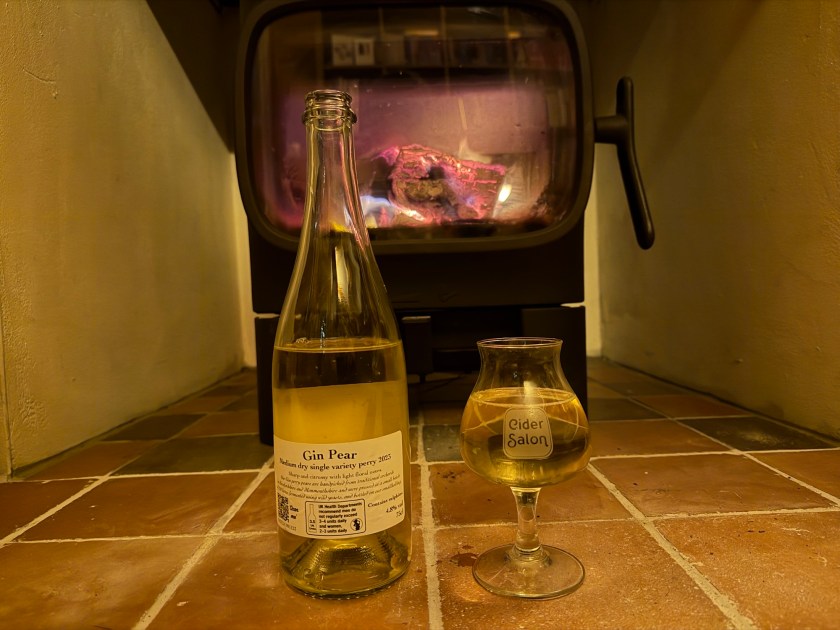
Cwm Maddoc, Gin Pear 2023 – review
Andrew’s review
How I served: Out of the fridge for an hour
Appearance: Blush
On the nose: Slightly floral, elderflower and mountain herbs. Honey.
In the mouth: Medium dry. Juicy acids and soft tannin.
In a nutshell: Delicate and clean.
Jack’s review
How I served: Evening in the garage, cellar temperature.
Appearance: Crystal clear, again straw gold hue, no effervescence and no sign of a mousse on the liquid in the glass. On the final pour from the bottle, 45 mins later, out came the perry diamond (as Little Pomona so poetically call them) of tannin.
On the nose: Lots of juniper, lime, and pear bonbons. There’s a certain aroma when you walk or bike past Poplar trees, this perry delivers that leafy aroma in plentiful supply. Green is the aroma.
In the mouth: Super clean delivery, vanilla and lime ice cream notes, much softer tannin across the palate, Werther’s Original meets Chocolate Lime sweets. I’d say a medium dry, there’s a very approachable quality to this perry at 4.8% abv. Again, Gin Perry and Mexican food, it’s a real winning combo!
In a nutshell: An elegant and quaffable lower abv perry. Long may this variety survive!

Balance Brewing, Yarlington Mill Season 2023 – review
Andrew’s review
How I served: Out of the fridge for an hour
Appearance: Burnt orange
On the nose: Red berries, dried fruit, vanilla, tobacco
In the mouth: Complex tannin. Soft, fuzzy and woody. Touch of lanolin.
In a nutshell: Barrels of barrel.
Jack’s review
How I served: A dreich day outside, wind rattling on the garage door, temperature never into double digits. Cellar temp by way of the garage.
Appearance: A rich, hazy, orange marmalade glow. Gentle effervescence and a small, stacked mousse around the rim of the glass.
On the nose: Yarlington Mill is already one of the most aromatic of cider apple varietals, and then you stick it in an ex-Bordeaux Wine cask to really ramp of the vanilla notes. It’s apple crumble with custard on top. Mulled cider alongside a vanilla ice cream wafer (the kind my Nan used to buy me when I was a kid).
In the mouth: There really is a good deal of effervescence to this, I can feel the bubbles popping inside my mouth with each swig. This is quite reminiscent of an Oliver’s Yarlington Mill, just on the right side and levels of volatile acidity here (perhaps from the barrel having contained wine rather than spirit before?). A fruity, jaggedy tannic development, not a world away from Temple Cider’s Coat Jersey SVC, but juicier. There’s that menthol cooling effect again I get from some tannic ciders and perries, resting on the roof of my mouth. A small sip goes a long way, it’s really beautiful, and at 8.2% abv, generous with the fruity, autumnal, orchard floor notes it imparts.
In a nutshell: The next iteration of barrel-aged ciders from Balance are ones to seek out! Yarlington Mill to float nearly everyone’s boat.
Cover image: Pear tree at dusk by Barry Masterson.
Discover more from Cider Review
Subscribe to get the latest posts sent to your email.
 Cider Review