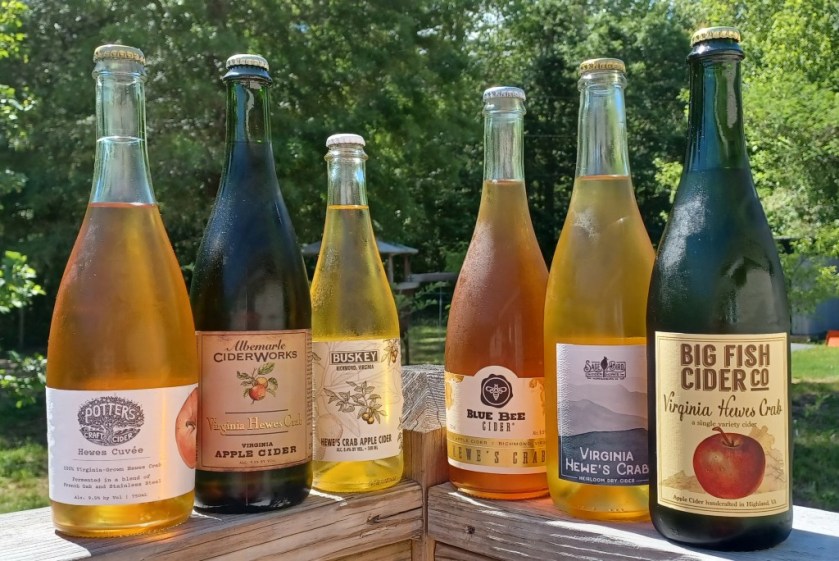
In the wonderful world of cider in Virginia, there is perhaps no more iconic apple than the Virginia Hewe’s Crab. For some Virginian cidermakers it holds a similar standing to Coloradonna or Solarina in the Basque Country, in that it is the epitome of a truly Virginian cider.
It is thought that Virginia Hewe’s Crab is a cross between a European apple variety and the native North American crabapple, malus augustifolia. Some of the earliest references to the apple come from Thomas Jefferson, who was himself an avid fan of the variety and stocked his North Orchard at Monticello with this, and the now lost Talliafero apple, exclusively for his cider production. In writing to James Mease of the, grandiosely monikered, Philadelphia Society for Promoting Agriculture, Jefferson noted that it was a “common apple on the James River” [which runs from the Blue Ridge Mountains in the west to the Chesapeake Bay on the Atlantic coast]. Jefferson also recalled that it had already been known by the name Virginia Hewe’s Crab since at least the 1710s, though sometimes spelt “Hughes'”.
The apple itself is small, little more than a few centimeters in diameter, and when fully ripe is red with streaks of green, as well as white spotting. Jefferson described pressing the juice from the apple as being like “squeezing a wet sponge”. Virginia Hewe’s Crab is prone to watercore, indeed this characteristic is something that cider makers throughout the US seek out as the sorbitol created adds some balance to the acidity of the apple.
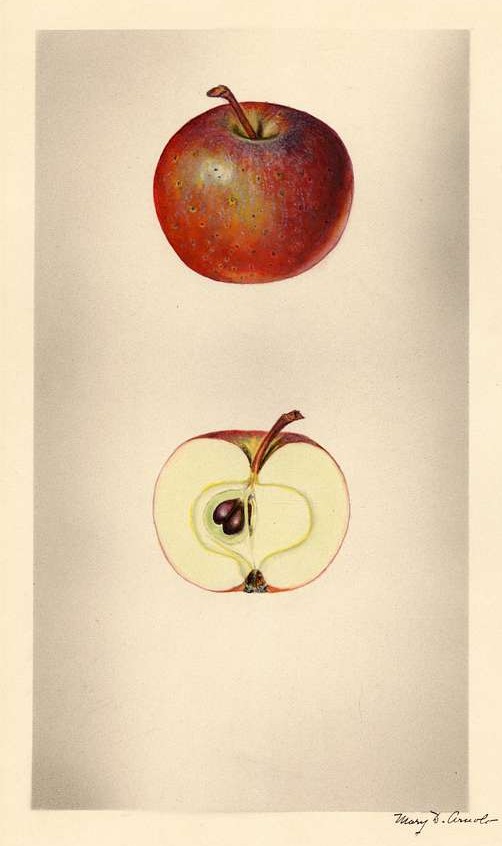
Having been the backbone of Virginia’s cider production through the 18th and 19th centuries, Virginia Hewe’s Crab survived the predation of Prohibition’s zealots as a rootstock variety. The renaissance of “hard” cider, that began in the early 2000s, has seen its revival as a cider apple, both in blended ciders and as a growing number of single varietals.
Virginia boasts various apple growing regions, the gently rolling hills of the Piedmont, the idyllic Shenandoah Valley, and the mountainous realms that form part of Appalachia in the South West. Each region has its own climate, bedrock, and altitude, which inevitably impact the fruit grown there. The Virginia Hewe’s Crab is grown wherever there are orchards in Virginia.
So it was, with this in mind, that I went on a shopping spree to gather examples from around Virginia, and gathered a few friends to help me polish off the 6 bottles that made it to the tasting.
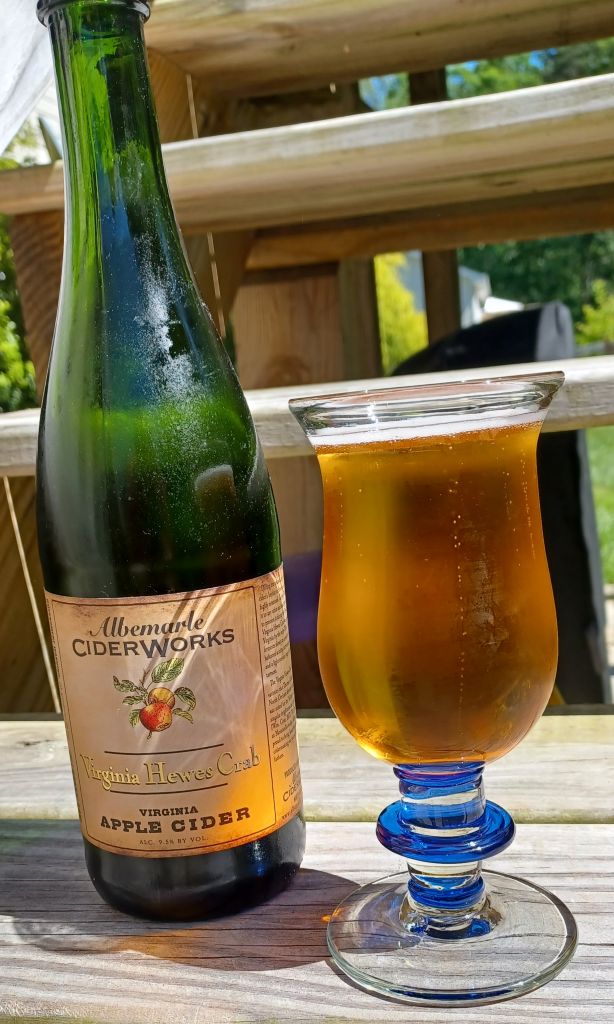
Albemarle CiderWorks: Virginia Hewe’s Crab – review
How I served: straight from 13°C fridge
Appearance: The cider pours a rich amber, beautifully clear, with a fine carbonation creating a thin layer of foam that quickly dissipates.
On the nose: Straight out of the gates is a delicate citrus aroma, straddling the line between lemon and Key lime. Following along are notes of pear drops, and perhaps a hint of vanilla, that really reminded me of getting a quarter pound of boiled sweets from a glass jar in a sweet shop.
In the mouth: In common with all of the Sheltons’ ciders, this is decidedly dry, with a lovely acidity that presents, again, as lemon, though perhaps with a hint of floralness making it more lemon blossom. Our friend the pear drop almost makes an appearance, though lacking the vanilla from the nose. The cider is fruit forward, with a hint of drying tannins, and a minerality in the finish that just begs you to drink more.
In a nutshell: At 9.5% abv, this cider almost has no right to be as easy to drink as it is. Yes it is dry, but being so complex and fruit-forward makes it a delight to sit on the deck in the sun before realising you’ve polished off the whole bottle.
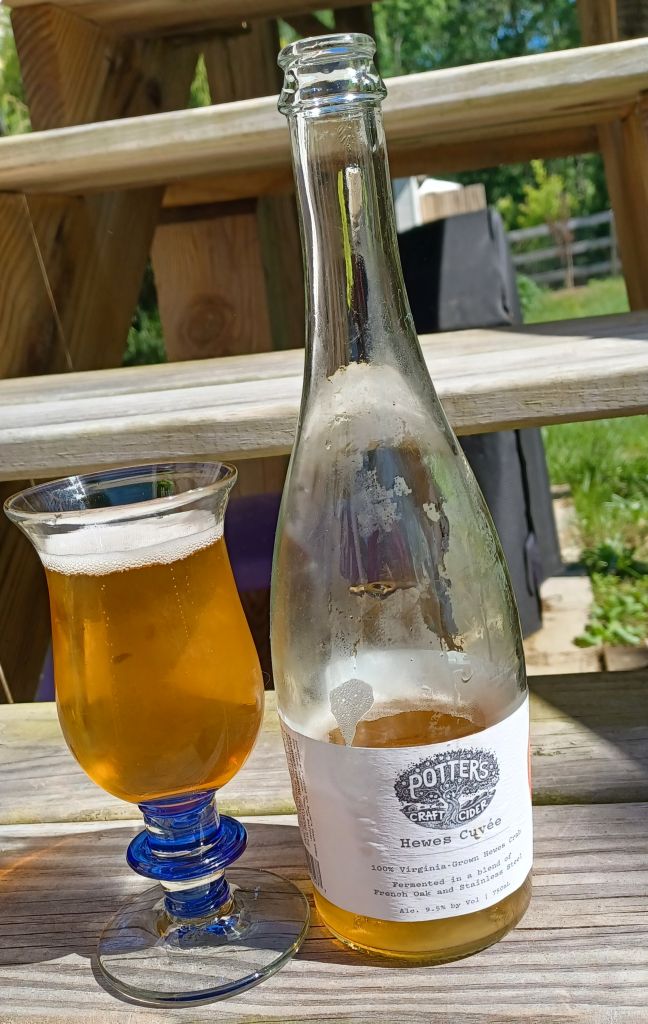
Potter’s Craft: Hewes Cuvée – review
How I served: Straight from 13°C fridge
Appearance: Pouring a rich golden, with copper highlights, the champagne style carbonation creates a half centimetre of head that fades to a schmeer pretty quickly.
On the nose: Where I was expecting the classic hit of citrus, this cider was notably spicy in aroma, in particular a cinnamon character that made me think it would be a lovely pairing with fruit cake. Having been aged in French oak barrels, as well as stainless steel, there is a noticeable wood character.
In the mouth: The spice notes from the aroma carry over, and are perhaps more prevalent, in the taste department. In addition to the cinnamon notes, there is a ginger-like zing, as well as some cardamom, I assume from the oak, wisps of white pepper flit in and out. Eventually though the fruit makes its way through, presenting primarily as pear, with a hint of banana in the background.
In a nutshell: This is a deeply complex cider, whose champagne style burst of bubbles, lifts the flavours whilst scraping the palate clean with each mouthful with its drying minerality in the finish.
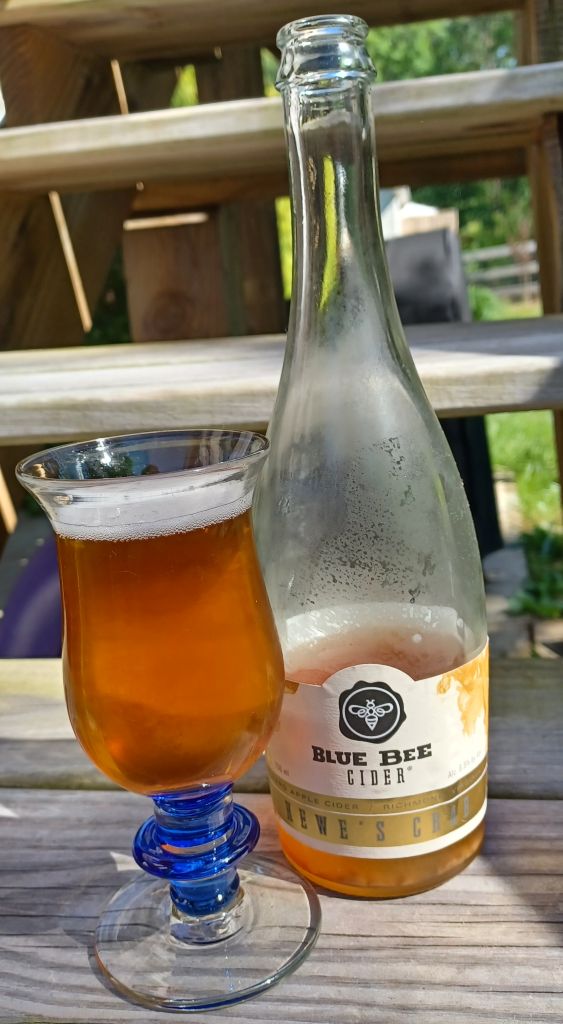
Blue Bee Cider: Hewe’s Crab – review
How I served: Straight from 13°C fridge
Appearance: Ok, so this might sound marginally insane, but as I poured this cider into my glass, it foamed just enough to give it a decent head, that for a moment made it look for all the world like Pilsner Urquell.
On the nose: Here there is a very definite aroma of butterscotch or perhaps dulce de leche, something that is perfectly within the bounds of possibility with Virginia Hewe’s Crab.
In the mouth: This is a delightfully juicy cider, in which the full expression of the apple almost runs amok. At turns there is a banana flavour, soon followed by hints of pear and some lemon as well. Given Virginia Hewe’s Crab tendency to watercore, there is a sweet structure lingering in the background that more and more made me think of apple strudel.
In a nutshell: Bursting with flavour, and a little lower ABV, “only” 8.5%, this GLINTCAP 2025 Gold medal winner is an afternoon sipper by the fireplace.
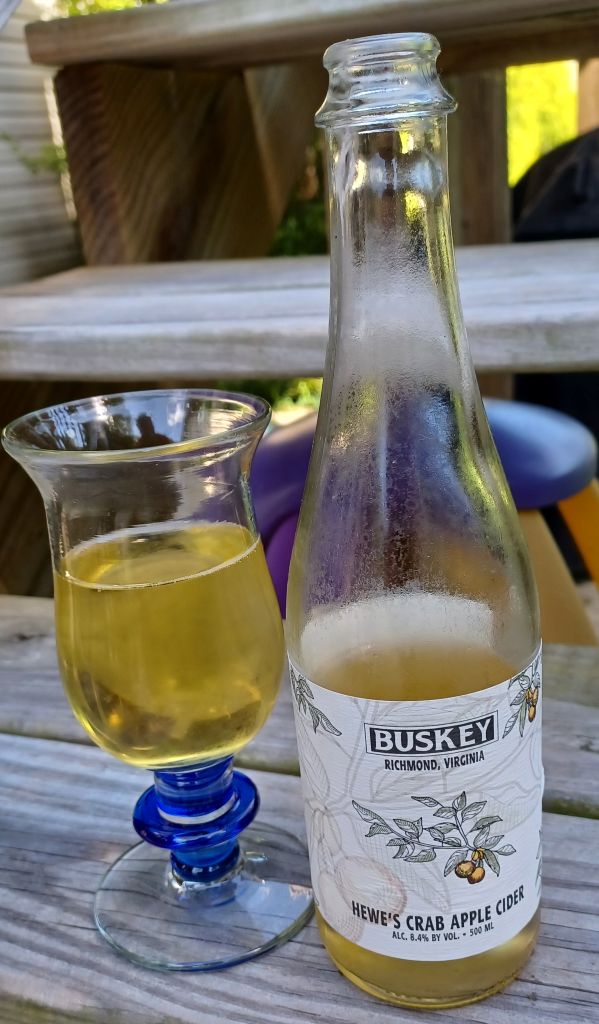
Buskey Hard Cider: Hewe’s Crab Apple Cider – review
How I served: Straight from 13°C fridge
Appearance: Pouring a pale straw yellow, this cider is beautifully clear, with just enough carbonation to raise a fine, thin, foam that falls back almost as quick as it rose.
On the nose: Imagine the scene, if you will, of being sat in an Alpine lodge in early spring as the wild flowers in the meadows are in full bloom. A gentle breeze wafts the scent of hundreds of wild flower varieties up to your nose. That, just that.
In the mouth: Zing, the acid is front and centre here, and it is stunning. Surprising notes of sour cherries and bright apple vie for attention. The classic flavours of Hewe’s are there as well though, mainly presenting as fresh pear with a hint of butterscotch sweetness. The tannins that are there are very subtle, almost like drinking very milky tea – don’t worry there is nothing milky about the flavours, just the perception of tannins.
In a nutshell: 8.4% and my only gripe is the size of the bottle, I wanted more than 500ml.
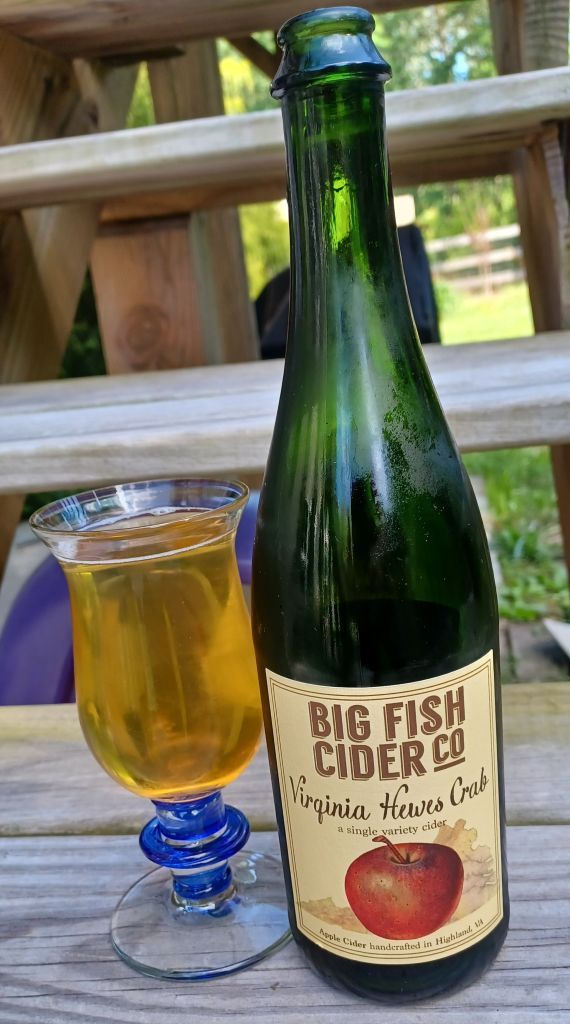
Big Fish Cider: Virginia Hewe’s Crab – review
How I served: Straight from 13°C fridge
Appearance: This one pours a light golden colour that is crystal clear.
On the nose: Flowers, lots and lots of flowers as well as some gentle butterscotch notes that linger in the background as the floral notes take the stage and steal the show.
In the mouth: There is a very defined citrus character to this offering from Big Fish, a pleasing blend of limes and lemons, set off by a green apple flavour that brings even more brightness. While the acidity is front and centre, there is a strong supporting cast of cinnamon spiciness coupled with stone fruit, mainly peaches. The finish is clean, dry, and leaves you wanted more, lots more.
In a nutshell: One of life’s most happy accidents, this 8.4% cider was originally intended for blends, but was too good not to let it shine alone.
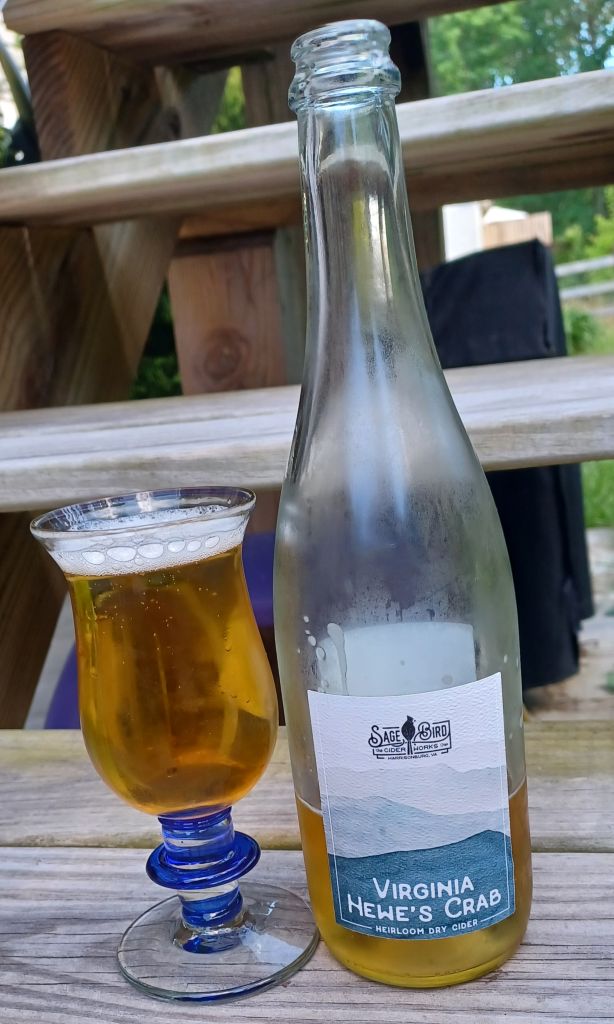
Sage Bird Ciderworks: Virginia Hewe’s Crab – review
How I served: Straight from 13°C fridge
Appearance: This pours a lovely burnished gold, almost like the leaves of a hickory in autumn, glowing in the forest.
On the nose: A rather complex set of aromas rise from the glass here, there is a bright spiciness that makes me think of lemongrass, some delicate sweet caramel notes, and even a deep, rich, trace of old leather.
In the mouth: The bright acidity you expect from the aromas of the cider come through beautifully in the drinking, this is a zippy cider that zings from mouthful to mouthful. The bright apple and citrus notes are on full show here, and in the mix is a sweetness not entirely unlike my favourite Scottish sweet, tablet. Binding it all together though is a delightful earthiness that pulls the acidity back from racing off into the atmosphere.
In a nutshell: Delightfully acidic and dry, perfect for pairing with a Farmhouse Cheddar or duck breast prosciutto.
Conclusion
Many of the cideries that dot Virginia from coast to mountain, urban and rural, make a single varietal with the Virginia Hewe’s Crab, the 6 presented here were just the ones I happened to have knocking about in the fridge. Plain to say that I am a fan of Virginia’s native apple, especially for that bright acidity and spicy notes that characterise such ciders, regardless of which region the fruit itself was grown in. Given that the majority of cidermakers in Virginia buy in at least some of their fruit, it is difficult to pinpoint exactly which terroir the fruit came from.
It never ceases to amaze me though that cider makers are able to take a single variety and bring their own perspectives and processes to bear, creating distinct ciders that don’t blur into a single flavour profile. While the goal of this tasting was not primarily to pick out a “winner” – all 6 are fantastic expressions of Virginia Hewe’s Crab after all – I did ask the group of folks I had gathered to tell me their top three, to which I assigned a points value, 10 for top, 5 for second, and 2 for third. The overall preferred cider was Big Fish Cider in Highland County, way up in the mountains on the state line with West Virginia, and one of the best cideries in Virginia today.
References:
Arnold, M. D. (n.d.) Malus: Hewes. [online]. Available from: https://handle.nal.usda.gov/10113/POM00003580
Discover more from Cider Review
Subscribe to get the latest posts sent to your email.
 Cider Review
Thanks Alastair, a very nice and informative article. Just for my own curiosity I would like to have known about secondary methods for these ciders: carbonation vs sparkling, pet nat vs disgorged, malolactic, dosage if any. Here in Massachusetts I’ve been a bit disappointed with my Hewe’s. Which I suppose reinforces the case for finding apples best adapted to your local conditions. My Hewe’s trees are not prolific bearers, the fruit has great flavor when fermented but has a very narrow window to harvest at its peak sugar which can be 18 to 20 brix as evidenced by the high abv of the ciders you tasted. The flavor soon fades into dry mealiness if not picked at the peak and too acidic if picked early. Our acidic gravelly soils here are generally pretty different than Virginia soils so that could account for a lot. I especially applaud you and CR for drawing attention to fine American ciders with the emphasis on regional character.
Cheers! Steve Garwood
Ragged Hill Cider Company LLC
LikeLike