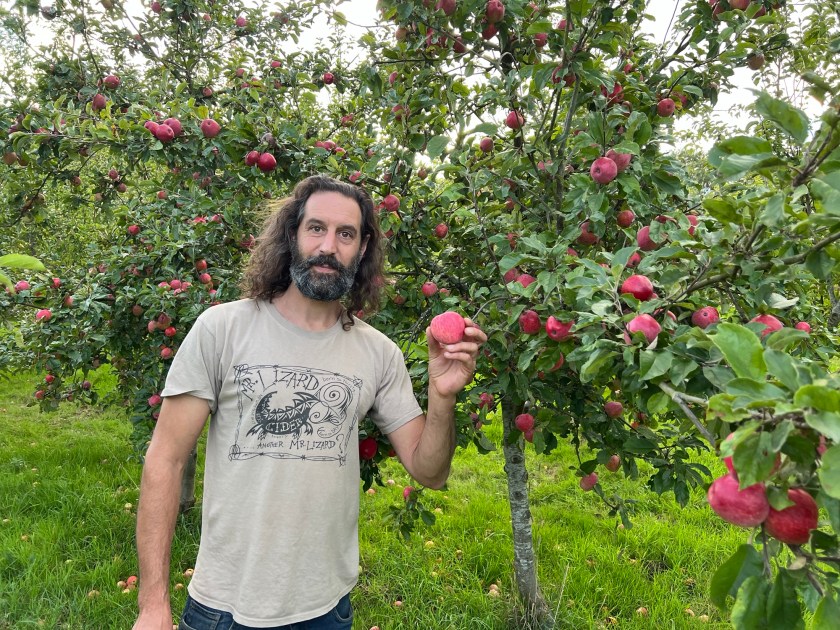
It’s a real privilege to visit an orchard during harvest time. The trees are laden with fruit (if you find yourself walking around in an “on” year). The ambition and purpose of the trees being planted in this particular spot, that may now be marked as an orchard on OS Maps, is now realised and quite literally bearing fruit for all to see. Quite often in veteran and remnant orchards I feel a similar energy and atmosphere to visiting the ruins of buildings: half fallen down Abbeys, pulled apart after the Reformation of Henry VIII’s time as monarch; or abandoned bothies, farmhouses, and settlements in Scotland, ripped apart after the brutal Clearances which still leave landscapes depopulated and stuck in time. The sentinel trees which still stand in remnant orchards remind us of an unnamed farmer and friends, now long gone, that 200+ years ago, took the plunge and committed to planting X number of varieties of apple and pear trees on their land. The trees have long outlived the farmer or landowner. They stand as reminders of a different century, an alternative agricultural attitude, an approach to the passing of time which is on a different scale to that which we experience in our lifetime (I’m thinking of that scene in Interstellar here where Matthew McConaughey goes down on planet with drastically different gravity, and years pass in the relative minutes it takes him to get back up to his spaceship). A visit to Jessica Deathe’s orchard in Monmouthshire, or Oliver Mann’s orchard nearby in Marshland St James fills me with this lovely, nostalgic, wistful thoughts of orchardists long gone.
Conversely, it’s still very rare an opportunity that you get to meet the person/persons who planted an orchard of 20/30/40 years of age. I am good friends with Mark & Lisa of Whin Hill Cider here in Norfolk, but they’re the second generation tending this orchard that was planted mid-1990s. The same with my friend Ben’s orchard down the road from me: the Polish Lock Keeper that came to visit him in the late 1990s with trees, after also planting an even bigger cider apple orchard near the town of Thetford (that Crones Cider thankfully now use) tragically died in a car accident a few years ago. The questions I would love to ask him about the where and the why of his selection of trees! This is all to say that if you get the opportunity to meet someone who planted an orchard a few decades ago and is enjoying making cider and perry from that orchard now, embrace that experience for it is a rarified thing in life.
After doing a BIB run of Whin Hill, Crones, and Toye’s Cider to Nottingham Beer & Cider Festival earlier in October, I had just that opportunity to seize. Rob Clough, the man behind Charnwood Cider, a regular visitor to Ross Cider Festival, friend of Rob Castle from university days, all round lovely arborist, invited me to his orchard in the middle of what has proved to be quite the Harvest 2025. Not only are the trees heavily laden, but the media opportunities also surrounding this mast year, and all the ensuing higher specific gravity juice produced from it, have congregated in a heart-warming way on this brilliant small-scale cidermaker from Leicestershire. And you know what, it couldn’t be for more deserving a figurehead for the kind of cider and perry-making that we love here on the digital pages of Cider Review. From the BBC, the Daily Telegraph, Somerset Live, to other local media outlets, all we need now is Rob to get an interview with The Grocer and certain “conversation-starting”, highly irritating comments from larger producers who should tread slightly more carefully given their scale, could be addressed by the kind-hearted, cidermaking arborist of Charnwood Forest. We’ve reviewed a few of Rob’s earlier releases on Cider Review, Chris took a look at his single variety Browns releases and here, whilst Adam reviewed a swathe of 2019 & 2020 releases. This year, Rob embarked on releasing a number of 750ml bottles for the first time, alongside his usual 500ml and BIB offerings. With an invite to tour his orchard, the stars aligned for the following orchard in-conversation. Enjoy!
CR: I’m here on the edge of the Charnwood Forest near the city of Leicester with Rob Clough from Charnwood Cider. How are you doing?
Rob Clough: Very good, thanks.
CR: How long have you been making cider and perry for?
Rob Clough: I’ve been making cider for about 20 years now, but 15 years commercially. This will be my 15th harvest.
CR: When you make cider this way, which is seasonally and full juice, you only get one chance every year to make it. How do you feel in your 15th harvest? Are you different to the Rob of 15 years ago?
Rob Clough: Very much so. I went commercial with a thousand litres, which is quite a small scale. I’ve got more space now, but not enough, because I’m forever juggling space. What I do for work, outside of cidermaking, has changed, I’ve got a bit more free time now, I can take my time a little bit, picking fruit when it’s ready a bit more. When I started out, we used to go around local orchards, we’d grab everything, regardless of what variety it was. Now, as you’ll shortly find out, I’ve got a lot of cider fruit, which I didn’t have access to back then. So it’s a different course of action.
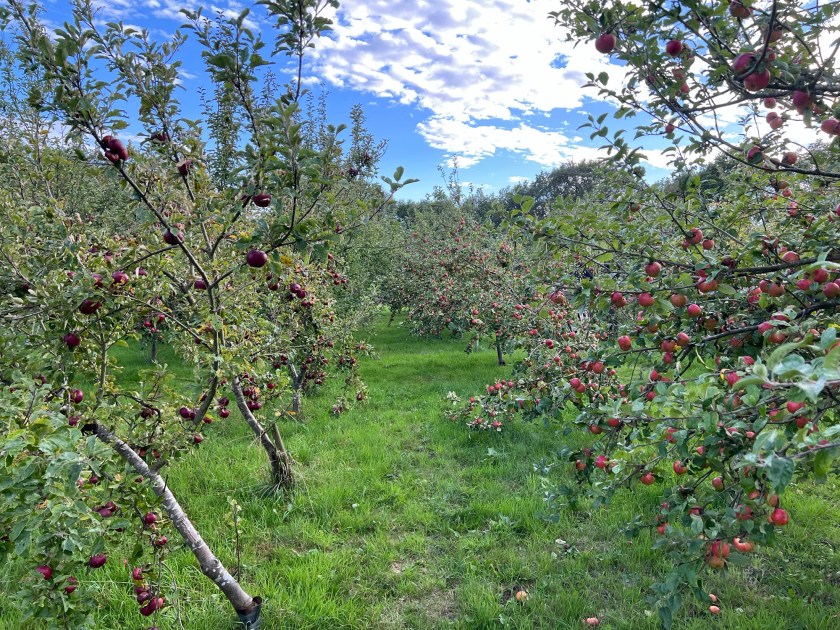
CR: We’re stood here right on the perimeter of your orchard. Tell us a bit about this land and how you came by it. Was it the orchard already, or is this all your handywork?
Rob Clough: This is all my handywork. These are all trees that I’ve grafted. I think there’s six or seven trees in total in the orchard that I bought in, everything else are trees that I’ve grafted.
CR: How old are they now? They look in brilliant shape.
Rob Clough: These will be 15-16 years old. I planted the first hundred and I’m the first to admit, there’s a lot of mistakes I’ve made. This here is a Danish apple called Elshof. My brother used to work on an apple farm in Denmark and sent me a load of cuttings over. I can’t really find much reference to it. I think it’s a sport of Elstar. It’s quite a late variety. They’re all still on the tree (at the start of October). It’s a really nice eating apple. Very striking deep burgundy colour to it. Absolutely beautiful.
CR: What rootstock are we talking about with all these trees?
Rob Clough: They’re all on MM106, which is a kind of semi vigorous rootstock. You might notice that on a lot of these trees, they’re not actually very big. When we go over to another patch of the orchard where I planted the first 100 trees you’ll see a difference. The second batch of trees I planted around 200 the year after. We’re on thin soil here, there’s a lot of clay and the mistake I made was having a local farmer coming up with a mini digger to dig holes, and then I backfilled them with compost and some soil that I acquired – thinking it would give the trees a good start. Actually, I think what’s happened is by digging into the clay, it creates a bowl. So when it’s wet, the trees get wet legs. The rest of the trees are just literally spaded them in, you know, make a slot on the ground with a spade and those trees have grown so much better.
CR: Do you find apple trees are funny about having wet feet? Pear trees can almost do anything. They don’t really care. They can be on rocky terrain, wet terrain.
Rob Clough: Well, I don’t know a lot about pear trees. I’ll show you my little pears down here in a minute. In the last few years, I’ve got a bit more interested in pears and perry, but I would say I’ve always been more of a Cider man. A lot of these varieties I’ve got here, they’re all cuttings from Broome Farm, Ross Cider. When I first started making cider, my friends and I didn’t really know much about cider varieties. We used to go to local beer festivals, and there was a guy called Mark Shirley used to make Rockingham Forest cider, it’s down the road from here, not far away. He used proper cider apple varieties, and he made a Blakeney Red perry too. He was a bit of an inspiration. We were making cider out of local fruit. I went on holiday down to Ross on Wye with my girlfriend at the time and came across Broome Farm. I think I’ just gone commercial. They said they had a cider festival, so me and my mates all went down later on that year. I was speaking to Mike Johnson and asked him “Can I come and get some cuttings, because I wanted to grow my little business please.” So most of the varieties I’ve got here in this orchard are ones that Mike said “Oh, you probably want some of that. You probably want some of those. You probably want some of this one.”
CR: An orchard curated by Mike Johnson, that’s lovely! A really nice link between different generations and different cider makers in different regions.
Rob Clough: Obviously, I’ve got Ball’s Bittersweet, which has the whole story about it being Not Ball’s bittersweet. My Ball’s Bittersweet stems from their trees. So, it’s also “Not” as well.
CR: So yourself, Albert Johnson and James Forbes now have all got this DNA oddity!
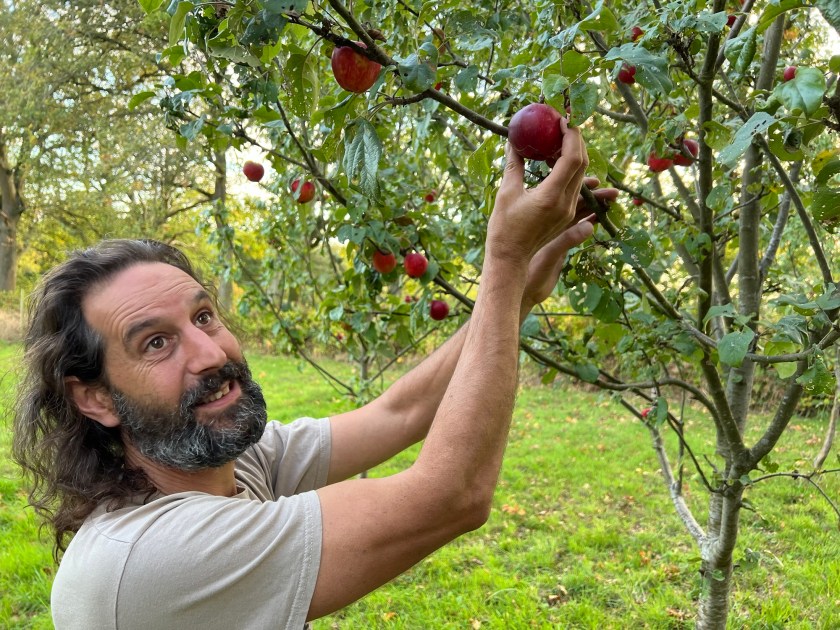
Rob Clough: Yes, but it makes a cracking cider. I’ve actually got another of row of it in the new orchard further down the lane, in which I’ve planted another 200 trees. These are Harry Masters Jersey. It’s always a nice colour. Some of them are really big now.
CR: And you’re not going to cut all these down and top graft them like the top-grafting project at Ross Cider? You’re keeping them?
Rob Clough: I want to keep them absolutely! I’ve got one tree down at where my cider barn is of Harry Masters Jersey – there’s a horse manure pile next to it, and the fruit is massive! Those trees down there were planted the year before these, so they must be 17 years old.
CR: Have you done much formative pruning to these to get them into the shape that we see today?
Rob Clough: I’ll point out as we go around, I can show you a lot of how not to prune trees. I’ve learned an awful lot. For my main job, I do tree work, but pruning fruit trees is a bit different than forestry and tree surgery. This is my one Sweet Alford tree. It’s got a decent amount of fruit on it. I’ve only ever done a single variety of once a couple of years ago, and I wasn’t really that taken with it. There’s loads of fruit on the floor already. This year’s not so bad, but normally I get loads of slugs up here. If I leave the fruit on the floor, it won’t be there in after a week.
CR: That contributes to the natural ecosystem you’re building here, more slugs, then more thrushes and other birds around and then, there’s a balance.
Rob Clough: These trees here are the ones I brought in. Those three are Tremlett’s Bitter, and I’ve actually shaken them all out now because there were so many on the floor. The pips were really dark, so I’ve done a blend. These two trees here are Fillbarrel. I don’t know why they’re called that, because I’ve never had enough to fill a barrel.
CR: It’s looking good right now, this could be your first year!
Rob Clough: There’s quite a lot on the floor. You’ll find that some apples keep a lot better than others. The Not Ball’s Bittersweet seem to keep really well, because I’ve had a couple of sacks with stuff off the floor. They were in sacks for a few weeks, and not many of them weren’t bad at all.
CR: What’s the history of cider making around Leicestershire then? I know nothing about this area and cider. Are you making the history by actively planting orchards? Are there many other orchards going in, or is this quite uncommon for this county?
Rob Clough: There’s a few orchards around here itself. There’s one down the road, Thirsty Farmer, his family’s from Somerset, and they make cider. I think they now class themselves as a Nottinghamshire cidermakers. There’s Hallaton Bottle Kicking Cider Company, who’ve been going probably a similar amount of time to me. They’re a bit more commercial in that they do a lot of lower percentage abv, flavoured ciders. There’s also Simply Cider, who again, does a lot of fruit ciders. Then obviously there’s Sidentro over near Melton Mowbray.
CR: Ah they’re around here! It seems like yourself and Sidentro are in a similar position in terms of styles of cider you’re releasing. Does it feel a bit lonely making cider in a county where there aren’t that many other cidermakers releasing a product like you are?
Rob Clough: When you look at it as the East Midlands, there’s a fair amount of producers, and we all know each other quite well. I’m good friends with Hannah and Kev from Kniveton Cider, who are just up the road in Derbyshire. Ray Blockley from Torkard, he’s been making side for 30 years, and just retired from it. Leo and Emma Blue Barrel Cider. I was over theirs (now in Cambridgeshire) the other day. I went and helped Leo pick some of these wild pears on massive trees they’ve just got access to.
CR: Did you come to the Cambridge Cider Club?
Rob Clough: I did the Cambridge Cider Club with them yes. I shared some drinks with them, they’re a good bunch, nice informal evening. I shared my first Perry there. Leo’s like my cider brother. We always joke about this. His orchard is a similar age to mine. He’s not actually been over to see my orchard yet. It’s very interesting to see how the trees look and how different they are between Leicestershire and Cambridgeshire. I mow my orchard and strim the grass the trees around three times a year. Their orchard is a bit more wild in that regard. We’ve both been going a similar length of time, so we have this working relationship.
CR: I think it’s important to pinpoint these cider and perry-maker that are of a similar generation. You can have family farms that have been going for five generations, but you can also have the school of 2010, and there are a certain number of cidermakers that have kept going from that time.
Rob Clough: There’s not many cidermaking families, ones that people have passed it on to their children, in this area, the East Midlands generally. I’ve also got Luke from Monkey Bridge, and Alistair Smith, from Sisson and Smith’s, small scale producers.
CR: Multi-award-winning Alistair Smith!
Rob Clough: Multi-ward winning Alistair yes! Goodness me, he was cleaning up at the Malvern Autumn Show! He does really well, obviously knows what he’s doing! These here are an apple called Ingrid Marie. Again, this is a Danish variety, but interestingly, the parents of the tree, are Cox’s Pomona and Cox’s Orange Pippin. I pressed this variety a couple of years ago, just a demijohn as an experiment, and it actually made it quite a good dessert fruit cider. I’m going to do it again this year, but a bigger quantity, because I’ve got five trees and I’ve actually got a new row down there too.
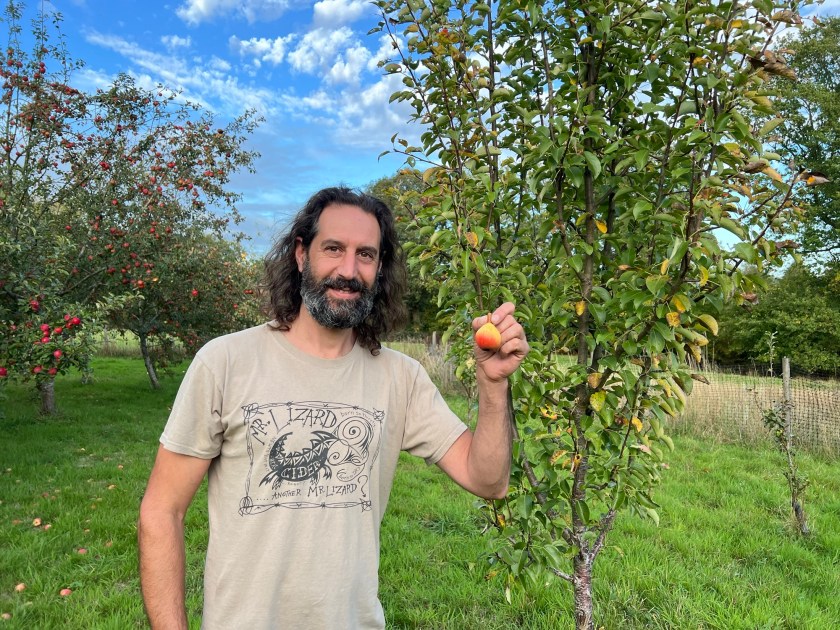
CR: And what’s behind us here? Do I spot some pear trees?
Rob Clough: These are pear trees. I’ve got five different perry pear varieties, three of each. These are four or five years old. They’re all trees I bought in, and they’ve all got really bad canker. I’ve been advised by somebody that the tree might push it out and it looks like it might push on past it. They’re about 12 foot tall now, and as of yet, I’ve never had any fruit on any except my Brandy, which I think has mostly dropped now.
CR: If they’ve only been in for five years, you’re just about to hit the sweet spot in the next year or two where they all start producing fruit!
Rob Clough: I’ve got Thorn, Brandy, Barnet, Thurston Red (otherwise known as Dymock Red) and Blakeney Red.
CR: Was it Mike Johnson that advised on these varieties as well?
Rob Clough: I went to a catalogue and picked some out. Blakeney Red, Brandy, and Thorn because I’ve heard of them. Thurston Red and Barnet I hadn’t heard of.
CR: Do you get any hedgehogs here for Barnet? It’s known as theHedgehog pear because of its russeting on the skin.
Rob Clough: No actually, I never see hedgehogs around here. Never see them. There’s a lot of badgers around. I think the badgers may eat hedgehogs. The next load of pears are the Charnwood Perry Pear. It’s a wild pear that I’ve grafted. I’ve got a couple of potential names for it. They have thorns on them and it took three attempts grafting them. The first year, not many took. Second year, all my cuttings dried out, and third year, I had a good success rate, so I’ve got maybe 20 odd little wild pear trees. Now, I’ve had one bite of one pear once until this year, so twice now, and it’s super sweet and super tannic. So I thought that might make a nice perry.
CR: Where did you find this pear? What’s the story?
Rob Clough: It was growing in an industrial estate in a village down the road, where my mate works and he told me about it. There are bushes under all of it, you can’t get the pears off the floor, you can’t get in under the canopy. There are thorns over it all and the rest of it is over tarmac, so they sort of get driven over and smashed. I’ve never actually been able to collect enough pears from the mother tree. It’s a pure gamble.
CR: This is exactly along the lines of the in-conversation I had with Tom Oliver at Perry Fest 2025 the other week: By Chance or by Design! By chance you find this pear in an industrial state, but now by design, you’re about to grow it in a commercial manner on grass that will allow you to harvest the fruit. Brilliant!
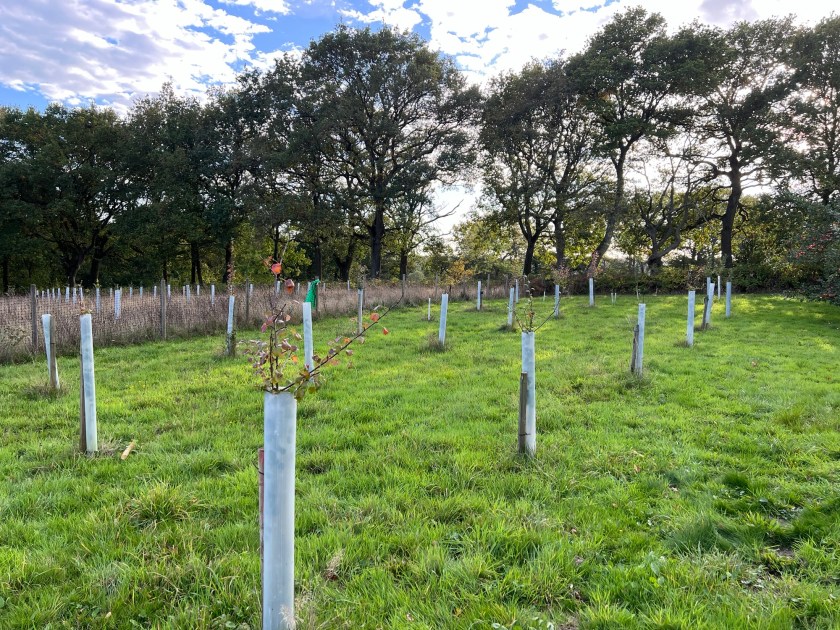
Rob Clough: Exactly! Here we have as well Ellis Bitter. My single variety Ellis Bitter from 2023 was super soft, soft tannins, absolutely one of my favourite drinks from 2023 and great on its own. So obviously every year’s going to be slightly different. Here we’ve got Dabinett, Dabinett, Dabinett. I’ve got over 50 Dabinetts, which is a lot. They’re all quite bushy as well, they tend to tip over on the top. These are Major. It can make a cracking cider. That’s Foxwhelp over there too.
CR: 15 years on, are you happy with your selection, your ingredients list for your ciders, or are there other cider varieties that you’ve encountered on your journey that you’d like to add in?
Rob Clough: I haven’t got any Yarlington Mill in here, but I have in the new orchard down the lane. Obviously, a truly great cider apple. I’ve got 40 young trees down there. So that’s one I wish I’d put in earlier. I’ve made it with other people’s apples a few times and it’s cracking, absolutely cracking. Kingston Black is another classic cider apple, which I don’t have. I don’t have many sharps, I’ve mostly bittersweets, probably because I can get dessert and culinary apples quite easily. This row here, Browns apple. This variety doesn’t get enough praise. I love it. It’s great for blending in with other stuff. After the wind we’ve had, there’s a lot on the floor now.
CR: Are you hand-picking your fruit?
Rob Clough: Handpicking everything. I grade the fruit when I’m picking. I then sort again before pressing and chuck any ones that have gone bad since I’ve picked them.
CR: What’s your production style? Are you using rack and cloth, cheeses and a hydraulic press?
Rob Clough: Yeah, rack and cloth. It’s a press that me and my friend designed; he worked for a hydraulics company. We designed the size. We over-specked it, which was a good thing in the end. We got it fabricated and built it. It’s based on an old cable trailer, so it could be wheeled or towed with a vehicle. In one pressing, if it’s dessert fruit, I can get up to 250 litres of juice. If it’s cider fruit, I often don’t quite fill a 220-litre barrel.
CR: Are you pitching with a yeast or wild ferment?
Rob Clough: Wild ferment. In the whole time Charnwood Cider has been going, I’ve never added a cultured yeast, and I’ve never sulphated either
CR: In plastic or a mixed of plastic and oak barrels?
Rob Clough: Just plastic I don’t have space for oak barrels. I’d like to experiment with it, but I just don’t have space. Just blue plastic barrels and blend into an IBC. I don’t ferment in an IBC. I do 60 litre barrels and even do 30 litre buckets. In 2023 when I last had a bumper crop, I did lots of demijohns as well. I made maybe 30 single variety ciders that year.
CR: If your orchard’s going slightly biennial, is it the odd years for you that are your “on years”, namely 2023 and now 2025?
Rob Clough: At the minute yes, but trees like Somerset Redstreak, I’ve found that not all the trees are in-synch with each other. I’ll have one or two on this row, which I’ve got bumper crops on this year, and then there’s a little bit of fruit on some of the others, and then the next year it will be the other way round. My Browns apples also have all got fruit on this year.
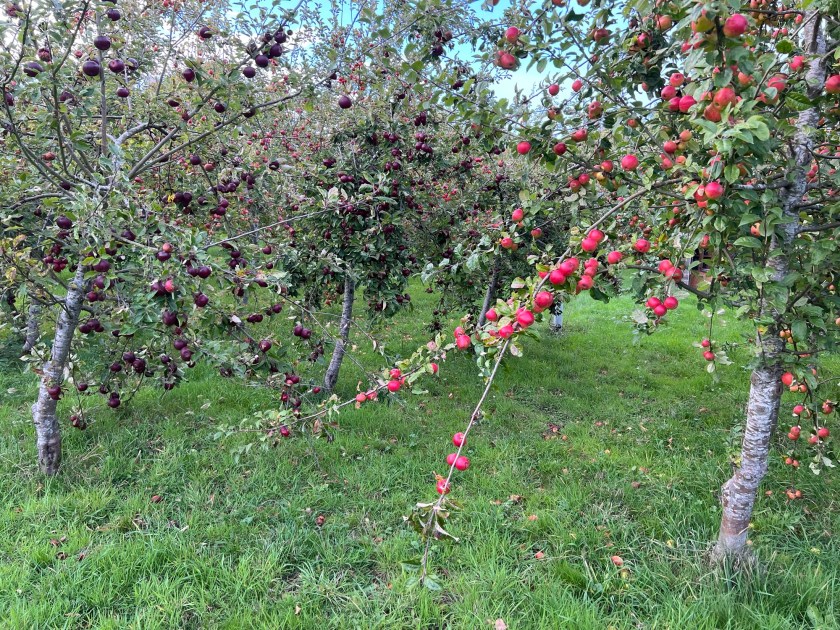
CR: The history and selection of these cider apples, to come out of counties that are hundreds of miles away, and be trusted by growers on the other side of the country – they must have some inherently good qualities don’t they? And for every travelling, widely adopted variety nationwide, there will have been a hundred other varieties that just stayed local, just stayed with a few farmers. I guess the farmer may never have wanted to give graftwood away to their friends…
Rob Clough: Let me show you these trees. These are one of my favourite varieties, and there’s a little story connected to Broome Farm with these too. So, these are Knotted Kernel. I’ve been picking these off the floor. In my experience, they’re normally tiny little apples. They’re huge this year! My original Knotted Kernal tree and is 16/17 years old, by my cider barn. The graftwood for that came from the Knotted Kernel tree in the old orchard at Broome Farm, it’s no longer there I think, it died. All my subsequent scionwood has come from that original tree, so it lives on in my orchard. I love the form of the tree, they’re very upright trees.
When me and my friends first discovered Broome Farm, and single variety ciders, we used to go down there, buy a load of 500ml single variety bottles, and then have a night, blending them, just one at a time with our own cider. It was a general consensus that Knotted Kernel was the best variety that blended with our ciders. This year, I’ve already filled a 30-litre bucket with what I’ve picked off the ground. I’ve got easily enough picks to do another 30 litres, so I can transfer both into a 60 litre bucket. I’ve still got more on the trees, so I might even get another 30 litres, I might be able to do 90 litres this year, which is incredible!
The gravity on first pressing of these was 1.080! Which means it’s going to be 10.5% abv. I’ve never had a cider that strong. I’ve broken the record twice this year. First one with Foxwhelp. The highest specific gravity I’ve ever had is 1.064 in all the years I’ve been doing it. The Foxwelp came out at 1.068 near enough 1.070 which puts it about a 9.1% abv.
CR: Cidermakers are just going to see that more and more SGs like that if we have more years like 2025, with the long, hot, like Mediterranean climate, let’s be frank. Also, your trees are getting more mature and the older the tree, the higher the gravity can go in the right conditions. At least with pears that’s the case – when you look at Luckwill & Pollard’s Perry Pears book, they compare the SG from 10 very old mature trees with 10 younger ones and the young ones are always lower gravity. These trees are obviously very happy here if they’re producing fruit of their size and they’ve got someone looking after them. I feel the orchard gives back to the orchardist.
Rob Clough: The other great thing is that I planted these trees, and I can now climb them and shake the apples out. To climb up a tree that you planted is just an amazing feeling. I’ve created this habitat and now I can come up here and have BBQs with my friends.
I can’t physically really make more than 5,000 litres a year really, unless I decide to fill some barrels, and blend it them and pump them into an IBC, which takes less floor space. So that’s one way of doing it for me.
CR: Do you find it’s as much you’re a cidermaker as you are an educator about different cider around here? People just won’t necessarily have heard of some of these varieties and then they won’t have tried a dry cider until now…
Rob Clough: I like doing the single varieties because, it showcases the character of that individual apple. If you make it year on year, then you get to understand the different expressions that the fruit can give. By doing that and selling it locally, other people get the chance to learn about it as well. I ran a pub for four years. It was a joint venture with a friend who ran a brewery, so it was a brewery tap and cider house. I had eight draft ciders on at a time, plus my bottles. You’ll find there’s actually a lot of people who are more aware of single variety ciders.
CR: How did you come by this site? Was it through your arborist work you heard about it?
Rob Clough: Word of mouth, friend of a friend knew the person who was selling it. It was just pasture before. The bottom of the field is a bank and ditch, there’s a bigger enclosure down there. The bank and ditch are the opposite way around to a deer park. In a deer park, you want the animals in, so you have a ditch on the inside, then a fenced bank. It’s to keep the animals in stop them getting out. That’s the other way around, so it’s what’s known as an Assart, an old unit of land, pre-enclosure act and the agricultural revolution. It’s supposed to stop animals getting in. They would have been growing crops in there originally
CR: It’s lovely that in the history of this land, it’s been many things, and right now, it’s lucky enough to be an orchard right here, right now.
Rob Clough: I bumped into some neighbours the other day and they remembered me planting this and at the time they were sure that fruit trees would never grow successfully up here. But we’ve got lots of mature trees surrounding us acting as windbreaks. It’s very protected from the worst of the weather.
CR: At the time of this interview, we’re halfway through Harvest 2025. What does the rest of the year ahead hold for Charnwood Cider?
Rob Clough: Picking, pressing, and doing markets at the minute. I’m booked into quite a few events to sell my wares. With the high sugars of everything and the high alcohol content of everything I’ve pressed so far, it’s a little concerning, because I sell quite a lot to pubs in bag in box. Not everyone’s going to want 8.4% ciders. I’ve got nothing left over from last year to blend it with. I think a lot of it is going to end up in 750ml bottles.
CR: It’s the first year you’ve released cider and perry in 750ml bottles, how are they being received?
Rob Clough: Very well! People aren’t put off by the size or the price. They’re special sizes for me, and I think if you’re going to put stuff in a 750ml there’s got to be something special about it. You can’t just put anything in a 750ml bottle and sell it for more and it be mediocre. I’m selling mine at markets for £10 – £12 a bottle.
CR: I think that’s a good price. It’s enough that it differentiates it, but it’s not too much to scare off, maybe someone that’s never tried anything other than Inches or Strongbow before.
Rob Clough: Exactly. I’m finding that people aren’t put off by them. My three ciders in 750ml are all matured for three years. 2022 was a high sugar year so they’re all quite strong abvs, 7.8% – 8.4 %. But they’re not just strong abv-wise, they’ve got deep and fruity, big bold flavours. I compare them to the 2023 vintage, the Dabinett’s only 6% compared to 8.4%, and the single variety Somerset Redstreak is only 5.6% compared to 7.8%. By holding it in a barrel for three years, I’ve made less cider because the juice is held up in those barrels, and space is a premium for me.
CR: Would you consider bottling it earlier, but keeping it in bottle for a long time before you release it?
Rob Clough: Again, space is the issue. You know, bottles take a lot of space up. I would consider doing that, but release it a bit sooner, which is what I’ll probably do with some of the 2025 vintage when it’s ready.
Conclusion
I’m so impressed with what I saw in Rob’s orchard. Cider apple trees entering their prime. Perry pear trees lined up to provide mystery and intrigue in the years to come. An orchardist, arborist, and cidermaker that is in synch with the local environment, as well as the drink preferences of his nearby pubgoers. Bring this orchard adventure back full circle to Nottingham Beer & Cider Festival, Rob absolutely cleaned up with First Prizes for a range of his drinks. There were awards won at the Malvern Autumn Show and at the Yew Tree Cider trials as well this year. He is, in short, a cidermaker entering his prime, with a decade and a half of experience behind him, and many more to come. What do you do when your local region has little history of using cider apples in their cider? You consult with your peers and, for want of a better word, the elders you look up to in your industry, and you bring those varieties to your area. The cycle then will hopefully continue, with Rob inspiring a few more local cidermakers to start up, be the class of 2025, and in another twenty years’ time, have an orchard or two to show another generation around.
Rob and I did a little bottle exchange in his orchard, and I can’t wait to try the range he gave me to try. That will be for another week here on Cider Review, due to the expansive nature of this orchard stroll. There’s one bottle in the mix that my friend Amy recommended to me at RossFest this year. When it came time to try the bottle for the first time, expectation was high, but it did not disappoint, and our paths have crossed three or four more times since late August. More on that to come. I wish Rob all the best with a rich and fulfilling future releasing a range of ciders and perries to the lucky drinkers of Leicestershire and beyond. With Autumn in full swing and Winter just around the corner, perhaps you can take a leaf out of Rob’s book: buy some apple or pear rootstock, and try your hand at grafting that eye-catching tree you’ve passed on the way to work, or on the morning dog walk? You never know, you might have something special on your hands and be responsible for promoting it wider and farther than it could have ever gotten in the wild.
Discover more from Cider Review
Subscribe to get the latest posts sent to your email.
 Cider Review
A fab article, Jack. I’m thoroughly enjoying a big batch of Charnwood’s ciders which I bought from Rob at Rossfest this year. He’s an inspiration – starting from scratch, both orcharding and cidermaking. I’m a good ten years behind him at Hoe Hill Cider and sometimes it’s a lonely furrow to plough, but it’s great to see what could lie in the cidery paradise to come!
LikeLiked by 2 people
I agree it’s quite often a solitary pursuit Paul, but never lonely, not with all those trees around ☺️ Glad you enjoyed the article 👍🏻👍🏻👍🏻
LikeLike
Pingback: A Melange of Charnwood Cider Bottlings | Cider Review