Now we’ve passed into July, I can say with some certainty that June was a bit of a here, there, and everywhere month for me. Easily the likes of which I haven’t embarked on since pre-2020 days. Work and leisure took me over and under the North Sea, down to London, and then up to Scotland. It’s enough to make you feel like a visitor in your own home! All at the same time as the launch of the Nintendo Switch 2, which not immediately having a travel case for, I was loathe to take it anywhere with me in case of near immediate clumsy drops, sit-ons, trip-overs etc, of which I am extremely prone to do. One of these trips, you’ll be pleased to read from a suitable thematic stance, was solely cider-related. I’ve wanted to visit the acclaimed Joran Cidrothèque for a number of years, having seen their excellent Instagram feed and been mesmerised by the selection of European and Worldwide cider and perry they on offer there. This year, everything worked out perfectly time-wise to include a visit to this Aladdin’s Cave of a cider bar, whilst I was already over in Belgium.
I’d booked a Eurostar train over to Brussels, again, something I’d not done since pre-2020. I’ve passed through the Kings Cross St Pancras train station area loads of times in the last few years, but had heard that train travel, particularly passport control, had got a bit trickier of late. Compared to the bedlam that London Gatwick or Stansted can become if some of their e-gates go down, this way of travel was still an absolute breeze in comparison to air travel. You can bring a really substantial two big bags of luggage with you (should you wish), with no weight limit, and as long as the bottles are not opened for consumption on the train, this can include booze to bring to friends across the border. I really enjoyed the novelty of getting my UK passport stamped with the Euro border police “Londres”, never experienced that before. I’d still take full EU membership again in comparison, but it’s the little wins we must cling to these days.
On the Saturday morning train over to Brussels, my carriage was filled to the brim with Welsh football fans in their 20s. Wales were due to play Belgium in a World Cup Qualifier the following Monday, so these fans there to experience the delight of Brussels a few days in advance. Tins of Thatchers Haze were used as a prize (or punishment) in games of poker across the aisle from me. I was very much hoping to find something a little more interesting in the particular corner of Brussels my internal compass was directing me towards…
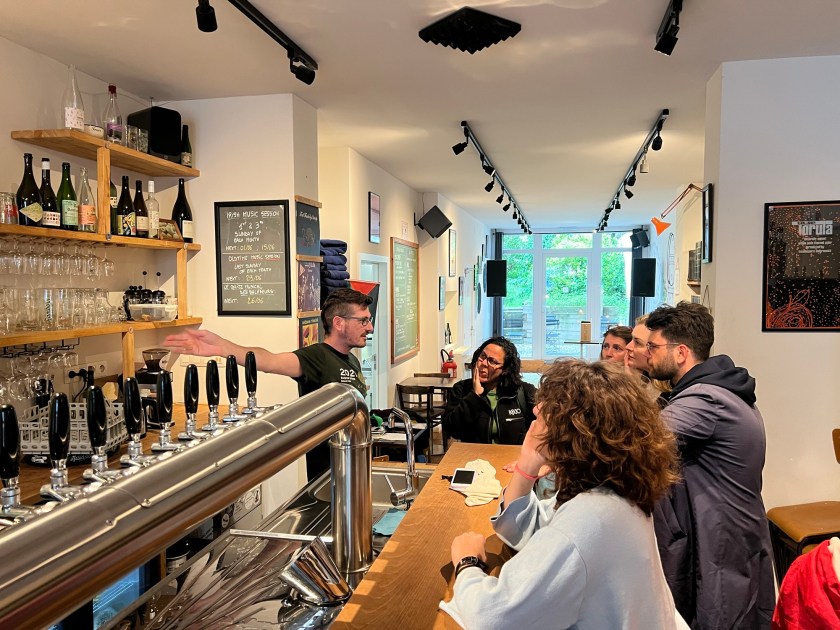
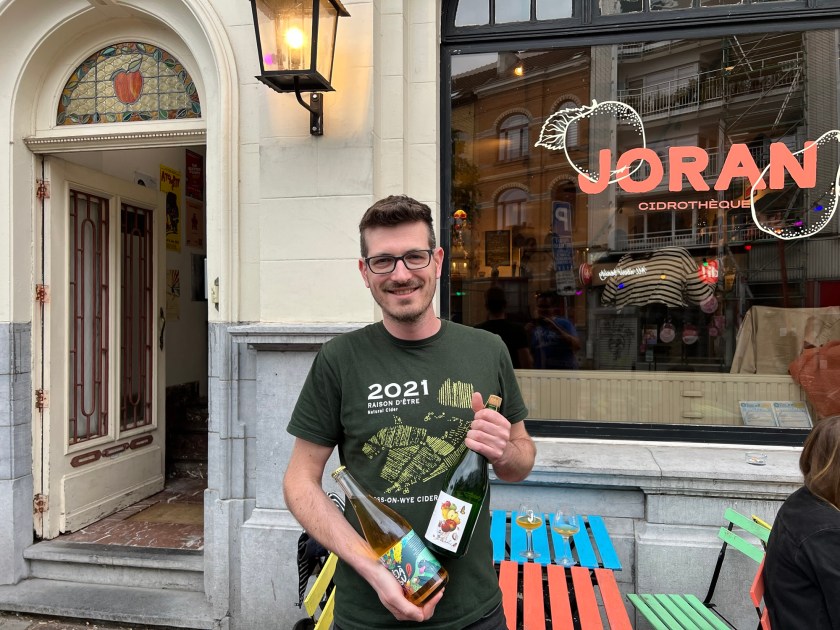
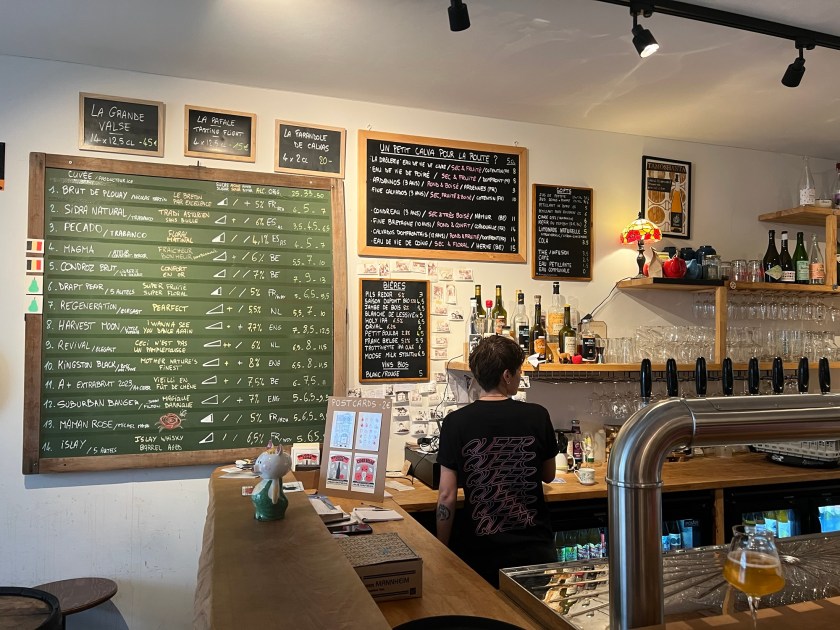
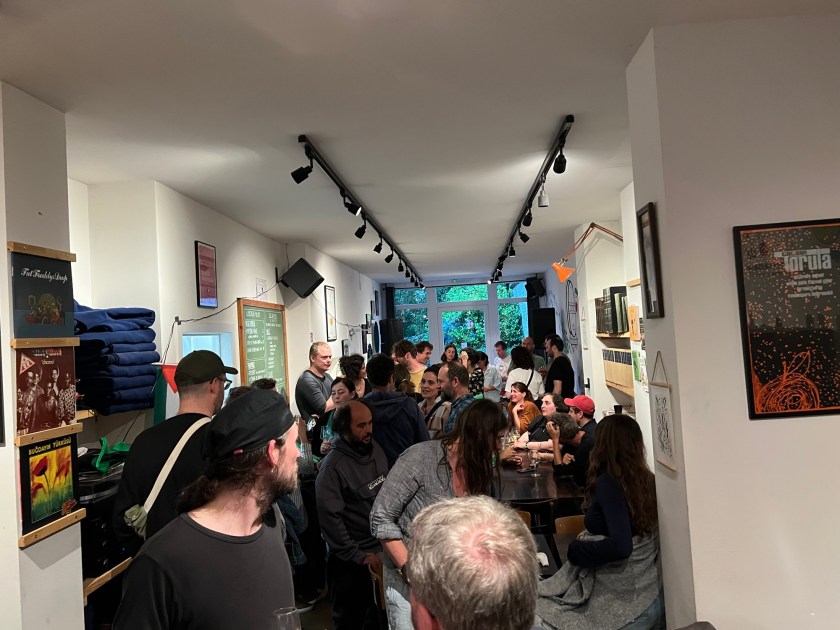
A few hours later, I was off the train, navigated through Brussels slightly North-East of the city centre, and found myself walking up to the bar I was here to see. Tables and chairs outside were populated by folk having an evening conversation and tipple, there was also a street party of sorts taking place nearby. This bit of Brussels feels much more like a neighbourhood that a tourist honeytrap. A big window, illuminated by the soft light of the bar within gave an inviting street front feel, as did the apple-themed stained glass above the doorway. Joran was being visited by the new local mayor when I first walked in. Good to see the world of politics and cider interacting. It’s a bar where the beer list is on the small chalkboard, and the cider & perry list is very much the large chalkboard on the wall. Quite the inversion to the norm, particularly in a country like Belgium, famed worldwide for its amazing beers. Across from the bar, shelving contained an array of cider and perry from producers familiar and unknown. When you’re this into cider and perry, there’s a magic to the air stepping into a bar like this for the first time. You trust the setting you find yourself in and look forward to the unwinding exploration to come as the evening progresses. After a few minutes, the mayor and their entourage depart. I introduce myself to Joran, dressed in the deep green Ross on Wye Raison D’Etre 2021 t-shirt, and we sit at the bar for a chat.
CR: Hi Joran, thank you for chatting to us here on Cider Review. How long have you been the proprietor of your own Cidrothèque?
Joran Le Stradic: It’s going to be six years soon, since I opened in September 2019, just months before a certain COVID pandemic arrived too. It hasn’t been easy at the beginning, but now it’s been running super smoothly for quite a time now.
CR: For a country that’s known for its beer and it’s love of beer, how have the Belgians taken to a cider bar?
JLS: I think it’s actually easier to open a cider bar here in Brussels than in a cider-making region, because in cider-making regions, most people have preconceived ideas of what cider is or should be in their mind, and most people don’t like it, or, they have a very narrow opinion of what cider can be. I say this more about France than England, but in Brittany, Normandy, most people think that cider is either that appley, fizzy thing or a horsey flavoured drink. But anyway, everyone has a grandpa, or someone who used to make cider that tasted like shit and that was sold for one or two euros a bottle. And that’s still the only opinion they have about it. So, if they see a cider bar, they may think, no, I don’t want to go there. They’re gonna see our prices and think, oh no, cider can’t cost more than one euro or two euros, doesn’t make sense for something that tastes of horse. It’s just because they have no idea what cider can really be. So, whereas here in Brussels, I mean, it’s very multicultural, and there is no culture of cider here. Historically, people have much less preconceived ideas, so they’re much more open to try and discover. Also for me, it’s worked well for a few more reasons, but specifically, we’re not anywhere touristy in Brussels here.
It’s a specific neighbourhood where I’ve lived for more than ten years, which is a very residential area. Ten years ago, there was no good places to go out in the neighbourhood here. Started to be a few, about ten years ago for the first one. I kind of took on that wave of new, nice, good places around, but still, it’s very, very few places. I opened first as a bar for the neighbourhood, and secondly, one that offers a wide selection of ciders. But that’s said, because of that, when I opened, I had many people just living around who came by saying, “I don’t like cider, but the place looks nice. What else do you have to drink?” And I told them, “Why not you like cider?” And it’s either A: it’s too sweet or B: it stinks. Because I have the ciders on tap here, I give them something to taste that is not sweet or not stinky, depending on what they don’t like, and they discover that they can actually like cider. It can be something else other than what they thought. So they like it, they come back, they drink more, and they tell their friends. Whereas if I had opened in the trendiest places of Brussels, in the midst of many other cool bars, well, the only people, like people passing by would have seen us and said “Oh a cider bar, I don’t like cider, I’ll go to the beer bar next to it.” Here, people came like, “Oh a cider bar, I don’t like cider, but it’s the only bar around, so let’s have a look!”
CR: It’s a great business plan for it. You’re in essence, like a lighthouse for cider and perry here. A beacon that invites you in to try different things. You mentioned the fact you’re based here in one of the most multicultural cities in Europe. Does the nationality of the cider and perry that you pick on the bar here reflect that?
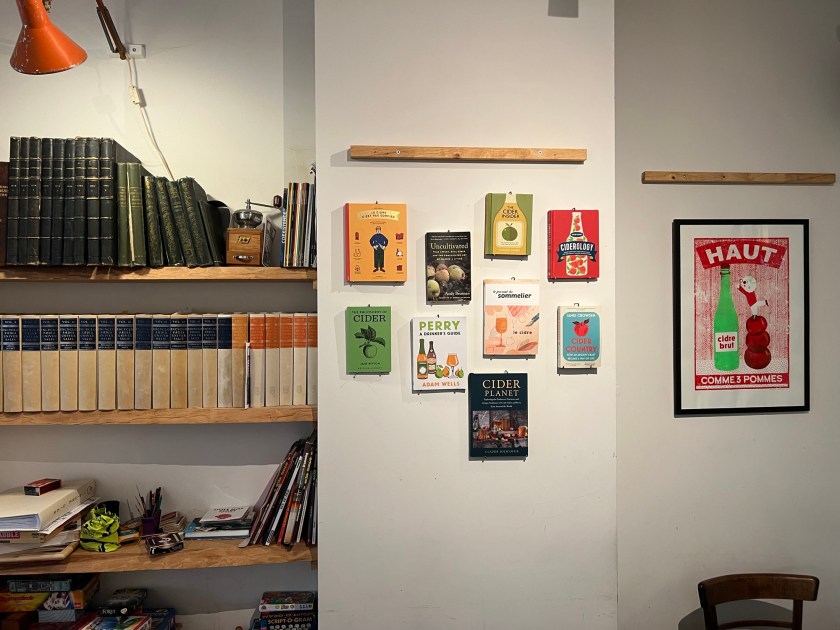
JLS: Yes and no. My way of sourcing cider, my philosophy for not only cider, for anything, is as local as possible. But, regarding cider, because this is a Cidrothèque, in French this means plays on the word bibliothèque, meaning: library. The idea is really to showcase everything humans can do with apples and pears and quince. I’ll be as local as possible, but I will also look as far as needed to find a type of cider that does not exist closer. In other words, the furthest I go is Asterias and the Basque Country, and Spain because they have these specific apples varieties and terroir. More than anything else, their way of making cider is more about the technique than the fruits. It’s a very unique style of cider that does not exist anywhere else in Europe. Take, first instance, Poland where they have lots of great cider makers. In terms of the style of ciders they make, it’s going to be very similar to what can be made in Belgium or the Netherlands. So I’m not going to go to Poland to buy cider because it’s too far to travel, compared to not adding diversity in the section here. Of course, I’ll have English ciders, because in England, you have such a history of cider, with these historic varieties of pears and apples that are so unique. You also end up having some of the best makers. It’s also about the people. It takes just one person or a few people to push the boundaries of what can be made with apples – the work on single varieties at Ross-on-Wye for instance. Or the sheer exploration of what can be done with fruit over at Little Pomona… it’s completely unique. There could be someone doing the same work maybe in Brittany or Normandy, but not yet I think. I try to have a Breton or Norman Cider, of course, English. More and more Belgian ones, and Dutch as well.
CR: Ah yes I see Elegast up there on the board. We met Arjen from Elegast at RossFest22 I think, on the opening night Cider Club. A lovely guy.
JLS: Yes, unfortunately, they went bankrupt a couple of months ago. It’s very sad. A big loss for the world of cider, because they were pushing boundaries in their cidery. They were very innovative and doing great stuff, and sadly, they are not anymore. I still have some kegs left, but they’ll be the last ones. (good news to report, since the start of June, all is not lost).
CR: Our thoughts are with Arjen and his team, that’s really sad news.
As the curator or librarian of all these different types cider and perry, what trends are you seeing? Have you been able to crack the nut that is getting consumers to embrace dry cider and perry, perhaps with high acid or high tannin?
JLS: It’s linked to what I said in the first place. Most of the customers in this bar are people who don’t like cider in the first place, or don’t know what it is. 95% of the population is like this. Because of that, I think this is probably the place where you’ll have the largest selection of dry ciders that you can find anywhere else. I hopefully introduce them to the taste of ciders that I like. I opened this bar at the same time as La Sirie in Paris. They opened in a very trendy place in the heart of Paris, and their clientele already want to drink cider in the first place. They come with their idea of cider already formed, which is most of the time sweet and fruity.
I was born and raised in Brittany. I was drinking a little bit of cider once in a while, at a crêperie, a crêpe restaurant, to try it. It’s only when I discovered other styles of cider from elsewhere, dry ones, that I really started to like this style and format. So with this bar, it’s my selection and I want to enable people to discover this style too. The biggest section of my customers here are people who enjoy natural wine or craft beer. They’re not the drinkers of Somersby, Strongbow, and Bulmers. They’re very happy to discover that cider can be dry.
CR: How does it feel being this kind of dry cider outpost? How do you feel personally? Do you wish there was a bar like yours in every city?
JLS: I would love that! No, no, I would say I’m not happy being the only one. When I go out, I don’t want to get drunk on beer anymore because that’s the worst hangover there is. It’s heavy on your belly, it hurts your head. I like a good beer, but I can’t drink it all night long anymore. Whereas with dry cider, you can go all night and feel fresh the day after. I love wine as well, but it’s too heavy in alcohol to drink it all night long. I would be so happy if I could find good ciders everywhere. Good, dry, natural ciders. Everyone deserves to know this style. I dream of a world in a near future where of course you won’t have a selection as large in every place. But if there was one bar like mine in every big city that would be great. I’d also be happy with just every regular bar or restaurant to have at least two or three different ciders on the menu. Sweet one, a dry one, different options, just like you’d have with wine. That’d be nice.
CR: Please describe to our readers the composition of your bar.
JLS: It’s mostly all keg, but you have a lot of cans and bottles that are also available to buy. Mostly we have ciders and perries on tap over 14 draught lines. Five of them are always the same: the classic ciders and the local Belgian producers. We really want to showcase at least one Belgian cider or perry at all times. Then for the other ten lines, we are rotating and changing on a regular basis.
CR: Do you stock Bag-in-Box (BIB) here?
JLS: No, it’s all keg. I tried some BIB at the beginning, but people tend to like sparkling more. So, no more BIB for the moment. I won’t say never again, but at this time, we’re only on keg. With 14 draught lines on at a time, I always have about 50 different kegs in stock to rotate. Behind you, we have a wide shelf with about 150 different bottlings, large ones, small ones, a real mixture. The bottles are available to take away. They can also be drunk inside. We have one of each in the fridge. We also stock a bit of apple, pear, and quince spirits as well.
To get a full picture of the business, since all the products I work with did not exist in Belgium beforehand, I had to become an official importer and distributor. At some point, I was distributing both bottles and kegs until I realised that I was losing money on the bottles because I was stocking way too many bottles for restaurants or bars who would not always take the full allocation of bottles. If I don’t sell a keg to another bar, I’m going to sell it here quickly enough. I’ve struck a deal with a company in Brussels called Terroirist – they’re a small distributor, mostly for organic, local food, selling between the farm and the restaurant. However, you can’t make a life out of distributing lettuce so you have to diversify a bit. They now sell a bit of dry goods and a few drinks too. I deal with them for pretty much everything food-wise in the Cidrothèque. They have all the business and distribution of bottles, and I do everything with the kegs.
CR: Have you found a successful way to bring UK cider and perry over to Brussles, or is it a complete faff?
JLS: Before Brexit, everything was inside the European Union, I did all the paperwork myself. Since Brexit, I don’t even know if it would be possible to do this paperwork on my own, I found a company to do it for me. Brexit has been great for accountants, but bad for producers and bars. As a result, English cider has become more expensive for us, but it still gets here.
CR: What have we got to look forward to at Joran Cidrothèque for the rest of 2025?
JLS: At the end of August is the PomPomPom Cider festival in Brussels, I’ll be part of that. With it being at the end of August, it’s usually the same weekend as the Ross Cider Festival, so I’ve never been able to go to Ross at this time… it’s very important for me to be present at the PomPomPom Cider Festival in Brussels. This year, they’re on different weekends, so I’m very much hoping to visit both!
I just bought a whole lot of stainless-steel kegs, that are going to remain here in Belgium. I have 1000 litre IBC of perry that I brought over from Normandy. I’ll keg that and distribute here in Belgium. This is I think is a great idea to have a fleet of stainless kegs remaining here in Belgium, with just one IBC going back and forth between Normandy, making the process nearly completely waste free (and much cheaper for everyone). Who knows in the future, maybe bring some English cider over in the IBC as well…
Our thanks to Joran for taking the time to sit down and chat in what was a very busy bar, filled with a 40th Birthday party gang and regulars. Over to a few reviews of what was on the bar that evening!
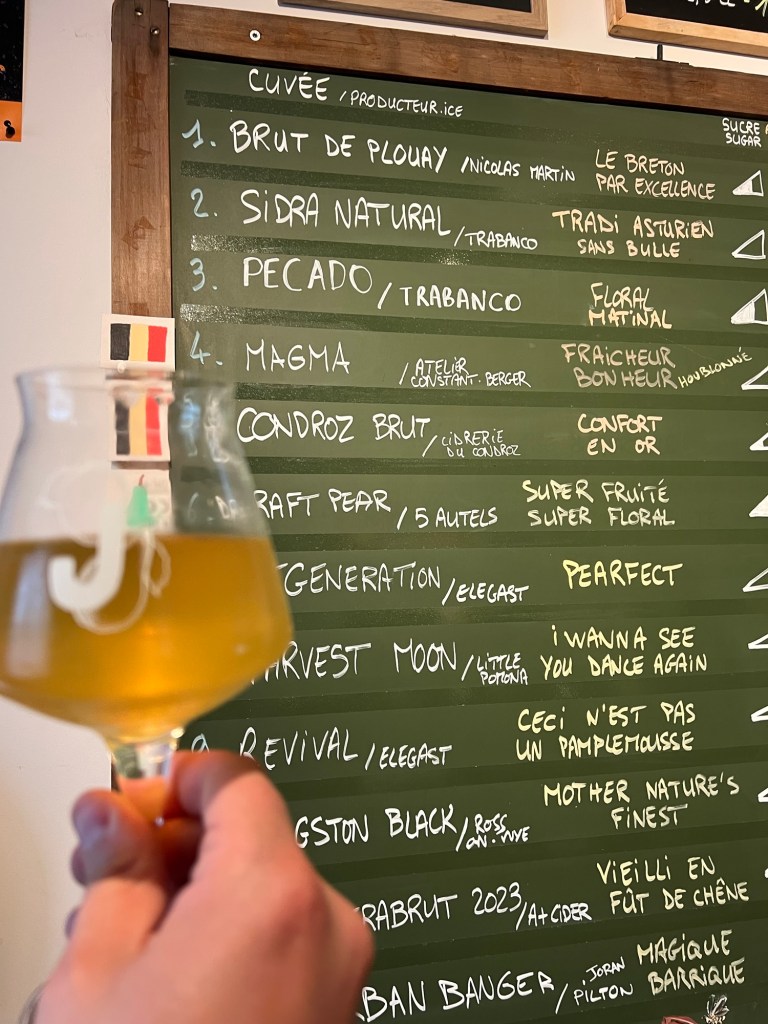
Atelier/Constant Berger, Magma – review
How I served: Straight from the tap in Joran.
Appearance: Good clarity, perhaps the faintest of hazes, light effervescence, pastel orange colour, thin mousse around the rim.
On the nose: Fresh Orange peel, slightly herbaceous, pitching with a Belgian beer yeast? There’s something very familiar here.
In the mouth: Bone dry, more orange soda than any cider I’ve tried before, very refreshing. Local Belgian hops are used in this and that’s the familiar note I was grasping for on the nose. Dessert & culinary fruit work so well with hops. There’s a mild astringency to it, and those hops are leaving a lovely, long, lingering finish at 6% abv.
In a nutshell: Orange barley squash soda. Absolutely delicious.
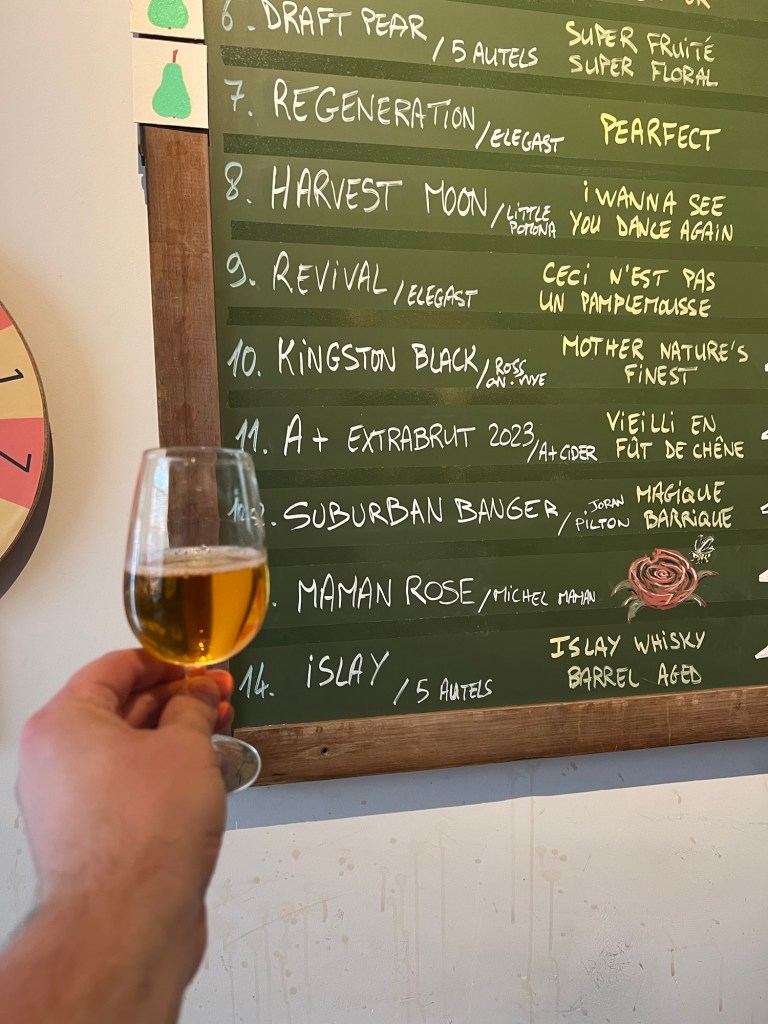
Pilton, Suburban Banger – review
How I served: Fresh from the taps at Joran.
Appearance: Radiant orange marmalade (almost akin to the colour of Kevin Minchew’s The Last Hurrah), near still, a rim of big-bubbled mousse around the edge of the liquid.
On the nose: Houston, I think I’m picking up barrel-influence! An almost mulled spices, apple crumble aroma, hinting at something incredibly rich and just waiting to be savoured.
In the mouth: Again, bone dry, big, oily, astringent, orange oils, bittersweet bombastic cider. It’s 7% abv and seems very happy to have found its way over to Belgium. This is the cider equivalent of a Rioja or Ribero del Duao redwine, spice and mouthfeel, candied apple. I feel like it’s bonfire night (Nov 5th) with every sip.
In a nutshell: Pilton bringing the dry, barrel-aged party to Brussels in fine style! Exporting the best of UK cider to Belgium.
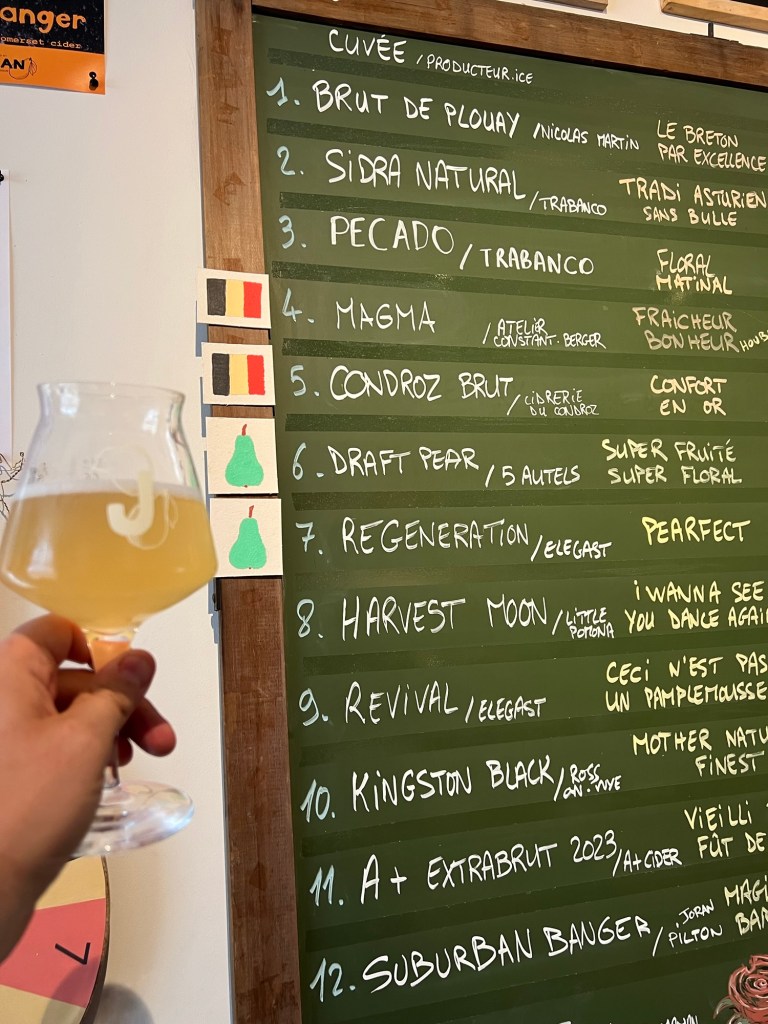
Elegast, Regeneration – review
How I served: From the tap in Joran, 4-6°C
Appearance: Hazy straw gold, light effervescence and a thin mousse around the rim.
On the nose: I’m guessing these are dessert pears that Arjen is using from his orchard contacts in the Netherlands. There’s a bit of VA flying around, reminiscent of some Spanish Sidra, and quite similar to how Oliver over at Marshland Cider presents his Conference and Concorde Perry.
In the mouth: Sour and tart, yes there’s an acetic twang, but it quite compliments the tropical, estery notes of the pears used. Soft tannins here that you can feel resting in your tongue after each sip. I’m picking up a bit of BBQ pineapple here, tinned pear, pomelo, white grapefruit. At only 5.5% abv the citric acidity is giving the mouthfeel of the perry way more credentials than I would expect. Perhaps some culinary fruit mixed into the blend too?
In a nutshell: Dutch perry in the Asturian/ Marshland St James style from a producer I hope we get to see again in the future.
Cidrerie du Condroz, Condroz Brut – review
How I served: Fresh from the tap at Joran
Appearance: Slight haze, light egg yolk yellow, near still, zero mousse this time.
On the nose: Vanilla ice cream and apple puree, very inviting.
In the mouth: Utilising Southern Belgian heritage dessert apples, fully fermenting and racking into 2nd, 3rd, 4th fill oak barrels, that oaky, vanilla cream note continues, slight crème brûlée sweetness to start, but then it drops away to a lovely dry finish. You would not guess this is 7% abv. I’m so impressed with the journey this one gives you on the palate. Almost a Werther’s Original butter candy note.
In a nutshell: A great example of barrels being able to elevate fruit that lacks the higher levels of acidity or tannin into something altogether more Germanic confectionary!
Conclusions
If you’re UK-based and can get to St Pancras International Railway Station relatively easily, a Eurostar trip to Belgium comes so highly recommended it’s practically in neon flashing signage. Often for less than the cost of a train up to Scotland, you can find yourself over on mainland Europe, within reach of Antwerp, Brussels, and Ghent (I accidentally went to Ghent on my weekend trip, catching the wrong train and doing a big roundabout schlep back to Brussels). If you’re visiting from further afield and are looking to get a sense of the European cider scene, start here at Joran Cidrothèque to get your bearings, taste through an exquisite bar menu (buy a couple of bottles to take away) and then head out in the countryside and visit the makers.
If every city had a bar like this, it would be transformative for cider & perry. Joran’s is a true lighthouse bar in the storm, a north star to navigate towards through a sea of meh. Coincidentally, my final few hours in Brussels before catching the train home were spent in Brewdog’s Brussels Outpost, yes an outpost for their beers across mainland Europe (though mostly brewed in their German site I think), but also an unlikely spot to find Ross Cider’s Red Pear/Aylton Red 2023 perry. At the eye-watering price of €8.70 per 25cl if the menu board was to be believed, but there nonetheless. This relationship with the bar is down to Joran’s influence in the city and a bar manager who very much loves all things UK-cider-related.
For any of you heading to Ross Cider Festival at the end of August, most of the Cider Review team will be there in one capacity or another, hopefully along with Joran, who I know will be given the warmest of welcomes by the UK cider family that head to the festival. I’ll swap roles this time and be barman to his curious visitor. Here’s to a great summer of cider and perry ahead of us!
Discover more from Cider Review
Subscribe to get the latest posts sent to your email.
 Cider Review
The place he mentions in Paris is La Cidrerie https://www.la-cidrerie.com/ – I came across it accidentally, recommended.
LikeLiked by 1 person
I need to plan a weekend trip to Paris as well to check this one out too then Justin ☺️
LikeLike
Great post.
LikeLiked by 1 person
Cheers Michael, glad you enjoyed it ☺️ Have you been to Joran before?
LikeLiked by 1 person
Pingback: Raison D’Être 2023 | Cider Review
Pingback: Ross-on-Wye Cider & Perry Festival 2025 | Cider Review