
If you’ve been following along with any of my pieces on Cider Review so far then thank you, if you’re the person, I probably owe you a drink. But you’ll have noticed that everything has been very Somerset-centric, this isn’t by design, just the way it’s worked out so far. But a full-time job outside of cider and a family etc etc doesn’t have me leaving the shire as much I’d like, so for now I have to live vicariously through some of my fellow contributor’s more far flung travels in the cider world. So if for no other reason than to stave off accusations of laziness I’m giving you this little preface, because today’s subject doesn’t even take me outside of the Frome city limits, if indeed Frome was actually big enough to have city limits.
Frome has changed a lot over the many years I’ve lived here. It’s (probably) rightly seen as a hip, trendy place to live, which is a delight to some but elicits the chagrin of others. So when a new natural wine bar opens up in Frome it’s maybe no surprise. That it’s in a car park on a small industrial estate next to the town train station only adds to the sense that maybe you’re witnessing an English take on a Portlandia sketch. Natural wine, like Frome itself, feels like an easy target for mockery and scorn by some. Both aren’t shy of their hipsters and occasional pretence, both have their Tik Toks and Reels parodying their more outlandish quirks, and I’m sure at least a few of you had an instinctive gut reaction when I said the words ‘natural wine’. Trust me, it’s the same way when you mention to people you live in Frome, there’s a reaction one way or another. All of which is to say, both manage to be a very marmite proposition in people’s minds.
At one point there was a movement by some residents here, maybe seriously, maybe jokingly, or quite possible a mix of both, that saw stickers appear round the town declaring ‘Make Frome Shit Again’ in a kind of anarchistic paean to its humbler market town roots. It’s easy to imagine an equally pointed ‘Make Wine with Intervention Again’ campaign carried out by a group of disgruntled somms, but that kind of misses the point that, respectively, each has its great points and what each does it does extremely well. Any negative connotation of either only comes about from someone doing something poorly or at worse trying to be ‘too cool for school’, of which neither is short of. So you can imagine my slight trepidation felt upon hearing a new natural wine bar has just opened in Frome.
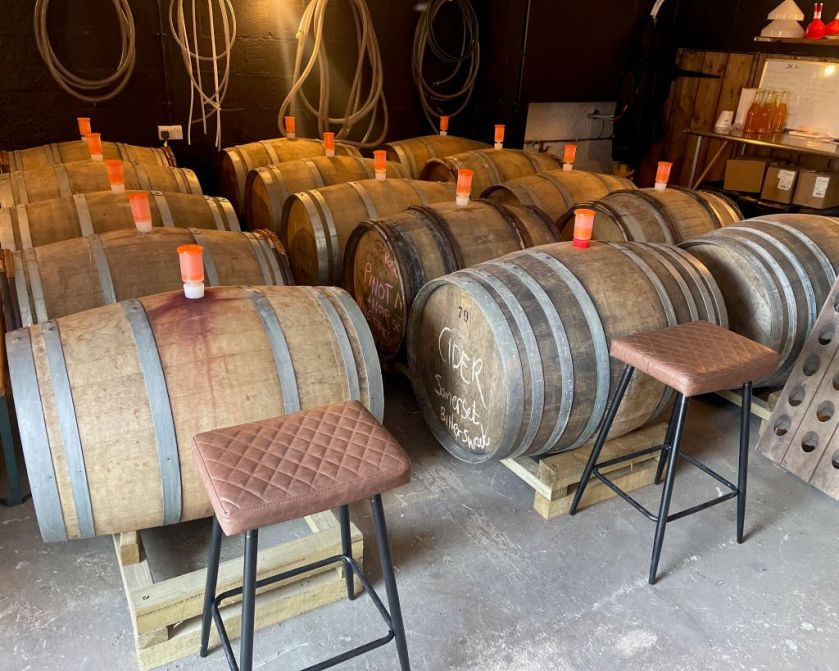
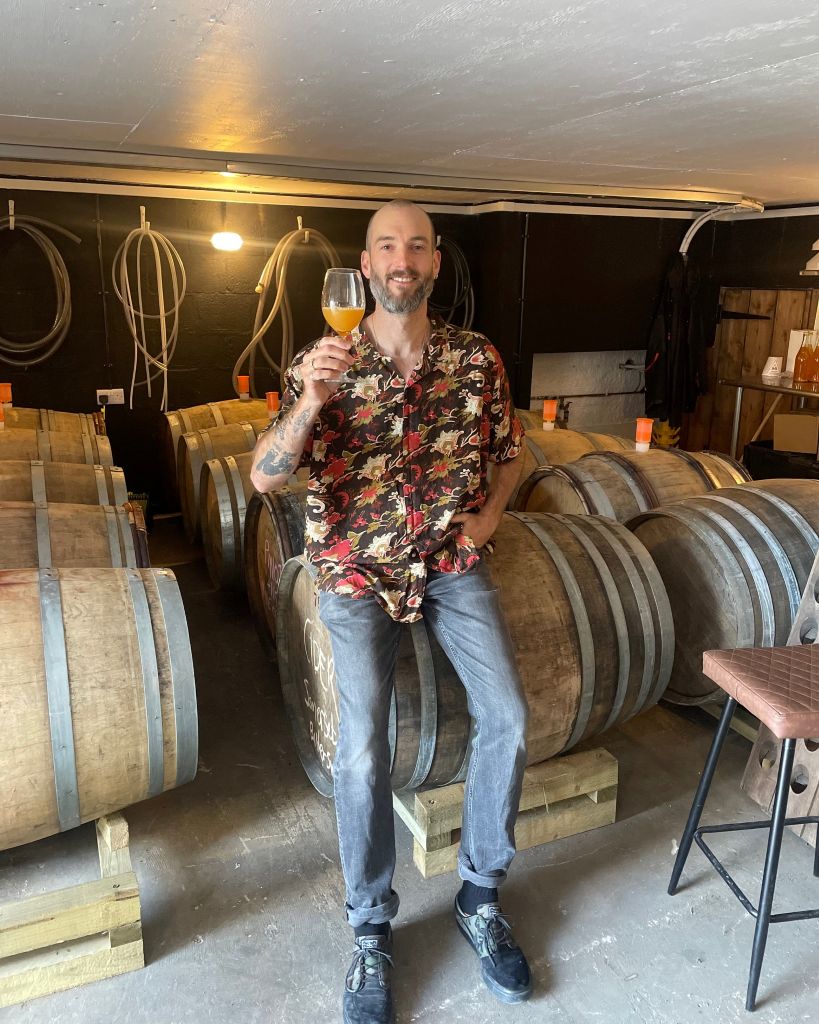
Thankfully though, the rumours versus the reality of a new opening proved quite different from one another, as Saddle Goose isn’t a natural wine bar. Not in the traditional sense anyway, and not in a way that might match yours or my preconceived notions. What it is in fact is a winery and the place itself is exactly as they describe, a cellar door. There is a door on a building in an unassuming corner of a car park and inside is a cellar with a bar counter and a few chairs and a lot of barrels. It’s shorn of the airs and graces that you might expect and frankly all the better for it. They make all their own wine along with two beautiful vermouths (a drink I have a growing love for outside of the realms of cider) and of course the catalyst for this piece, their very own cider, a self-described old school scrumpy with a smoky finish.
I sat down with Adam Collins the owner and ‘Head Goose’ a couple of weeks after a casual visit one Saturday afternoon got us introduced and chatting about our respective love of drinks, as well as him very kindly letting me try his as-yet unreleased new cider that he describes as ‘a really crazy orchard blend of bitter-sweets’. After a funny and deeply ironic case of mistaken identity that had him thinking I was one of his other customers (what can I say? I’m a generic looking middle-aged guy with a beard and glasses, it’s very much on brand for Frome) we chatted about his route into natural wine making, how cider became a part of what he does and what the future might hold.
* * *
Cider Review: Hi Adam, I’d like to talk a little bit about your background, how you came to wine and how that became Saddle Goose?
Adam Collins: So, I had a different career, but I was a huge food fan. My mum is a chef, and that’s what we do together, just eat and drink. I was doing my other work, I was an artist originally and got into art direction, but then food and drink were just a passion of mine. I was taking time off work here and there to learn about wine, do tastings in my spare time, lots of wine education. Then I started taking more time off work to do short courses at Plumpton College which is like a wine University, and it just kept going and going and started getting out of hand. I started taking sabbaticals, doing harvests abroad. And at this point I didn’t think I was gonna quit all my other stuff to do that, but working in the city, working in central London was not good for my head, I started getting headaches and just feeling really unhealthy. And at this time my passion for nature and what’s going on in the world, being out in nature and being connected to it was just so much more important to me than just staring at concrete blocks and screens all the time. So all of this, all of these things, changed my mind. I wanted to spend more time in nature, I wanted to do more things with my hands again, I didn’t want to stare at screens anymore, and my passion for wine had just gone through the roof.
CR: At this point did you have a plan in mind or know the next step?
AC: Well then I was like, I’ve done a few harvests and I could make wine at this point, people started liking my wines and I thought fuck it, I’m gonna start making it properly, make it more professional, see where it takes me. Then a mixture of things happened, and I ended up applying on a whim to this masters course, a masters in wine making which led to a year in France and a year in Portugal, as well as a Master of Science. Because I thought to myself, I wanna do things really naturally, it’d be really interesting to know chemically what’s going on, because there’s nowhere to hide in natural wine. In conventional wine you can just throw in a lot of products, manufactured yeasts etc to obtain things you know, add more tannins, remove tannins, clarify it, change the flavour of it. And the majority of them are pretty brutal to be honest. And so I thought, well, if I can learn about everything that conventional producers do, the science behind why they’re doing that, why they’re adding that or that, then I could look to the natural world to see what I could use, material, temperature, time, movement, and how to achieve the qualities of wine without using anything more than my hands. Starting out as an artist and coming to this, for me, it’s a real blend of art and science.
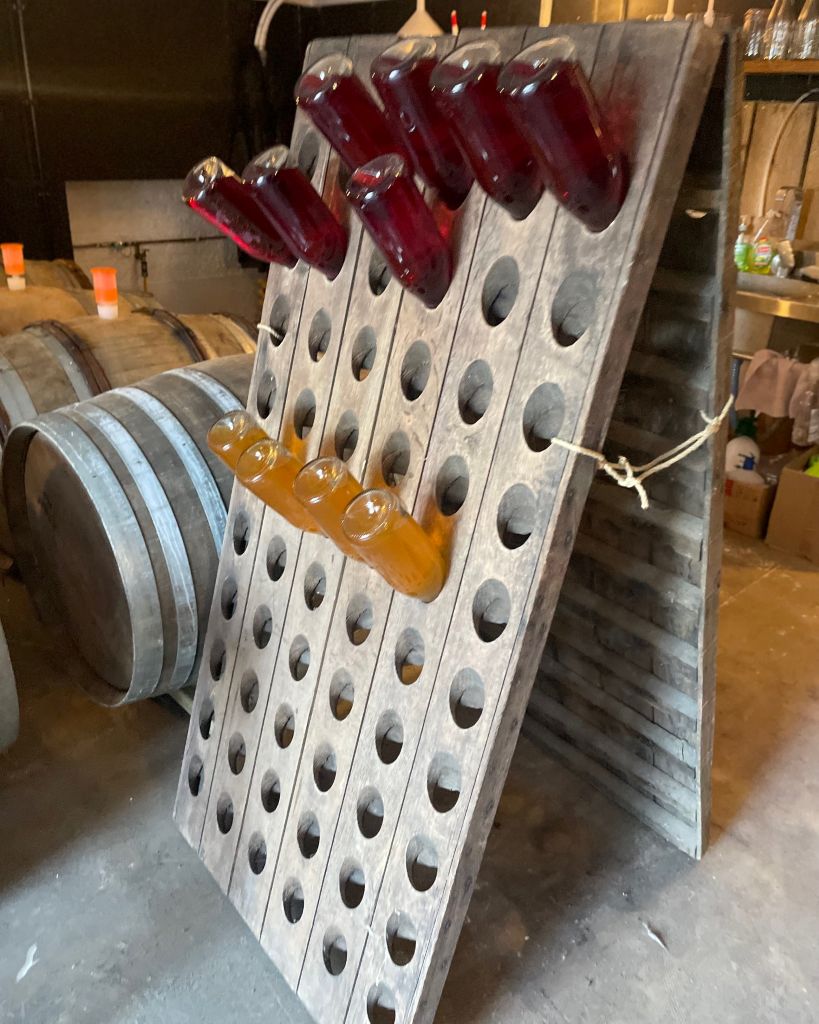
CR: So being an artist and the artistic element has continued being a major factor in how you work and approach things?
AC: That’s how I see it you know, I’m definitely more instinctive and artistic first, but I’ve got that grounding of the science behind me now, which allows me, I think, to elevate the quality of what I’m doing.
CR: How did the cider start to fit in to what you were doing?
AC: Cider is another product I’ve always loved, you know? I love good beer, I love good cider, love good spirits, there’s vermouth up there (points to the shelf above the bar) which I love. I made Port wine in the Douro Valley for a year as well, making fortified wines. So the wines I’m selling are my English wines, but I’ve got wines I’ve made in Portugal, wines I’ve made in Chile. It’s important for me to just understand different techniques all the time, to understand different grapes, because some of the wine making I did in Chile inspired how I approach things here. Where I was in Chile was a small place, and because the space here is quite small as well, but where I was before was a big winery, you kinda go wow we did things like this or that, and it just helps again with the process and the quality of what you’re doing and what you want to do. And yeah, cider was just another feather in the cap that I wanted to have because it’s a product that I’ve always loved. Then moving to Somerset, before moving to Somerset even I was using organic apples, and I loved it, so I thought I just want to keep pushing and learning and bringing my wine making preciseness to cider, to elevate it. Hence the barrel fermentation, sometimes using single varieties, extended aging, and just trying to pull out those flavours that are not necessarily those conventional flavours you get all the time. I’ve always loved what you’d probably think of as scrumpy, but sometimes when you taste it, it can be a bit rough around the edges, for me it’s how do you smooth those edges?
CR: How long did the Old Goosey cider spend in barrel?
(For clarity and context we’re both drinking the Old Goosey cider during the interview)
AC: That was in barrel, probably about ten months, nine to ten months fermentation in barrel that previously had Bacchus in. And that was all fermentation in barrel. Whereas this year I’ve split it to see the differences between the stainless steel and barrel. I think that’s why this one has picked up a bit more of that smoky edge to it. I’ve found Redstreak can have a little bit of that anyway, but the barrel itself has enhanced that, and the colour is just fantastic.
CR: Is it fair to say that from the beginning you wanted to take the natural route with everything you produce?
AC: In the very very beginning, probably not. I didn’t really know about it, I was just being taken to restaurants or going to places as I was learning about wine in general. But you know this was 14 years ago, and when we started talking more about climate change and understanding more that that was going on, natural wine was around but there was more chat around Organic wine, natural wine wasn’t really in the conversation. And then I actually had a girlfriend who worked in a wine bar, so serving more natural, small producer wines. And she worked in hospitality and I didn’t, so the only time I could really see her was if I was hanging around the bar. I’d sit in the bar drinking all the time and started learning about all these natural wines. These grape variety that I understood just tasted different, more alive, or a different expression, different blends, different regions and new producers. That world just started coming alive for me, and then the more I was getting drawn to nature and simplifying myself and my process and wanting to be in nature myself It just made absolute sense. I’ve got this migraine condition and when I drank conventional wine more often than not, I’d feel shocking and when I drank natural wine, I wouldn’t. I knew there was something in that from even before I began producing because of how I felt around the product. And so I’ve just grown with that and continued on that path.
You know I’m not a strict everything has to be biodynamic and zero zero and all that, because I think every year is different, the quality of the grapes or the apples you get every year depend on the seasons, the conditions. Nature produces in apples, and in grapes especially, natural sulphur, you can get up to 10mg per litre of sulphur occurring naturally in grapes, and that’s so they stay bright and colourful. They want to retain those colours, they want to be attractive to the birds, so the birds eat them and that’s how they continue to propagate. So for me, if I put in, let’s say roughly the same amount of sulphur as nature puts in, and I’m just putting in a little bit to keep the colour and to keep it attractive and to keep the flavours great, to attract people to drink it, it’s not that different, I think, from what nature does anyway. It’s less than what’s in a regular slice of bread.
But the amount of chemicals that you do find in regular wine and cider can be pretty bonkers, they want to be able to make it the other side of the world and ship it, they want it to taste the same the day it arrives to 15 years down the line when someone finds in a cupboard that’s been next to an oven.
What natural ingredient do you expect to last 10-15 years and stay the same you know? In my mind, I mean I’ve just opened a bottle of my 2020 wine which was my first official vintage and that’s drinking amazing, it’s drinking better than it’s ever drank before. I’d say the ‘20, ‘21’s are probably peaking now, so four to five years old and almost zero sulphur. I do do some completely zero sulphur if the conditions are right, and then there’s some that are like so little it’s about a fifteenth of what you’d find in a supermarket wine. They won’t last as long as a supermarket wine, they wont last 20 years. Well they might, who knows? But compared to something that’s got so much sulphur in the wine is pretty much dead anyway. It’s been sterile filtered, sulphur added in, ascorbic acid, all those things. So it’s not alive, it’s not evolving, it’s not changing.
CR: How did you approach the cider making, did you go in with a plan in mind?
AC: It mainly starts with a conversation with the growers, depending on what they’ve got and the condition the apples are coming in. So, for instance, I love still cider, I really love still cider. But for the last couple of years, it’s not tasted right to me to make a still cider. And generally, as I say if it’s not got sulphur or very little sulphur added I do like having a little bit of CO2 as natural protection. I just thought they tasted better sparkling. This harvest I’m going to get some Dabinett, and I’ve had some really good still ciders with a 100% Dabinett, so I’ll see how that tastes at the end of fermentation because I’d really like to do a still cider. So the Dabinett I’m looking forward to because I’ve used it in a blend before but have never done a single variety with it.
CR: Do you let the cider ferment to dry as a rule?
AC: Yes, although I’d quite like to if I have time and more importantly space, I’d like to have a little play with keeving. I’m not a fan of sterile filtering or back-sweetening, so having something that retains those residual sugars is definitely more my vibe.
CR: You mentioned briefly your growers, where are the orchards you get your fruit from?
AC: It’s from a place in the south of Somerset, I always feel like he’s out in the middle of nowhere. Do you know Ross Mangles?
CR: Ah, yes!
AC: Yeah, North Down orchard in Crewkerne. Have you been down to his barn? Because they’ve just built a little cider barn in the winery. And he does so many apples it’s ridiculous. It’s a beautiful place to go, and they grow almost everything under the sun. Just looking at the list he’s got here (pointing to the list he’s brought up on his phone), Kingston Black I’m really interested in, Yarlington Mill I’d really love to do a single variety of. But this year’s is just a crazy mix of bitter-sweets, I wanted to do a proper traditional blend, see where it goes, never be quite sure what the result will be. This one that were drinking is actually a little bit more sediment-y than I wanted. I had a volunteer helping me when I was racking the barrels, and you have to be super careful and gentle when you’re racking. And they hadn’t really done it before, so I’m saying for them to just hold this hose there and wait, and I’m on the other end and I suddenly see all this sediment come through, and I look back to see if they’re ok and they’re shaking the barrel trying to get the last little bit out, you know thinking they’re being helpful. And I was like ah ok (lets out a resigned sigh). It’s all part of the character though, isn’t it? I think the people who drink cider and that understand cider don’t mind a little sediment.
CR: Lastly what does the rest of the year hold for you, anything coming up that you’re excited about?
AC: Because this is the first year in this new winery I’m trying to see how it goes really. I had a small harvest last year, just because the conditions were shit, so there were less grapes, and this is the first year I’m gonna get grapes from my own vineyards just outside of Bath. So new place, new grapes, and the Dabinett plus a new staff member. So it’s trying not to push it too much further than that. Just get settled and see how it rides out.
CR: Adam, thanks so much for your time.
AC: Pleasure, thanks.
* * *
If there’s maybe one other thing you could accuse me of during my tenure as part of Cider Review, it’s that I haven’t written many actual reviews, so I am going to rectify that one here and now. I was secretly hoping though that between initially tasting the new cider during my first meeting with Adam and the interview that it would get bottled so I could review alongside the Old Goosey. Alas it wasn’t meant to be. Still, ever onwards…
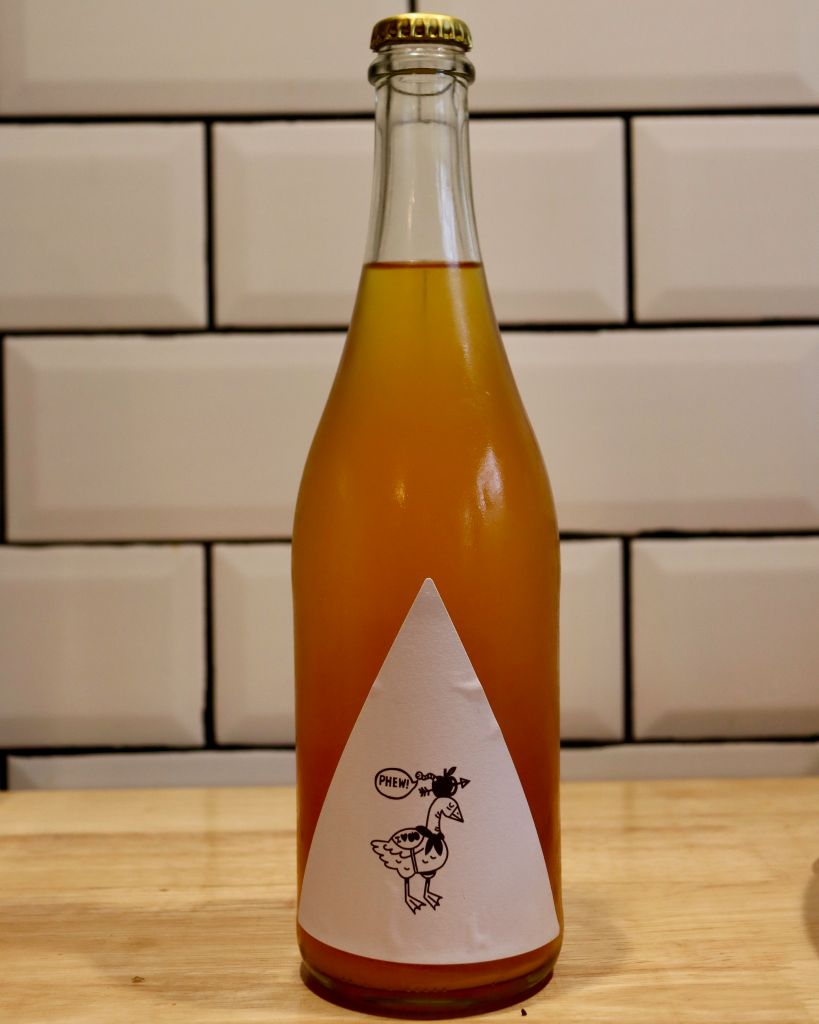
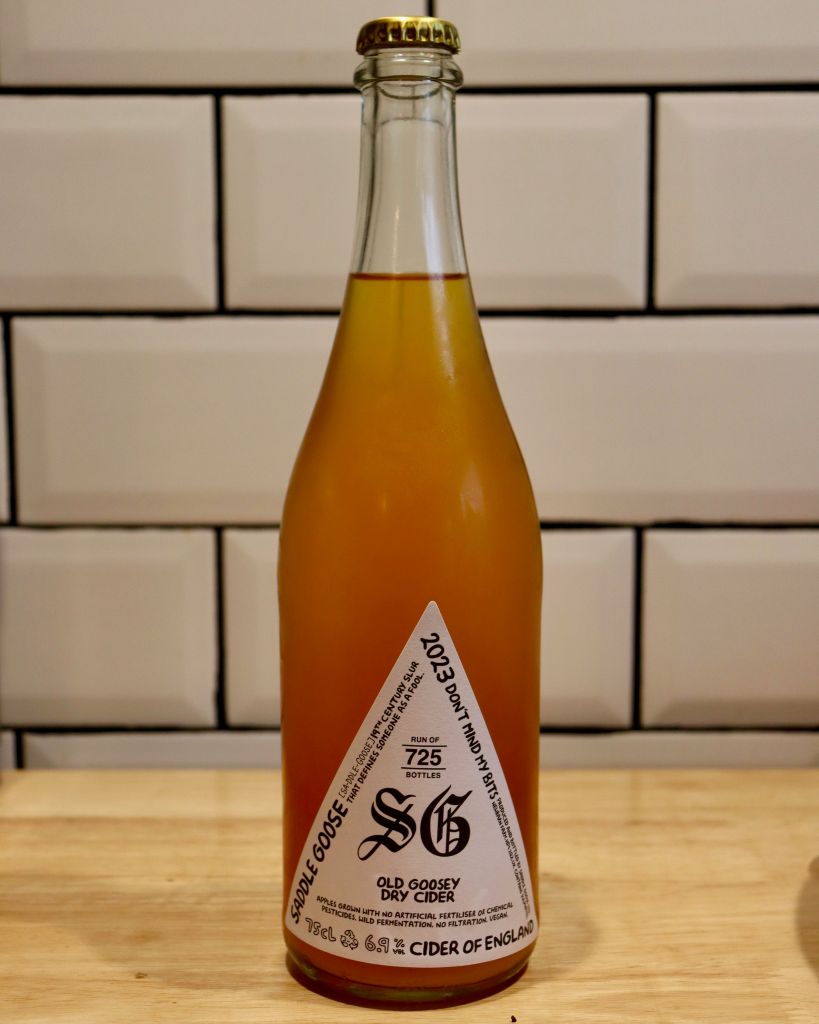
Saddle Goose, Old Goosey dry cider 2023 – review
50% Somerset Redstreak, 20% Michelin, 20% Coat Jersey, 10% Dabinett.
How I served: All day in the fridge, 20 minutes at room temperature to acclimatise. A really hot spring day outside so didn’t want to leave it out too long before opening.
Appearance: Hazy golden approaching amber. Once opened a split-second delay in activity before a whoosh of bubbles sends the sediment round the bottle like a snow globe. A fine light sparkle when poured into the glass.
On the nose: Initially a big hit of creamy toffee, almost Werther’s Original vibe, that opens up to orange/clementine pith, coconut oil, smoky black cardamom and a slight hint of blackcurrant leaf and acacia honey.
In the mouth: Lots of juicy chewy tannins get a grip on the palate instantly and hold court throughout, almost a marshmallow-y texture to it. The tannins bolstered by the character of the barrel. Plenty of gentle acids at the sides of the mouth stop the tannins from becoming too heavy as continue you go on. Bright green apple flesh, herbaceous, nettles, blackcurrant leaf again and a gentle saline, slate-y minerality. Like a countryside hedgerow. All rounded off with a persistent smoke that accentuates everything without ever becoming intrusive or dominant.
In a nutshell: The Bacchus character of the barrel plays a beautiful muse for the redstreak whilst the smoke and tannins carry everything along. If you’re a fan of the last two vintages of Ross-on-Wye’s Raison d’Être, this will evoke similar vibes whilst bringing something new to the table.
Conclusions
I love seeing Bacchus utilised with cider as it reminds me of one of my gateway ciders Pilton’s In Touch II. The barrel integrating so well into the mixwithout becoming overwhelming after being fermented entirely in barrel is quite the balancing act. Somerset Redstreak isn’t usually a go to for me, SV’s I’ve tried previously have left me a little cold, but with the Michelin, Coat Jersey and Dabinett as the supporting players there’s so much to love here and plenty of layers to pick apart. With the promise of the next two vintages being different entities entirely I’m intrigued to see what’s to come.
Old Goosey is available from the Saddle Goose website – saddlegoose.co.uk where they also have a list of stockists. They are @saddlegoosewine on Instagram.
Discover more from Cider Review
Subscribe to get the latest posts sent to your email.
 Cider Review
Amazing to think I drank a stashed bottle of In Touch II just the other day — that was one of your gateway ciders, and here you are with a cider shop and more! Thanks for flying the Somerset flag, Brett.
LikeLiked by 1 person