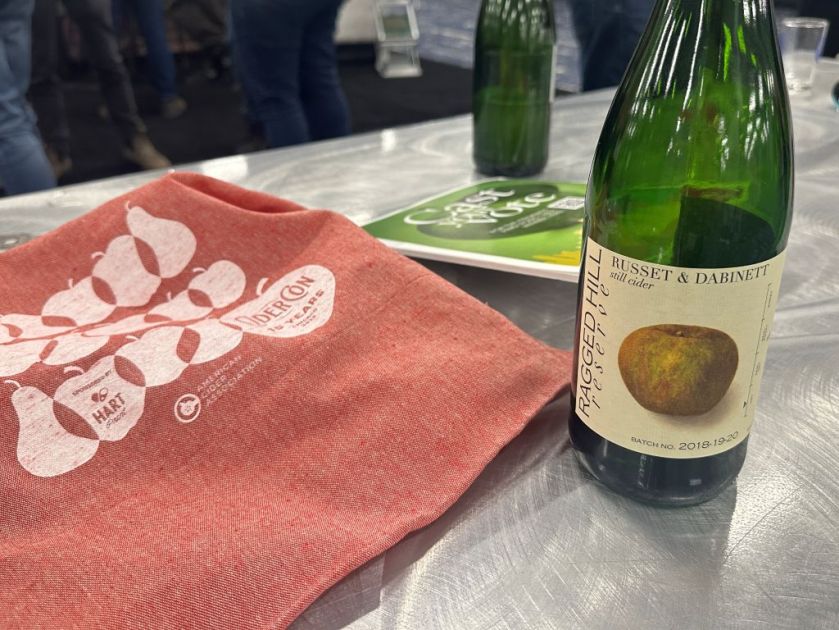
Sunday, February 2nd, 2025
Like the keen bean I am, I arrive the Sunday before CiderCon, the American Cider Association’s annual cider conference, kicks off. I take the L train from the airport into Chicago’s downtown. Dominated by rickety metal tracks that criss-cross improbably above busy roads and snake between skyscrapers, it’s a delightful if imposing train-set world.
Housed in a frothy neo-Gothic tower, my hotel is close to some of my favourite Chicago edifices (such as the “corn cobs”) and right on the river. Unfortunately, it’s also right across from the T***p Tower. My already heavily jet-lagged eyes ignore the latter, preferring to let my gaze to follow the lights twinkling down the river, under 6 or 7 bridges and out towards Lake Michigan.
After unpacking, I go for a chilly wander. I ponder that Chicago — all rattling rivets, towering glass, and gridded pavement — is in some ways an unlikely place for a major cider convention, associated as the drink is with barns, orchards, and the like. I suppose it’s about the city’s geographical location: it’s a place to meet in the middle of this huge country. Apropos unexpected meetings, I come across an Anglican church with an imminently scheduled Candlemas evensong. A renegade choral singer myself, I settle in, and I emerge reinvigorated by the ethereal music and candlelight.
Monday, February 3rd, 2025
All too early, I’m up and ready (as ready as I’ll ever be) for my morning walk. The first obligatory stop is the Doughnut Vault, one of my top Loop-area tips. Nursing my old-fashioned buttermilk reward on the way back, I accidentally end up inside a maze of a mall hosting a posh menswear convention. It’s a Truman Show-esque experience; everyone around me is dressed very similarly and very well. Finally, I find my way back out into the misty morning and to my hotel, where I settle in for a day of remote work.
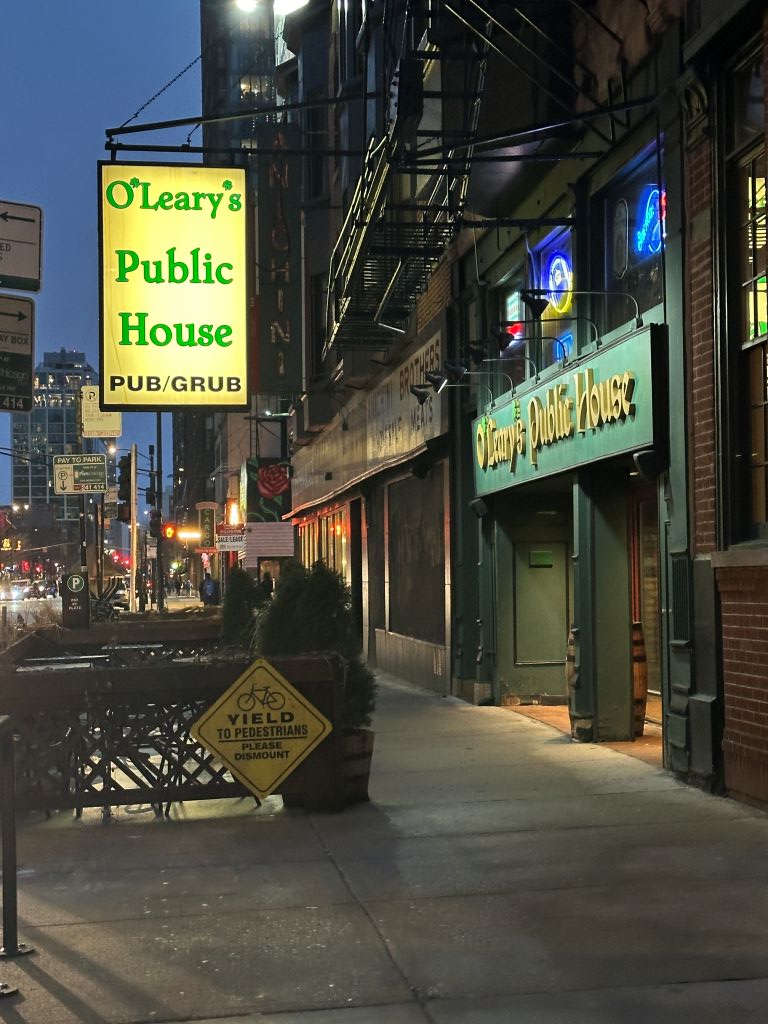
In the evening, I meet up with your esteemed co-editor Adam and Albert of Ross on Wye, who have been invited to CiderCon to give a talk on Porter’s Perfection (on Thursday afternoon, they will be joined by Autumn from Eve’s and others to explore and compare how this apple expresses itself in the US and the UK). From O’Leary’s Public House — your classic American bar — we make our way to a rather swankier place, a French restaurant chosen for a friend’s birthday.
Back at the Hilton hotel where CiderCon being hosted, Matt Moser-Miller, former Eve’s apprentice and soon-to-be professional Ohio cider maker at Pealer Mill Cider, starts pouring his creations: everything from a lemony, almond-y Finger Lakes blend to various drinks involving the fruit of his prize “Wassail” tree, an unidentified descendent of McIntosh that brings a lovely Concorde grape note. This is exactly what I was hoping for from CiderCon: being poured delicious things by a new cider maker friend in a random hotel room at too late an hour.
Tuesday, February 4th, 2025
It’s another day of work for me, with a quick break for the customary extra-crisp walk and an extra-soggy lunch at Al’s #1 Italian Beef. Forget the implausibly early skyscrapers, Chicago’s true triumph is the Italian beef sandwich: a deceptively workaday roll only just managing to contain a mass of expertly shredded, deeply flavourful braised beef, punctuated by sharp, spicy, celery-forward giardiniera (my favourite of the available toppings) and dipped in the beef’s greasy, savoury cooking liquor. I digress.
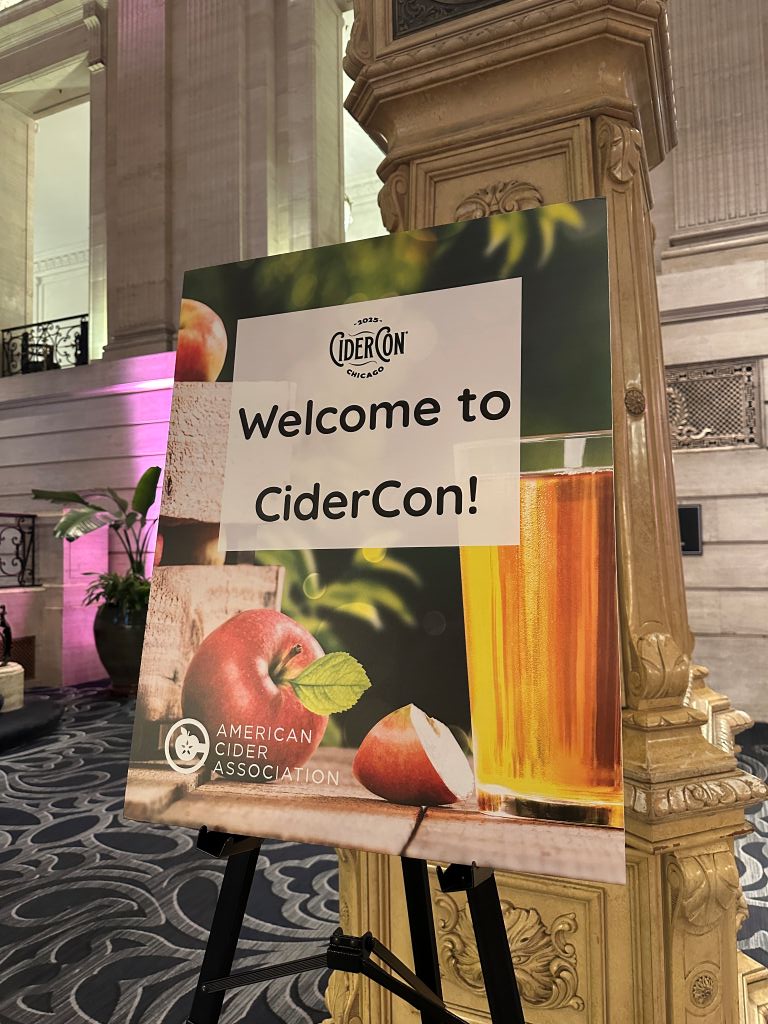
Soon enough, it’s time for the early evening start to my first-ever CiderCon. The Cider Institute of North America is hosting a welcome party in a suite at the top of the Hilton; I grab a nametag and head in with what I suppose is a kid-in-a-candy-shop expression on my face. As I meander between new and old acquaintances, many intriguing beverages are poured into my glass, most of which have been made by those who brought them. I’m bucking that trend with my contribution, a delightfully rich and blossomy Betty Prosser from Cwm Maddoc that I’ve brought along under the assumption that there’s unlikely to be many other Herefordshire perries on the table. Standouts from that table include the bold, spicy Sidra Brut Nature from Bodegas Ergo in Santiago de Chile as well as the many “Limona” SVs on the table (a premonition of this conference’s Chilean theme). Despite my avowed love of terpenes, I’m not in love with the spruce tip-infused cider I try, but I can get on board with the slightly menthol quality from the Limona made by José Antonio Alcalde, who teaches fermentation and enology at the Pontifical Catholic University of Chile (and was part of the project that created the useful Catálogo de Manzanas Ancestrales de la Región de los Ríos).
Some international cider friends and I have dinner at Virtue, a Southern restaurant I’ve been meaning to try since the last time I was in Chicago. We chat about everything from the ideal cider pairing (according to our French delegate, Normandy cider and Pont-l’Évêque cheese is basically the deal meal) to the difference between French andouillette and American andouille (it’s a big difference). My blackened fish with buttery grits and crab étouffée is relatively transcendent, and I realize towards the end of the meal that I am seated next to Pete Buttigieg — be still, my public transport-loving heart!
Wednesday, February 5th, 2025
CiderCon proper kicks off this evening with the (in)famous Cider Share, but first I’m due at the Northwest Cider Association’s press event up in the suite. In classic NWCA style, the best of the region in being showcased in both liquid and human form; multiple red-fleshed ciders, including the two that won gold in the category I judged at least year’s Northwest Cider Cup, are being poured, and almost all the bottles’ makers are here to talk about them to interested parties. Those in attendance include Eli Shanks, who’s from New York but lived in Chile for many years and has recently become the cidermaker at Montana’s Western Cider. Through the newly formed “Cosichi” (Colectivo Sidrero de Chile), he’s also been central to bringing delegates from this year’s guest country, Chile, to the conference.
The ensuing cider share is a glorious rush. I receive the good advice to be quite strategic and pick what I want to focus on before going in. Regardless, once inside, I spend too long at the margins of the hall umming and aahing rather than just going for it. As much as I love big tasting fairs like this, they can be imbued with a sense of urgency and FOMO that takes away from the ability to both form nuanced impressions of drinks and relax!
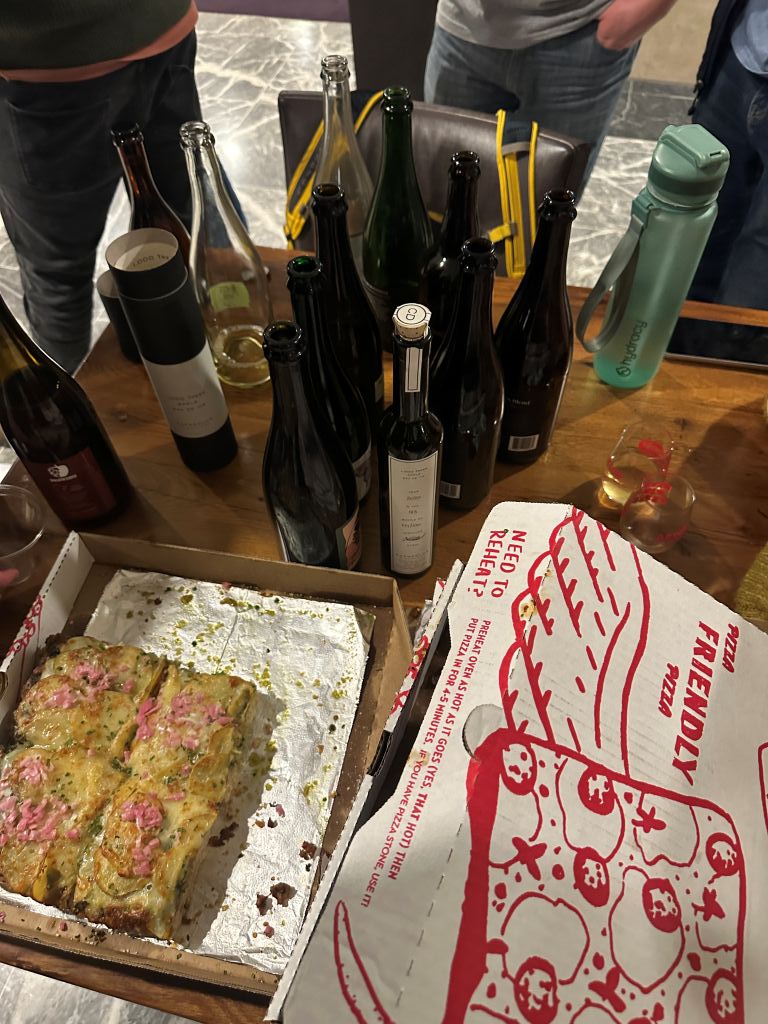
Of course, I do get over myself, and I manage to get in a bunch of brief but fascinating conversations and tastings. I decide to head for the Baltic table first, where a cider co-fermented with 20% aronia (chokeberry) from Mūrbūdu Cider in Lativa stands out: it has a grassy, spicy bitterness, almost like a fancy olive oil, that I often get with ciders made with tannic berries or plums. Moving into American territory, I’m struck by how different the high-elevation Yarlington Mill, Foxwhelp, and Chisel Jersey from Snowcapped Cider in Colorado are from how these cider varieties typically express in England. At the Eden table, I savour a liquid cracker jack of an ice cider; at RAW, I try a resinous, rosy Frequin Rouge. The tasting eventually moves to the lobby and continuous, tavern-style pizza–fuelled, late into the evening.
Thursday, February 6th, 2025
The (spittoon-less) cider share may have taken a bit of a toll, but by the time of my first scheduled talk, “Experimental Food Forest in a Chilean Heritage Orchard”, I am ready to dive back in. Carlos Flores, the speaker, grew up in Patagonia, where lamb with cider was the traditional holiday fare. He worked for 20 years as an architect in the Chilean capital of Santiago before moving back south. He settled in Valdivia, a unique area of Patagonia full of lakes and wetlands. Having bought land planted with heritage apple trees, he discovered a rich cider history and a network of old, widely spaced orchards, often maintained by local women. He learned cider making from the aforementioned Eli, who was running a cider bar in the coastal city of Valparaíso, and the two of them founded Punta de Fierro Fine Cider. Carlos’ talk, however, is all about how, inspired by the multi-level structure of the Patagonian rainforest, he has turned his orchard into a food forest full of local plants, from tiny ugni berries to towering Chilean oaks (or they will be — “Come back in 100 years!”). It’s the uncanny valley of the Southern hemisphere: his “bosque comestible” makes me think of the one Sam and Beccy are maintaining at Wilding Cider near Bristol, but this Chilean orchard is on about the same latitude as Melbourne and parts of South Africa. Apples are truly the most enterprising of fruits. And, as I learned when going down rabbit holes about Chilean cider after this talk, Charles Darwin wrote in the 1830s while travelling along Valdivia’s Calle-Calle river that “[he had] never seen a country where the apple tree grows so well as in this humid part of South America.”
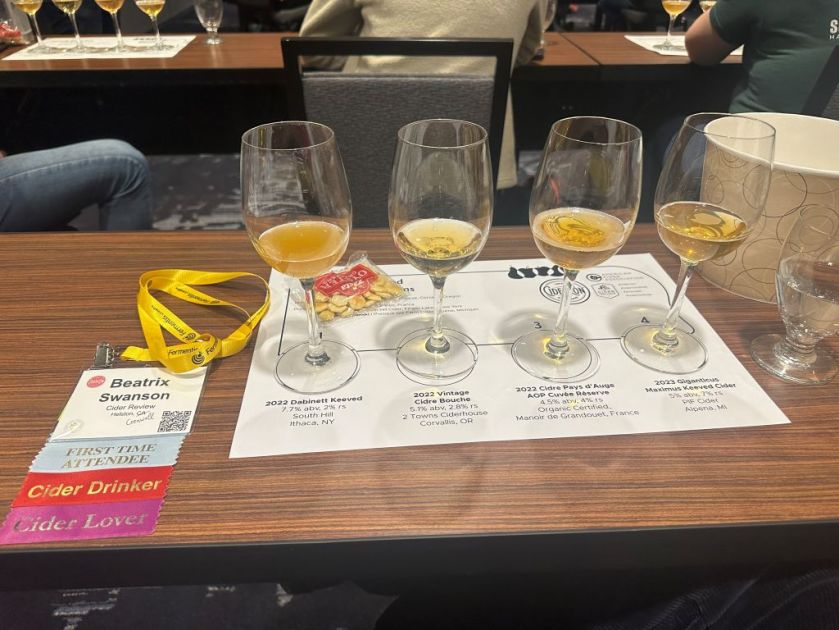
The rest of the day is spent getting rather technical about how orcharding and cider-making practice can shape cider. First, I listen to American cider writer Darlene Hayes and French cider-making consultant Yann Giles talk us through an “orchard network study” that took 40 orchardist-growers in Normandy, on different soils and using different orchard management techniques, and evaluated their juice from four main varieties over 12 years. Broadly, the results showed that the more apples a tree produced during a given harvest, the less sugar was in the fruit, and the same dilution effect were true of polyphenols and nitrogen. While apple variety was still the main factor determining phenolic and acidic compound diversity, the findings showed how much this can be modulated in the orchard and highlighted the trade-offs one might expect between flavour density/quality and yield.
Then, there’s “Keeving: Basics and Practical Applications.” The panellists come from all over the cider spectrum, and while they do give an overview of the basics of the keeving process (with Yann pitching in his Normandy expertise), they spend more time discussing why they keeve — from wanting flavours that “you can only get with arrested fermentation” and thinking that “no filtration is the most elegant way to make cider” to just being “really intrigued by the flavours of French cidre”. Of course, we’re also here to taste an incredibly diverse range of keeved ciders: Oregon, Michigan, New York, Normandy. Then, it’s a relatively early bed for me, as I need to rest up for even more talks as well as the end-of-CiderCon party tomorrow!
Friday, February 7th, 2025
My morning walk today is the best yet: the clouds lie low above the lake, but it’s bright out, and the water itself is an eerily glassy turquoise dotted with shifting sheets of ice. When I arrive at the Hilton, I pop into the scion exchange (a hushed, cultish gathering of devotees exchanging small bundles of sticks in a windowless room below a staircase), and I briefly check out the trade fair — far brighter but, if I may say so, far less exciting and conspiratorial. I then head to the hotly anticipated talk on Chilean cider, where I learn loads, including: how multiple waves of European migration (starting with the Spaniards who arrived in Peru in the early 16th century) have created a rich diversity of mostly ungrafted apple descendants which thrive in Chile; how the country’s coast mirrors the West Coast of the US (except of course that the North is warmer than the South); and how Chile’s pre-Columbian people made all kinds of fermented-fruit drinks called “chicha”. These days, chicha refers almost exclusively to a cheap, still-fermenting apple cider made by and for an older generation (on mostly home-made wooden equipment), with the men doing the cidermaking and the women tending the orchards. It’s usually sold in reused plastic bottles by the side of the road, and it’s a category ripe for the celebrating and elevating by the team of passionate Chilean cidermakers giving the talk. Of course, they’ve brought ciders to try, everything from a dry keeve with notes of blueberry and flowers from Tencai (the cider is hauntingly named “Cold and serene death” to call attention to the loss of traditional orchards) to a complex cyser from 3er Circlo with salty olive, grape, and guava notes as well as an herbal smokiness. Cosichi is organizing the inaugural “Pomum Cup” for cider in Temuco this year, and the Cata d’Or World Wine Awards in Santiago have just instituted a cider panel — watch this space!
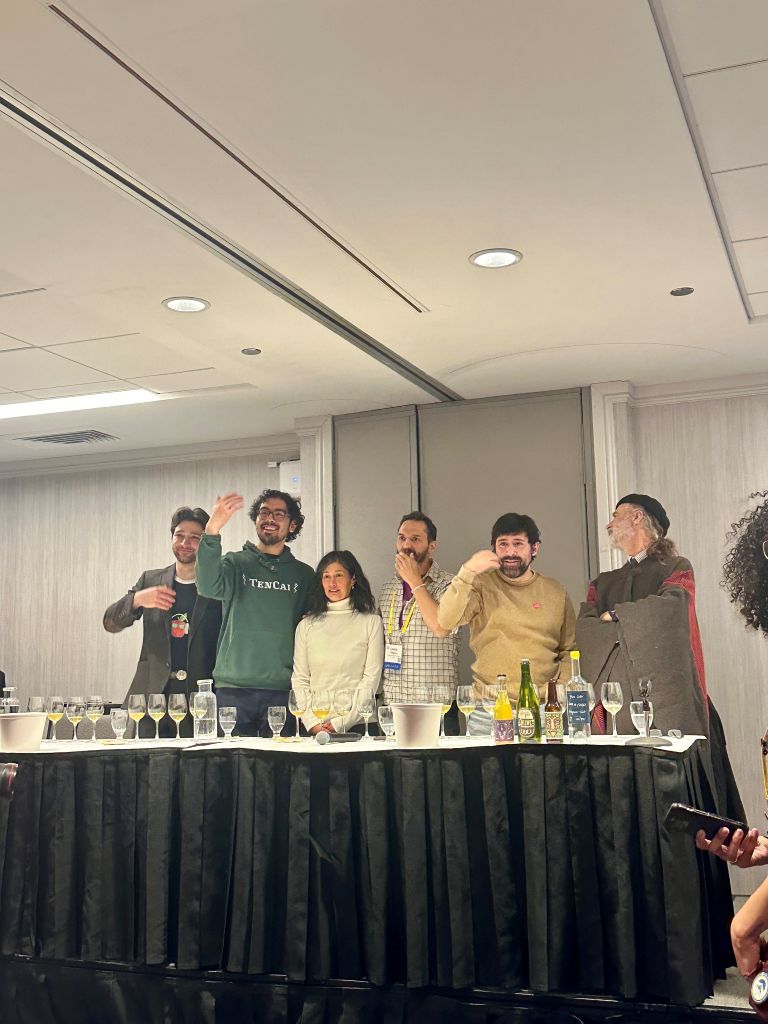
I somehow have two more talks to attend, first on “the paradigm of natural cider” and then on my beloved quince. The former is a panel moderated by Haritz Rodriguez (aka Ciderzale), a key representative of the Basque cider region, so I come in expecting something of a deep dive on sagardoa naturala. Instead, it’s more US-focused, exploring the (unregulated) term of “natural cider” from the perspective of both zero-zero, “natural wine-style” makers (Brooklyn Cider House) and those that seek to emulate Asturian or Basque cider specifically (Son of Man). I think I know my way around the “natural” debate, but I take away lots of thought-provoking nuggets, from the fact that Son of Man actually ferment in an oxygen-free environment and then deliberately infect their cider with lactic acid cultures isolated from the Basque country, to Richard from Brooklyn Cider House’s idea that the volatile acidity that’s present in many of these ciders can be thought of as a way to give cider back its life and zing after the (once inevitable) malolactic fermentation.
Brandon Buza’s quince panel serves up the longest tasting flight yet (five ciders and two juices). The panellists, which are drawn from both coasts of the US as well as various areas of Chile, and participants alike muse on the diversity of flavours present in the drinks; everything you can, can’t, and might do with quince; the availability of the fruit in various locations; and the need for further study of this unique and delicious pome. I particularly enjoy the cubes of fresh “Kubanskaya” quince that are passed around, which have a delicate, sour but floral flavour as well as the juicy-firm bite of fresh coconut — I end up snaffling up a lot of the leftovers at the end.
Saturday, February 8th, 2025
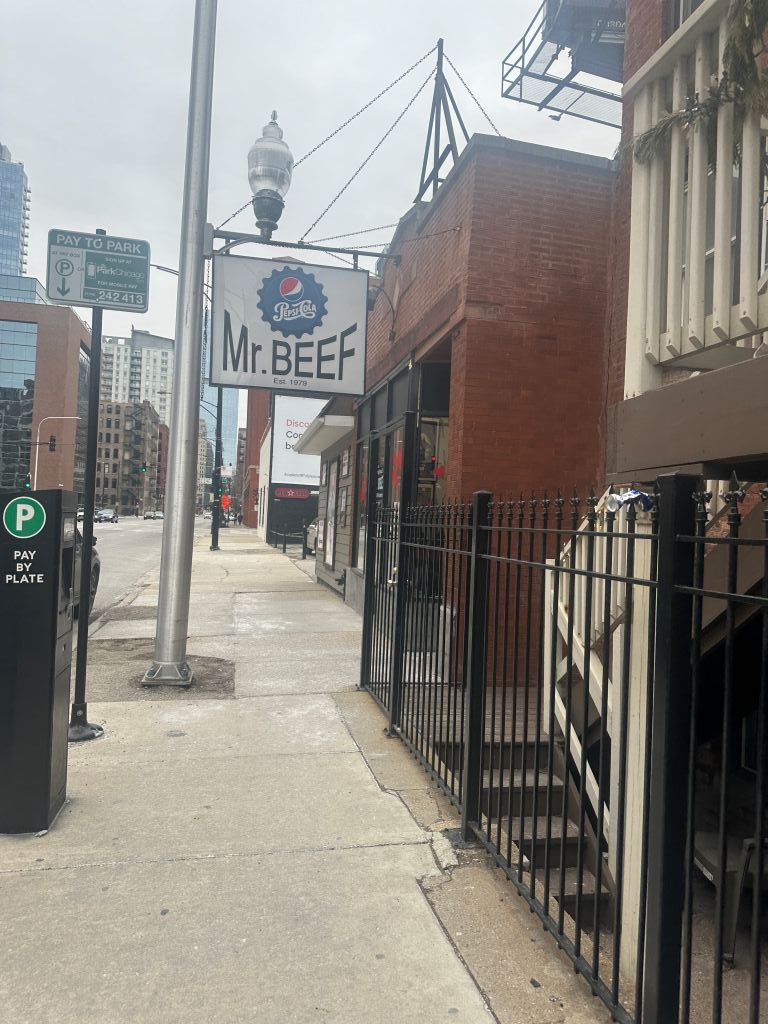
Having stayed up late at the post-Cider Con party last night, I take it blissfully easy this morning — no hotel corridors to get lost in, no talks to find a seat at, no tasting notes to write. At lunchtime, I meet up with the UK-cum-Ohio crew for Italian beef sandwiches at Mr. Beef (which, I am assured, is superior to Al’s). For somewhere that inspired a very popular TV show (The Bear), it’s a surprisingly “real” and reasonably priced establishment, and I’m deeply torn about whether to just go and get another sandwich. (I did not do so, but I’ll never be sure it was the right decision).
As I’m enjoying a last wander through Chicago later that afternoon, it suddenly starts to snow. I’m standing atop the pedestrian bridgeway that connects Millenium Park and the top floor of the Art Institute, and the sight of Chicago suddenly all white-swirling and hushed leaves me slack-jawed. I stand there for a long time, turning every so often to catch a different view, watching everything including me become enveloped in white. Finally, I get too cold, and I walk back to my hotel to warm up before the concert (Beethoven and Bartók) that I’m attending at the famous Chicago Symphony that evening.
I learned a lot at CiderCon, but most of all I was buoyed by the enthusiasm and energy of nearly a thousand (!) cider-obsessed attendees. Many connections were forged in conversations over lunch in the ballroom or paper cups at a party, nodding over our glasses at a tasting talk or catching up in the line for an event. In my little corner of England, southwest though it may be, (fine) cider can feel an incredibly niche pursuit, but at CiderCon, it’s everything. Cider is a wonderful community, and I never tire of learning about the many beautiful, remote, and/or unexpected corners of the world where people are making this drink.

Discover more from Cider Review
Subscribe to get the latest posts sent to your email.
 Cider Review