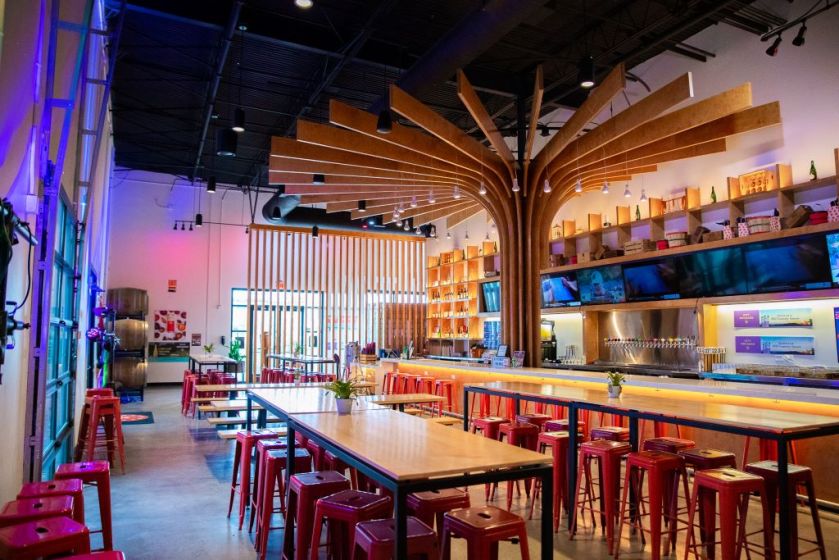
On a balmy October day back in 2022 my husband and I were pottering around sunny Houston Texas and, en route to a brewery as is so often the case, happened to spot a simple red logo bursting brightly from a crisp white wall. The words City Orchard piqued my curiosity, and soon we were ensconced in a sleek, expansive taproom boasting a gleaming 50ft marble bar with a beautifully carved stylistic rendering of a giant apple tree overhead. Already eyeing up the neatly stacked rack of barrels in the corner and elegant arrangement of bottles on display, I quickly had an inkling that this was not your regular run-of-the-mill (pun intended) Southern cidery.
A swift glance at the menu proved me right. Oh, hello Orchard Blend #10 – a blend of estate-grown Porter’s Perfection, Brown Snout and Golden Delicious! I see you friend, and I raise you Orchard Blend #12, featuring Northern Spy, Acey-Mac, Yarlington Mill and more Porter’s Perfection. I may have begun skipping, cooing and otherwise making the kind of fuss I’d make over a puppy or a kitten. It is not inconceivable. I certainly insisted that we try everything on the menu. Pictures from that day show me basking on their breezy patio, quaffing each and every cider with beaming excitement, most likely going far too fast to grasp every nuance of care that had gone into their creation – but that was a job for future visits.
Moving to Texas, I had considered locally made quality cider to be something left behind for visits home, like cask ale and meat pies. Fortunately, my new hometown of Austin proffered all of the above, including two excellent cideries whose stories I shall save for another day. The discovery of City Orchard, however, opened up new and exciting possibilities for two reasons: the first being their significantly broader range and higher turnover of varietals than we have in Austin, and the second being their superb range of canned ciders, both pure and fruited.
As a cider lover and professional, I am always fascinated by the possibilities of flavour that cider can offer, and how craft cideries are pushing boundaries, cultivating heirloom apples, working with wild yeast and mastering blending techniques. I love the joy of popping a fancy bottle, inhaling the aroma, swirling it in a slim stemmed glass and taking that first exploratory sip.
However, I also love canned cider. Crushable, backyard-poolside-car journey-pub garden don’t-think-too-hard-just-enjoy cider. And in the most ideal of ideal worlds, that cider will be a local cider. So, after five years of living in Central Texas, where local craft cider meant a trip to the taproom or a bottle-pour at home, I was delighted to find a range of high quality canned cider that quickly became incorporated into my everyday oeuvre – not that there’s anything everyday about City Orchard’s cans.
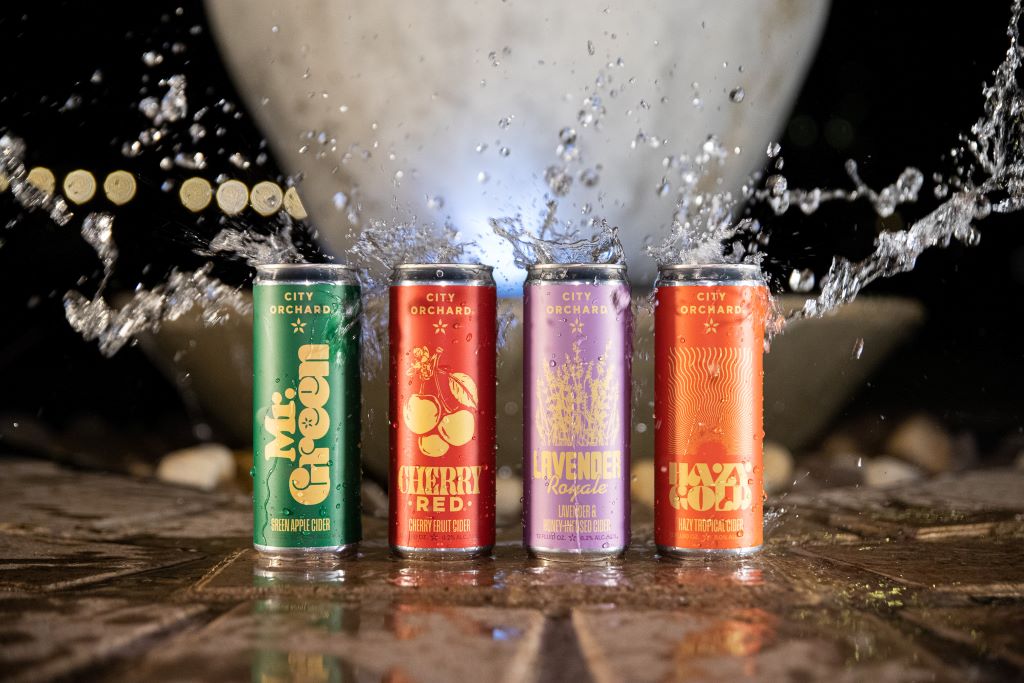
My first taste of the perfectly balanced Lavender Royale, crisp and gently biting Cherry Red and exquisite Rhode Island Greening single varietal Mr Green were in the City Orchard taproom, but I soon discovered that their joy was in no way limited to draft. Their slim vividly coloured cans offer up just as pleasing a drinking experience as a freshly poured glass, and now, nearly five years after opening, the brand is taking off around the state.
Much later, when interviewing cofounder Patrick Kwiatkowski, I asked him about why City Orchard chose to make both complex, upscale bottles mixing heirloom and European apple varieties and a high-end version of mass-market canned cider. The answer was a complex one, and lies in City Orchard’s roots as a culturally Houstonian and Texan brand, the company’s access to a wide range of apple varieties from co-founder Mat Smith’s family farm in upstate New York, and the three founders’ (Clay Watson is the third) commitment to quality. Kwiatkowski, Smith and Watson all moved to Houston to follow careers in the energy sector, and met through their mutual love of cider in the early 2000s. The trio noticed a gap in the market for locally produced quality cider, and with access to fresh juice from the Smith farm, purchased by his grandfather in 1929, decided to create City Orchard.
The trio’s initial goal was to build a cidery in a European model, recreating the ciders they fell in love with in France and Spain, but they soon realized that this wasn’t possible, partly because of the different apples grown in upstate New York, but also because of the demands of the Texas market which they wanted to fulfil.
“We decided to make all our cider here so it is made by Texans in Texas,” says Kwiatkowski. “Texas is a much bigger market – but it’s also the Wild West when it comes to cider, anything goes!” He goes on to explain how in France and England, and even in the established American cider communities, such as Fingers Lake, close to the Smith family farm, traditions are very strong. “You couldn’t get mango cider in France!” he laughs. However, while the trio agree that the traditional ciders that they love are still their favourites, Texans feel differently.

“People down here want flavour and difference,” says Kwiatkowski, reflecting insights shared in a 2023 Good Beer Hunting article. “There’s a national trend for crazy flavors and the cider market is no different.” Kwiatkowski cites how this was a challenge for City Orchard – how to keep their traditional values and make a market-pleasing mango cider. They resolved this conflict through a commitment to quality. “It’s all down to raw materials – we had to find right flavour sources,” Kwiatkowski explains. “The cider that really redirected efforts was our Lavender Royale which became a best seller.”
For traditional cider makers, a lot of experimentation was required. City Orchard’s natural flavours are all distilled flavours – something that distinguishes them from most of their shelfmates. Kwiatkowski explains that they require careful handling. “We developed our skillset with the Lavender Royale – too much can turn into shampoo!” he explains. “You have to go easy – it’s the same with cherry, it can end up like cough syrup. There is a critical inflection point as natural flavours are v delicate to get right, but we also don’t want to hide the apples.” City Orchard’s commitment to using top quality apples from the Smith family farm and their neighbours runs across all their products, from their highly limited ice ciders to their new fruited Fresca range which features flavours like lime and hibiscus. The apples, Kwiatkowski affirms, are what make the cider, and using apples from what Kwiatkowski describes as one of the finest apple-growing regions on earth, the glacial soil of Sodus Bay on the shores of Lake Ontario, gives City Orchard an unparalleled edge in the Lone Star State – one makes leaning into Texans’ desire for canned cider a very smart move indeed.

While City Orchard has originally planned to focus on on-premise sales from their gorgeous taproom, Covid, which hit shortly after their initial opening, quickly quashed this aspiration. Smartly, City Orchard pivoted swiftly to distribution, and despite the challenges of placing an untried brand onto supermarket shelves, their quality shone through and they made it through the pandemic, securing distribution at 150 HEB and Central Market stores across Texas (our largest supermarket chain by some measure). Now, however, City Orchard have set their sights on a bigger prize, and are making impressive headway into gaining distribution in local brewpubs – determined to crack the craft market further by reaching out to a targeted audience of quality-conscious, mindful drinkers who might fancy something other than a beer once in a while.
“Currently our biggest strategy is getting brewpub customers,” says Kwiatkowski, citing many of my local breweries such as Austin’s Meanwhile, Lazarus, and Zilker, as well as Houston breweries like B52 who all stock City Orchard. “The challenge is to get our cider into consumer’s mouths, and brewpubs are so important because they attract people who have purchasing power and interest and who care about what they are drinking – they bring in people who might not want a beer and can then try our cider.” Incidentally, City Orchard solves this problem in reverse by serving their own small-batch beers brewed on-site by Watson, which are also ever so good.
The brewpub market is key for City Orchard because distribution in Texas is complex and competitive. Kwiatkowski explains the difficulty to get on tap in bigger bars and restaurants. Cider only gets one or two taps at most bars which are taken by big distributors. We also discuss the issue of market positioning and how that affects building a customer base. “There is no market for cider over $25 a bottle in Texas, even though some are superior to Prosecco or Champagne,” Kwiatkowski explains. Because cider is stocked with beer rather than wine in Texas and shelf space is limited there is significant pricing pressure from competitors, meaning that while City Orchard is a premium brand, they can’t afford to be too expensive. By leaning into the canned cider market, they can get their product out to consumers at a lower cost and remain competitive with other local craft brands, and also reach that crucial brewpub demographic.
While I will always head back to the City Orchard mothership for pours and bottles of their exquisite limited edition bottles, such as their divine oaky-tart Spanish-style Espia Northern Spy single varietal and lush smoky-tannic BA #1 Sodus Bay Blend, my fridge will be forever full of their Lavendar Royale, tropical-mango Hazy Gold, Cherry Red and Mr Green which meet that grab-and-go need without ever compromising on flavour or quality. And although I buy my cans in-store or from the cidery, I always keep an eye out for City Orchard when I visit a local brewery taproom and give a little smile to the drinkers snapping open their cans. At a recent festival I attended, the Mr Greens were selling like hot cakes, and I was happy to note that Texas beer and music lovers also have good taste in cider.
Cover image by City Orchard.
Discover more from Cider Review
Subscribe to get the latest posts sent to your email.
 Cider Review
Pingback: Cider Review article: ‘City Orchard: cider deep in the heart of Texas’ – Craft Beer Amethyst