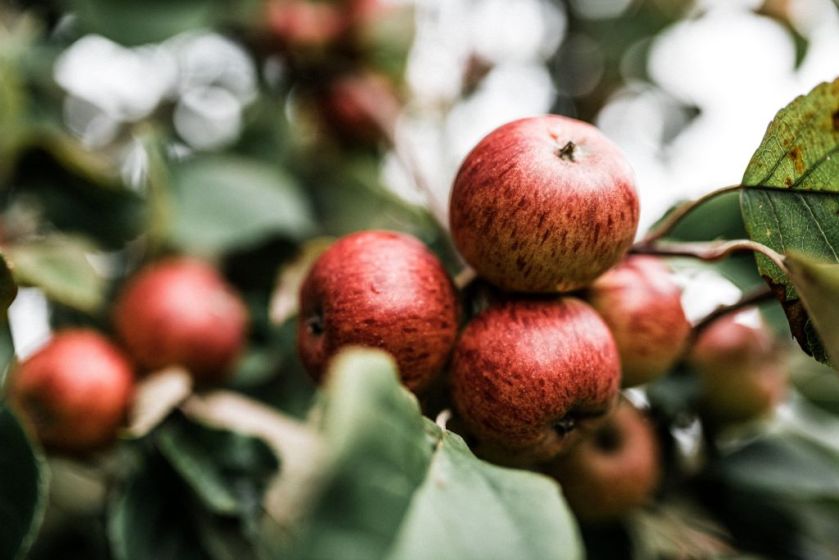
It all began with Sandford Orchards’ Barny Butterfield standing at the apple intake conveyor, watching fruit come through from the various orchards that supply his business. After twenty years, it is like welcoming home old friends. Familiar varieties roll past, and Barny can tell which orchard they come from – and even in some cases pinpoint the precise area where their specific trees grow. But suddenly apples he didn’t recognise started to pass by. His interest was piqued.
“This particular fruit was just a totally bizarre shape,” Barny tells me. “I kept putting them in my pocket. It is a lovely mild bittersweet with really interesting character and makes a gorgeous single variety. I was determined to find out what this apple was.”
Serendipitously, at a National Association of Cider Makers (NACM) Pomology meeting soon afterwards, Barny heard Professor Keith Edwards of Bristol University speak about some preliminary work they’d been doing on genotyping cider apple cultivars.
National Institute for Cider and Fruit Research at Long Ashton
It is worth taking a moment to understand the context and relevance of the Long Ashton Research Station to this momentous project. It was once the UK’s leading apple and cider research facility. First founded in 1893 by a single cider producer on his own orchard near Glastonbury, it led to the formation of the National Fruit and Cider Institute in 1903, moving to land provided by the Smyth Family of Ashton Court. Their aim was to support cider production in the West Country.
In 1912, the station was absorbed into Bristol University’s Department of Agricultural and Horticultural Research and its name was changed to Long Ashton Research Station. It continued to grow and was taken over by the Government’s Agricultural Research Council in 1931. The Ministry of Health developed a blackcurrant syrup there during the Second World War that would later be marketed as Ribena.
In 1981, the decision was taken to close two of Long Ashton’s major research divisions – Pomology & Plant Breeding and Food & Beverage. Arable crops became the main research focus and cider apples – the reason the station had been founded in the first place – fell by the wayside. The NACM took over responsibility for cider pomology research in 1990, with £50k contributed by each of the three major producers, Bulmers, Taunton and Showerings. A 25p/tonne levy was also contributed by members of the two growers’ associations in Herefordshire and Somerset. The Long Ashton digital archive was lodged at Bristol University.
When the site was finally closed entirely in 2003, the intention was to put it up for sale for housing. But no one really knew who owned it. It transpired that it had been given as a gift by Lady Emily Smyth of Ashton Court after her death in 1914. Her will stated that the land would remain with the newly founded research station on condition that it was used for agricultural, fruit and cider research.
The Charity Commission decided that the land could be sold, but the proceeds from the land had to be invested into those same research area. The bequest was given to Bristol University, and I understand it to be one of the biggest that they have. The fund was used to set up the Bristol Centre for Agricultural Innovation, which the University says is “at the cutting edge of agricultural research.” Professor Edwards’ project is highlighted in the Centre’s literature, but it is notable that no other cider research projects are mentioned at any other point. Perhaps there could be an opportunity here for the University to encourage more work in this area, which will truly “continue the legacy of Lady Emily Smyth.”

Establishing a method
The Lady Emily Smyth Research Fund was one of the pots of money that funded Keith’s internationally significant research career. He had worked at the Long Ashton Research Centre near Bristol since 1995 identifying wheat varieties. Along with Professor Graham Moore, Keith was awarded the 2018 Rank Prize in Nutrition (Human and Animal Nutrition and Crop Husbandry) – considered to be a mini UK version of the Nobel Prize. One of his peers at the facility was Liz Copas, the last pomologist at the Research Centre.
“People would send in a fruit or a leaf or a picture and say ‘Could you tell me which variety of apple this is?’” Keith told me. “Because of her vast experience, she was able to make a good guess. It was something that would take a lifetime of experience to get to know.”
The wheat research was wound down, as Keith “retired” in 2019. Noticing Liz’s book, A Somerset Pomona, on his shelf, Keith wondered then whether she was still working in the same field, so he got in touch with her. Talking about the identification of apple varieties, Keith suggested that they adapted the technology they had developed for wheat and apply it to cider apples. It seems his retirement was shortlived.
A small grant from the Lady Emily Smythe Research Fund gave Keith and Liz the money needed to set the system up and they made an appeal on local radio for the public to send in samples in the same way they had done when Liz worked at Long Ashton. This resulted in 840 samples being received, to which they could apply their new technology and generate a DNA fingerprint for the tree.

“It’s exactly the same as the forensic services use,” Keith explained. “We used it to identify one individual versus another. We generate a barcode for the individual and we match it up to the barcode of other individuals. If they match, they’re the same and if they’re different, then they’re different varieties.”
Their technique was quicker and cheaper than anything that had come before. Previously, DNA fingerprinting had been run out of the East Malling Research Station in Kent. They would use microsatellite fingerprinting, which needs a degree of expertise to interpret and cost around £50 a sample.
The new technique doesn’t require interpretation, so there is no potential for ambiguity. Keith and Liz needed a database of known named varieties to match the public samples against and were permitted to sample 2500 trees from the Brogdale National Fruit Collection in Kent. The fingerprinting of these trees and the 840 samples from the public took only six weeks.
Liz mentioned that in the latter days of Long Ashton, they had carried out one final apple breeding experiment. This resulted in a set of lines called The Girls – around 20 apple varieties that are now widely used in the cider industry. The problem was that during their establishment, the parentage of each of The Girls was lost. Within a week, The Girls had been fingerprinted and their parentage was known again.

The work was quick – their Lab Technician was able to fingerprint up to 5000 individuals in a single day, at a cost of around 50p-£1 per sample. The only real limitation was the physical act of sampling, as with the best will in the world a small team couldn’t hope to sample 5000 trees in one day.
What Keith was looking for in the results were trees that had a new fingerprint which didn’t match anything in the reference database, but did appear in two or more separate orchards. An apple grown from a pip would have a unique DNA fingerprint. But two trees with a shared DNA fingerprint must have been generated by a grafting event – somebody had seen value in a certain tree and chosen to deliberately propagate it.
Enter Barny Butterfield
Seeing Keith talk about his work at the NACM meeting, Barny says he “sort of stalked” the professor to let him know about the unique fruit coming out of the old Devonshire orchards Sandford worked with. A modern orchard is composed of rows of known varieties – although there can still be a small margin of error – whereas the heritage orchards of Devon, Somerset and Hereford are more of a patchwork of different trees.
As well as being grafted because they provided useful apples, these ancient trees have survived a long time. That suggests that they have a degree of disease resistance and sustainability in the face of climate change. They are worth knowing, and worth propagating.
After collecting a few preliminary DNA samples, the team were presented with a kaleidoscope of lost and unrecorded varieties.
“We found more varieties by accident than on purpose,” Barny laughs. “That’s one of the problems with apples, they all look the bloody same. The one I found I picked out because it was really taxonomically different. Mostly they aren’t. They are little green jobs or little red jobs. But now we could test a whole orchard for the same cost as one tree before.”
Barny successfully applied for DEFRA funding to extend the trial. Many more leaf samples were taken around the old orchards of Devon, Somerset and Hereford, from the National Collection of Wales and down into Cornwall.
All told, the complete database, which is now being finalised, will have some 8000 samples in it – focused on cider apples. The samples are located either using GPS or WhatThreeWords. Identifying the geographical relationships between the individual examples of lost varieties may start to uncover the social history of these trees and the people who used them and chose to graft them in new locations.
But Keith will have to retire at some point, properly and finally, and so the sustainability of the project has had to be considered. The database will be handed over to a commercial company, the LGC Group. Keith did the same with his wheat database when that research was wound down.
This means that the fruits of the research will be maintained. If an orchard keeper or member of the public wants to find out what varieties are in their orchard, they will be able to send a leaf to LGC. They will fingerprint it and compare the results to the database. Of course, this will be a chargeable service and no doubt cost slightly more than in the lab, but it will still be considerably more affordable and faster than previous methods.
Barny’s mystery apple has now been christened Henry’s Potato, after the owner of the orchard where it was sourced and the fruit’s distinctive shape.

What next?
The project has already thrown up tens of trees that have a unique fingerprint, and many of the really interesting ones come from places where people historically made cider. At Tedburn St Mary in Devon, for example, an apple was discovered that has double the acidity of Bulmer’s Foxwhelp. Barny explained why this is significant:
“You’ve got to be some kind of crazy cat to want a single variety cider like that. But acidity is a fundamental element for successful, clean fermentation. Most people add Foxwhelp or maybe Brown’s Apple for clean fermentation purposes. To bring the pH down and prevent microbial spoilage as well as for the structure and flavour of the drink itself.
“If you’ve got an apple which is 18g a litre of acidity rather than 9g like a Foxwhelp, then you can add half as many. If you’ve got a character apple that you really want to show off; maybe a Dabinett, maybe a Yarlington, you can add more of your character apple and less of your balancing apple.
“Part of this study which is bringing me great pleasure is that you can tell that in the past a farmer wasn’t going to tell his neighbours what he’s got. You can feel it, you know, they win the prize at the show and they’re not about to share how they did it. I’m convinced that we’re going to be finding those sorts of rare varieties.”
Barny has already proved this concept. He made a few demijohns of cider with some of the rediscovered, unnamed apples and put them into the Farmhouse Cider competition at the Devon County Show, the oldest competition in the country.
It was nearly a clean sweep. Barny took 1st, 2nd and 3rd place in the dry and medium cider categories, but only (only!) first place in the sweet cider competition “because we only entered one cider in the sweet class.”
“Immediately after feeling a bit pleased,” Barny says, “I felt sort of ashamed for my generation and the generation before. What the fuck were we doing? Our grandfathers and uncles, the cidermakers were saying, you need some of those, boy. And you need some of those. And we were happily saying, no, we’ve invented a new way. We’ve invented bush orcharding. We only need twenty kinds of apple. That’ll do. Let’s just bin a thousand years of cultivation and give ourselves a pat on the back.
“There’s a wee lesson for us there somewhere. We were pretty scattergun with those ciders. That’s from the earliest of trials with a handful of these varieties.”
The potential for this research is truly phenomenal. The chance to rediscover the knowledge of past generations of farmhouse cider expertise and experience is there – the chance to make even more truly great cider. And to cultivate more of these trees that have proven they are natural survivors. They have beaten the odds and survived this long against disease, against climate change.

There are commercial applications outside of cider. Dessert apples use a huge amount of energy in comparison to cider apples because they have to be carefully picked whilst still under-ripe and kept refrigerated and blemish-free until they are needed. Instead, this research could help to identify eating apples that could be stored at ambient temperatures, potentially taking out a huge part of the carbon footprint from our everyday food chain. There are undoubtedly hidden varieties out there in ancient orchards that made the best apple sauce too, for example, and that knowledge could be recaptured.
But therein lies the rub, someone needs to want to do the research and they need to be prepared to pay for it. But, quite reasonably, Barny wants to focus on cider:
“We’ve got to find out as much as we can about these apples. We could map every apple tree in the UK and know what it is. It’s not as preposterous as it sounds.
“Once we’ve got them identified we can collaborate to discover the qualities of the fruit, how that juice ferments. And some people will be more successful with given cultivars in different areas. I’m certain we’re going to see some of these varieties are hyper-local and some will cross boundaries.
“Given the changing climate, I think we should be picking up Brogdale and cloning it in other climatically zoned parts of the UK because without finding out how these trees do in different scenarios we’re a bit stuck.”
In an ideal world then, this project will increase the quality of cider being made, give a more diverse range of apples to use in cidermaking and ultimately help to make the industry more resilient against climate change and disease. But it requires funding and it requires collaboration. While Barny Butterfield is undeniably a force of nature in the cider world, this is not a project that one person can handle alone. Who will step forward?
All photos courtesy of Sanford Orchards.
Discover more from Cider Review
Subscribe to get the latest posts sent to your email.
 Cider Review
Excellent work. Time is running out to find those hidden gems before they disappear.
Are there talks with research institutions in other countries? No doubt there are plenty of unnamed varieties waiting to be discovered in apple growing regions across Europe.
LikeLike
Pingback: oliverscider
I wouldn’t have thought there are talks with anyone – while I’m sure Barny will continue to move things along, Prof Edwards will be retiring (hence why the project database is moving over into private hands for safe keeping). There is certainly lots of room for partners abroad to use the database, add to it and participate, but they’ll need to find money and organisation to do it.
LikeLike
Thanks for this Laura, it’s a great article. It’s good to see research like this still taking place. I think Cornell University were doing something similar but their focus was more on apple breeding.
It’s still a woefully underfunded area of research in the UK but thankfully there have been some bigger initiatives funded by UK Research & Innovation (UKRI) and the constituent research councils that have resulted in projects like https://www.growingkentandmedway.com/
Still a long way to go though!
LikeLike
Thanks Andrew, glad you enjoyed it. It’s a brilliant project and I hope that it gets the opportunity to continue to grow. There are pots of money out there, if someone has the time and energy to apply for them! Personally, I’d love to get access to some funding to start digging into the social history side of people purposefully propogating these trees in the past.
LikeLiked by 1 person
Pingback: Hagloe Crab: back from the brink! | Cider Review
Pingback: North American Guild of Beer Writers Announces 2025 Awards Winners, Honoring the Best in Beer Media – The Reporter's Notebook
Pingback: Cider Review 2025: A Year in Reflection | Cider Review