I don’t care for blind tastings. Have I said that before? Probably, somewhere or other. Anyway. I’ve definitely said it now. I don’t like them.
Well, actually, a few caveats. I like some blind tastings, and indeed I like some elements of all blind tastings. I like judging cider competitions now that the old first-timer nerves have largely been sloughed off. I appreciate the experience of allowing a cider (or perry, wine, whisky, whatever) to speak entirely with its liquid voice, untroubled by any influences of label. And, because I am human, I like when someone gives me a glass of something and I am able to guess exactly what it is, as our new contributor Albert recently managed with a cider from Madeira.
What I don’t like about blind tastings is the element of pressure. The perceived threat to face. And it’s no good telling me ‘oh it doesn’t matter,’ ‘there isn’t any threat to face,’ because I feel that it does and that there is, and since it is my brain that is impacted by these things, I’m afraid you have no say in the matter.

Some of these pressures have to be sucked up as a means to an end. I have done sensory analysis for varying levels of WSET and, most recently, the Certified Pommelier qualification, and in the scenario of an exam room I can accept that pressure comes with the territory. And, like any exam, you learn the system, follow the methodology, approach it systematically and remember at the end of the day that actually guessing the identity of the drink is only worth a couple of marks, and papers aren’t published in any case.
But what I don’t especially like is having some mysterious liquid put in front of me, especially in a group setting, and being challenged to identify it. (Though I should admit to a dollop of hypocrisy here, because I have done this to other people, predominantly my cousin Justin, who to be fair enjoys – or apparently enjoys – the experience). Nothing is so nerve-wrackingly triggering of imposter syndrome. Nothing shakes me so insistently from the state of mind in which I can most usefully assess and enjoy a drink.
The argument that blind tasting is the only way to form an objective opinion of a drink is a compelling and seductive one, and in some cases it is very nearly true. The aforementioned competition setting, wherein no judge really has any skin in the game besides (for some people) possibly not wanting to offer a contrarian opinion in front of other, sometimes more experienced, palates. That’s probably the most comfortable scenario for an objective opinion on a drink to gestate, with the caveat that judging is generally undertaken by necessity at a far faster rate, and amidst a far higher number of other samples than, for instance, the writing of a tasting note for Cider Review.
But whilst blind tasting frees you from the siren song of the label, it unlocks an entirely fresh realm of bias and suggestion, inherently engaging your brain in ways that have very little materially to do with the contents of your glass, but distract you from them nonetheless. An obvious one is that you find yourself trying to guess what the drink is from the very earliest of stages – the look of it; the colour; the fizz or lack thereof. The aroma: ‘oh I’ve smelled something like that before.’ One of the most consistent ways in which candidates of the WSET or Pommelier course trip themselves up is in getting an early idea of what a drink might be and then tailoring their answers to that notion, rather than blocking out any kind of guessing and simply sticking to filling out levels of acidity, tannin, body, intensity, flavour etc and using their working to come up with an answer at the end.
You also, more often than not, start ‘playing the opponent, not the ball’; looking for clues as to what the drink might be through the identity of the person who has served it, especially if you know them well and have played this game with them before. What sort of drinks might they have chosen. Are they the sort of person who might look to catch you out with something obscure? Or is this going to be something that is actually very obvious, but which they hope you will overthink? A bluff? A double bluff? And so, more often than not, these games can become a round of poker in which any sort of objectivity can be overridden by the sorts of brain whirlpools and anxieties which affect us all, and to which – fair enough, might as well admit it – I find myself especially prone. I actually have a surprisingly reasonable record when it comes to this sort of blind tasting. But I remain not a fan.
Having dealt with all that, let me tell you about a fantastic blind tasting I was recently a part of.

A little while before the last RossFest, Barry and I received a message from a cidermaker friend of ours in America, Kris Kazaks, who was once again crossing the pond for cider’s most joyful celebration. He had, he told us, a collection of dry, still North Eastern States ciders, mostly with a good few years of ageing, and he thought it would be fun to get us to do a blind tasting.
Until that last bit about blind tasting I had been ready, in Justin Wells parlance, to windmill-slam the metaphorical ‘yes’ button. ‘Dry, still North Eastern States’ is one of my favourite lexical combinations in cider. I was lucky enough to visit the Finger Lakes Region a couple of years ago, and the various dry, still creations of Eve’s and South Hill drift happily through my head more often than I can tell you. I decided to just enjoy myself at this year’s CiderCon rather than take assiduous notes, but a still dry blend of Golden Russet and Baldwin (named ‘Goldwin’) from South Hill was probably close to the best thing I’ve tried in 2024. Indeed the relatively small handful of still dry ciders from the North Eastern States that I’ve been able to try have made such an impression on me that I have persuaded my two fellow would-be cidermakers at Three Wells that they should be a central mood board for our own creations.
There was, in any case, a pressure release to this particular blind tasting, in the form of my relative ignorance of the North East American cider scene. Eve’s and Eden might be familiar names to this website, but beyond that and occasional hooverings-up of any South Hill or Redbyrd I happen to have chanced upon, I’m woefully narrowly-tasted when it comes to the region. And since you can’t be expected to guess what you don’t know in the first place, I decided that my fragile taster’s ego had a get-out and said an effusive ‘yes please and thank you’ to Kris.
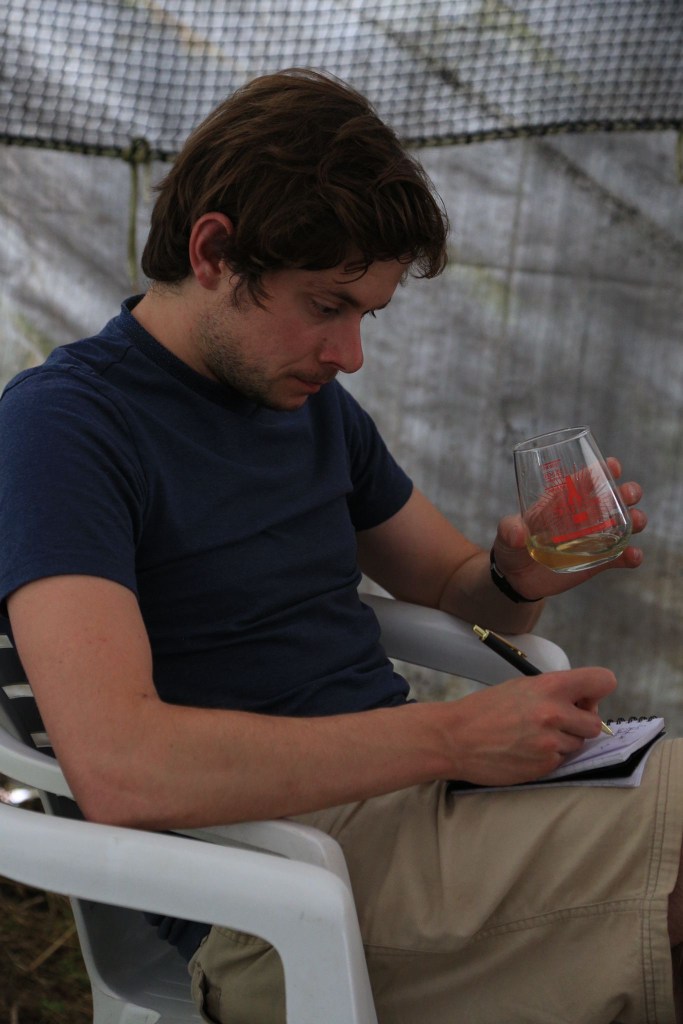
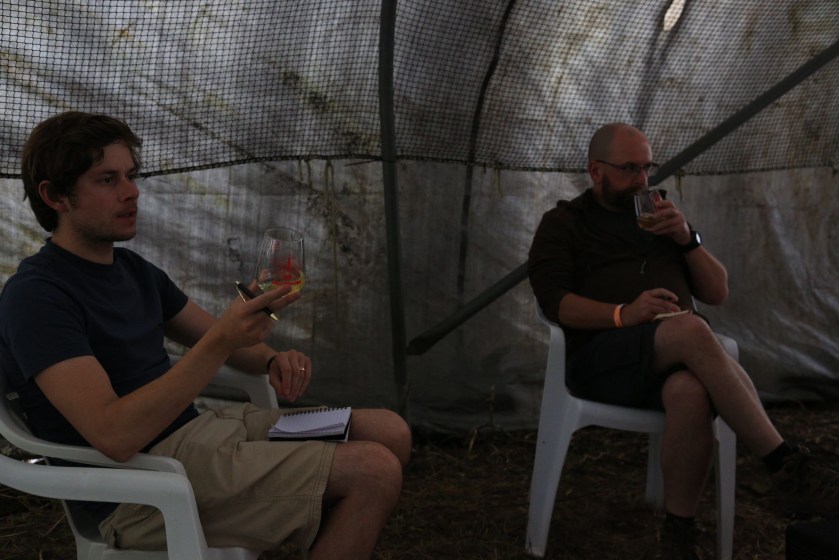
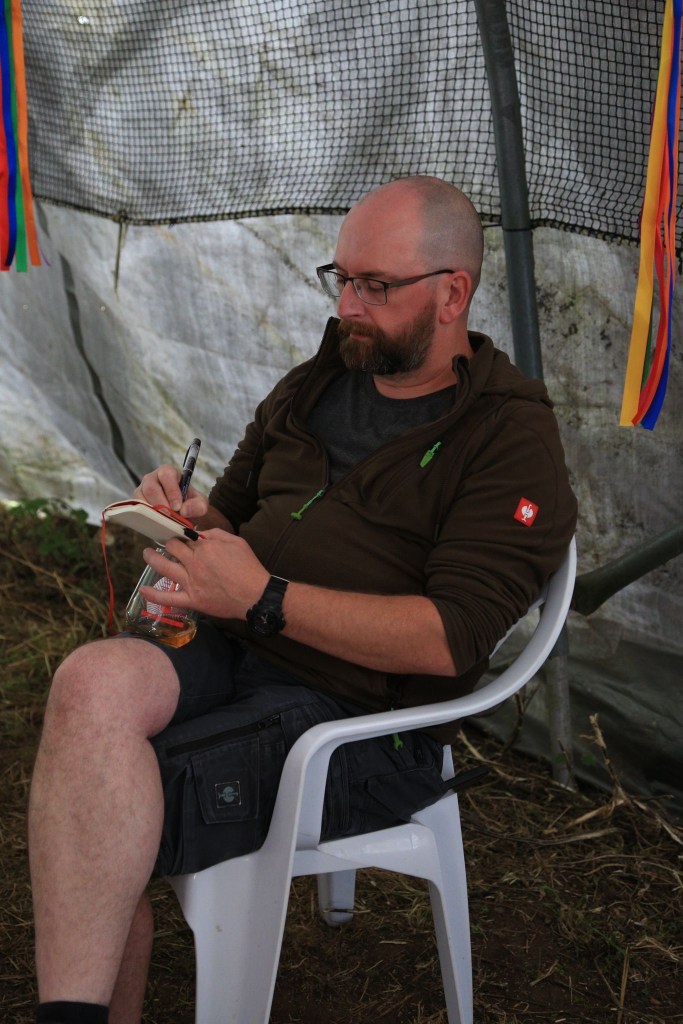
The timing of the tasting ended up rather shoved about in the end (which was my fault – RossFest this year turned out to be busier than anticipated!) But eventually we found ourselves in the shadowy, hidden depths of a decommissioned polytunnel, with a box full of bottles in blind tasting sheaths and Kris’ sister Maia acting as master of ceremonies. At this point, keen as I was on the tasting, a degree of the imposter syndrome anxiety returned. I was tasting, after all, with Kris – who literally works with and among these cideries – and Barry, a maker himself, and one whose palate I expect to be far better than mine. In which circumstances there is always the concern of exposing yourself with an especially bad take.
But too late to change course now and all that. Bottles duly opened and tasted in academic silence one by one, with all revelations saved to the end. Notes, therefore, are written here as they were recorded at the time, ignorant of the cider’s identity. (Although I have given the name of the cider at the top of each one, as is the Cider Review norm).

Eden Chinin’ NV – review
How I served: Lightly chilled – all subsequent bottles the same
Appearance: Pale Gold, super-light petillance
On the nose: Really honeyed aroma, but in a light, bright way. Honeysuckle. Crisp yellow fruit. Seashells.
In the mouth: Nice texture here. Acidity is fresh but gentle. Little or no tannin. The lightest touch of malolactic butter perhaps. Again that yellow apple, touch of green leaf, slatey minerality, tangerine skin, honeysuckle and beeswax.
In a nutshell: Lovely, elegant stuff. Very classic North Eastern States (from my limited experience).
Eve’s Albee Hill 2019 – review
Appearance: Deeper, brassier, light haze.
On the nose: Bruised apple. Some slightly oxidative character, but there’s ruddy red fruit coming through. A little stewed spiced fruit.
In the mouth: Pretty developed on the palate. Hard to tell if this is a case of the fruit starting to get a little tired or – my guess – possibly an issue with the cork? Structure has come apart slightly, with some drying bitterness on the finish. Fruit follows the nose: bruised apple, a little stewed red berry. Hemp and old oak.
In a nutshell: Either a cider at the end of its life, or there have been some closure issues here I think? Hard to tell without seeing what it is.
[NB – this is the only one of the lineup that I actually had bottles of at home. It tasted so different from the last one I opened – just a month before the festival – that I thought something was likely awry. So a few days after going home I opened another, and can confirm that the sample tasted blind at RossFest was definitely suffering from a cork issue and not representative of bottles you might buy. So here’s a bonus tasting note for comparison. Just not tasted blind.]
Eve’s Albee Hill 2019 – review (separate)
Appearance: Rich brass. Clearer than at festival
On the nose: This makes more sense. Fruit development, sure, but rather than oxidative characters, here are sultanas, dried cranberries, apple juice, wilted rose petals and wood. Blood orange, crushed mixed berries, pith and spice. The interplay between fruit ripeness and savouriness is so alluring.
In the mouth: Vivd, full and deep delivery braced by slight, well-integrated, pithy tannin and an acidity that, whilst not especially high by the standards of some of these North Eastern US ciders, has structure aplenty. I love the mouthfeel of this actually; it’s almost Bordelais, in a malic, lower-alcohol sort of way. Fruit again is a mélange of fresh and dried, juicy and savoury, intermingling with some dusty spice, wood, autumn leaf, salinity and slate. Almost rancio in moments. Somewhat drying finish – but I love it, and it would make it even better with food.
In a nutshell: Very much the Albee Hill I know and love. Though a big-boned, rumbling example.

Back to the festival bottles…
Eve’s Albee Hill 2021 – review
Appearance: Lightly hazy rich straw Gold
On the nose: Lovely waxy nose that beautifully marries fresh and developed apple tones. Mineral, a little malolactic touch of butter and a dab of plumper stone fruit. But it’s all in a beautiful harmony; the notes meld into each other rather than presenting individually. It’s all about the whole. I love this nose.
In the mouth: Surprisingly fresh and tangy acidity leads an electric red and yellow palette of flavours; fizzy laces, lemons, sour cherries. But also a juicier, riper fruit-and-florals centre than that suggests. Even a touch of mint. Beautiful finish, with a memory of distant tannin.
In a nutshell: Complex, surprising, vibrant, elegant. Sensational still dry cider, very of its place I think.
South Hill Stone Fence Farm 2019 – review
Appearance: Old Gold
On the nose: Some similarities to theprevious, but the fruit is deeper and more dried; the waxes, hessian, even a touch of leather more prominent. Fruit character is more orange in hue; Sicilian blood orange, Seville orange rind. A flutter of old wood. Super complex.
In the mouth: Again a good and slightly unexpected spritz of acidity on the palate, but in this instance the flavours cleave more closely to the characters found on the nose. Those drier, deeper notes again. I’d guess this is close to its peak; primary fruit starting to cede dominance to tertiary tones. But it’s very lovely stuff. Just a little drying astringency showing its age perhaps? (Or maybe I’m miles wrong!)
In a nutshell: An ageing master starting to get beyond its prime, but still with so much to give.
Rose Hill Farm Chiffoner 2021 – review*
Appearance: Hazy gold
On the nose: Very different – super-fruity, ripe, tropical, very aromatic. There’s a distinct lemony note and a little petrichor and nettle. Something ever so slightly solventy though? Phenolic? A little rubberiness? A rough edge perhaps, but there’s a lot going on.
In the mouth: Another full, vinous texture and more intertwangling of lemons and tropical tones. There is a bit of growing volatility here, which amidst the nature of the acidity is giving the cider almost a slight Basque inflection. Don’t know if that’s deliberate maybe?
In a nutshell: There’s lots going on here, much to like, but the volatile elements become a little bit too much for me personally.
Conclusions
What a fascinating lineup. All the more so for tasting them blind. Fascinating, as it turned out, that I had tried ciders from three of the four cideries showcased before, but that the only actual bottling of the lineup I had previously encountered turned out to be the one that in this instance had been affected by (I presume) a cork issue.
Without question there was a theme running through several of these bottles – the Chinin’, Albee Hill 2021 and South Hill 2019 especially. All the more fascinating since each one, it seems, was an orchard blend of numerous different apple varieties, in each instance comprising cider apples along with cooker-eaters, English bittersweets alongside old American sharps.
I’m loath to make generalisations about the characteristics of ciders that, after all, grow nearly as far apart from each other as the grapes of Bordeaux do from those of Champagne – and the slight relative lightness of the Eden could as easily be attributed to apple varieties, tree age, vintage and numerous factors besides as it could to the colder climate of Northern Vermont. But the themes of persistent minerality, almost salinity, the texture that offers the gentlest brush of tannins whilst cleaving otherwise to a mouthfeel that weaves between firm and full, not quite plush enough to quite hit ‘vinous’, but edging in that direction with a bracing vividness that is every bit as compelling – all allied to a fruit that is not perhaps the bulging orange of many western English ciders, but bristles with shades of yellow that swirl around citrus and honesysuckle and fresh straw and lighter stone and tropical fruits – these seem consistent enough to nod towards regional patterns.
Fundamentally, I haven’t tried enough New England and New York ciders to draw more than back-of-a-napkin theories by way of conclusion. And everything my American friends tell me suggest that Eden, Eve’s and South Hill in particular sit high in the US pantheon, and are perhaps not absolutely representative of broader quality. Nonetheless, one of the most fascinating tastings I’ll likely undertake this year. One that has deepened my intrigue with and love of the dry still ciders of this magnificent region, and opened my eyes further to the quality and inflections of flavour of which it is capable. Even if, in this instance, I was tasting blind.

Thanks to Kris for the tasting and Jesse Tendler for the photos.
*Postscript: Kris told us at the time, but I forgot to write down and thus record here belatedly, that the Chiffoner was 50% Riesling. Which explains the vinous flavours and peculiar tropicality – but definitely points for being one of the most harmonious grape-apple co-ferments this correspondent has tasted.
Discover more from Cider Review
Subscribe to get the latest posts sent to your email.
 Cider Review
Pingback: My essential case of cider and perry 2024 | Cider Review