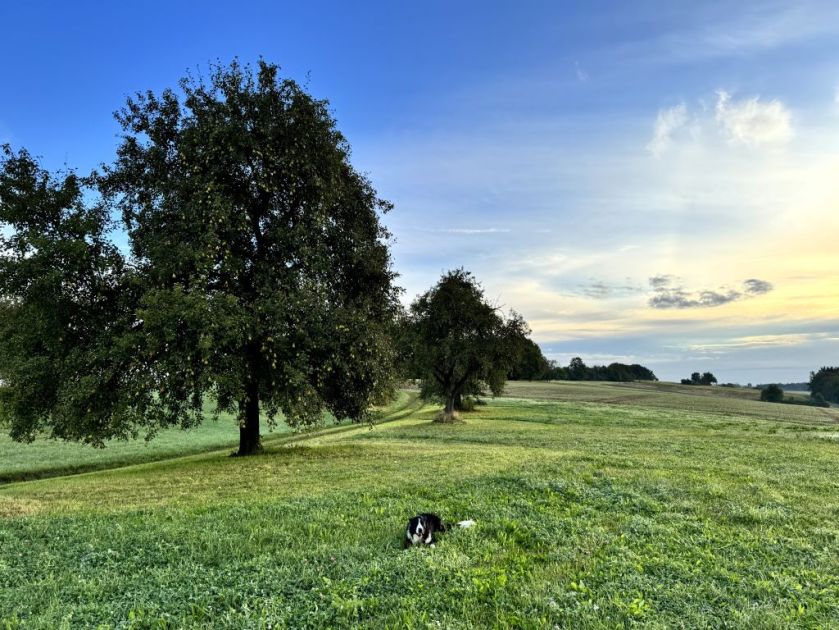
It began with her sending me photos while I was at the Ross Cider Festival. Masses of pears lying squashed on the Römerstraße between here and Mosbach at the end of August. “It is starting” she said. My reply: “Oh god… I’m not ready for it!”
My wife was of course referring to the pear harvest. I’ve built a reputation of sorts around my love of perry pears, but I sometimes think that I hate the harvest. At least before I start. The anticipation of the workload and the masses of rotten pears to deal with does nothing to inspire me.
Ines, on the other hand, can’t seem to wait. Within an hour of arriving back from my trip to Herefordshire she more or less forced me into the car to go look at some trees, about 6km away from the house, that she had gotten permission to harvest from. She has a knack for finding the people who own these roadside trees. We ended up out for a couple of hours, putting dots on the perry pear tree map and trying to put names to the varieties. I think one might be an Owener Mostbirne, a variety we’ve never pressed before, and one I think we have in our back garden. As I type the name, I am thinking we should have picked them all up last week already.
Saturday, 7th of September 2024
I made an effort to clear and mow under all the pear trees along the old Schafacker track in preparation for proper harvesting. Nine trees in total. Hot work. The three at the west end were in a good state as I’d already mown twice earlier in the year. The two Bayerische Weinbirne trees here have a little more fruit than I expected and are hanging well. The Schweizer Wasserbirne had dropped a hell of a lot of fruit already, and it was very messy. Worthless early falls.
Over at Elfriede’s meadow, just a couple hundred metres east along the ridge, the three Schweizer Wasserbirne have practically no fruit. The April frost seems to have hit them harder there. One of the two Bayerische Weinbirne has literally nothing, while the other is looking pretty good. This may rescue this year’s single variety BWB. But the Gelbmöstler… they are nearly all down and turning into chocolate. I don’t understand it. This year had plenty of rain and wasn’t too hot, but they’ve fallen a couple weeks earlier than normal. I didn’t waste my time clearing the mush and mowing. I fear no Gelbmöstler SV perry this year. But there is another one at the seven sisters.

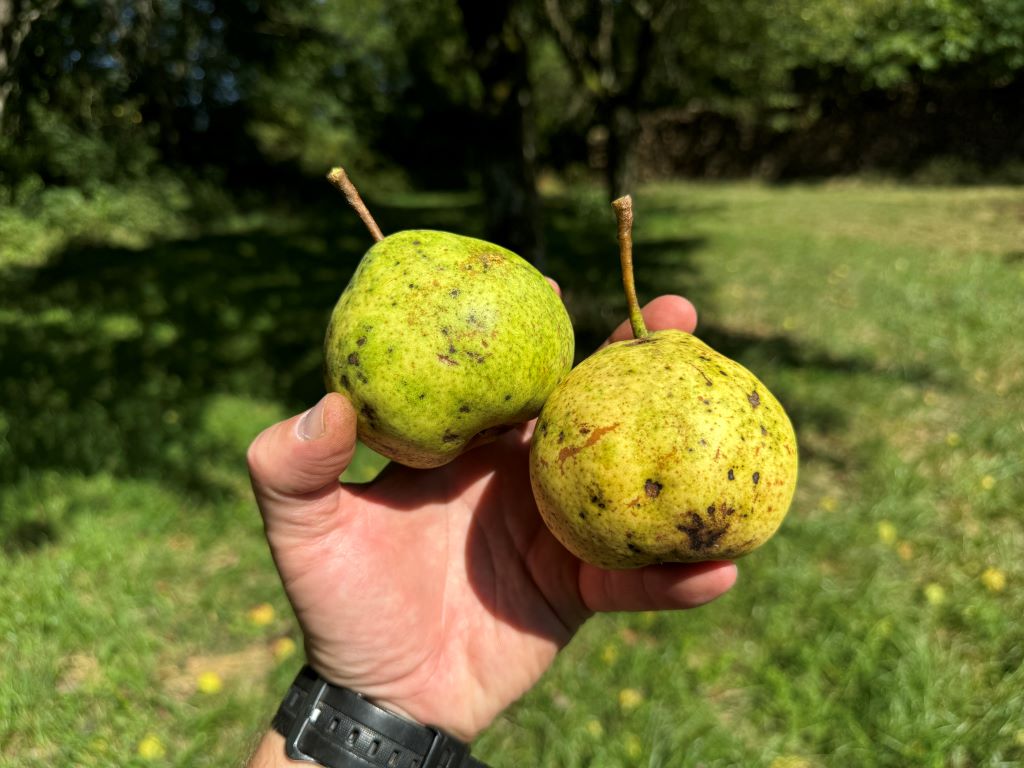
We have permission to harvest from over 70 big old pear trees at this stage, scattered across a range spanning ten kilometres. When we started picking these kinds of pears in earnest five years ago, it was pretty manageable with maybe ten trees to chase. We’d clear early falls, sifting out the good ones, but discarding a very large percentage. At that stage, the early drops are either already rotting, or worm-eaten and will not keep. Then we’d return every couple of days to pick up wind falls. The trees are too big to shake, but besides, we want ripe fruit, so prefer them to drop first. As the number of trees we have access to increased, this time-heavy approach doesn’t scale well when there’s only two of you. Now we scout ahead, assess what is worth harvesting from, and try to focus our actions. This year we’re not bothering to sort out the 1 or 2% that could be kept from the first clearances.
Often, it’s what I want to make that determines what trees we focus on. I always want Oberösterreicher Weinbirne, Luxemburger Mostbirne, Kirchensaller and Conference to make our annual Levitation blend. This year I am not sure we’ll make it. Even the Oberösterreicher Weinbirne, not usually harvested till mid-October, are falling in their droves and our main tree, what we call “tree number 1” (we name everything so we both know what trees we are referring to), is very light on pears indeed. It all seems upside-down.
Sunday, 8th of September 2024
Swung by the former vineyard terraces at Helden this morning. This tree is just amazing, even in years it doesn’t carry fruit. Given the late frosts, I’m very happy to see so many pears on it, but not as much as 2022. It’s so good to have an “on” year again. The pears fall so nicely and keep fairly well, so at least clearing under it yesterday wasn’t an exercise of mudslinging. Now I can assess the rate of fruit fall. I think we’ll lay down the olive nets again this year, so we can haul in the harvest every couple of days. I think we might have an ID on the variety. Karcherbirne seems most likely. Late morning and most of the afternoon was spent filling the new Schefflenzer Edelmost cider, then a beer and Gyros at the EDEKA 25th anniversary fest. Early to bed.
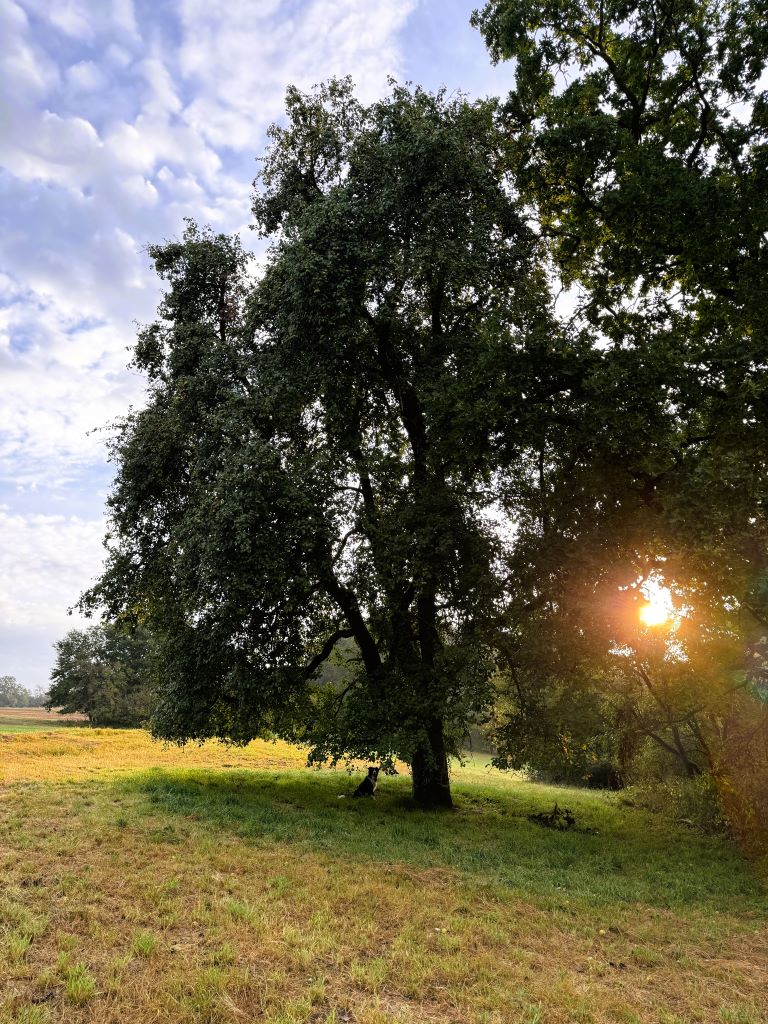

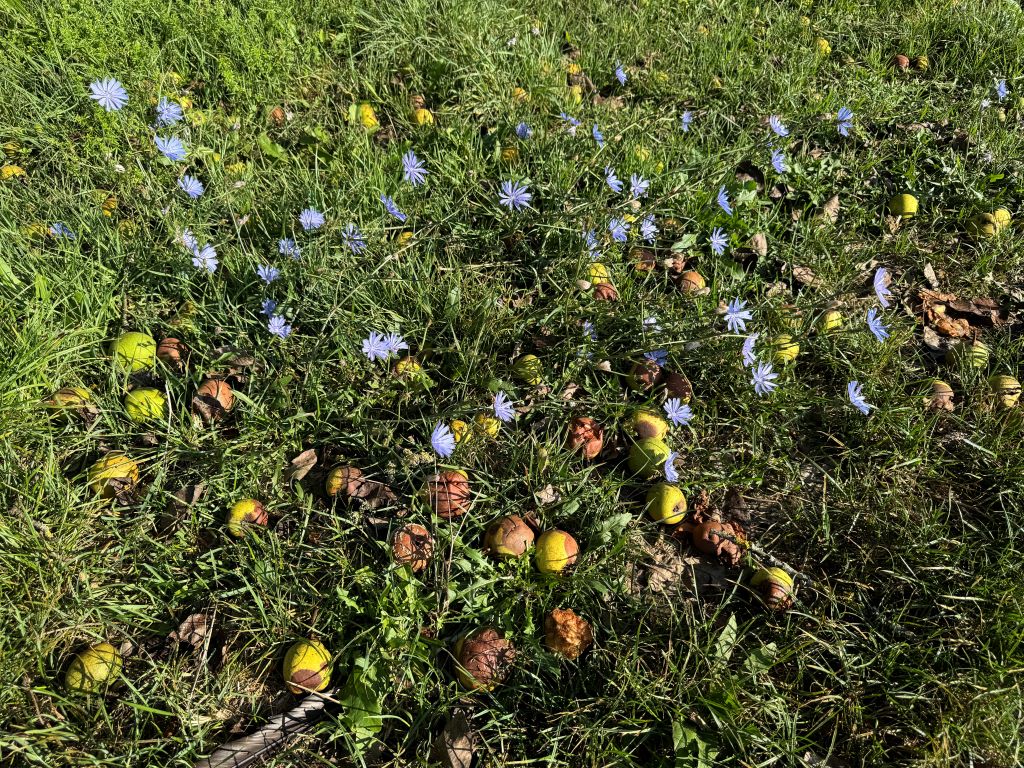
I sent a photo to Albert at Ross Cider recently. It showed a tilled field carpeted with small yellow-green pears. He expressed envy that it all looked so easy to harvest. Looks can be deceiving, of course. It’s often nice to have pears having a soft landing into recently tilled earth. It’s better than the other half of the tree that overhangs a paved road, where every pear explodes on impact and is then driven over. Like something from a cartoon, I almost expect a marching band and steamroller to follow the cars, just to add insult to injury. A ditch on the side of the road can be a great larder, however. Protected from the sun, pears often last longer in there. The ones baking on the tilled earth can turn quicky though.
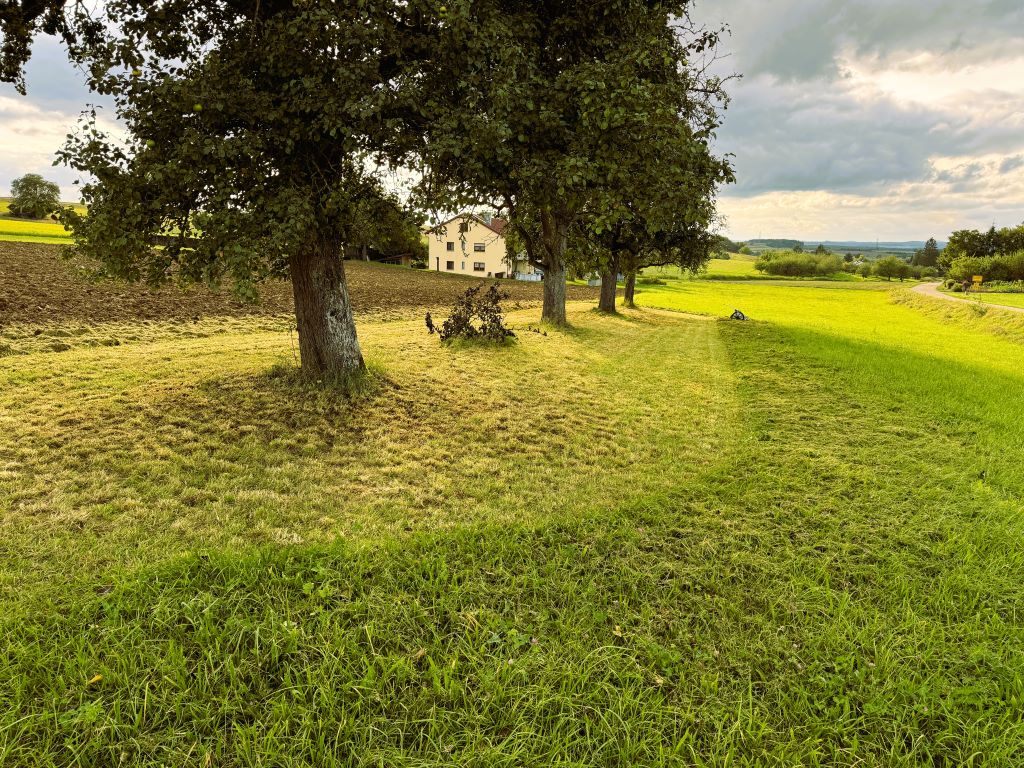
It’s a mixed bag, though. We have trees straddling road and tillage, trees completely in tillage, trees in lovely meadows and trees in small, uncared for orchards that do not belong to us, but we are told late in the season if we can take what remains. The trees in the meadows are my favourite. The meadows are usually mown by a farmer twice or three times a year, then I come in with the smaller mower to do under the trees. Such maintenance is part of the deal for us to get that fruit. The tidiest of trees in the village.
9th of September, 2024
Autumn has suddenly arrived. Just a couple days ago it was 30°C, this week the max is 16. It’s been raining all day. I forgot my wellies at Hermann’s two weeks ago, and now he’s moved to Nürnberg. We really need to clear the orchard floor before the grass gets too long for the Obstraupe, but after work today we decided to start harvesting the Schweizer Wasserbirne I cleared under at Trieb over the weekend. Ines can take a lot of sorting on the fly, but after 15 minutes of picking up, even she said it was worthless. Only about 2% of fruit being kept. They are brown before they hit the ground, and we don’t know why. I’ll return tomorrow and clear with the machine and see what the later falls are like. Maybe we should shake this one.
Instead, we picked up from a tree near Oberschefflenz then did a tour of more new trees she got permission to harvest from, some distance away, near Neckarburken. An amazing row of seven huge trees, one of which is a Luxemburger Mostbirne, one a Gelbmöstler, and four may be Owener Mostbirne. Ines will pick what she can on the way home from work later in the week. Nearby, smack in the middle of a meadow, is a wonderful Welsche Bratbirne. I wonder if she can track down the owner.

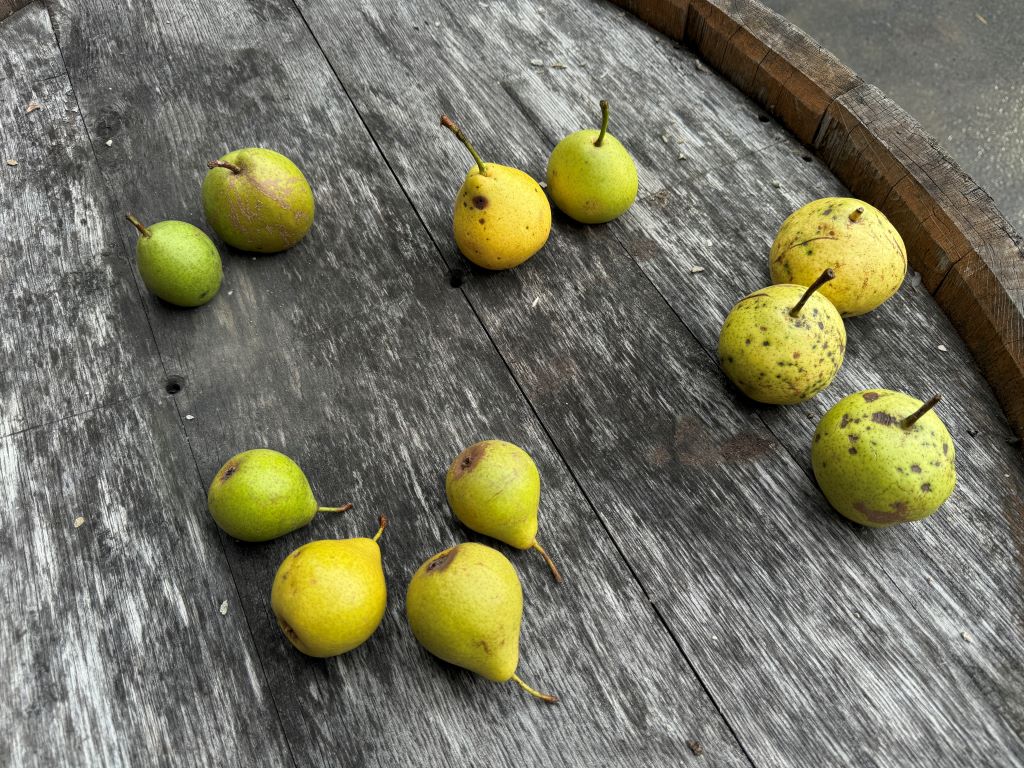
When the ground conditions are suitable, I like to do the initial clearing work with the Obstraupe, well, they call it a Fruitcat now, a battery-powered harvester that is pretty gentle on fruit. Maybe no not so gentle on pears that are already half mush, but it does a very good job at quickly clearing the first falls from under trees. It does need to be hosed down after, coated as it is with sticky brown pear splooge. Clearing this muck from under the trees is the first task. Sometimes we do it by hand, sorting as we go if there seems to be enough pears worth rescuing. Otherwise, it’s clear fast, dump the lot, mow, and have a clean slate to begin harvest proper.
Ines prefers picking by hand. In tillage and ditches it’s anyway the only way. Often the grass is a little too long around some of the pear trees in the interstitial spaces of the farming landscape for the Fruitcat to be effective. Actually, we tend to only use the Fruitcat for final harvesting apples at the orchard. With the pears to be pressed, we tend to pick up by hand. Ines bending down, me usually on my knees to avoid dizzy spells, shuffling along, dragging a fruit basket beside me, hurling bad pears as far away from the tree as we can. It can be incredibly frustrating on the first rounds, when you are throwing well over 90% of the fruit over your shoulder into the field to rot away, but the keep rate improves with further clearance rounds. It can be satisfying seeing the space under a tree half cleared, with crates of pears stacking up beside the car.
Tuesday, 10th of September 2024
Met Ellen while walking the dog this morning. She said the tree in her neighbour’s abandoned garden is hanging full this year. Had a look at lunchtime and it’s a Schweizer Wasserbirne. The long grass will make it like a game of hide and seek.
After work I went and cleared the SW at Trieb for the second time, then up to the Seven Sisters to begin the big clearance. There was a lot of Grüne Jagdbirne and Luxemburger down already, but it’s way too early for these varieties. Plenty more in the trees, we’ll wait for them. Had to mow high then do a mass clearance with the ‘raupe, then mow tight on the four near the road. Almost pristine now. So satisfying. The Gelbmöster up the slope had dropped absolutely masses of pears already, but still a hell of a lot hanging. I must have cleared 150kg of early falls from under that tree alone before mowing. There’s probably still enough for a small-batch single variety, and in a much better state than Elfriede’s tree. Will keep a close eye on it.
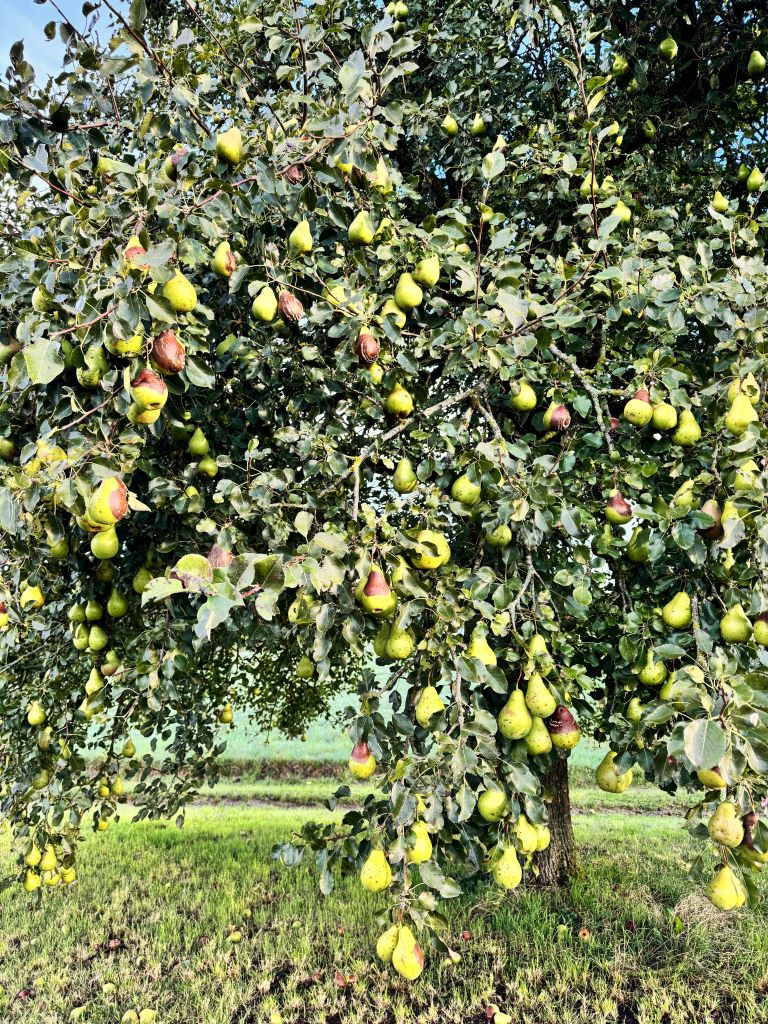
Most of the perry pear trees we harvest are between 80 and 140 years old. They’re tall. Even with our 6 metre long telescopic panking pole (the shaky shaky stick), I rarely get half way up a given tree. On some I struggle to reach even the lower branches. Years of increasing farm machinery size have led to lower limbs of field-side trees being lopped off, leaving some looking like giant lollipops in the landscape.
There are only three varieties I like to shake down if I can. Bayerische Weinbirne as it likes to rot in the tree. Welsche Bratbirne as by the time we’ve collected enough fruit for one pressing the stuff we’ve picked up from six days previously is a mess. And Brunnenbirne, as by the time they fall they are soft and have lost what little tannins they had to begin with. I should probably add Gelbmöster to that list from now on.
Wednesday, 11th of September 2024
Pissing rain. No point mud wrestling. Occupied myself with the pear pip reference collection and checking/trimming the 2023 pear babies in pots. Made a plan to get samples from a range of trees that are not 100% IDed yet and sending away for confirmation. Let’s see how my hit rate goes.


As the harvest goes on, the yard and barn start filling up with crates of fruit. Stacked on pallets to reduce the strain on our backs, we’ve slowly switched to slightly smaller crates that take maybe 14kg of pears as opposed to 28kg. I need about 10 or 11 for a single pressing in our 170L hydropress. I dislike using sacks for pears, they tend to spontaneously press under their own weight if not kept under close watch.
Everything gets sorted by variety and, if possible, by tree, though that’s rare. They jostle for space with the apple crates, though this year is not a good apple year. Not a great pear year either, it seems, but better than our apple crop. The aim is usually to try and produce as much single variety perry as possible. Especially if it is a pear variety we have not pressed before. A noble cause to my mind, as we want to highlight what each fruit has to say, and it’s a useful reference for future blending, knowing what each variety brings to the table. But needs must, as they say, and often we make harvest blends that are part happy accident of what needs to be processed, and part me pre-blending in my head, like choosing from a palette of flavours. Or pallet of flavours in this case.
Here, the pallets become the embryos of a new perry. Six of those, three of those, two of those and one of them. That’ll be the Levitation 2024 blend ready to go. If we get enough of the required varieties that is, and this year it will be very tight.
Thursday, 12th of September 2024
We both went out to the first Römerweg site after work today. We need a name for it, as two Römerweg locations just don’t work. Anyway, got a few crates of the one I think is Owener Mostbirne, and the tree is still loaded. They are just about to fall, so I think we should shake to guarantee I can press a single variety before the ones we picked off the ground are mush.
Collected samples from several other trees for ID purposes, then we drove back via a back route we never travelled and found a slew of interesting perry pear trees. Of course nobody is using them.
Made a deal with the mayor for the council to take over costs for a fruit show in early October. I’m an idiot. That’ll be two weekends doing fruit show when I should be harvesting and pressing. Pomology competes with perry making again.

One of the biggest challenges of being a perry maker is timing. Especially when you are a part time maker. You’ve probably heard of the stories before, pear varieties that have such tight windows of perfection that a day will see them go from ideal to mush. It’s all true! Though thankfully they aren’t all like that. More often it is the earlier varieties hat behave like that. Generally, the later the variety the longer it will keep. Generally! Pears are assholes after all.
But it means that as maker, even more so than with apples, you need to be constantly watching and evaluating exactly when to press. Some makers swear the only time to press them is when they start bletting, that overripening process that sees them turn brown from the core outwards, tannins and acids softening till it’s like a honeyed… well, I’m not sure how to describe it. It’s rich, umami-like, and tastes like honey mixed with marmite. An acquired taste. Leave it too long and you increase the risk of things going awry. Do it too soon and you may have more astringency and acids than you’d like.
Of course, when half of them are just starting to blett, another quarter are already spontaneously turning to liquid, so you have to just take the plunge sometimes. I’ve learned from experience, and from old books, that with some varieties you’re better of pressing before they get to that stage. Varieties with lower levels of tannin often won’t benefit from being allowed to blett. Schweizer Wasserbirne is one, Gelbmöstler another, to my mind. And hen there are those that should almost certainly be allowed to blett a little. I’ve made my own experiences there too!
But now we are getting into the territory of the maker and their preferences, and that is where the art and science of making come together to transform all that toil into something delightful in a glass. One cannot understate the influence that a maker’s choices will have on the final product. Well, hopefully it will be something delightful!
Friday, 13th of September 2024
Today was mix of scouting missions and harvesting. Well, Ines went on a solo run on her way home after work and brought back crates of pears from the second Römerweg site. She also did what she does and spoke to, well, I don’t know how many farmers near Neckarburken, securing permission for even more trees. It might not mean more pears, but it’s an insurance policy if the harvest near us is bad. We must have access to over 90 trees now, I need to upate the map.
She brought back bags of pears, numbered and mapped so I could ID what I could, and those I couldn’t or were in two minds about got packed up to send to KOB for some confirmation.
Had a nice German perry. I note a definite increase in the interest in perry amongst small German makers!

We’ve only just started into the harvest season. We haven’t touched on the apples yet, but I think that will be a shorter season this year, given we’ve lost over 80% of the potential fruit to frost. Harvesting and pressing usually runs from September through to the end of October, and often into November. I have pressed fruit in December, but that was for someone else.
With both of us working full time jobs, it’s all done in stolen moments, in the evenings after work and all weekend. It’s typically just the two of us, but sometimes a couple of neighbours help out, which is especially great when picking apples at the orchard. But the way we work on the pears, scattered as they are over a large chunk of landscape, it’s piecemeal, spur-of-the-moment and reactionary, so it’s almost impossible to try to plan helpers in. At least I’ve felt I cannot take in people who asked to be WWOOFers to come to stay and help for a week while wanting to gain experience in making. I’d love to be able to do that with them.
Saturday, 14th of September 2024
Ugh… These Welsche Bratbirne trees are hard to harvest at the best of times, standing on top of a bank, flanked by a ditch and road on one side, and tillage on the other. When Andy has had a summer grain crop in its great, the ground is tilled, so half the pears have a relatively soft landing. The ones dropping on the road are lost causes anyway. We turned up this evening to find the field is full of maize this year. We don’t fancy grubbing about in the maize, but it will be harvested soon. I hope the pears hang on a little longer. But these ones are mush in a couple of days, so we need to get as many as quick as we can and process them asap. God, I hate working with these pears, but they make an incredible perry. I really want to try to press them again having had to dump the 2023 pressing due to MLF. The tree near the orchard may offer salvation if the maize isn’t gone soon.

By the time the end of season comes, we’re aching and I wonder why we are doing this to ourselves. We don’t make money on the cider and perry really, but everything is put back in to improve equipment and processes, and a large chunk to help fund our planting and orchard care activities. Ines doesn’t even drink our produce, but being an idealist and the original proponent of our “conservation through use” motto, she cares deeply for the trees and their preservation. And that is the excitement that powers us through the darkening Autumn evenings, as we bend and creak and haul our way through fields covered in fallen pears.
Sunday, 15th of September 2024
We have enough for a first harvest-blend pressing. A visit to the Seven Sisters this afternoon yielded 3 good crates of Gelbmöstler and a few crates of early Luxemburger and Grüne Jagdbirne. We’re chasing our tails hoping for a single variety perry this early, given the state of what’s falling, so we’ll just have to press whatever we have before the crates we picked up from earlier in the week have to be discarded. Sometimes these random blends turn out to make the best perries, so I will at least write down the proportions!
Only another two, probably three months to go…
* * *
All photos by Barry Masterson
Discover more from Cider Review
Subscribe to get the latest posts sent to your email.
 Cider Review