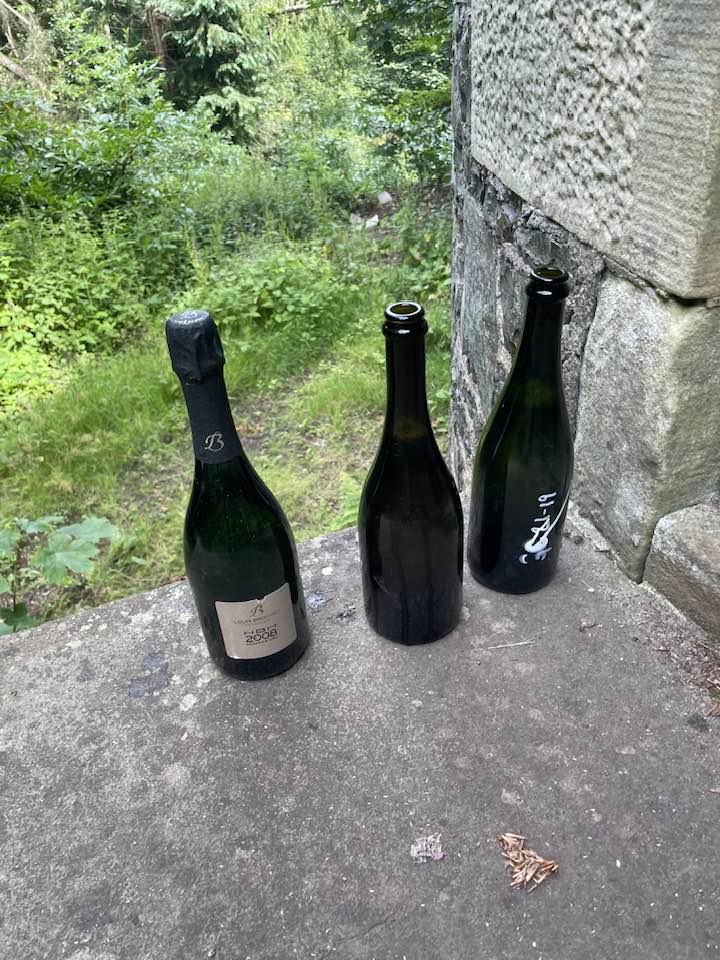
Peter Crawford is giving me a look. At first I don’t quite notice, squinting out through the cold dimness of the little stone roundhouse into the bright sunlight where he is disgorging unlabelled green bottles. I think he hasn’t heard me. But then I notice the look. It comes with a side of theatrical pause, which feels about right for Peter.
‘That’s a very odd question, Adam.’
Maybe it is. After all, I’ve just asked one of the country’s foremost champagne experts why he is so into champagne. I meant it as opposed to any other form of wine, but perhaps that isn’t how it’s landed. Or perhaps it really is just an odd question in the first place.

Fife doesn’t feel all that much like the rest of Scotland. It doesn’t have the loom and lurk of the borderland hills, the operatic grandeur of the west coast or the empty, keening, clearances-imposed loneliness of much of the north east. It’s only across the Forth from Edinburgh, but especially towards the north of the peninsular, it doesn’t have the bustle of the central belt. It feels quieter; its low hills gentler, softer.
Almost uniquely amongst Scottish regions it feels distinctly agricultural. In many ways, rolling over its waves of wheat and barley, you could almost be four hundred miles to the south, but for the few little tells of wildness – the lower, patchier hedgerow, the mottling scruffs of pine or gorse, the brief flashes of silvery firth when you crest a fresh undulation.
Ten years ago I lived here – in Newport, on the north coast of Fife, and before that in Dundee, across the Tay – but a decade later the complexion of the place has subtly shifted. I’ve no keen eye for cities beyond their food and drink offerings, but with those as my barometer there’s no question that an evolution has happened. Many of the old Dundonian places I used to nose quietly into are still there, but now they jostle with independent coffee shops, speakeasies and diverse restaurants. The main street on Newport seems transformed by deli and bakery; even the fish and chip shop – perhaps the place I remember most cheerfully from my stint – has had a makeover. And I am here, of all things, because Fife has emerged as amongst the most exciting British cider regions outside its traditional heartlands. And the Fife maker turning perhaps the most heads is Peter Crawford at Naughton.
Many of the UK’s cidermaking community have unusual and surprising backgrounds – indeed that is part of what makes it so rich and personable – but few are quite as idiosyncratic as Peter’s. A former professional polo player, director and owner of a physiotherapy clinic chain, founder of the Sip Champagnes grower champagne importers and retailers and, incidentally, owner of several thousand bottles of champagne – amongst the largest private collections in the world. I don’t like to ask exactly how many; it seems oddly personal; but seven years ago it stood at over 4,000 and I doubt whether it’s shrunk.
Peter’s route to cider came through champagne (predictably), his family home and his children. When his first child was born, he had a champagne made in celebration. He chose the vineyards and grapes, was hands-on with the process and put the final cuvée together. Everything was to his specifications, but something felt missing. So when his second was born he wanted to take things a step further – to make something that was, entirely, from him.
At this point Peter had moved from London to Peter’s old family home in Balmerino, northern Fife. It’s some place; a grand old farmhouse whose grounds include, importantly, a walled orchard. For the time being this part of the world is a little cold to grow grapes of the quality Peter would want. But apples were another question. So Peter’s attention turned to cider and, predictably, specifically to traditional method cider.
Aspirational cider’s favourite story about itself by a country mile is that it ‘invented champagne’. Or, rather, that traditional method cider – a drink whose natural sparkle is achieved by a deliberately-induced secondary fermentation in bottle – pre-dated not only champagne, but any other form of traditional method drink. In James Crowden’s marvellous Cider Country, he shows that the accidental invention of a thicker sort of glass in the 17th century enabled the pressures of natural carbonation to be contained within a stoppered bottle following the addition of ‘a walnut of sugar’ to an already-fermented liquid.
But whilst cider might have got there first, it’s fair to say that wine has taken the lead on the traditional method’s subsequent use and development. If I say ‘traditional method’ to the average person, they wouldn’t have a clue what I was on about. If I say ‘champagne’, it would be a rare person indeed who didn’t already have a mental picture not only of the drink itself, but of the orchestra of associations that sound so enthusiastically around it.
Champagne is not merely a wine made in a particular method, it is a ‘vibe’ above and beyond the basic drink itself. It is celebration, it is luxury, it is prestige, it is special; it is drunk reverently and at moments of great importance. Most people will pay far more for their special occasion bottle of champagne than they will for any wine of any sort at any other time of year. And, for the most part, aren’t especially bothered about how it tastes, beyond ‘like champagne’. Champagne, to the average drinker, has ‘goodness’ inherently baked in. Effectively only drunk at moments of great joy and festivity, the mood itself gilds the flavours, doing much of the actual wine’s legwork for it. It is, as an association and a whole ‘brand’, perhaps the most powerful in all of drinks. Which of course is why aspirational cider is so keen to emphasise the ‘we did it before they did’ point in the first place.
But traditional method cider and perry has, nonetheless, traced a quiet history from those first experimental walnuts of sugar. References to it lightly trace the eighteenth and nineteenth centuries in what few records of cider remain from those periods. Unscrupulous winemakers and merchants certainly mislabelled bottles of traditional method cider and perry as something a little grapeyer – even in champagne itself. In the 1920s, in the first Bulmers advert Museum of Cider Director Elizabeth Pimblett has found in which they call themselves the biggest cidermakers in the world, they are advertising two different single variety traditional method ciders as well as ‘Pomagne’, their flagship cuvée. Pomagne continued to be made in the full traditional method until (I am almost certain) somewhere between 1958 and 1963. And even Babycham, before it became a watered-down from-concentrate monolith, was a genuinely nation-beating champagne method perry.

For a few decades, traditional method cider slipped away, until early in the 1990s when it was quietly revived at an artisanal level, first by Gospel Green in Sussex and then by Devon’s Bollhayes. My own point of entry to the world of aspirational cider was a bottle of Chalkdown. Today there are traditional method ciders and perries scattered throughout the international aspirational scene, from the Finger Lakes to Austria to New Zealand and almost everywhere in between. And excellent things many of them are, too.
After a few wrong turns down slender non-driveways (finding rural Scottish addresses can be very much a case of sticking in the postcode and hoping for the best) I interrupt Peter in the act of putting up a marquee. This is a service I am happy to provide, and if I ever find myself in the act of putting up a marquee I should hope someone is decent enough to come and interrupt me. He is setting up for bottling in a few days, and has summoned a team of friends who are fuelled, as far as I can glean, by the righteous diesel of cider and champagne. To his credit he finishes the bit of the marquee he is working on before making his apologies to the toilers and leading me off towards the low garden buildings that serve as his cidery.
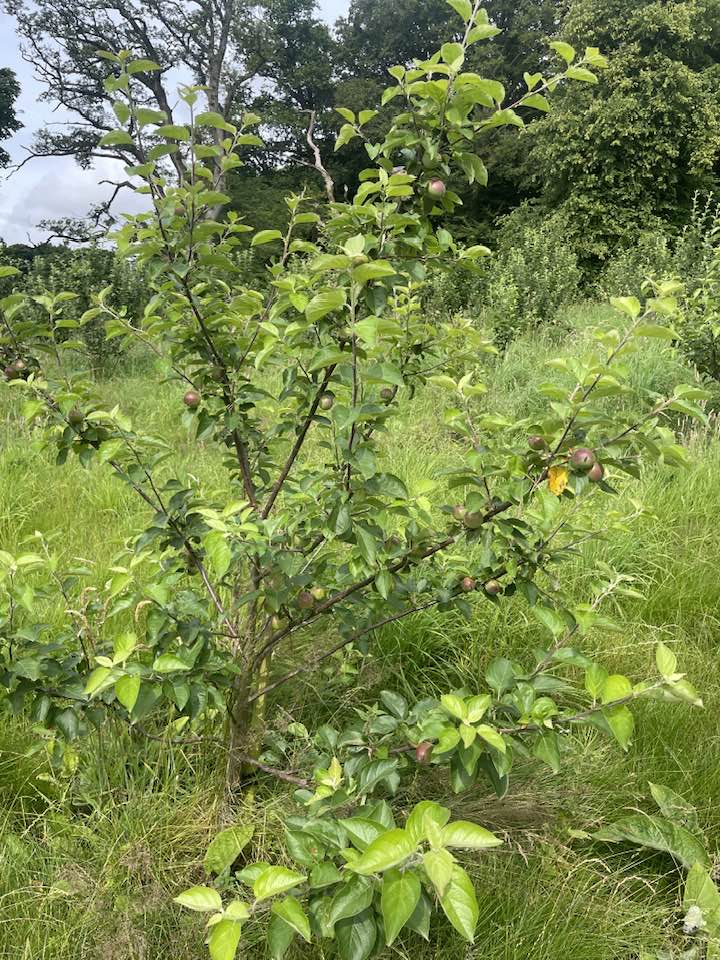
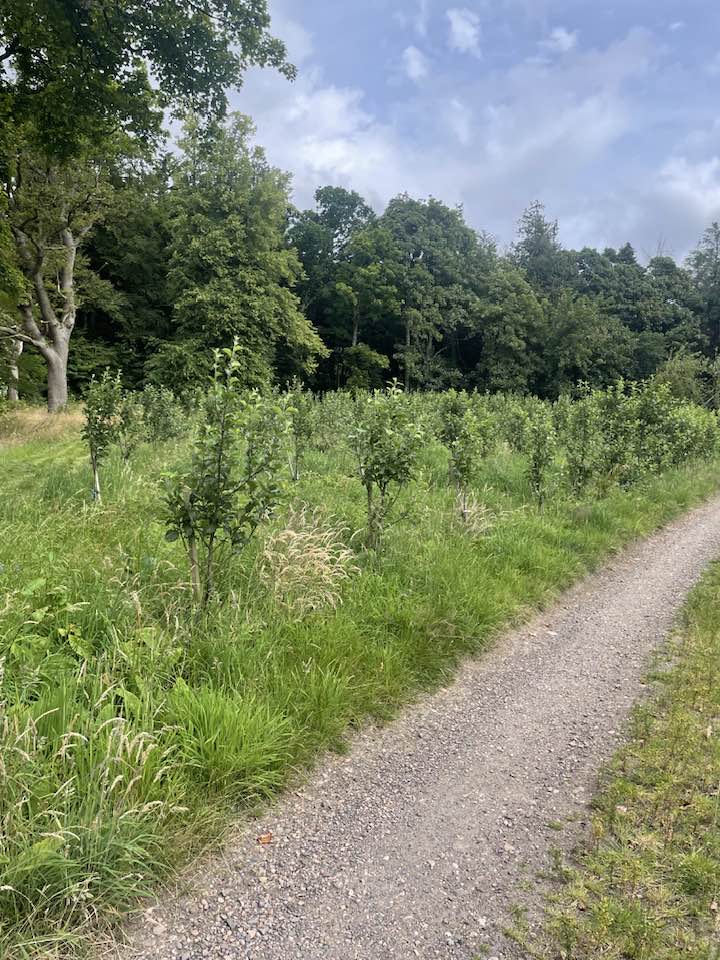
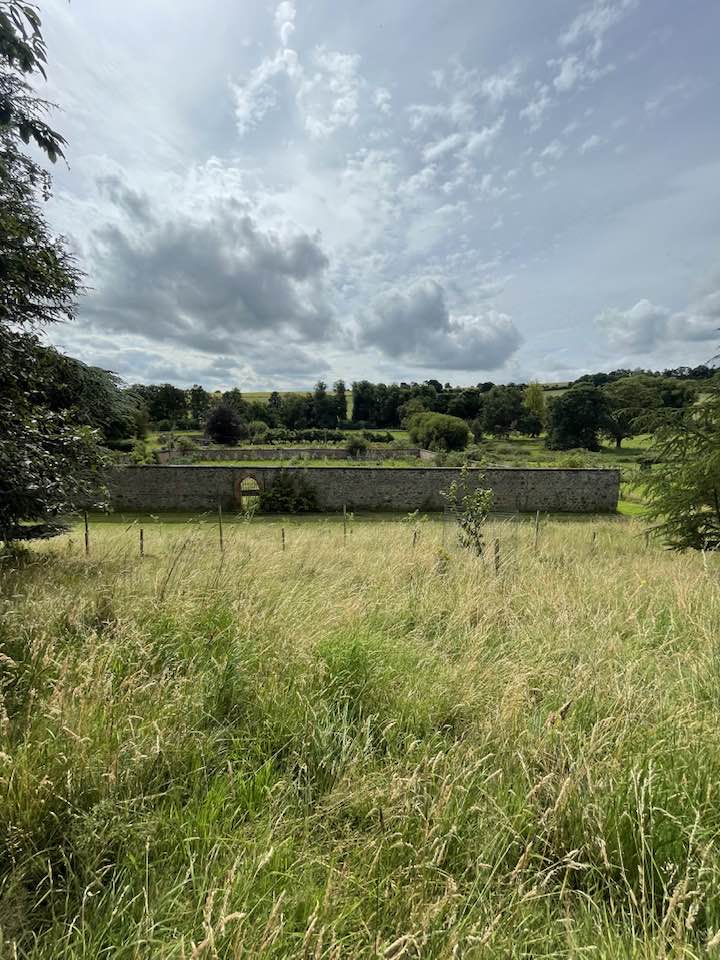
In the six years since Peter began his cidermaking project he has been busy. Every spare inch of space, or so it seems, has been filled with apple trees – and the areas that haven’t been yet are marked for future planting. There are 1500 trees in the ground already, all on south-facing slopes that form a beautiful natural amphitheatre around the farm buildings, protected at the crest of the hill by woodland. 900 more are due to follow.

Almost everything is here; an orchard of informed trial and error, of finding out what works both with the Balmerino microclimate, and with the particular styles of cider that Peter intends to make. There are bittersweets and bittersharps – Dabinett, Bisquet, Kingston Black and the like – beside eastern counties cooker-eaters, and Scottish apples like the vibrant, tangy James Grieve. He’s planted a small orchard of perry pears as well – every variety he could get his hands on – and he’s filled the beautiful walled orchard with new trees to augment those that were already there. Pottering round it, trying not to step on the chickens which seem to have mistaken my shoes for corn, I am struck by the marked increase in temperature. Walled orchards are remarkable incubators, and Peter is interested in discovering what difference that makes to the apples he is able to grow, and the cider he gleans from them.
This experimentation bleeds into Peter’s making, and it’s apparent that the lack of certainty, of set rules – the journey of discovery – is something that he relishes. Since his own trees are very much in their juvenile stage, he augments his Balmerino fruit with apples from Somerset, Kent and Oxfordshire. Interestingly he deliberately buys several of the same varieties from these disparate orchards, specifically to investigate differences in terroir and broader regionality. We taste Cox’s Orange Pippin from Kent and Somerset next to his own from the Walled Garden and, surprisingly, there is distinctly more length and depth in the Scottish fruit.
The cidery is packed to its low rafters with oak, all from world class French cooperages, all previously used in the making of champagne before they found their way to Fife. One of the buildings has a small cluster of stainless steel variable capacity tanks, but Peter tells me these are now almost entirely for topping up. Oak, he feels, is critical for bringing roundness and breadth.
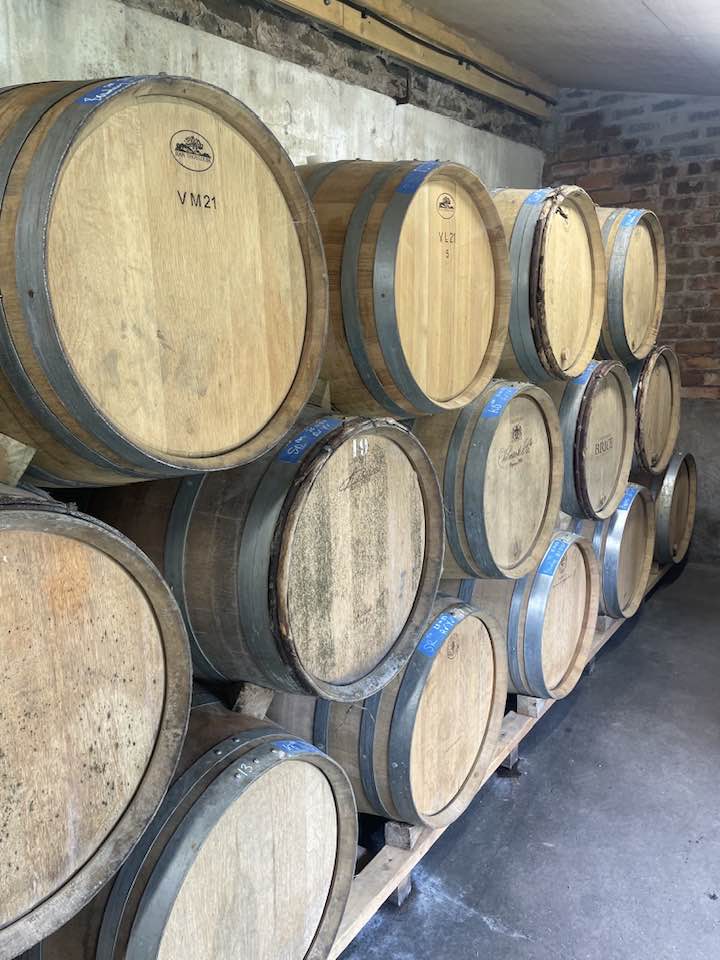
With only half the alcohol of champagne, cider is at an inherent disadvantage when it comes to texture and body, and although Peter does work with some rich, tannic bittersweets, these sorts of apples aren’t really the profile he’s after for his traditional method. Bittersharps like Kingston Black and Stoke Red go some way to making up for the shortfall in bulk, but Peter is nonetheless deploying every trick he can to build texture. Oak fermentation, extended lees contact (he currently doesn’t rack off the gross lees whatsoever until bottling) and malolactic fermentation all play a role. He tells me that he’s struggling to get Bramley to go through ‘malo’, and that controlling the malolactic part of the process is one of the elements of cidermaking he is keenest to dig into.
Alongside building texture, ensuring that the cider is absolutely without fault is critical to Peter’s work. After all, these are ciders intended for long ageing before release – so any flaw in the liquid will only be magnified by the time it reaches the customer. ‘Nice clean cider at the front end, oak for texture, long ageing for development,’ is his broad summary. He ferments with a neutral champagne yeast – IOC 18-2007, for the data-minded amongst you – uses a small amount of sulphite according to ph, and casks are scrupulously checked and topped up. Removing the risk of acetic acid is another of his key ambitions for the next few years; across the dozens of casks we taste from, we find it in only two, and he is furious there are as many as that. Those won’t be released, and the casks themselves will be thoroughly cleaned before they hold anything else. (He shows me the price of a proper cask steamer; it’s what you might call ‘an investment’. But it’s less costly than wasted caskfuls of cider).
I don’t know how many casks Peter had initially intended us to taste from, but it ends up being a lot. We work through Cox’s Orange, Kingston Black, Stoke Red, Yarlington Mill, Bramley – all from different orchards and regions. Peter’s sheer enthusiasm, and the rate at which he discusses his creations is almost hard to keep up with; a not unwelcome change from makers who occasionally seem reluctant to talk about their work whatsoever. The cidery is full of little wine world touches; from the stemware we’re sampling with to the familiar cooperage stencils on the casks. There’s a rather on-brand Krug notebook tucked on a side, used to record data during harvest; Peter himself wears a faded t-shirt reading ‘Krug Man’.

So far though, so primary fermentation. All admirable, all fascinating and precise. Some of Peter’s ciders go no further than this; his still ‘Homage To Hogg’ expressions, much lauded in these pages, and his 500ml Lanthorn range for instance. All very tasty and distinctly worthy of your time. But it’s in the next stage that Naughton cider really moves into little-charted cider waters.
For the majority of cidermakers working with secondary fermentation, particularly in the UK, the very fact that they are making something in the traditional method – bottle fermented, left on lees for a while and then disgorged – is enough. Indeed arguably, in many ways, it is. Between us the contributors to Cider Review have worked through most of the traditional method ciders available in the UK, whether we’ve written them up here or not. Most are good, some are excellent, and at any level they require a high degree of craft and care. But if I can pick a small nit, they are often a little bit samey. Usually single vintage, usually not left more than a few months on lees. There are one or two exceptions – Chalkdown’s Extra Lees Aged comes to mind, as does Little Pomona’s Brut Zero. But I have always felt that there was a wider world here to explore when the right maker came along.
It is certainly Peter’s intention to be that maker. Although his first commercially-available ciders have followed the single-vintage pattern, both spent longer on their lees than the traditional method cider norm – 24 months, the sort of time that would pass muster for a non-vintage champagne. And these only represent his first small tinkerings. The expressions he is working on, which he intends to be his flagships, are a new evolution entirely.

It’s shorts and t-shirt weather as we wander across the grounds towards the small, pine-sheltered greystone buildings that house Peter’s bottles. So it’s a slight shock when he opens a door and we step into a room whose temperature sits somewhere between cellar and fridge. Peter’s ciders will spend far longer bottled in these buildings than they will in their primary fermentation vessels. When I ask him about expected ageing before release, his answer sits vaguely between five and six years.
But more than the long ageing, it’s the creation of non-vintage cuvées that grabs my interest and tolls a distant bell from the dusty recesses of my wine industry fizz studies. In a throwaway comment in the second paragraph of this article I mentioned how keen I’d be to see a traditional method cider created in the style of Non-Vintage champagnes, where reserve wines from multiple vintages are layered together to create a ‘house style’ for relative vintage on vintage consistency and, crucially, a higher level of complexity than would be possible through a single vintage.
Peter messaged me the day of that article’s publication to say that this was exactly what he was building at Naughton, and today I am given the chance to see it for myself. His Grande Cuvée, still at least a couple of years away from launch, brings together three distinct vintages – 2019, 2020 and 2021 – largely of the same varieties, with Cox’s Orange Pippin at its heart. The next iteration, whenever it is launched, will feature four vintages – the original three plus 2022. The iteration after that five vintages and so on and so on.
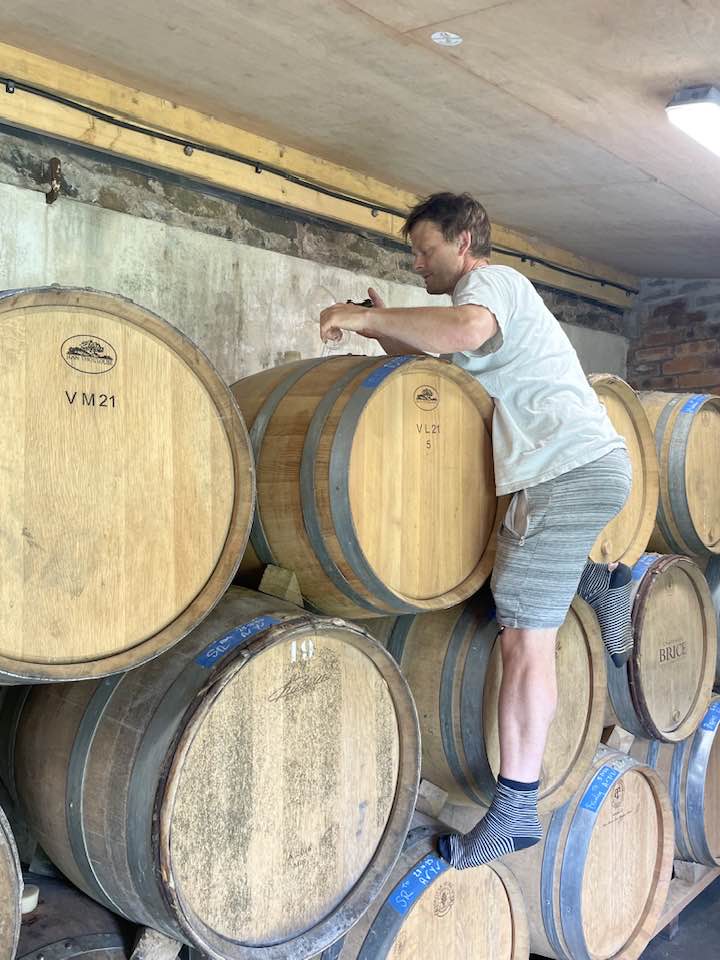
This is, or will be, achieved through a so-called ‘perpetual reserve’. A quantity of wine kept back specifically for blending purposes; not quite a sherry-style solera, but with a not dissimilar intention. Obviously this requires distinctly reductive cidermaking if the reserve ciders are not to oxidise, and for the most oxygen-protected approach of all, Peter has drawn further on his champagne learnings with a technique called ‘remise en cercle.’
This involves bottling the reserve wines in magnums at a (relatively) low pressure of two bar. (For reference, full traditional method is around six bar – the same pressure as a fully-inflated HGV tyre). The slight degree of secondary fermentation forms a protective blanket of carbon dioxide, as well as as throwing a sediment of lees that add further antioxidative weight. The magnums wait for as long as the cidermaker wishes, before they are brought together in tank, then bottled as a cuvée at the usual six bar pressure. It takes a lot of space, a lot of time and a lot of skill, and yes, I’ve had to have that all explained to me several times, and no I’m still not certain I’ve fully understood it. But that’s the sort of territory we’re entering here.
We’ve been talking for a couple of hours by this point, so Peter wisely decides we ought to open a few bottles. I take the opportunity to be nosy and peer about the roundhouse, ogling the various august vintages of outrageous champagnes casually tucked into just about every cranny and the pupitres loaded with as-yet unlabelled bottles. It’s not entirely clear where wine ends and cider begins, which I dare say is apposite imagery. Peter has even chosen a champagne to taste alongside his Naughtons and it’s at this point that I ask my silly question and get that look.

He tells me it was a 1988 Pol Roger that did it. He’d been a wine drinker already, but his encounters with champagne had left him feeling it was perhaps a little simple; a little wispy in body and flavour. The Pol Roger’s depth and length and texture – allied to the elegant lightness – won him around. A lightning bulb moment that led to goodness knows how many thousands more. As we wander back to the cottage we’ll be tasting in he expresses a slight regret that many modern champagne makers have turned away stylistically from that lightness and freshness and elegance. ‘They want a wine that can be drunk with any occasion. But 95% of people don’t drink champagne all the time. It should be a celebration drink.’
Peter’s already-released Traditional Method 2020 is tasty indeed. Four years old, but it still tastes like an enthusiastic youngster, full of lightness and vibrancy and poise and delicacy. The fruit is bright, but at this stage of its evolution the lees have a leading hand; those saline touches of dough and light biscuit.
The first evolution, when it is released, will be his ‘Clos’. Another 2020, but this is made entirely from Peter’s own Balmerino fruit (predominantly Cox’s Orange Pippin and Bramley) and was fermented entirely in oak, with a high proportion of first-fill. Still resting on its lees (Peter intends it to have 36-40 months before disgorging) it is a wholly different animal. Broader, more robust and immediate in its aromatics and upfront palate. The complexity and body compared to the Traditional Method 2020 is enormous.
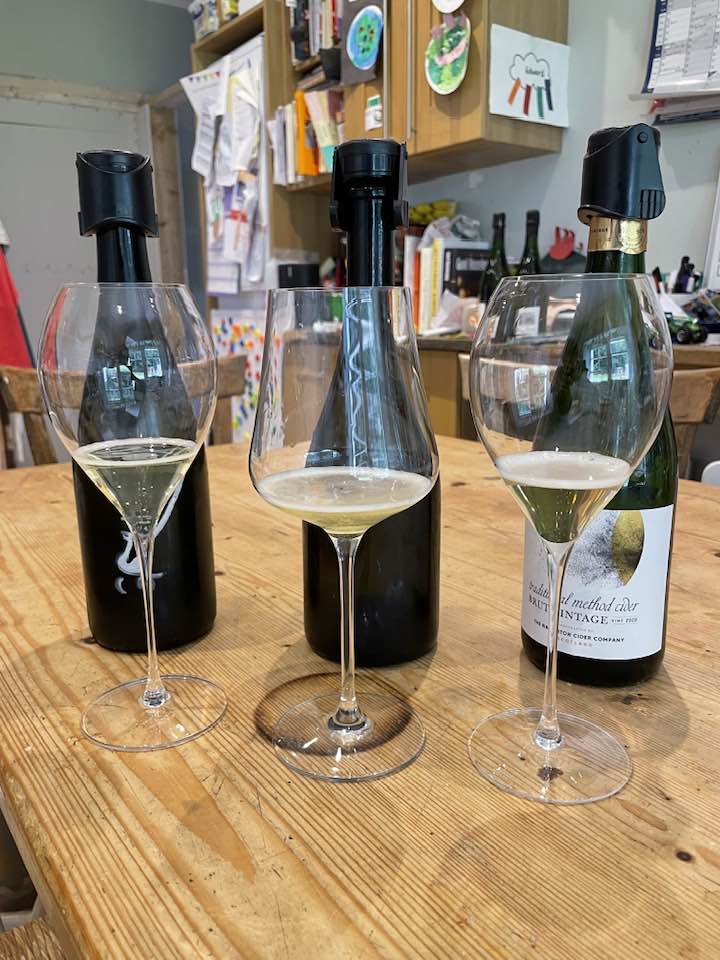
We taste it alongside the other work in progress – Peter’s multi-vintage Grande Cuvée. Again the depth compared to the cider he has already released is marked. This is lighter than the Clos – less first-fill oak, but more complex. It contains multitudes; high notes and depth, twisting interplays of fruit and lees. I sense it has further to go in its evolution than the Clos – Peter confirms it will be released later, after perhaps as many as 72 months on lees – but it is already spellbinding; a leap beyond the traditional method cider norm.
All of the Naughtons are distinct, but each riffs on a shared theme of salinity and lemon fruit. Though all are older than the majority of ciders released in the UK, all feel in their first plume of youth. There’s a long way yet to go. That’s emphasised when Peter opens the champagne – a 2008 that spent 13 years on lees. Peter looks at me again as we taste it. ‘That’s why.’ Delicious as the Naughtons already are, they are at the start of their journey. But I get the sense that Peter relishes the idea of every step to come.
The marquee is up by this point, and I leave Peter to it, wishing him luck with his bottling. A few days later his instagram is awash with it; some hundred or so guests all joining in, oiled (of course) with an utterly bewildering variety of champagnes. I spend the rest of the day weaving around Fife, ambling consciously through old places from ten years ago, dredging up memories, searching for the familiar and finding change woven through it everywhere I look.
Nothing is constant. We know this. People and places shift with the gradual inching of time until one day, unexpectedly, you look back and see how far everything has come; how different things suddenly seem to be. The rethink cider movement is now six and a half years old; almost a mature revolution. The traditional method ciders, still so rare and far-between when I first encountered them, have given way to a vast ocean of aspirational bottlings of every style and apple variety from cideries across the globe.
Yet traditional method cider, for the most part, has remained a little-pushed frontier. Few bottlings I have tasted in the last half decade have evolved beyond that which first won my heart and palate around 2017. Judging at the IWSC a couple of years back, a wine sommelier expressed concern that no Golds had been given in the traditional method category, the first we tasted. ‘Surely these will be the best of the day?’ he asked. I assured him they almost certainly wouldn’t be. I was right.
But after trying the Naughtons I not only believe that changes are coming; I am certain of it. I’ve tasted them. Ten years ago I would never have thought that such things would emerge from Balmerino – I wouldn’t even have believed it three years back. But there it is. Aspirational cider, I feel, is evolving once again – in the ways it is made, and the people and places which make it. And perhaps it’s only right that the style which first made cider aspirational 350 years ago should finally take a fresh new approach as well.

Discover more from Cider Review
Subscribe to get the latest posts sent to your email.
 Cider Review
Pingback: Where You’ll Find Me Now | Cider Review