Every so often, something happens which restores your faith in social media. When I recently tweeted that I would soon be doing a Pacific Northwest road trip with my Californian grandmother and asked #cidertwitter for recommendations, I got nothing for a week or so. Then, Michelle McGrath, CEO of the American Cider Association, got in touch. She asked whether I’d like to judge the Northwest Cider Association’s annual competition, the Northwest Cider Cup, while I was the area — globally speaking. With a bit of juggling-around of dates, I was able to get myself to Portland, a city I’d always wanted to visit, just in time. Thank you, Michelle!
* * *
Sunday, June 2: Judge Training Day (featuring a meditation on The Modern and The Traditional)
My partner Alfie and I arrived in Portland on Saturday night after more than 24 hours of travel. A tad bleary-eyed, I showed up the following afternoon for judge training at Double Mountain Overlook, a taproom in the north of the city. I was warmly welcomed by Emily Ritchie, director of the Northwest Cider Association, with whom I had been in touch previously. I’d also met head judge Scott Katsma (he of Seattle Cider Company), at the Cider Salon in Bristol — small world.
The training session, led by cider writer and educator extraordinaire Darlene Hayes (she of the Certified Pommelier study guide), was very helpful. It emphasised working with efficiency, respect, and willingness to compromise during the judging; our mission was to provide honest feedback to producers and celebrate quality. Moreover, tasting a few ciders with all the judges and talking through the sensory evaluation thereof was a great way of getting everyone on the same page. The free pizza afterwards didn’t hurt, either.
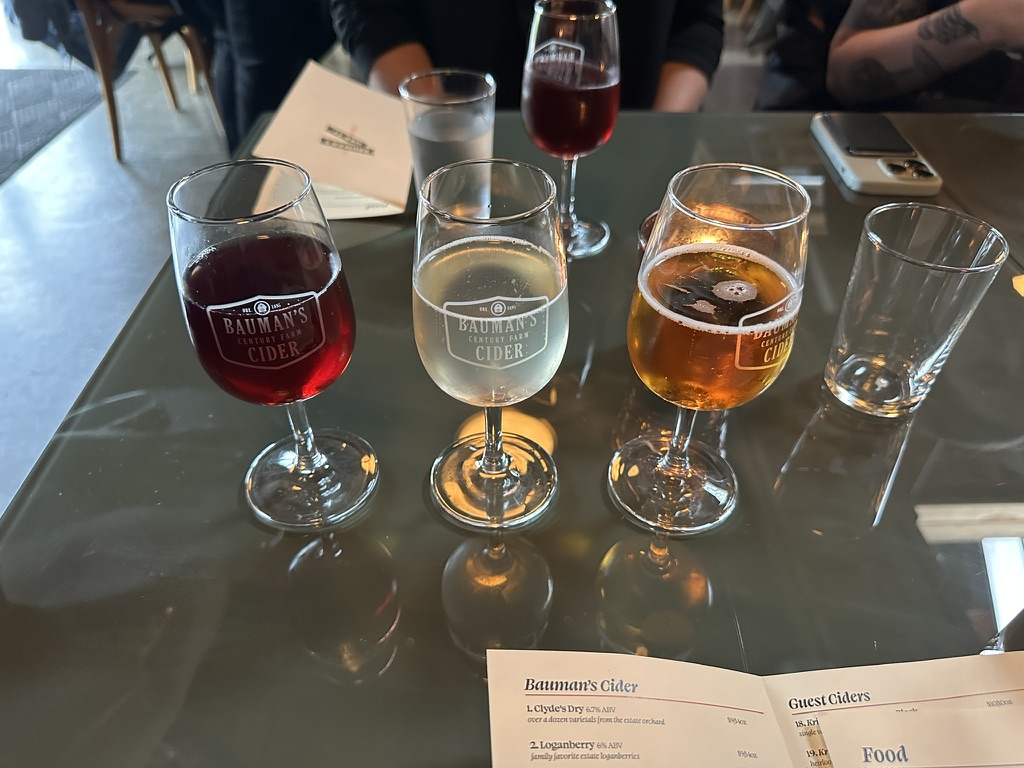
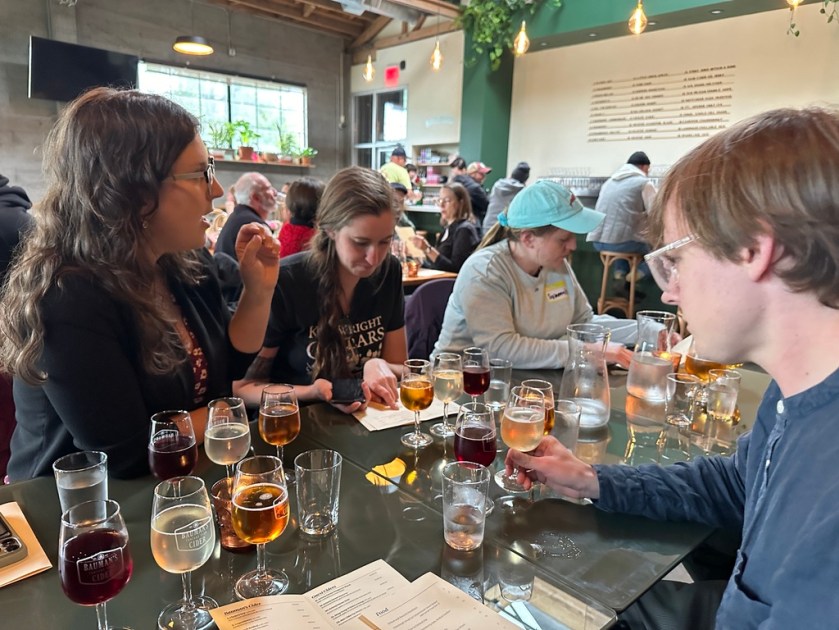
In the evening, the Northwest Cider Association was kind enough to invite a group of us media wonks to the shiny new ‘Bauman’s on Oak’. For those unaware, the much-admired Bauman’s is one of the US’s most successful and diversified cidermaking operations in the ‘craft’ category, producing everything from contemporary-style flavoured ciders to several collabs with the inimitable Tom Oliver.
Recently, when founder and head cidermaker Christine Walter (née Bauman) was looking for a new production facility to cope with expansion outgrowing the family farm, it turned out Ecliptic Brewing was just going out of business, and one of its two locations, the ‘Moon Room’ on Oak Street, was just the right size. Although opening a tap room in addition to this urban cider-making operation wasn’t originally part of the plan, a snowball of events — including hard-to-turn-down hospitality bigwigs expressing interest in working with Christine — led to her to create this taproom-cum-cidery. Bauman’s moved in on January 1st this year.
The taproom half of the building, Bauman’s on Oak, had only been open for about a month, but it was positively hopping (excuse the beer pun). There were about 30 ciders on tap, and everything we ate was delicious, with the tiny crab roll on homemade pretzel potato bread particularly memorable. The experience was especially enjoyable for me because there isn’t much like this in the UK: of course, there are plenty of taprooms with plenty of small plates, but not run by cideries.

Just behind the taproom, all polished concrete and wooden beams (and very cool tables created by Christine’s furniture designer daughter Hannah), is the production facility. Christine was kind enough to give us nerds a tour — glass in hand, of course. The large stainless-steel tanks and warehouse vibes contrasted with her description of her family’s farm, where the business started, and the smaller-batch Bauman’s ciders are made. It’s on the list for my next visit to the area.
Of the cider flight graciously chosen for us by Emily, my favourite was probably Song Within a Song, a co-ferment of bittersweet and sharp apples with marionberries (Oregonian blackberries) and Dolcetto and Tannat grapes. This wasn’t a Bauman’s at all — not quite. Stray Cider, a small co-ferment-focused brand, is made by the aforementioned Hannah and her partner, Deron Davenport (who also happens to be head cidermaker for the more mainstream-oriented Portland Cider Co.).
The other ciders we tried were mostly — though not all — what Bauman’s and other cider makers in this milieu call ‘modern’: large-scale pitched-yeast fermentations of dessert fruit, often with post-fermentation additions of other fruit, that tend to be produced all year round (with stored Pacific Northwestern fruit or juice at Bauman’s; with concentrate in other places). Indeed, ‘post-fermentation fruit addition sweet’ was by far the largest category in the competition at 40/269 entries.
An interesting thing about the US cider scene for me was that there was plenty of ‘modern’ cider with an overtly refreshing character and mass appeal being made by mid-sized brands. These look like very large operations indeed compared to most of the UK’s aspirational cider makers, but they pride themselves on using real juice (often from a mix of their own orchards and others’, as well as culled commodity fruit) and not adding the same additives as the really macro brands. This category of cidermaker is practically absent in the UK — not enough land and money around, it seems.
‘Modern’ makes some sense as a term for this kind of cider, but ‘heritage’ or ‘traditional’ — ostensibly the counterparts — are a bit trickier. Some American cidermakers used these terms to refer to cider made with American ‘heirloom’ varieties (not necessarily tannic ones); others meant ciders akin to various well-known Old-World styles; others meant harvest-based, more likely wild-fermented products.

I guessed that the ambiguity and sometimes-implicit value judgements and baggage — the term ‘heritage’ having been called into question by discussions like this — were likely why, following public consultation, the American Cider Association decided to move away from them in their official guidance. Indeed, the Certified Pommelier study guide doesn’t classify ciders at all in this way, focusing instead on what it terms ‘Cider Families’: cider, perry, fruit cider/perry, botanical cider/perry, and dessert cider/perry.
Michelle told me that, yes, the Malus article was part of it, “but ultimately it came down to apples not fitting into neat little boxes. We have a term, ‘harvest driven’. But that is about process and not flavour or apple class.” She has previously described the process of changing the nomenclature as well as the ACA’s subsequent admirable work on inclusivity in this wonderful interview conducted by Adam for Cider Review.
Note that the term ‘harvest-driven’, as elucidated in this CiderCraft article Michelle shared with me, refers to cider made with “apples or pears at or around harvest time”, while “harvest-driven cider makers are those who make cider with a harvest-driven approach 75% or more of the time” (not necessarily with their own apples). A 2022 survey quoted in the article found that just 1.7% of American cider makers fit this bill.
I should say that most of the people I met in the context of the Northwest Cider Cup still used ‘modern’ and ‘traditional’ in conversation — whether that’s because it’s hard to change people’s behaviour or it’s still felt to be a useful shorthand dichotomy, I’m not sure. Of course, there are many obvious objections to the classification of cider in this manner; what about the myriad products that don’t really fit either bill, like those of cider makers putting untraditional, even ‘modern’ spins on natural, orchard-based cider production? If you’d rather not wrangle with these terms, I recommend a simple taxonomy like this one (no bias here, nope). [Ed – bias totally legitimate.]
It’s interesting that the term ‘modern’ doesn’t seem to be as contested: The CiderCraft Awards dropped the ‘heritage’ category in 2024 in favour of ‘high tannin sweet’, ‘high tannin dry’, and ‘rosé’ (other new categories included ‘non-alcoholic’ and ‘imperial [8% ABV+] cider with adjuncts’). However, they still have several ‘modern’ categories. Meanwhile, Michigan’s GLINTCAP has both a ‘modern’ category and a ‘heritage’ category (essentially cider made from American heirloom varieties), as well as a ‘traditional’ one (for ciders from the regions of England and France that traditionally use tannic cider apple varieties — for traditional cider from Spain, see ‘natural cider’).

Regardless of what exactly we mean by modern and traditional and/or heritage, it’s pretty clear that Bauman’s embodies both, and skilfully so. I think I can spoil the Cup results a teeny bit by saying Bauman’s did rather well! The business began its life on the family fruit farm in Gervais, Oregon (Christine is the fifth generation); from making 5,000 gallons [c. 19,000 litres] in 2015, it has grown to around 123,000 gallons per year, or almost 500,000 litres, as of 2023. Modern, larger-scale production takes place in the facility adjacent to the new taproom, while Christine noted that the “small-batch, single-varietal, barrel program and amphora ciders” are still made at the farm.
Monday, June 3: Judging Day
I didn’t quite know what to expect when I turned up to Columbia Distributing Center outside Portland at 8:30 am sharp for judging day (thank you Hannah and Deron for the ride). I’m glad it turned out to be bagels with cream cheese. Once we had breakfasted, the judging began. The group of 50 judges was made up of a wonderful mix of cider makers (many of whom had entered the competition themselves), writers, orchardists, hospitality professionals, and general pommeliers. A decent number were from out of state, and a few from out of the Pacific Northwest, but I think I was the only one from overseas… no pressure.
Happily, I didn’t have to worry about ‘modern’ and ‘traditional’ today: the Northwest Cider Association classifies its entries by something like the aforementioned Cider Families, splitting them into ‘high tannin’ and ‘low tannin’ as well as ‘sweet’ and ‘dry’ (if there are enough entries to justify it). I had been assigned ‘high-tannin sweet cider’ for the morning’s judging session and ‘red-fleshed ciders’ (including both sweet and dry by implication) for the afternoon.

Most entries in my first category were what I’d call French-inspired: amber in tone and generally lightly sparkling, at least one of them turned out to be keeved (as my table suspected). I enjoyed the push and pull between ‘best example of the category’ and ‘best cider’ that took place between us judges, and I was grateful to be easing into the competition on familiarly tannic — if unfamiliarly PNW — ground.
Of course, coming from the UK, my definition of ‘highly tannic’ isn’t the same as most Americans’; at one point, I blurted out to Michelle, “The thing is, none of these highly tannic ciders are actually very tannic!” I immediately feared I might have offended; luckily, she laughed and laughed.
The red-fleshed category, my post-lunch assignment, was a whole different (and equally engaging) ball game. Ciders made mostly or solely from red-fleshed apples are rarely seen in the UK or elsewhere in Europe, but there is a real passion for them in the US. Maybe the craft cider makers there are just more business-minded — many of them seemed to make a punchy hopped cider as a beer gateway and an alluringly pink ‘rosé cider’ as a wine gateway. But that sounds cynical coming from someone who practically coos with delight every time they see the cross-section of a red-fleshed apple (read, me).

Local pride certainly came into it, too: Oregonians have a special fondness for the picture-perfect Airlie Red apple, which is said to have been found in the hamlet of Airlie, southwest of Salem, Oregon, in the 1960s. Coyly green on the outside, with the occasional cherry blush, and candy-pink on the inside, it’s also known, somewhat contestedly, as ‘Mountain Rose’ and the trademarked ‘Hidden Rose’— an indication of its success. Indeed, named apples were key to this category: it was the only one in the competition for which entrants were required to state the variety or varieties from which their cider was made.
A whole host of these varieties (possibly even Airlie Red) were created in nearby (it’s all relative) in Humboldt County, northern California by plant-breeding ‘wizard’ Albert Etter. A nationwide celebrity in his day, Etter bred scores of successful (and less successful) strawberries and apples in the early 20th century. These included a bunch of red-fleshed daughters of the European variety Surprise — itself a likely descendent of the native Central Asian Malus Niedwetzkyana.
The apples from Etter’s now-revitalised experimental orchard at Ettersburg — naming a town after yourself was the kind of thing that was possible in 1890s America — are now being used by Tom Hart of Humboldt County Cider Company, as he explains here. I was able to procure a delicious (and very pretty) can of HCCC’s ‘Albert’s Experiment’; I hope to visit Tom’s taproom and the Etter orchard on my next trip.
From detractors of red-fleshed varieties, mostly outside the US, I’ve heard that their crab apple-like characteristics make their flavour underwhelming — a case of anthocyanin style over substance — and that the colour doesn’t get retained after natural fermentation anyway. Clearly, however, there are processes that allow you to keep the colour, as the cornucopia of shades from palest peach to deep cherry on the tasting table in front of me attested to. And they certainly weren’t flavourless; while red berry notes dominated, other flavours from grape and lemon to brisk, stemmy tannins revealed themselves.

In terms of the process, we judges were divided into tables of three or four. We had about three minutes to evaluate each entry by ourselves and fill in a detailed online form assessing everything from tannin and acidity level to carbonation, as well as give our personal feedback to the maker. Then, we had a couple minutes more to discuss the cider and come to a consensus. To a fresh-faced ingénue like me, this seemed rather quick, but I’m told it’s an aeon compared to what you usually take over each entry when judging wine competitions.
At the end of each judging round, medals had to be awarded by the group — ideally, but not necessarily, one each of gold, silver, and bronze. These were not lightly and broadly awarded participation prizes, but real, argued-over stamps of quality. In this process, our head judges kept us in check, and I am delighted to have struck up a friendship with fellow quince enthusiast and head judge Brandon Buza in the process. (Clue the cliché about this-or-that industry being all about the people.)
In the evening, the afterparty began at Loyal Legion, a beer-focused bar downtown. I can understand wanting to drink something different after a day of pomes — and I did greatly enjoy my ‘judge happy hour’ wild ale aged in oloroso sherry barrels and neutral oak — but we’d been spittooning all day. The cider itch not yet been entirely scratched. So, a group of us headed out to the cider bar that, especially after last year’s Portland-based CraftCon, I’d heard so much about.
A very jolly evening was spent at The Place with Erik and Storie (our new friends of Press Then Press fame) and a couple of regulars, with owner David opining on everything tasted at the counter. I decided to put myself firmly off-duty and not take any notes. I can say that the drinks I tried included an intriguingly beer-like cider made by Cameron Winery from the famous White Oak Orchard’s apples (likely a draught version of this), several Foxwhelps (the mystique is perhaps even greater stateside), and my first Cidrerie du Vulcain bottle, a perry.

An achingly cool, thoroughly modern bar-cum-bottle shop focused almost entirely on aspirational cider, with pommeau on draught and walls dripping in house plants? Only in Portland. I can’t wait to go back, and I hope to discover establishments like this elsewhere soon.
Tuesday, June 4: A visit to Peak Light
It was a somewhat slow start to the day… I may have drunk a lot of cider the day before. Luckily, our Northwest Cider Association road trip didn’t start until lunchtime, giving Alfie and me plenty of time to mosey over to Blue Star Donuts for breakfast. I still miss their buttermilk old-fashioned cake donut.
From NWCA director Emily’s house, we departed with PR spokesperson Lota LaMontagne and fellow writer Kristen for Sauvie Island. Having got to know the cider scene in town, it was time to check out the country. Luckily, Portland has a good chunk of that right just to the north of the city in the form of Sauvie. The largest island in the Columbia River, it’s partially designated ‘ag only’ to take full advantage of its fertile, river-lapped soil. This means that most who live there run some kind of agricultural business, mostly small private farms, U-pick berry operations, and plant nurseries. We were headed for Peak Light Cider, a family business with enviable views of all the snow-capped peaks around.
Almost as soon as we arrived, Travis Lovejoy took us out to show us the orchard where the fruit is grown. All on semi-dwarfing for ease of harvesting, there was everything from quince to pluots, but mostly apples. Travis and his wife Jen are inspired by biodynamic principles and try to work with the nature around them, turning their land 4 acres of land with its 450 trees into a closed system. It’s been four years since they sprayed anything here.

Of course, it’s not a sheep-grazed, ground-harvested operation like many of my favourite UK equivalents — as Travis pointed out, the FDA is very iffy about apples being harvested from the ground. This partially explains the reluctance to implement harvesting machinery in the US and the continued reliance on (expensive) hand-harvesting, even for non-eating apples. The US is has reclaimed its strong cider history, previously wiped out with prohibition, and necessarily coming at this from a place of using surplus dessert fruit. In this little oasis, however, there are quinces, heirloom American apples, and even British cider varieties galore.
Back at the (rather swanky) ranch, it was time to try some cider. Lota had laid on a wonderful spread of cold cuts, salads, bread and cheese — always a good cider pairing. We started with the 2023 Orchard Reserve Quince, which Emily was keen for me to try after reading my Hymn to the Quince. An ‘estate cider’ made with a 50/50 blend of heirloom apples and quince, it had an intriguing slight sweetness (achieved with cryo-concentrated first-melt quince juice) and a big and juicy acidic quince flavour, almost verging on super-floral apricot. (This is what I love about that particular pome: you think it has one flavour profile, and then it never ceases to surprise you.)
The next, the 2023 Orchard Reserve Red, wasa blend of type 1 and 2 red varieties from the Niedzwetzkyana line: Burford Red, Firecracker, Almata, and the ultra-red OG itself. It had a somewhat bitter vegetal taste, almost reminiscent of tomato leaf, and was reasonably dry. It also had a slightly floral smell and was reminiscent of sophisticated rosé — one of the most engaging red-fleshed ciders so far, certainly.
But it was the Barrel Aged Cherry Cider, a small-batch collaboration with the all-women Freeland Spirits distillery, that really wowed me. A straw-coloured co-ferment of yellow Rainier cherries in bourbon barrels, it had a unique, rounded palate with compelling notes of coconut, almond, vanilla, and grilled peaches, as well as a touch of funk. With its sweet and heady aromatics, I immediately tipped it as an excellent Gewürztraminer alternative. A cherry cider that just tastes like cherries? That would be too easy.
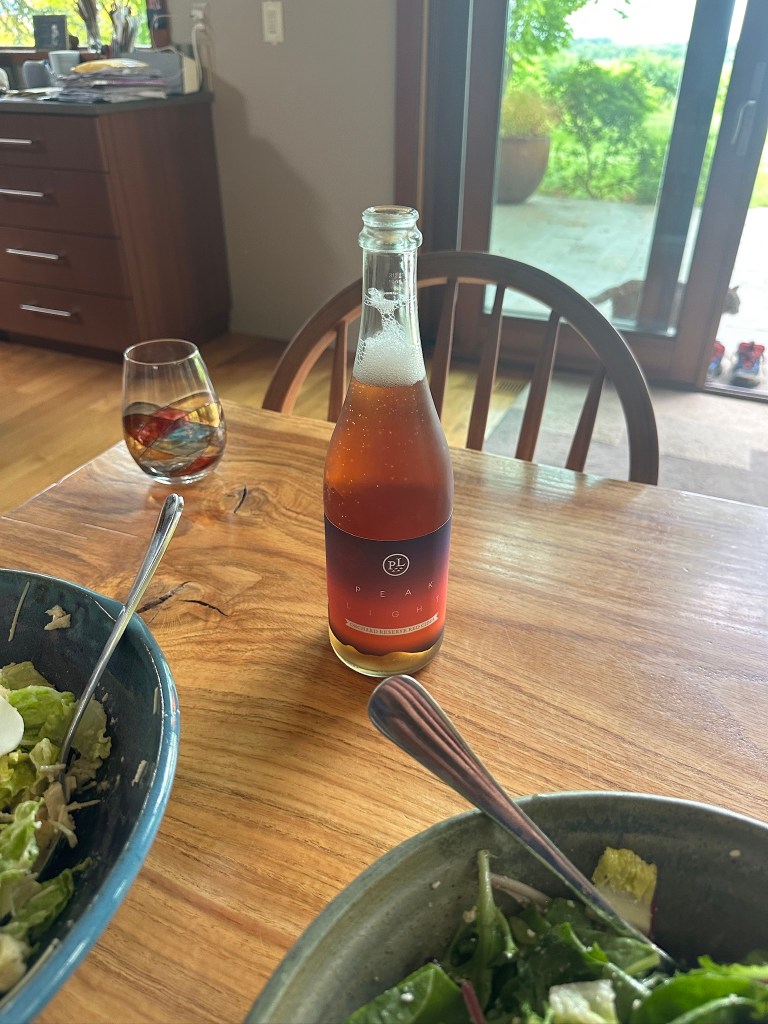
It was wonderful to taste some explicitly harvest-based cider as part of my trip to the PNW (at least, not blind). Not everything takes place at the orchard site: like a decent number of the smaller American cider makers I encountered (in this case, making under 20,000 litres a year), Peak Light rents production facilities and equipment from another maker in the area; that’s where pressing, fermenting, bottling and storage take place. Still, provenance is celebrated; the Peak Light bottles even have a gridded map of the orchard on the back, showing you what trees’ fruit produced the liquid.
As we walked out the door at the end of our visit, we couldn’t help but comment on a rather impressive wood carving hanging above a stairwell near the entrance. A curvaceous and rather fanciful depiction of an apple tree, apparently in some tropical hardwood, it was distinctive in depicting blossom and fully formed apples on the tree at the same time. Travis told us it had been left (due to its impressive size) by the previous owner — a relic of travels to somewhere where the artisans weren’t particularly familiar with apple trees. I thought it was wonderful — an exotic treasure marooned on what was (to me) an exotic island of endless blueberry bushes, stunning mountain views, and spindly neo-Gothic bridges back to Portland.
* * *

All told, I feel incredibly lucky to have had the chance to experience some of the richness of the Pacific Northwest’s cider scene, try some of its best ciders while judging an the competition, and meet so many friendly and fascinating people. This area of the US, and perhaps Portland in particular, is well-known as a craft beverage stronghold with confidently quirky, progressive, and countercultural sensibilities. The city’s slogan is ‘Keep Portland Weird,’ after all.
Crucially for my interests, Portlanders have a pride in their local produce that is tangible from the minute you set out to grab your first drink or dinner (dressed in your #gorpcore, of course): it’s perfectly natural to shop, eat, and drink local. I was delighted to be able to participate for a time, and I took home a fascination with American cider apples and much-raised standards when it comes to taprooms.
Okay, okay, we all want to know who won. To save my repeating what others have ably analysed, please see a summary of winners and trends here and the official Winners Guide here.
* * *
Many thanks to the Northwest Cider Association for supporting my attendance at the Northwest Cider Cup judging and organising my visits to Bauman’s on Oak and Peak Light Cider.
Discover more from Cider Review
Subscribe to get the latest posts sent to your email.
 Cider Review
Pingback: Crowds and kings and sparkling bibs: the Yew Tree Cider and Perry Trials | Cider Review
Pingback: A 2025 CiderCon Diary | Cider Review