What’s your position on natural wine, cider and perry?
Perhaps you don’t have a terribly strong one. Perhaps you’ve never given it terribly much thought, and honestly more power to you – I have spent far too much of my valuable dead time mulling it over. All the more futile given that I find myself still unable to settle comfortably on any one precisely.
The binary positions on natural wine and cider are that they are either an antidote to the chemical poison and cynical over-intervention of ‘mainstream’ drinks (not a good term, but what is?) or that they are farmy, vinegary, infected filth. I don’t actually think many people hold either of these positions, since both are so demonstrably false. But a large number of people hold strong views at all points along the spectrum that runs between these two poles and, social media being what it is – so tribal, so rewarding of outrage and extreme opinion – that unpacking the nuances of exactly what you think without exterior influence can be difficult.
So what do I think? Or, possibly, what do I think I think?
Well, I think I think for all that the term ‘natural’ is as elusive and as tossed-about as a paper bag in a thunderstorm that, boiled down to its essentials, the theory of natural wine and cider is impossible to take a dim view of. Cider and wine whose fruit is grown in the most considerate and environmentally conscious way and whose makers seek to express that fruit with the minimum of additions or heavy-handed processes. These tenets are laudable, noble and possibly, in the long term, essential – especially with regards to agricultural practices.
What’s more, the results are frequently extraordinary. I should admit to not being the most regular of natural wine drinkers; Reading, where I live, has virtually none to offer through either on or off trade, and none of the wine companies I ever worked for took more than the most cursory interest. But I’ve nonetheless tried my fair share, I dare say more than many, and those that I’ve tried have included, without doubt, some of the most extraordinary and delicious drinks I’ve ever tasted. On the cider and perry side of things I’m far better versed, and this website groans beneath the weight of drinks that would be classified under any definition of ‘natural’, as do my annual lists of year-end favourites. Just look at my love for the likes of Artistraw, Little Pomona and Find & Foster.
At the same time, I’m aware of an involuntary but distinct wariness I feel whenever I find myself confronted with a new bottle of anything – but especially perry – which I know to have been made without the addition of sulphites. Occasionally I see a zero-zero approach described as like ‘taking the stabilisers off’, but actually riding a bike is relatively straightforward and predictable once you’re used to it. Whereas working with comparatively low-acid, low-gravity fruit fermented with ambient yeasts and without sulphites is more along the lines of that challenge in Takeshi’s castle where competitors had to cross a high, narrow, rickety rope bridge whilst being shot at with balls fired from cannons. It is hard to predict, takes skill to control and you can do everything right and still fall off anyway.
Whether it be oxygen, bacteria or microfauna, the air is full of things that want to interact with your fermenting must. Some of these things are wonderful – indeed necessary for the complex magnificence that is naturally-fermented cider or perry. And some of these things wish for nothing more than to take your drink in a direction of flavour that we might at best call ‘a distinct matter of preference’ and at worst an unpalatable fault.
Yes, yes, I know – ‘a distinct matter of preference’ could be applied to absolutely anything. I certainly have preferences that aren’t shared by everyone – look at my love for single variety Foxwhelp, cider matured in Islay casks and strong spirits. Differentiating these extreme flavours from those produced by the likes of acetic acid, mouse, hydrogen sulphide (H2S) or TCA (see our guide if these are unfamiliar terms) is something I’ve come to increasingly struggle with, and it isn’t for me to dictate preference. At a cider festival I once led a tasting of expressions I thought were beautiful, only for one attendee to catch me sometime afterwards to show me a glass of heavily acetic cider he had chosen and tell me that this was the sort of thing he’d really come for. Everyone, I have found, has a different tolerance level for different faults. I know makers who can’t stand acetic but are relatively unconcerned by H2S and vice versa. I myself don’t mind a low level of brett in certain styles of cider, and of course around 40% of people genetically can’t even taste mouse.
I suppose the issue for me with excessive biological or oxidative influence on the flavours of a cider is twofold. Firstly, there is a transparency question. Whereas the aforementioned Foxwhelps, Islay casks and high-strength spirits wear their intensities on their sleeves and, pertinently, their label descriptions, the flavours of faults are almost never disclosed before the bottle is opened. I’ve written before, all the way back in 2020, about my personal hatred of the term ‘funk’, and my frustration when it is used as a euphemism to cover the likes of acetic and H2S. You’ll certainly never – or virtually never – be told on a label if a cider is vinegary or sulphury, smells of dung or glue or has the awful musty finish of mouse. And I think that this lack of disclosure tells its own story about flavours that makers do or don’t intend to be there.
Linked to that, there’s no question that faulty ciders, especially those pitched at a higher-end price, do lasting reputational damage to cider. There is still an unfair and problematic generalisation of farmhouse cider as something rough-and-ready, vinegary and difficult to palate. There is also an immensely frustrating frequent tendency for wine writers who should know better to describe the flavours of acetic natural wine as ‘cidery’ – a description born from exposure to acetic ciders that predates the modern popularity of natural wines.
I don’t want this article to be about faults. Cider made with the utmost care for orchards, agriculture and the land should be championed as vociferously as we possibly can. And I have the greatest admiration for makers who are daring enough to eschew sulphites, talented enough to release results that often redefine my notions of how brilliant and characterful cider and perry can be, and brave enough not to sell ciders and perries which have become impacted by meaningful faults, even at their own expense.
These are cidermakers I want to champion and who I think are important to highlight and celebrate. They’re cidermakers who fascinate me, who I love to learn from and talk to – and yet at the moment of purchase, so often, an involuntary and slightly shameful thought of ‘oh but what if?’ pops into my head, and I find myself choosing something else. What’s more, from time to time, experiences with makers whose creations I had previously thoroughly enjoyed have put me off being a customer again, sometimes for years.
When I first found myself in the wonderful world of aspirational, full-juice cider I would explore with abandon and without thought, buying and tasting everything I came across without preconception; happy to leap without looking. Experience, as in all things, can be jading, but I think that’s a shame. It should be possible to be aware of faults, to hold legitimate concerns about their presence in commercially-available ciders and perries, but to taste without inhibition nonetheless. Or, at least, that’s the state to which I would like to return.
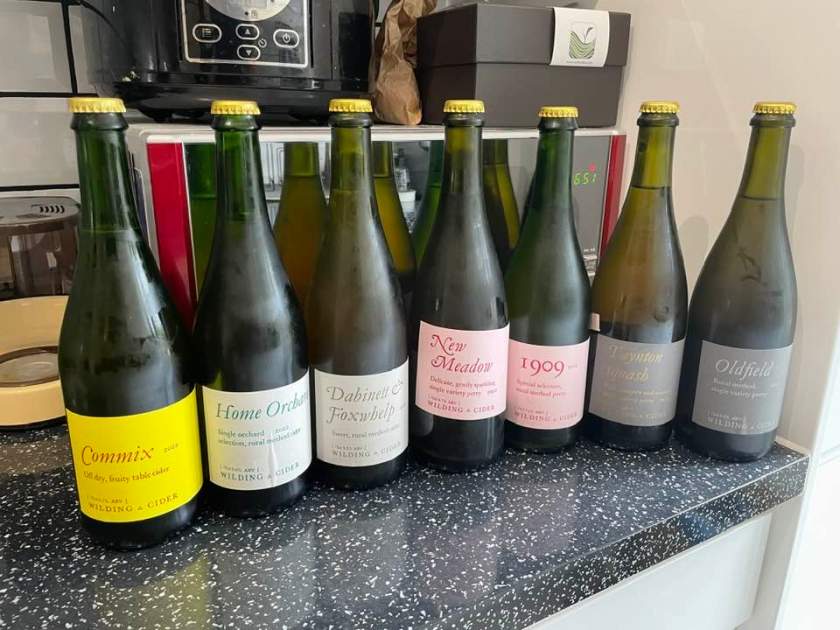
One natural maker whose creations have rocketed in quality in the last year or so is Wilding, run by Sam and Beccy Leach in Somerset, and whose forays into distillation were so brilliantly covered by our recently-grafted contributor Beatrix here.
They’ve always released great ciders – their Dabinett-Foxwhelp blend of a year or two ago was one of my favourites of that year – but what has really seemed to leap forward has been their consistency. This was brought home to me at last year’s Cider Salon, where I tasted not only the best of their perries I’d had to that point, but a full raft of delicious and utterly fault-free natural ciders. I’ve since drunk far more Wilding in the last year than I had in the three years beforehand combined and they were a very early name on the teamsheet when I was coming up with the list of producers to feature in Perry: A Drinker’s Guide.
Around October or November of last year, Sam kindly sent me a trio of unreleased perries following a conversation we’d had about Taynton Squash. I was very intrigued, but also conscious that reviewing them at that time wouldn’t have been much use when they were several months off becoming commercially available. (Indeed Sam himself told me they weren’t yet ready). So I have sporadically bothered him over the subsequent months, and just a couple of weeks ago he gave me the green light and kindly augmented them with a few other new releases.
All are made from fruit harvested in traditional, unsprayed orchards in Somerset during the magnificent 2022 vintage. (Looking out at a grey July it’s proving hard to remember just how sunny that year was…) Fermented with wild yeast and without sulphites, with any carbonation coming as a result of continued primary fermentation in bottle, these are as faithful to natural principles as it’s possible to get.
Though Wilding themselves don’t have a webshop, most of what’s reviewed below is already available through the Fine Cider Company, whilst the likes of Pullo, Aeble and The Cat in the Glass are likely to follow pretty close behind. No getting away from the fact that these bottles sit at the higher end of cider’s pricepoints, coming in at just shy of £20 each. But considering the care and costs involved with making them, and given the prices of equivalent wines, that’s far from unreasonable if the quality stacks up.
So let’s see if it does! Perries first, I think, with ciders following on.

Wilding New Meadow 2022 – review
(NB, not a single variety I have enormous familiarity with – always fun)
How I served: Lightly chilled
Appearance: Pearlescent gold, light mousse
On the nose: These are the kind of aromatics that, in an incredibly generic world, you would say ‘smell like perry’! In a simply clean, unassuming, delicate, fragrant, floral and pear-scented way. Light dabs of honeydew melon and greenery and perhaps a touch of straw. Just a delicate, classic springtime perry nose generally. Nice.
In the mouth: Lovely balance of acidity and fizz with just a gentle dab of sweetness. Follows the nose closely but there’s a touch of tangeriney citrus amidst the fresh pear and florals. Nice minerality too. Fruitier than the aroma, and with more fullness of body than expected, it’s a lovely, detailed and gentle perry with lots to enjoy.
In a nutshell: A really classic floral perry despite being a single variety. Full of springtime aroma and flavour. Very nice.
Wilding Oldfield 2022 – review
How I served: Lightly chilled
Appearance: Paler, brighter gold.
On the nose: Loads of perfumey, heady florals here. Aromatic stuff. Heavy on rich summer blooms with pear skin and lemon pith. A very little touch of peardrop acetate too perhaps? As Oldfield is wont to do it skews away from aromas that can simply be categorised by their ‘fruitiness’; lots of mineral wet stone and petrichor character. Complex.
In the mouth: Sweet! Full-bodied and with just enough acidity and tannin to prevent the sugars getting heavy. Pears in lemon syrup? Lemons in pear syrup? Very elegant, with none of the peardrop of the nose. Bright, floral, melony, apricoty and underscored by that refreshing slatey minerality.
In a nutshell: On the sweet end but charming and very flavourful. Though I remain unable to precisely define the flavours of Oldfield in my head. A Quixotic endeavour maybe!
Wilding Taynton Squash 2022 – review
How I served: Very lightly chilled. Cool.
Appearance: Deeper, more coppery. Less mousse.
On the nose: A deep, burly, tropical, mulchy Taynton Squash nose, this. Pulpy orange, grape mistelle, forest floor, ultra-ripe mango. Aromas lurk in the glass rather than bounding out. Definitely sits on the heavy end of perry, as Taynton Squash often does.
In the mouth: A big, rumbling mouthful of marmalades, heather honeys, syrups, overripe tropical fruit and a savoury edge of autumn leaves. Just a touch of oxidation too, in a lightly musty sense. This is giving big ‘orange wine but perry’ vibes. It’s a big, heavy perry for sure, the low acidity wrestling for balance and without the ballast of mousse that the other two have. Not quite my favourite, though in fairness I often seem not to be the biggest Taynton Squash fan…
In a nutshell: The perry for orange wine drinkers. Big, rumbustious, autumnal fare, perhaps with just a slightly rough edge.
Wilding 1909 Perry 2022 – review
(Unlike the others this is an orchard blend. ‘Taynton Squash, Moorcroft, Barland and Pine form the backbone, with Barnet, White Longdon and Blakeney Red used to soften the whole and keep balance.’
How I served: Lightly chilled
Appearance: Pearlescent old gold. Trace mousse.
On the nose: Very aromatic and fruit-forward. Tropical flowers in a greenhouse. Rich honey. Super-juicy melon and pear compôte. I’m supposed to be seeing the dentist tomorrow at the date of writing these notes, and by the smell of I reckon this is going to add a quid or two. But it’s incredibly alluring!
In the mouth: Continues the theme of the nose. Lime marmalade with peel. Bright fresh honey and lightly spiced pear tart complete with frangipane. A lovely seam of acidity keep things fresh. Flavours aren’t quite identical but this is actually a reasonable facsimile for a sweeter late harvest Alsace Riesling actually, though there’s a more orangey citrus depth here too. Great minerality once again. Super expressive.
In a nutshell: Really lovely, complex and hedonistic sweet perry.
Enough of these pears! To the cider.

Wilding Commix 2022 – review
‘Off-dry, fruity table cider’. A blend of various bittersweet and bittersharp varieties.
How I served: Very lightly chilled
Appearance: Hazy copper. Still
On the nose: A very juicy-fruity number. Kind of a hybrid of oranges and stone fruits somehow; not quite exactly one or the other, or both side by side. A bite into some kind of satsuma-mango-apricot mashup! A little fresh hay too. Simple but very cheerful. A summer cider indeed.
In the mouth: A riot of that pure, off-dry, orangey, tropical, ever-so-lightly spicy, gently tannic, gently acid fruit. Beautifully balanced; plenty of everything, not too much of anything. Lots of body, just a touch of sweetness. A juicy mouthful of joy.
In a nutshell: This is ultimate picnic basket cider if we ever get the weather back.
Wilding Dabinett & Foxwhelp 2022 – review
How I served: As above
Appearance: Pure sunshine
On the nose: Everything I’ve just written about the Commix – double it! Dabinett at its most sun-filled, alluring orangiest, offset by ripe canteloupe and a blush of ripe strawberry (and strawberry jam) from the Foxwhelp. Huge, broad, joyful aromas that you can catch from the other side of the room. It’s actually not super ‘complex’, but it is unbelievably appealing. The hedgehog with one superlative trick rather than the fox with a load of smaller ones!
In the mouth: Yes, this is the Commix’s more joyful, full-hearted and gregarious sibling. Beaming with that ultra-ripe 2022 fruit, there’s no excess of either Dabinett tannin or Foxwhelp acidity here; both are melded beautifully into the multi-hued orange-yellow-red gummy, juicy, chortling beam of this cider’s fruit-filled palate. There’s residual sugar here but it is wonderfully balanced.
In a nutshell: Never mind waiting for summer – this absolute treat will make summer happen for you.
Wilding Home Orchard 2022 – review
How I served: As above
Appearance: Brassy, light mousse
On the nose: Still lots of that big, ripe fruit, but here it’s taken on a duskier, darker and slightly savoury edge, as though slightly caramelised. More orange marmalade than fresh orange. Spiced apple, clove, peel and pith. That lignin-y sense of polished wood. And, in fact, just a touch of wood polish. More cerebral than the two before it, and with just a smudge of volatility too.
In the mouth: Another with huge body and great texture. Tannins are chewier in this one though, fruit slightly firmer-edged. Perceives as slightly drier, though there is still a good dab of residual sweetness. As on the nose there’s a blend of almost overripe fruit alongside spice and forest floor. Sadly it’s also just a shade more volatile than is my preference.
In a nutshell: Lots of nice, complex, autumnal, cerebral elements, but the volatility isn’t for me I’m afraid.
Conclusions
A riot of flavour and texture that underscores the character of fruit that can be found through zero-zero natural methods. I love the range of intensities here, from the delicacy of New Meadow to the sheer vivacity of that wonderful, wonderful Dabinett & Foxwhelp.
Aside from the flavours themselves, every bottle was beautifully well-behaved on opening – a far cry from the years when pét nat Wildings were sometimes on the most kitchen-decorating end of the feisty spectrum. Pét nats are a hard act to judge, especially in perry, so a conscious effort has clearly gone in here, and it’s massively appreciated and deserves highlighting.
Though none of the perries quite eclipses the November 2021 in my head as my favourite Wilding perry yet, there’s lots to love here, and the Commix and Dabinett & Foxwhelp were fantastic. I remain convinced that this is a maker on a fantastic trajectory, will enthusiastically dive into whatever they bottle next, and remain optimistic that the quality of natural cider more broadly will continue its upward trend.
Discover more from Cider Review
Subscribe to get the latest posts sent to your email.
 Cider Review