
Just over two and a half years ago, Chris covered Purbeck Cider’s crowd-pleasing canned cider range. Then just over a year ago, James covered their inaugural Kings Hill release, an On-Leaf Dabinett svc. Now, thanks to a very generous offer of a couple of new bottles hitting the UK market, I’m stepping up to the digital plinth, tasting notes to hand, ready to offer my thoughts on these drinks from Purbeck Cider, a maker I don’t see much of around Norfolk way.
Nestled down close to the South Coast of England, in the county of Dorset, Purbeck Cider looks to be a great place to visit for anyone embarking on the SC500 – the southern UK version of Scotland’s very popular NC500 road route. Both bottlings sent through are in the Traditional Method style: one a perry pear orchard blend; the other a single variety Knotted Kernel. I believe I’ve only tried this in a blend or two from Artistraw Cider before, so I thought I’d firstly check in with Artistraw’s very own Lydia Crimp to see what she has to say about this variety of apple:

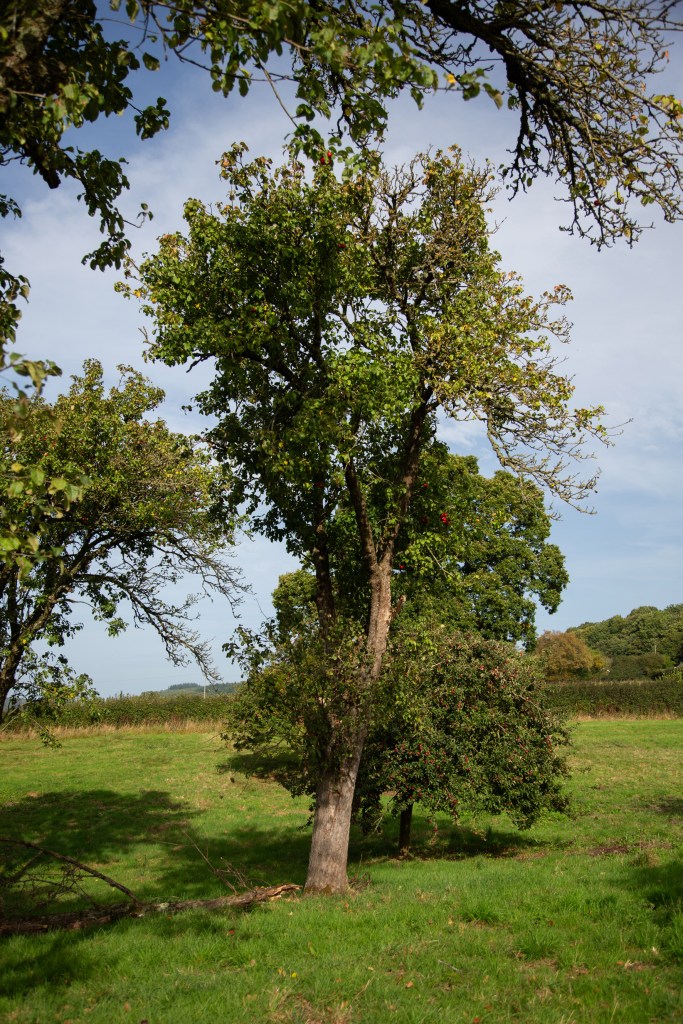
Lydia: The size of a cherry and with the looks to match, this is one of the most alluring of the varieties we work with. The knotted kernel tree has long been out of favour in commercial orchards due to its ability to grow enormously tall and also on account of its afore mentioned size. Indeed, in the 1980s its decline was such that it was thought to be extinct, until a tree was discovered growing all the way over in New Zealand! Scion wood was sent back to the UK, whereupon it was grafted, and the variety assumed saved. However, planted in 1936, the wonderful old trees that we gather fruit from are 88 years old, meaning that this strange fruit has been in the UK the whole time. We think the five majestic trees we have access to are the oldest in the country.
Incredibly high in sugar, the fruit from our old trees reliably achieves an SG of anything from 1070-85. The trees themselves are very upright in habit and vigorous growers. As previously mentioned, the fruit is very small and the flesh woolly with barely any juice. In short, they are flipping hard work, but we find they produce a delicious cider with a pronounced ‘earthy’ flavour and nice rounded tannins so we persevere!
With my interest piqued on this once-presumed extinct apple variety, I can’t wait to try the cider! If there’s a good origin story, or some kind of dramatic element to a varietal’s continued existence throughout the centuries, I always find it easier to fall in love with it. When I spoke with Lydia, she was as excited as me to try another single variety Knotted Kernel from a different producer. Onto a chat now with Kate Hartle, Marketing Executive from Purbeck Cider, who very generously answered a few questions around these latest Kings Hill releases. Additionally, I hope that Lydia and Kate’s orbits criss-cross at a future cider festival, and they can compare their own notes on this variety…
CR: Thank you for sending over the Kings Hill bottles to review. Let’s delve into them a little further. Your Wedding Perry uses fruit from your bush orchard and standard perry pear trees orchard. Do you want to produce a single variety from any of the trees you’ve got in the orchard?
Kate: We have produced a Kings Hill single variety before, a Hendre Huffcap. Going forward we hope to use more varietals to produce a whole host of different variety perries. We’ve got a relatively good amount of perry pear orchard here, around 10 acres or so. This features Blakeney Red, Thorn, Gin, Hellen’s Early, and Hendre Huffcap. The older standard trees are up in Kingston, our original farm site, and then we’ve got a newer, commercial bush orchard down here, as well as another standard orchard, which sits at 3 or 5 acres. We do source some perry pears from further afield as well. This bolsters our crop, as most of our perry pear trees are quite young still.
CR: What’s the reaction to folk in your local area when you say you’ve got perry for sale? Is the awareness there of what a treat is instore for them?
Kate: I’m always excited down at the farm when we get the opportunity to talk about perry because it is something which is a bit unsung. We do tastings here for free in the farm shop. There’s always the potential to shout a bit louder about perry, and that’s what we hope to do further with the Kings Hill range to explore the varieties and what they can offer. It’s great to talk about the Method Champenoise/Traditional Method process, as well as the elements of perry that set it apart from cider as a drink. It would be great to build on the success of the Kings Hill range, so that more people locally, across the UK, and even internationally, get to try it.
CR: At Purbeck Cider, you utilise the full range of presentation styles for your drinks from what I can see: cans, bottles, BIBs, and keg. What’s your view on these presentation styles? Do some suit certain settings or times of the year?
Kate: Producing such a wide range of products can be a bit of a minefield, but it does open us up to a lot of different markets. Doing kegs was one of Joe’s first loves (Joe Hartle being Purbeck Cider’s Founder and Chief Cidermaker.) That put us in front of pubs, and that’s where the majority of the volume of our cider and perry has been drunk so far. The area we live in is visited by lots of tourists, with many local pubs running beer and cider festivals. This is where we find our drinks in BIB work well. We’ve also recently moved into selling smaller volumes in pouches – these are proving very popular in campsites locally. A lot of establishments don’t have space on tap for an independent cidery, so having products in bottles gives us that versatility to get in them in their fridges, also opening us up to the retail environment too. Cans were a new addition for us a couple of years back, opening up the opportunity to sell to people travelling on trains, and the packaging moves us more into that sustainable area of the industry too. We’re seeing a lot of interest from a 20 and 30 something crowd for our cans – the look and the smaller volume is appealing to them. 750ml bottles allow us to lean into the celebration market, giving us the opportunity to produce some interesting small batch work. It’s nice to have a range of presentation style, but it does come with a bit of extra legwork involved!
CR: As a UK producer, are you looking to, or already do, export your products outside of the UK? I could see these Kings Hill bottles being viewed with interest from our cider-drinking friends on mainland Europe and in the US.
Kate: We get a lot of comments likening our products to the Normandy-style cidres, so there is potential for us to reach out with exports. There is that element of competition, so going somewhere that already has an established cider scene could be a bit challenging but we do get a lot of compliments from cider drinkers that like that Normandy style of cider.
CR: Knotted Kernel is such an interesting variety of apple. What made you put that variety into your bush orchards?

Kate: Interestingly, Knotted Kernel was never supposed to be planted in the orchard. Initially it was supposed to be Ashmead’s Kernel – known for producing a lovely apple juice. Joe had intended on something of that ilk. There was however a bit of a mix-up in the nursery that was growing the trees for us, and after planting, Joe looked in the orchard and said “I really don’t think this looks like Ashmead’s Kernel!” On closer inspection it was Knotted Kernel. So the 15 acre block of bush trees in the orchard, split between 4 different varieties now contains this variety purely by accident. After reading up about it, and seeing how well the trees are growing, we’re really pleased by this accident. The trees have a lovely shape to them and are relatively disease-resistant. They produce a beautiful cider. The apples have a higher than normal residual sugar content, so the resulting cider has quite a pokey abv! A lucky accident for the orchard.
CR: How old are the trees in your orchards now?
Kate: The bush apples were planted before the perry pears, so they’ve been in the ground 7 years now, and probably had a couple of years in the nursery beforehand. They’re still quite young, but are starting to come into their own now.
CR: What does Traditional Method/Method Champenoise bring to the table for you? It’s a lot more work as a producer to make a cider or perry in this manner. Is the effort worth the reward at the end?
Kate: It’s just a beautiful method. Joe is particularly fussy on his production processes. The fruit goes in for initial fermentation in tank for around a year, developing its flavour. It’s then taken off the lees, a small dosage is added alongside champagne yeast when it goes into bottle. It’s then riddled over the course of a year, disgorged, and that then leaves you with a drink that has a fine, delicate bubble , with beautiful clarity and robust flavour. It’s a very different style of bubble to forced carbonation, a more refined flavour.
CR: How has the Kings Hill range been received so far?
Kate: The first varieties we’ve sold from the Kings Hill range have sold really well in our shop. That’s the only establishment we’ve sold them in currently. There’s definitely a market for it. People want to try and enjoy that bespoke, small batch, crafted range. They want to try something from the orchards around them. It always us to experiment with different varieties of apple and pear, without treading on the toes of our bigger lines of cider in the company. At around £12 a bottle, it’s much cheaper than a champagne, but still has that presence on the shelf, and lets people try something a bit different.
With that brilliant bit of extra context around the drinks, it’s only right to delve into the tastings now.

Purbeck Cider Kings Hill Collection: Knotted Kernel – review
How I Served It: Afternoon in the fridge, then fireside (it’s May but it’s super chilly and windy tonight when I try it).
Appearance: Light golden hue, automatic effervescence appearing in the glass with a thin mousse (or as in now should start saying after hearing James Crowden mention it…mantel).
On The Nose: A pronounced russeted apple skin, buttery note at first. Veers into a lime and white pepper note as it opens up in the glass. Very pleasant.
In The Mouth: That Traditional Method bottle conditioning is giving its effervescent bubbles a real pronounced pop in the mouth, so much flavour erupting here on each sip! Softened tannins, that lime note again, and a very tasty note that is sitting similar to a Gin pear Perry: a flinty, juicy, juniper note. Like The Cranberries, it sits and lingers, and makes me want to come back for more.
In A Nutshell: If, like me, you have not experienced that many single variety Knotted Kernel ciders, have no fear. It works beautifully in this Traditional Method presentation. The 750ml bottle and all the additional information on the label really does elevate this cider – it could sit as comfortably on your kitchen table at home as in an esteemed restaurant pairing perfectly with Venison Steaks, Roast Pork, or a really dense, herby Nut Roast. Now I’m hungry!
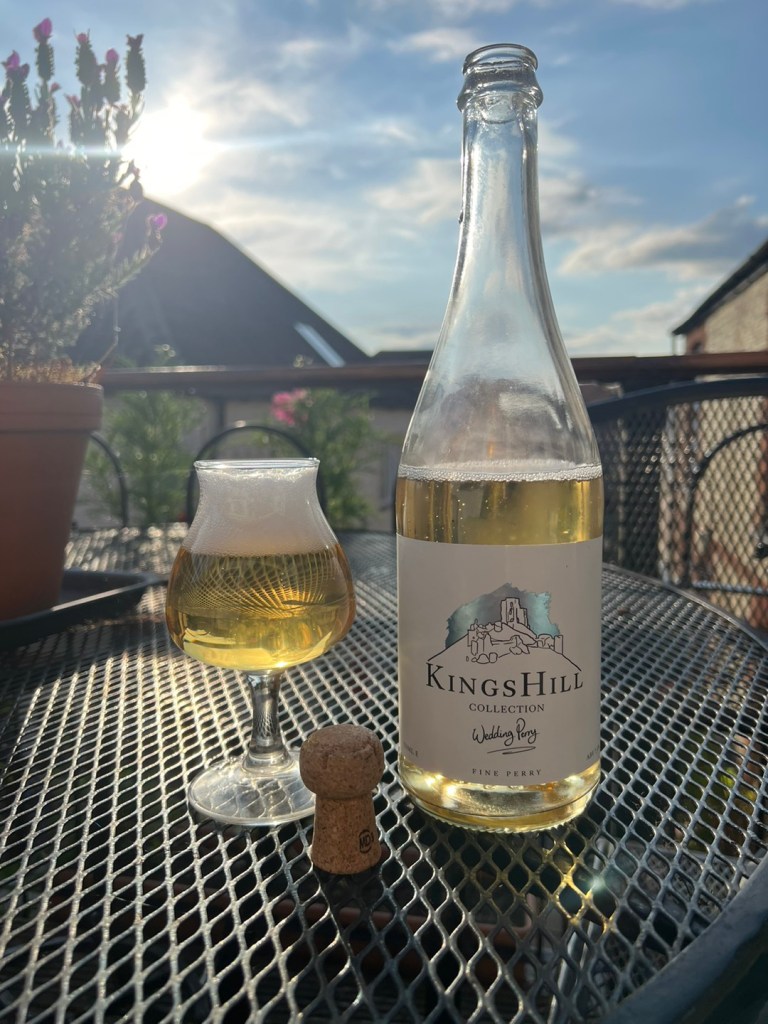
Purbeck Cider Kings Hill Collection: Wedding Perry – review
A blend of Hendre Huffcap, Blakeney Red, Helens Early, Thorn, Gin, Green Horse and more!
How I Served It: Afternoon in the fridge, then out on the balcony, a warm May evening (but not a wedding in sight).
Appearance: Liquid gold from Smaug’s lair! An initial chunky mantle gives way to a thin rim of mousse (I can fit both words in!). Light bubbles bursting away in the glass.
On The Nose: An explosion of pear drops, honeydew melon, and elderflower hedgerow. It’s making me think of Spring, when that aroma of blossom wafts on the air (we didn’t get much of that this year admittedly).
In The Mouth: Gorgeous, delicate citric acid note sitting on the front of the mouth after the first sip. Pomelo meets elderflower. Thinking the Thorn is coming to the fore here. It lingers, but in a very precise, delicate manner. Three cheers for the Wedding Perry!
In A Nutshell: A delicious celebration perry, not just for weddings, would go down as well over Hogmanay, a General Election evening, or even…Ridiculously Good Perry Monday! Versatility for all celebrations
Conclusions
It’s brilliant to see another producer bringing not only a precise, clean, bright perry to the market, but also showcasing an unusual variety apple in a cider, both in 750ml format, and both given the traditional method presentation style. I think the roughly £12 rrp sits very reasonably in terms of price point, and by cracking the cork off, you are instantly instigating your own celebration when enjoying the liquid inside. At the time of writing, I’ve found the Wedding Perry for sale online, with the Knotted Kernel available as an exclusive bottle to pick up at Purbeck Cider’s tap room – Dorset Cider Farm. I like this as a release strategy – it’s sits in a similar place to the Pour Your Own bottlings at Distillery Visitor Centres, only available there, and for a limited time. If you really want to try a very special release, it’s a strong reason to visit in-person.
Listening to Gabe Cook talk to Adam and Albert on Cider Voice last week – be one of their many 12 listeners (it’s a blast!) – it strikes me that Purbeck Cider fit neatly into that category of mid-sized producer that Gabe said was so important to seeing growing in the UK. Their plethora of presentation styles evidently allows them access to as many different routes to sale as possible. Alongside the likes of Temple Cider, Marshwood Vale, and Isaac Cider, Purbeck are helping to create a healthy ecosystem of producers and orchards across Dorset once more – that’s something to be applauded and appreciated. I can’t wait to see what else comes out of their orchards and into the Kings Hill range in the future!
Discover more from Cider Review
Subscribe to get the latest posts sent to your email.
 Cider Review
Pingback: Dry, Medium, and Sweet – all from the barrel. A spotlight on Wylands Cider | Cider Review