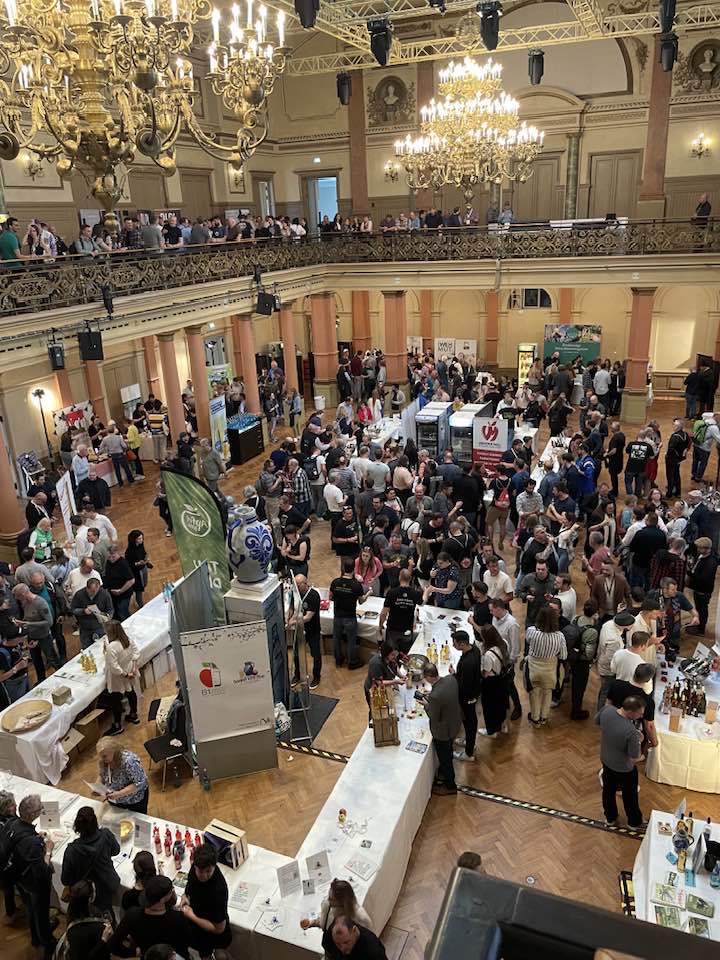
At the time of writing I am just coming to the end of my first ever CiderWorld, which represents an absolutely enormous tick on my personal cider bucket list.
I’m not sure how many producers were there, how many bottlings were available to taste or how many punters were in attendance, making their way through some of Europe and the USA’s best ciders, but what really blew my mind was our Barry and Cider Explorer’s Natalia telling me that it was significantly fewer than last year. As far as I could tell, the place was heaving.
CiderWorld is held annually in Frankfurt, the epicentre of Germany’s cider – or apfelwein – culture, in the heart of the region of Hessen, which makes more apfelwein than anywhere else in the country. There is so, so much that I ought to – and hopefully will – share about the event, about the American Cider Association’s Pommelier Exam which I and seven other advocates were taking, and about Frankfurt itself which has absolutely broadened my view on cider’s place at the table and within the broad spectrum of gastronomy. And I ought to direct you to Natalia’s writeup of the event here for more comprehensive picture of the 3 days.
But what CiderWorld is, first and foremost, is a great big tasting fair. And, like San Sebastián’s Sagardo Forum, which I attended for the first time last December, it represents a rare opportunity to taste not only across a breathtaking spectrum of producers, but a raft of different countries.
This being Frankfurt, German makers represented the majority as you’d expect, but the gantries of Frankfurt’s beautiful Palmengarten were heaving with producers from Italy, from Finland, from France, from Denmark and from many more besides. I didn’t get to absolutely everyone I wanted to, but I certainly got to my fair share. And since I had my notebook handy, as I did in San Sebastián, I thought I’d take the opportunity to unleash a possibly-ridiculous bombardment of international cider tasting notes upon you.
As previously, these come with the caveat that notes were taken at greater speed and under markedly different conditions than is my norm, and the usual format is adjusted accordingly. Really this is a long flight of general impressions gleaned from ciders I’d seldom otherwise have the chance to taste. I’ve made a few favourites clear at the end – and, hopefully, in the notes themselves! – but as at Sagardo Forum it was a generally impressive swathe; barely a faulty number amongst them. Hopefully, if nothing else, it serves to illustrate the remarkable breadth of European cider – and perhaps persuades you to buy a ticket to next year’s edition of CiderWorld. If you’d like to know more about any of the producers, I’ve linked to their cidery in each of their names.
A final rather exciting aside, which is that during the course of this avalanche, we’ll pass the 1000th tasting note for cider, perry or related product recorded on Cider Review. The smallest of beans compared to the numbers websites of other drinks rack up, but it feels like a milestone to me nonetheless. I’ll give it a wave as we hurtle by, so you can don your party hat and give it a toot.
Right. 18 producers, 7 countries and 52 bottlings. Onwards!
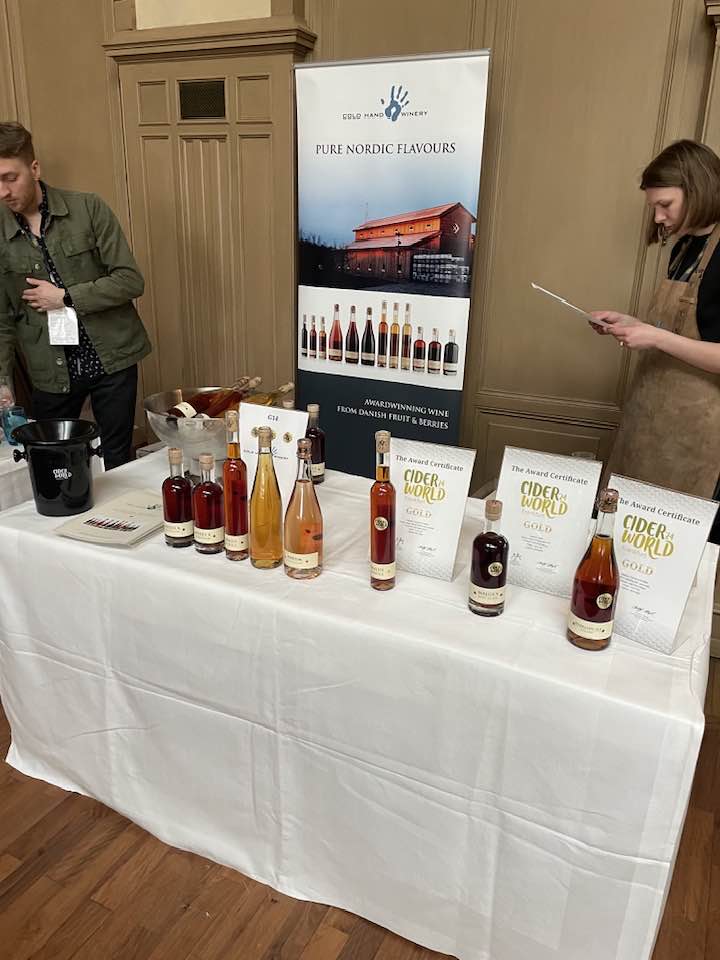
Cold Hand – Denmark
A cidery – though they describe their wares as ‘wines’ – I have only previously experienced at CidrExpo in Caen in February 2020. They absolutely blew me away at the time with their precision and playfulness around ice cider, and I’ve hoped to get reacquainted ever since. Each of these bottlings is in some way ice cider related, yet only one is a straight up, no-frills ice cider. Spoilers, I should probably have just put stars next to this producer’s name and have done with it. They are, simply, phenomenal.
Cold Hand Alba 2020 – note
(Cryo-conditioned cider fermented virtually to dryness, bottled still)
Fabulous aroma. The cryo-concentration really comes across. Honeys and caramels and a surprising lift of almost mintiness amongst the big, ripe, juicy apple fruit and sweet spices. Beautiful balance, lovely full body, just a touch off-dry. Can see why it’s in a flute bottle; truly an aromatic wine of the cider world. I’m in love with this; superb. What a start!
Cold Hand Malus Danica 2018 – note
(Cryo-conditioned ice cider)
Already has that lovely, deep apple fruit and burnt caramel development on the nose, augmented by molasses, cinnamon and some deep dried red fruit. Acidity is still super vibrant despite six years of ageing but the whole thing is full, balanced, rich and fresh. This is a benchmark ice cider that despite its age is only at the start of its life.
Cold Hand Feminam 2018 – note
(Effectively Malus Danica fortified with apple spirit to 19%. As an aside, I’m not sure its name, or the name of the bottling afterwards really needed to be gendered…)
Lots of the aromatic tones of the Malus Danica, but there’s a gorgeous rancio note of mushrooms and forest floor and fruitcake and almost dunnage warehouse over the top. Huge sweetness, but it’s balanced by refreshing acidity – often lacking in some fortified ciders – and those hedonistic Christmas cake notes have deepened even further. God I love this.
CIDER REVIEW’S 1000th TASTING NOTE INCOMING! (Cue the party poppers)
Cold Hand Masculine – note
(Partially-fermented Malus Danica fortified to 40% (!) with apple spirit and aged in a new oak cask)
Lots of upfront oak char and spice, which lends a smoked, toasty character to the super-deep apple, raisin and burned caramel. Oh my god, a spirit with acidity! This is completely mind-boggling at 40% and with that bright acid component. Dazzlingly intense but I’m absolutely here for it. This is wild! And huge! And I love it! A thunderous, whistle-clean eruption of apple and treacle and rancio and oak and sugar and spirit. Epic.
Cold Hand Sparkling Ice 2019 – note
(Ice cider force-carbonated as a sparkling dessert wine)
A different character. Still the same deep, pure apple, but here we’re into rich honeys, brown sugars, bursting into tropical fruits and HUGE fizzy strawberry laces on the palate. Big sugars, but again the acidity balances it. So vibrant and energised and just full-on fun. What a remarkable producer.
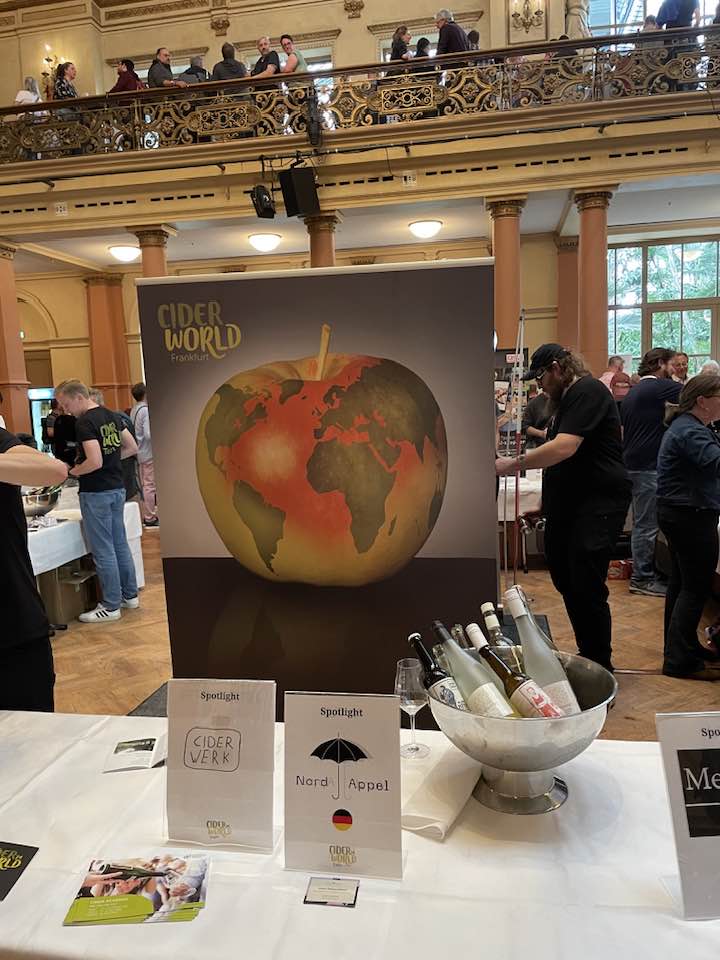
Von Wiesen – Germany
My near-total ignorance of German producers who haven’t made an appearance in these pages already meant that I was taking a complete punt on the stands I visited, but I rather enjoyed this one. Based a little south of Frankfurt, as far as I can tell, they’re another who describe their drinks as wines, having come to them from a winemaking background.
Von Wiesen Apfel and Hopfen 2020 – note
(Pet nat hopped cider)
Nice, clean citrus and piney hop integration with bright green apples. A little softer pineapple too. Thrilling, integrated delivery rounded by lees with great, dry, soft apple and bright but not at all dominant hop oil character. A really super example of hopped cider which shows what can be done with the style in countries where the government lets drinks like these be full strength without an onerous duty burden.
Von Wiesen Rosé Brut 2020 – note
(Traditional method cider with a red and blackcurrant dosage)
Super delicate, the berries expressing as just a pink blush augmented by sun-warmed rose petals. Some bready lees impact on the palate beside a nibbly lemon and green apple fruit character. On the light side, but elegant and detailed. Would be a lovely aperitif.
Von Wiesen Feld, Wald & Wiesen 2021 – note
(Traditional method Apple and Quince co-ferment with a dosage of juniper)
Oh my word. Juniper and quince is a fabulously perfumed combination. Ginseng and black pepper and rose and fresh, bright, yellow quince fruit. Big acid and herb and more ginseng on the palate, with a dab of sweetness and fresh, clean, crunchy quince. This is clever, very fun, an aromatic revelation and absolutely delicious.

Kelterei Herberth – Germany
The first of the traditional German apfelwein tables I made my way to, again armed with no knowledge whatsoever. They’re a little north-west of Frankfurt, describe themselves as a ‘medium sized’ cidery, and their range of single variety and blended 750ml – 1 litre bottles, some still and some sparkling, looked very much a blueprint for German apfelwein producers in this area – it was very hard to distinguish between some tables!
Kelterei Herberth Erbstuck 2023 – note
(A blend of apples with about 1.5% Speierling. To learn more about the Speierling, a very tannic, very acidic fruit traditionally added to apfelwein to lend structure, read Barry’s article here. It’s common to see producers add the tiniest touch (1-3%) and most say any more would overwhelm the cider. Inevitably, I believe Barry’s working on one that’ll be about 33%.)
Bright, crisp lemon and red apple skin nose leads to a brisk, dry, very winey palate with medium body, more lime and strawberry augmenting tart green apple. Nice structure, with just a touch of tannin. It’s young, and will develop with a bit of time, but I already liked this rather a lot.
Kelterei Herberth Boskop 2020 – note
(A variety you see a lot on German labels. I believe it’s the same as Belle de Boskoop, also written in German as Schöner aus Boskoop. But Barry may put me right there. If so, a dual-purpose cooker-eater variety with a good bit of russetting. And we do love a russet in these pages).
Wow. I wouldn’t have guessed this was nearly four years old. Really gentle aromatics of blossom, soft apple and pear. Spring meadow stuff. Gently rounded palate with a touch of sweetness adds more emphasis to the juicy apple. Simple, and to my taste could do with a little more structure, but it’s pleasant enough.
Kelterei Herberth Apfel-Klassiker Herb 2019 – note
(Traditional method cider and a former winner of CiderWorld’s overall trophy)
Lovely clarity of apple and lemon fruit with leesy toast and salty dough on the nose. Another that tastes younger than its years, but this is much more aromatic and energised and defined than its predecessor. Nice intensity. Vivid palate with lovely creamy bubbles and distinct brioche development over apple, lime and sherbet. Great stuff.

Obstbau and Kelterei Schmitt – Germany
Another in the traditional apfelwein-style producer category, but this one is further out from Frankfurt, in the Saar region, getting deep into German wine country, where the apfelwein is called Viez. Their orchards sit on limestone soils and boast both heirloom apple varieties and diverse fruits such as pears, quinces, plums and mirabelles. Barry is probably clasping his head in his hands at my limited grasp of both Germany’s geography and cider cultures, so I’ll leave it to their website to fill you in on more details and just tell you what I tasted.
Obstbau and Kelterei Schmitt Apfelwein – note
(Seemingly their ‘house’ cider, bottled still under cork)
Slightly musty aroma. A touch of TCA perhaps? I went back later to taste from a different bottle and my impression remained. A shame, as it sits over some nice blossomy florals, soft apples and melon. A bit of lees impact on the palate, with a nibble of lemon. But predominantly rounded orchard fruit, blossom and sherbet. A little simple, but without that TCA would have been pleasant for sure.
Obstbau and Kelterei Schmitt Holler – note
(Apple and elderberry co-ferment)
Nice, soft, juicy perfume with touches of elder (shockingly) and plum. Another very gentle and balanced delivery with summer berries and soft, well-integrated acidity. A dab of sweetness heightens the juicy red and purple fruits. Very charming. Stick in in a picnic basket on a summer’s day.
Obstbau and Kelterei Schmitt Schöner von Boskoop – note
Delicate fragrance of dried herbs, lemongrass, grated lemon peel. Really attractive delivery in which we get a rounded version of that lemon and herb character augmented with a flashing red dab of strawberry juiciness. Very tasty stuff – my pick from this maker by some distance.
Obstbau and Kelterei Smitt Genussvoll No.3 Secco Cuvée Apfel/Birne – note
(Sparkling apple/pear blend, but I didn’t catch the method and can’t find it online. Apologies.)
A little pear drop acetone on the nose beside distinct cut grass, elderflower and green apple skins. It’s a similar story on the palate – vivid green fruit and grass and elderflower. The sweetness is perhaps a little unbalanced to my taste – could do with a touch more acid structure, and there’s a little touch of reduction. But plenty here to like.

Four from the USA
The USA were the guests of honour at this edition of CiderWorld, so I dropped by the stand where my Pommelier examiners Michelle and Darlene were kept very busy all afternoon. I tried four different ciders from four different makers, so I shan’t give you the backstory for each one of them, but their website is linked in the note title.
Metal House Pearlina (2021 vintage, not that you can say ‘vintage’ on US cider…) – note
(A wild-fermented pet nat co-fermentation of wildling pears With Esopus Jonathan, Rambo and Idared apples)
Vivid, boisterous aromatics of flowers, blossom, green pear and citrus pith with a touch of savoury, yeasty lees influence. Delivery is full and textured despite the relatively low tannin. Lemon and pear skin and blossom and petrichor. Really like this – complex, dry and arresting. A cidery I’ll have to look up.
Bauman’s Kingston Black (Non-vintage – thanks for nothing, TTB) – note
Full aromatics again. Super ripe apricot (skins, flesh, pit and all) with bark and forest floor and pure red apple. All-but-dry delivery and here the deep apple tones crank up a notch, augmented by dried citrus (orange and mandarin). A touch of tannin. Fascinating to try a Kingston Black single variety from so far away from its home. I just about recognise it, but it’s certainly not as I know it. Nonetheless: full, winey, very nice.
Alpenfire Cinders Méthode Champenoise – note
(Traditional method single variety Airlie. ‘Airlie’ is a red-fleshed apple better known as the trademarked Hidden Rose. Ironically they’ve had to use the other name for that apple, but have stuck with ‘Champenoise’ as the method descriptor. They’ll be raging in Reims!)
The gorgeous pale pink colour is reflected in note-perfect, whistle-clean aromas of warmed blossom, pink grapefruit and raspberry skin. Delicate and ethereal, yet fantastically aromatic. Delivery is great; full, fresh, electric acidity but beautifully balanced and echoes the aroma note for note, adding an extra nuance of strawberry sponge. Very few traditional method rosé ciders have ever struck me as true facsimiles for the flavours of actual rosé champagne, but here’s on that absolutely does.
Raging Cider Jonathan and Liberty 2022 – note
(A wild-fermented, pét nat blend of the two eponymous apples)
Big, chunky aromatics with leather and a touch of warm hay joining ripe, bruised apple and tropical fruit. Great, textural, full-bodied delivery whose flavours follow the nose almost precisely. This is a big, full-bodied, generous gastronomic cider for serving with heaps of rich food, ideally outdoors.

Gutshof Kraatz – Germany
Florian Profitlich is a more familiar face in these pages. We caught up with him in our perrymaker interview series in 2022and more recently tasted a trio of his wares last year. Florian’s definitely not local to Frankfurt, being based right up in the north of Germany, but some of his apples and approaches and certainly the styles he looks to produce overlap.
Gutshof Kraatz Vor dem Walde 2022 – note
(A still dry mix of local apples)
Lovely, full, tropical aromatics. Um Bongo! Quince, ripe yellow apple and that almond-skin note you get from lots of great russeted apple ciders. (No idea whether any in this blend were russeted, mind). Winey, dry, low tannin but plenty of body and mouthfeel, all abetted by that beautiful golden fruit. Very impressive still cider.
Gutshof Kraatz Wilde Kerle 2022 – note
(Still dry cider from ungrafted wilding trees)
Not quite as aromatic as Vor dem Walde but very evocative, with apple skin and petrichor joining melon and stone fruit. Delivery to match; super concentrated fruit at the moment; apple, melon, citrus, seashell. Has great weight and acid – should open up really nicely but just at the minute it’s a little tight. Drink in a year or so.
Gutshof Kraatz Apfel Cider 2022 – note
(Lightly bottle-fermented Rheinischer Bohnapfel single variety; another multi-purpose fruit commonly seen in Germany, which Natalia of Cider Explorer cited as one of her favourite German apples)
More phenolic than the previous pair, with yeast and hay and wet slate atop the bright lemon and melon fruit. Same story on the palate – big lees impact and phenolics (by German standards) on top of burly, lightly-tannic yellow fruit and a nice sparkle. Another that, while good now, will certainly benefit from a bit of ageing time.
Gutshof Kraatz Birnen Cider 2022 – note
(Lightly bottle-fermented perry)
Fresh lime skin, slate and cut grass with juicier green pear and some seashell and saline dough character from the lees. Really big, vivid, pure green delivery with vivid acid and some grippy tannins. Thorn meets Butt almost, with their combination of vibrant green fruit beside petrichor, wet slate and natural gas. Love this one.
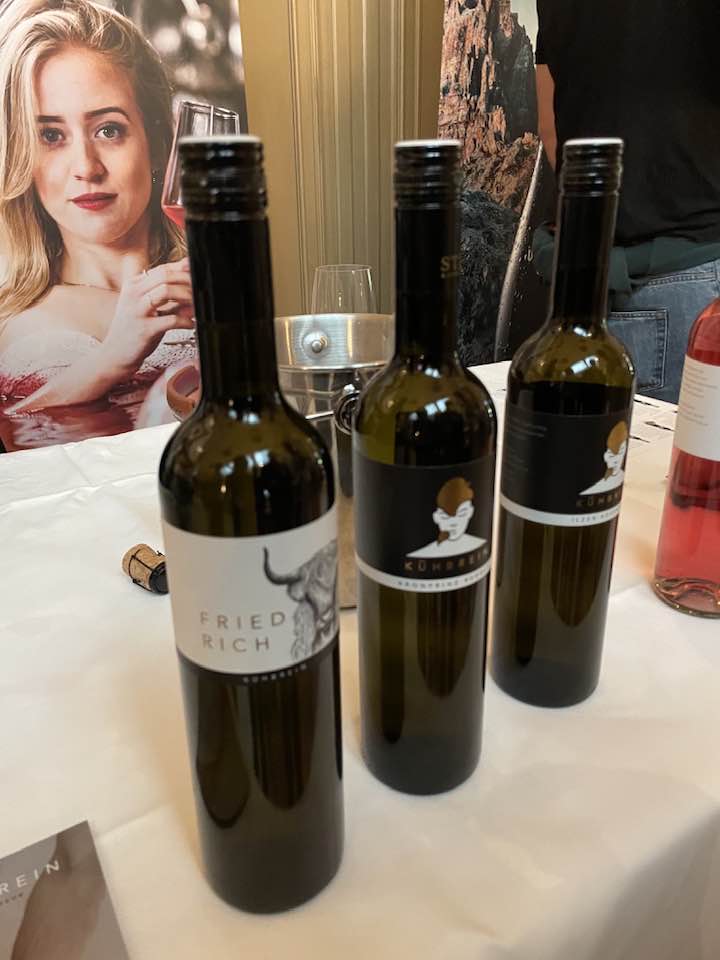
Kühbrein – Austria
A cidery I’ve only previously tasted from at the Sagardo Forum. One of these days I really must try and do some proper-format notes of their stuff, because what they make is seriously impressive. As with many an Austrian producer, they’re heavily leaning towards the local style of white wine, but few similiarly-minded producers achieve the same clarity, purity and character as these folk.
Kühbrein Friedrich 2023 – note
(A blend of Kronprinz Rudolph, Rubinette and Braeburn apples. Still and dry)
This is New Zealand Sauvignon Blanc, surely? Lime and gooseberry and passion fruit with huge aromatics, beautiful acidity and enormous in-mouth perfume. Vivacious, joyful, supremely fruity dry cider. It’s hard to thing of a bottle that could so compellingly bring so many white wine drinkers round to cider.
Kühbrein Kronprinz Rudolf 2023 – note
(A single variety totally new to me. A bit more about it here.)
Floral, blossomy soft pear fruit – yes I know it’s a cider! White flowers and hedgerow. Pristine but much gentler than the Friedrich. Same story on the palate, with a whistle-clean lick of malic acidity. This is what most Pinot Grigio wishes it was. Wants seafood and a beach.
Kühbrein Champagner Renette 2023 – note
(Single variety, allegedly raised in Champagne. One of many ‘Renette’ apples, but not one I’m super familiar with)
Fresh tropical bouquet. Peach and light banana with some floral and grapey tones. Feels young, but it’s very complex, very aromatic and, as with all Kühbreins I’ve tasted, immaculately clean. A big delivery; heightens those tutti fruitti tropical pineapple tones, augmented by a full mouthfeel. These really are stunning ciders for lovers of pristine, unoaked whites. So much precision, aroma and character.
Kühbrein Secco 2023 – note
(Single variety Braeburn, carbonated)
Sherbet limes on the nose! Do such things exist? If they do, this is how I imagine they smell. Again huge, crystal-clear aromas, utterly pristine green apple and blossom. Palate adds a dab of sugar but it’s very well balanced with fruit and acid. That this isn’t my favourite from Kühbrein shows what a talent this maker is. Recommended, as they all are.
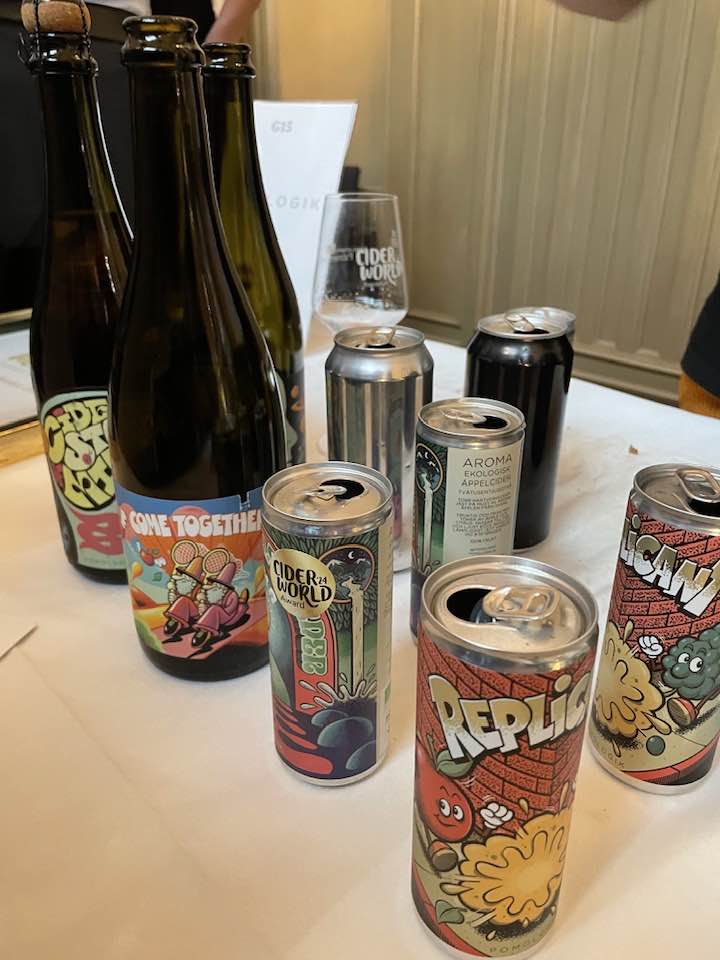
Pomologik – Sweden
A producer I loved even before starting my cider writings, and whose founder I interviewed when this site was a mere column on a whisky blog. I then wasn’t able to try much of their stuff until the Sagardo Forum, where certain bottlings blew me away, and one even made my year-end ‘Essential Case’. Pomologik have gone from strength to strength, now served at the Nobel Awards Ceremony, and picking up a record nine Gold medals at this edition of Cider World. High expectations then.
Pomologik Cider Sommas – note
(An annual seasonal blend with elderflowers)
Yep, smells like elderflowers! But it’s clean, billowing and buoyed by the weight of a full, robust culinary apple base. Some deeper tones of mandarin and hop here too. Full, tasty delivery. Very summery indeed – fresh apple, elderflower, mint and hop with a squeeze of lime. Somehow cider’s answer to the mojito!
Pomologik x Oliver’s Wassail (new edition – note
(A collaboration with Tom Oliver blending Herefordshire fruit (Dabinett and Kingston Black) with Swedish. I tasted the previous one here.)
Juicier, more tropical and higher-toned than I seem to remember the previous iteration being, as though the Kingston Black has more of the tiller hand. Orange and apricot and dark chocolate. Full, winey delivery with just a touch of tannin and a load of that luscious tropical fruit deepened by some savoury leather. Good stuff.

Maison Ferré – France (Normandy)
A cidery I’ve not previously encountered from the tiny appellation of Du Perche, in Normandy. I was pointed towards it by HRH Gabe Cook on his recommendation of their pommeau, but it would have been rude not to have tasted more broadly…
Maison Ferré Poiré Les Secrets de Camille – note
(A blend of varieties including Fausset, Antricotin, Du Cloche and others. Pét Nat, as is the Norman norm)
In the fresh, grassy, hawthorn school of French perry noses, with dabs of pear and melon and blossom. On the simple side but very pleasant. Juicy delivery but with vibrant acidity by French perry standards, and drier than the norm, too. Loads of lime and grass and slate softened by hedgerow and a nibble of tannin. Nice.
Maison Ferré Cidre Extra Brut La Cuvée du Brasseur – note
Very classic Normandy cider nose; slatey, leathery, warm hay phenolics atop orange and ultra-ripe tropical fruit. Flavours near identical in the mouth, with creamy, unintrusive mousse and a structurally arresting dovetail of juicy orange, crisp apple and some firm but not at all astringent tannin. Very classic Du Perche in that sense of feeling stylistically between Pays d’Auge and Cotentin. Benchmark Norman cider.
Maison Ferré Le Pommeau d’Oscar – note
(Mr Cook’s tip. Aged for four years, so longer than the pommeau norm)
Cracking, integrated pommeau nose. Four years in oak has knitted spirit and juice and cask together. Burnt orange, toffee apple, creme brûlée, dark bitter chocolate. Some polished oak and earthy rancio. Super complex. Ripe, juicy, integrated, bold palate oozing spice and luxury. Fruit – mainly dried but much still fresh and juicy – entwined with layers of oak and Calvados, the sweetness perfectly matched by savoury tones. Epic pommeau. What a difference ageing makes.
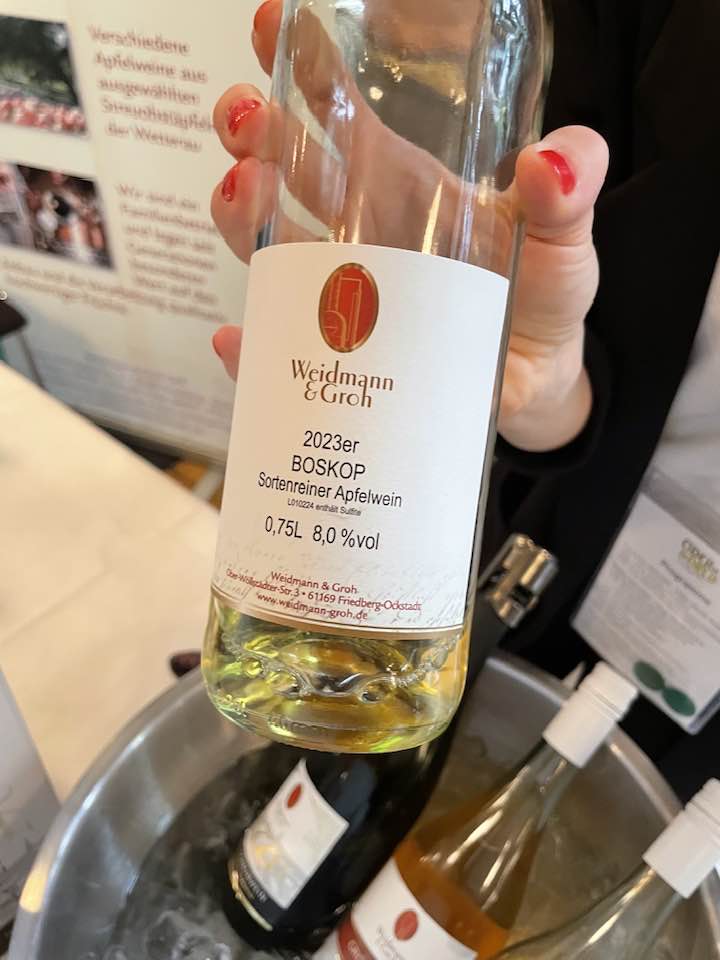
Weidmann & Groh – Germany
One of the more regularly-spotted makers amongst the bottleshops of Frankfurt, boasting a pretty massive range of apfelweins – single varieties, blends, still, sparkling – and a host of eau de vie. I’m slightly shocked that this is their Cider Review debut, given they’ve been on my radar for years now, and of course Barry is well aware of them – but better late than never! Another table that Mr Cook advocated when we bumped into each other. No pressure then!
Weidmann & Groh Boskop 2023 – note
(New vintage single variety still Boskop. As an aside, it’s worth noting that much of what I was tasting generally, especially from German producers, was the brand new stuff. So very young and fresh – just as much of it is designed to be drunk – but inevitably some of it was still very ‘tight’)
A very nice nose, though on the simple, young and concentrated side. Some nutty russety apple skin (is this a russeted apple?) Lime and green apple lightened with a little blossom. The delivery is sherbety, lemony – and, indeed, sherbet-lemony – with big acid and a dab of icing sugar sweetness over a flutter of pineapple hinting at broader, riper things to be developed into.
Weidmann & Groh Goldpärmane 2023 – note
(Still, single variety Goldpärmane. A variety I rather took to in general over the weekend, having only tried scant examples of it beforehand. One that surprised Natalia I think, who hadn’t seemed to think much of it previously!)
Very tropical aromatics; mango, apricot, pineapple, though all within a very white wine-esque framework. If that makes sense? (eg not as dense as those notes would express in, say, an unfiltered Kingston Black). Big, alluring, super fruit-driven nose. Carries onto the palate borne by tangfastic acidity and more of that sharp but clean tropical fruit, the lightest grip of tannin and a fairly big dab of sugar. Tasty stuff.
Weidmann & Groh Kaiser Wilhelm 2023 – note
(Single variety still Kaiser Wilhelm (what a name for an apple…))
Apple-driven, green, floral, cut-grass. I’m getting a bit repetitive with some of these notes, but there we are. Again totally clean young aromatics, but perhaps a little bit simple if we’re picking nits (and we ought to, oughtn’t we, as a consumer-facing site?) Another super-zingy, green delivery. Apple sherbet and lime laces if such things exist. Kiwi, gooseberry. All cushioned by a fair bit of sugar. Decent if not earth-shattering.
Weidmann & Groh Speierling 2023 – note
(A blend of 97% apples with 3% sorbs)
Deep, citrusy orange pith, lime marmalade and lemon curd nose. Very aromatic, lots going on. A big, full, golden, citrus delivery; quince, more lime marmalade, lots of racy acidity. My favourite from this producer, though I’ve enjoyed all of their stuff. What I will say is there is a clear thread running through a lot of these apfelweins from various producers. They’re regional in the way that the Basque or Norman ciders can often be – though of course their style and flavours are very different to those two producers. It’s a markedly different scenario to the UK.
Weidmann & Groh Trierer Weinapfel 2023 – note
(A new single variety to me, but interesting apparently related to the apple grown by Ross-on-Wye and also used by Little Pomona that was previously thought to be Balls Bittersweet but apparently is not. Anyway, Trier Weinapfel is allegedly an intensely tart variety, so Weidmann & Groh fermented this one on its pulp to try and soften it slightly and allowed it to go through malolactic fermentation.)
Gosh, nosed blind I’d have sworn this had quince in. Big, distinctive rose and lychee and yuzu and … well … quince! But apparently not. Just the apple. A lovely nose, quince or no quince. Electric lemon and honeysuckle and tangfastics and sour quince delivery. That is epic acidity, even with the on-pulp fermentation and a fair bit of malolactic (which has definitely not made this in any way creamy, but perhaps has softened the pointiest elements. I’d really like to try this one dry; the sugar feels a touch heavy – but I accept that may just be my weird, masochist palate. (Though I’d argue there’s no point trying to make an out-there apple cater to mainstream tastes). Anyway, it’s lovely. And quincey!
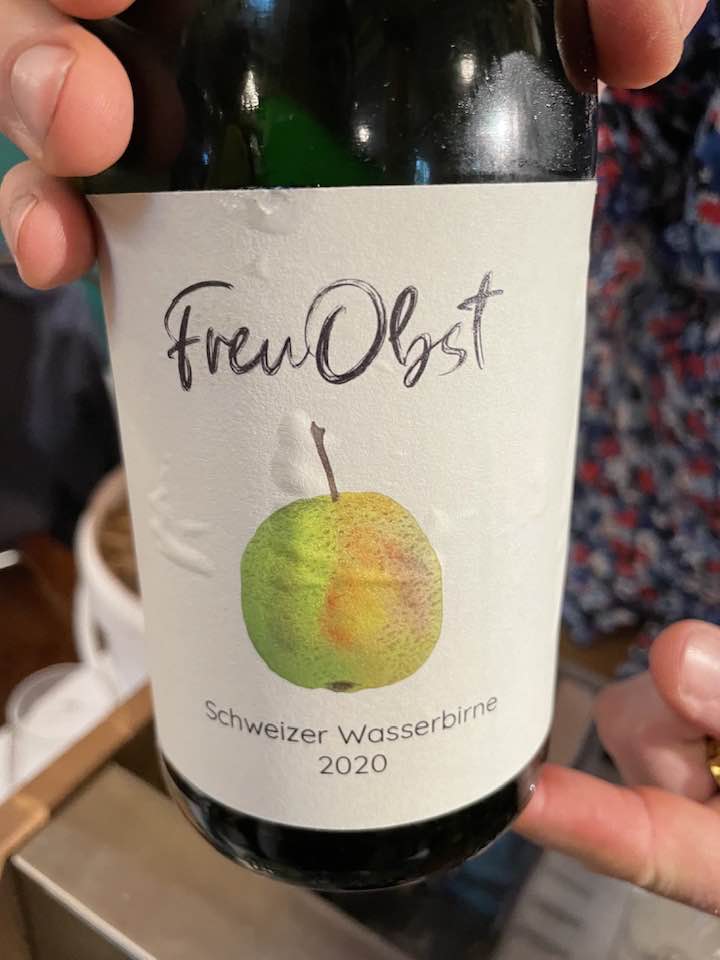
FreuObst – Germany
A German producer it was tricky to find much out about. Natalia didn’t seem to know them and although Barry knew Jakob, their maker, and tipped me off that they had made a perry, he didn’t seem to have tried their wares. So this was a total punt in the dark as far as I was concerned. Let’s boldly go…
FreuObst Schweizer Wasserbirne 2020 – note
(Single variety Schweizer Wasserbirne perry. Sparkling)
Herby, rainwater-on-moss woodland aromatics. Gentle but with a nice bit of lime skin and juicy pear. Not at all shouty, but rather complex, if that makes sense – certainly for a variety that can often be rather simple. Delivery is similarly detailed, delicate and evocative of woodlands and rockpools rather than being, in inverted commas, merely ‘fruity’. It’s something more. This is actually really complex in its gentleness, a difficult balance to manage. It’s also very refreshing and spotlessly clean. Almost wasted in the middle of a big tasting. I’d love to get a bottle and spend hours slowly unpicking it.
FreuObst Freude Cuvée No.1 – note
(A bottle fermented blend of fruit. Afraid I didn’t catch whether it was pet nat or traditional method)
Lemon and grapefruit and some salty, doughy lees on the nose. Fresh, fragrant stuff, with broader aromatics than a lot of the classic apfelweins, though there’s still great concentration and precision here. Deliver is also fuller than the apfelwein norm – more breadth and texture and body – which integrates the relatively high acidity nicely. Lovely interplay of yellow fruits and lees. Good complexity – one that’s hard to unpick individual flavours from. Impressive stuff. Getting the sense that this might be a very good producer.
FreuObst Apfel Zider 2022 – note
(Sparkling, barrel-fermented cuvée of mixed meadow orchard apples)
Red apple notes mixed with gentle vanilla and coconut oak underlacing from the barriques. Some honey and troical fruit too. Another broader texture than the German average, with zippy strawberry and lemon acidity well wrapped-up by the apple fruit, soft oak and a brush of tannin. This is another winner.
FreuObst Cidre Brut 2020 – note
(Jakob’s homage to the French style of cider, albeit expressed with sharper, higher-toned German apples)
Some French-style smoke and slate and hay phenolics but with higher tones of yellow tropical fruit than would be the norm in Normandy. It’s drier than most French ciders too, with firm structure and more of those smoke and hay phenolics playing with heightened tropical tones. I like this one, again. Brilliant, interesting ciders on show here.
FreuObst Vulkan-Zider 2020 – note
(A cuvée dedicated to the ancient volcanic soils these trees were planted on)
Another big, complex intertwangling of waxy yellow fruit, lees and slatey phenolic. Even some detailed floral tones drifting over the top of the aromatics, adding complexity. Delivery again is dry, full, follows the tones of the nose and has just a divine mineral, tannin and acid structure. How has Barry not yet covered this producer? Evocative, compelling creations.

Van Nahmen – Germany
Another German producer, though one which seems to specialise predominantly in juices and other non-alcoholic creations. Their website lists two ciders, a sweet and a ‘demi-secco’. Both look very similar – to the degree that I’m ashamed to say I’m not sure which one this was. So an extra caveat emptor there. An interesting spelling of ‘cidre’ on the label nods to the French influence over production.
Van Nahmen Apfel Cidre – note
(Naturally sparkling cider)
All things sweet! Sherbet, apple sweeties, icing sugar and a little white petals. A simple nose, but an inviting one. Big acid, big sugar and big mousse on the palate. That being said, clean, fresh flavours that are a carbon copy of the nose. Juicy, accessible and refreshing, if a little simple and sickly-sweet for my personal tastes.

Cidrerie du Pays d’Auray (Famille Maho) – France (Brittany)
A Breton cidermaker – a shamefully rare sight on these pages! I came across them at CidrExpo in 2020, loved their stuff and wasn’t taking notes, then missed them again at the Forum last december. So this is a four-years-overdue writeup.
Cidrerie du Pays d’Auray l’Incongrue – note
(Naturally sparkling cider)
Super rich, super-juicy aroma of apple compote and petrichor. Some lovely earthy phenolics and the skins of tropical fruits. This is a complex, robust, bittersweet aroma. Boom! That’s some delivery. Waxy yellow fruits, minerals, grapefruits skins and then a huge, coarse whack of pithy tannin. Bring protein for this one. Lovely gentle acidity and freshness and just enough fruit for balance. It’s big, it’s mighty, it’s great fun and right up my street – but those tannins might be a bit bitey for some.
Cidrerie du Pays d’Auray Cidre Fermier 2023 – note
(Naturally sparkling cider)
Extremely juicy, and far more about fruit than any sense of phenolics. Almost like sweet cooking apples. Has a ‘really good apple juice’ sense. Clean, ripe, sweet, outrageously juicy delivery full of apple juice, mandarin and light spices, with a nice gentle tannin structure. Nothing ‘fermier’ about this one – whistle, clean, joyful fare that wants a sunny day and some charcuterie. Yes please.
Cidrerie du Pays d’Auray Cidre Guillevic 2023 – note
(The lesser-spotted French single variety. Guillevic has better acidity than most French varieties, is higher-toned and less tannic. That’s the theory, anyway – let’s give it a taste.)
I’ve not had a Guillevic in some time, but this instantly has all the classic, fresh, fragrant yellow apple, blossom and white flowers I remember. So different to the French norm. Shades of very good Bisquet somehow? Fresh, youthful, super-alluring. Great acid and big fruit on delivery. Dessert pear, fresh apple, cut grass. Sweet, but full-bodied and beautifully balanced. Some tropical tones of light banana on the long finish.

Lepola – Finland
Finnish cider! Another first on our global tour-by-bottle here on Cider Review. But these Finnish ciders are made by an Australian. (One of these days we’ll have the chance to taste Australian ciders made by an Australian – I wish, at least). Anyway, all sorts of exciting things being made at Lepola, many of them combined with various local berries and hops. A distinct change of pace then, much needed at this point. I have Barry to thank for pointing these folk out to me.
Lepola Crabapple – note
(Wild fermented, barrel-aged blend of culinary and crabapples)
Big aroma – very honeyed. Young and fresh with vanilla and waxy apple skins. Even bigger on the palate and it’s another with huge, bright and distinctly quincey tones. Lemon and vanilla. Lots of acidity. This is a big-flavoured, super-tasty thing.
Lepola Rajka with New Zealand Hops – note
(Hopped cider made from 80% Rajka apples and 20% Dolgo, with Dr. Rudi and Green Bullet hops. All new to me!)
Superb hop integration. Just a lovely, exotic perfume of rosewater and lemon atop the fresh, crunchy apple. I could nose this for a long time. Delivery is similarly seamless – green apple, quince, ginger, hop, rose and lime leaf with a fresh and surprisingly spicy finish. Really considered marriage of hop and apple. One of my favourite hopped ciders to date.
Lepola Hoppy Dry Hopped Cider 2022 – note
(A dry blend of apples with Australian Galaxy hops)
Oh wow. This is Thorn Pear meets New Zealand Sauvignon Blanc. Elderflower, passion fruit, lime marmalade, gooseberry. Huge aromatics yet they’re all balanced and integrated. I wish all hopped cider aromas were as compelling as this. The theme continues on the palate, albeit with a markedly upped hit of elderflower and a bigger hit of those crunchy apples. This is so refreshing, so delicious and so harmonious. This is what happens when governments don’t muck about with stupid duty laws and people can make hopped ciders that are all they could be. That said, especially sensitive and considered matching of hop to apple. Cracking stuff.
Lepola Vega Ice Cider – note
(Barrel-aged ice cider with cloudberries)
From the young, honeyed, syruped and brightly red-cherried school of ice cider. Cranberries too. Vanilla and orange marmalade. A cracking, fresh and high-toned ice cider nose. Light, fresh end of the ice cider delivery spectrum, with great cleansing acidity matching the intense sweetness. A nibble of astringency is a bit unusual. Bright citrus peels and honey. To be honest it’s not the deepest or most complex ice cider ever, but it’s fresh, it’s balanced and it’s very delicious.

Traunsecco – Austria
Just when I thought I was out, Gabe Cook dragged me back in with something too interesting not to end on. An Austrian maker, but from Upper Austria rather than the Mostviertel. This is a rosé perry made with naturally red-fleshed pears, aged in rum barrel. It’s just one of the bottlings they make but I didn’t have time (or space in the notebook) for any more. Can we end with a bang?
Traunsecco Herzbluat 2022 – note
What rum barrel?! Fragrances of red berry, rose petal and very fresh pear. Delicate and ethereal stuff, but very appealing. BIG acid delivery followed by whopping tannins and then, in that paradoxical way that no other drink does but perry, those delicate flavours of rose petals, other mixed flowers and red berries glide blithely over the top of all that structure. A tiny bit of barrel finally emerges on the finish but this is mainly about that beautifully delicate pink fruit and absolute riot of a structure. A bit of sweetness binds it all together. A great note to end on.
Conclusions
I don’t know about you, but my palate needs a lie-down. A fascinating jaunt around continental Europe there (with a few whistlestops on the other side of the Atlantic).
Standouts? Cold Hand, though I already knew that – an acquaintance I was overjoyed to rekindle and finally scribble up for Cider Review. I got their business card and I certainly hope it won’t be four years before I encounter them again.
FreuObst was perhaps my breakout find of the tasting from a ‘never even heard of before and was blown away’ point of view. Another example of interesting, textural ciders being made by a small German maker. Seek them out if, like me, you hadn’t previously been aware of them.
Loved the stuff Lepola were doing, especially their hopped creations; a cut above the adjuncted norm – as was the quince-juniper hybrid from Von Wiesen. Kühbrein was also a pleasure to revisit, I really liked most of the French and American creations and some of Florian’s handiwork with Gutshof Kraatz. The Traunsecco was a cracker to finish with.
To be honest there was very little here that I didn’t like – and the pleasure of a roomful of almost entirely fault-free, high-to-full-juice creations can’t be understated. The worst I can say about most of them is that a few were on the young and simple side, and personally I’d take simple over mouse or acetic any day of the week.
It was very interesting to finally taste a broad swathe of German ciders. My experience at the exhibition, as well as in the taverns of Sachsenhausen in the evenings, suggested a clear delineation between the regional apfelweins of Hessen and the ciders of the rest of Germany. To be expected, I guess, and it’s not to say that there aren’t certain similarities between the two, but it’s something I’d like to explore more fully in a future article in tandem with Barry’s excellent small German makers series.
One final point, which is just to dwell for a moment on 1000 ciders and perries tasted for the site. It’s a milestone I’ve had my eye on for a little while now. (I keep an excel document updated; I am that person). Cider Review is a deliberate evolution of the style of writing I began in my whisky blogging days on Malt Review. Long-form articles which, sometimes almost incidentally, have reviews tacked onto the bottom of them. I know several readers are less interested in tasting notes – sometimes not particularly interested at all – and indeed Cider Review is more features-heavy than its whisky-scented progenitor.
But, to me, the reviews, the tasting notes, are vital. They are our proof of concept: that cider and perry, fundamentally, can be profound, diverse and delicious. Can be more than the ubiquitous British macro brands. It’s a concept still only held by a minority of in-the-know drinkers, and if this website has any purpose whatsoever, it is the increasing of that minority. The articles and thoughtpieces are vital, lovely ad a pleasure to write, but ultimately meaningless if they are not backed up by drinks that are fundamentally worth writing about.
CiderWorld, like the Sagardo Forum, is a reminder that not only do such drinks exist, but that they are increasing in both number and quality all over the world. So there couldn’t be a better place for us to rack up our 1,000th note, or to inspire us towards the next 1,000 to come.
So cheers to CiderWorld, cheers to Frankfurt, cheers to cider and perry, and if you make or drink it anywhere in the world, cheers to you.
Big thanks to CiderWorld for having me over for the first time. And a special shoutout to my chaperones Barry, Natalia and Gabe.
Discover more from Cider Review
Subscribe to get the latest posts sent to your email.
 Cider Review
Pingback: Cider on ice: a conversation with Denmark’s Cold Hand Winery | Cider Review
Pingback: My essential case of cider and perry 2024 | Cider Review
Pingback: In conversation with Michael Stöckl, the man behind CiderWorld. | Cider Review