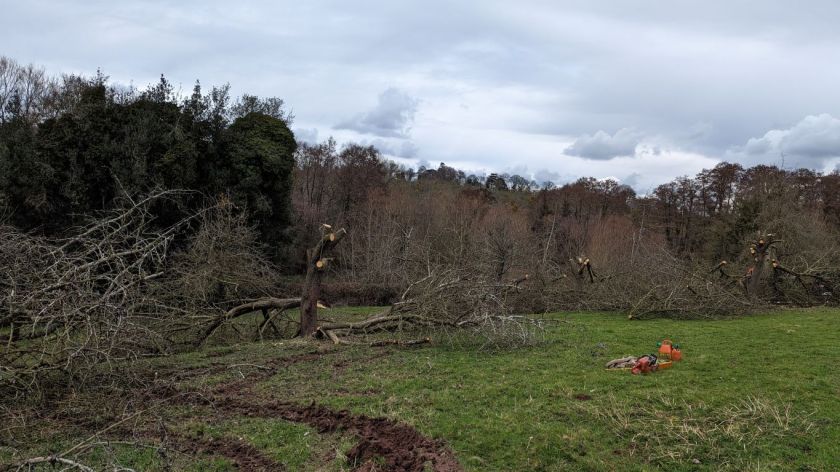
What is fireblight?
Fireblight is a disease caused by the Erwinia amylovora bacterium. There’s really no way of describing it without sounding like a harbinger of doom; this is serious stuff. It causes massive destruction and is highly infectious. The disease can attack practically any part of the plant – leaves, roots, fruit, blossom, shoots and branches.
The key victims of this devastation are plants in the Rosaceae family, which is described as one of the most economically significant global crop families. The edible plants of Rosaceae include strawberry, cherry, plum, almond – and of course, apple and pear.
Once it takes hold in an orchard, fireblight can cause significant tree mortality. It has been described as the most destructive bacterial disease in cider and perry orchards, thereby posing a direct existential threat to both cider and perry. It’s probably worth getting to know the enemy.
What does fireblight do?
When an infected tree returns to active growth in the spring, the first sign of fireblight will be a clear, watery secretion from cankers on twigs and branches. This sap-like goo will darken as it is exposed to air, leaving dark trails on the wood. However, the cankers may be small and inconspicuous, meaning that early infection warning signs can be easy to miss.
It is this secretion that spreads the bacteria to new hosts. Insects and the action of rain can transmit it to other nearby blossoms or injury sites on shoots and branches.
Later in the season, new shoots, leaves and newly developed fruit that are infected will shrivel and blacken. These blackened areas do not drop from the tree, but cling on throughout the season, giving a scorched appearance – hence the name. The infection can be localised to a small area, or spread across twigs, whole branches and even into the trunk. Susceptible varieties of Rosaceae may be killed, while more fireblight tolerant types of trees can still be severely disfigured.
Open flowers are the most common sight of infection, and as it spreads into the wood an orange flecking can be seen, if the bark is lifted. The bacteria spreads into healthy wood at these sites and around active cankers. Once a tree harbours the pathogen, it will stay there.
Most varieties of pear are notably susceptible to fireblight, posing a truly existential threat to perry. There are also cider apple varieties, like Brown’s Apple, that are known to be particularly prone to damage.

Where is fireblight from?
Fireblight was first identified in the United States, near to New York, in the late 18th century. A massive devastation of apple, pear and quince trees was seen, but for a full century the cause of fireblight was not understood. Sun damage, ‘bad sap’, insect pests, the wrath of god (that old chestnut) and even the agency of human pathogens were all presented as possible reasons for the irrevocable damage being wrought on orchards and other crops.
In 1878, Thomas Burrill at the University of Illinois was the first to recognise that there were live bacteria in the mucus-like secretions which seeped out from the diseased wood of a pear tree he had examined under a microscope. After this, the bacterial nature of the infection came, quite literally, into focus, with flowers being noted as the chief entry point for the disease. By 1925, four new countries beyond the United States saw the spread of the disease – Canada, Japan, Mexico and New Zealand.
In 1954, it looked like there was hope. An American scientist, Dr Robert N Goodman tested a spray containing small amounts of the antibiotics terramycin and stretomycin. He reported that fireblight had been stopped. However, we now know that antibiotic treatments can only be used on open blossoms. They can’t be used at any other time, and so an untreated infection can still spread quickly.
Dr Goodman’s work was not the magic bullet that orchardists so hoped for, and the spread continued. By 1955, it was reported that fireblight had almost entirely destroyed pear culture in the central and north-eastern states, as well as considerably reducing apple production in the Missouri fruit-growing area.
What is the history of fireblight in the UK?
By 1957, the bacteria was recorded in the United Kingdom. The initial cases arose in Kent. Looking at the newspaper archive for the period, it is clear that the spread was rapid. In 1958, the government issued the Fire Blight Disease Order, made under the Destructive Insects and Pests Acts, 1877-1927.
The order stated that suspected cases had to be immediately reported to the Ministry of Agriculture, Fisheries and Food. By November 1958, outbreaks were reported in Kent and the West Midlands. Eight orchards in Kent had been impacted, involving 150 acres and 1500 trees. The varieties taking the biggest hit in the West Midlands were reported to be Laxton’s Superb and Williams.
Further spread of fireblight was rightly feared “unless growers cooperated in eliminating over-wintering sources of infection by grubbing all diseased trees” according to the Tonbridge Free Press.
The issue of compensation was an important one because of the scale of the work required to counteract fireblight. The Kent Branch of the National Farmers Union discussed the situation in relation to pears, as the Kentish Express reported on 6th February 1959:
“Dr W F Darke, Ministry of Agriculture Plant Health branch, has discussed it with the county’s fruit committee, when one member said that he had grubbed 75 trees and had been ordered not to move or dispose of 27,000 young trees in his nurseries and to stop using any budding or graft wood from the affected farm.
The resolution of the fruit committee, accepted by the County executive says “Fire Blight being a new disease this committee considers that it can be eliminated by active co-operation between the NAAS and the grower and that this can best be achieved by paying compensation for specific or consequential loss”.

By the early summer of 1959, the disease was being identified in private gardens, and 2600 trees had been destroyed across 14 orchards. Just three months later, another 1000 diseased trees had been disposed of on one farm in Kent alone. Country Life reported on 1st October 1959 that a new case had been identified in Worcestershire, and “more alarming, in that it opens unexpected channels for the spread of the disease, is the notification of fire blight from private gardens and roadside trees not only in pears – the most readily affected – but in other trees of the rose family including whitebeam, mountain ash, hawthorn and cotoneaster in Essex, Surrey and south-east London as well as in Kent. Moreover, the risk that the disease may spread to apples cannot be ruled out.”
The reports from the period show that incidences of fireblight in private gardens were a particular cause for concern, as the costs of grubbing up and burning individual established trees were a heavy burden for private individuals, not to mention the costs to farmers where whole orchards were lost. Appeals were made in Parliament in 1960 to help landowners pay for the costs of destroying infected trees, but such compensation was not deemed to be within the powers of the Act. This decision may have helped to exacerbate fireblight’s rapid march across the country, despite the Ministry of Agriculture having powers to remove infected trees where this duty was neglected on private land.
By 1964, a new protagonist enters our story. Fireblight infections had been noted in hawthorn, apparently for the first time that spring in the Cooling-Rochester area. The Ministry of Agriculture expressed concerns that unless these bushes were actively sought out and destroyed, there would be too many unknown vectors in play to prevent further spread to pear crops. The Illustrated Sporting and Dramatic News reported on this issue on 1st October 1964:
Non-fruit farmers are naturally less concerned that their hawthorn hedges are dying but they must be made to realise that their disinterest represents the biggest threat to the pear orchards. Reports that some graziers in Kent are neglecting to report outbreaks in their hedges and demanding compensation for their destruction are to be deplored.
Within ten years of its accidental introduction into the UK, fireblight had claimed its first complete victim. The highly susceptible Laxton’s Superb pear had been one of the key varieties to be infected from the start, and in 1968 it was ordered that all remaining Laxton’s Superb were to be grubbed up or top worked into another variety as a measure against the disease’s spread. This was later confirmed again in The Plant Health (Great Britain) Order 1987 which forbade the budding, grafting or growing of Laxton’s Superb. The variety was irrevocably wiped out from our landscape and is still not available for sale.
Interestingly, the wording of this legislation also gives us an indication of what the fireblight-free region was in 1987 – “the region comprising Scotland and the counties of Northumberland, Cumbria, Tyne and Wear, Durham, Cleveland and North Yorkshire (except the district of Selby and the Borough of York).”
Sadly, those areas are no longer sacrosanct as the bacterium has found its way through to infect the rest of these islands in the intervening decades. Now the fireblight-free zone is the sole preserve of Jersey, the only area where fireblight remains a notifiable disease. There are tight controls on the entry of potential host plants into the area – high plant health standards require plant passports that demonstrate that they were either produced within a controlled zone or have had two disease-free growing seasons before they can be brought in to Jersey. Pest-free area status has to be applied for annually after rigorous inspections have been made.
Case Study: Ross Cider
I wanted to get a feel for how contemporary perry makers are responding to the threat of fireblight and the impact it has on their work, so I talked to Albert Johnson at Ross Cider in Herefordshire. He was unequivocal in his assessment of the disease’s impact, although characteristically hopeful that a way forward could be found through the cultivation of fireblight-resistant varieties.

“Fireblight has devastated our potential to make perry. In just three years, the number of mature pear trees on the farm has been reduced by a third, as the bacteria has leapt from tree to tree, silently and relentlessly. When it started to appear in late spring 2020, it was the first time we had actually seen fireblight in action, and we were fairly ignorant and naive about how to react. I feel that most pear tree custodians are in a similar position.
In Britain, we just do not have the experience or knowledge of how to spot, identify, remove, and prevent the spread of fireblight as decisively as in the United States. Even if we do develop that shared knowledge, growers across the pond know how damaging and difficult it is to cope with the problem.
Our biggest challenge is that there is no database and no research on what, if any, British varieties have resistance to fireblight. With no legal ‘antidote’ in the UK, once a variety succumbs, it can be incredibly hard to remove the infection from a tree that may well be more than thirty feet high!
If we are to ensure that perry as a drink, and pear trees as a wonderful common good, can be made and grown in the future, we need orchardists to be brought together more to share knowledge and learnings as quickly as possible. We also need a concerted effort to be made to find new varieties that will grow happily in our changing climate and that have resistance to this bacteria – evidence from the United States suggests that fireblight will not stop being a problem, only something we can learn to live with.
There is research happening in the US right now on innovative solutions and preventative measures – particularly the use of UV light – but accessibility to these measures is going to be limited for a length of time, and our trees are under threat right now.
We are replanting new pear trees this year, and introducing new varieties on them, in the hope of finding a more secure future through that diversity. Unfortunately, sad though it is, the varieties we have lost to fireblight we aren’t going to waste time on replanting. Our Gin Pear, Moorcroft, Green Horse, Oldfield, Boy Pear and Turner’s Barn have all been affected. At this stage, the three varieties that appear to be the best at refusing entry to the bacteria are Red Pear, Hendre Huffcap and Yellow Huffcap. Long may it prove so”!
Albert’s words are a clarion call to growers and to the government to take the ongoing threat of fireblight seriously. Indeed, it’s hard to think of something that could pose a more grave existential threat to perry in the UK right now. As with so many things, we need collaboration and knowledge sharing, as well as considerable research to tread a path through this particular minefield. Although the clock has already been ticking for 66 years, a lot of the momentum that was built up when fireblight was first reported in the UK has been lost. The new generation of growers, like Albert, do not have the tools that they need even though the risk is still great.
Cover image: Fireblight on pear trees. Photo by A. Johnson.
Discover more from Cider Review
Subscribe to get the latest posts sent to your email.
 Cider Review
A worrying article. Thank you. More orchardist should be made aware of this disease.
incidently i thought laxtons superb was a dessert apple ?
LikeLike
There is an apple variety of the same name, which I suppose you are much more likely to have heard of!
LikeLiked by 1 person
Good article! Fireblight is a huge problem here in the eastern US. Spraying Streptomycin immediately before or after a warm rain or heavy dew event is the only somewhat effective remedy. It makes blossom time a period of fearful vigilance and sisyphean effort for apple and pear growers. Quince has become virtually impossible to grow in our area. It seems especially bad in dwarf and young plantings where the infection can race through the entire tree in hours. Warm wet weather in New England during bloom time is on the increase setting up fireblight conditions every few days. Repeated Streptomycin sprays risk the evolution of Strep resistance in the fireblight bacillus which has been observed in some places.
LikeLike
Thanks Steve, I’m really glad you enjoyed reading it. It’s really interesting to hear about your experiences on the ground as well – what speed fireblight travels at! Such a shame about the quince too, how sad.
LikeLike
Pingback: Four perries and a cider from Palmers Upland | Cider Review
Pingback: Cider Review’s review of the year: 2024 | Cider Review