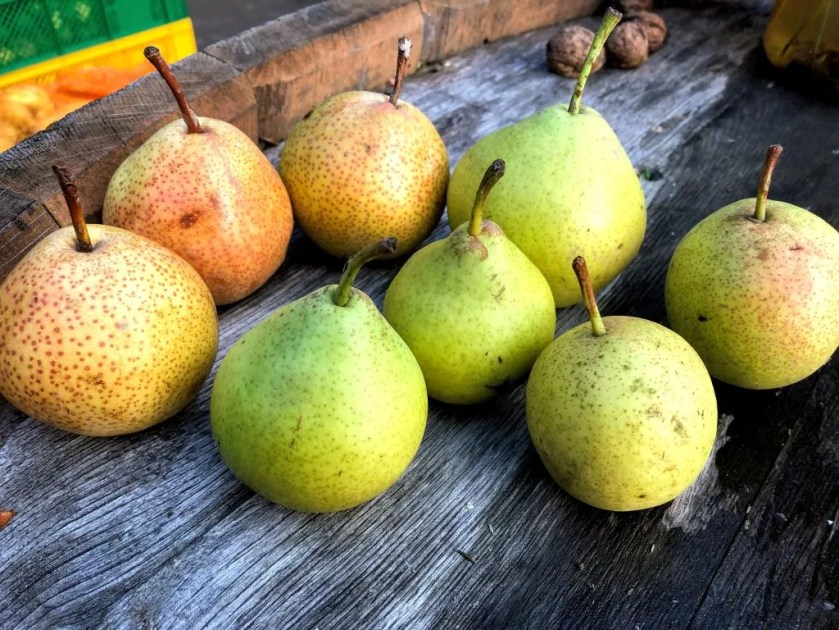
We are continuing a theme touched upon last week, considering old apple and pear varieties, and how resilient they may or may not be in a changing climate and the myriad pressures that brings. Of course, this has obvious affects in traditional apple and pear growing regions, but it may be that other regions become more suitable than they used to be! However, that kind of hopeful thinking certainly has other reality-based limitations, length of growing seasons in higher latitudes being but one.
For orchardists and cidermakers who are planting for your future cider, there is a difficulty in not knowing how far things will change. The lag time between planting trees and getting a first harvest can be considerable. Perhaps just a few short years for densely planted, modern orcharding practices, but will often be over a decade for more traditional, low density, meadow-orchard approaches with big, full standard trees.
While the spread of diseases, and the tolerance certain varieties may or may not have is incredibly important, there is also the basic growing seasons that need to be considered.
I was recently talking with someone in Scotland who wants to plant perry pears. Given the climate there, they had a preference for late flowering (to avoid frosts), short-season, early harvesting pear varieties. While the United States has well defined growing zones and reasonably well researched data on how apples may comparatively behave in different zones, I get the impression that this is perhaps less well defined for climatic regions across Europe, and for cider apples and perry pears most definitely so! I could provide typical harvest times for hundreds of perry pear varieties based on their country of origin, but clearly that would change between regions. Add to that, I know harvest time has been getting earlier here in southern Germany in recent years, so how reliable is the data presented in books written 20, 50, or even 110 years ago? So how can growers predict how varieties that are new to them might behave in their own orchards?

As much as I love old pomonas, there are limitations when it comes to their fit to purpose. While the majority from the mid-19th Century books are focussed on recording detailed phenotype descriptions of the trees and fruit, for cider makers there are details that are usually missing. Typical acid content, tannin content, sugar levels, expected flavour profiles – the basic things cidermakers, and drinkers, like to know. I have even been asked to recommend perry pears that have a high malic acid and lower citric acid content that would suit a perry maker wanting to do wild, non-sulfited fermentations where a secondary malolactic fermentation might have a field day with the citric acid, converting it into acetic. These are details that are very hard to come by without a detailed analysis, and there’s precious little of that happening since the Long Ashton Research Station, near Bristol, was closed down in 2003.
As mentioned, harvest times may have shifted with the climate, but so too can blossom times. Even varying year by year, an unexpectedly warm early Spring can coax trees into blossoming a little earlier, and with that comes an increased risk of frost damage if there is a cold snap. We had that happen in back in 2020, when hard frosts, exactly on the Ice Saints days in mid-May, destroyed over 90% of our apple crop which were in full bloom at the time.
So while orchardists will know how their own trees behave and can watch out for local warning signs, how do we cater for global makers/growers who want to grow varieties not common in their region? A comparison of varieties blossom and harvest times between regions is certainly important as a benchmark for those wishing to preserve varieties in foreign lands. I wish I knew the details beforehand!
The basics, that’s what we really need to know to be able to chart a way forward. Things that anyone from a hobbyist gardener with a single tree to industrial orchardists can observe and record themselves. Real world, annual, practical information that can be shared for the common good. And with enough data we can compare how different varieties behave in different climate zones, and orchardists and cider makers can then plan effectively for at least the mid-term future.
There are some resources online, like Pomiferous or FruitID. But for cider makers we need something a little more specialised. And this is where the likes of online, crowd-sourced pomonas can be invaluable tools for growers and makers, and as it happens, Albert Johnson of the Ross-on-Wye Cider and Perry Company launched just such a tool in 2021: Our Pomona.
But enough beating around the bush. Let’s ask Albert what the intention is here.
* * *

CR: Albert, thanks for taking the time to be quizzed. What led you to want to create a new online pomona?
Albert: In 2019 we started a grafting project where we reintroduced historic varieties with the intention of propagating enough trees to make a commercially viable amount of each as a single variety cider. But we were doing this totally blind; when these apples were recorded in historic pomonas, almost no information is available on how they taste or how to work with them to get the most out of them.
We also often get asked which varieties to plant or what is ‘essential’ in a small orchard for cidermaking. Why isn’t this information publicly available? I felt there was not a database of information for cidermakers, only for apple growers, but how can the apple growers know what to plant if the cidermakers don’t know what they want either?!
Our Pomona was my solution. I really feel there is a lot of value in sharing our information to try and understand our fruit better. In addition, I think it is a very useful tool for the product and marketing end of the industry as well. By having a database of tasting notes, we should be moving closer to developing a proper lexicon for cider, with a better understanding of the flavours we are working with.
The other main aspect of the site is growing data in different regions. The importance of this has really become more obvious in 2022. A massive year for fruit sugars in the UK meant that our average ABV from our cidermaking was 8.2%. The legal limit for cider to be classed as that under UK Duty is 8.49%, so many of our juices either need to be blended down or have water added, just to remain considered as ‘cider’ despite being 100% fermented apple juice. As the climate changes, the idea that we could have a year in the near future where the sugars are so high that most cider made in the UK will exceed 8.49% is not inconceivable – arguably, it is likely. Having a database showing this trend would be impactful when engaging with government to improve legislation to support cidermakers for the future.
CR: Given that cider makers are keeping records of everything, there’s a real opportunity for adding historical data to the database too! But what else makes Our Pomona more specific to cider and perry than other online resources?
Albert: There’s really a lot less information in the world of cider or perry than there is with other drinks industries. It is only going to change if the people with the information start to share it! The admirable work of Cider Review in producing tasting notes is fantastic, with Adam’s ‘Apple and pear varieties by taste’ being of particular importance, but there are hundreds of varieties being used for cidermaking across the globe and nowhere else is there a collective effort to actually write about how these apples grow in different regions, or how the ciders they produce actually taste.
CR: I think for me taste is also a key here. Browsing through lists of varieties trying to decide what to graft or plant, it often ends up being a crap shoot when you at rein the less popular or rare varieties section. This makes a strong case for cider makers to be adding their single variety tasting notes or characteristics to the pile too, and drinkers too. Or what kind of people would you like to be contributing?
Albert: Our Pomona is meant to be for everyone. If you are drinking single variety ciders, you should definitely be uploading your tasting notes! If you are growing apples, you should be uploading blossom and harvest times! If you are making cider, you should be uploading pH and sugar levels! The more individuals start to contribute information and data, the more useable the site becomes, and the more users will be encouraged to start contributing as well. The biggest challenge with Our Pomona is getting to the point where we have enough data that the site is at ‘critical mass’ and becomes a useful tool. Regrettably, we aren’t there yet.
CR: Content is king! I guess there could mean a strong feedback loop can be built in between drinkers and makers. Why should contributing to Our Pomona, not just reading, be of interest to cider drinkers?
Albert: One of the motivations I had for adding tasting notes to each variety was that I felt it would aid cidermakers in holding themselves to a standard. If you make a SV cider from a certain apple, and it doesn’t taste anything like the word cloud of notes that have been crowdsourced, perhaps that cider might need examining to see why it doesn’t. Maybe something has gone wrong in the making, or maybe the fruit was misidentified. In any case, it could be a helpful reference point to flag if there is an issue, even there may not be.
In the long term, the more publicly available information we have about different varieties, the more informed orchardists and cidermakers can become. We can make better choices about what varieties are planted, we can protect ourselves from disease or bacteria that threaten our trees, we can harvest our fruit at the correct time (or as correct as possible!), and we can be making more cider and better cider.
CR: Excellent. Everyone can really help. But it can be hard to incentivise people to do so, as it sometimes feels like work. But it can be pretty easy, can’t it?
Albert: It is easy. Next time you’re drinking a single variety cider this year, just bring up Our Pomona, find the apple on there, scroll down to the word cloud, and start typing! There’s no wrong answers. With a crowd sourced word cloud, we should ‘find’ the common characteristics, if enough people help. And you get instant feedback – if you agree with a tasting note that’s already there, type it in, and it will instantly become bigger. Very satisfying! Anyone can contribute, you don’t need a pommelier qualification, or to be a cidermaker, or to have drank cider for years and years. It’s for all of us, whoever you are.
* * *
And there you go. It’s certainly something I want to contribute more to – I already added some perry pear varieties we find in Germany – but I’ll be paying more attention to tasting notes in future. Whether a maker or drinker, indeed espeically if you are a cider and perry drinker, it would be great if you could help too. Bookmark that link below!
Discover more from Cider Review
Subscribe to get the latest posts sent to your email.
 Cider Review