
Hello, hello, incredibly belated Happy New Year and all that jazz. Hope you’ve been drinking lots of cider and perry and not given up on 2024 quite yet.
I’m out of my much-extended winter hibernation, which here translates as having been all over the place (some of which I’m overdue writing up and will catch you up on soon), working on that other project, which I should shamelessly mention again is available to pre-order here, enjoying myself tremendously on Cider Voice, which I’d love you to listen to if you haven’t already and indulging my guilty amateur theatre habit.
But anyway, I’m back now, my keyboard is braced for another year of hammering out apple-scented wordery, and to make sure I’m kicking off with a great big fortified bang, how about a few mistelles? Yes, I think so.
Mistelles, for those who haven’t had the good fortune to encounter them yet, are the combination of about two thirds unfermented juice with one third distilled fruit spirit, making a drink that clocks in at around 17-20% ABV. (‘Crikey, that’s pretty strong, isn’t it?’) In apple and pear terms, they’re most famously a staple of the Norman and Breton cider scene as ‘pommeau’, which we covered most fully in our interview of a few years back with Mathilde de Bazouges, still one of my all-time favourite pieces on this site.
They’re also (in my opinion) one of the tastiest and most under-discussed cider styles, and therefore one which I witter on about here as often as I either remember or can get my hands on them, neither of which is as often as I’d like. My most recent year-end ‘Essential Case’ included three pommeaux or pear mistelles, and the only reason it wasn’t four was that I didn’t get a chance to make a proper note for the Eve’s I also tried last year, and Antoine Marois hadn’t yet bottled his when I tasted it from cask. Bottom line: mistelles are great.
The last time they formed the basis of an article here I was musing on the use of the word ‘Pommeau’ for bottles made outside Normandy and Brittany. My argument at the time was that ‘Pommeau’ was a legally-protected and regionally-specific term, and therefore one that probably shouldn’t be used elsewhere. This led to some interesting online back-and-forth, as one reader argued that whilst ‘Pommeau de Normandie’ might be a protected term, it was both unnecessary, and perhaps counterproductive for the ‘Pommeau’ bit to be restricted to Northern France only.
This gave me a bit of pause for thought, and I’m still not entirely sure where I’ve landed, but overall I’m starting to think he may have a point. ‘Pommeau’ is a better-known, stronger and more specific word than ‘mistelle’, after all, and goodness knows cider could do with its styles not being any more muddled and diluted than they already are.
On the other hand, ‘Pommeau’ as it currently exists is defined not only by the places but the specific manner in which it is made. There are rules; it isn’t just a case of ‘bosh some juice in with some spirit and away you go’. There are standards which have been put in place to govern style, flavour and quality. Things like the types of apples – mostly bittersweet – length of ageing in cask (at least 18 months for Pommeau de Normandie, but often significantly longer) and so on. Whilst I’d love to see mistelle in general and pommeau in particular better known and more widely spread, I certainly wouldn’t want to see the ‘pommeau’ name associated with a dip in production standards.
On the other hand, not being bound by legislation means that producers can play around with their mistelles in a way that, far from watering down quality, uncovers new styles, flavours and ways of splitting the atom. One of the most memorable cider tastings I’ve ever done was of this quintet of so-called Pommeaux from South Hill in the Finger Lakes, each showcasing a different single variety. I’ve tasted glorious unaged mistelle from the Basque Country, all luscious juice and vibrancy. Producers can make their spirit in different ways, rather than using the stills preferred in Normandy’s Pays d’Auge or Domfrontais, or choose apples stylistically different to classic Norman bittersweets. Indeed one of the shortcomings I occasionally find in some Norman pommeaux is a slight deficiency of acidity that impacts balance. Using a proportion of sharper apples in the juice blend can often be all to the good.
What’s more, by exploring a range of flavours and styles, mistelles and pommeaux can broaden the ways, times and places they are drunk. Being fortified and often oak-aged drinks, my tendency is to think of them as a deep, dark and warming drink for the long, cold nights of autumn and winter, but as we learned from Mathilde they can be just as good served cold with a slice of orange. The vibrancy and piquancy of younger or more acid-led examples might be just the thing on a hot summer’s day; I’ve even had dessert-fruit and pear mistelles whose high-toned, floral flavours seemed to trill with spring.
We can go further. Purists might grind their teeth at the idea, but their fulsome flavours and inherent sweetness make mistelles an excellent and versatile ingredient in a number of cocktails. Eve’s recently posted a recipe for a Mistelle Old Fashioned on their instagram, which sounds very good indeed to me, and I can see them subbing in for the rye component of a Manhattan too. You could call it a ‘Big Apple,’ although actually that’s so good that I demand you pay me a quid every time you make one. (If a ‘Big Apple’ cocktail already exists, and I bet it does, I don’t want to know. Don’t message me on social media, don’t post in the comments. I will block you and complain to your parents).
All in all, irrespective of what you call them, there’s a great deal to be said for exploring the various possibilities of apple (and pear) based mistelles. Cider as a whole isn’t a monolith and nor should the styles be that fall under its umbrella.
Which brings me in a distinctly roundabout way to today’s samples, which have been eyeing me judgementally for over a year now. Even by my own shoddy standards that’s a long delay. We have a quartet to taste, and in an unexpected homage to last weekend’s Six Nations, it’s Ireland vs England as East Cork’s Killahora Orchards line up next to Cornwall’s Gould. Both are cideries whose creations I’ve thoroughly enjoyed in the past – indeed I’ve reviewed a previous example of mistelle from Killahora Orchards and liked it a lot – and both have given their mistelles a distinctly un-Norman twist.
We’ll start with Killahora I think, since I have previous with their magnificently named Pom’O. I’ve even tasted it from cask when I visited their gorgeous orchards on the south coast. Giving their classic mistelle a distinct twist, the team not only use their own fruit, but as I learned when I tasted the prior example, include local herbs, varying batch on batch. It’s then aged in whisky casks, rather than the usual apple brandy casks, this being Ireland where there’s a good bit of whisky about. Even if they usually spell it wrong. (I joke, don’t @ me.)
The second of their bottles I have today is, indeed, a celebration of that whisky connection, having been aged specifically in casks that previously housed malt and grain whisky from Roe & Co. It also, as I learned on X when I recently posted about it, contains a small portion of their ice cider (or apple ice wine, as Killahora calls it) and is blended across both early and late season apples. Readers in Ireland can pick the classic up for €26.95 directly from source or the Roe & Co edition for €29.95. For readers this side of the Irish Sea, cideriswine.com and The Cat in the Glass have both stocked Pom’O previously too.
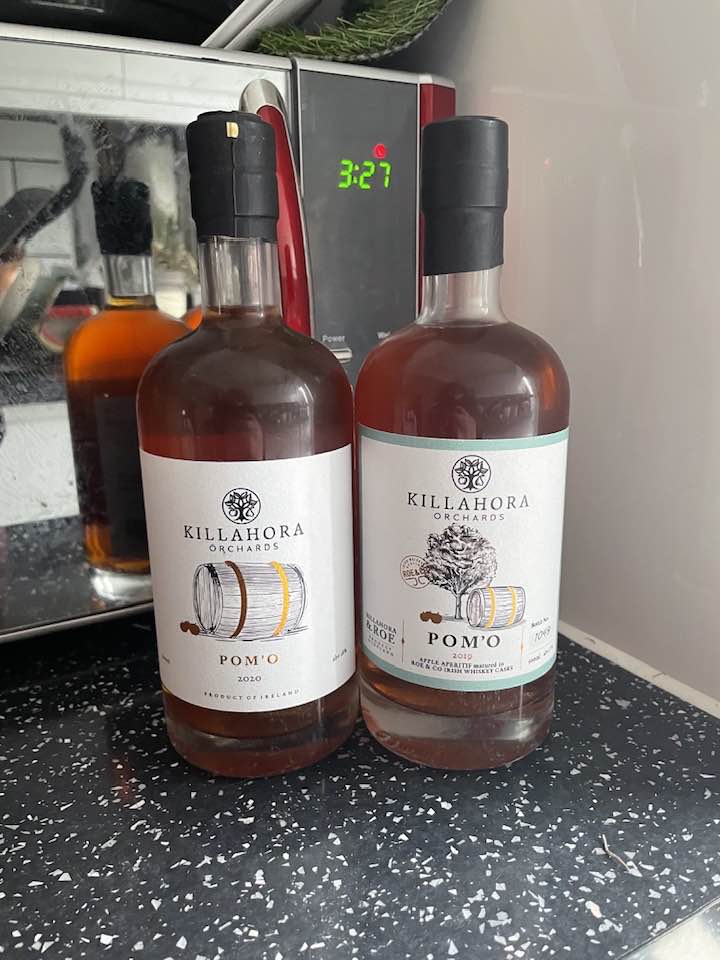
Killahora Orchards Pom’O 2020 – review
How I served: Lightly chilled
Appearance: Rich copper
On the nose: Has a lovely, high-toned freshness by comparison with Norman pommeau though its aromatics of orange, herb, even juniper and fresh and baked apples are offset nicely by deeper, plusher tones of caramel, vanilla and light wood. Really well-balanced, and expresses well at a range of temperatures actually, though my favourite is that light, half-hour-in-the-fridge chill.
In the mouth: Time has leant a lovely harmony here. That freshness is preserved, but apple, spirit and cask have really knitted together harmoniously. Toffee apple, vanilla, a little spiciness from the oak especially on the finish. Orange bitters and twist of herbs. Balanced sweetness, lovely weight without being a blockbuster. I love it as is but I reckon mixologists could have it playing all sorts of tunes.
In a nutshell: A clever, fresh and distinctive mistelle. Like it a lot.
Killahora Orchards Killahora and Roe Pom’O 2019 – review
How I served: Lightly chilled
Appearance: Ruddier. Moving into bronze
On the nose: Altogether deeper and duskier, this. The apples have dried and darkened and are now studded with cloves and currants, whilst the wood is a little more to the fore, presenting some polished oak and a pleasing sense of antique sideboard and leather-bound book. A touch more influence from the whisky too I’d say, though the apple remains the star. Still keeps its freshness too, with lovely, clean-lined aromatic definition.
In the mouth: Same story on the palate. All a couple of shades darker than the previous. Stewed spiced apple – strudel spices – lignin, clove, fresh vanilla pod, nutmeg. Nice firm structure. If the previous was your Manhattan, this is a richer, deeper Old Fashioned. Again great apple, oak, spirit integration. Deep, complex, sonorous stuff that retains fruit and elegance.
In a nutshell: Grown-up, serious-faced mistelle. Perfect for this time of year. Highly recommend.
A fine showing from Ireland there – let’s move on to Cornwall. Gould are a producer who blew me away with the first perries I ever tried from them, and have provided numerous excellent moments since – with the occasional creation that was less to my fancy. I’ve not tasted their wares for the blog in quite a while though, so I’m looking forward to putting that to rights.
Jonathan Gould loves playing around, especially with his distillates, so it’s no surprise that these two are a complete departure from the Pommeau norm. Both feature a blend of pot still apple brandy with unfermented cryo-concentrated juice (so ice cider pre-fermentation). On that basis we’d expect massive flavours, massive body, massive sweetness.
Of the pair, we’ve a blend from Jonathan’s own orchard, as well as a single variety, King Byerd, which is absolutely a first for me, but apparently is a dual purpose cooker-eater. Both bottles are dated November 2022, so whilst I can’t absolutely swear to it, I reckon these haven’t been aged in oak. Let’s see how we get on, starting with the blend.
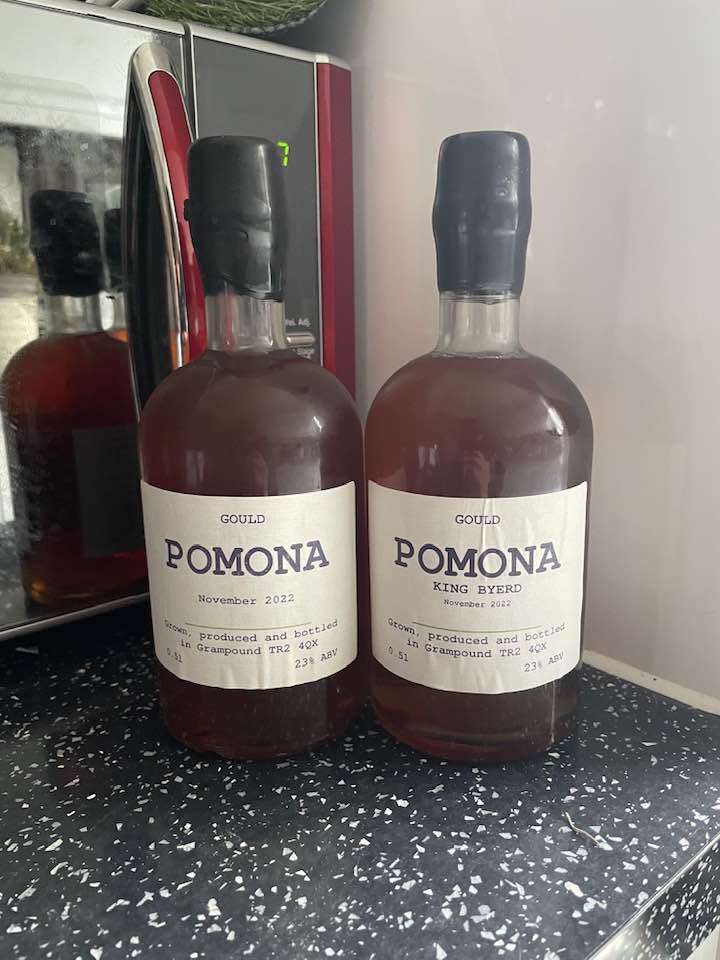
Gould Pomona November 2022 – review
How I served: Lightly chilled
Appearance: Slightly hazy chestnut
On the nose: Wow! Never smelled mistelle like this before. Fizzy apple sweets, sour cherries, cola bottles, strawberry laces – all my favourite pick-n-mix. Vibrant, very sweet fruit; the impact of the cryo-concentration is immediate. A little red apple skin and light vanilla. A ‘sits you bolt upright in your seat’ kind of nose, that’s for sure.
In the mouth: Double wow! A cattle prod zap of sugar and acid and cherry-forward (very cherry-forward) pick’n’mix. This is so intense. A mouthful of sour skittles. Never had acid in mistelle like it. Cherry cola postmix, super-concentrated red apple. A riot. A rollercoaster! This is a total, no-holds-barred, wild-haired, elbows-on-table mistelle. It’d be booted out of the Normandy members club for raucousness, but I kind of love it.
In a nutshell: An off-the-wall original. Not for purists maybe, but colour me a fan.
Gould Pomona King Byerd November 2022 – review
How I served: Lightly chilled
Appearance: Clear bronze
On the nose: High-toned nose of fresh apple, herbs, clove, wood polish and quite a bit of alcohol. Both of these Goulds are 23% incidentally, which is a third as strong again as normal pommeau – definitely on the pokey side. Lignin. Angostura bitters even,. It’s interesting stuff but a little too young, boozey and spiky for my personal taste, picking a nit.
In the mouth: Another very intense delivery, firing with apple and bitter orange and spice and alcohol. Quite a lot of fire here, especially on the finish. Gets a bit peppery. A whack of spiced wood, a crack of fairly astringent tannin – even when warmed to room temperature – and a big sweet and bitter hit of fruit. This is a bit much for even me at this stage of its life. Shows the wisdom of giving some mistelles a good bit of ageing, just to bring fruit and alcohol together a little. Hang on to your bottles for now.
In a nutshell: Some fascinating and tasty things going on, but it’s slightly unbalanced to my palate at this time of its life. Wants a few years to mellow and harmonise, for me.
Conclusions
Well, I wanted mistelles that showed something different from Normandy Pommeau and I certainly got them. The Gould blend was a full-on blast of flavour; a colourful riot that I absolutely loved, but I think the Killahoras take it for me, this time. Buy them both. The King Byerd wants a little while I think. Fascinating to try, but just a little bit youthfully impetuous for now perhaps. Just my opinion of course.
Whenever I review mistelles I always sign off with ‘and this has been a reminder that I really need to try more,’ and then I don’t for a long while – mainly because they’re pretty few and far between if you don’t have a Normandy postcode. But I maintain nonetheless that this is one of the most exciting and delicious cider categories of all, and you can certainly expect me to carry on writing up any I can find.
How’s that for a woolly New Year’s Resolution?
Discover more from Cider Review
Subscribe to get the latest posts sent to your email.
 Cider Review