The year was 2020 or 2021, the exact time…somewhere in lockdown. I had really started to relish ordering cider and perry from Scrattings online bottle shop once a month or so. The dizzying array of choice was exactly what I was after, as the curiosity and elasticity of my mind started to stretch in different directions away from my notions of a 13 year+ career ladder that had led to, at this point, …furlough and the possibility of no discernible job at the end of the pandemic. The world of cider and perry began to become increasingly of interest. There amongst the many pages of stock on Scrattings website, were a few 500ml bottles from Temple Cider, a producer I hadn’t heard of, but really back then, I hadn’t heard of hardly anyone, so I assumed they had been around for a long time. For every order that I placed including Temple Cider’s bottlings, I found myself continually impressed with their output.
Fast forward a couple of years and Scrattings has now ceased trading alas, but Temple Cider are going from strength to strength. I first bumped into Jo and Paul, the cidermaking duo behind Temple Cider, at Bristol Cider Salon last year, and you know how it goes – absolutely lovely to put a face and name to the producers of some consistently good ciders that accompanied you through some tricky times in life. It was in Bristol that I tried their excellent Coat Jersey single variety cider, and two of their recently released 440ml cans made it into the Top Drinks of 2023 list from James and I in Cider Review’s Year That Was 2023 article. As the new year dawned, it felt high time to shine the spotlight towards Dorset and find out a bit more about these excellent cider (and potentially perry…) makers!
CR: Happy New Year Jo and Paul! Where is Temple Cider located and when did you start to make cider?
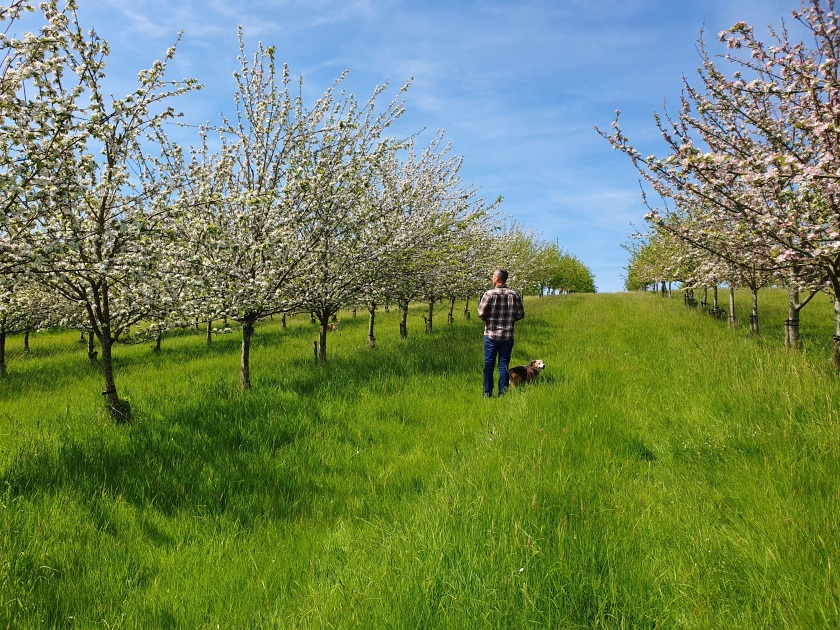
Paul: We run our farm in West Dorset, close to the Devon and Somerset border, where we live. We got interested in cider from an initial interest in drinks and fermenting in general. It started when we lived in Derbyshire, we used to press some of the apples we had in our garden, which followed on to planting a small vineyard and making wine (which we did for a few years). We then moved to Dorset around 10 years ago, and found ourselves surrounded by cider and cider culture, which fostered a deeper interest in producing cider. We planted a few apple trees on patches of land and pressed a small amount of cider until in early 2019 I bought a hydraulic from an auction site, and in the Autumn of 2019, we then pressed a larger amount of apples, and decided to sell the resulting cider. From there on in, we’ve just been consumed by making cider, and finding out lots more about different apple varieties.
CR: Temple cider falls into this lovely category of partners working together, harmoniously, for the greater good. I think of the likes of Cwm Maddoc, Bartestree, Artistraw, and Little Pomona. How is working together as a couple?
Jo: Generally, I’d say Paul and I work well together, although at times he can drive me insane! We each have very different strengths. Paul’s very practical, he’s got an engineering brain so he’s very good at solving problems and fixing things. If he has a bright idea, he’ll go for it to see if it works, whereas I’d be more “oh I’d need to think about this and plan it a bit”. He’s more interested in the cidermaking skills, although I’m getting more and more interested in how things are going. Pauls got a bit more of an intuition for what to do I’d say, as well as the drawings for the labels. My skills are on the writing side, I used to be a technical author. I enjoy anything to do with writing and Paul does not like the writing element, so that works. I am responsible for our social media, the website, and most of the admin. I do help with bottling and canning, as well as with picking the apples (but I don’t like the cold weather so I’m not always great there). I also enjoy the tasting and blending of the cider. Overall, I think we work very well as a team!
CR: What is the environment around you like for cidermaking? Have you got friends and neighbours that are cidermakers as well? Do you find yourself steeped in the history of West Country cidermaking?
Paul: Around us there are quite a few small orchards, if you go looking for them, mostly cider apple varieties in those orchards. It’s not overtly cidery around us. Most of our friends and neighbours have made cider at some point – whether that’s using a friend’s press to press some apples or a community pressing day. There’s a lot of cider around us, but it’s not in your face as such. What really piqued my interest was a friend who gave me some of their cider that they’d made at their home, it was so good, it made me realise with the right cider apples you can make a great drink! In the past we’d always used dessert apples from the garden, and it was perfectly drinkable, but I’d say not really recognisable as good cider. With the right apples, which there are plenty of around us, you can make something really interesting. It then fuels an interest in different varieties and making cider. When we were in Derbyshire, I couldn’t discern any really history or culture of making cider – it may have changed now as this was over 10 years ago I’m talking about.

CR: Since you started selling your cider commercially, how have you found the scaling-up of the business has gone? Are there lots of farmers markets and online bottle shops that are willing to take your cider?
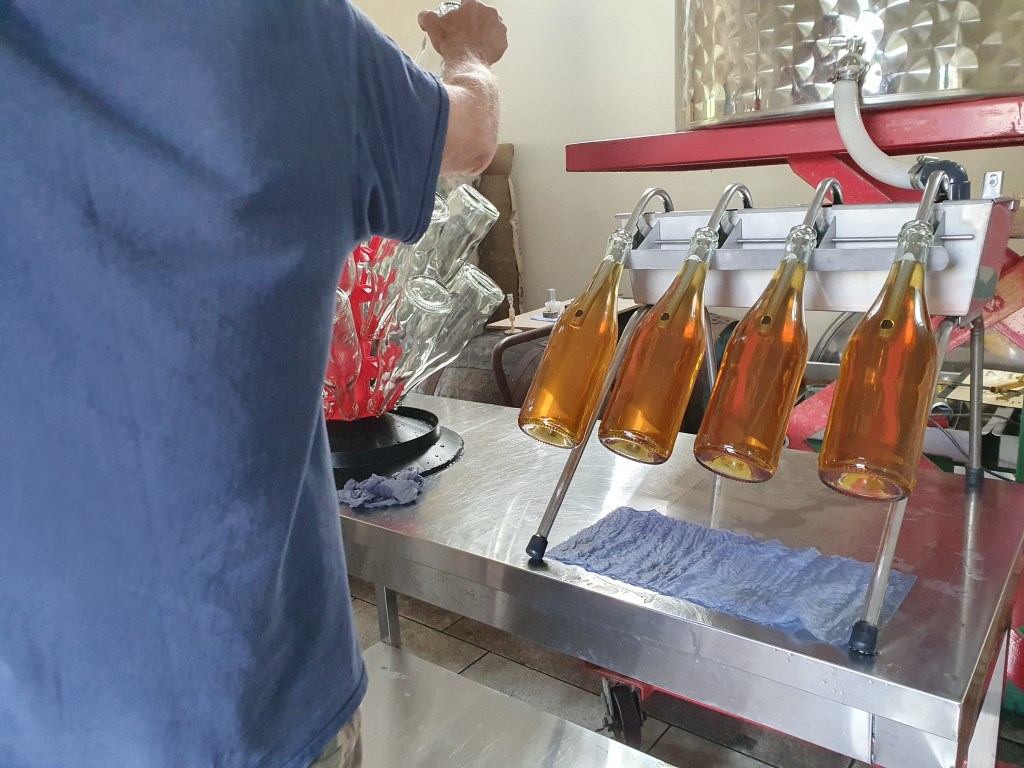
Paul: In our first year of pressing cider in Dorset, I started out pressing without the intention of actually selling it. It was just for my own consumption really. I filled one tank and then picked some more apples, so then bought another tank, but then picked some more apples and so on. I ended up making quite a bit of cider. Since we started selling it, we’ve made a consistent amount of cider each year (more than the first year). As far as selling it, that’s the hardest part. Especially selling traditionally made, dry cider. We want to carry on making the type of cider that we like making: minimum intervention, wild ferments, nothing added, nothing taken away, 100% juice. It’s what we enjoy making. We haven’t found “the best” way to package it yet – we’re still working on that. At the start of our production career, we had lockdowns from Covid, so when I initially made our first lot, I intended to sell it to pubs and bars in BIBs as still cider. Lockdown changed that, so we bottled some in 500ml, which we’ve continued with as we enjoy it. The 750ml bottles we find interesting, being able to showcase different single varieties and methods. In the past everything we’ve sold has been directly – either to local bottle shops, farm shops, pubs. We’ve also sold to online sellers – whoever at the time will take it. Now we’ve also opened our own online shop and selling through a distributor, which is also going well. We want to increase our output if these two continue to grow sales.
CR: You mentioned a love of trees and apples – I think that’s fundamental to being a cidermaker. What are some of your favourite varieties to work with? As well as your blends, I see you have a range of single variety ciders, including Coat Jersey, which I don’t think I’ve seen from any other producer yet.
Paul: Because we’re an orchard-based cidermaker, apple trees and different varieties are really important to us – they’re in our thoughts nearly all the time. I’m a bit obsessive about different varieties. The first orchard we took on and started picking from, well none of the varieties were known in there, but we soon discovered we had Kingston Black, Dabinett, Yarlington Mill, a block of apple trees that we still haven’t identified (we’ve DNA tested them and they’re still unknown at this time). At the end of some of the rows, we’ve got Coat Jersey as you mention. It’s become one of our favourite apples. It stays on the ground, nothing eats it, it doesn’t rot. It became tradition to pick up the Coat Jersey apples in that orchard last at the end of each season.
As far as favourites, Yarlington Mill has become my favourite. If it’s picked at the right time, it’s nice to press; it always seems to ferment well and make a nice cider. For the future, on our farm we’ve planted quite a lot of varieties, and I’ve got lots more to plant still as I’m constantly grafting new varieties that I’m interested in. We’ve put a lot of Dorset varieties in. There’s a great book by Liz Copas and Nick Poole, The Lost Orchards, recently published, rediscovering old Dorset varieties, and we’ve put a number of trees in that feature in that book: Golden Ball, Tom Legg, Matravers. All ones that should produce a traditional Dorset cider. Have also put in some red-fleshed varieties – hoping to experiment producing some rose cider. Because of my name, we’ve also put in an American variety called Harrison – looking forward to seeing what sort of cider that produces in this country. We’ve also got a reasonable block of perry pears in our orchard. We’ve started picking them in 2022. So, we’re looking forward to seeing what we can do with that in the future.
CR: Let’s talk labels! I love the labels for your ciders. They include dogs on some, and on others, Guinea Fowl (which I don’t think I’ve seen used on a cider label before). What are the artistic choices with these?
Jo: I’m the dog-obsessive person, I’m the trustee of a dog rescue for old dogs, called Oldies Club, and I work on the web team, spending a lot of my time writing about old dogs to try to help them find new homes. When we needed to quickly think of something to put on a cider label I said, “it’s got to be dogs!” Paul took a photo of one of our old dogs at the time and the cider became Mylo’s Magic.
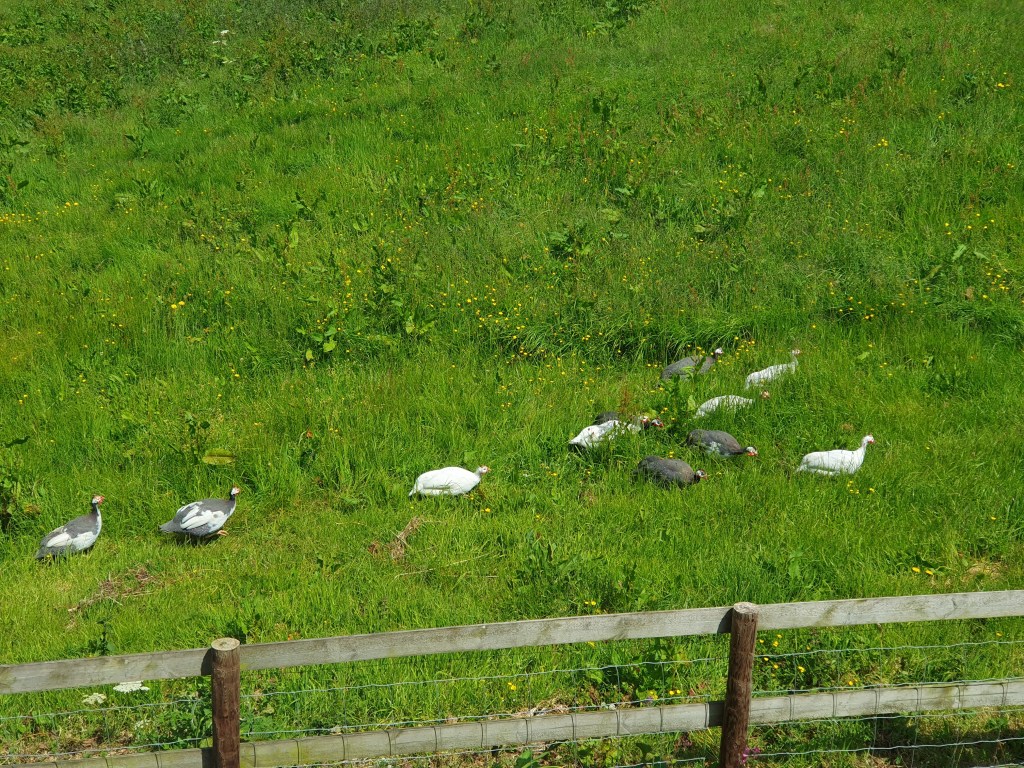
Paul: When we need to make a new label, Jo and I audible begin to groan, because it’s such an important part of the perception of the cider, perhaps more than it should be, but that’s how it is. In truth I quite enjoy making them, a great outlet for creativity. Doing it ourselves keeps it personal to us – we call ourselves artisanal cidermakers. For the 750ml labels, I did a drawing for the first bottlings we did in 2020. Since then, I do a drawing each year, I’ll sit down with my coloured pencils and crayons, each season has a different one. We keep a small flock of Guinea Fowl, and they do run in the orchard, they’re great pest controllers. By putting them on our labels it keeps things personal to us.
CR: What kind of fermentation vessels are you using at Temple Cider?
Paul: We do all our fermenting in either plastic or stainless steel. We have some large plastic tanks that work really quite well for fermenting and some stainless-steel variable capacity tanks which are good for racking into – you can keep the headspace to a minimum without having to use top-ups. We also have a selection of oak barrels, which we use for our Whisky Barrel Oak Aged cider, we’ll take a freshly emptied whisky barrel and mature cider in there. It will take on quick a bit of the character of the barrel. After that, the second or third use still works well with certain ciders, but don’t take on as much of the character of the barrel. We’ve done some Islay whisky barrel this year and it really took on the character of Islay whisky, which is quite heavily pronounced in my opinion. We’ll see what we do with those barrels in the future, as they’ve still got a strong peaty nose to them.

CR: It wouldn’t be a Cider Review interview without mentioning perry! I’ve seen a lot of cider released from you over the years, what about a perry or two?
Paul: Are we tempted to make perry? Yes, we are! We do have our own perry pear trees in our orchard – we picked our first pears in 2022. That is currently all in oak barrels maturing, getting ready for doing something out there this year. We are learning about perry, as it’s so surprisingly different to cider fermentation. It’s a lot of fun though, looking forward to making more in the future.
CR: Were the perry pears already planted in your orchard when you got it, or did you plant them yourselves? What kind of varieties have you got growing?
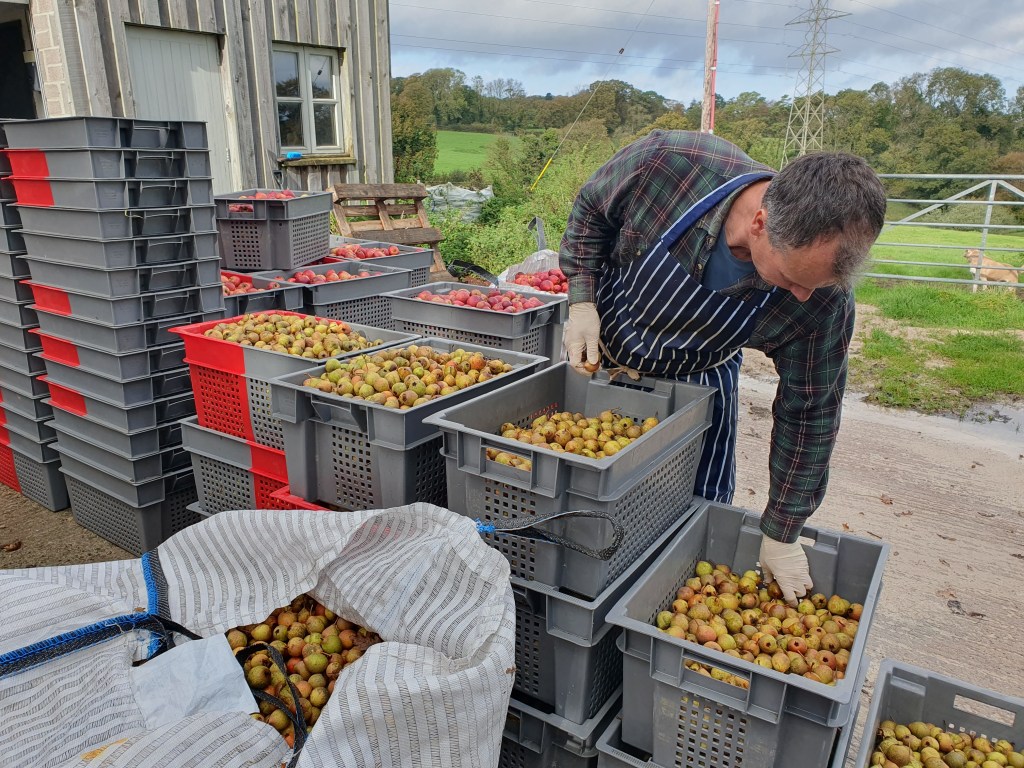
Jo: The orchard that contains the perry pear trees is a few miles away from our farm, towards Bridport. They were planted around 15 years ago, they produce a fair amount of fruit now. There are six varieties there: Hellen’s Early, Blakeney Red, Thorn, Winnal’s Longdon, Hendre Huffcap and Judge Amphlett. We had the list when we first started picking from the orchard but didn’t know which tree was which. We’ve just about nailed it now after gazing at little green pears for a few years! There were a few gaps in the orchard though, so Paul has been planting some different varieties in there too, some varieties that were more suited to the westerly conditions, so he’s put in some Welsh varieties and ones that can handle the climate here. He’s put in Potato Pear, Betty Prosser, and Cowslip. We have also planted and continue to plant an orchard here at our farm too, that’s being added to each year.
CR: You released three 440ml canned ciders towards the end of 2023, two of them making it to James and my own’s top ciders of the year lists. Tell us a bit about the decisions behind releasing this cider in canned format please.
Paul: The canned ciders we’ve released have created quite a bit of interest so far. We first started looking into canning a few years ago when the price of glass had rocketed up. The benefits of cans over bottles on matters like UV light, oxygenation, lighter weight, recycling aluminium all seemed good. Unloading a pallet of them at our cidery is a lot less stressful than a pallet of glass bottles! Looking at the craft beer market, when you look in bar or bottle shop fridge there’s row upon row of brightly coloured cans, and then at the bottom of the fridge would be half a dozen bottles of cider which looked a bit out of place – so we were trying to position ourselves in that market as well. We found a canning machine that fills one can at a time, so we do that ourselves in our cider shed. The labels are printed directly to the cans which is better for recycling too. It seems to have gone well so far. Lots more plans for the future! That may even be where our first batch of perry ends up in cans too. Watch this space.
CR: I met you both in-person at Cider Salon Bristol, and then at RossFest23. How do you feel festivals like these benefit “the scene”. They’re a whole different atmosphere and audience to a lot of the CAMRA Beer & Cider Festivals. What’s it like attending these as producers as well as punters?
Jo: I thought RossFest was brilliant – we didn’t attend that as producers really, just seeing what it was like and to enjoy it. We did end up chatting to people there in our role as producers. It was great to see that some people who went there we obviously just local and had gone to have a good time and got drawn into the world of cider. At the other end of the scale, you’d got the real cider aficionados who were enjoying analysing everything they were drinking. It was really interesting, and we really enjoyed it (as well as being able to bring our dogs along!).
Cider Salon Bristol, it’s great to have all those producers together, would have been nice to have a bit more time there so we could have got around and met some of the producers. At the start of the day, it feels like there’s loads of time, and then before you know it “oh…it’s time to go already!”. It’s gone in a flash. We’re always amazed by the breadth of the attendees there: from the casual attendees to those experts in the field who are super into their cider. Both events are really good for cider as a whole.
Discover more from Cider Review
Subscribe to get the latest posts sent to your email.
 Cider Review
Great article. Good to see so many new cider producers emerging, long may it last. I see Temple Cider will be hosting the Cider Club at Ross Cider, The Yew Tree Inn on Feb 14th. Really want to try some of those cans…
LikeLike
Thanks Marcus, glad you enjoyed the article ☺️ Hope you can make the Ross Cider club event with them, and if not, they do a 12 pack of their cans for a very reasonable rate from their webstore 👍🏻🍏
LikeLiked by 1 person
Thankyou. 🍻
LikeLike
Pingback: Dry, Medium, and Sweet – all from the barrel. A spotlight on Wylands Cider | Cider Review
Enjoyed reading this while drinking my first can of the 2022 Yarlington Mill. Great reading Jack and delicious cider Paul and Jo.
LikeLiked by 1 person
Awww thank you Alison ☺️ They’re doing great stuff down in West Dorset at Temple! Can’t wait to try their perry 😍
LikeLike