‘Perry is the champagne of the English’ – Napoleon Bonaparte, absolutely.
All right. Fair enough. I probably shouldn’t obsess about this quote as much as I do. To be honest there’s an awful lot I shouldn’t obsess about as much as I do – but that, perhaps, is an aside for a professional to consider at some point in the muddy future. For now, let’s stick to Napoleon.
Napoleon’s alleged praise for English perry is unavoidable to anyone who has stuck more than the tip of their nose into the world of fermented pear. Almost every British book I have ever read that touches on perry brings it up. If a broadsheet article is penned on perry you can bet Napoleon will rear his imperial head. I’m at the point of half-expecting Joaquin Phoenix to spend most of Ridley Scott’s imminent epic riding around Austria, Russia and Egypt necking Yellow Huffcap by the carafe, and I dare say it’d be a better world – and perhaps even a better film – if he did.
But where does this quote come from? This is what obsesses me. Such fanciful suggestions, surely, don’t just spring from nowhere. Yet for all the mentions of Bonaparte across the British perry corpus, not once have I seen an attribution that goes further than ‘Napoleon said’. Not so much as an anecdotal “‘I say,’ remarked the Emperor, straining to be heard over the Rivoli artillery, ‘Winnal’s Longdon is awfully good, isn’t it?’” No. At some point somewhere between Corsica and St Helena, Napoleon Bonaparte apparently just expressed his fondness for English perry unto the general air, before moving on to pronounce on Berliner weisse or the like, and we have duly repeated it ever since. ‘Napoleon loves English perry. Pass it on.’
Having spent much of the last year peering as thoroughly as possible under perry’s rock, you can imagine I’ve spent a fair bit of time looking for the origin of this quotation. One perrymaker, a serial winder-upper, has spent much of that time insisting that he’s seen the source and that it’s all definitely true. Which has caused me much consternation, because I have found absolutely nothing. Not a sausage. But can you imagine if I declared this quote to be fabricated nonsense in my book, then the day after publication some letter emerges: ‘Dear Josephine, field won at Austerlitz, Francis and Alexander in full retreat. BTW 1803 vintage Moorcroft actually banging – pls send two more cases. Love from Napoleon’?
You see my dilemma. So, coward that I am, I have simply referenced an ‘abiding claim’ in the book and acknowledged my own failure to unearth any definitive evidence either way. Truly, I may be Part Of The Problem.
Anyway, the point of this Napoleonic introduction is really to suggest that we put a disproportionate amount of emphasis on something that someone very famous probably didn’t say (sorry) and in doing so ignore all of the genuine and fascinating links between French and English perry and indeed between perry and champagne.
It is, for instance, a fact that various forms and varieties of perry have been compared to champagne over the long course of the two drinks’ histories. I’ve seen it in English essays, in the catalogues of 19th century New York fruit nurseries and, most tellingly, in articles written by 20th century Parisians. (Even where the perry in question is not, to my mind, terribly like champagne at all).
It is similarly a fact that perry pears once grew and that perry was made in what is now the Champagne region around Reims. (Even if it was of significantly less importance than the fermented grape). Part of the largely-lost ‘perry band’ that crossed from England, across northern France, through southern Germany, Luxembourg, Switzerland and conceivably even further. The champagne connection lives on in the names of perry pear varieties – Champagne Bratbirne in Germany, Champagne in France, both now growing in small quantities in England.
Indeed even if Napoleon did make the ‘champagne of the English’ comment, it might easily have been a backhanded compliment. Because at the turn of the 19th century – and for well over a century thereafter – unscrupulous wine merchants in England (but also wine makers in France) were either adding perry to wine to stretch the more expensive grapes further, or simply bottling pure perry under the label ‘champagne’. As Barry has showed me, a German named Heinrich Semler observed in 1895 that in many countries, ‘especially Britain’ you were as likely as not to find wine that was in fact just a sort of cider or perry cocktail to which various other substances had been added.
(Rather entertainingly, Semler adds: ‘If these drinks were only sold under their true name, there would be no objection to their existence, for they consist of harmless ingredients, whereas this cannot always be said of the genuine wines mentioned.’
Similarly, there are records across the 19th and 20th centuries, before wine legislation tightened with the rise of AOPs, that excess perry was transported across from Normandy to fill bottles in Champagne itself, no doubt principally to make up the shortfall of grapes caused by the phylloxera epidemic of the late 19th century.
And of course, perry has been made for hundreds of years using the so-called ‘champagne method’ of an induced secondary fermentation in bottle. And since British perry (and cider’s) other favourite (and more verifiable) story about itself is that this technique was first used on them, rather than on French wine, I don’t need to labour the point too hard again here.
All of which is to say that I simply don’t think we need Napoleon. Granted, he’s a tremendously famous chap, it’s a very striking (and marketable) story, and certainly very interesting if true. And it’s an easier line to trot out and sell than all the rather more niche and wonkish history I’ve gone into above. But until any actual evidence is provided that he said anything whatsoever on the subject, we might as well go the whole hog and also claim that Shakespeare wrote Hamlet on the strength of Taynton Squash and that Jesus only reached for wine at the last supper because they’d finished all the Thorn, Flakey & Friends. Too few of perry’s true and fascinating stories are shared and published as it is. I wish we’d stop clogging what few column inches perry is actually given with unverifiable likely-myth.
But then also, maybe I’m just a boring old curmudgeon. It’s very probable.
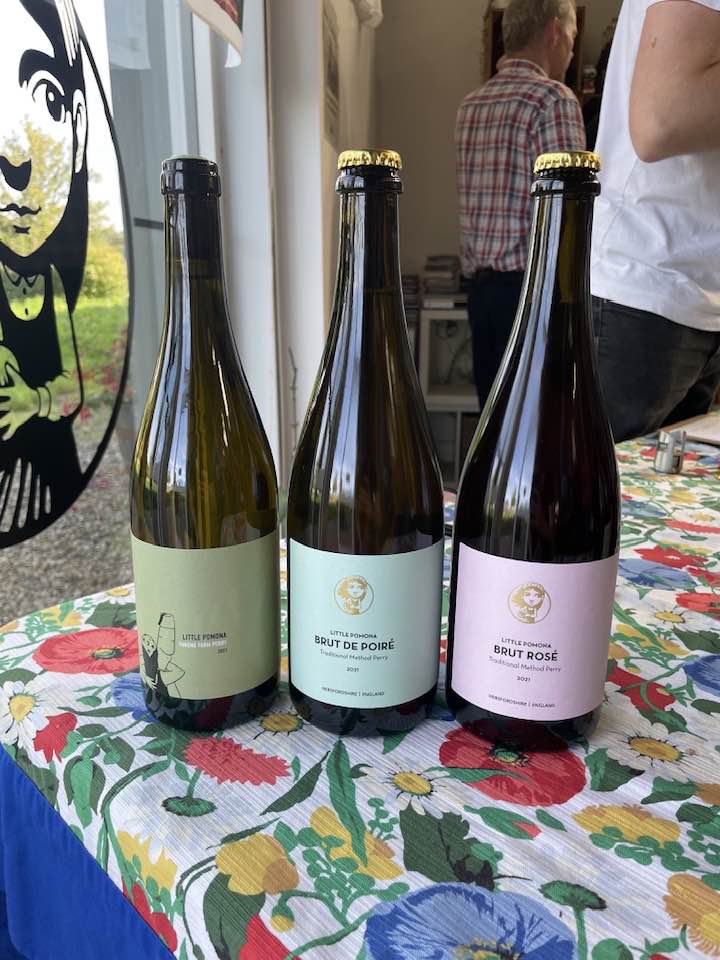
Anyway, on the subject of perry’s Anglo-French connections, both disputed and confirmable, how about a trio of English perries made with French varieties of pear? Indeed whilst we’re also talking about the champagne connection, how about a couple of traditional methods? I think so.
Little Pomona are well-trodden ground in these parts. A glance at the spreadsheet shows I’ve written up some 47 of their creations on Cider Review to date, my colleagues covering a handful more, making them our second most reviewed producer behind Ross-on-Wye. For a long time, though, they didn’t produce a great deal of perry. Their annual Pét Nat perry was always a highlight of their output (I reviewed a comprehensive flight here), but one a year, with additional perrykins and co-fermentations here and there, was all we got.
Recently, however, they seem to have doubled down on their pear-shaped output, and I for one am all for it. The trio I have today all came from the 2021 vintage, all from French varieties (Antricotin, Longbois and Fausset) and all from the same orchard – Throne Farm. Intriguingly, just the other day Jack and I reviewed another perry made from 2021 Throne Farm Antricotin and Longbois, that of Linn Cider in Fife. That perry was one of the very best I’ve had this year, so I have high hopes for today’s trio of Little Pomonas.
As you’d expect from this ever-innovative maker, the triptych has been cut three very distinct ways. First up is their Throne Farm Perry 2021 – the first still perry Little Pomona have ever bottled, realising a long-held ambition of theirs. Aged in second and third-fill barrels (so not very active oak), it was bottled dry, as is most of this cidery’s output. £15 gets you a 750ml from their website; it’s also available from The Fine Cider Company and The Cat in the Glass.
The remaining duo are the traditional methods. Firstly the ‘straight’ perry, ‘Brut de Poiré’ another 2021 vintage blend of Antricotin and Longbois, aged just over a year on its lees before disgorging. £25 from Little Pomona’s website. Finally, this being Little Pomona after all, their Brut Rosé features ‘a blend of local pears’ blended with damsons, again disgorged after a year on the lees. £27.50 directly from LP.
Undeterred by the shameless opening line on the labels of the traditional method bottlings (yes, it’s our guy Napoleon once more…) onto the tasting:
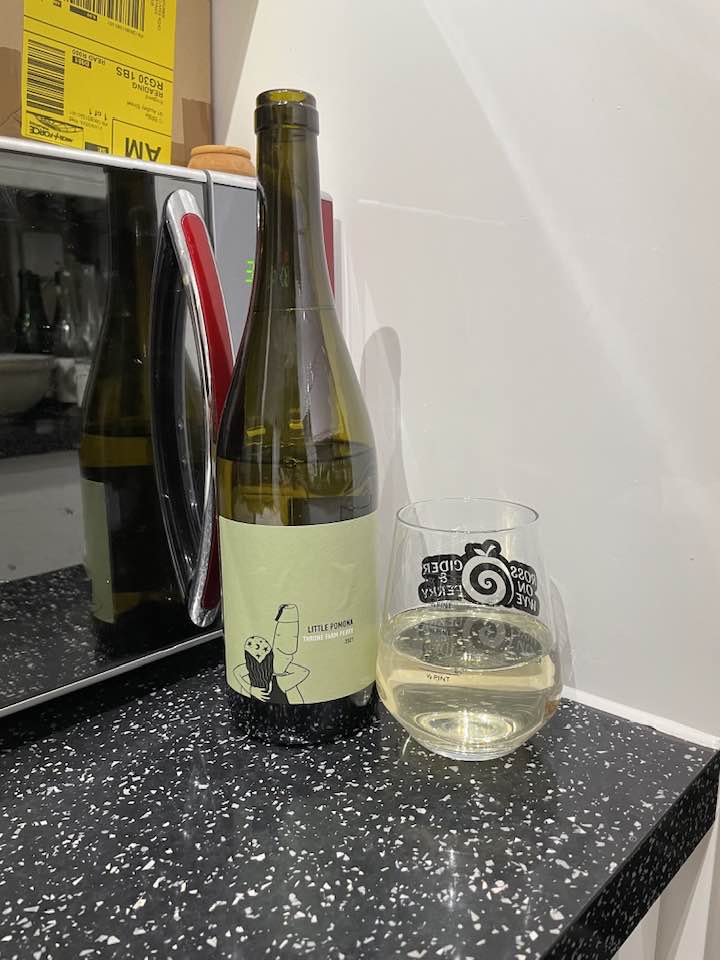
Little Pomona Throne Farm Perry 2021 – review
How I served: Lightly-chilled
Appearance: Almost water-white. Green-flecked. Still.
On the nose: Astonishingly aromatic, with some of the purest peach notes you’ll ever find on a perry. Juice, flesh and skin.These are wreathed in the green of kiwi, of gooseberry, of tomato stem, of fresh leaves. In wine terms I’m sort of around Hunter Semillon territory, but ‘sort of’ is doing fairly heavy lifting. Vivid, vibrant, pure and beautiful.
In the mouth: The peach, if anything, is amplified here – the oak presents less as ‘oakiness’ and more as a heightening of the fruit. (Need to check but I’m pretty sure these were wine casks of some sort). Tart white grapes, kiwi, nectarine. Whole pieces of fruit – and not simply the fruit itself, but stem and leaf too. Soft in its fruit but gentle acidity and the lightest tannin lend a markedly vinous texture and poised structure.
In a nutshell: An all-time-great still perry. No apologies for the wine-heavy language either, this is one of the most overtly vinous perries you’ll taste. Phenomenal.
Little Pomona Brut de Poiré 2021 – review
How I served: Chilled
Appearance: Very pale lemon-green. Creamy mousse.
On the nose: Very different. Whilst still very fruit-forward – not too much lees influence by my mileage – here the inflection is towards juicy pear with just a touch of peach. Very light honeyed tones too, with honeysuckle and white flower topnotes. Just a little touch of brioche and pear skin as it sits in the glass, opening and warming. A study in detailed delicacy.
In the mouth: Beautiful delivery. A perfectly-integrated mousse buoys a more acid (though it is soft acid, if that makes sense) profile than the nose implied. Lime juice and skin join gooseberry overlaid atop the honeyed florals of the nose. Surprisingly mineral, too. A little more brioche on the finish along with vivid emerald pear and a ‘pelzig’ perry texture (a term I love and which I’m given to understand means that sense of not-quite-tannic-grip-but-glancing-in-that-direction – thanks Barry!)
In a nutshell: Phenomenally elegant young traditional method perry. Will age for many years to come, as attractive as the fruit profile is already.
Little Pomona Brut Rosé 2021 – review
How I served: Chilled
Appearance: Deep strawberryish blush. Same fizz as Brut de Poiré.
On the nose: Damsons to the fore, not only in their pinkish, fleshy tones, but with accents of marzipan and the pink sections of battenberg. (I used to chuffing love battenberg. Not had one in miles over a decade. Going in search as soon as finished writing this). Anyway, returning to point: big berried tones. It’s even more fruit-forward than the Brut de Poiré. Pears lend softness and gentle florals without being too assertive. Just an exceedingly full, soft and joyful pink pillow of an aroma.
In the mouth: An absolute riot of popping pinky-red fruit; strawberry, raspberry, even a little cranberry sauce. A purpler impression of plum (‘impression’ – who have I become?!) and some strawberry lace and ripe, ruddy, almost-blood-orangey citrus acidity bolstered by a superbly-judged level of carbonation. Big intensity of flavour that is unencumbered by any excess of structure – just beautifully supported by totally balanced acidity and the lightest brush of tannin.
In a nutshell: A pure, clear peal of high-definition fruit – and so much fun at the same time. A fabulous made wine.
Conclusions
A deliciously varied trio that richly vindicates Little Pomona’s decision to up their pear intake. And what a vintage Throne Farm had in 2021! Totally different to the Linn expression in all but clarity and poise (and maybe a little peachiness from the varieties – but I don’t know Antricotin or Longbois quite well enough to comment definitively) but equally magnificent.
Being a dull old fun-hating stick in the mud before my time, I’m going to zig where most others will likely zag and call the still Throne Farm as my personal pick of the trio. But you want all of these in your life. I’ve started considering the perfect perries and ciders for each stage of Christmas Day recently (I know, how are we there already?) and each of these would fit in wonderfully at different stages of the festivities. Special occasion prices, sure, but these are special occasion drinks that fully stand up to the entry fee.
And, of course, all three are equally perfect choices if you’re standing in the cannon-smoke and rubble of Toulon, having laid siege the city, routed the royalist occupants, driven the combined Anglo-Spanish fleet away and just need something champagne-esque to quench your perishing thirst. After all, occasions surely don’t get much more special than that.
Discover more from Cider Review
Subscribe to get the latest posts sent to your email.
 Cider Review
The most dramatic perry review I have read to date … cannon-smoke and rubble … made my Saturday morning. But completely warranted, celebrating as it does the arrival of perry on the Christmas fine drinks scene.
LikeLike
Got to do something to get their attention!
And absolutely – such a difficult sales time of year for cidermakers in the UK with our cultural insistence on cider as a summer drink. A few ideas planned for some winter content to try and push the fine drinks for Christmas and ‘not just for summer’ lines. (Albeit to most readers here we’re preaching to the converted.)
Cheers as ever for commenting!
Adam
LikeLike
Pingback: PerryFest 2025 | Cider Review