British perry defies generalisation. Come to that, even Three Counties perry does. We can deploy a blanket statement that the overwhelming majority uses ‘perry pears’, but that’s about as useful a statement as saying that most western counties ciders use ‘cider apples’ or most French wines use ‘wine grapes’.
The distance of flavour between, say, a dry Flakey Bark from Ross-on-Wye to an Oliver’s Keeved, to a traditional method from Gregg’s Pit or Little Pomona or The Wonder Ice Perry from Once Upon a Tree is a chasm. In fact we could have just said ‘the distance between a Ross Flakey Bark or a Ross Green Horse’. And that’s before we even get into perries from the likes of Turner’s or Nightingale which use dessert fruit pears and thus are vastly different again.
Even in these broad strokes, Britain eludes any sort of strict regional categorisation in terms of flavour. Perry pears might dominate in the Three Counties and Monmouthshire, but they’re by no means restricted to that region. Jack found that wonderful perry pear orchard in Whin Hill, for instance, whilst the Brennan’s have made perry from Huffcap pears they harvested in Cheshire. There are perry pears growing in Cumbria, in Nottinghamshire, in Lancashire – even in Scotland. And of course producers can and do just harvest fruit from one part of the country and process it in another – see perries from the likes of London’s Luke’s and Scotland’s Fleming’s Fife, Naughton and Linn.
To the curious drinker, this can be a wonderful thing. There are vanishingly few instances of two British perrymakers trying to do exactly the same thing as each other, and even when they’re deploying similar methods, more often than not they’re using very different fruit. We can talk about the flavour camps of pears, we can talk about methods of making, and in doing so we can cobble together a rough taxonomy that (I certainly hope) can be of some assistance, but the potential for a new perry to take us completely by surprise is never diminished. There are only so many untasted bottlings I can look at with a truly concrete idea of exactly how they’ll taste. How magnificent is that?
At the same time, it does put an additional burden of transparency on the British producer when it comes to giving consumers a decent idea of what any given perry might taste like. Returning to the aforementioned Ross-on-Wye Flakey Bark, whilst it’s a perry that occupies no small portion of my heart, I’ll happily admit that it also occupies a place on the off-piste end of the flavour spectrum. No demure, gently fruited creature; this is an earthy, brawny beast of tannin and meat and rough pear skin and smoke and sometimes caramel and undergrowth and deep, broody, unusual fruit. It’s perhaps the ultimate marmite perry, and if you taste it without knowing what to expect you’ll be in for a shock which you may well love as much as I do, but which might also make you far more hesitant to take another step into perry.
Ross-on-Wye, I hasten to add, are models of clarity when it comes to managing consumer expectations through their labelling. Every cider or perry not only has the basics – variety, origin, method and so on – but describes the profile of that fruit. Not just its levels of tannin and acidity, but some of the flavours a consumer might find within it. Little Pomona, perhaps more than anyone, moved the dial on label comprehensiveness, and several producers since have followed suit. To my mind this is vitally important work. Drinks worlds like wine and whisky and indeed beer broadened their devoted followings exponentially by unpacking flavour to the consumer. So long as those flavours aren’t too strictly codified and gatekept – so long as there is still space for each drinker’s own opinion – these organoleptic roadmaps are one of the greatest tools in world-building at a drinks category’s disposal. Especially when that drink is as convoluted as British cider and perry.
The other two major perrymaking nations in the modern era – France and Austria – are in almost the opposite situation. In both instances, their key regions, Normandy’s Domfront and the Mostviertel respectively, are almost too easy to paint in broad strokes. The Mostviertel’s perries are largely still (or lightly sparkling), usually dry to off-dry, almost invariably have looked to the local white wine for a degree of inspiration and thus for the overwhelming part cleave in a green citrusy fruit offset with white floral tones and sometimes a slightly rounded soft apple and peach direction. They very rarely show any great level of tannin – certainly to compare with the likes of England’s Butt, Flakey Bark, Rock or others – and generally in youth display a marked acidity. Although Mostviertel makers bottle a good number of single varieties, they generally still operate within the rough parameters of the descriptions above. The journey from Speckbirne to Grüner Pichelbirne as bottled in the Mostviertel is far shorter than from Butt to Hendre Huffcap as bottled in Peterstow.
In Domfront, not only is there a dominant style, but it is enshrined in appellation law, as we’ve described in this article on the area, and this more detailed deep-dive into the region. In brief, to display ‘Domfront AOP’ on the label, a perry must (amongst other strictures) be naturally sparkling and at least 40% from the Plant de Blanc variety. In practice most producers use a significantly higher proportion of this pear in their cuvées, and single varieties are common. Such is Domfront’s influence within French perry, and such is the respect in which Plant de Blanc is held, that even producers from outside the appellation often use a significant proportion of the pear. Antoine Marois, for instance, who makes one of my favourite French perries of all, travels specifically to Domfront to harvest Plant de Blanc.
The dominance of one pear and style makes it far easier to describe a typical Domfront profile to a potential consumer. All are rounded, with a fruit profile that tends to tack in the direction of poached pears, tangerines, apricots and peaches, that fruit becoming more ‘golden’ and ultimately dried as it ages. All are naturally fairly highly sparkling, with a creamy, frothy mousse and most are at least medium-sweet, though many of the best makers are starting to tack in a drier direction.
I hasten to add that I adore the perries of Domfront and Mostviertel, and wish I had readier access to them. I also think that there are great benefits to being able to regionally generalise a little. My own initial explorations of wines, for instance, were made far easier by having a fairly good idea of what to expect from the likes of Barossa Shiraz, Chablis, New Zealand Sauvignon, Chianti and so on even before I’d necessarily tasted them. Knowing what you’re getting into when you buy a bottle of something can be a great comfort – indeed it is specifically what most drinkers want. And given the inherent vintage-on-vintage change in the profile of any given perry, any strands of consistency can be a boon to makers in need of repeat custom from a broad base of consumers.
At the same time, too much similarity can lead to some consumers (yes, I’m one of them) becoming a little jaded and looking for pastures new. I don’t always want to drink the same, or even quite similar, sort of thing. I want some of that constant surprise that you find within complicated, difficult-to-navigate English perry. Which is why, as much as I love the classic profiles of Domfront and Mostviertel, I’m delighted that makers within those regions have begun really pushing boundaries, investigating different fruits and methods and uncovering new flavours in the process. In our Domfront deep-dive we met Jérôme Forget, who having helped set the rules of the AOP, is perhaps the key force in making perries which sit outside them. As well as Jacques Perritaz, who has moved over from Switzerland to exploit the bounty and variety of pears in Domfront’s collective orchard.
Ultimately I suspect that Domfront and Mostviertel will end up with the best of both possible worlds – a broadly defined style which drinkers can easily understand and comfortably navigate, alongside a thriving spirit of innovation and experimentation that builds fresh avenues of untapped flavour for drinkers to explore. I can’t wait.
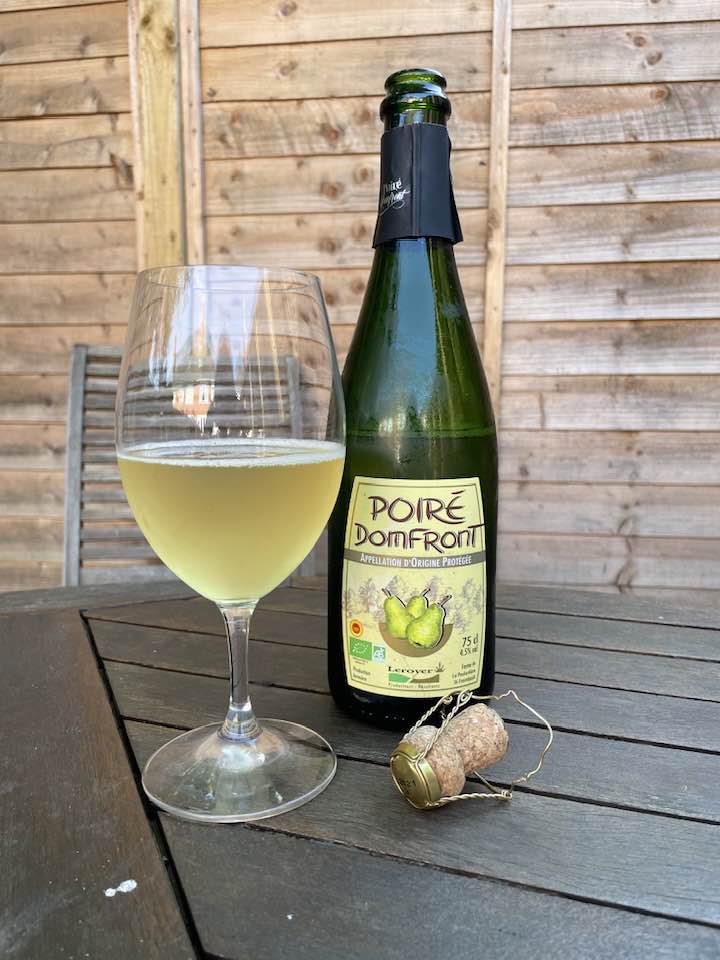
In the meantime, I’ve not had Domfront AOP for a little while, so I’m delighted to be returning to its comfortable familiarity today via a producer of whom I don’t think I have any previous experience.
GAEC de la Poulardière (GAEC stands for Groupement Agricoles d’Exploitation en Commun, and so far as I understand is a sort of shared farming system wherein farmers pool resources) is where the Leroyer brothers – Stéphane, Dominique and Michel – make their perry. Like more or less every Domfront farm it is mixed agriculture, with dairy cows grazing the old, traditional perry pear orchards outside of harvest season. They’re an organic producer in the south of the appellation near Saint-Fraimbault and like many/most Domfront producers they seem broadly allergic to the internet, so I can’t tell you a great deal more about them – though apparently you can book to visit any time via this link!
I found today’s bottle in the town of Domfront itself, where it cost me all of about €6, and possibly even less. Our European readers can find it listed on this Dutch website for €7.50. As far as I can tell, this bottling represents their house Domfront AOP. No mention of the vintage on the label – a shame, I think – and no clues online as to the particular blend of pears, though this webpage mentions ‘several varieties’. As an aside, for all my deep love of Domfront perry, I deeply, deeply wish there was more information generally available from producers or collected by those who run the AOP.
Nevertheless, let’s have a taste.
Leroyer – Ferme de La Poulardière – Poiré Domfront AOP – review
How I served: Chilled
Appearance: Clear pale straw, frothy mousse.
On the nose: Domfront on cruise mode. Just effortlessly clean, aromatic, big-fruited. Don’t know what the vintage or the percentages of pear varieties are but this feels like the high-toned, vivacious end of the AOP. Perhaps a 2021, when I know Plant de Blanc numbers were down. But just conjecture. Fruit is very fresh and green; apples and pears, blossom, very light peach and lime zest. Even a little gooseberry and fresh hay. Minerally. Fabulous stuff. The springtime face of Domfront.
In the mouth: Same story here. Teacher’s pet levels of clean, fresh, pure fruit. High-toned again; green orchard fruits, goodeberry, lemon’n’lime and white florals of blossom and delicate elderflower rather than anything particularly peachy or tropical. Medium in its sweetness, but an extra nibble of acidity by Domfront standards keeps things fresh and balanced. Maintains a lovely roundness. Delicious stuff. Domfront is just so reliably great, isn’t it?
In a nutshell: Domfront in May. So fresh and vibrant and flavourful and well-made. Absolutely buy it if you see it.
Conclusions
Domfront just makes me so happy. I led a tasting of some of the best perries in the UK last Sunday, with one rogue Domfront thrown in, and when it came to voting, I’m pretty sure the Domfront edged it. Always reliable, always packed with flavour, and the scary thing is that I reckon quality is still on the up.
For all the joy of wandering the various flavour avenues of perry’s world, sometimes you just want to settle back with something familiar that you absolutely know is going to deliver. You can’t do much better for that than with Domfront AOP.
Discover more from Cider Review
Subscribe to get the latest posts sent to your email.
 Cider Review